



NTPDase2
NTPDase2 is a plasma-membrane ecto-ATPase that hydrolyzes extracellular ATP to ADP and thereby shapes purinergic signaling[1]. Mechanistically, NTPDase2 differs from NTPDase1 because it preferentially hydrolyzes nucleoside triphosphates and permits ADP accumulation, whereas NTPDase1 limits ADP accumulation more efficiently[1][2]. In adult mouse neurogenic niches, NTPDase2 scavenges mitogenic extracellular nucleoside triphosphates and controls neural progenitor cell proliferation[3]. In taste buds, Entpd2 deletion causes extracellular ATP accumulation, receptor desensitization, and reduced taste-nerve transmission[2]. In liver models, portal fibroblast NTPDase2 inhibits bile duct epithelial proliferation through blockade of P2Y activation, while biliary cirrhosis selectively down-regulates NTPDase2 expression[4][5]. For experimental applications, ARL 67156 is not an effective inhibitor of NTPDase2, so NTPDase2 studies require isoform-aware enzymatic assays rather than assuming broad ecto-ATPase inhibition[6].
Références:
- [1]. Mateo J, et al. Functional expression of a cDNA encoding a human ecto-ATPase. Br J Pharmacol. 1999 Sep;128(2):396-402. [Content Brief]
- [2]. Alvarado-Castillo C, et al. Regulation of P2Y1 receptor-mediated signaling by the ectonucleoside triphosphate diphosphohydrolase isozymes NTPDase1 and NTPDase2. Mol Pharmacol. 2005 Jan;67(1):114-22. [Content Brief]
- [3]. Gampe K, et al. NTPDase2 and purinergic signaling control progenitor cell proliferation in neurogenic niches of the adult mouse brain. Stem Cells. 2015 Jan;33(1):253-64. [Content Brief]
- [4]. Jhandier MN, et al. Portal fibroblasts regulate the proliferation of bile duct epithelia via expression of NTPDase2. J Biol Chem. 2005 Jun 17;280(24):22986-92. [Content Brief]
- [5]. Dranoff JA, et al. Ectonucleotidase NTPDase2 is selectively down-regulated in biliary cirrhosis. J Investig Med. 2004 Nov;52(7):475-82. [Content Brief]
- [6]. Lévesque SA, et al. Specificity of the ecto-ATPase inhibitor ARL 67156 on human and mouse ectonucleotidases. Br J Pharmacol. 2007 Sep;152(1):141-50. [Content Brief]
All Product Categories
-
NTPDase2 Produits associés (2)
Produits associés (2)

-
NF279
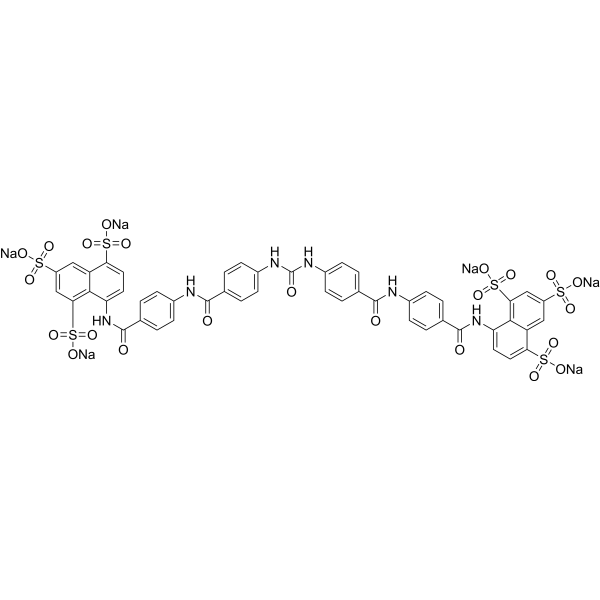 0 ImagesNF279 is a selective P2X1 receptor antagonist and NTPDase inhibitor, with a P2X1 IC50 value of 19 nM. NF279 suppresses GABA-evoked currents, reduces ATP-excited respiratory activity, alters hypoglossal nerve burst parameters, and blocks CXCR4, CCR5, CXCR3, and CXCR7-mediated calcium responses. NF279 arrests HIV-1 fusion downstream of CD4 binding, inhibits R5- and X4-tropic HIV-1 strains. NF279 can be used for the research of HIV-1 infection.




