



(±)-BI-D
Based on 6 publication(s) in Google Scholar
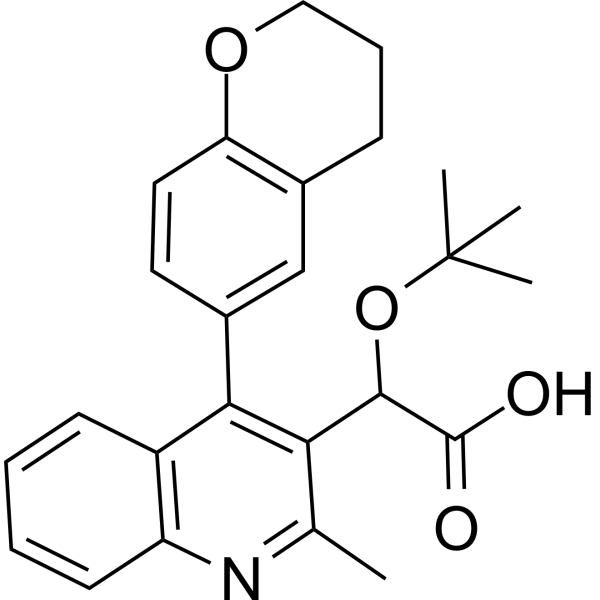
(±)-BI-D is a potent ALLINI (allosteric integrase inhibitor). (±)-BI-D binds integrase at the LEDGF/p75 binding site. (±)-BI-D inhibits HIV-Luc infection in cells (IC50: 0.16 μM in Psip1 knockout E9 mouse embryonic fibroblasts, 2.9 μM in wild-type E9 mouse embryonic fibroblasts).
Nos produits utilisent uniquement pour la recherche. Nous ne vendons pas aux patients.
- Pureté : 98.06%
- CAS No.: 1416258-16-6
- Formule: C25H27NO4
- Masse moléculaire:405.49
-
Stockage:Powder -20°C, 3 years , 4°C, 2 years ; In solvent -80°C, 2 years , -20°C, 1 year

To place orders, for customer services and technical support, please contact: MedChemExpress USA
Tel: 609-228-6898 E-mail: [email protected] [email protected]


-
 Activité biologique
-
Chemical Information
-
Solvant et solubilité
- Protocole
- Pureté et documentation
- Références
-
 Help & FAQs


-
HY-18595
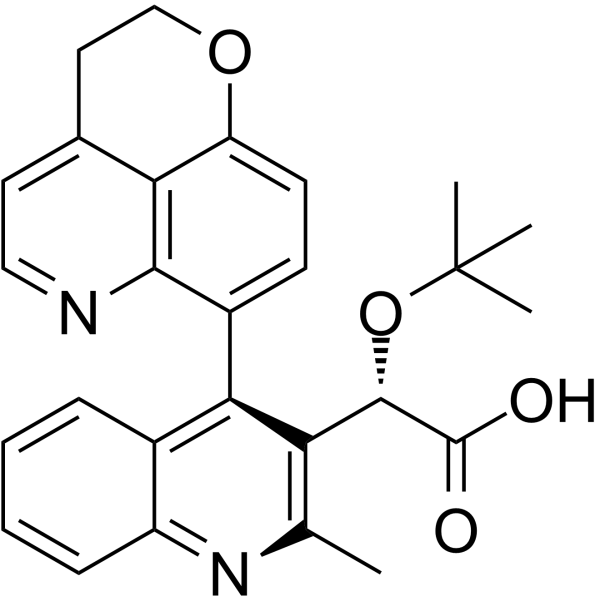
BI 224436 -
HY-130000
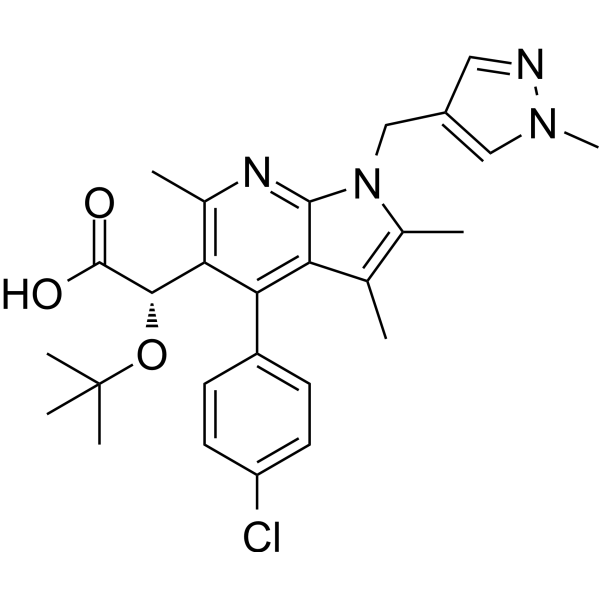
PirmitegravirALLINI Inhibitor -
HY-14740
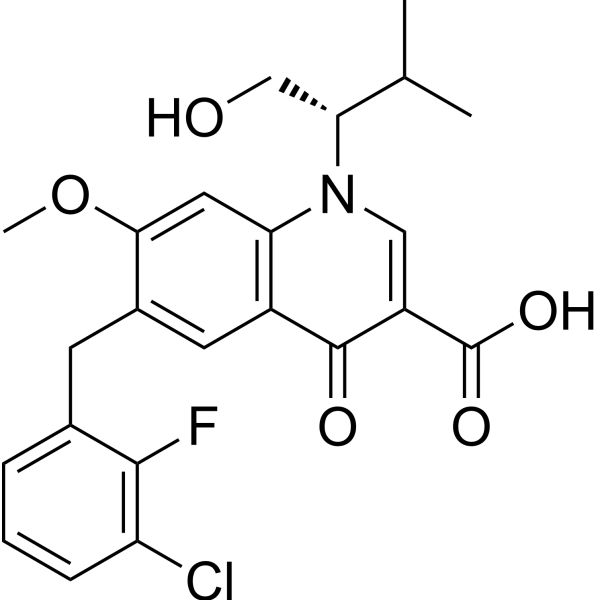
ElvitegravirHIV Integrase Inhibitor -
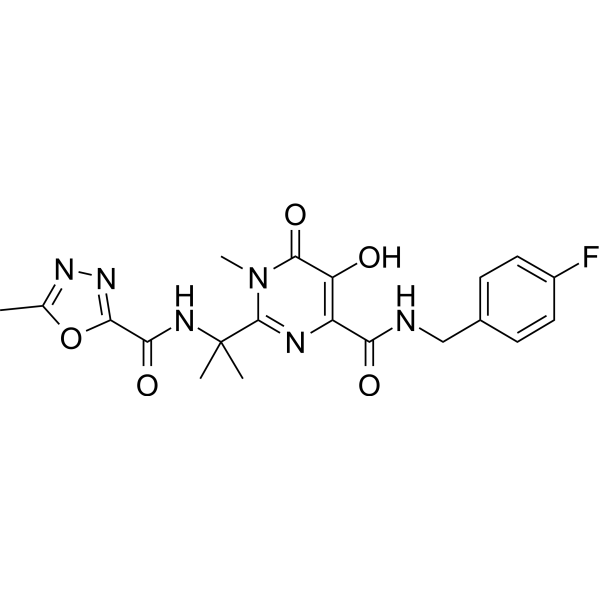
HY-10353
RaltegravirIntegrase Inhibitor -
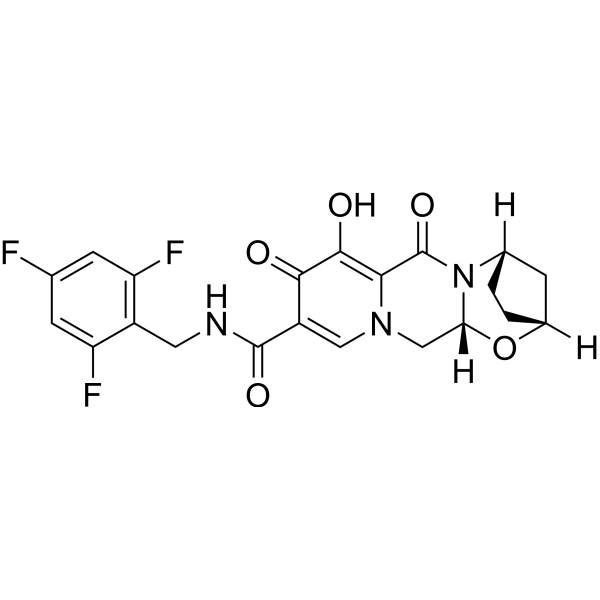
HY-17605
BictegravirHIV-1 Integrase Inhibitor -
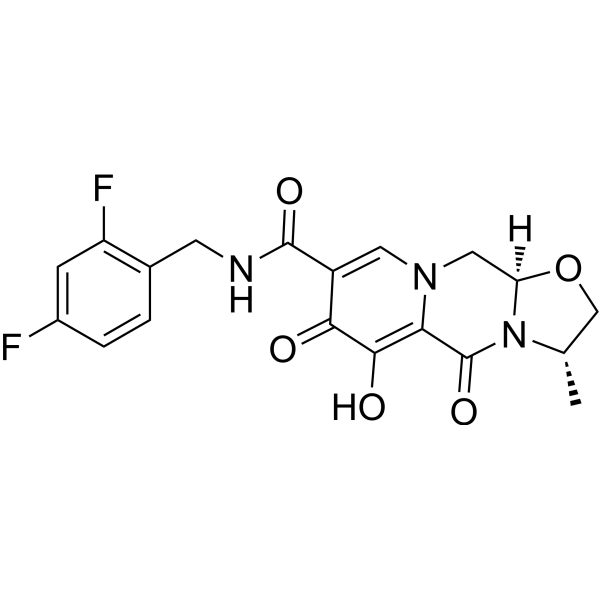
HY-15592
CabotegravirHIV Integrase Inhibitor -
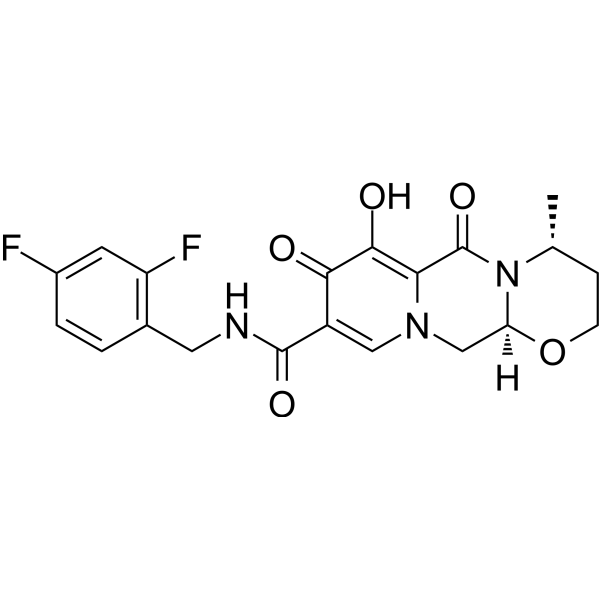
HY-13238
Dolutegravir -
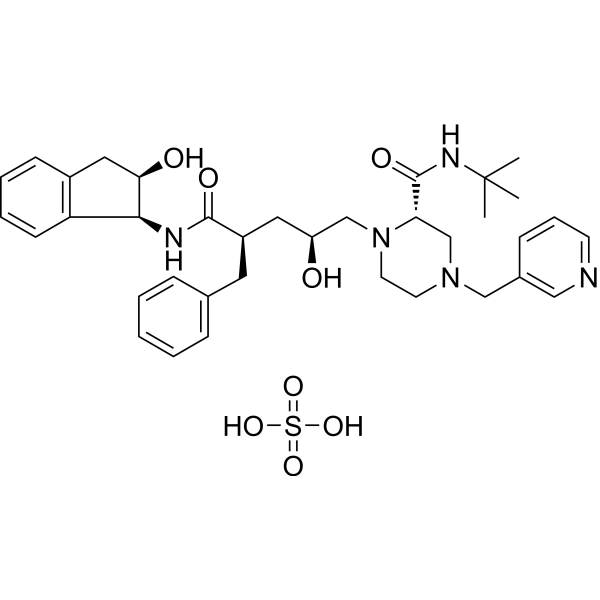
HY-B0689A
Indinavir sulfateHIV Protease Inhibitor -
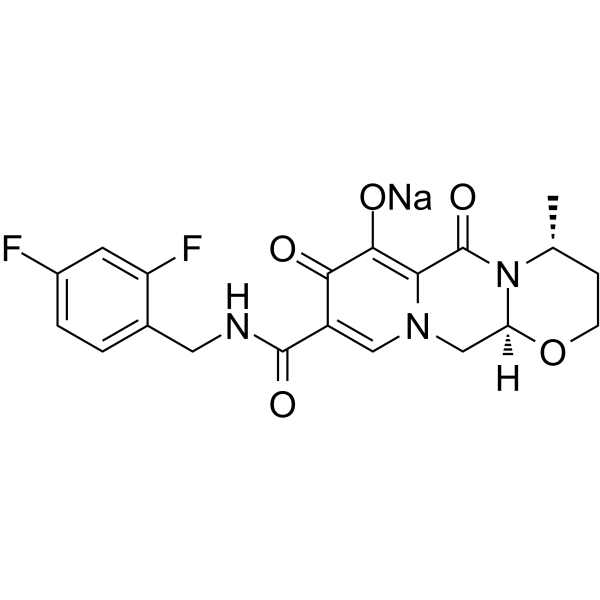
HY-13238A
Dolutegravir sodiumHIV Integrase Strand Transfer Inhibitor -
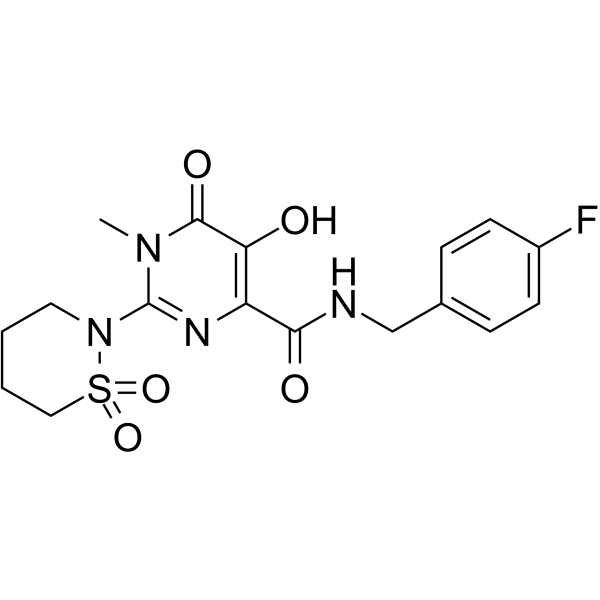
HY-13269
BMS-707035HIV-1 Integrase Strand Transfer Inhibitor -

HY-13238R
Dolutegravir (Standard) -
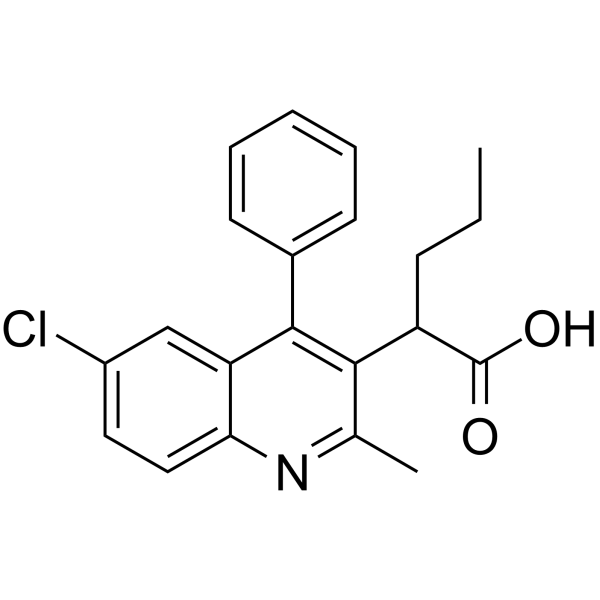
HY-10522
LEDGIN6HIV Inhibitor
Publications Citing Use of MedChemExpress (MCE) (±)-BI-D
More Customer Validation & Images

-
IF


Activité biologique
Description
In Vitro
(±)-BI-D inhibits HIV-Luc infection in E9 mouse embryonic fibroblasts with an IC50 of 0.16 μM in Psip1 knockout cells, which is lower than 2.9 μM in wild-type cells[1].
MedChemExpress (MCE) has not independently confirmed the accuracy of these methods. They are for reference only.


Chemical Information
-
CAS No. 1416258-16-6
-
Appearance Solid
-
Masse moléculaire 405.49
-
Formule C25H27NO4
-
Color Light yellow to yellow
-
SMILES
OC(C(OC(C)(C)C)C1=C(C(C=CC=C2)=C2N=C1C)C3=CC(CCCO4)=C4C=C3)=O
-
Livraison
Room temperature in continental US; may vary elsewhere.
-
Stockage
Powder -20°C 3 years 4°C 2 years In solvent -80°C 2 years -20°C 1 year


Publications (6)
-
Journal Impact Factor
-
Most Recent
-
Cell Host Microbe
Capsid-CPSF6 Interaction Licenses Nuclear HIV-1 Trafficking to Sites of Viral DNA Integration. [Abstract]2018 Sep 12;24(3):392-404.e8. PMID: 30173955
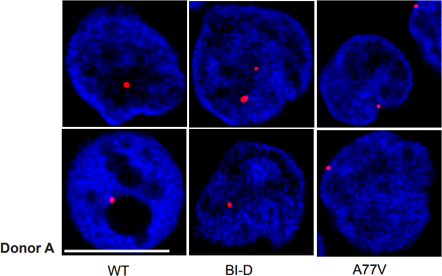
(±)-BI-D purchased from MedChemExpress. Usage Cited in: Cell Host Microbe. 2018 Sep 12;24(3):392-404.e8. [Abstract]
Representative MICDDRP images (scale bar, 5 µm), with quantitative assessment of 196 to 284 foci shown to the right for n=2 independent experiments, each conducted in duplicate.
-
mBio
The Drug-Induced Interface That Drives HIV-1 Integrase Hypermultimerization and Loss of Function. [Abstract]2023 Feb 28;14(1):e0356022. PMID: 36744954 -
Retrovirology
2020 Aug 31;17(1):28. PMID: 32867805 -
J Virol
Inhibition of HIV-1 Maturation via Small-Molecule Targeting of the Amino-Terminal Domain in the Viral Capsid Protein. [Abstract]2017 Apr 13;91(9):e02155-16. PMID: 28202766 -
Viruses
Allosteric Integrase Inhibitor Influences on HIV-1 Integration and Roles of LEDGF/p75 and HDGFL2 Host Factors. [Abstract]2022 Aug 26;14(9):1883. PMID: 36146690 -


Solvant et solubilité
In Vitro:
DMSO : ≥ 100 mg/mL (246.62 mM; Hygroscopic DMSO has a significant impact on the solubility of product, please use newly opened DMSO)
* "≥" means soluble, but saturation unknown.
Please refer to the solubility information to select the appropriate solvent. Once prepared, please aliquot and store the solution to prevent product inactivation from repeated freeze-thaw cycles.
Storage method and period of stock solution: -80°C, 2 years; -20°C, 1 year. When stored at -80°C, please use it within 2 years. When stored at -20°C, please use it within 1 year.
Please refer to the solubility information to select the appropriate solvent. Once prepared, please aliquot and store the solution to prevent product inactivation from repeated freeze-thaw cycles.
Storage method and period of stock solution: -80°C, 2 years; -20°C, 1 year. When stored at -80°C, please use it within 2 years. When stored at -20°C, please use it within 1 year.
Concentration (start) × Volume (start) = Concentration (final) × Volume (final)
In Vivo:
Select the appropriate dissolution method based on your experimental animal and administration route.
- For the following dissolution methods, please ensure to first prepare a clear stock solution using an In Vitro approach and then sequentially add co-solvents:
- To ensure reliable experimental results, the clarified stock solution can be appropriately stored based on storage conditions. As for the working solution for In Vivo experiments, it is recommended to prepare freshly and use it on the same day.
- The percentages shown for the solvents indicate their volumetric ratio in the final prepared solution. If precipitation or phase separation occurs during preparation, heat and/or sonication can be used to aid dissolution.
Add each solvent one by one: 10% DMSO 40% PEG300 5% Tween-80 45% Saline
Solubility: ≥ 2.5 mg/mL (6.17 mM); Clear solution
This protocol yields a clear solution of ≥ 2.5 mg/mL (saturation unknown).
Taking 1 mL working solution as an example, add 100 μL DMSO stock solution (25.0 mg/mL) to 400 μL PEG300, and mix evenly; then add 50 μL Tween-80 and mix evenly; then add 450 μL Saline to adjust the volume to 1 mL.
Preparation of Saline: Dissolve 0.9 g sodium chloride in ddH₂O and dilute to 100 mL to obtain a clear Saline solution.
Add each solvent one by one: 10% DMSO 90% (20% SBE-β-CD in Saline)
Solubility: ≥ 2.5 mg/mL (6.17 mM); Clear solution
This protocol yields a clear solution of ≥ 2.5 mg/mL (saturation unknown).
Taking 1 mL working solution as an example, add 100 μL DMSO stock solution (25.0 mg/mL) to 900 μL 20% SBE-β-CD in Saline, and mix evenly.
Preparation of 20% SBE-β-CD in Saline (4°C, storage for one week): 2 g SBE-β-CD powder is dissolved in 10 mL Saline, completely dissolve until clear.
In Vivo Dissolution Calculator
Please enter the basic information of animal experiments:
-
-
-
-
Recommended: Prepare an additional quantity of animals to account for potential losses during experiments.
Please enter your animal formula composition:
-
%DMSO +
Recommended: Keep the proportion of DMSO in working solution below 2% if your animal is weak.
-
%+
-
+%Tween-80 + +
-
%Saline +
The co-solvents required include: DMSO, . All of co-solvents are available by MedChemExpress (MCE). , Tween 80. All of co-solvents are available by MedChemExpress (MCE).
Working solution concentration: 0.22 mg/mL
Method for preparing stock solution: mg drug dissolved in μL DMSO. Stock solution concentration: mg/mL.
1. Take μL DMSO stock solution;
2. Add μL .
μL , mix evenly;
3. Then add μL Tween 80, mix evenly;
4. Then add μL
Please ensure that the stock solution in the first step is dissolved to a clear state, and add co-solvents in sequence. You can use ultrasonic heating (ultrasonic cleaner, recommended frequency 20-40 kHz), vortexing, etc. to assist dissolution.


Pureté et documentation
-
Fiche technique (286 KB)
-
SDS (252 KB)
- English - EN (252 KB)
- Français - FR (252 KB)
- Deutsch - DE (252 KB)
- Norwegian - NO (252 KB)
- Español - ES (252 KB)
- Swedish - SV (252 KB)
- Italian - IT (252 KB)
- Korean - KR (252 KB)
- Portuguese - PT (252 KB)
-
Instruction de manipulation (2659 KB)
Références
[1]. Wang H, et al. HRP2 determines the efficiency and specificity of HIV-1 integration in LEDGF/p75 knockout cells but does not contribute to the antiviral activity of a potent LEDGF/p75-binding site integrase inhibitor. Nucleic Acids Res. 2012 Dec;40(22):11518-30. [Content Brief]
[2]. Fader LD, et al. Minimizing the Contribution of Enterohepatic Recirculation to Clearance in Rat for the NCINI Class of Inhibitors of HIV. ACS Med Chem Lett. 2014 Apr 16;5(6):711-6. [Content Brief]


Complete Stock Solution Preparation Table
Please refer to the solubility information to select the appropriate solvent. Once prepared, please aliquot and store the solution to prevent product inactivation from repeated freeze-thaw cycles.
Storage method and period of stock solution: -80°C, 2 years; -20°C, 1 year. When stored at -80°C, please use it within 2 years. When stored at -20°C, please use it within 1 year.
| Optional Solvent | Concentration Solvent Mass | 1 mg | 5 mg | 10 mg | 25 mg |
|---|---|---|---|---|---|
| DMSO | 1 mM | 2.4662 mL | 12.3308 mL | 24.6615 mL | 61.6538 mL |
| 5 mM | 0.4932 mL | 2.4662 mL | 4.9323 mL | 12.3308 mL | |
| 10 mM | 0.2466 mL | 1.2331 mL | 2.4662 mL | 6.1654 mL | |
| 15 mM | 0.1644 mL | 0.8221 mL | 1.6441 mL | 4.1103 mL | |
| 20 mM | 0.1233 mL | 0.6165 mL | 1.2331 mL | 3.0827 mL | |
| 25 mM | 0.0986 mL | 0.4932 mL | 0.9865 mL | 2.4662 mL | |
| 30 mM | 0.0822 mL | 0.4110 mL | 0.8221 mL | 2.0551 mL | |
| 40 mM | 0.0617 mL | 0.3083 mL | 0.6165 mL | 1.5413 mL | |
| 50 mM | 0.0493 mL | 0.2466 mL | 0.4932 mL | 1.2331 mL | |
| 60 mM | 0.0411 mL | 0.2055 mL | 0.4110 mL | 1.0276 mL | |
| 80 mM | 0.0308 mL | 0.1541 mL | 0.3083 mL | 0.7707 mL | |
| 100 mM | 0.0247 mL | 0.1233 mL | 0.2466 mL | 0.6165 mL |


(±)-BI-D Related Classifications
HY-18601 Related Classifications
 Powered by Bioz