



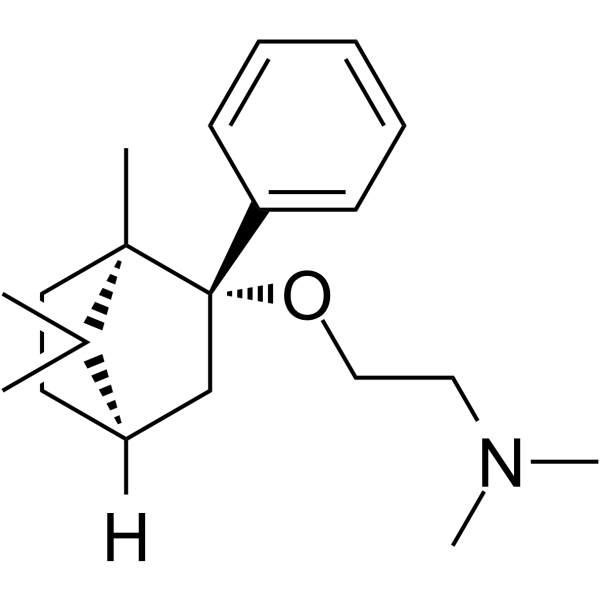
Deramciclane

Based on 1 Customer Validation
Deramciclane has a high affinity for 5-HT2A and 5-HT2C receptors; it acts as an antagonist at both receptor subtypes and has inverse agonist properties at the 5-HT2C receptors without direct stimulatory agonist.
Nur für Forschungszwecke. Wir verkaufen nicht an Patienten.
- Reinheit: 98.04%
- CAS. Nr.: 120444-71-5
- Formel: C20H31NO
- Molecular Weight:301.47
-
Speicherung:
4°C, sealed storage, away from moisture and light
* In solvent : -80°C, 6 months; -20°C, 1 month (sealed storage, away from moisture and light)


-
 Biologische Aktivität
-
Chemical Information
-
Lösungsmittel & Löslichkeit
- Protokoll
- Reinheit & Dokumentation
- Verweise
-
 Help & FAQs
-

GPCR/G Protein Compound Library
HY-L006
-
Neuronal Signaling Compound Library
HY-L013
-
Clinical Compound Library
HY-L026
-
Drug Repurposing Compound Library
HY-L035
-
Neurotransmitter Receptor Compound Library
HY-L062
-
Anti-Alzheimer's Disease Compound Library
HY-L069
-
Anti-Parkinson's Disease Compound Library
HY-L085
-
Neurodegenerative Disease-related Compound Library
HY-L086
-
5-HT Receptor Compound Library
HY-L121
-
Human Metabolite Library
HY-L123
-
Coagulation and Anti-coagulation Compound Library
HY-L136
-
Membrane Protein-targeted Compound Library
HY-L149
-
Membrane Receptor-targeted Compound Library
HY-L150
-
Multi-Target Compound Library
HY-L176
-
Bioactive Compound Library Max
HY-L181
-
MCE Bioactive Compound Library
HY-L001V
-
Drug Repurposing Compound Library Plus
HY-L035P
-
Clinical Compound Library Plus
HY-L026P
-
Bioactive Compound Library
HY-L001
-
High-Throughput Bioactive Compound Library
HY-L205
-
Mass Spectrometry Human Metabolite Library
HY-L215
-
Lactylation Compound Library
HY-L249


Alle 5-HT Receptor Isoform-spezifische Produkte anzeigen
More

Biologische Aktivität
|
5-HT2A Receptor |
5-HT2C Receptor |
Deramciclane is a novel anxiolytic agent that binds with high affinity to 5-HT2A/2C receptors. The interactions of Deramciclane with the serotonin 5-HT2C receptor are characterized further using receptor phosphoinositide hydrolysis assays and receptor autoradiography. Deramciclane antagonizes 5-HT2C receptor mediated 5-HT-stimulated phosphoinositide hydrolysis with an IC50 value of 168 nM. Deramciclane also decreases basal phosphoinositide hydrolysis by up to 33% (EC50= 93 nM) in a physiological system in the choroid plexus, suggesting that Deramciclane possesses inverse agonist properties at this receptor[1].
MedChemExpress (MCE) has not independently confirmed the accuracy of these methods. They are for reference only.
MedChemExpress (MCE) has not independently confirmed the accuracy of these methods. They are for reference only.


Chemical Information
-
CAS. Nr. 120444-71-5
-
Appearance Oil
-
Molecular Weight 301.47
-
Formel C20H31NO
-
Color Light yellow to yellow
-
SMILES
CC1(C)[C@]2(C)[C@@](OCCN(C)C)(C3=CC=CC=C3)C[C@@]1([H])CC2
-
Synonyms
EGIS-3886
-
Versand
Room temperature in continental US; may vary elsewhere.
-
Speicherung
4°C, sealed storage, away from moisture and light
* In solvent : -80°C, 6 months; -20°C, 1 month (sealed storage, away from moisture and light)


Lösungsmittel & Löslichkeit
DMSO : 100 mg/mL (331.71 mM; Need ultrasonic; Hygroscopic DMSO has a significant impact on the solubility of product, please use newly opened DMSO)
Please refer to the solubility information to select the appropriate solvent. Once prepared, please aliquot and store the solution to prevent product inactivation from repeated freeze-thaw cycles.
Storage method and period of stock solution: -80°C, 6 months; -20°C, 1 month (sealed storage, away from moisture and light). When stored at -80°C, please use it within 6 months. When stored at -20°C, please use it within 1 month.
Please refer to the solubility information to select the appropriate solvent. Once prepared, please aliquot and store the solution to prevent product inactivation from repeated freeze-thaw cycles.
Storage method and period of stock solution: -80°C, 6 months; -20°C, 1 month (sealed storage, away from moisture and light). When stored at -80°C, please use it within 6 months. When stored at -20°C, please use it within 1 month.
Konzentration (Stammlösung) × Volumen (Stammlösung) = Konzentration (Ziellösung) × Volumen (Ziellösung)
Select the appropriate dissolution method based on your experimental animal and administration route.
- For the following dissolution methods, please ensure to first prepare a clear stock solution using an In Vitro approach and then sequentially add co-solvents:
- To ensure reliable experimental results, the clarified stock solution can be appropriately stored based on storage conditions. As for the working solution for In Vivo experiments, it is recommended to prepare freshly and use it on the same day.
- The percentages shown for the solvents indicate their volumetric ratio in the final prepared solution. If precipitation or phase separation occurs during preparation, heat and/or sonication can be used to aid dissolution.
Add each solvent one by one: 10% DMSO 40% PEG300 5% Tween-80 45% Saline
Solubility: ≥ 2.5 mg/mL (8.29 mM); Clear solution
This protocol yields a clear solution of ≥ 2.5 mg/mL (saturation unknown).
Taking 1 mL working solution as an example, add 100 μL DMSO stock solution (25.0 mg/mL) to 400 μL PEG300, and mix evenly; then add 50 μL Tween-80 and mix evenly; then add 450 μL Saline to adjust the volume to 1 mL.
Preparation of Saline: Dissolve 0.9 g sodium chloride in ddH₂O and dilute to 100 mL to obtain a clear Saline solution.
Add each solvent one by one: 10% DMSO 90% (20% SBE-β-CD in Saline)
Solubility: ≥ 2.5 mg/mL (8.29 mM); Clear solution
This protocol yields a clear solution of ≥ 2.5 mg/mL (saturation unknown).
Taking 1 mL working solution as an example, add 100 μL DMSO stock solution (25.0 mg/mL) to 900 μL 20% SBE-β-CD in Saline, and mix evenly.
Preparation of 20% SBE-β-CD in Saline (4°C, storage for one week): 2 g SBE-β-CD powder is dissolved in 10 mL Saline, completely dissolve until clear.
Please enter the basic information of animal experiments:
-
-
-
-
Recommended: Prepare an additional quantity of animals to account for potential losses during experiments.
Please enter your animal formula composition:
-
%DMSO +
Recommended: Keep the proportion of DMSO in working solution below 2% if your animal is weak.
-
%+
-
+%Tween-80 + +
-
%Saline +
The co-solvents required include: DMSO, . All of co-solvents are available by MedChemExpress (MCE). , Tween 80. All of co-solvents are available by MedChemExpress (MCE).
Working solution concentration: 0.22 mg/mL
Method for preparing stock solution: mg drug dissolved in μL DMSO. Stock solution concentration: mg/mL. * In solvent : -80°C, 6 months; -20°C, 1 month (sealed storage, away from moisture and light)
1. Take μL DMSO stock solution;
2. Add μL .
μL , mix evenly;
3. Then add μL Tween 80, mix evenly;
4. Then add μL
Please ensure that the stock solution in the first step is dissolved to a clear state, and add co-solvents in sequence. You can use ultrasonic heating (ultrasonic cleaner, recommended frequency 20-40 kHz), vortexing, etc. to assist dissolution.

Protokoll
Mice[2]
Male Wistar rats are used. Samples for determination of basal levels of dopamine, DOPAC and HVA are collected for 60 min. and after that the drugs (doses refer to the salts) are given intraperitoneally in a volume of 5 mL/kg of body weight. Treatments are Deramciclane fumarate 3 mg/kg (=7.2 µmol/kg), 10 mg/kg (=24 µmol/kg) and 30 mg/kg (=72 µmol/kg); D-amphetamine sulfate 2 mg/kg (=5.4 µmol/kg); Ritanserin 1 mg/kg (=2.1 µmol/kg) and Buspirone hydrochloride 5 mg/kg (=12 µmol/kg). All drugs are suspended in 0.5% carboxymethylcellulose (CMC) dissolved in 0.9% saline. Vehicle control group (n=5) are injected intraperitoneally with 5 mL/kg of 0.5% CMC solution. There are nine rats in each treatment group.The doses of Deramciclane fumarate are considered to produce plasma levels comparable to therapeutic plasma levels in human beings (3 mg/kg) or about three times higher (10 mg/kg) 1-3 hr after the administration of the drug. Behavioural data from earlier Deramciclane studies in rats indicates that Deramciclane has some antidopaminergic activity at high doses (20-40 mg/kg). The highest dose of Deramciclane (30 mg/kg) is selected in this dose range. Fairly high doses of the reference drugs are chosen based on the literature and our own experience to detect the ability of selected drugs to modify extracellular dopamine levels in either the striatum or the nucleus accumbens. After administration of each drug, samples are collected for 240 min. and then divided into two aliquots (35 µL/15 µL). The first aliquot of the samples is stored at 4°C and assayed for dopamine within 24 hr. The other aliquot is frozen and stored at -70°C until assayed for DOPAC and HVA.
MedChemExpress (MCE) has not independently confirmed the accuracy of these methods. They are for reference only.


Reinheit & Dokumentation
-
Data Sheet (280 KB)
-
SDS (252 KB)
- English - EN (252 KB)
- Français - FR (252 KB)
- Deutsch - DE (252 KB)
- Norwegian - NO (252 KB)
- Español - ES (252 KB)
- Swedish - SV (252 KB)
- Italian - IT (252 KB)
- Korean - KR (252 KB)
- Portuguese - PT (252 KB)
-
Handling Instructions (2659 KB)
Verweise
[1]. P?lvim?ki EP, et al. Deramciclane, a putative anxiolytic drug, is a serotonin 5-HT2C receptor inverse agonist but fails to induce 5-HT2C receptor down-regulation. Psychopharmacology (Berl). 1998 Mar;136(2):99-104. [Content Brief]
[2]. K??ri?inen TM, et al. Comparison of the effects of deramciclane, ritanserin and buspirone on extracellular dopamine and its metabolites in striatum and nucleus accumbens of freely moving rats. Basic Clin Pharmacol Toxicol. 2008 Jan;102(1):50-8. [Content Brief]


Complete Stock Solution Preparation Table
Please refer to the solubility information to select the appropriate solvent. Once prepared, please aliquot and store the solution to prevent product inactivation from repeated freeze-thaw cycles.
Storage method and period of stock solution: -80°C, 6 months; -20°C, 1 month (sealed storage, away from moisture and light). When stored at -80°C, please use it within 6 months. When stored at -20°C, please use it within 1 month.
| Optional Solvent | Concentration Solvent Mass | 1 mg | 5 mg | 10 mg | 25 mg |
|---|---|---|---|---|---|
| DMSO | 1 mM | 3.3171 mL | 16.5854 mL | 33.1708 mL | 82.9270 mL |
| 5 mM | 0.6634 mL | 3.3171 mL | 6.6342 mL | 16.5854 mL | |
| 10 mM | 0.3317 mL | 1.6585 mL | 3.3171 mL | 8.2927 mL | |
| 15 mM | 0.2211 mL | 1.1057 mL | 2.2114 mL | 5.5285 mL | |
| 20 mM | 0.1659 mL | 0.8293 mL | 1.6585 mL | 4.1463 mL | |
| 25 mM | 0.1327 mL | 0.6634 mL | 1.3268 mL | 3.3171 mL | |
| 30 mM | 0.1106 mL | 0.5528 mL | 1.1057 mL | 2.7642 mL | |
| 40 mM | 0.0829 mL | 0.4146 mL | 0.8293 mL | 2.0732 mL | |
| 50 mM | 0.0663 mL | 0.3317 mL | 0.6634 mL | 1.6585 mL | |
| 60 mM | 0.0553 mL | 0.2764 mL | 0.5528 mL | 1.3821 mL | |
| 80 mM | 0.0415 mL | 0.2073 mL | 0.4146 mL | 1.0366 mL | |
| 100 mM | 0.0332 mL | 0.1659 mL | 0.3317 mL | 0.8293 mL |


 Powered by Bioz