



FITM
Based on 1 publication(s) in Google Scholar
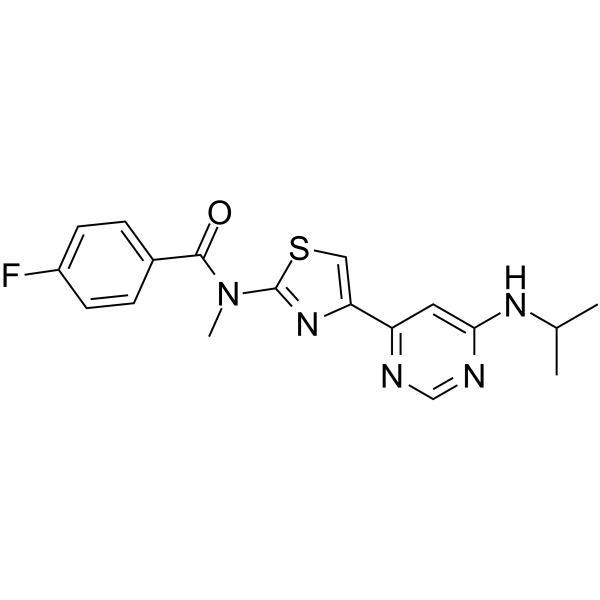
FITM is a negative allosteric modulator of mGlu1 receptor with a Ki of 2.5 nM.
Nur für Forschungszwecke. Wir verkaufen nicht an Patienten.
- Reinheit : 98.00%
- CAS. Nr.: 932737-65-0
- Formel: C18H18FN5OS
- Molecular Weight:371.43
-
Speicherung:Powder -20°C, 3 years , 4°C, 2 years ; In solvent -80°C, 2 years , -20°C, 1 year

To place orders, for customer services and technical support, please contact: MedChemExpress USA
Tel: 609-228-6898 E-mail: [email protected] [email protected]


-
 Biologische Aktivität
-
Chemical Information
-
Lösungsmittel & Löslichkeit
- Reinheit & Dokumentation
- Verweise
-
 Help & FAQs


-
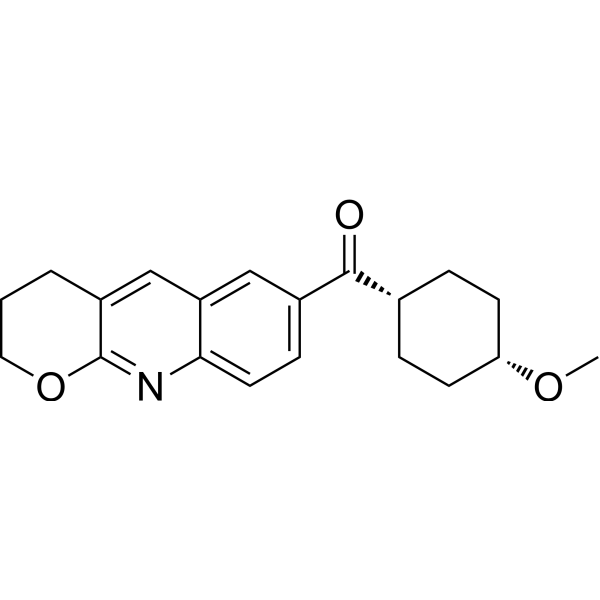
HY-100407
JNJ16259685mGlu1 Receptor Antagonist -
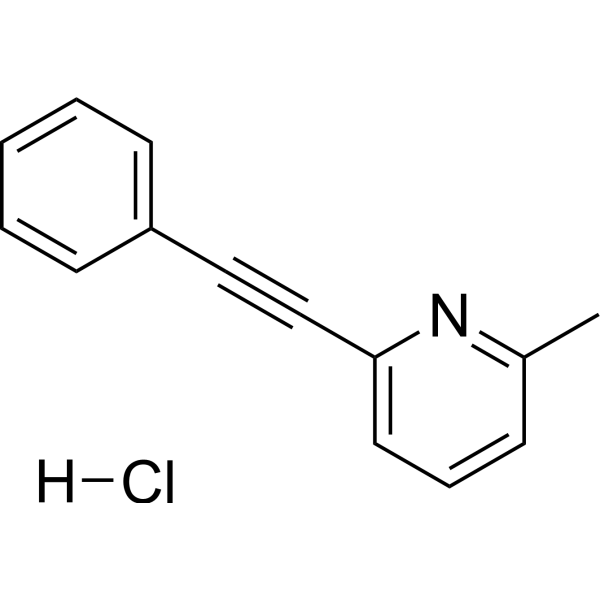
HY-14609
MPEP HydrochloridemGlu5 Receptor Antagonist -
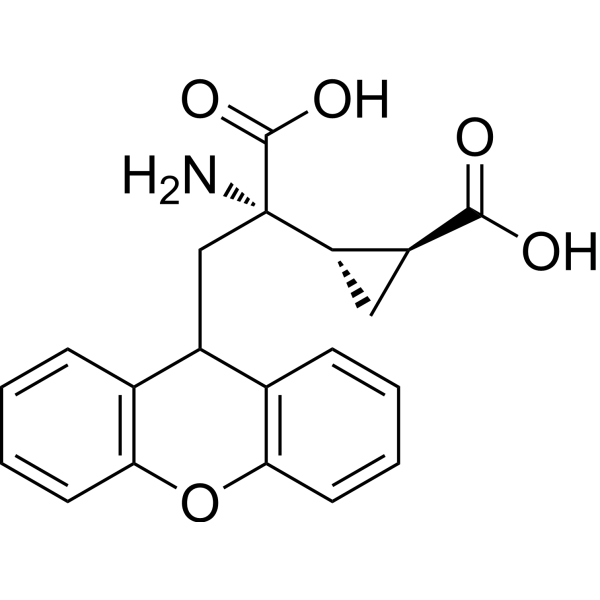
HY-70059
LY341495mGluR Antagonist -
HY-100403
Ro 67-7476mGluR1 PAM -
HY-18941
EglumegadmGlu2/3 Receptor Agonist -
HY-15446
BasimglurantmGlu5 Negative Allosteric Modulator -
HY-100371
(RS)-MCPGmGluR Antagonist -
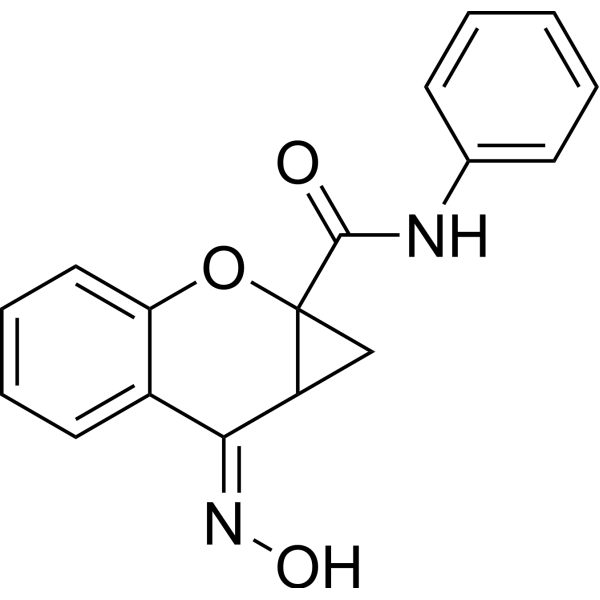
HY-100409
PHCCCGroup I mGluR Antagonist -
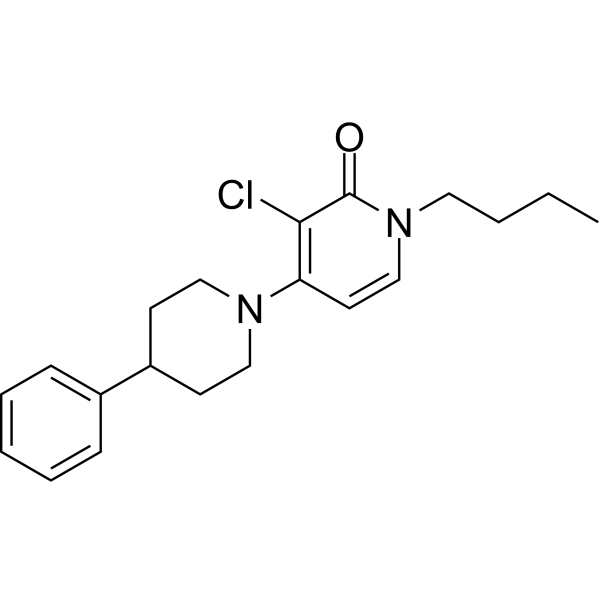
HY-15748
JNJ-40411813Glu2R Positive Allosteric Modulator -
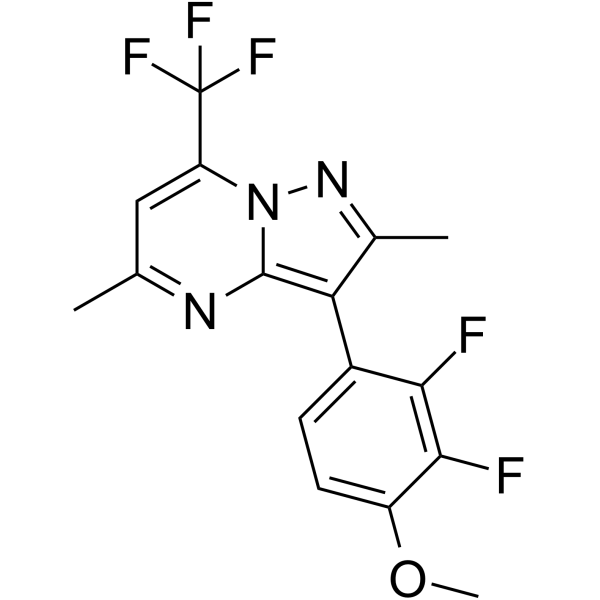
HY-107982
VU6005649mGlu7/8R Agonist -
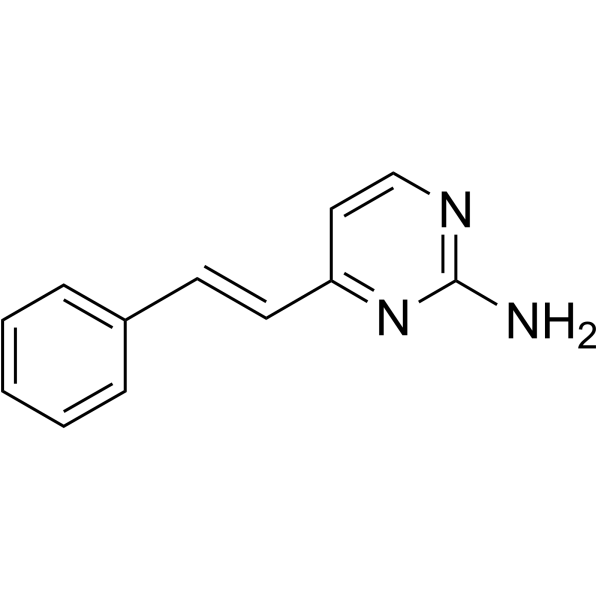
HY-14419
TCN238mGlu4 Receptor PAM -
HY-100405
FTIDCmGluR1 Antagonist
Publications Citing Use of MedChemExpress (MCE) FITM
More

Biologische Aktivität
Beschreibung
IC50 & Target
[1]|
mGlu1 2.5 nM (Ki) |
Cellular Effect
|
Cell Line

|
Type | Value | Description | References |
|---|---|---|---|---|
| CHO | IC50 |
5.1 nM
Compound: 27
|
Antagonist activity at human mGluR1 receptor expressed in CHO cells by FLIPR assay
Antagonist activity at human mGluR1 receptor expressed in CHO cells by FLIPR assay
|
[PMID: 19674894] |
| CHO | IC50 |
7 μM
Compound: 27
|
Antagonist activity at human mGluR5 receptor expressed in CHO cells by FLIPR assay
Antagonist activity at human mGluR5 receptor expressed in CHO cells by FLIPR assay
|
[PMID: 19674894] |
In Vitro
FITM fits tightly into the long and narrow pocket. Most of the ligand-receptor interactions are hydrophobic with the exception of the contacts of the pyrimidine-amine group with the T815 7.38 side chain. The mGlu1 binding pocket for FITM largely corresponds to mutagenic data for the common allosteric site in mGlus and likely extends to other class C GPCRs. FITM which shows high affinity and selectivity for mGlu1 over mGlu5[1]. FITM has the high hydrogen bonds occupancy with Thr815 and Tyr805 in dimer A and B of mGlu1 during molecular dynamics simulations. The nitrogen and hydrogen atoms of FITM form the dynamical hydrogen bonds with the hydrogen atom of Tyr805 and oxygen atom of Thr815, respectively. It indicates that there is a strong attraction interaction between FITM and allosteric sites[2].
MedChemExpress (MCE) has not independently confirmed the accuracy of these methods. They are for reference only.
In Vivo
MedChemExpress (MCE) has not independently confirmed the accuracy of these methods. They are for reference only.


Chemical Information
-
CAS. Nr. 932737-65-0
-
Appearance Solid
-
Molecular Weight 371.43
-
Formel C18H18FN5OS
-
Color White to off-white
-
SMILES
O=C(N(C)C1=NC(C2=NC=NC(NC(C)C)=C2)=CS1)C3=CC=C(F)C=C3
-
Versand
Room temperature in continental US; may vary elsewhere.
-
Speicherung
Powder -20°C 3 years 4°C 2 years In solvent -80°C 2 years -20°C 1 year


Publications (1)
-
Journal Impact Factor
-
Most Recent
-
Cell Rep Med
A 211At-labelled mGluR1 inhibitor induces cancer senescence to elicit long-lasting anti-tumor efficacy. [Abstract]2023 Apr 18;4(4):100960. PMID: 37003259


Lösungsmittel & Löslichkeit
In Vitro:
DMSO : 100 mg/mL (269.23 mM; Need ultrasonic; Hygroscopic DMSO has a significant impact on the solubility of product, please use newly opened DMSO)
Please refer to the solubility information to select the appropriate solvent. Once prepared, please aliquot and store the solution to prevent product inactivation from repeated freeze-thaw cycles.
Storage method and period of stock solution: -80°C, 2 years; -20°C, 1 year. When stored at -80°C, please use it within 2 years. When stored at -20°C, please use it within 1 year.
Please refer to the solubility information to select the appropriate solvent. Once prepared, please aliquot and store the solution to prevent product inactivation from repeated freeze-thaw cycles.
Storage method and period of stock solution: -80°C, 2 years; -20°C, 1 year. When stored at -80°C, please use it within 2 years. When stored at -20°C, please use it within 1 year.
Konzentration (Stammlösung) × Volumen (Stammlösung) = Konzentration (Ziellösung) × Volumen (Ziellösung)
In Vivo:
Select the appropriate dissolution method based on your experimental animal and administration route.
- For the following dissolution methods, please ensure to first prepare a clear stock solution using an In Vitro approach and then sequentially add co-solvents:
- To ensure reliable experimental results, the clarified stock solution can be appropriately stored based on storage conditions. As for the working solution for In Vivo experiments, it is recommended to prepare freshly and use it on the same day.
- The percentages shown for the solvents indicate their volumetric ratio in the final prepared solution. If precipitation or phase separation occurs during preparation, heat and/or sonication can be used to aid dissolution.
Add each solvent one by one: 10% DMSO 40% PEG300 5% Tween-80 45% Saline
Solubility: ≥ 2.5 mg/mL (6.73 mM); Clear solution
This protocol yields a clear solution of ≥ 2.5 mg/mL (saturation unknown).
Taking 1 mL working solution as an example, add 100 μL DMSO stock solution (25.0 mg/mL) to 400 μL PEG300, and mix evenly; then add 50 μL Tween-80 and mix evenly; then add 450 μL Saline to adjust the volume to 1 mL.
Preparation of Saline: Dissolve 0.9 g sodium chloride in ddH₂O and dilute to 100 mL to obtain a clear Saline solution.
In Vivo Dissolution Calculator
Please enter the basic information of animal experiments:
-
-
-
-
Recommended: Prepare an additional quantity of animals to account for potential losses during experiments.
Please enter your animal formula composition:
-
%DMSO +
Recommended: Keep the proportion of DMSO in working solution below 2% if your animal is weak.
-
%+
-
+%Tween-80 + +
-
%Saline +
The co-solvents required include: DMSO, . All of co-solvents are available by MedChemExpress (MCE). , Tween 80. All of co-solvents are available by MedChemExpress (MCE).
Working solution concentration: 0.22 mg/mL
Method for preparing stock solution: mg drug dissolved in μL DMSO. Stock solution concentration: mg/mL.
1. Take μL DMSO stock solution;
2. Add μL .
μL , mix evenly;
3. Then add μL Tween 80, mix evenly;
4. Then add μL
Please ensure that the stock solution in the first step is dissolved to a clear state, and add co-solvents in sequence. You can use ultrasonic heating (ultrasonic cleaner, recommended frequency 20-40 kHz), vortexing, etc. to assist dissolution.


Reinheit & Dokumentation
-
Data Sheet (275 KB)
-
SDS (251 KB)
- English - EN (251 KB)
- Français - FR (251 KB)
- Deutsch - DE (251 KB)
- Norwegian - NO (251 KB)
- Español - ES (251 KB)
- Swedish - SV (251 KB)
- Italian - IT (251 KB)
- Korean - KR (251 KB)
- Portuguese - PT (251 KB)
-
Handling Instructions (2659 KB)
Verweise
[1]. Wu H, et al. Structure of a class C GPCR metabotropic glutamate receptor 1 bound to an allosteric modulator. Science. 2014 Apr 4;344(6179):58-64. [Content Brief]
[2]. Bai Q, et al. Investigation of allosteric modulation mechanism of metabotropic glutamate receptor 1 by molecular dynamics simulations, free energy and weak interaction analysis. Sci Rep. 2016 Feb 18;6:21763. [Content Brief]
[3]. Yamasaki T, et al. In vivo measurement of the affinity and density of metabotropic glutamate receptor subtype 1 in rat brain using 18F-FITM in small-animal PET. J Nucl Med. 2012 Oct;53(10):1601-7. [Content Brief]
[4]. Xie L, et al. Molecular imaging of ectopic metabotropic glutamate 1 receptor in melanoma with a positron emission tomography radioprobe (18) F-FITM. Int J Cancer. 2014 Oct 15;135(8):1852-9. [Content Brief]


Complete Stock Solution Preparation Table
Please refer to the solubility information to select the appropriate solvent. Once prepared, please aliquot and store the solution to prevent product inactivation from repeated freeze-thaw cycles.
Storage method and period of stock solution: -80°C, 2 years; -20°C, 1 year. When stored at -80°C, please use it within 2 years. When stored at -20°C, please use it within 1 year.
| Optional Solvent | Concentration Solvent Mass | 1 mg | 5 mg | 10 mg | 25 mg |
|---|---|---|---|---|---|
| DMSO | 1 mM | 2.6923 mL | 13.4615 mL | 26.9230 mL | 67.3074 mL |
| 5 mM | 0.5385 mL | 2.6923 mL | 5.3846 mL | 13.4615 mL | |
| 10 mM | 0.2692 mL | 1.3461 mL | 2.6923 mL | 6.7307 mL | |
| 15 mM | 0.1795 mL | 0.8974 mL | 1.7949 mL | 4.4872 mL | |
| 20 mM | 0.1346 mL | 0.6731 mL | 1.3461 mL | 3.3654 mL | |
| 25 mM | 0.1077 mL | 0.5385 mL | 1.0769 mL | 2.6923 mL | |
| 30 mM | 0.0897 mL | 0.4487 mL | 0.8974 mL | 2.2436 mL | |
| 40 mM | 0.0673 mL | 0.3365 mL | 0.6731 mL | 1.6827 mL | |
| 50 mM | 0.0538 mL | 0.2692 mL | 0.5385 mL | 1.3461 mL | |
| 60 mM | 0.0449 mL | 0.2244 mL | 0.4487 mL | 1.1218 mL | |
| 80 mM | 0.0337 mL | 0.1683 mL | 0.3365 mL | 0.8413 mL | |
| 100 mM | 0.0269 mL | 0.1346 mL | 0.2692 mL | 0.6731 mL |


FITM Related Classifications
HY-101845 Related Classifications
 Powered by Bioz