



Enzomenib

Based on 1 Customer Validation
Enzomenib (DSP-5336) is an orally active Menin inhibitor (IC50=1.4 nM, Kd=6.0 nM). Enzomenib disrupts the interaction between Menin and KMT2A/MLL fusion proteins, specifically inhibits the expression of leukemia driver genes such as HOX/MEIS1, and upregulates ITGAM. Enzomenib effectively induces cell differentiation, inhibits tumor cell proliferation, and suppresses primitive cell colony formation. Enzomenib reduces disease burden and prolongs survival, but causes adverse reactions including differentiation syndrome and QTc interval prolongation. Enzomenib is used for research on relapsed/refractory acute myeloid leukemia, acute lymphoblastic leukemia, and other hematologic malignancies with mixed lineage leukemia (MLL) rearrangements or NPM1 mutations.
Nur für Forschungszwecke. Wir verkaufen nicht an Patienten.
- Reinheit : 99.88%
- CAS. Nr.: 2412555-70-3
- Formel: C33H43FN6O3
- Molecular Weight:590.73
-
Speicherung:Powder -20°C, 3 years , 4°C, 2 years ; In solvent -80°C, 6 months , -20°C, 1 month


To place orders, for customer services and technical support, please contact: MedChemExpress USA
Tel: 609-228-6898 E-mail: [email protected] [email protected]


-
 Biologische Aktivität
-
Chemical Information
-
Lösungsmittel & Löslichkeit
- Protokoll
- Reinheit & Dokumentation
- Verweise
-
 Help & FAQs


-
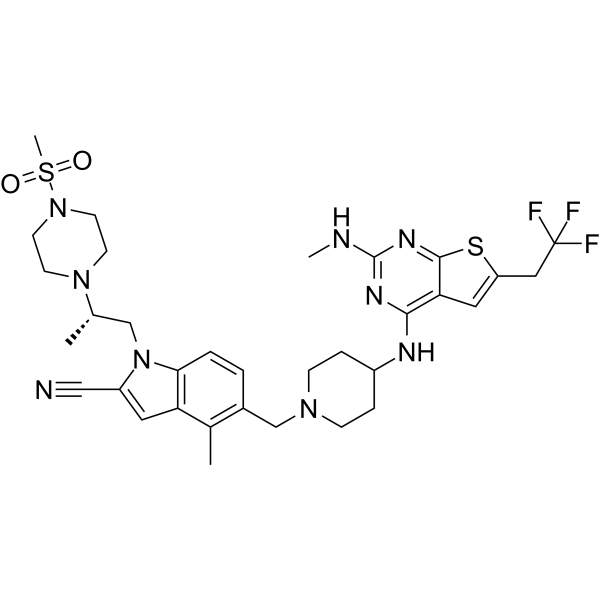
HY-132001
ZiftomenibMenin-MLL Interaction Inhibitor -
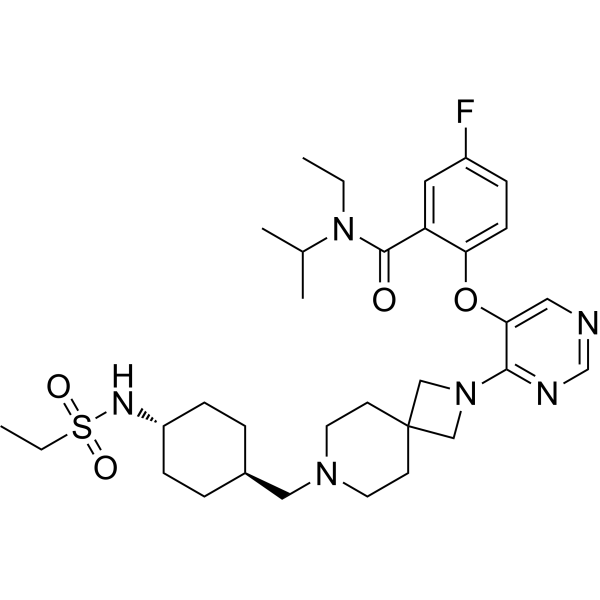
HY-136175
RevumenibMenin-MLL Inhibitor -
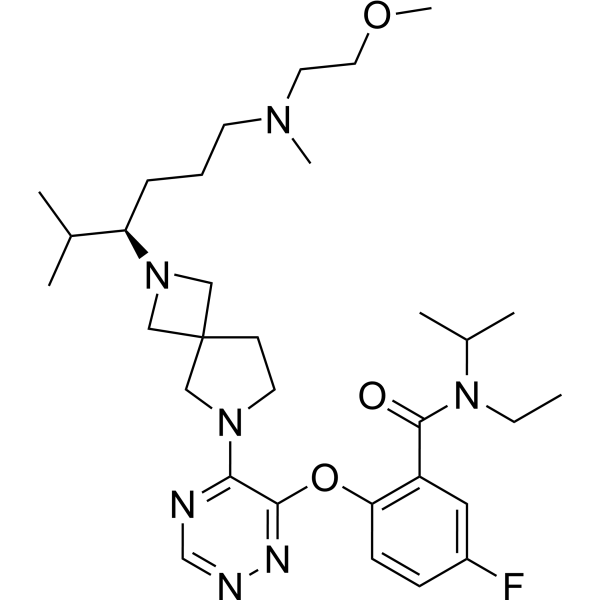
HY-148669
BleximenibMenin-KMT2A Inhibitor -

HY-150105
IcovamenibMenin-MLL Inhibitor -
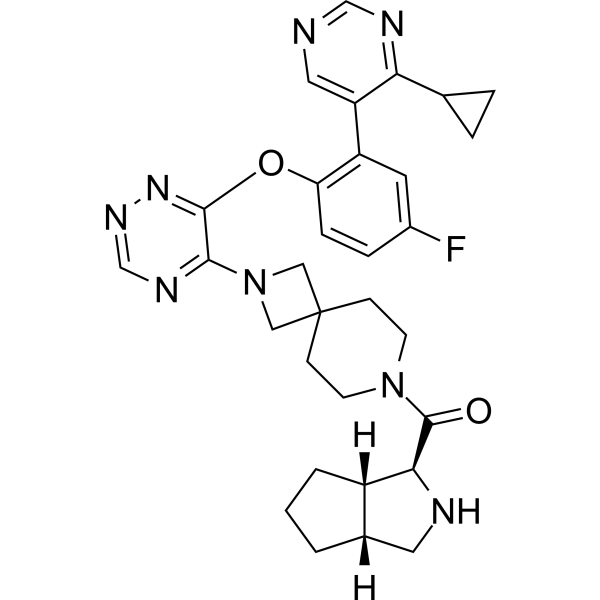
HY-153714
ZefamenibMenin Inhibitor -
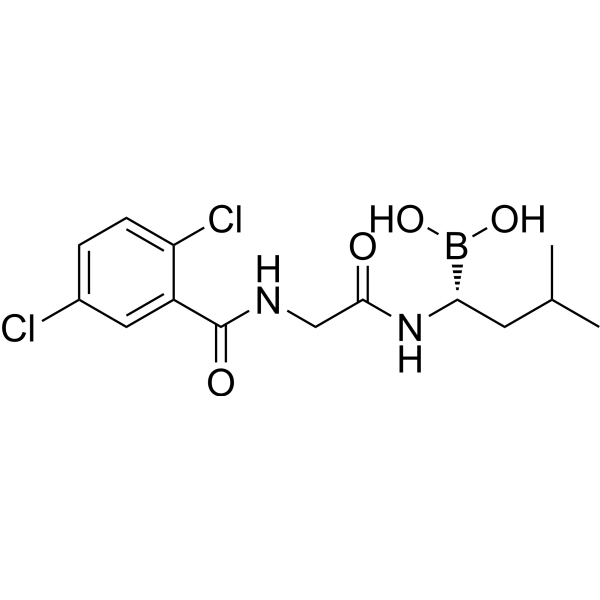
HY-10453
IxazomibProteasome Inhibitor -

HY-172416
BalomenibMenin-KMT2A Interaction Inhibitor -
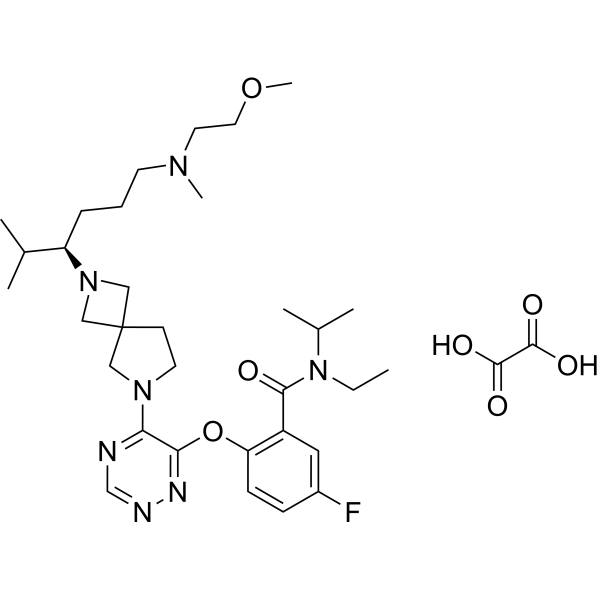
HY-148669A
Bleximenib oxalateMenin-KMT2A Inhibitor -
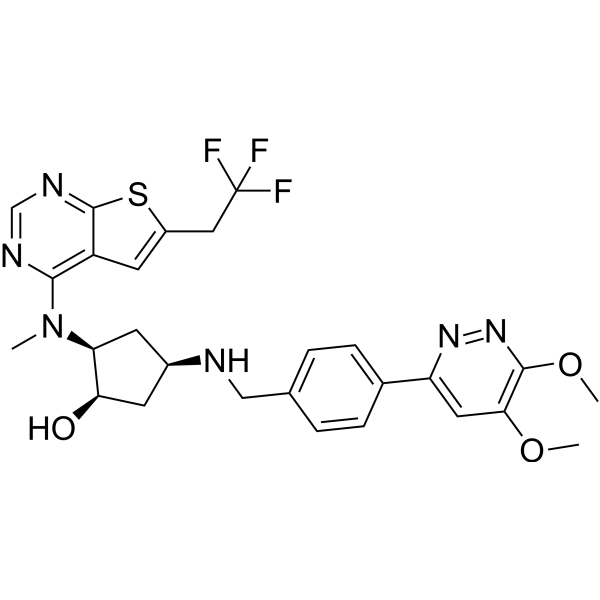
HY-148676
EmilumenibMenin-MLL Inhibitor


Biologische Aktivität
Beschreibung
In Vitro
Specific MEN1 mutations confer resistance to Enzomenib (DSP-5336) in MOLM13 acute myeloid leukemia cells, resulting in reduced drug efficacy[1].
Enzomenib exhibits selective cell growth inhibitory activity against human acute leukemia cell lines harboring MLL rearrangement or NPM1 mutation[2].
Enzomenib selectively inhibits the growth of human leukemia cell lines with MLL rearrangement or NPM1 mutation[3].
Enzomenib downregulates the expression of leukemia genes MEIS1 and HOXA9, and upregulates the expression of terminal differentiation marker ITGAM in MV-4-11 cells[3].
Enzomenib potently inhibits colony formation and modulates the expression of HOXA9, MEIS1 and ITGAM in primary AML model samples positive for the MLL-AF6 fusion[3].
MedChemExpress (MCE) has not independently confirmed the accuracy of these methods. They are for reference only.
-
Cell Line:MV-4-11, MOLM-13, KOPN-8, and OCI-AML3 & human leukemia cell lines
-
Concentration:IC50
-
Incubation Time:/
-
Result:Inhibited the growth of MLL-rearranged or NPM1-mutated human leukemia cell lines with IC50 values of 10 nM (MV-4-11), 15 nM (MOLM-13), 31 nM (KOPN-8), and 15 nM (OCI-AML3).
Did not affect the cell growth of human leukemia cell lines such as HL-60, MOLT-4, and Reh, with IC50s>10 μM.
In Vivo
Enzomenib (DSP-5336) (200 mg/kg; p.o.; once daily) significantly prolongs survival in syngeneic MLL-ENL or MLL-AF10 AML mice, outperforming standard chemotherapy[3].
MedChemExpress (MCE) has not independently confirmed the accuracy of these methods. They are for reference only.
-
Animal Model:Acute myeloid leukemia mice model[3]
-
Dosage:200 mg/kg
-
Administration:p.o.; once daily
-
Result:Induced significant prolongation of survival compared to both vehicle control and standard chemotherapy (cytarabine+daunorubicin) groups.
- RNA extraction experimental
- BrdU Incorporation Assay
- Somatic Cell Culture
- CFSE Dye Dilution Proliferation Assay
- Dye-dilution cell tracking and proliferation staining
- CCK-8/WST-8 Cell Proliferation Assay
- Protocol for Cell Cycle
- Cell Counting-Based Growth Curve Assay
- Colony Formation (Clonogenic) Assay
- Cell Viability Determination by MTT Colorimetric Assay
- EdU Incorporation Assay (Click Chemistry-Based DNA Synthesis Measurement)
- Ki-67 Immunostaining Proliferation Assay
- PCNA Immunodetection Proliferation Assay
- Protocol for Cell Counting and Cell Density Analysis
- Soft Agar Colony Formation Assay
- MTT Cell Proliferation Assay
- iPSC cell differentiation


Chemical Information
-
CAS. Nr. 2412555-70-3
-
Appearance Solid
-
Molecular Weight 590.73
-
Formel C33H43FN6O3
-
Color White to off-white
-
SMILES
O=C([C@@H](N[C@]1([H])C2)[C@@](CC1)([H])C2=C)N3CCC4(CC3)CN(C5=NC=NC=C5OC(C=CC(F)=C6)=C6C(N(C(C)C)C(C)C)=O)C4
-
Synonyms
DSP-5336
-
Versand
Room temperature in continental US; may vary elsewhere.
-
Speicherung
Powder -20°C 3 years 4°C 2 years In solvent -80°C 6 months -20°C 1 month


Lösungsmittel & Löslichkeit
In Vitro:
DMSO : 66.67 mg/mL (112.86 mM; ultrasonic and warming and heat to 60°C; Hygroscopic DMSO has a significant impact on the solubility of product, please use newly opened DMSO)
Please refer to the solubility information to select the appropriate solvent. Once prepared, please aliquot and store the solution to prevent product inactivation from repeated freeze-thaw cycles.
Storage method and period of stock solution: -80°C, 6 months; -20°C, 1 month. When stored at -80°C, please use it within 6 months. When stored at -20°C, please use it within 1 month.
Please refer to the solubility information to select the appropriate solvent. Once prepared, please aliquot and store the solution to prevent product inactivation from repeated freeze-thaw cycles.
Storage method and period of stock solution: -80°C, 6 months; -20°C, 1 month. When stored at -80°C, please use it within 6 months. When stored at -20°C, please use it within 1 month.
Konzentration (Stammlösung) × Volumen (Stammlösung) = Konzentration (Ziellösung) × Volumen (Ziellösung)
In Vivo:
Select the appropriate dissolution method based on your experimental animal and administration route.
- For the following dissolution methods, please ensure to first prepare a clear stock solution using an In Vitro approach and then sequentially add co-solvents:
- To ensure reliable experimental results, the clarified stock solution can be appropriately stored based on storage conditions. As for the working solution for In Vivo experiments, it is recommended to prepare freshly and use it on the same day.
- The percentages shown for the solvents indicate their volumetric ratio in the final prepared solution. If precipitation or phase separation occurs during preparation, heat and/or sonication can be used to aid dissolution.
Add each solvent one by one: 10% DMSO 40% PEG300 5% Tween-80 45% Saline
Solubility: ≥ 5 mg/mL (8.46 mM); Clear solution
This protocol yields a clear solution of ≥ 5 mg/mL (saturation unknown).
Taking 1 mL working solution as an example, add 100 μL DMSO stock solution (50.0 mg/mL) to 400 μL PEG300, and mix evenly; then add 50 μL Tween-80 and mix evenly; then add 450 μL Saline to adjust the volume to 1 mL.
Preparation of Saline: Dissolve 0.9 g sodium chloride in ddH₂O and dilute to 100 mL to obtain a clear Saline solution.
In Vivo Dissolution Calculator
Please enter the basic information of animal experiments:
-
-
-
-
Recommended: Prepare an additional quantity of animals to account for potential losses during experiments.
Please enter your animal formula composition:
-
%DMSO +
Recommended: Keep the proportion of DMSO in working solution below 2% if your animal is weak.
-
%+
-
+%Tween-80 + +
-
%Saline +
The co-solvents required include: DMSO, . All of co-solvents are available by MedChemExpress (MCE). , Tween 80. All of co-solvents are available by MedChemExpress (MCE).
Working solution concentration: 0.22 mg/mL
Method for preparing stock solution: mg drug dissolved in μL DMSO. Stock solution concentration: mg/mL.
1. Take μL DMSO stock solution;
2. Add μL .
μL , mix evenly;
3. Then add μL Tween 80, mix evenly;
4. Then add μL
Please ensure that the stock solution in the first step is dissolved to a clear state, and add co-solvents in sequence. You can use ultrasonic heating (ultrasonic cleaner, recommended frequency 20-40 kHz), vortexing, etc. to assist dissolution.


Reinheit & Dokumentation
-
Data Sheet (277 KB)
-
SDS (254 KB)
- English - EN (254 KB)
- Français - FR (254 KB)
- Deutsch - DE (254 KB)
- Norwegian - NO (254 KB)
- Español - ES (254 KB)
- Swedish - SV (254 KB)
- Italian - IT (254 KB)
- Korean - KR (254 KB)
- Portuguese - PT (254 KB)
-
Handling Instructions (2659 KB)
Verweise


Complete Stock Solution Preparation Table
Please refer to the solubility information to select the appropriate solvent. Once prepared, please aliquot and store the solution to prevent product inactivation from repeated freeze-thaw cycles.
Storage method and period of stock solution: -80°C, 6 months; -20°C, 1 month. When stored at -80°C, please use it within 6 months. When stored at -20°C, please use it within 1 month.
| Optional Solvent | Concentration Solvent Mass | 1 mg | 5 mg | 10 mg | 25 mg |
|---|---|---|---|---|---|
| DMSO | 1 mM | 1.6928 mL | 8.4641 mL | 16.9282 mL | 42.3205 mL |
| 5 mM | 0.3386 mL | 1.6928 mL | 3.3856 mL | 8.4641 mL | |
| 10 mM | 0.1693 mL | 0.8464 mL | 1.6928 mL | 4.2321 mL | |
| 15 mM | 0.1129 mL | 0.5643 mL | 1.1285 mL | 2.8214 mL | |
| 20 mM | 0.0846 mL | 0.4232 mL | 0.8464 mL | 2.1160 mL | |
| 25 mM | 0.0677 mL | 0.3386 mL | 0.6771 mL | 1.6928 mL | |
| 30 mM | 0.0564 mL | 0.2821 mL | 0.5643 mL | 1.4107 mL | |
| 40 mM | 0.0423 mL | 0.2116 mL | 0.4232 mL | 1.0580 mL | |
| 50 mM | 0.0339 mL | 0.1693 mL | 0.3386 mL | 0.8464 mL | |
| 60 mM | 0.0282 mL | 0.1411 mL | 0.2821 mL | 0.7053 mL | |
| 80 mM | 0.0212 mL | 0.1058 mL | 0.2116 mL | 0.5290 mL | |
| 100 mM | 0.0169 mL | 0.0846 mL | 0.1693 mL | 0.4232 mL |


Enzomenib Related Classifications
HY-156794 Related Classifications
 Powered by Bioz