



Mensacarcin
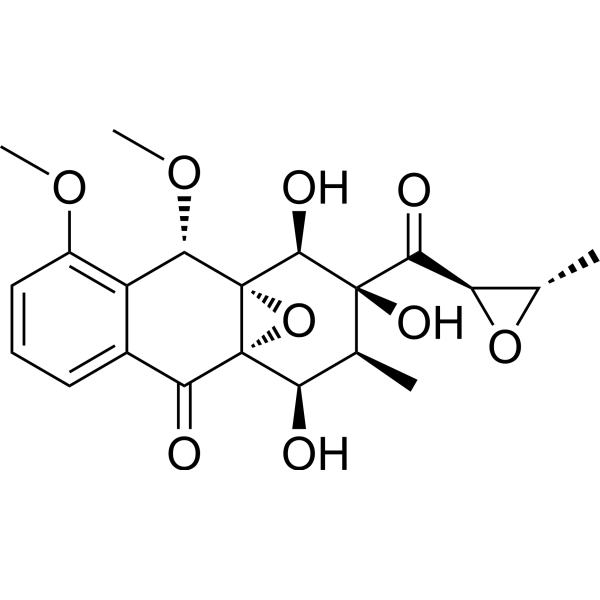
Mensacarcin, a highly complex polyketide, strongly inhibits cell growth universally in cancer cell lines and potently induces apoptosis in melanoma cells. Mensacarcin targets to mitochondria, affects energy metabolism in mitochondria, and activates caspase-dependent apoptotic pathways. Mensacarcin, an antibiotic, can be used as a cytotoxic component of antibody-drug conjugates (ADCs).
Nos produits utilisent uniquement pour la recherche. Nous ne vendons pas aux patients.
- CAS No.: 808750-39-2
- Formule: C21H24O9
- Masse moléculaire:420.41
-
Stockage:
Please store the product under the recommended conditions in the Certificate of Analysis.

To place orders, for customer services and technical support, please contact: MedChemExpress USA
Tel: 609-228-6898 E-mail: [email protected] [email protected]


-
 Activité biologique
-
Chemical Information
- Pureté et documentation
- Références
-
 Help & FAQs


Voir tous les produits spécifiques à Isoform ADC Payloads
More

Activité biologique
|
Traditional Cytotoxic Agents |
|
Cell Line

|
Type | Value | Description | References |
|---|---|---|---|---|
| HCT-116 | IC50 |
1.3 μM
Compound: Mensacarcin
|
Antiproliferative activity against human HCT-116 cells measured after 24 hrs by MTT assay
Antiproliferative activity against human HCT-116 cells measured after 24 hrs by MTT assay
|
[PMID: 37411007] |
| MDA-MB-231 | IC50 |
0.6 μM
Compound: Mensacarcin
|
Antiproliferative activity against human MDA-MB-231 cells measured after 24 hrs by MTT assay
Antiproliferative activity against human MDA-MB-231 cells measured after 24 hrs by MTT assay
|
[PMID: 37411007] |
Mensacarcin (0-100 μM; 24 hours) exhibits general cytostatic but type-specific cytotoxic effects for melanoma cells[1].
Mensacarcin (2-50 μM; 15 hours) induces rapid apoptotic cell death in melanoma cells[1].
Mensacarcin exhibits potent cytostatic properties (mean of 50% growth inhibition=0.2 μM) in almost all cell lines of the National Cancer Institute (NCI)-60 cell line screen and relatively selective cytotoxicity against melanoma cells. Mensacarcin is a highly oxygenated polyketide that was first isolated from soil-dwelling Streptomyces bacteria. Mensacarcin impairs mitochondrial function in melanoma cells[1].
MedChemExpress (MCE) has not independently confirmed the accuracy of these methods. They are for reference only.
-
Cell Line:SK-Mel-28 and SK-Mel-5 melanoma cells, HCT-116 colon cancer cells
-
Concentration:0.01, 0.1, 1, 10, 100 μM
-
Incubation Time:24 hours
-
Result:Induced concentration- and time-dependent cell death in the two tested melanoma cell lines. HCT-116 colon carcinoma cells were strongly inhibited.
-
Cell Line:SK-Mel-28, SK-Mel-5 cells
-
Concentration:2, 10, 50 μM
-
Incubation Time:15 hours
-
Result:Induced the formation of 89-kDa PARP-1 fragments as well as caspase-3 activation in SK-Mel-28 and SK-Mel-5 beginning between 6 and 15 h after exposure.


Chemical Information
-
CAS No. 808750-39-2
-
Masse moléculaire 420.41
-
Formule C21H24O9
-
SMILES
CO[C@@H]1[C@@]23[C@](C(C4=CC=CC(OC)=C14)=O)([C@@H]([C@H](C)[C@](C([C@H]5[C@H](C)O5)=O)(O)[C@@H]3O)O)O2
-
Livraison
Room temperature in continental US; may vary elsewhere.
-
Stockage
Please store the product under the recommended conditions in the Certificate of Analysis.


Pureté et documentation
Références

Calculators
Concentration (start) × Volume (start) = Concentration (final) × Volume (final)


Mensacarcin Related Classifications
HY-122534 Related Classifications
 Powered by Bioz