



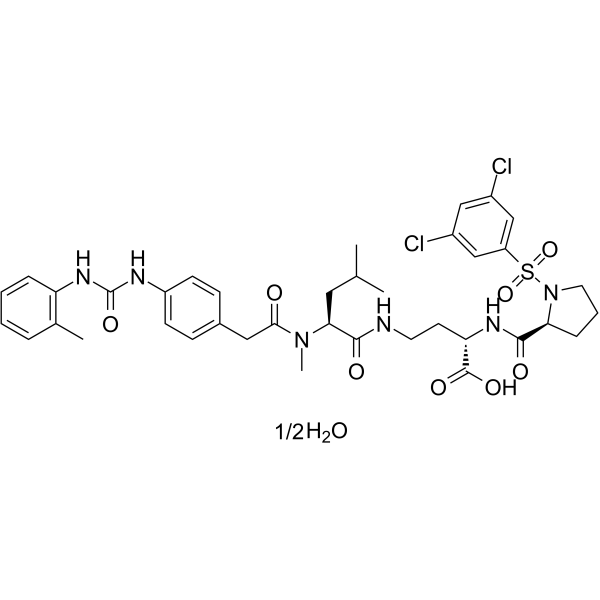
BIO5192 hydrate
Based on 2 publication(s) in Google Scholar
BIO5192 hydrate is a selective and potent integrin α4β1 (VLA-4) inhibitor (Kd<10 pM). BIO5192 hydrate selectively binds to α4β1 (IC50=1.8 nM) over a range of other integrins. BIO5192 hydrate results in a 30-fold increase in mobilization of murine hematopoietic stem and progenitors (HSPCs) over basal levels.
Nur für Forschungszwecke. Wir verkaufen nicht an Patienten.
- Reinheit : 99.96%
- Formel: C38H46Cl2N6O8S.1/2H2O
- Molecular Weight:826.79
-
Speicherung:
-20°C, sealed storage, away from moisture
* In solvent : -80°C, 6 months; -20°C, 1 month (sealed storage, away from moisture)

To place orders, for customer services and technical support, please contact: MedChemExpress USA
Tel: 609-228-6898 E-mail: [email protected] [email protected]


-
 Biologische Aktivität
-
Chemical Information
-
Lösungsmittel & Löslichkeit
- Reinheit & Dokumentation
- Verweise
-
 Help & FAQs


Publications Citing Use of MedChemExpress (MCE) BIO5192 hydrate
More

Biologische Aktivität
Beschreibung
IC50 & Target
[1]|
α4β1 1.8 nM (IC50) |
α9β1 138 nM (IC50) |
α2β1 1053 nM (IC50) |
α4β7 >500 nM (IC50) |
In Vivo
BIO5192 hydrate (30 mg/kg; s.c; bid; during days 5 through 14) delays paralysis associated with EAE (experimental autoimmune encephalomyelitis)[2].
BIO5192 hydrate (1 mg/kg, i.v.) shows the terminal half-life is 1.1 hours. BIO5192 hydrate (3, 10, and 30 mg/kg; s.c.) shows half-lives of 1.7, 2.7, and 4.7 hours, respectively. The blood plasma curves show that the AUC for the s.c. route of administration increased about 2.5-fold from 5,460 h*ng/ml for the 3 mg/kg dose to 14,175 h*ng/ml for the 30 mg/kg[1].
MedChemExpress (MCE) has not independently confirmed the accuracy of these methods. They are for reference only.
-
Animal Model:C57BL/6J x 129Sv/J F1 mice[1]
-
Dosage:1 mg/kg (with Plerixafor: 5 mg/kg)
-
Administration:I.v.
-
Result:Exerted an additive effect on progenitor mobilization.
-
Animal Model:Healthy female Lewis rats weighing 150g[2]
-
Dosage:30 mg/kg
-
Administration:S.c; bid; during days 5 through 14
-
Result:Showed a 3-day delay in onset of disease.


Chemical Information
-
Appearance Solid
-
Molecular Weight 826.79
-
Formel C38H46Cl2N6O8S.1/2H2O
-
Color White to off-white
-
SMILES
O=[S](N(CCC1)[C@@H]1C(N[C@H](C(O)=O)CCNC([C@H](CC(C)C)N(C)C(CC(C=C2)=CC=C2NC(NC(C=CC=C3)=C3C)=O)=O)=O)=O)(C4=CC(Cl)=CC(Cl)=C4)=O.O.[1/2]
-
Versand
Room temperature in continental US; may vary elsewhere.
-
Speicherung
-20°C, sealed storage, away from moisture
* In solvent : -80°C, 6 months; -20°C, 1 month (sealed storage, away from moisture)


Publications (2)
-
Journal Impact Factor
-
Most Recent
-
Immun Ageing
Vascular Cell Adhesion Molecule-1 (VCAM-1) contributes to macular fibrosis in neovascular age-related macular degeneration through modulating macrophage functions. [Abstract]2023 Nov 20;20(1):65. PMID: 37985993 -
Blood Adv
VLA-4 agonist promotes engraftment and immune reconstitution of allogeneic hematopoietic stem cells. [Abstract]2026 May 12;10(9):3103-3117. PMID: 41758999


Lösungsmittel & Löslichkeit
In Vitro:
DMSO : ≥ 100 mg/mL (120.95 mM; Hygroscopic DMSO has a significant impact on the solubility of product, please use newly opened DMSO)
* "≥" means soluble, but saturation unknown.
Please refer to the solubility information to select the appropriate solvent. Once prepared, please aliquot and store the solution to prevent product inactivation from repeated freeze-thaw cycles.
Storage method and period of stock solution: -80°C, 6 months; -20°C, 1 month (sealed storage, away from moisture). When stored at -80°C, please use it within 6 months. When stored at -20°C, please use it within 1 month.
Please refer to the solubility information to select the appropriate solvent. Once prepared, please aliquot and store the solution to prevent product inactivation from repeated freeze-thaw cycles.
Storage method and period of stock solution: -80°C, 6 months; -20°C, 1 month (sealed storage, away from moisture). When stored at -80°C, please use it within 6 months. When stored at -20°C, please use it within 1 month.
Konzentration (Stammlösung) × Volumen (Stammlösung) = Konzentration (Ziellösung) × Volumen (Ziellösung)
In Vivo:
Select the appropriate dissolution method based on your experimental animal and administration route.
- For the following dissolution methods, please ensure to first prepare a clear stock solution using an In Vitro approach and then sequentially add co-solvents:
- To ensure reliable experimental results, the clarified stock solution can be appropriately stored based on storage conditions. As for the working solution for In Vivo experiments, it is recommended to prepare freshly and use it on the same day.
- The percentages shown for the solvents indicate their volumetric ratio in the final prepared solution. If precipitation or phase separation occurs during preparation, heat and/or sonication can be used to aid dissolution.
Add each solvent one by one: 10% DMSO 40% PEG300 5% Tween-80 45% Saline
Solubility: ≥ 2.5 mg/mL (3.02 mM); Clear solution
This protocol yields a clear solution of ≥ 2.5 mg/mL (saturation unknown).
Taking 1 mL working solution as an example, add 100 μL DMSO stock solution (25.0 mg/mL) to 400 μL PEG300, and mix evenly; then add 50 μL Tween-80 and mix evenly; then add 450 μL Saline to adjust the volume to 1 mL.
Preparation of Saline: Dissolve 0.9 g sodium chloride in ddH₂O and dilute to 100 mL to obtain a clear Saline solution.
In Vivo Dissolution Calculator
Please enter the basic information of animal experiments:
-
-
-
-
Recommended: Prepare an additional quantity of animals to account for potential losses during experiments.
Please enter your animal formula composition:
-
%DMSO +
Recommended: Keep the proportion of DMSO in working solution below 2% if your animal is weak.
-
%+
-
+%Tween-80 + +
-
%Saline +
The co-solvents required include: DMSO, . All of co-solvents are available by MedChemExpress (MCE). , Tween 80. All of co-solvents are available by MedChemExpress (MCE).
Working solution concentration: 0.22 mg/mL
Method for preparing stock solution: mg drug dissolved in μL DMSO. Stock solution concentration: mg/mL. * In solvent : -80°C, 6 months; -20°C, 1 month (sealed storage, away from moisture)
1. Take μL DMSO stock solution;
2. Add μL .
μL , mix evenly;
3. Then add μL Tween 80, mix evenly;
4. Then add μL
Please ensure that the stock solution in the first step is dissolved to a clear state, and add co-solvents in sequence. You can use ultrasonic heating (ultrasonic cleaner, recommended frequency 20-40 kHz), vortexing, etc. to assist dissolution.


Reinheit & Dokumentation
-
Data Sheet (276 KB)
-
SDS (252 KB)
- English - EN (252 KB)
- Français - FR (252 KB)
- Deutsch - DE (252 KB)
- Norwegian - NO (252 KB)
- Español - ES (252 KB)
- Swedish - SV (252 KB)
- Italian - IT (252 KB)
- Korean - KR (252 KB)
- Portuguese - PT (252 KB)
-
Handling Instructions (2659 KB)
Verweise
[1]. Ramirez P, et al. BIO5192, a small molecule inhibitor of VLA-4, mobilizes hematopoietic stem and progenitor cells. Blood. 2009;114(7):1340‐1343. [Content Brief]
[2]. Leone DR, et al. An assessment of the mechanistic differences between two integrin alpha 4 beta 1 inhibitors, the monoclonal antibody TA-2 and the small molecule BIO5192, in rat experimental autoimmune encephalomyelitis. J Pharmacol Exp Ther. 2003;305(3):1150-1162. [Content Brief]


Complete Stock Solution Preparation Table
Please refer to the solubility information to select the appropriate solvent. Once prepared, please aliquot and store the solution to prevent product inactivation from repeated freeze-thaw cycles.
Storage method and period of stock solution: -80°C, 6 months; -20°C, 1 month (sealed storage, away from moisture). When stored at -80°C, please use it within 6 months. When stored at -20°C, please use it within 1 month.
| Optional Solvent | Concentration Solvent Mass | 1 mg | 5 mg | 10 mg | 25 mg |
|---|---|---|---|---|---|
| DMSO | 1 mM | 1.2095 mL | 6.0475 mL | 12.0950 mL | 30.2374 mL |
| 5 mM | 0.2419 mL | 1.2095 mL | 2.4190 mL | 6.0475 mL | |
| 10 mM | 0.1209 mL | 0.6047 mL | 1.2095 mL | 3.0237 mL | |
| 15 mM | 0.0806 mL | 0.4032 mL | 0.8063 mL | 2.0158 mL | |
| 20 mM | 0.0605 mL | 0.3024 mL | 0.6047 mL | 1.5119 mL | |
| 25 mM | 0.0484 mL | 0.2419 mL | 0.4838 mL | 1.2095 mL | |
| 30 mM | 0.0403 mL | 0.2016 mL | 0.4032 mL | 1.0079 mL | |
| 40 mM | 0.0302 mL | 0.1512 mL | 0.3024 mL | 0.7559 mL | |
| 50 mM | 0.0242 mL | 0.1209 mL | 0.2419 mL | 0.6047 mL | |
| 60 mM | 0.0202 mL | 0.1008 mL | 0.2016 mL | 0.5040 mL | |
| 80 mM | 0.0151 mL | 0.0756 mL | 0.1512 mL | 0.3780 mL | |
| 100 mM | 0.0121 mL | 0.0605 mL | 0.1209 mL | 0.3024 mL |


BIO5192 hydrate Related Classifications
HY-107589A Related Classifications
 Powered by Bioz