



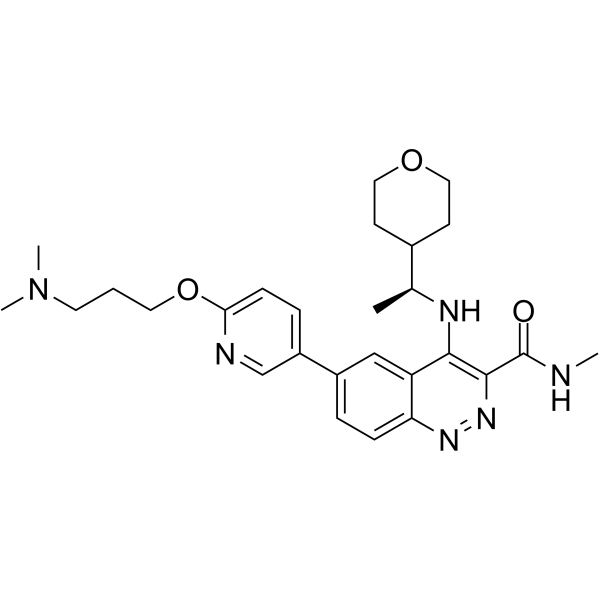
ATM Inhibitor-1
ATM Inhibitor-1 is a highly potent, selective and orally active ATM inhibitor, with an IC50 of 0.7 nM, shows weak activity against mTOR (IC50, 21 μM), DNAPK (IC50, 2.8 μM), PI3Kα (IC50, 3.8 μM), PI3Kβ (IC50, 10.3 μM), PI3Kγ (IC50, 3 μM) and PI3Kδ (IC50, 0.73 μM). ATM Inhibitor-1 exhibits anti-tumor activity.
For research use only. We do not sell to patients.
- CAS No.: 2135639-94-8
- Formula: C27H36N6O3
- Molecular Weight:492.61
-
Storage:
Please store the product under the recommended conditions in the Certificate of Analysis.

To place orders, for customer services and technical support, please contact: MedChemExpress USA
Tel: 609-228-6898 E-mail: [email protected] [email protected]


-
 Biological Activity
-
Chemical Information
- Purity & Documentation
- References
-
 Help & FAQs




Biological Activity
|
ATM 0.7 nM (IC50) |
ATM 2.8 nM (IC50, Cellular assay) |
PI3Kδ 0.73 μM (IC50) |
PI3Kγ 3 μM (IC50) |
PI3Kα 3.8 μM (IC50) |
PI3Kβ 10.3 μM (IC50) |
DNAPK 2.8 μM (IC50) |
mTOR 21 μM (IC50) |
ATM Inhibitor-1 (Compound 21) is a highly potent, selective and orally active ATM Inhibitor, with an IC50 of 0.7 nM, shows weak activity against mTOR (IC50, 21 μM), DNAPK (IC50, 2.8 μM), PI3Kα (IC50, 3.8 μM), PI3Kβ (IC50, 10.3 μM), PI3Kγ (IC50, 3 μM) and PI3Kδ (IC50, 0.73 μM)[1].
In cellular assays, ATM Inhibitor-1 exhibits IC50s of 2.8 nM, >30 μM and >19 μM for ATM, ATR/PI3Kα and PI3Kβ/mTOR, respectively[1].
MedChemExpress (MCE) has not independently confirmed the accuracy of these methods. They are for reference only.
MedChemExpress (MCE) has not independently confirmed the accuracy of these methods. They are for reference only.
-
Animal Model:SW620 mice model[1]
-
Dosage:50 mg/kg
-
Administration:P.O., once daily for 3 days every week starting 24 h post-irinotecan dosing, 21 days
-
Result:Inhibited the growth of tumor combined with 50 mg/kg irinotecan in SW620 mice model.


Chemical Information
-
CAS No. 2135639-94-8
-
Molecular Weight 492.61
-
Formula C27H36N6O3
-
SMILES
C[C@@H](C1CCOCC1)NC2=C(C(NC)=O)N=NC3=CC=C(C4=CC=C(OCCCN(C)C)N=C4)C=C32
-
Shipping
Room temperature in continental US; may vary elsewhere.
-
Storage
Please store the product under the recommended conditions in the Certificate of Analysis.


Purity & Documentation
References

Calculators
Concentration (start) × Volume (start) = Concentration (final) × Volume (final)


ATM Inhibitor-1 Related Classifications
HY-112614 Related Classifications
 Powered by Bioz