



Sickle Cell Disease
-
Sickle Cell Disease (21)

- 1
- 2
- Molecular Weight: 143.47 kDa
Rituximab (anti-CD20) is an anti-CD20 chimeric monoclonal antibody used to treat certain autoimmune diseases and types of cancer.

- Formula: C27H31N5O3
- Molecular Weight: 473.57
GSK484 is a PAD4 inhibitor that effectively inhibits protein citrullination and the formation of neutrophil extracellular traps (NETs) by blocking the catalytic activity of PAD4. GSK484 suppresses the production of histone H3, MHC-I expression, CD8+ T cell activation, proliferation and inflammatory cytokine release. GSK484 reduces inflammation and bone destruction in collagen-induced rheumatoid arthritis, alleviates pain and mast cell activation in sickle cell disease, and improves myocardial ischemia-reperfusion injury and experimental colitis. In addition, GSK484 restores intestinal microbial homeostasis by reversing ferroptosis-induced dysbiosis. GSK484 can be used to study the disease mechanisms of rheumatoid arthritis, sickle cell disease, thrombosis, myocardial injury, colitis and other conditions.

- Formula: C20H21N5O4
- Molecular Weight: 395.41
ASP-8731 is an orally active BACH1 inhibitor. ASP-8731 activates antioxidant, anti-inflammatory and globin gene pathways by relieving the inhibitory effect of BACH1 on NRF2-mediated gene transcription. ASP-8731 significantly upregulates the expression of HMOX1, FTH1 and various globins (such as HGB, HBG, HBA), increases fetal hemoglobin (HbF) levels, and effectively induces F-cell production in hydroxyurea-unresponsive cells. Meanwhile, ASP-8731 reduces inflammatory responses and white blood cell counts by downregulating VCAM1, ICAM-1 and the phosphorylation level of NF-κB(p65), and blocks heme-induced glutathione depletion and microcirculatory stasis. ASP-8731 holds potential for inhibiting sickle cell disease and related hematological disorders.

- Formula: C24H30F3N3O6
- Molecular Weight: 513.51
(R,R)-dWIZ-1 TFA is the (R,R) enantiomer of dWIZ-1 (HY-159098). dWIZ-1 is a potent WIZ molecular glue degrader. (R,R)-dWIZ-1 TFA can be used in studies related to sickle cell disease and β-thalassemia.
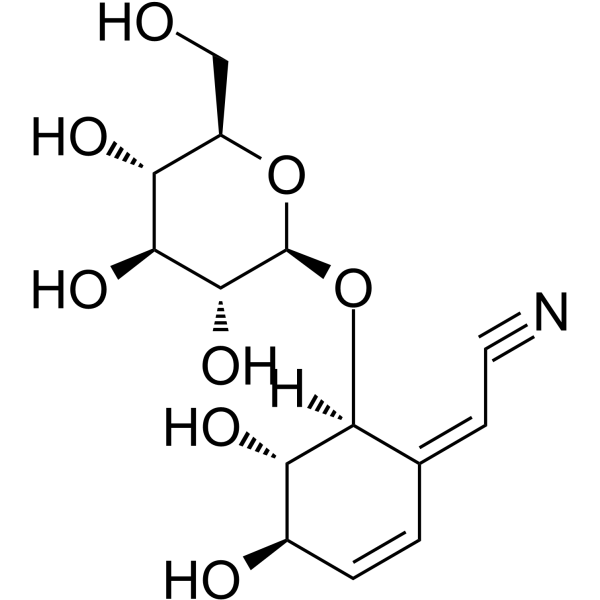
- Formula: C14H19NO8
- Molecular Weight: 329.30
Lithospermoside (Griffonin) is an orally active Na+/K+-ATPase inhibitor and hypoglycemic agent. Lithospermoside increases intracellular sodium levels in normal and sickle red blood cells. Lithospermoside reduces fasting blood glucose levels, improves glucose tolerance, and prevents weight loss in diabetic mice. Lithospermoside can be used in the research of sickle cell disease and diabetes.

- Formula: C37H46N3O6PS2
- Molecular Weight: 723.88
SNOTRAP (SNO trapping by triaryl phosphine) is a chemical probe used for detecting S-nitrosylated (SNO) proteins. SNOTRAP selectively converts S-nitrosylated cysteines in proteins into stable disulfide-iminophosphorane intermediates, which are then enriched with streptavidin and detected by nanoLC-MS/MS. SNOTRAP enables global enrichment and label-free quantification of SNO proteins and their modification sites in complex biological samples such as mouse brain tissues. SNOTRAP can be applied to studies related to nitrosative stress-associated diseases, including neurodegenerative diseases, cancer, and multiple sclerosis.

- Formula: C22H29N3O4
- Molecular Weight: 399.48
dWIZ-1 is an orally active molecular glue and chemical probe targeting the WIZ transcription factor, which based on an IMiD backbone, binding to human WIZ with an affinity of 3.5 μM. dWIZ-1 recruits WIZ to the cereblon-DDB1 complex via its ZF7 domain, thereby triggering proteasome-dependent degradation of WIZ. dWIZ-1 significantly induces fetal hemoglobin expression in erythroblasts while reducing the level of inhibitory H3K9 dimethylation at WIZ binding sites such as the β-globin locus. Meanwhile, dWIZ-1 does not affect the proliferation and differentiation of erythroblasts, and no cytotoxicity is observed in in vitro cells or cynomolgus monkey models. dWIZ-1 serves as a critical tool molecule for investigating the mechanism and underlying pathways of sickle cell disease.

- Formula: C23H23ClN4O4
- Molecular Weight: 454.91
SH6 is a CRBN-dependent proteasome degrader that targets ZBTB7A. SH6 can be used in the research of sickle cell disease and β-thalassemia.
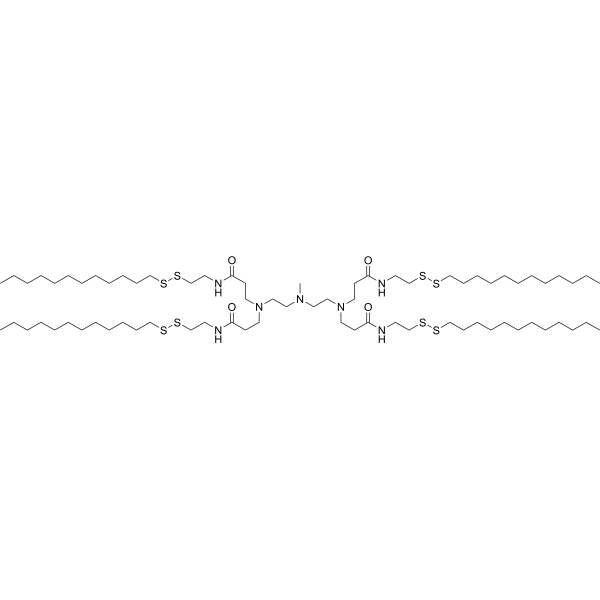
- Formula: C73H147N7O4S8
- Molecular Weight: 1443.51
113-N16B is an ionizable cationic lipid that can be used for the synthesis of lipid nanoparticles. 113-N16B delivers mRNA to pulmonary endothelial cells. 113-N16B can be formulated as a component into hybrid lipid nanoparticles for lung-specific delivery of mRNA (including MFSD7C mRNA and luciferase mRNA) in mice. 113-N16B is applicable to research related to lymphangioleiomyomatosis, sickle cell disease, and hemolysis-induced lung injury.

- Formula: C20H25N3O4
- Molecular Weight: 371.43
WIZ degrader 4 is a WIZ molecular glue degrader with an AC50 value of 16 nM. WIZ degrader 4 induces the expression of fetal hemoglobin (HbF) with an EC50 of 47 nM. WIZ degrader 4 can be used to investigate sickle cell disease (SCD) and thalassemia.

- Formula: C22H29N3O4
- Molecular Weight: 399.49
(R,R)-dWIZ-1 is the (R,R) enantiomer of dWIZ-1 (HY-159098). dWIZ-1 is a potent WIZ molecular glue degrader. (R,R)-dWIZ-1 can be used in studies related to sickle cell disease and β-thalassemia.

- Formula: C18H23N5O3
- Molecular Weight: 357.41
WIZ degrader 3 (Compound 29) is a molecular glue degrader for widely interspaced zinc finger motifs (WIZ), with an AC50 of 6.4 nM. WIZ degrader 3 induces the expression of fetal hemoglobin (HbF), with an EC50 of 45 nM. WIZ degrader 3 can be used for the research of blood disorders, such as sickle cell disease and β- thalassemia.

- Formula: C24H33N5O3
- Molecular Weight: 439.55
WIZ degrader 2 (Compound 142) is a molecular glue degrader for widely interspaced zinc (WIZ) finger motifs with an AC50 of 0.011 μM. WIZ degrader 2 induces the expression of fetal hemoglobin (HbF) with an EC50 of 0.038 μM. WIZ degrader 2 can be used in research related to hereditary blood disorders, such as sickle cell disease (SCD) and thalassemia.

- Formula: C14H19NO8
- Molecular Weight: 329.30
Lithospermoside (Griffonin) (Standard) is the analytical standard of Lithospermoside (HY-N0821). This product is intended for research and analytical applications. Lithospermoside is an orally active Na+/K+-ATPase inhibitor and hypoglycemic agent. Lithospermoside increases intracellular sodium levels in normal and sickle red blood cells. Lithospermoside reduces fasting blood glucose levels, improves glucose tolerance, and prevents weight loss in diabetic mice. Lithospermoside can be used in the research of sickle cell disease and diabetes.

- Formula: C31H26F4N6O2
- Molecular Weight: 590.57
DCN1 modulator-1 is a DCN1 modulator. DCN1 modulator-1 binds covalently to DCN2. DCN1 modulator-1 induces the expression of fetal hemoglobin mRNA (HBG1) and fetal hemoglobin protein (HbF). DCN1 modulator-1 is applicable to research related to sickle cell disease and thalassemia.

- Formula: C20H35NO2
- Molecular Weight: 321.50
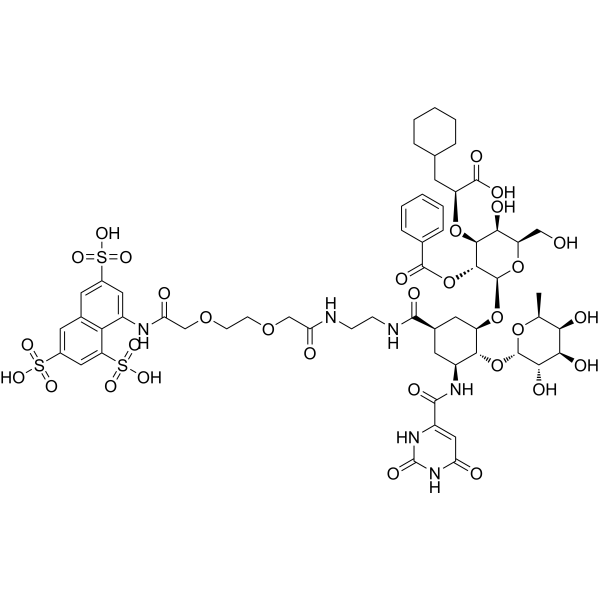
- Formula: C58H74N6O31S3
- Molecular Weight: 1447.42
Rivipansel is a small-molecule glycomimetic pan-selectin antagonist with inhibitory activity against E-selectin and P-selectin. Rivipansel binds tightly to the lectin domain of E-selectin, and selectively blocks the recognition of CD62L by E-selectin without affecting the binding of PSGL-1 to E-selectin. Rivipansel functionally inhibits the adhesion of hematopoietic cells to endothelial cells, and is applicable to research related to sickle cell disease.

- Formula: C29H24N6O4
- Molecular Weight: 520.54
WIZ degrader 7 (Example 16) is a WIZ molecular glue degrader with an IC50 value of < 0.01 μM. WIZ degrader 7 can be used to investigate sickle cell disease (SCD) and thalassemia.

- Formula: C28H22FN5O5
- Molecular Weight: 527.50
WIZ degrader 6 (compound 10) is a WIZ molecular glue degrader with the EC50 of <0.01 μM. WIZ degrader 6 can be used for study of sickle cell disease.

- Formula: C21H27N3O4
- Molecular Weight: 385.46
WIZ degrader 5 (example 41) is a molecular glue degrader for widely interspaced zinc (WIZ) finger motifs with an AC50 of 0.14 nM. WIZ degrader 5 induces the expression of fetal hemoglobin (HbF) with an EC50 of 25 nM. WIZ degrader 5 can be used in research related to hereditary blood disorders, such as sickle cell disease (SCD) and thalassemia.
- 1
- 2



