



ASP-8731

Based on 1 Customer Validation
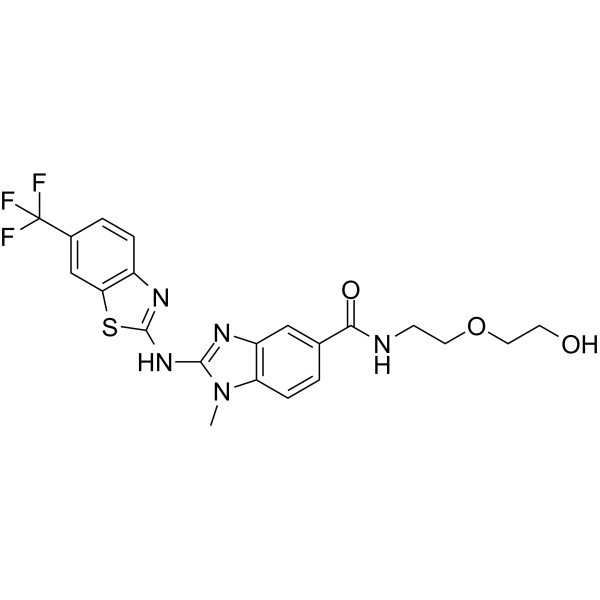
ASP-8731 is an orally active BACH1 inhibitor. ASP-8731 activates antioxidant, anti-inflammatory and globin gene pathways by relieving the inhibitory effect of BACH1 on NRF2-mediated gene transcription. ASP-8731 significantly upregulates the expression of HMOX1, FTH1 and various globins (such as HGB, HBG, HBA), increases fetal hemoglobin (HbF) levels, and effectively induces F-cell production in hydroxyurea-unresponsive cells. Meanwhile, ASP-8731 reduces inflammatory responses and white blood cell counts by downregulating VCAM1, ICAM-1 and the phosphorylation level of NF-κB(p65), and blocks heme-induced glutathione depletion and microcirculatory stasis. ASP-8731 holds potential for inhibiting sickle cell disease and related hematological disorders.
商品は「研究用試薬」です。人や動物の医療用・臨床診断用・食品用の製品ではありません。
研究用途以外に使用した場合、当社は一切の責任を負いかねます。
- 純度 : 99.12%
- CAS 番号: 2488255-42-9
- 分子式: C20H21N5O4
- 分子量:395.41
-
保管条件:Powder -20°C, 3 years , 4°C, 2 years ; In solvent -80°C, 6 months , -20°C, 1 month


To place orders, for customer services and technical support, please contact: MedChemExpress USA
Tel: 609-228-6898 E-mail: [email protected] [email protected]


-
 生物活性
生物活性
-
化学情報
-
溶剤 & 溶解度
- プロトコル
- 純度とドキュメンテーション
- 参考文献
-
 Help & FAQs




生物活性
製品説明
IC50 & Target
|
p65 |
体外実験
ASP-8731 (0.1-50 μM; 24 h) potently upregulates the mRNA levels of HMOX1 and FTH1 in human hepatocellular carcinoma HepG2 cells[1].
ASP-8731 (1-10 μM; pre-incubated for 24 h prior to 4 h of TNF-α treatment) reduces TNF-α-induced VCAM1 mRNA levels in primary human pulmonary artery endothelial cells[1].
ASP-8731 (1-3 μM; pre-incubated for 24 h followed by 30 min hemin treatment) inhibits hemin-induced reduction of glutathione levels in primary human pulmonary endothelial cells[1].
ASP-8731 (0.3-1 μM; 7 days of erythroid differentiation) increases HBG mRNA levels and the proportion of HbF-containing F cells during erythroid differentiation of human bone marrow-derived CD34+ cells, and ASP-8731 (1-3 μM) induces the generation of F cells in HU non-responder donor cells[1].
ASP-8731 (0.3-10 μM; 10 days of erythroid differentiation) upregulates the mRNA levels of HBG, HBA and multiple antioxidant genes in erythroid-differentiated CD34+ cells derived from patients with sickle cell disease, but exerts no effect on the mRNA level of HBB[1].
Erythroid differentiation:
This is the process by which hematopoietic stem cells in the bone marrow undergo stepwise directional development and maturation into functional red blood cells under the regulation of specific signals.
The process involves continuous stages from erythroid progenitor cells (BFU-E, CFU-E) to proerythroblasts, erythroblasts (early, intermediate and late stages), and finally enucleation to form reticulocytes that mature into red blood cells, with the entire process taking approximately 7 days.
During this process, cells undergo significant morphological and biochemical changes, including massive synthesis of hemoglobin, gradual reduction in cell volume, and eventual extrusion of the nucleus, to maximize their oxygen-carrying capacity.
Reference for erythroid differentiation medium[1]:
X-Vivo-15, rhIL-3 (10 ng/mL), rhSCF (100 ng/mL), Epo (3 U/mL)
MedChemExpress (MCE) has not independently confirmed the accuracy of these methods. They are for reference only.
-
Cell Line:HepG2
-
Concentration:0.1, 10, 50 μM
-
Incubation Time:24 h
-
Result:Effectively increased the mRNA levels of HMOX1 and FTH1, even more potently than DMF (HY-Y0345) (1-250 μM).
体内実験
ASP-8731 (3-25 mg/kg; p.o.; once daily; 14 days) upregulates the expression of HO-1 and heme oxygenase activity in the liver of Townes HbSS mice, while it reduces the expression of NF-κB phosphorylated p65 and ICAM-1, upregulates the expression of γ-globin, and increases HbF-containing F cells[1].
MedChemExpress (MCE) has not independently confirmed the accuracy of these methods. They are for reference only.
-
Animal Model:Townes-sickle (HbSS) (male and female, 12-16 weeks of age, 129/B6 mixed genetic background, knock-in model)[1]
-
Dosage:1, 3, 25 mg/kg
-
Administration:p.o.; once daily, 6 days per week; 4 weeks
-
Result:Reduced hemin-induced microvascular stasis to 26% (1 mg/kg), 21% (3 mg/kg), and 7% (25 mg/kg) (vs 33% in vehicle controls).\n
Reduced white blood cell counts to 22 × 103/μL (1 mg/kg), 18 × 103/μL (3 mg/kg), and 13 × 103/μL (25 mg/kg) (vs 28 × 103/μL in vehicle controls).
-
Animal Model:Townes-sickle (HbSS) (male and female, 12-16 weeks of age, 129/B6 mixed genetic background, knock-in model)[1]
-
Dosage:3, 10, 25 mg/kg
-
Administration:p.o.; once daily; 14 consecutive days
-
Result:Increased microsomal heme oxygenase-1 (HO-1) protein expression in the liver at 25 mg/kg.\n
Decreased nuclear NF-ĸB phospho-p65 and microsomal ICAM-1 protein expression in the liver at all tested doses.\n
Increased hepatic heme oxygenase activity in a dose-dependent manner.
Increased the ratio of gamma globin to gamma globin + beta-S globin to 7.8% (3 mg/kg) and 8.3% (25 mg/kg) (vs 5.8% in vehicle controls).
Increased the percentage of HbF-containing F-cells to 1.8% (3 mg/kg) and 2.1% (25 mg/kg) (vs 1.0% in vehicle controls).
臨床実験
| NCT Number | Sponsor | Condition | Start Date |
Phase

|
|---|---|---|---|---|
| NCT01329991 | Plexxikon| | 2011-05 | PHASE1 |


化学情報
-
CAS 番号 2488255-42-9
-
性状 Solid
-
分子量 395.41
-
分子式 C20H21N5O4
-
Color Off-white to light yellow
-
SMILES
O=C(C1=CC(N=C(N2C)NC3=NC4=C(O3)C=CC=C4)=C2C=C1)NCCOCCO
-
輸送条件
Room temperature in continental US; may vary elsewhere.
-
保管条件
Powder -20°C 3 years 4°C 2 years In solvent -80°C 6 months -20°C 1 month


溶剤 & 溶解度
体外:
DMSO : 100 mg/mL (252.90 mM; Need ultrasonic; Hygroscopic DMSO has a significant impact on the solubility of product, please use newly opened DMSO)
Please refer to the solubility information to select the appropriate solvent. Once prepared, please aliquot and store the solution to prevent product inactivation from repeated freeze-thaw cycles.
Storage method and period of stock solution: -80°C, 6 months; -20°C, 1 month. When stored at -80°C, please use it within 6 months. When stored at -20°C, please use it within 1 month.
Please refer to the solubility information to select the appropriate solvent. Once prepared, please aliquot and store the solution to prevent product inactivation from repeated freeze-thaw cycles.
Storage method and period of stock solution: -80°C, 6 months; -20°C, 1 month. When stored at -80°C, please use it within 6 months. When stored at -20°C, please use it within 1 month.
濃度 (開始) × 体積 (開始) = 濃度 (終了) × 体積 (終了)
体内:
Select the appropriate dissolution method based on your experimental animal and administration route.
- For the following dissolution methods, please ensure to first prepare a clear stock solution using an In Vitro approach and then sequentially add co-solvents:
- To ensure reliable experimental results, the clarified stock solution can be appropriately stored based on storage conditions. As for the working solution for In Vivo experiments, it is recommended to prepare freshly and use it on the same day.
- The percentages shown for the solvents indicate their volumetric ratio in the final prepared solution. If precipitation or phase separation occurs during preparation, heat and/or sonication can be used to aid dissolution.
Add each solvent one by one: 10% DMSO 40% PEG300 5% Tween-80 45% Saline
Solubility: ≥ 5 mg/mL (12.65 mM); Clear solution
This protocol yields a clear solution of ≥ 5 mg/mL (saturation unknown).
Taking 1 mL working solution as an example, add 100 μL DMSO stock solution (50.0 mg/mL) to 400 μL PEG300, and mix evenly; then add 50 μL Tween-80 and mix evenly; then add 450 μL Saline to adjust the volume to 1 mL.
Preparation of Saline: Dissolve 0.9 g sodium chloride in ddH₂O and dilute to 100 mL to obtain a clear Saline solution.
Add each solvent one by one: 10% DMSO 90% (20% SBE-β-CD in Saline)
Solubility: ≥ 5 mg/mL (12.65 mM); Clear solution
This protocol yields a clear solution of ≥ 5 mg/mL (saturation unknown).
Taking 1 mL working solution as an example, add 100 μL DMSO stock solution (50.0 mg/mL) to 900 μL 20% SBE-β-CD in Saline, and mix evenly.
Preparation of 20% SBE-β-CD in Saline (4°C, storage for one week): 2 g SBE-β-CD powder is dissolved in 10 mL Saline, completely dissolve until clear.
In Vivo Dissolution Calculator
Please enter the basic information of animal experiments:
-
-
-
-
Recommended: Prepare an additional quantity of animals to account for potential losses during experiments.
Please enter your animal formula composition:
-
%DMSO +
Recommended: Keep the proportion of DMSO in working solution below 2% if your animal is weak.
-
%+
-
+%Tween-80 + +
-
%Saline +
The co-solvents required include: DMSO, . All of co-solvents are available by MedChemExpress (MCE). , Tween 80. All of co-solvents are available by MedChemExpress (MCE).
Working solution concentration: 0.22 mg/mL
Method for preparing stock solution: mg drug dissolved in μL DMSO. Stock solution concentration: mg/mL.
1. Take μL DMSO stock solution;
2. Add μL .
μL , mix evenly;
3. Then add μL Tween 80, mix evenly;
4. Then add μL
Please ensure that the stock solution in the first step is dissolved to a clear state, and add co-solvents in sequence. You can use ultrasonic heating (ultrasonic cleaner, recommended frequency 20-40 kHz), vortexing, etc. to assist dissolution.


純度とドキュメンテーション
-
データシート (278 KB)
-
SDS (251 KB)
- English - EN (251 KB)
- Français - FR (251 KB)
- Deutsch - DE (251 KB)
- Norwegian - NO (251 KB)
- Español - ES (251 KB)
- Swedish - SV (251 KB)
- Italian - IT (251 KB)
- Korean - KR (251 KB)
- Portuguese - PT (251 KB)
-
取扱説明書 (2659 KB)
参考文献


Complete Stock Solution Preparation Table
Please refer to the solubility information to select the appropriate solvent. Once prepared, please aliquot and store the solution to prevent product inactivation from repeated freeze-thaw cycles.
Storage method and period of stock solution: -80°C, 6 months; -20°C, 1 month. When stored at -80°C, please use it within 6 months. When stored at -20°C, please use it within 1 month.
| Optional Solvent | Concentration Solvent Mass | 1 mg | 5 mg | 10 mg | 25 mg |
|---|---|---|---|---|---|
| DMSO | 1 mM | 2.5290 mL | 12.6451 mL | 25.2902 mL | 63.2255 mL |
| 5 mM | 0.5058 mL | 2.5290 mL | 5.0580 mL | 12.6451 mL | |
| 10 mM | 0.2529 mL | 1.2645 mL | 2.5290 mL | 6.3226 mL | |
| 15 mM | 0.1686 mL | 0.8430 mL | 1.6860 mL | 4.2150 mL | |
| 20 mM | 0.1265 mL | 0.6323 mL | 1.2645 mL | 3.1613 mL | |
| 25 mM | 0.1012 mL | 0.5058 mL | 1.0116 mL | 2.5290 mL | |
| 30 mM | 0.0843 mL | 0.4215 mL | 0.8430 mL | 2.1075 mL | |
| 40 mM | 0.0632 mL | 0.3161 mL | 0.6323 mL | 1.5806 mL | |
| 50 mM | 0.0506 mL | 0.2529 mL | 0.5058 mL | 1.2645 mL | |
| 60 mM | 0.0422 mL | 0.2108 mL | 0.4215 mL | 1.0538 mL | |
| 80 mM | 0.0316 mL | 0.1581 mL | 0.3161 mL | 0.7903 mL | |
| 100 mM | 0.0253 mL | 0.1265 mL | 0.2529 mL | 0.6323 mL |


ASP-8731 関連分類
HY-167874 関連分類
 Powered by Bioz