



Oxalic acid, 99%
Based on 1 publication(s) in Google Scholar
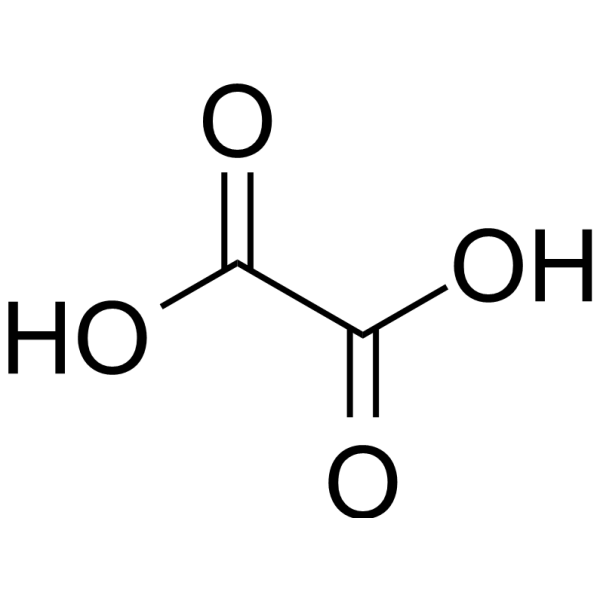
Oxalic acid, 99% (Ethanedioic acid) is a dicarboxylic acid found in a wide variety of plants. Oxalic acid, 99% shows antioxidant acyivity and suppresses lipid peroxidation. Oxalic acid, 99% is a pathogenicity factor for sclerotinia sclerotiorum, and suppresses the oxidative burst of the host plant. Oxalic acid, 99% exerts acaricidal activity. Oxalic acid can be used for the researches of sclerotinia disease, varroatosis and inflammatory diseases.
Para uso exclusivo en investigación. No vendemos a pacientes.
- Pureza: 99.31%
- No. CAS: 144-62-7
- Fòrmula: C2H2O4
- Peso molecular:90.03
-
Almacenamiento:Powder -20°C, 3 years , 4°C, 2 years ; In solvent -80°C, 2 years , -20°C, 1 year

To place orders, for customer services and technical support, please contact: MedChemExpress USA
Tel: 609-228-6898 E-mail: [email protected] [email protected]


-
 Actividad biológica
-
Chemical Information
-
Solvente y solubilidad
- Pureza y Documentación
- Referencias
-
 Help & FAQs
-

Anti-Infection Compound Library
HY-L002
-
Immunology/Inflammation Compound Library
HY-L007
-
Metabolism/Protease Compound Library
HY-L012
-
Natural Product Library
HY-L021
-
Antioxidant Compound Library
HY-L037
-
Ferroptosis Compound Library
HY-L051
-
Medicine Food Homology Compound Library
HY-L055
-
Orally Active Compound Library
HY-L061
-
Traditional Chinese Medicine Active Compound Library
HY-L065
-
FDA Approved & Pharmacopeial Drug Library
HY-L066
-
Gut Microbial Metabolite Library
HY-L078
-
Microbial Metabolite Library
HY-L084
-
Glucose Metabolism Compound Library
HY-L092
-
Food-Sourced Compound Library
HY-L094
-
Anti-inflammatory Traditional Chinese Medicine Active Compound Library
HY-L114
-
Human Metabolite Library
HY-L123
-
Radioprotector Library
HY-L178
-
Bioactive Compound Library Max
HY-L181
-
MCE Bioactive Compound Library
HY-L001V
-
Natural Product Library Plus
HY-L021P
-
Bioactive Compound Library
HY-L001
-
Pesticide Compound Library
HY-L183
-
Anti-Fibrosis Compound Library
HY-L185
-
Miao Ethnicity Medicine Compound Library
HY-L190
-
Tibetan Medicine Compound Library
HY-L191
-
PBCRBS Traditional Chinese Medicine Compound Library
HY-L193
-
Heat-Clearing and Detoxification Traditional Chinese Medicine Compound Library
HY-L194
-
RO5 Drug-like Natural Product Library
HY-L200
-
Flavor Compound Library
HY-L202
-
High-Throughput Bioactive Compound Library
HY-L205
-
High-Throughput Natural Product Library
HY-L206
-
Ancient Chinese Classical Formulas Traditional Chinese Medicine Active Compound Library
HY-L209
-
Mouse Metabolite Compound Library
HY-L217
-
Antitussive and Antiasthmatic Traditional Chinese Medicine Active Compound Library
HY-L223
-
Diarrhea-Related Traditional Chinese Medicine Active Compound Library
HY-L224
-
Nucleotide Metabolite Compound Library
HY-L234
-
Mongolian Medicine Compound Library
HY-L238
-
Chinese Baijiu Compound Library
HY-L241
-
Natural Product Diversity Scaffold Library
HY-L245
-
Tonifying Traditional Chinese Medicine Monomer Compound Library
HY-L246
-
Environmental Pollutant Compound Library
HY-L247
-
Carbohydrate Metabolite Compound Library
HY-L252
-
Natural Product and Natural Product-Like Compound Library
HY-L021M


Publications Citing Use of MedChemExpress (MCE) Oxalic acid, 99%
MoreVer todos los productos específicos de isoformas Endogenous Metabolite
More

Actividad biológica
Oxalic acid, 99% (4-32 mM; 10 min) suppresses Fe3+-ADP/NADPH-induced lipid peroxidation in rat liver microsomes in a concentration-dependent manner, with 32 mM reducing levels to 5.9% of control values[1].
Oxalic acid, 99% (16 mM; 90 min) almost completely suppresses lipid peroxidation in rat brain homogenate, reducing TBARS levels to 10% of control values[1].
Oxalic acid, 99% (0.5-8.0 mM; 5 min) reduces Cu2+/H2O2-induced oxidation of ascorbic acid in a cell-free in vitro system in a concentration-dependent manner, with 8.0 mM maintaining the highest ascorbate levels after 5 min of incubation[1].
Oxalic acid, 99% (4-10 mM) inhibits OGA-induced oxidative burst in suspension-cultured Glycine max cells with an IC50 of 4 mM and achieves maximal inhibition at 6 mM[2].
Oxalic acid, 99% (4-10 mM) inhibits oxidative bursts induced by multiple distinct elicitors in suspension-cultured tobacco and soybean cells with IC50 values of 4 to 5 mM and achieves maximal inhibition at 6 to 7 mM[2].
Oxalic acid, 99% (10 mM) increases OGA-induced cytosolic Ca2+ transients in aequorin-transformed suspension-cultured tobacco cells rather than inhibiting them[2].
MedChemExpress (MCE) has not independently confirmed the accuracy of these methods. They are for reference only.


Chemical Information
-
No. CAS 144-62-7
-
Appearance Solid
-
Peso molecular 90.03
-
Fòrmula C2H2O4
-
Color White to off-white
-
SMILES
OC(C(O)=O)=O
-
Synonyms
Ethanedioic acid
-
Structure Classification
-
Initial Source
-
Envío
Room temperature in continental US; may vary elsewhere.
-
Almacenamiento
Powder -20°C 3 years 4°C 2 years In solvent -80°C 2 years -20°C 1 year


Publications (1)
-
Journal Impact Factor
-
Most Recent
-
Nature
2025 Jul;643(8070):192-200. PMID: 39695227


Solvente y solubilidad
DMSO : 130 mg/mL (1443.96 mM; Need ultrasonic; Hygroscopic DMSO has a significant impact on the solubility of product, please use newly opened DMSO)
Please refer to the solubility information to select the appropriate solvent. Once prepared, please aliquot and store the solution to prevent product inactivation from repeated freeze-thaw cycles.
Storage method and period of stock solution: -80°C, 2 years; -20°C, 1 year. When stored at -80°C, please use it within 2 years. When stored at -20°C, please use it within 1 year.
Please refer to the solubility information to select the appropriate solvent. Once prepared, please aliquot and store the solution to prevent product inactivation from repeated freeze-thaw cycles.
Storage method and period of stock solution: -80°C, 2 years; -20°C, 1 year. When stored at -80°C, please use it within 2 years. When stored at -20°C, please use it within 1 year.
Concentration (start) × Volume (start) = Concentration (final) × Volume (final)
Select the appropriate dissolution method based on your experimental animal and administration route.
- For the following dissolution methods, please ensure to first prepare a clear stock solution using an In Vitro approach and then sequentially add co-solvents:
- To ensure reliable experimental results, the clarified stock solution can be appropriately stored based on storage conditions. As for the working solution for In Vivo experiments, it is recommended to prepare freshly and use it on the same day.
- The percentages shown for the solvents indicate their volumetric ratio in the final prepared solution. If precipitation or phase separation occurs during preparation, heat and/or sonication can be used to aid dissolution.
Add each solvent one by one: 10% DMSO 40% PEG300 5% Tween-80 45% Saline
Solubility: 3.25 mg/mL (36.10 mM); Suspended solution; Need ultrasonic
This protocol yields a suspended solution of 3.25 mg/mL. Suspended solution can be used for oral and intraperitoneal injection.
Taking 1 mL working solution as an example, add 100 μL DMSO stock solution (32.5 mg/mL) to 400 μL PEG300, and mix evenly; then add 50 μL Tween-80 and mix evenly; then add 450 μL Saline to adjust the volume to 1 mL.
Preparation of Saline: Dissolve 0.9 g sodium chloride in ddH₂O and dilute to 100 mL to obtain a clear Saline solution.
Add each solvent one by one: 10% DMSO 90% (20% SBE-β-CD in Saline)
Solubility: ≥ 3.25 mg/mL (36.10 mM); Clear solution
This protocol yields a clear solution of ≥ 3.25 mg/mL (saturation unknown).
Taking 1 mL working solution as an example, add 100 μL DMSO stock solution (32.5 mg/mL) to 900 μL 20% SBE-β-CD in Saline, and mix evenly.
Preparation of 20% SBE-β-CD in Saline (4°C, storage for one week): 2 g SBE-β-CD powder is dissolved in 10 mL Saline, completely dissolve until clear.
Please enter the basic information of animal experiments:
-
-
-
-
Recommended: Prepare an additional quantity of animals to account for potential losses during experiments.
Please enter your animal formula composition:
-
%DMSO +
Recommended: Keep the proportion of DMSO in working solution below 2% if your animal is weak.
-
%+
-
+%Tween-80 + +
-
%Saline +
The co-solvents required include: DMSO, . All of co-solvents are available by MedChemExpress (MCE). , Tween 80. All of co-solvents are available by MedChemExpress (MCE).
Working solution concentration: 0.22 mg/mL
Method for preparing stock solution: mg drug dissolved in μL DMSO. Stock solution concentration: mg/mL.
1. Take μL DMSO stock solution;
2. Add μL .
μL , mix evenly;
3. Then add μL Tween 80, mix evenly;
4. Then add μL
Please ensure that the stock solution in the first step is dissolved to a clear state, and add co-solvents in sequence. You can use ultrasonic heating (ultrasonic cleaner, recommended frequency 20-40 kHz), vortexing, etc. to assist dissolution.


Pureza y Documentación
-
Ficha de datos (274 KB)
-
SDS (614 KB)
- English - EN (614 KB)
- Français - FR (614 KB)
- Deutsch - DE (614 KB)
- Norwegian - NO (614 KB)
- Español - ES (614 KB)
- Swedish - SV (614 KB)
- Italian - IT (614 KB)
- Korean - KR (614 KB)
- Portuguese - PT (614 KB)
-
Instrucciones de manejo (2659 KB)
Referencias
[1]. Kayashima T, et al. Oxalic acid is available as a natural antioxidant in some systems. Biochim Biophys Acta. 2002;1573(1):1-3. [Content Brief]
[2]. Cessna SG, et al. Oxalic acid, a pathogenicity factor for Sclerotinia sclerotiorum, suppresses the oxidative burst of the host plant. Plant Cell. 2000;12(11):2191-2200. [Content Brief]


Complete Stock Solution Preparation Table
Please refer to the solubility information to select the appropriate solvent. Once prepared, please aliquot and store the solution to prevent product inactivation from repeated freeze-thaw cycles.
Storage method and period of stock solution: -80°C, 2 years; -20°C, 1 year. When stored at -80°C, please use it within 2 years. When stored at -20°C, please use it within 1 year.
| Optional Solvent | Concentration Solvent Mass | 1 mg | 5 mg | 10 mg | 25 mg |
|---|---|---|---|---|---|
| DMSO | 1 mM | 11.1074 mL | 55.5370 mL | 111.0741 mL | 277.6852 mL |
| 5 mM | 2.2215 mL | 11.1074 mL | 22.2148 mL | 55.5370 mL | |
| 10 mM | 1.1107 mL | 5.5537 mL | 11.1074 mL | 27.7685 mL | |
| 15 mM | 0.7405 mL | 3.7025 mL | 7.4049 mL | 18.5123 mL | |
| 20 mM | 0.5554 mL | 2.7769 mL | 5.5537 mL | 13.8843 mL | |
| 25 mM | 0.4443 mL | 2.2215 mL | 4.4430 mL | 11.1074 mL | |
| 30 mM | 0.3702 mL | 1.8512 mL | 3.7025 mL | 9.2562 mL | |
| 40 mM | 0.2777 mL | 1.3884 mL | 2.7769 mL | 6.9421 mL | |
| 50 mM | 0.2221 mL | 1.1107 mL | 2.2215 mL | 5.5537 mL | |
| 60 mM | 0.1851 mL | 0.9256 mL | 1.8512 mL | 4.6281 mL | |
| 80 mM | 0.1388 mL | 0.6942 mL | 1.3884 mL | 3.4711 mL | |
| 100 mM | 0.1111 mL | 0.5554 mL | 1.1107 mL | 2.7769 mL |


Oxalic acid, 99% Related Classifications
HY-Y0262 Related Classifications
 Powered by Bioz
- Oxalic acid, 99%
- 144-62-7
- Ethanedioic acid
- Environmental Pollutants
- Endogenous Metabolite
- suspension-cultured soybean cells
- varroa mites
- lipid peroxidation
- Sclerotinia sclerotiorum
- oxidative burst
- rat liver microsomes
- honey bee colonies
- suspension-cultured tobacco cells
- cytosolic Ca2+ fluxes
- rat brain homogenate
- Inhibitor
- inhibitor
- inhibit