



BGC20-761
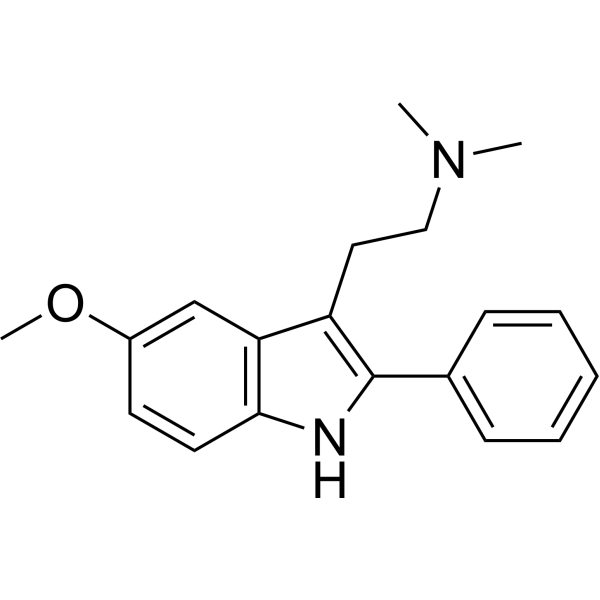
BGC20-761 is a selecvtive 5-HT6 and dopamine receptor antagonist (human receptor Ki values: 5-HT6 (20 nM), 5-HT2A (69 nM), D2 (140 nM). BGC20-761, can enhance long-term memory. BGC20-761 has potential utility as an antipsychotic agent.
Para uso exclusivo en investigación. No vendemos a pacientes.
- No. CAS: 17375-63-2
- Fòrmula: C19H22N2O
- Peso molecular:294.39
-
Almacenamiento:
Please store the product under the recommended conditions in the Certificate of Analysis.

To place orders, for customer services and technical support, please contact: MedChemExpress USA
Tel: 609-228-6898 E-mail: [email protected] [email protected]


-
 Actividad biológica
-
Chemical Information
- Pureza y Documentación
- Referencias
-
 Help & FAQs




Ver todos los productos específicos de isoformas 5-HT Receptor
MoreVer todos los productos específicos de isoformas Dopamine Receptor
More

Actividad biológica
|
5-HT2A Receptor |
5-HT6 Receptor |
Human 5-HT6 Receptor 20 nM (Ki) |
Human 5-HT2A Receptor 69 nM (Ki) |
Human D2 Receptor 140 nM (Ki) |
BGC20-761 has highly potent and selective 5-HT6 receptor antagonist activity; rat Ki values for other rats receptors: 5-HT2A (470 nM), 5-HT2C (675 nM), D2, D3, D4, DAT and SERT (>10,000 nM)[1].
MedChemExpress (MCE) has not independently confirmed the accuracy of these methods. They are for reference only.
MedChemExpress (MCE) has not independently confirmed the accuracy of these methods. They are for reference only.
-
Animal Model:Forty-two male 8-week-old Longe Evans rats and 12 male four-week-old SpragueeDawley rats[1]
-
Dosage:2.5 mg/kg, 5 mg/kg and 10 mg/kg
-
Administration:Administered (i.p.) immediately after the training session for the social recognition test
-
Result:Administered alone did not show any difference in social recognition as compared to saline treated control animals. However, 5 mg/kg and 10 mg/kg reversed a Scopolamine induced deficit in social recognition.


Chemical Information
-
No. CAS 17375-63-2
-
Peso molecular 294.39
-
Fòrmula C19H22N2O
-
SMILES
CN(C)CCC1=C(C2=CC=CC=C2)NC3=C1C=C(OC)C=C3
-
Envío
Room temperature in continental US; may vary elsewhere.
-
Almacenamiento
Please store the product under the recommended conditions in the Certificate of Analysis.


Pureza y Documentación
Referencias

Calculators
Concentration (start) × Volume (start) = Concentration (final) × Volume (final)


BGC20-761 Related Classifications
HY-21995 Related Classifications
 Powered by Bioz