



GC-7
Based on 9 publication(s) in Google Scholar
GC7 Sulfate is a deoxyhypusine synthase (DHPS) inhibitor.
For research use only. We do not sell to patients.
- CAS No.: 150333-69-0
- Formula: C8H20N4
- Molecular Weight:172.27
-
Storage:
Please store the product under the recommended conditions in the Certificate of Analysis.


To place orders, for customer services and technical support, please contact: MedChemExpress USA
Tel: 609-228-6898 E-mail: [email protected] [email protected]


-
 Biological Activity
-
Chemical Information
- Purity & Documentation
- References
-
 Help & FAQs


Publications Citing Use of MedChemExpress (MCE) GC-7
More- Nature. 2026 Jul;655(8122):516-524. [Abstract]
- Immunity. 2023 Nov 14;56(11):2508-2522.e6. [Abstract]
- Nat Commun. 2024 Mar 19;15(1):2461. [Abstract]
- Acta Pharm Sin B. 2025 Apr;15(4):2095-2113. [Abstract]
- NPJ Biofilms Microbiomes. 2026 Jul 7.
- bioRxiv. 2026 Mar 15.
- SSRN. 2025 Dec 4.
- SSRN. 2025 Nov 6.
- Research Square Preprint. 2021 Nov.
 Customer Validation & Images

-
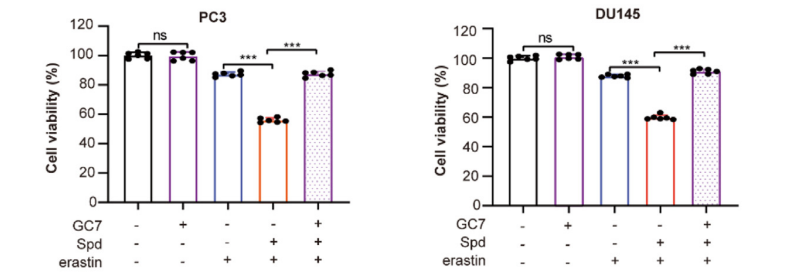
Cell Proliferation/Viability Assay
-
WB
-
In Vivo Efficacy Study
-
Cell Proliferation/Viability Assay
-
WB
All DNA/RNA Synthesis Isoforms
More

Biological Activity
Description
IC50 & Target
DHPS[1]
Cellular Effect
|
Cell Line

|
Type | Value | Description | References |
|---|---|---|---|---|
| A-375 | IC50 |
1.48 μM
Compound: GC7
|
Cytotoxicity against human A-375 cells assessed as reduction in cell viability incubated for 24 hrs by CCK-8 assay
Cytotoxicity against human A-375 cells assessed as reduction in cell viability incubated for 24 hrs by CCK-8 assay
|
[PMID: 34473510] |
| B16 | IC50 |
5.25 μM
Compound: GC7
|
Cytotoxicity against mouse B16 cells assessed as reduction in cell viability incubated for 24 hrs by CCK-8 assay
Cytotoxicity against mouse B16 cells assessed as reduction in cell viability incubated for 24 hrs by CCK-8 assay
|
[PMID: 34473510] |
| HaCaT | CC50 |
3.96 μM
Compound: GC7
|
Cytotoxicity against human HaCaT cells assessed as reduction in cell viability incubated for 24 hrs by CCK-8 assay
Cytotoxicity against human HaCaT cells assessed as reduction in cell viability incubated for 24 hrs by CCK-8 assay
|
[PMID: 34473510] |
| SK-MEL-28 | IC50 |
0.79 μM
Compound: GC7
|
Cytotoxicity against human SK-MEL-28 cells assessed as reduction in cell viability incubated for 24 hrs by CCK-8 assay
Cytotoxicity against human SK-MEL-28 cells assessed as reduction in cell viability incubated for 24 hrs by CCK-8 assay
|
[PMID: 34473510] |
In Vitro
The treatment of MYCN2 (±Dox) and BE(2)-C cells with GC7 for 72 h at various concentrations (0.1 to 100 μM) significantly reduces the number of viable cells in a dose-dependent manner. In MYCN2 cells, 5 μM of GC7 inhibits cell viability by ~40 and ~60 %, respectively, compare to untreated control cells. BE(2)-C cells require 25 μM of GC7 to reduce cell viability by ~50 %. Exposure to 10 and 100 μM GC7 for 72 h clearly decreases the levels of total retinoblastoma (Rb) and phosphorylated Rb as well as of Cdk4 protein, and increases the levels of p21 protein[1]. Between 0 and 20 μM, GC7 induces little cytotoxicity in HCC cells, while higher concentrations of GC7 (50 to 100 μM) significantly inhibit the viability of all five HCC cell lines tested. Newly synthesized 3H-labeled hypusine of eIF5A1/eIF5A2 is rarely detected after 20 μM GC7 treatment, compare to untreated control. The activity of [3H]-spermidine incorporated into HCC cells is significantly decreased by 20 μM GC7 or higher concentration[2].
MedChemExpress (MCE) has not independently confirmed the accuracy of these methods. They are for reference only.
Clinical Trial
| NCT Number | Sponsor | Condition | Start Date |
Phase
|
|---|---|---|---|---|
| NCT01329991 | Plexxikon| | 2011-05 | PHASE1 |


Chemical Information
-
CAS No. 150333-69-0
-
Molecular Weight 172.27
-
Formula C8H20N4
-
SMILES
NC(NCCCCCCCN)=N
-
Shipping
Room temperature in continental US; may vary elsewhere.
-
Storage
Please store the product under the recommended conditions in the Certificate of Analysis.


Publications (9)
-
Journal Impact Factor
-
Most Recent
-
Nature
2026 Jul;655(8122):516-524. PMID: 42129552 -
Immunity
Polyamine metabolism controls B-to-Z DNA transition to orchestrate DNA sensor cGAS activity. [Abstract]2023 Nov 14;56(11):2508-2522.e6. PMID: 37848037 -
Nat Commun
Polyamine-mediated ferroptosis amplification acts as a targetable vulnerability in cancer. [Abstract]2024 Mar 19;15(1):2461. PMID: 38504107
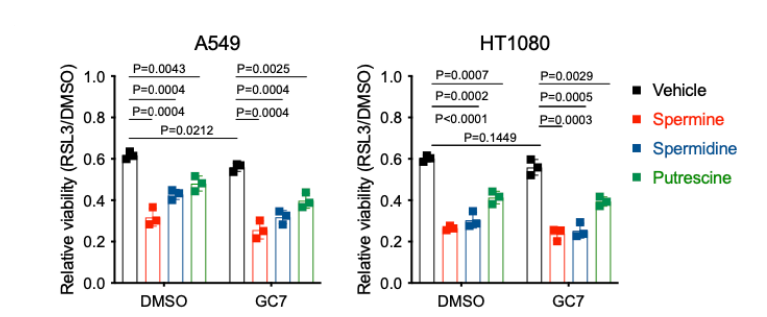
GC-7 purchased from MedChemExpress. Usage Cited in: Nat Commun. 2024 Mar 19;15(1):2461. [Abstract]
Cell viability in A549 or HT1080 cells treated with RSL3 following pre-treatment with 1 μM GC7 for 16 h and polyamines.
-
Acta Pharm Sin B
2025 Apr;15(4):2095-2113. PMID: 40486852
GC-7 purchased from MedChemExpress. Usage Cited in: Acta Pharm Sin B. 2025 Apr;15(4):2095-2113. [Abstract]
PC3 and DU145 cells were pretreated with GC7 (2 μmol/L) for 6 hours, then cultured for another 24 hours with the specified reagent, and cell viability was then assessed.
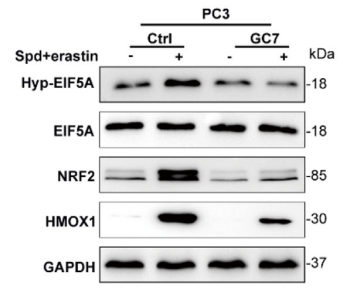
GC-7 purchased from MedChemExpress. Usage Cited in: Acta Pharm Sin B. 2025 Apr;15(4):2095-2113. [Abstract]
Western blot analysis of Hyp-EIF5A, EIF5A, NRF2, and HMOX1 in PC3 cells. Endogenous polyamines in PC3 cells were depleted by incubation with 1 mmol/L DFMO for 2 days. Polyamine-depleted cells were pretreated with GC7 (2 μmol/L) for 6 hours, followed by treatment with Spd and erastin for 8 hours.
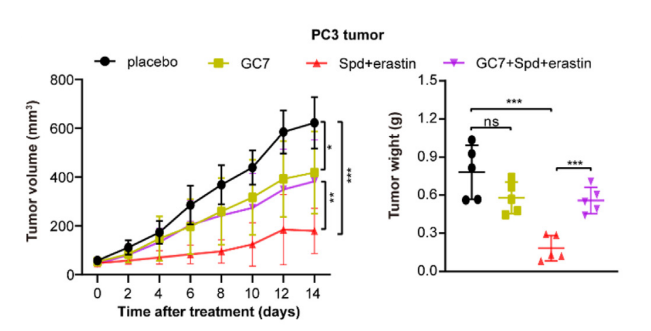
GC-7 purchased from MedChemExpress. Usage Cited in: Acta Pharm Sin B. 2025 Apr;15(4):2095-2113. [Abstract]
GC 7 (2 mg/kg, intraperitoneal injection). The volume of the PC3 xenograft tumor was monitored every other day, and the tumor weight was divided into 4 groups.
-
-
-
-
-
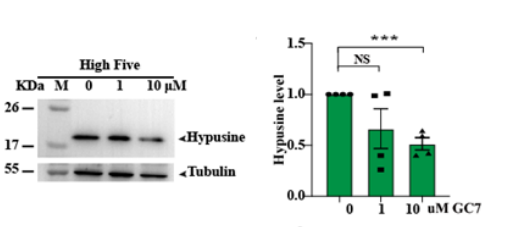
GC-7 purchased from MedChemExpress. Usage Cited in: Research Square Preprint. 2021 Nov.
Experimental results show that GC7 inhibits hypoxanthine modification of eIF5A in a concentration-dependent manner.


Purity & Documentation
References
[1]. Bandino A, et al. Deoxyhypusine synthase (DHPS) inhibitor GC7 induces p21/Rb-mediated inhibition of tumor cell growth and DHPS expression correlates with poor prognosis in neuroblastoma patients. Cell Oncol (Dordr). 2014 Dec;37(6):387-98. [Content Brief]
[2]. Lou B, et al. N1-guanyl-1,7-diaminoheptane (GC7) enhances the therapeutic efficacy of doxorubicin by inhibiting activation of eukaryotic translation initiation factor 5A2 (eIF5A2) and preventing the epithelial-mesenchymal transition in hepatocellular carcinoma cells. Exp Cell Res. 2013 Oct 15;319(17):2708-17. [Content Brief]

Calculators
Concentration (start) × Volume (start) = Concentration (final) × Volume (final)


GC-7 Related Classifications
HY-108314 Related Classifications
 Powered by Bioz