



GS-441524 hydrochloride
Based on 27 publication(s) in Google Scholar
GS-441524 hydrochloride is a potent, orally active and CNS-penetrant viral RNA-dependent RNA polymerase inhibitor. GS-441524 hydrochloride competes with natural nucleosides to block viral RNA transcription as an alternative substrate and RNA chain terminator. GS-441524 hydrochloride inhibits the replication of feline infectious peritonitis virus, African swine fever virus, and severe acute respiratory syndrome coronavirus 2. GS-441524 hydrochloride reduces viral RNA levels in cats. GS-441524 hydrochloride can be used in research related to feline infectious peritonitis, African swine fever, and coronavirus disease 2019 (COVID-19).
For research use only. We do not sell to patients.
- Purity : 99.62%
- CAS No.: 2378280-82-9
- Formula: C12H14ClN5O4
- Molecular Weight:327.72
-
Storage:Powder -20°C, 3 years , 4°C, 2 years ; In solvent -80°C, 6 months , -20°C, 1 month


To place orders, for customer services and technical support, please contact: MedChemExpress USA
Tel: 609-228-6898 E-mail: [email protected] [email protected]


-
 Biological Activity
-
Chemical Information
-
Solvent & Solubility
- Protocols
- Purity & Documentation
- References
-
 Help & FAQs


Publications Citing Use of MedChemExpress (MCE) GS-441524 hydrochloride
More- Nature. 2025 Apr;640(8058):514-523. [Abstract]
- Nat Commun. 2021 Nov 5;12(1):6415. [Abstract]
- Nucleic Acids Res. 2021 Jan 8;49(D1):D1113-D1121. [Abstract]
- Nano Lett. 2023 Oct 25;23(20):9437-9444. [Abstract]
- J Med Chem. 2024 May 9;67(9):7470-7486. [Abstract]
- Int J Mol Sci. 2024 Sep 14;25(18):9930. [Abstract]
- ACS Omega. 2022 Jun 13;7(25):21385-21396. [Abstract]
- ACS Omega. 2022 Jan 11;7(3):2960-2969. [Abstract]
- iScience. 2023 Oct 4;26(11):108147. [Abstract]
- Clin Transl Sci. 2022 Mar;15(3):732-740. [Abstract]
- FEBS J. 2025 Jun;292(11):2865-2881. [Abstract]
- Vet Q. 2024 Dec;44(1):1-13. [Abstract]
- Vet Res. 2024 Sep 27;55(1):124. [Abstract]
- J Med Virol. 2021 Jul;93(7):4454-4460. [Abstract]
- ACS Chem Biol. 2023 May 19;18(5):1200-1207. [Abstract]
- Vet Sci. 2023 Aug 9;10(8):513. [Abstract]
- Virology. 2025 Mar:604:110422. [Abstract]
- J Feline Med Surg. 2022 Oct;24(10):943-953. [Abstract]
- J Am Vet Med Assoc. 2024 Feb 7;262(4):489-497. [Abstract]
- Biomed Res. 2025;46(2):37-50. [Abstract]
- bioRxiv. 2026 Jun 10.
- SSRN. 2023 Sep 11.
- Utah State University. 2023 Feb 1.
- Biomed Pharmacother. 2023 Jan:157:114037. [Abstract]
- bioRxiv. 2021 Aug 10:2021.08.06.455494. [Abstract]
- Research Square Preprint. 2021 Aug.
- bioRxiv. 2020 Jul.
 Customer Validation & Images

-
Cell Proliferation/Viability Assay
-
Microbiological Assay
-
Cell Proliferation/Viability Assay
-
PK/PD Analysis

-
PK/PD Analysis
All DNA/RNA Synthesis Isoforms
More

Biological Activity
Description
IC50 & Target
[1]|
RNA Polymerase |
In Vitro
GS-441524 (1.2-100 μM; 24-72 h) hydrochloride shows no cytotoxicity to Crandell-Rees feline kidney (CRFK) cells, with a CC50 >100 μM[1].
GS-441524 (0-3 μM; 72 h) hydrochloride dose-dependently inhibits FIPV-79-1146-induced CPE in CRFK cells, with an EC50 of 0.78 μM[1].
GS-441524 (0.1-50 μM; 20 h) hydrochloride inhibits FIPV-79-1146 RNA replication in CRFK cells[1].
GS-441524 (10 μM; 20-72 h) hydrochloride potently inhibits wild-type FIPV RNA replication in naturally infected feline peritoneal macrophages[1].
GS-441524 (1 μM; 6-72 h) hydrochloride is internalized by CRFK cells, phosphorylated to its active triphosphate form[1].
GS-441524 (20-800 μM; 72 h) hydrochloride exhibits cytotoxicity toward porcine alveolar macrophages with a CC50 of 287.51 μM, with minimal cytotoxicity at concentrations ≤200 μM[2].
GS-441524 (20-200 μM; 48 h) hydrochloride inhibits African swine fever virus replication in porcine alveolar macrophages in vitro in a dose-dependent manner, with an EC50 of 73.2 μM, reducing viral titer, mRNA levels, and protein expression[2].
GS-441524 (100 μM; 0-16 h post-infection) hydrochloride inhibits African swine fever virus replication in porcine alveolar macrophages[2].
GS-441524 (100 μM; 48 h) hydrochloride shows an inhibitory effect on African swine fever virus replication in porcine alveolar macrophages, which is dose-dependently attenuated by ATP, while does not alter the levels of IFN-α, IFN-β, TNF-α, or IL-6[2].
GS-441524 hydrochloride potently inhibits SARS-CoV-2 in multiple cell lines, with a median IC50 of 0.87 μM and median IC90 of 1.42 μM[3].
MedChemExpress (MCE) has not independently confirmed the accuracy of these methods. They are for reference only. Further protocols information, click here.
-
Cell Line:Crandell-Rees feline kidney (CRFK) cells
-
Concentration:1.2, 3.7, 11.1, 33.3, 100 μM (24 h); 10 μM (72 h)
-
Incubation Time:24; 72 h
-
Result:Showed no uptake of CellTox Green dye at all tested concentrations.
Caused no cytopathic effect observed visually or via crystal violet staining quantitation at all tested concentrations.
Exhibited the cytotoxic concentration-50% (CC50) to be >100 μM.
-
Cell Line:FIPV-79-1146-infected CRFK cells
-
Concentration:0, 0.1, 1.0, 10, 50 μM
-
Incubation Time:20 h
-
Result:Achieved complete inhibition of viral RNA expression at 50 and 10 μM.
Achieved partial inhibition of viral RNA expression at 1.0 μM.
Caused no inhibition of viral RNA expression at 0.1 μM.
-
Cell Line:Naturally FIPV-infected feline peritoneal macrophages
-
Concentration:10 μM
-
Incubation Time:20; 72 h
-
Result:Reduced cell-associated FIPV RNA transcripts by approximately 1000-fold relative to untreated cells at 10 μM for 20 h.
Caused a significant reduction in cell-associated FIPV RNA relative to untreated cells at 10 μM for 72 h.
-
Cell Line:porcine alveolar macrophages (PAMs)
-
Concentration:20, 50, 100, 200, 400, 800 μM
-
Incubation Time:72 h
-
Result:Reduced PAM survival rate to 30% at 400 μM.
Maintained cell survival rate over 85% at concentrations ≤200 μM with no obvious morphological difference from untreated cells.
Exhibited a CC50 of 287.51 μM.
-
Cell Line:porcine alveolar macrophages (PAMs) infected with African swine fever virus (ASFV) strain GZ201801
-
Concentration:100 μM
-
Incubation Time:0, 1, 3, 6, 9, 12, 16 h post-infection
-
Result:Significantly inhibited transcription of the early ASFV gene CP204L starting at 1 h post-infection, with increasingly significant effects over time.
Inhibited transcription of the late ASFV gene B646L first observed at 6 h post-infection.
-
Cell Line:porcine alveolar macrophages (PAMs) with or without African swine fever virus (ASFV) strain GZ201801 infection
-
Concentration:100 μM
-
Incubation Time:48 h
-
Result:Showed no significant differences in IFN-α, IFN-β, TNF-α, or IL-6 levels.
Showed significant differences in ATP concentrations in different treatment groups.
Parmacokinetics


Chemical Information
-
CAS No. 2378280-82-9
-
Appearance Solid
-
Molecular Weight 327.72
-
Formula C12H14ClN5O4
-
Color White to off-white
-
SMILES
N#C[C@@]1(C2=CC=C3N2N=CN=C3N)O[C@H](CO)[C@@H](O)[C@H]1O.[H]Cl
-
Shipping
Room temperature in continental US; may vary elsewhere.
-
Storage
Powder -20°C 3 years 4°C 2 years In solvent -80°C 6 months -20°C 1 month


Publications (27)
-
Journal Impact Factor
-
Most Recent
-
Nature
2025 Apr;640(8058):514-523. PMID: 40140569 -
Nat Commun
Oral prodrug of remdesivir parent GS-441524 is efficacious against SARS-CoV-2 in ferrets. [Abstract]2021 Nov 5;12(1):6415. PMID: 34741049
GS-441524 hydrochloride purchased from MedChemExpress. Usage Cited in: Nat Commun. 2021 Nov 5;12(1):6415. [Abstract]
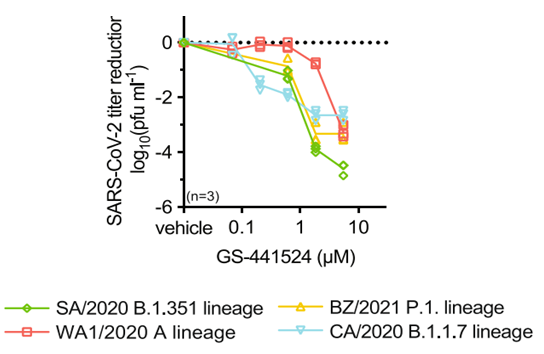
Virus yield reduction of SARS-CoV-2 clinical isolates WA1/2020 (red squares), CA/2020 (blue triangles), SA/2020 (green diamonds), and BZ/2021 (yellow triangles) representing the A, B.1.1.7 (α), B.1.351 (β) and P.1 (γ) lineages, respectively, by GS-441524 (0.1-10 μM; 48 h) on VeroE6 cells.
GS-441524 hydrochloride purchased from MedChemExpress. Usage Cited in: Nat Commun. 2021 Nov 5;12(1):6415. [Abstract]
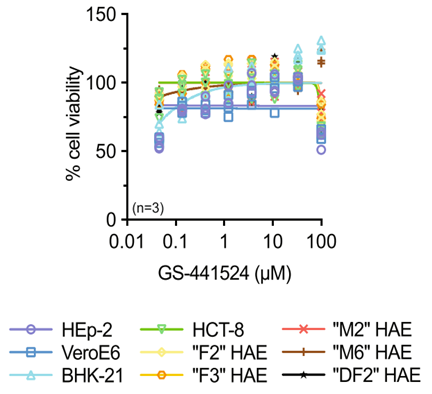
In vitro cytotoxicity profiles of GS-441524 (0.01-100 μM; 72 h) on VeroE6 (blue squares), HEp-2 (purple circles), BHK-21 (light blue triangles), HCT-8 (green triangles) and a panel of primary HAE cells from independent donors (“F2” (yellow diamonds), “F3” (orange circles), “M2” (red “×” symbols), “M6” (brown “+” symbols), “DF2” (black stars)).
GS-441524 hydrochloride purchased from MedChemExpress. Usage Cited in: Nat Commun. 2021 Nov 5;12(1):6415. [Abstract]
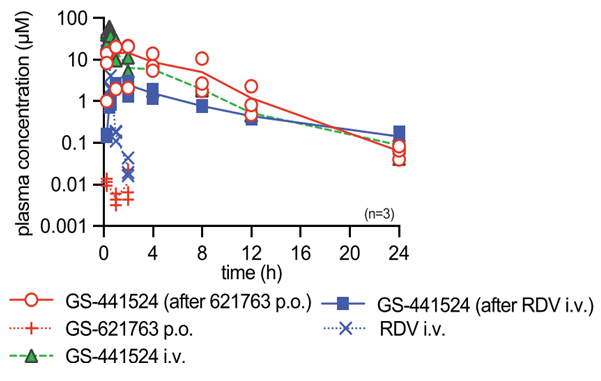
Single dose pharmacokinetic parameters of GS-441524 (20 mg/kg)following administration of either intravenous GS-441524 or remdesivir or oral GS-621763 in ferretsaapproximately 10 nM GS-621763 transiently observed in first two hours
GS-441524 hydrochloride purchased from MedChemExpress. Usage Cited in: Nat Commun. 2021 Nov 5;12(1):6415. [Abstract]
Single-dose PK study in ferrets showing plasma concentrations of GS-441524, GS-621763, and remdesivir (RDV) as specified after dosing with GS-621763 (30 mg/kg; p.o.; red “+” symbols), remdesivir (10 mg/kg; i.v.; blue “×” symbols), and GS-441524 (20 mg/kg; i.v.; green triangles). Symbols represent individual biological repeats (n = 3), lines depict sample means.
-
Nucleic Acids Res
COVID19 Drug Repository: text-mining the literature in search of putative COVID19 therapeutics. [Abstract]2021 Jan 8;49(D1):D1113-D1121. PMID: 33166390 -
Nano Lett
2023 Oct 25;23(20):9437-9444. PMID: 37818841 -
J Med Chem
Differential Bioactivation Profiles of Different GS-441524 Prodrugs in Cell and Mouse Models: ProTide Prodrugs with High Cell Permeability and Susceptibility to Cathepsin A Are More Efficient in Delivering Antiviral Active Metabolites to the Lung. [Abstract]2024 May 9;67(9):7470-7486. PMID: 38690769 -
Int J Mol Sci
Baicalin Inhibits FIPV Infection In Vitro by Modulating the PI3K-AKT Pathway and Apoptosis Pathway. [Abstract]2024 Sep 14;25(18):9930. PMID: 39337417 -
ACS Omega
Efficacious Preclinical Repurposing of the Nucleoside Analogue Didanosine against COVID-19 Polymerase and Exonuclease. [Abstract]2022 Jun 13;7(25):21385-21396. PMID: 35785294 -
ACS Omega
Potent Inhibitory Activities of the Adenosine Analogue Cordycepin on SARS-CoV-2 Replication. [Abstract]2022 Jan 11;7(3):2960-2969. PMID: 35071937 -
iScience
2023 Oct 4;26(11):108147. PMID: 37876803 -
Clin Transl Sci
Exploration for the effect of renal function and renal replacement therapy on pharmacokinetics of remdesivir and GS-441524 in patients with COVID-19: A limited case series. [Abstract]2022 Mar;15(3):732-740. PMID: 34761554 -
FEBS J
Derivatives of MOPS: promising scaffolds for SARS coronaviruses Macro domain-targeted inhibition. [Abstract]2025 Jun;292(11):2865-2881. PMID: 40070175 -
Vet Q
2024 Dec;44(1):1-13. PMID: 38712855 -
Vet Res
Development and characterization of reverse genetics systems of feline infectious peritonitis virus for antiviral research. [Abstract]2024 Sep 27;55(1):124. PMID: 39334482 -
J Med Virol
2021 Jul;93(7):4454-4460. PMID: 33666253 -
ACS Chem Biol
A Fluorescence Polarization Assay for Macrodomains Facilitates the Identification of Potent Inhibitors of the SARS-CoV-2 Macrodomain. [Abstract]2023 May 19;18(5):1200-1207. PMID: 37126856 -
Vet Sci
Comparative Evaluation of GS-441524, Teriflunomide, Ruxolitinib, Molnupiravir, Ritonavir, and Nirmatrelvir for In Vitro Antiviral Activity against Feline Infectious Peritonitis Virus. [Abstract]2023 Aug 9;10(8):513. PMID: 37624300
GS-441524 hydrochloride purchased from MedChemExpress. Usage Cited in: Vet Sci. 2023 Aug 9;10(8):513. [Abstract]
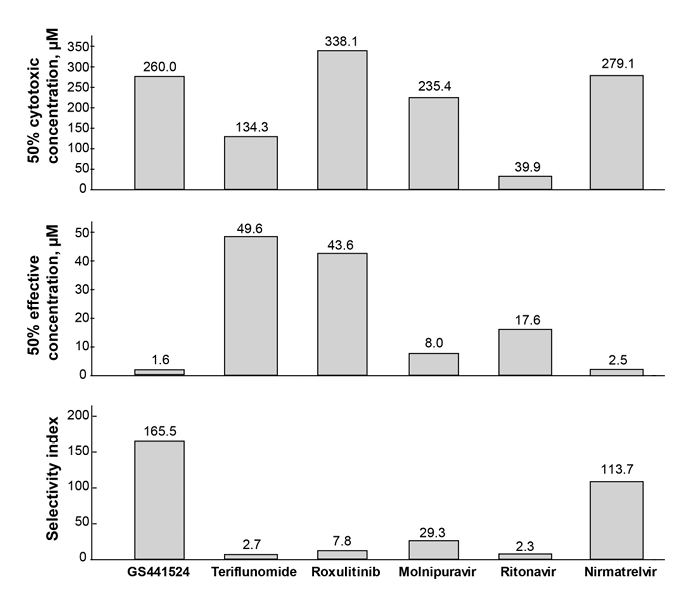
The CC50, EC50, and SI for six compounds against FIPV. The half-maximal cytotoxic concentration (CC50) values are from four measurements of diluted drugs using MTT assay, in CRFK cells treated with drugs for 48 h. The half-maximal effective concentration (EC50) values are from six measurements of diluted drugs against FIPV replication in CRFK cells for 48 h. Based on the SI value (mean CC50)/(mean EC50), GS-441524 was found highly selective (SI 165.5) against FIPV among the drugs tested and showed high efficacy (EC50 1.6 µM) against FIPV with a less deleterious effect (CC50 260.0 µM) on the cells. Nirmatrelvir also showed promising efficacy (EC50 2.5 µM) and selectivity (SI 113.7) against FIPV. Ritonavir showed the highest toxicity level in the cells (CC50 39.9).
-
Virology
Cepharanthine: A promising natural compound against feline infectious peritonitis virus infection and associated inflammation. [Abstract]2025 Mar:604:110422. PMID: 39884162 -
J Feline Med Surg
Investigation of monotherapy and combined anticoronaviral therapies against feline coronavirus serotype II in vitro. [Abstract]2022 Oct;24(10):943-953. PMID: 34676775 -
J Am Vet Med Assoc
Unlicensed antiviral products used for the at-home treatment of feline infectious peritonitis contain GS-441524 at significantly different amounts than advertised. [Abstract]2024 Feb 7;262(4):489-497. PMID: 38324994 -
Biomed Res
Possible involvement of neuropeptide Y sub-receptor 1 (NPY-Y1) in the anti-viral response of SARS-CoV-2 infection in Syrian hamster. [Abstract]2025;46(2):37-50. PMID: 40189329 -
-
-
-
Biomed Pharmacother
Remdesivir inhibits the progression of glioblastoma by enhancing endoplasmic reticulum stress. [Abstract]2023 Jan:157:114037. PMID: 36427388 -
bioRxiv
Broad-spectrum in vitro antiviral activity of ODBG-P-RVn: an orally-available, lipid-modified monophosphate prodrug of remdesivir parent nucleoside (GS-441524). [Abstract]2021 Aug 10:2021.08.06.455494. PMID: 34401879 -
-


Solvent & Solubility
In Vitro:
DMSO : 100 mg/mL (305.14 mM; Need ultrasonic; Hygroscopic DMSO has a significant impact on the solubility of product, please use newly opened DMSO)
Please refer to the solubility information to select the appropriate solvent. Once prepared, please aliquot and store the solution to prevent product inactivation from repeated freeze-thaw cycles.
Storage method and period of stock solution: -80°C, 6 months; -20°C, 1 month. When stored at -80°C, please use it within 6 months. When stored at -20°C, please use it within 1 month.
Please refer to the solubility information to select the appropriate solvent. Once prepared, please aliquot and store the solution to prevent product inactivation from repeated freeze-thaw cycles.
Storage method and period of stock solution: -80°C, 6 months; -20°C, 1 month. When stored at -80°C, please use it within 6 months. When stored at -20°C, please use it within 1 month.
Concentration (start) × Volume (start) = Concentration (final) × Volume (final)
In Vivo:
Select the appropriate dissolution method based on your experimental animal and administration route.
- For the following dissolution methods, please ensure to first prepare a clear stock solution using an In Vitro approach and then sequentially add co-solvents:
- To ensure reliable experimental results, the clarified stock solution can be appropriately stored based on storage conditions. As for the working solution for In Vivo experiments, it is recommended to prepare freshly and use it on the same day.
- The percentages shown for the solvents indicate their volumetric ratio in the final prepared solution. If precipitation or phase separation occurs during preparation, heat and/or sonication can be used to aid dissolution.
Add each solvent one by one: 10% DMSO 40% PEG300 5% Tween-80 45% Saline
Solubility: ≥ 5 mg/mL (15.26 mM); Clear solution
This protocol yields a clear solution of ≥ 5 mg/mL (saturation unknown).
Taking 1 mL working solution as an example, add 100 μL DMSO stock solution (50.0 mg/mL) to 400 μL PEG300, and mix evenly; then add 50 μL Tween-80 and mix evenly; then add 450 μL Saline to adjust the volume to 1 mL.
Preparation of Saline: Dissolve 0.9 g sodium chloride in ddH₂O and dilute to 100 mL to obtain a clear Saline solution.
Add each solvent one by one: 10% DMSO 90% (20% SBE-β-CD in Saline)
Solubility: ≥ 5 mg/mL (15.26 mM); Clear solution
This protocol yields a clear solution of ≥ 5 mg/mL (saturation unknown).
Taking 1 mL working solution as an example, add 100 μL DMSO stock solution (50.0 mg/mL) to 900 μL 20% SBE-β-CD in Saline, and mix evenly.
Preparation of 20% SBE-β-CD in Saline (4°C, storage for one week): 2 g SBE-β-CD powder is dissolved in 10 mL Saline, completely dissolve until clear.
In Vivo Dissolution Calculator
Please enter the basic information of animal experiments:
-
-
-
-
Recommended: Prepare an additional quantity of animals to account for potential losses during experiments.
Please enter your animal formula composition:
-
%DMSO +
Recommended: Keep the proportion of DMSO in working solution below 2% if your animal is weak.
-
%+
-
+%Tween-80 + +
-
%Saline +
The co-solvents required include: DMSO, . All of co-solvents are available by MedChemExpress (MCE). , Tween 80. All of co-solvents are available by MedChemExpress (MCE).
Working solution concentration: 0.22 mg/mL
Method for preparing stock solution: mg drug dissolved in μL DMSO. Stock solution concentration: mg/mL.
1. Take μL DMSO stock solution;
2. Add μL .
μL , mix evenly;
3. Then add μL Tween 80, mix evenly;
4. Then add μL
Please ensure that the stock solution in the first step is dissolved to a clear state, and add co-solvents in sequence. You can use ultrasonic heating (ultrasonic cleaner, recommended frequency 20-40 kHz), vortexing, etc. to assist dissolution.

Protocols
-
Zymosan-Induced Peritonitis
Zymosan-induced peritonitis is a sterile acute-inflammation model produced by intraperitoneal injection of zymosan, a yeast cell-wall particle preparation, followed by quantification of leukocyte recruitment and soluble inflammatory mediators in peritoneal lavage fluid. Low-dose zymosan peritonitis is commonly used as a self-resolving acute inflammation model in which neutrophil recruitment occurs early and monocyte/macrophage accumulation follows later. The assay readouts include total peritoneal leukocyte number, differential neutrophil and monocyte/macrophage counts, peritoneal cytokines and chemokines, plasma or peritoneal exudation, and optional lipidomic or metabolomic changes during inflammation and resolution. Early neutrophil recruitment after zymosan depends strongly on complement and mast-cell C5a receptor signaling, whereas later monocyte recruitment is linked to MCP-1/CCL2 production.


Purity & Documentation
-
Data Sheet (287 KB)
-
SDS (252 KB)
- English - EN (252 KB)
- Français - FR (252 KB)
- Deutsch - DE (252 KB)
- Norwegian - NO (252 KB)
- Español - ES (252 KB)
- Swedish - SV (252 KB)
- Italian - IT (252 KB)
- Korean - KR (252 KB)
- Portuguese - PT (252 KB)
-
Handling Instructions (2659 KB)
References
[1]. Murphy BG, et al. The nucleoside analog GS-441524 strongly inhibits feline infectious peritonitis (FIP) virus in tissue culture and experimental cat infection studies. Vet Microbiol. 2018;219:226-233. [Content Brief]
[2]. Huang Z, et al. GS-441524 inhibits African swine fever virus infection in vitro. Antiviral Res. 2021;191:105081. [Content Brief]
[3]. Rasmussen HB, et al. Nucleoside analog GS-441524: pharmacokinetics in different species, safety, and potential effectiveness against Covid-19. Pharmacol Res Perspect. 2022;10(2):e00945. [Content Brief]
[4]. Pedersen NC, et al. Efficacy and safety of the nucleoside analog GS-441524 for treatment of cats with naturally occurring feline infectious peritonitis. J Feline Med Surg. 2019;21(4):271-281. [Content Brief]
[5]. Coggins SJ, et al. Outcomes of treatment of cats with feline infectious peritonitis using parenterally administered remdesivir, with or without transition to orally administered GS-441524. J Vet Intern Med. 2023;37(5):1772-1783. [Content Brief]


Complete Stock Solution Preparation Table
Please refer to the solubility information to select the appropriate solvent. Once prepared, please aliquot and store the solution to prevent product inactivation from repeated freeze-thaw cycles.
Storage method and period of stock solution: -80°C, 6 months; -20°C, 1 month. When stored at -80°C, please use it within 6 months. When stored at -20°C, please use it within 1 month.
| Optional Solvent | Concentration Solvent Mass | 1 mg | 5 mg | 10 mg | 25 mg |
|---|---|---|---|---|---|
| DMSO | 1 mM | 3.0514 mL | 15.2569 mL | 30.5139 mL | 76.2846 mL |
| 5 mM | 0.6103 mL | 3.0514 mL | 6.1028 mL | 15.2569 mL | |
| 10 mM | 0.3051 mL | 1.5257 mL | 3.0514 mL | 7.6285 mL | |
| 15 mM | 0.2034 mL | 1.0171 mL | 2.0343 mL | 5.0856 mL | |
| 20 mM | 0.1526 mL | 0.7628 mL | 1.5257 mL | 3.8142 mL | |
| 25 mM | 0.1221 mL | 0.6103 mL | 1.2206 mL | 3.0514 mL | |
| 30 mM | 0.1017 mL | 0.5086 mL | 1.0171 mL | 2.5428 mL | |
| 40 mM | 0.0763 mL | 0.3814 mL | 0.7628 mL | 1.9071 mL | |
| 50 mM | 0.0610 mL | 0.3051 mL | 0.6103 mL | 1.5257 mL | |
| 60 mM | 0.0509 mL | 0.2543 mL | 0.5086 mL | 1.2714 mL | |
| 80 mM | 0.0381 mL | 0.1907 mL | 0.3814 mL | 0.9536 mL | |
| 100 mM | 0.0305 mL | 0.1526 mL | 0.3051 mL | 0.7628 mL |


GS-441524 hydrochloride Related Classifications
HY-103586A Related Classifications
 Powered by Bioz
Keywords
- GS-441524
- 2378280-82-9
- GS441524
- GS 441524
- DNA/RNA Synthesis
- SARS-CoV
- feline infectious peritonitis
- CRFK cells
- porcine alveolar macrophages
- COVID-19
- feline peritoneal macrophages
- cats
- feline infectious peritonitis virus
- severe acute respiratory syndrome coronavirus 2
- African swine fever virus
- viral RNA-dependent RNA polymerase
- Inhibitor
- inhibitor
- inhibit