



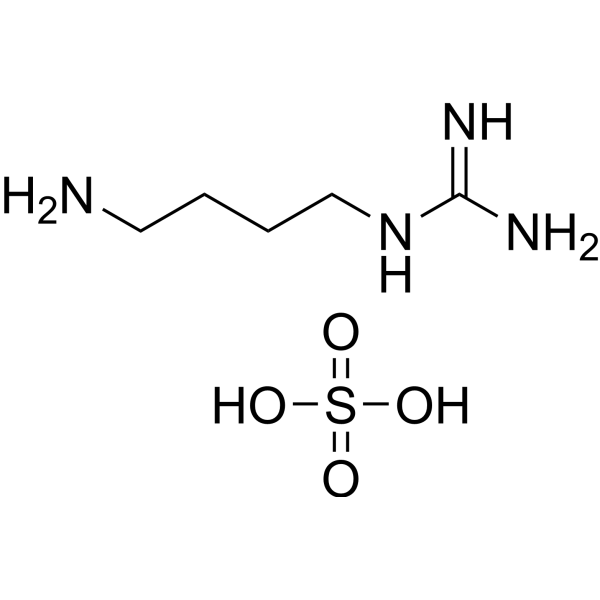
Agmatine sulfate
Based on 1 publication(s) in Google Scholar
Agmatine sulfate exerts modulatory action at multiple molecular targets, such as neurotransmitter systems, ion channels and nitric oxide synthesis. It is an endogenous agonist at imidazoline receptor and a NO synthase inhibitor.
연구목적의 판매만을 진행합니다. 환자를 대상으로 한 판매는 하지 않습니다.
- Purity: 98.0%
- CAS No.: 2482-00-0
- 화학식: C5H16N4O4S
- 분자량:228.27
-
보관:
4°C, sealed storage, away from moisture
* In solvent : -80°C, 6 months; -20°C, 1 month (sealed storage, away from moisture)

To place orders, for customer services and technical support, please contact: MedChemExpress USA
Tel: 609-228-6898 E-mail: [email protected] [email protected]


-
 Biological Activity
-
Chemical Information
-
용액&용해도
- Protocol
- 순도&문서
- References
-
 Help & FAQs
-

Natural Product Diversity Scaffold Library
HY-L245
-
Mass Spectrometry Natural Product Library
HY-L262
-
Immunology/Inflammation Compound Library
HY-L007
-
Metabolism/Protease Compound Library
HY-L012
-
Neuronal Signaling Compound Library
HY-L013
-
Natural Product Library
HY-L021
-
Anti-Cancer Compound Library
HY-L025
-
Human Endogenous Metabolite Compound Library
HY-L030
-
Anti-Aging Compound Library
HY-L034
-
Neuroprotective Compound Library
HY-L070
-
Angiogenesis-Related Compound Library
HY-L088
-
Targeted Diversity Library
HY-L099
-
Anti-Cancer Natural Product Library
HY-L107
-
Human Metabolite Library
HY-L123
-
Mitochondrial Protection Compound Library
HY-L144
-
Metabolic Enzyme Compound Library
HY-L146
-
Membrane Protein-targeted Compound Library
HY-L149
-
Membrane Receptor-targeted Compound Library
HY-L150
-
Mitochondrial Toxicity Compound Library
HY-L155
-
Animal-Sourced Natural Product Library
HY-L157
-
Multi-Target Compound Library
HY-L176
-
Bioactive Compound Library Max
HY-L181
-
MCE Bioactive Compound Library
HY-L001V
-
Natural Product Library Plus
HY-L021P
-
Natural Product and Natural Product-Like Compound Library
HY-L021M
-
Bioactive Compound Library
HY-L001
-
High-Throughput Bioactive Compound Library
HY-L205
-
High-Throughput Natural Product Library
HY-L206
-
Mass Spectrometry Human Endogenous Metabolite Library
HY-L207
-
Mass Spectrometry Human Metabolite Library
HY-L215


Publications Citing Use of MedChemExpress (MCE) Agmatine sulfate
MoreAll Endogenous Metabolite Isoforms
More

Biological Activity
|
Human Endogenous Metabolite |
Agmatine binds to alpha 2-adrenergic and imidazoline receptors and stimulates release of catecholamines from adrenal chromaffin cells. Its biosynthetic enzyme, arginine decarboxylase, is present in brain. Agmatine, locally synthesized, is an endogenous agonist at imidazoline receptors, a noncatecholamine ligand at alpha 2-adrenergic receptors and may act as a neurotransmitter[1]. Agmatine is synthesized in the brain, stored in synaptic vesicles in regionally selective neurons, accumulated by uptake, released by depolarization, and inactivated by agmatinase. Agmatine inhibits nitric oxide synthase, and induces the release of some peptide hormones[2]. Agmatine, 4-(aminobutyl)guanidine, is produced by decarboxylation of L-arginine by the enzyme arginine decarboxylase. Agmatine is a competitive inhibitor of all NOS isoenzymes but not an NO precursor. Ki values are approximately 660 μM (NOS I), 220 μM (NOS II) and 7.5 mM (NOS III)[3]. Agmatine stimulates nitrite production three-fold above basal nitrite formation by endothelial cells. Agmatine displaces [3H]-idazoxan from endothelial cellmembranes and is found to induce transients in the cytosolic calcium of endothelial cells. The transients could be downregulated by repeated exposure to agmatine but are not affected by pretreatment with norepinephrine[4].
MedChemExpress (MCE) has not independently confirmed the accuracy of these methods. They are for reference only.
MedChemExpress (MCE) has not independently confirmed the accuracy of these methods. They are for reference only.


Chemical Information
-
CAS No. 2482-00-0
-
Appearance Solid
-
분자량 228.27
-
화학식 C5H16N4O4S
-
Color White to off-white
-
SMILES
NC(NCCCCN)=N.O=S(O)(O)=O
-
Structure Classification
-
Initial Source
-
선적
Room temperature in continental US; may vary elsewhere.
-
보관
4°C, sealed storage, away from moisture
* In solvent : -80°C, 6 months; -20°C, 1 month (sealed storage, away from moisture)


Publications (1)
-
Journal Impact Factor
-
Most Recent
-
Psychopharmacology (Berl)
Agmatine ameliorates morphine-induced behavioral sensitization through blood-brain barrier protection and anti-neuroinflammatory effects in the nucleus accumbens. [Abstract]2025 Oct 24. PMID: 41134339


용액&용해도
H2O : ≥ 100 mg/mL (438.08 mM)
DMSO : < 1 mg/mL (insoluble or slightly soluble)
* "≥" means soluble, but saturation unknown.
Please refer to the solubility information to select the appropriate solvent. Once prepared, please aliquot and store the solution to prevent product inactivation from repeated freeze-thaw cycles.
Storage method and period of stock solution: -80°C, 6 months; -20°C, 1 month (sealed storage, away from moisture). When stored at -80°C, please use it within 6 months. When stored at -20°C, please use it within 1 month.
* Note: If you choose water as the stock solution, please dilute it to the working solution, then filter and sterilize it with a 0.22 μm filter before use.
Please refer to the solubility information to select the appropriate solvent. Once prepared, please aliquot and store the solution to prevent product inactivation from repeated freeze-thaw cycles.
Storage method and period of stock solution: -80°C, 6 months; -20°C, 1 month (sealed storage, away from moisture). When stored at -80°C, please use it within 6 months. When stored at -20°C, please use it within 1 month.
* Note: If you choose water as the stock solution, please dilute it to the working solution, then filter and sterilize it with a 0.22 μm filter before use.
Concentration (start) × Volume (start) = Concentration (final) × Volume (final)
For the following dissolution methods, please prepare the working solution directly:
It is recommended to prepare fresh solutions and use them promptly within a short period of time.
The percentages shown for the solvents indicate their volumetric ratio in the final prepared solution. If precipitation or phase separation occurs during preparation, heat and/or sonication can be used to aid dissolution.
Add each solvent one by one: PBS
Solubility: 25 mg/mL (109.52 mM); Clear solution; Need ultrasonic and warming

Protocol
Rats: Thirty-four male Sprague-Dawley rats are subjected to transient MCA occlusion for 90 minutes. Immediately after reperfusion, agmatine (100 mg/kg) or normal saline is injected intraperitoneally into the agmatine-treated group (n= 17) or the control group, respectively. MR imaging is performed after reperfusion[6].
Mice: Mice are pretreated with a range of sub-effective doses of either fluoxetine (1, 2.5 and 5 mg/kg, p.o.; a selective serotonin reuptake inhibitor), imipramine (0.01, 0.05 and 0.1 mg/kg, p.o.; a tricyclic antidepressant), bupropion (0.1, 0.5 and 1 mg/kg, p.o.; dopamine reuptake inhibitor with subtle activity on noradrenergic reuptake), or MK-801 (0.0001, 0.0005 and 0.001 mg/kg, p.o.; noncompetitive NMDA receptor antagonist) and immediately after, a sub-effective dose of either agmatine (0.0001 mg/kg p.o.) or vehicle is administered. After 60 min, the animals are subjected to behavioral testing[7].
MedChemExpress (MCE) has not independently confirmed the accuracy of these methods. They are for reference only.


순도&문서
-
Data Sheet (278 KB)
-
SDS (476 KB)
- English - EN (476 KB)
- Français - FR (476 KB)
- Deutsch - DE (476 KB)
- Norwegian - NO (476 KB)
- Español - ES (476 KB)
- Swedish - SV (476 KB)
- Italian - IT (476 KB)
- Korean - KR (476 KB)
- Portuguese - PT (476 KB)
-
Handling Instructions (2659 KB)
References
[1]. Li G, et al. Agmatine: an endogenous clonidine-displacing substance in the brain. Science. 1994 Feb 18;263(5149):966-9. [Content Brief]
[2]. Reis DJ, et al. Is agmatine a novel neurotransmitter in brain? Trends Pharmacol Sci. 2000 May;21(5):187-93. [Content Brief]
[3]. Galea E, et al. Inhibition of mammalian nitric oxide synthases by agmatine, an endogenouspolyamine formed by decarboxylation of arginine. Biochem J. 1996 May 15;316 ( Pt 1):247-9. [Content Brief]
[4]. Morrissey JJ, et al. Agmatine activation of nitric oxide synthase in endothelial cells. Proc Assoc Am Physicians. 1997 Jan;109(1):51-7. [Content Brief]
[5]. Zomkowski AD, et al. Agmatine produces antidepressant-like effects in two models of depression in mice. Neuroreport. 2002 Mar 25;13(4):387-91. [Content Brief]
[6]. Ahn SS, et al. Effects of agmatine on blood-brain barrier stabilization assessed by permeability MRI in a rat model of transient cerebral ischemia. AJNR Am J Neuroradiol. 2015 Feb;36(2):283-8. [Content Brief]
[7]. Neis VB, et al. Agmatine enhances antidepressant potency of MK-801 and conventional antidepressants in mice. Pharmacol Biochem Behav. 2015 Mar;130:9-14. [Content Brief]


Complete Stock Solution Preparation Table
Please refer to the solubility information to select the appropriate solvent. Once prepared, please aliquot and store the solution to prevent product inactivation from repeated freeze-thaw cycles.
Storage method and period of stock solution: -80°C, 6 months; -20°C, 1 month (sealed storage, away from moisture). When stored at -80°C, please use it within 6 months. When stored at -20°C, please use it within 1 month.
| Optional Solvent | Concentration Solvent Mass | 1 mg | 5 mg | 10 mg | 25 mg |
|---|---|---|---|---|---|
| H2O | 1 mM | 4.3808 mL | 21.9039 mL | 43.8078 mL | 109.5194 mL |
| 5 mM | 0.8762 mL | 4.3808 mL | 8.7616 mL | 21.9039 mL | |
| 10 mM | 0.4381 mL | 2.1904 mL | 4.3808 mL | 10.9519 mL | |
| 15 mM | 0.2921 mL | 1.4603 mL | 2.9205 mL | 7.3013 mL | |
| 20 mM | 0.2190 mL | 1.0952 mL | 2.1904 mL | 5.4760 mL | |
| 25 mM | 0.1752 mL | 0.8762 mL | 1.7523 mL | 4.3808 mL | |
| 30 mM | 0.1460 mL | 0.7301 mL | 1.4603 mL | 3.6506 mL | |
| 40 mM | 0.1095 mL | 0.5476 mL | 1.0952 mL | 2.7380 mL | |
| 50 mM | 0.0876 mL | 0.4381 mL | 0.8762 mL | 2.1904 mL | |
| 60 mM | 0.0730 mL | 0.3651 mL | 0.7301 mL | 1.8253 mL | |
| 80 mM | 0.0548 mL | 0.2738 mL | 0.5476 mL | 1.3690 mL | |
| 100 mM | 0.0438 mL | 0.2190 mL | 0.4381 mL | 1.0952 mL |
* Note: If you choose water as the stock solution, please dilute it to the working solution, then filter and sterilize it with a 0.22 μm filter before use.


Agmatine sulfate Related Classifications
HY-101238 Related Classifications
 Powered by Bioz