



L-NMMA hydrochloride
Based on 11 publication(s) in Google Scholar
L-NMMA (Tilarginine) hydrochloride is a non-selective and competitive inhibitor of nitric oxide synthase. L-NMMA hydrochloride inhibits three subtypes, namely nNOS, eNOS, and iNOS, and reduces NO production. L-NMMA hydrochloride alleviates mechanical allodynia, thermal hyperalgesia, and choroidal fibrosis. L-NMMA hydrochloride is applicable to research related to nociception, bone cancer pain, and myopia.
For research use only. We do not sell to patients.
- CAS No.: 156706-47-7
- Formula: C7H17ClN4O2
- Molecular Weight:224.69
-
Storage:
Please store the product under the recommended conditions in the Certificate of Analysis.


To place orders, for customer services and technical support, please contact: MedChemExpress USA
Tel: 609-228-6898 E-mail: [email protected] [email protected]


-
 Biological Activity
-
Chemical Information
- Purity & Documentation
- References
-
 Help & FAQs


Publications Citing Use of MedChemExpress (MCE) L-NMMA hydrochloride
More- Cell Metab. 2025 Jan 7;37(1):291-304.e9. [Abstract]
- Nat Immunol. 2023 Jan;24(1):162-173. [Abstract]
- Nat Commun. 2021 May 10;12(1):2587. [Abstract]
- Cell Mol Gastroenterol Hepatol. 2025;19(6):101474. [Abstract]
- Cell Mol Gastroenterol Hepatol. 2021;11(3):683-696. [Abstract]
- Life Sci. 2025 Feb 15:363:123415. [Abstract]
- EMBO Rep. 2025 Oct 20. [Abstract]
- Front Cell Dev Biol. 2021 Dec 23;9:741911. [Abstract]
- FASEB J. 2025 Sep 30;39(18):e71057. [Abstract]
- Eur J Immunol. 2020 Jun;50(6):795-808. [Abstract]
- Theriogenology. 2025 Oct 1:245:117517. [Abstract]
 Customer Validation & Images

-
Cell Proliferation/Viability Assay
-
Bio/Physico-chemical Assay
-
Cell Proliferation/Viability Assay
-
Bio/Physico-chemical Assay
-
Bio/Physico-chemical Assay
All Endogenous Metabolite Isoforms
More

Biological Activity
Description
In Vivo
L-NMMA (20 nmol; intravitreal injection; once every other day; 2 to 4 weeks) hydrochloride alleviates choroidal fibrosis and delays myopia progression by inhibiting the NO signaling pathway in lens-induced myopic guinea pigs[2].
MedChemExpress (MCE) has not independently confirmed the accuracy of these methods. They are for reference only.
-
Animal Model:C3H/HeJ (male, 4-6 weeks old, 20-22 g, intramedullary inoculation of NCTC 2472 osteosarcoma cells)[1]
-
Dosage:50 µg
-
Administration:i.t.; single administration
-
Result:Increased paw withdrawal mechanical threshold to 0.90 g at 2 h and 0.63 g at 12 h compared to 0.40 g in vehicle-treated tumor mice.
Increased paw withdrawal thermal latency to 16.2 sec at 2 h and 12.7 sec at 12 h compared to 10.1 sec in vehicle-treated tumor mice.
Lost analgesic effect at 24 h post-administration.
-
Animal Model:British short-haired tricolor guinea pigs (2-week-old, 110-130 g, lens-induced myopia model)[2]
-
Dosage:20 nmol
-
Administration:intravitreal injection; once every other day; 2 and 4 weeks
-
Result:Increased refraction significantly after 2 and 4 weeks compared to the lens-induced myopia group.
Reduced the D-value of axial length between the myopic eye and control eye significantly after 2 and 4 weeks compared to the lens-induced myopia group.
Increased choroidal thickness to 80.62 μm at 4 weeks compared to 63.54 μm in the lens-induced myopia group.
Reduced degradation of choroidal pigment particles and narrowed particle gaps compared to the lens-induced myopia group.
Produced denser, more orderly choroidal tissue structure compared to the lens-induced myopia group.
Reduced choroidal fibrosis compared to the lens-induced myopia group.
Lowered gene expression levels of NOS1, NOS3, TGF-β1, COL I, and α-SMA significantly after 2 and 4 weeks compared to the lens-induced myopia group.
Lowered protein levels of NOS1, NOS3, TGF-β1, COL I, and α-SMA significantly after 2 and 4 weeks compared to the lens-induced myopia group.
Reduced expression of COL I, α-SMA, NOS1, NOS3, and TGF-β1 in choroidal tissues compared to the lens-induced myopia group.


Chemical Information
-
CAS No. 156706-47-7
-
Molecular Weight 224.69
-
Formula C7H17ClN4O2
-
SMILES
N[C@@H](CCCNC(NC)=N)C(O)=O.Cl
-
Synonyms
Tilarginine hydrochloride; Methylarginine hydrochloride
-
Shipping
Room temperature in continental US; may vary elsewhere.
-
Storage
Please store the product under the recommended conditions in the Certificate of Analysis.


Publications (11)
-
Journal Impact Factor
-
Most Recent
-
Cell Metab
Lighting up arginine metabolism reveals its functional diversity in physiology and pathology. [Abstract]2025 Jan 7;37(1):291-304.e9. PMID: 39413790 -
Nat Immunol
Ammonia detoxification promotes CD8+ T cell memory development by urea and citrulline cycles. [Abstract]2023 Jan;24(1):162-173. PMID: 36471170
L-NMMA hydrochloride purchased from MedChemExpress. Usage Cited in: Nat Immunol. 2023 Jan;24(1):162-173. [Abstract]
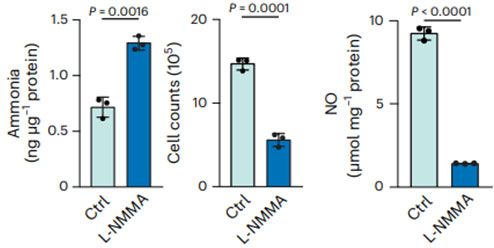
L-NMMA acetate (200 μM; 48 h) led to elevating ammonia and inhibiting CD8+ TM cell induction, in parallel with the inhibition of NO production.
L-NMMA hydrochloride purchased from MedChemExpress. Usage Cited in: Nat Immunol. 2023 Jan;24(1):162-173. [Abstract]
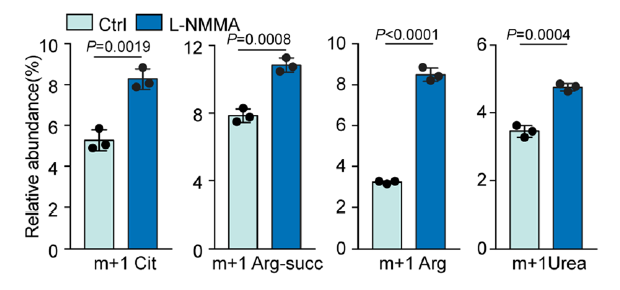
L-NMMA acetate (100 μM; 48 h) led to the accumulation of m + 1 arginine and a slowed nitrogen flow in CD8+ TM cells.
L-NMMA hydrochloride purchased from MedChemExpress. Usage Cited in: Nat Immunol. 2023 Jan;24(1):162-173. [Abstract]
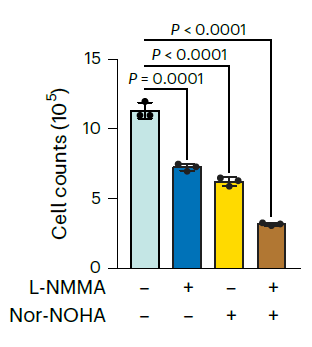
L-NMMA acetate (100 μM; 48 h) blocked formation of CD8+ TM cells.
L-NMMA hydrochloride purchased from MedChemExpress. Usage Cited in: Nat Immunol. 2023 Jan;24(1):162-173. [Abstract]
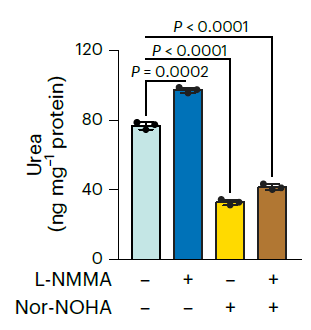
CD8+ TM cells were treated with L-NMMA acetate (100 μM; 48 h) and the level of urea was analyzed.
L-NMMA hydrochloride purchased from MedChemExpress. Usage Cited in: Nat Immunol. 2023 Jan;24(1):162-173. [Abstract]
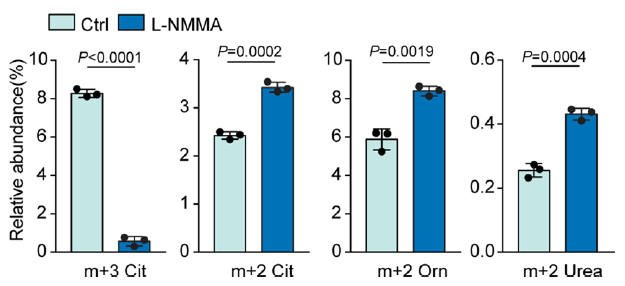
IL-15-derived CD8+ TM cells were treated with L-NMMA acetate (100 μM; 48 h), then were cultured with [U4] 15N-arginine for 6 hours and LC-MS/MS analysis was performed for m + 2, m + 3 citrulline, m + 2 ornithine and m + 2 urea.
-
Nat Commun
An infection-induced RhoB-Beclin 1-Hsp90 complex enhances clearance of uropathogenic Escherichia coli. [Abstract]2021 May 10;12(1):2587. PMID: 33972537 -
Cell Mol Gastroenterol Hepatol
2025;19(6):101474. PMID: 39923847 -
Cell Mol Gastroenterol Hepatol
2021;11(3):683-696. PMID: 33075564 -
Life Sci
Identification and regulation of a novel leptin receptor-linked enhancer during zebrafish ventricle regeneration. [Abstract]2025 Feb 15:363:123415. PMID: 39864617 -
EMBO Rep
Tudor-based proteomic strategy pan-specifically enriches and identifies protein arginine methylation. [Abstract]2025 Oct 20. PMID: 41116072 -
Front Cell Dev Biol
mTOR Signaling Regulates the Development and Therapeutic Efficacy of PMN-MDSCs in Acute GVHD. [Abstract]2021 Dec 23;9:741911. PMID: 35004668 -
FASEB J
Spatial Metabolism of Primary Limited Cutaneous Amyloidosis Based on Mass Spectrometry Imaging. [Abstract]2025 Sep 30;39(18):e71057. PMID: 40955599 -
Eur J Immunol
Fibroblast transdifferentiation promotes conversion of M1 macrophages and replenishment of cardiac resident macrophages following cardiac injury in mice. [Abstract]2020 Jun;50(6):795-808. PMID: 32068249 -
Theriogenology
2025 Oct 1:245:117517. PMID: 40460471


Purity & Documentation
References

Calculators
Concentration (start) × Volume (start) = Concentration (final) × Volume (final)


L-NMMA hydrochloride Related Classifications
HY-18732C Related Classifications
 Powered by Bioz