



Ovalbumin, low endotoxin

Based on 1 Customer Validation
Ovalbumin, low endotoxin are the major proteins in egg white. Ovalbumin, low endotoxin act as an allergen and inducer, and can be applied to mouse models of allergic diseases. Ovalbumin, low endotoxin can induce allergic rhinitis in mice via sensitization and nasal challenge. Ovalbumin, low endotoxin can be used to establish asthma models.
For research use only. We do not sell to patients.
- CAS No.: 9006-59-1
-
Storage:
Please store the product under the recommended conditions in the Certificate of Analysis.


To place orders, for customer services and technical support, please contact: MedChemExpress USA
Tel: 609-228-6898 E-mail: [email protected] [email protected]


-
 Biological Activity
-
Chemical Information
- Purity & Documentation
- References
-
 Help & FAQs


-
HY-W250978
OvalbuminsAllergen -
HY-B1521
Aluminum HydroxideAntacid Aegnt -

HY-D0842A
BSA Protein (Low Endotoxin,Fatty acid free)Oligonucleotide-binding Protein -
HY-D0842
BSA ProteinGlobular Protein -
HY-P1956
HSA ProteinAntioxidant/Anticoagulant -

HY-NP002D
BSA Protein (Biotinylated)Serum Albumin -

HY-P1956A
HSA Protein (Cell culture grade, Endotoxin<0.125 EU/mg)Plasma Protein -
HY-NP002
BSA Standard Solution (5 mg/mL)Biochemical Assay Reagents -

HY-NP002E
PSA Protein (Porcine)Serum Albumin -
HY-CP002
BSA Protein, Carrier ProteinCarrier Protein -

HY-NP002B
RSA Protein (Rabbit)Serum Albumin -
HY-19424
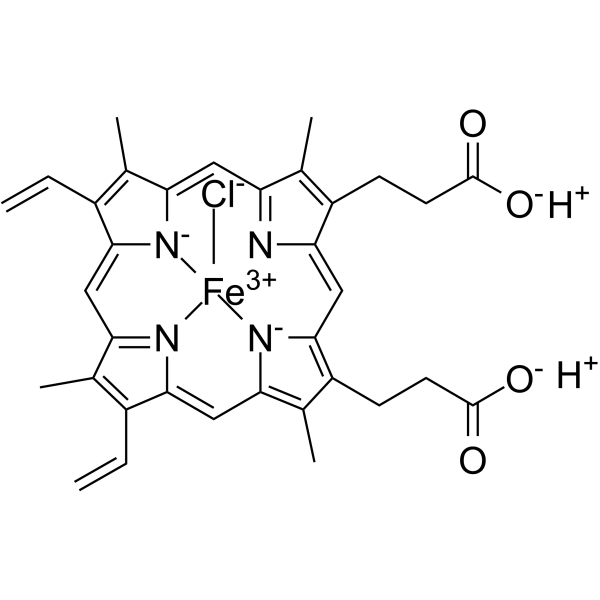
HeminHeme Oxygenase-1 Inducer


Biological Activity
Description
Induced Disease Models
Please do not refer to only one article to determine the experimental conditions. It is recommended to determine the optimal experimental conditions (animal strain, age, dosage, frequency and cycle, detection time and indicators, etc.) through preliminary experiments before the formal experiment.
Induction of Asthma[2][3].
Administration: 100 μg • intraperitoneal injection • on days 0, 7, and 14 • then challenged by inhaled Ovalbumin (OVA) (100 µg in 50 µL PBS per mouse) on Days 22, 24, and 26.
Rat: SD rats • male • four-week-old
Administration: 20 mg/kg • intraperitoneal injection • every other day for a total of 7 injections • After 16 days, the rats received a daily dose of 20 mg/kg OVA through ultrasonic atomizing inhalation for 7 days. Seven days after atomizing inhalation of OVA, allergic rhinitis (AR) responses are examined by dropping 50 μL of 2 % OVA into the nasal cavity of rats.
1) The BALB/c mice are sacrificed 24 h after the last OVA challenge.
Histological analysis: Induces a significant increase in the total number of cells infiltrating the peribronchial and perivascular areas of the lung tissues, predominantly eosinophils.
The lung tissues of OVA-sensitized rats showed significant inflammatory cell infiltration and goblet cell hyperplasia.
Biochemical markers: The content of IL-17A in the serum, NALF, BALF, and lung tissue homogenate of OVA-sensitized rats was increased.
Immunohistochemistry analysis: The expression of IL-22RA1 and IL-10RB in the lung tissues is significantly increased.
MedChemExpress (MCE) has not independently confirmed the accuracy of these methods. They are for reference only.


Chemical Information
-
CAS No. 9006-59-1
-
Appearance Solid
-
Color White to off-white
-
SMILES
[Ovalbumin, low endotoxin]
-
Shipping
Room temperature in continental US; may vary elsewhere.
-
Storage
Please store the product under the recommended conditions in the Certificate of Analysis.


Purity & Documentation
-
Data Sheet (270 KB)
-
SDS (251 KB)
- English - EN (251 KB)
- Français - FR (251 KB)
- Deutsch - DE (251 KB)
- Norwegian - NO (251 KB)
- Español - ES (251 KB)
- Swedish - SV (251 KB)
- Italian - IT (251 KB)
- Korean - KR (251 KB)
- Portuguese - PT (251 KB)
-
Handling Instructions (2659 KB)
References
[1]. Heejae Han, et al. Toxic and adjuvant effects of silica nanoparticles on ovalbumin-induced allergic airway inflammation in mice. Respir Res. 2016 May 18;17(1):60. [Content Brief]
[2]. Wang J, et al. Interleukin-22 attenuates allergic airway inflammation in ovalbumin-induced asthma mouse model. BMC Pulm Med. 2021 Nov 26;21(1):385. [Content Brief]
[3]. He Y, et al. Jieyu Guben decoction alleviates combined allergic rhinitis and asthma syndrome by balancing Th17/Treg expression and restoring PPARD. Phytomedicine. 2025 Apr;139:156508. [Content Brief]

Calculators
Concentration (start) × Volume (start) = Concentration (final) × Volume (final)


Ovalbumin, low endotoxin Related Classifications
HY-W250978A Related Classifications
 Powered by Bioz
Keywords