



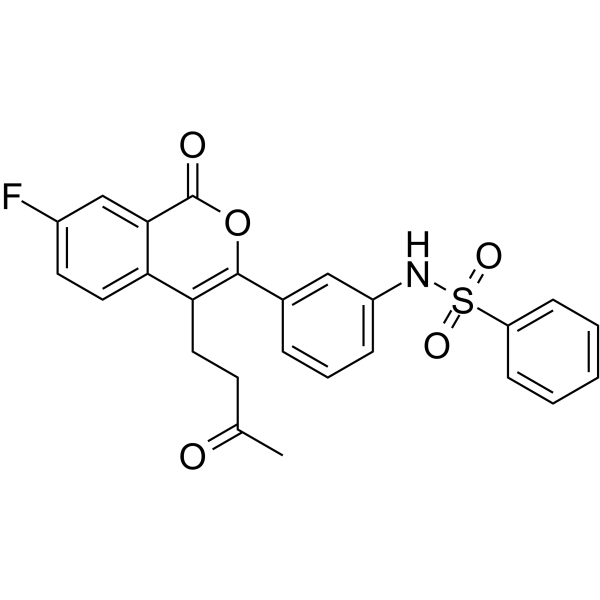
PDE4-IN-6
PDE4-IN-6 is a potent, safe and moderately selective PDE4 inhibitor with IC50s of 0.125 and 0.43 µM for PDE4B and PDE4D, respectively. PDE4-IN-6 can downregulate the expression level of TNF-α and IL-6. PDE4-IN-6 has potent immunomodulatory activity thereby its potential against rheumatoid arthritis. Anti-inflammatory and anti-arthritic effects.
For research use only. We do not sell to patients.
- Formula: C25H20FNO5S
- Molecular Weight:465.49
-
Storage:
Please store the product under the recommended conditions in the Certificate of Analysis.

To place orders, for customer services and technical support, please contact: MedChemExpress USA
Tel: 609-228-6898 E-mail: [email protected] [email protected]


-
 Biological Activity
-
Chemical Information
- Protocols
- Purity & Documentation
- References
-
 Help & FAQs




Biological Activity
Description
IC50 & Target
|
PDE4B 0.125 μM (IC50) |
PDE4D 0.43 μM (IC50) |
In Vitro
PDE4-IN-6 (compound 5f) (0.1-10 µM; 1 hour) has concentration-dependent inhibition on TNF-α in Raw 264.7 cells, with 42.3, 49.6, 57.2 and 68.7% inhibition at concentration of 0.3, 1, 3 and 10 µM[1].
MedChemExpress (MCE) has not independently confirmed the accuracy of these methods. They are for reference only.
-
Cell Line:Raw 264.7 cells[1]
-
Concentration:0.1-10 µM
-
Incubation Time:1 hour
-
Result:Showed concentration-dependent inhibition on TNF-α, with 42.3, 49.6, 57.2 and 68.7% inhibition at concentration of 0.3, 1, 3 and 10 µM.
In Vivo
PDE4-IN-6 (1-100 μM; incubated 4 days, 3 days or 4 hours) does not induce teratogenicity, hepatotoxicity and cardiac toxicity in zebrafish embryos[1].
MedChemExpress (MCE) has not independently confirmed the accuracy of these methods. They are for reference only.
-
Animal Model:Adjuvant-induced arthritis (AIA) albino wistar rats (150-200 g)[1]
-
Dosage:10 and 30 mg/kg
-
Administration:i.p.; daily from day 11 until day 20
-
Result:Improved body weight and reduced paw swelling, also ameliorated joint space narrowing, cartilage degeneration and joint structural deformity at dosing 30 mg/kg, depicting the anti-inflammatory and anti-arthritic effects in AIA model.


Chemical Information
-
Molecular Weight 465.49
-
Formula C25H20FNO5S
-
SMILES
CC(CCC1=C(OC(C2=CC(F)=CC=C21)=O)C3=CC(NS(=O)(C4=CC=CC=C4)=O)=CC=C3)=O
-
Shipping
Room temperature in continental US; may vary elsewhere.
-
Storage
Please store the product under the recommended conditions in the Certificate of Analysis.


Purity & Documentation
References

Calculators
Concentration (start) × Volume (start) = Concentration (final) × Volume (final)


PDE4-IN-6 Related Classifications
HY-115913 Related Classifications
 Powered by Bioz