



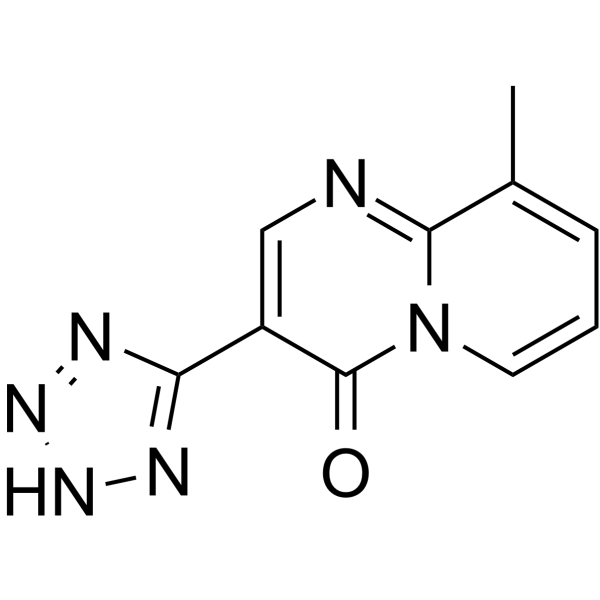
Pemirolast
Pemirolast is an orally active antiallergic agent. Pemirolast attenuates Paclitaxel (HY-B0015) hypersensitivity reactions. Pemirolast can be used for bronchial asthma and conjunctivitis research-.
商品は「研究用試薬」です。人や動物の医療用・臨床診断用・食品用の製品ではありません。
研究用途以外に使用した場合、当社は一切の責任を負いかねます。
- CAS 番号: 69372-19-6
- 分子式: C10H8N6O
- 分子量:228.21
-
保管条件:
Please store the product under the recommended conditions in the Certificate of Analysis.

To place orders, for customer services and technical support, please contact: MedChemExpress USA
Tel: 609-228-6898 E-mail: [email protected] [email protected]


-
 生物活性
生物活性
-
化学情報
-
溶剤 & 溶解度
- 純度とドキュメンテーション
- 参考文献
-
 Help & FAQs


Histamine Receptor アイソフォーム固有の製品をすべて表示
More

生物活性
製品説明
体外実験
Pemirolast (1 μM-1 mM) inhibits A23187-induced LTC4 and ECP release from the eosinophils in a dose-dependent manner[1].
Pemirolast (0.1-1 mM) also inhibits PAF-induced and FMLP-induced ECP release from the eosinophils[1].
Pemirolast prevents the activation of human eosinophils to inhibit granule protein LTQ and ECP release, so that alleviates controlling allergic diseases[1].
Pemirolast (100 nM-1 mM; 1-15 min) fails to significantly inhibit histamine release from human conjunctival mast cells[2].
Pemirolast (0.1 μg/mL-0.01 mg/mL) inhibits the activation of signal transduction phospholipases C and AZ in rat peritoneal mast cells, by inhibiting the degranulation reaction of antigen and compound 48/80, suppressing the formation of 1,2-diacylglycerol and phosphatidylic acid[3].
MedChemExpress (MCE) has not independently confirmed the accuracy of these methods. They are for reference only.
体内実験
Pemirolast (0.1-1 mg/kg; i.v.) inhibits taxel-induced pulmonary vascular hyperpermeability, and reverses paclitaxel-induced arterial PaO2 decreasing at a dosage of 1 mg/kg, 30 minutes after paclitaxel (HY-B0015) injection (15 mg/kg; i.v.)[4].
Pemirolast (10 mg/kg/d; p.o.; 4-5 d) significantly reduces Cisplatin (HY-17394)-induced kaolin intake on days 3 and 4 and inhibits cisplatin-induced substance P release in the cerebrospinal fluid (CSF) in rats[5].
MedChemExpress (MCE) has not independently confirmed the accuracy of these methods. They are for reference only.
-
Animal Model:Male Wistar rats (6-week-old, 160-250 g)[5]
-
Dosage:10 mg/kg
-
Administration:Oral gavage; 5 days: 1 h or 30 min before and 24, 48, 72 and 96 h (five times in total) after administration of cisplatin (2-10 mg/kg; i.v.)
-
Result:Inhibited the cisplatin-induced increase in kaolin intake on days 3 and 4, without decreasing in normal feed intake.
-
Animal Model:Male Wistar rats (6-week-old, 160-250 g)[5]
-
Dosage:10 mg/kg
-
Administration:Oral gavage; 4 days: 30 min before and 24, 48, 72 and 96 h (four times in total) after administration of cisplatin (5 mg/kg; i.v.).
-
Result:Significantly reversed the cisplatin-induced increase of substance P levels to vehicle levels in the CSF.


化学情報
-
CAS 番号 69372-19-6
-
分子量 228.21
-
分子式 C10H8N6O
-
SMILES
O=C1C(C2=NNN=N2)=CN=C3N1C=CC=C3C
-
輸送条件
Room temperature in continental US; may vary elsewhere.
-
保管条件
Please store the product under the recommended conditions in the Certificate of Analysis.


溶剤 & 溶解度
体外:
DMF : < 1 mg/mL (insoluble)


純度とドキュメンテーション
参考文献
[1]. Kawashima T, et al. Inhibitory effect of pemirolast, a novel antiallergic drug, on leukotriene C4 and granule protein release from human eosinophils. Int Arch Allergy Immunol. 1994;103(4):405-9. [Content Brief]
[2]. Yanni JM, et al. Comparative effects of topical ocular anti-allergy drugs on human conjunctival mast cells. Ann Allergy Asthma Immunol. 1997 Dec;79(6):541-5. [Content Brief]
[3]. Fujimiya H, et al. Effect of a novel antiallergic drug, pemirolast, on activation of rat peritoneal mast cells: inhibition of exocytotic response and membrane phospholipid turnover. Int Arch Allergy Appl Immunol. 1991;96(1):62-7. [Content Brief]
[4]. Itoh Y, et al. Pemirolast potently attenuates paclitaxel hypersensitivity reactions through inhibition of the release of sensory neuropeptides in rats. Neuropharmacology. 2004 May;46(6):888-94. [Content Brief]
[5]. Tatsushima Y, et al. Pemirolast reduces cisplatin-induced kaolin intake in rats. Eur J Pharmacol. 2011 Jul 1;661(1-3):57-62. [Content Brief]

Calculators
濃度 (開始) × 体積 (開始) = 濃度 (終了) × 体積 (終了)


Pemirolast 関連分類
HY-137863 関連分類
 Powered by Bioz