



pTH (1-34) amide (human)

Based on 1 Customer Validation
PTH (1-34) amide human is a type 1 PTH/PTHrP receptor agonist. PTH (1-34) amide human activates adenylate cyclase and phospholipase C pathways, thereby mediating mineral ion homeostasis and bone metabolism regulation. PTH (1-34) amide human increases serum calcium, decreases serum phosphorus, regulates renal excretion, while inducing the inhibition of endogenous PTH (1-84) and the increase of 1,25-dihydroxyvitamin D2 and bone resorption. PTH (1-34) amide human stimulates phosphatidylcholine hydrolysis via phospholipase D mediation, and its hypercalcemic effect is inhibited by human PTH-(7-84). PTH (1-34) amide human can be used in the research of diseases related to humoral hypercalcemia of malignancy.
For research use only. We do not sell to patients.
- Purity : 99.78%
- CAS No.: 83139-29-1
- Formula: C181H292N56O50S2
- Molecular Weight:4116.73
-
Storage:
Sealed storage, away from moisture.
Powder -80°C, 2 years , -20°C, 1 year* In solvent : -80°C, 6 months; -20°C, 1 month (sealed storage, away from moisture)


To place orders, for customer services and technical support, please contact: MedChemExpress USA
Tel: 609-228-6898 E-mail: [email protected] [email protected]


-
 Biological Activity
-
Chemical Information
-
Solvent & Solubility
- Protocols
- Purity & Documentation
- References
-
 Help & FAQs



All Phospholipase Isoforms
More

Biological Activity
Description
IC50 & Target
[1]|
PLC |
PTH1R |
In Vitro
pTH (1-34) amide human (3 nM; 72 h) stimulates bone resorption in neonatal mouse CD-1 strain calvariae, and this effect is inhibited by co-treatment with hPTH-(7-84)[1].
pTH (1-34) amide human (3 nM; 45 min) induces submaximal cAMP accumulation in ROS 17/2.8 rat osteosarcoma cells, and this response is not inhibited by hPTH-(7-84)[1].
pTH (1-34) amide human (2-3 nmol/L; 10 min) potently stimulates adenylyl cyclase activity in confluent SaOS-2 human osteosarcoma cells with an EC50 of approximately 2-3 nmol/L, displaying identical potency to hPTHrP(1-36), Tyr36hPTHrP(1-36)amide, and hPTHrP(1-40)[2].
pTH (1-34) amide human (0.1-10 nM; 30 min) stimulates phosphatidylcholine hydrolysis in UMR-106 osteoblastic osteosarcoma cells with equivalent potency to bovine PTH-(1-34) and human PTH-related peptide-(1-34)[4].
MedChemExpress (MCE) has not independently confirmed the accuracy of these methods. They are for reference only. Further protocols information, click here.


Chemical Information
-
CAS No. 83139-29-1
-
Appearance Solid
-
Molecular Weight 4116.73
-
Formula C181H292N56O50S2
-
Color White to off-white
-
Sequence
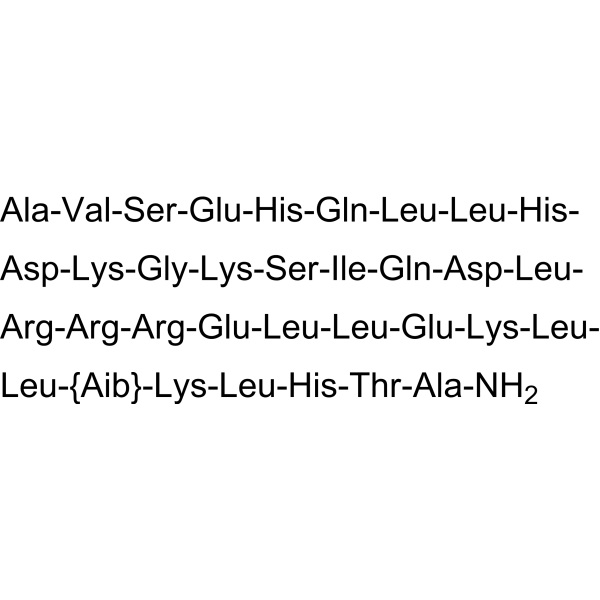
Ser-Val-Ser-Glu-Ile-Gln-Leu-Met-His-Asn-Leu-Gly-Lys-His-Leu-Asn-Ser-Met-Glu-Arg-Val-Glu-Trp-Leu-Arg-Lys-Lys-Leu-Gln-Asp-Val-His-Asn-Phe-NH2
-
Sequence Shortening
SVSEIQLMHNLGKHLNSMERVEWLRKKLQDVHNF-NH2
-
Shipping
Room temperature in continental US; may vary elsewhere.
-
Storage
Sealed storage, away from moisture
Powder -80°C 2 years -20°C 1 year * In solvent : -80°C, 6 months; -20°C, 1 month (sealed storage, away from moisture)


Solvent & Solubility
In Vitro:
DMSO : 100 mg/mL (24.29 mM; Need ultrasonic; Hygroscopic DMSO has a significant impact on the solubility of product, please use newly opened DMSO)
Please refer to the solubility information to select the appropriate solvent. Once prepared, please aliquot and store the solution to prevent product inactivation from repeated freeze-thaw cycles.
Storage method and period of stock solution: -80°C, 6 months; -20°C, 1 month (sealed storage, away from moisture). When stored at -80°C, please use it within 6 months. When stored at -20°C, please use it within 1 month.
Please refer to the solubility information to select the appropriate solvent. Once prepared, please aliquot and store the solution to prevent product inactivation from repeated freeze-thaw cycles.
Storage method and period of stock solution: -80°C, 6 months; -20°C, 1 month (sealed storage, away from moisture). When stored at -80°C, please use it within 6 months. When stored at -20°C, please use it within 1 month.
Concentration (start) × Volume (start) = Concentration (final) × Volume (final)

Protocols
-
Osteoclast differentiation from monocyte/macrophage precursors
Osteoclast differentiation is an in vitro induction assay in which monocyte/macrophage-lineage precursors are exposed to macrophage colony-stimulating factor (M-CSF) and receptor activator of NF-κB ligand (RANKL), generating multinucleated osteoclasts that are commonly identified by tartrate-resistant acid phosphatase (TRAP) staining and functionally confirmed by resorption pits on dentin, bone, or mineralized substrates. M-CSF supports survival and expansion of osteoclast precursors, while RANKL binding to RANK drives osteoclast commitment, fusion, maturation, and resorptive function; osteoprotegerin inhibits this pathway by binding RANKL and preventing RANK activation. The main readouts are the number of TRAP-positive multinucleated cells, formation of F-actin rings, and resorbed surface area; TRAP-positive multinucleated cells indicate osteoclast differentiation, whereas pit formation on dentin, bone, or mineralized coating indicates functional bone-resorbing activity.


Purity & Documentation
-
Data Sheet (271 KB)
-
SDS (254 KB)
- English - EN (254 KB)
- Français - FR (254 KB)
- Deutsch - DE (254 KB)
- Norwegian - NO (254 KB)
- Español - ES (254 KB)
- Swedish - SV (254 KB)
- Italian - IT (254 KB)
- Korean - KR (254 KB)
- Portuguese - PT (254 KB)
-
Handling Instructions (2659 KB)
References
[1]. Divieti P, John MR, Jüppner H, et al.. Human PTH-(7-84) inhibits bone resorption in vitro via actions independent of the type 1 PTH/PTHrP receptor. Endocrinology. 2002 Jan;143(1):171-6. [Content Brief]
[2]. Everhart-Caye M, Inzucchi SE, Guinness-Henry J, et al.. Parathyroid hormone (PTH)-related protein(1-36) is equipotent to PTH(1-34) in humans. The Journal of clinical endocrinology and metabolism. 1996 Jan;81(1):199-208. [Content Brief]
[3]. Strid H, Care A, Jansson T, et al.. Parathyroid hormone-related peptide (38-94) amide stimulates ATP-dependent calcium transport in the Basal plasma membrane of the human syncytiotrophoblast. The Journal of endocrinology. 2002 Nov;175(2):517-24. [Content Brief]
[4]. Singh AT, Kunnel JG, Strieleman PJ, et al.. Parathyroid hormone (PTH)-(1-34), [Nle(8,18),Tyr34]PTH-(3-34) amide, PTH-(1-31) amide, and PTH-related peptide-(1-34) stimulate phosphatidylcholine hydrolysis in UMR-106 osteoblastic cells: comparison with effects of phorbol 12,13-dibutyrate. Endocrinology. 1999 Jan;140(1):131-7. [Content Brief]


Complete Stock Solution Preparation Table
Please refer to the solubility information to select the appropriate solvent. Once prepared, please aliquot and store the solution to prevent product inactivation from repeated freeze-thaw cycles.
Storage method and period of stock solution: -80°C, 6 months; -20°C, 1 month (sealed storage, away from moisture). When stored at -80°C, please use it within 6 months. When stored at -20°C, please use it within 1 month.
| Optional Solvent | Concentration Solvent Mass | 1 mg | 5 mg | 10 mg | 25 mg |
|---|---|---|---|---|---|
| DMSO | 1 mM | 0.2429 mL | 1.2146 mL | 2.4291 mL | 6.0728 mL |
| 5 mM | 0.0486 mL | 0.2429 mL | 0.4858 mL | 1.2146 mL | |
| 10 mM | 0.0243 mL | 0.1215 mL | 0.2429 mL | 0.6073 mL | |
| 15 mM | 0.0162 mL | 0.0810 mL | 0.1619 mL | 0.4049 mL | |
| 20 mM | 0.0121 mL | 0.0607 mL | 0.1215 mL | 0.3036 mL |


pTH (1-34) amide (human) Related Classifications
HY-P4821 Related Classifications
 Powered by Bioz
Keywords
- pTH (1-34) amide (human)
- 83139-29-1
- PTHR
- Adenylate Cyclase
- Phospholipase
- 1
- 25-dihydroxyvitamin D 2
- CD-1 strain calvariae
- phosphatidylcholine transphosphatidylation
- phospholipase C
- ROS 17/2.8 rat osteosarcoma cells
- bone resorption
- bone metabolism
- type 1 PTH/PTHrP receptor
- mineral ion homeostasis
- adenylate cyclase
- Inhibitor
- inhibitor
- inhibit