207 Results for "

fluorogenic substrate

" in MedChemExpress (MCE) Product Catalog:
Products (207)

207 Results for "fluorogenic substrate" in MCE Product Catalog:

Art. -Nr.: HY-131028
Reinheit:  ≥95.0%
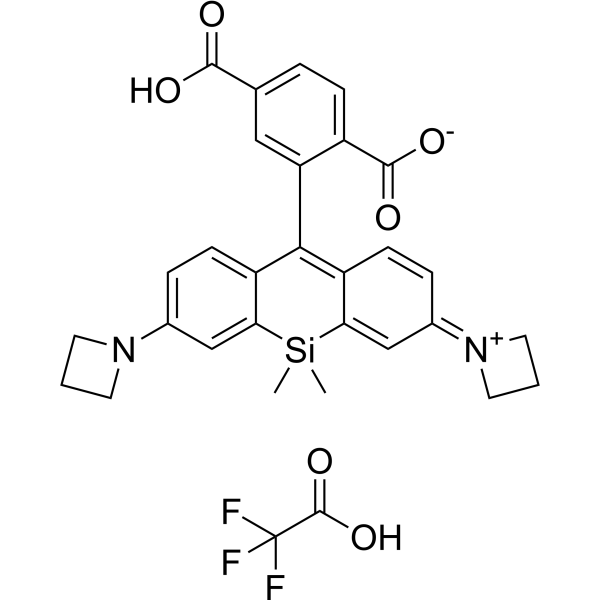
Synonyms: JF646 TFA
Janelia Fluor 646 TFA (JF646 TFA), a red fluorogenic fluorescent dye, can be used in the synthesis of Janelia Fluor 646 HaloTag and SNAP-Tag ligands. JF646 TFA is used in live cell imaging experiments . Janelia Fluor fluorescent dyes can be chemically conjugated to the specific HaloTag substrate (a chloroalkane ligand) to form a fluorescent ligand, rather than binding directly to the HaloTag protein itself. Janelia Fluor products are licensed under U.S. Pat. Nos. 9,933,417, 10,018,624 and 10,161,932 and other patents from Howard Hughes Medical Institute (Ex/Em = 646/664 nm).
loading...
    loading...
Art. -Nr.: HY-137199
CAS. Nr.: 65147-21-9
Target:  

Kallikrein

Forschungsgebiete:  

Others

Pro-Phe-Arg-AMC is a substrate for human glandular kallikrein 2. Pro-Phe-Arg-AMC can be used for the quantitative detection of enzyme activity .
loading...
    loading...
Art. -Nr.: HY-P2618
CAS. Nr.: 2237216-30-5
Target:  

Kallikrein

Forschungsgebiete:  

Others

Pro-Phe-Arg-AMC acetate is a substrate for human glandular kallikrein 2. Pro-Phe-Arg-AMC acetate can be used for the quantitative detection of enzyme activity .
loading...
    loading...
Art. -Nr.: HY-N15826
CAS. Nr.: 3077081-47-8
Forschungsgebiete:  

Cancer

RBM1-151, a 1-deoxy derivative and vinilog of RBM14-C12 (HY-150163), as a fluorogenic substrate of Amidases (HY-P2736) (Ex/Em). RBM1-151 is hydrolyzed by acid ceramidase (AC) (( appKm = 7.0 μM; appVmax = 99.3 nM/min), N-acylethanolamine-hydrolyzing acid amidase ( appKm = 0.73 μM; appVmax = 0.24 nM/min), and fatty Acid amide hydrolase (FAAH) ( appKm = 3.6 μM; appVmax = 7.6 nM/min) but not by other ceramidases. RBM1-151 is applicable for basic biological studies of lipid amidase function, as well as potential diagnostic/prognostic evaluations of diseases involving dysregulated AC, NAAA, or FAAH (Farber disease, cancer) .
loading...
    loading...
Art. -Nr.: HY-131027
Reinheit:  99.87%
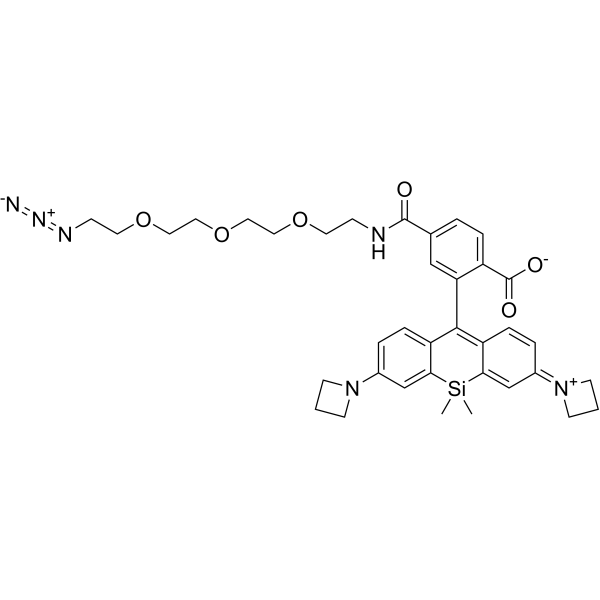
Synonyms: JF646, Azide
Janelia Fluor 646, Azide (JF646, Azide) is a red fluorogenic fluorescent dye containing a click chemistry group Azide. Janelia Fluor 646, Azide can be used for live-cell imaging experiments . Janelia Fluor fluorescent dyes can be chemically conjugated to the specific HaloTag substrate (a chloroalkane ligand) to form a fluorescent ligand, rather than binding directly to the HaloTag protein itself. Janelia Fluor products are licensed under U.S. Pat. Nos. 9,933,417, 10,018,624 and 10,161,932 and other patents from Howard Hughes Medical Institute. Janelia Fluor 646, Azide is a click chemistry reagent, it contains an Azide group and can undergo copper-catalyzed azide-alkyne cycloaddition reaction (CuAAc) with molecules containing Alkyne groups. It can also undergo strain-promoted alkyne-azide cycloaddition (SPAAC) reactions with molecules containing DBCO or BCN groups (Ex/Em = 646/664 nm).
loading...
    loading...
Art. -Nr.: HY-P1883
CAS. Nr.: 2857862-12-3
Target:  

Fluorescent Dye

Forschungsgebiete:  

Infection

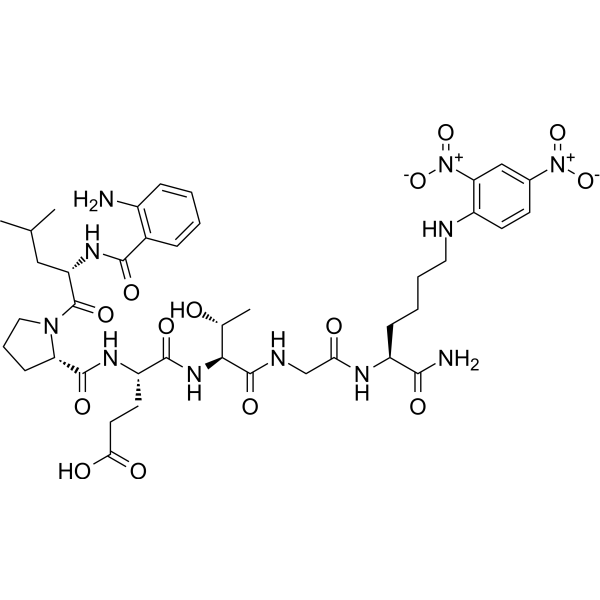
Bacterial Sortase Substrate III, Abz/DNP is a fluorescent peptide substrate. Bacterial Sortase Substrate III, Abz/DNP undergoes cleavage catalyzed by Staphylococcus aureus sortase A (SrtAΔN24) and Streptococcus pyogenes sortase A (SrtAΔN81), and catalyzes the formation of an amide bond between the carboxyl group of threonine and the amino group of the cell wall cross-bridge. Cleavage of this substrate can be detected at Ex/Em=320 nm/420 nm .
loading...
    loading...
Art. -Nr.: HY-P1883A
Target:  

Fluorescent Dye

Forschungsgebiete:  

Infection

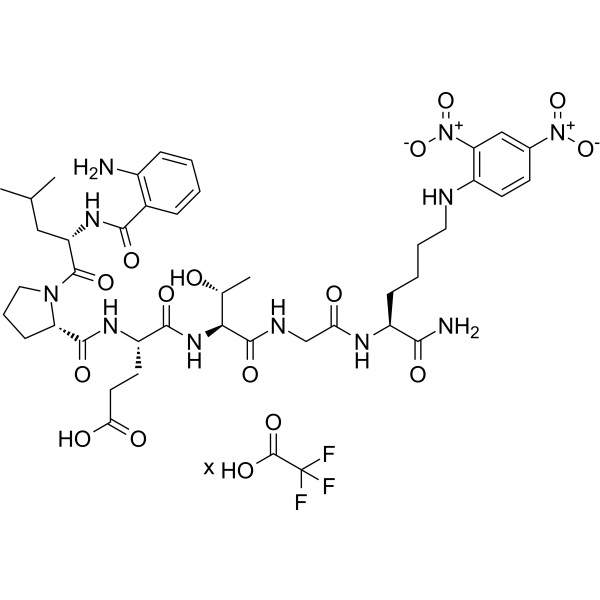
Bacterial Sortase Substrate III, Abz/DNP TFA is a fluorescent peptide substrate. Bacterial Sortase Substrate III, Abz/DNP TFA undergoes cleavage catalyzed by Staphylococcus aureus sortase A (SrtAΔN24) and Streptococcus pyogenes sortase A (SrtAΔN81), and catalyzes the formation of an amide bond between the carboxyl group of threonine and the amino group of the cell wall cross-bridge. Cleavage of this substrate can be detected at Ex/Em=320 nm/420 nm .
loading...
    loading...

