
17 Results for "

Glycerol Kinase

" in MedChemExpress (MCE) Product Catalog:
Products (17)

17 Results for "Glycerol Kinase" in MCE Product Catalog:

2
2 Cited Publications
Cat. No.: HY-108355
CAS No.: 120166-69-0
Purity:  ≥98.0%
Target:  

PKC

Research Areas:  

Cancer

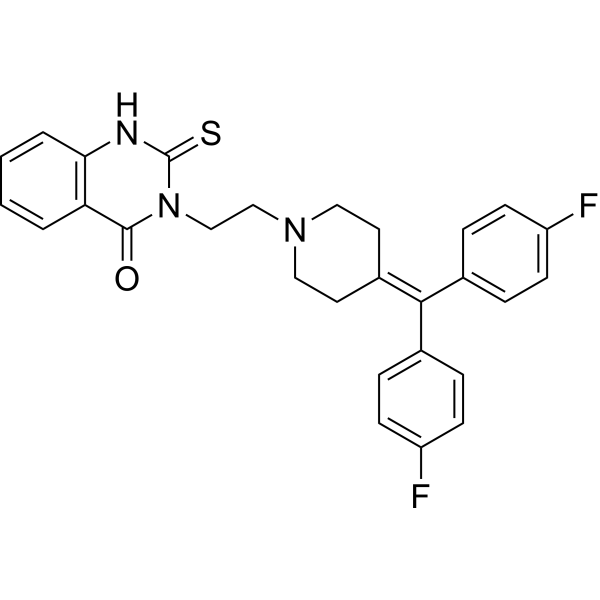
R59949 is a pan diacylglycerol kinase (DGK) inhibitor with an IC50 of 300 nM. R59949 strongly inhibits the activity of type I DGK α and γ and moderately attenuates the activity of type II DGK θ and κ. R59949 activates protein kinase C (PKC) by enhancing the levels of the endogenous ligand diacyl glycerol .
loading...
    loading...
2
2 Cited Publications
Cat. No.: HY-P2733C
CAS No.: 9046-28-0
Synonyms: GPO, microorganism
Target:  

Endogenous Metabolite

Research Areas:  

Metabolic Disease

Glycerol-3-phosphate oxidase, microorganism is an enzyme that catalyzes the oxidation of glycerol-3-phosphate to dihydroxyacetone phosphate, producing hydrogen peroxide in the process. Glycerol-3-phosphate oxidase is located in the mitochondria of microorganisms and is involved in the glycerol-3-phosphate cycle, regulating cellular energy metabolism. Glycerol-3-phosphate oxidase, microorganism can be used in conjunction with Lipoprotein Lipase and Glycerol Kinase to determine triglyceride levels .
loading...
    loading...
1
1 Cited Publications
Cat. No.: HY-131648
CAS No.: 86390-77-4
Purity:  ≥99.0%
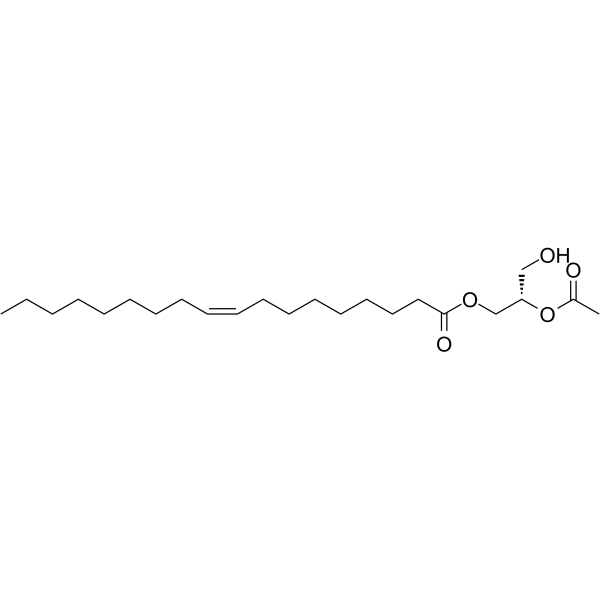
1-Oleoyl-2-acetyl-sn-glycerol is a cell-permeable analog of diacylglycerol (DAG) and can activate Protein kinase C (PKC). 1-Oleoyl-2-acetyl-sn-glycerol can activate the TRPC channels-mediated specific Ca 2+ influx. 1-Oleoyl-2-acetyl-sn-glycerol can stimulate superoxide-generation from human neutrophils. 1-Oleoyl-2-acetyl-sn-glycerol stimulates the formation of phosphatidylinositol 4-phosphate in intact human platelets. 1-Oleoyl-2-acetyl-sn-glycerol can stimulate ascites tumor cell proliferation .
loading...
    loading...
Cat. No.: HY-P2917
CAS No.: 9030-66-4
Synonyms: GyK
Glycerol kinase, microorganism (GyK) acts as a NR4A1 inhibitor with enzymatic activity. It directly binds to and inhibits the transcription factor NR4A1, thereby negatively regulating hepatic gluconeogenesis and reducing blood glucose levels. Glycerol kinase, microorganism positively regulates UCP1 expression via partial dependence on the β-adrenergic receptor-cAMP-CREB pathway, promotes browning of white adipose tissue and thermogenesis, and further modulates intracellular fatty acid composition and energy metabolism. In diabetic mouse models, overexpression of Glycerol kinase effectively antagonizes NR4A1-induced hyperglycemia, demonstrating potential for improving glucose homeostasis. Glycerol kinase, microorganism can be used for studies on diabetes and obesity .
loading...
    loading...
Cat. No.: HY-141572
CAS No.: 24529-88-2
Purity:  99.96%
Synonyms: sn-1,2-DioleoylGlycerol; 18:1/18:1-DG
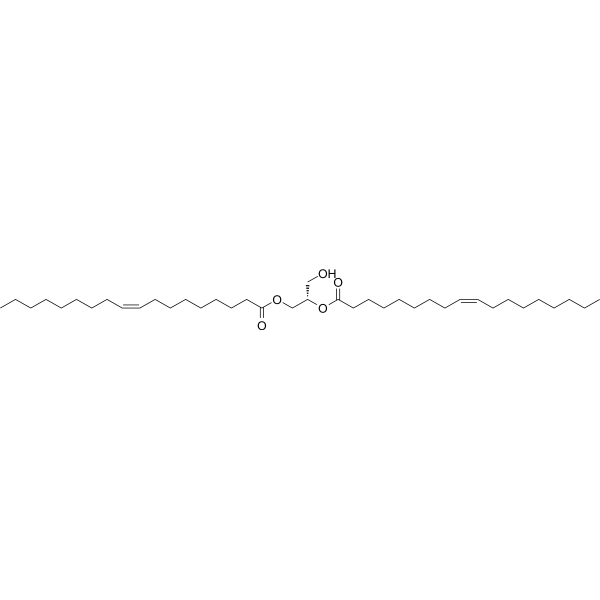
1,2-Dioleoyl-sn-glycerol (sn-1,2-Dioleoylglycerol; 18:1/18:1-DG) is a glycerolipid located on the plasma membrane. 1,2-Dioleoyl-sn-glycerol consists of two fatty acid chains covalently linked to a single glycerol molecule by means of an ester bond. 1,2-Dioleoyl-sn-glycerol is an analog of the protein kinase C-activating second messenger DAG. 1,2-Dioleoyl-sn-glycerol has been used as a source of diacylglycerol in the diacylglycerol O-acyltransferase 1 (DGAT1) assay. 1,2-Dioleoyl-sn-glycerol can induce acrosome reaction in human sperm .
loading...
    loading...
Cat. No.: HY-143212
CAS No.: 65886-80-8
Synonyms: 1-Stearoyl-2-docosahexaenoyl-sn-Glycerol
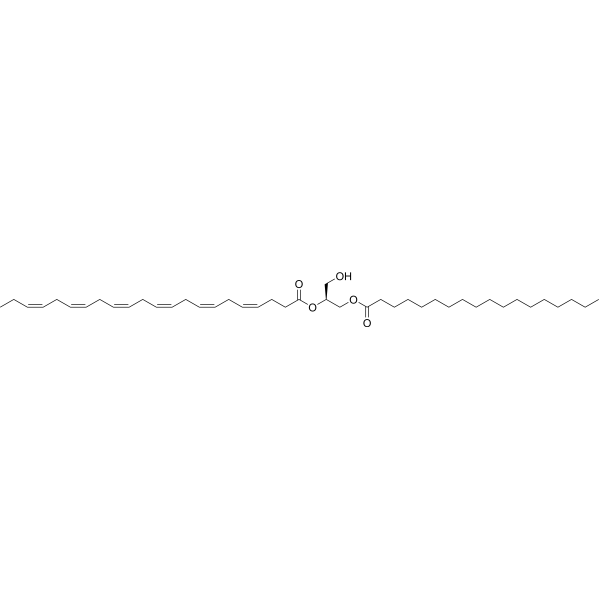
18:0-22:6 DG (1-Stearoyl-2-docosahexaenoyl-sn-glycerol) is a diacylglycerol (DG) that can interact with RasGRP (Ras guanine nucleotide-releasing protein) (Ki = 8.37 μM) and modulate the activation of MAP kinases (such as ERK1/ERK2), which play a crucial role in cellular signaling processes. 18:0-22:6 DG can also activate protein kinase C (PKC) isozyme. 18:0-22:6 DG can be used for research of cancer, immunology and metabolic disease .
loading...
    loading...
Cat. No.: HY-D0077
CAS No.: 195136-58-4
Synonyms: Oregon green 488
Target:  

Fluorescent Dye

Research Areas:  

Others

2',7'-Difluorofluorescein (Oregon green 488) is a fluorescein derivative and a pH-sensitive fluorescent probe (pKa ~4.7). Upon excitation at 488 nm, 2',7'-Difluorofluorescein exhibits pH-sensitive fluorescence intensity through the formation of dianions, while its pH sensitivity decreases under excitation at 450 nm, allowing its use in ratiometric pH analysis. 2',7'-Difluorofluorescein can be used for the quantitative analysis of pH values in the range of 2-7 in submicron aerosol particles. 2',7'-Difluorofluorescein undergoes buffer-mediated and buffer-free excited-state proton transfer between different protonated forms, and its cationic form undergoes rapid excited-state deprotonation. 2',7'-Difluorofluorescein is resistant to photodegradation, maintains stable absorption and fluorescence properties within the physiological pH range, and serves as a fluorescent protein label, a component of Ca 2+ indicators, a fluorescent imaging agent, and an anisotropy probe .
loading...
    loading...
Cat. No.: HY-P2917A
CAS No.: 9030-66-4
Synonyms: GyK, Cellulomonas sp.
Target:  

Endogenous Metabolite

Research Areas:  

Others

Glycerol kinase, Cellulomonas sp. (EC 2.7.1.30) is a bacterial sugar kinase, is often used in biochemical studies. Glycerol kinase, Cellulomonas sp. catalyzes the first step of glycerol metabolism by transforming the triol into glycerol-3-P (G3P). Glycerol kinase, Cellulomonas sp. is crucial for regulating channel/facilitator-independent uptake of glycerol into the cell .
loading...
    loading...
Cat. No.: HY-P2917B
CAS No.: 9030-66-4
Synonyms: GyK, Flavobacterium meningosepticum
Target:  

Endogenous Metabolite

Research Areas:  

Metabolic Disease

Glycerol kinase, Flavobacterium meningosepticum (GyK, Flavobacterium meningosepticum) is a thermostable glycerol kinase isolated from Flavobacterium meningosepticum. Glycerol kinase, Flavobacterium meningosepticum catalyzes the first step in glycerol metabolism by converting triol to glycerol-3-p (G3P). Glycerol kinase, Flavobacterium meningosepticum is essential for regulating glycerol uptake in cells that is independent of channels or facilitators and is useful for biochemical studies .
loading...
    loading...
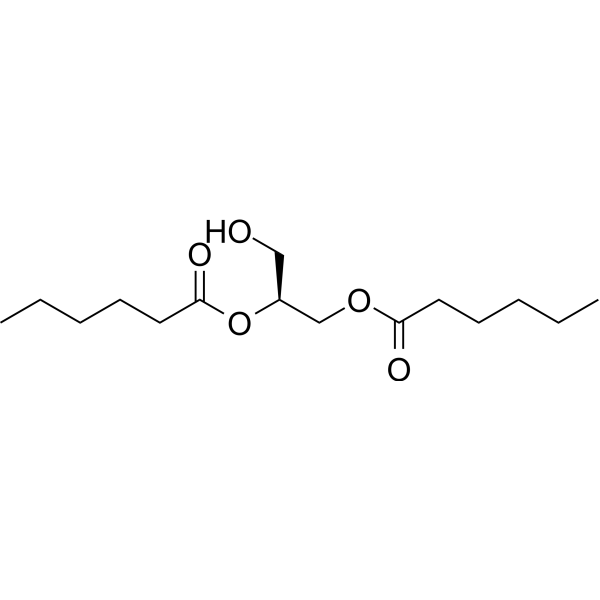
Cat. No.: HY-117115
CAS No.: 30403-47-5
1,2-Dihexanoyl-sn-glycerol is an analog of protein kinase C (PKC) that activates the second messenger diacylglycerol (DAG). Although the biological activity of 1,2-dicaproyl-sn-glycerol has not been well characterized, it is expected to behave similarly to 1,2-dioctanoyl-sn-glycerol.
loading...
    loading...
Cat. No.: HY-158800
CAS No.: 2309189-98-6
Research Areas:  

Others

1-NBD-decanoyl-2-decanoyl-sn-glycerol is a diacylglycerol (DAG) derivative, which is labeled with a fluorescent group NBD. 1-NBD-decanoyl-2-decanoyl-sn-glycerol is the substrate for diacylglycerol kinase (DGK), and can be used for quantitative detection of the DGF enzyme kinetics in vitro, and the changes in DAG and PA during cell signaling .
loading...
    loading...
Cat. No.: HY-N15340
CAS No.: 91125-76-7
Target:  

PKC

1-Oleoyl-2-linoleoyl-sn-glycerol is a diacylglycerol (DG). 1-Oleoyl-2-linoleoyl-sn-glycerol can activate protein kinase C (PKC), thus triggering downstream signaling cascades and promoting tumor growth. 1-Oleoyl-2-linoleoyl-sn-glycerol is promising for research of breast cancer .
loading...
    loading...
Cat. No.: HY-W838254
CAS No.: 322647-32-5
Research Areas:  

Others

1,2-Dipentadecanoyl-sn-glycero-3-phospho-(1'-rac-glycerol) sodium functions as an activator for the protein kinase C family and is an anionic phospholipid found in mitochondrial and microsomal membranes, playing a crucial role in the composition of lung surfactant, particularly within the membranes of lamellar bodies in the lungs.
loading...
    loading...
Cat. No.: HY-P83154
Synonyms: GK; Glycerol Kinase; GK; GlyceroKinase; ATP:Glycerol 3-phosphotransferase

Host:  

Rabbit

Application:  

WB, FC, IP

Reactivity:  

Human, Mouse, Rat

loading...
    loading...
Cat. No.: HY-E70936
Target:  

Endogenous Metabolite

Research Areas:  

Metabolic Disease

Glycerokinase, Streptomyces canus (EC 2.7.1.30) is a phosphotransferase enzyme involved in triglycerides and glycerophospholipids synthesis. Glycerol kinase catalyzes tge MgATP-dependent phosphorylation of glycerol to produce sn-glycerol-3-phosphate and is the rate limiting enzyme in the utilization of glycerol.
loading...
    loading...
Cat. No.: HY-P810434
Synonyms: ATP Glycerol 3 phosphotransferase, ATP:Glycerol 3 phosphotransferase, ATP:Glycerol 3-phosphotransferase, D930012N15Rik, GK, GK1, GKD, GLPK_HUMAN, GlyceroKinase, Glycerol Kinase

Host:  

Rabbit

Application:  

WB, IHC-P, FC

Reactivity:  

Human, Mouse, Rat

loading...
    loading...
Cat. No.: HY-108355R
CAS No.: 120166-69-0
Target:  

Reference Standards PKC

Research Areas:  

Cancer

R59949 (Standard) is the analytical standard of R59949 (HY-108355). This product is intended for research and analytical applications. R59949 is a pan diacylglycerol Kinase (DGK) inhibitor with an IC50 of 300 nM. R59949 strongly inhibits the activity of type I DGK α and γ and moderately attenuates the activity of type II DGK θ and κ. R59949 activates protein Kinase C (PKC) by enhancing the levels of the endogenous ligand diacyl glycerol .
loading...
    loading...
  • 1

