10 Results for "

NQO1 substrate

" in MedChemExpress (MCE) Product Catalog:
Products (10)

10 Results for "NQO1 substrate" in MCE Product Catalog:

1
1 Cited Publications
Cat. No.: HY-128895
CAS No.: 1800405-30-4
Purity:  99.94%
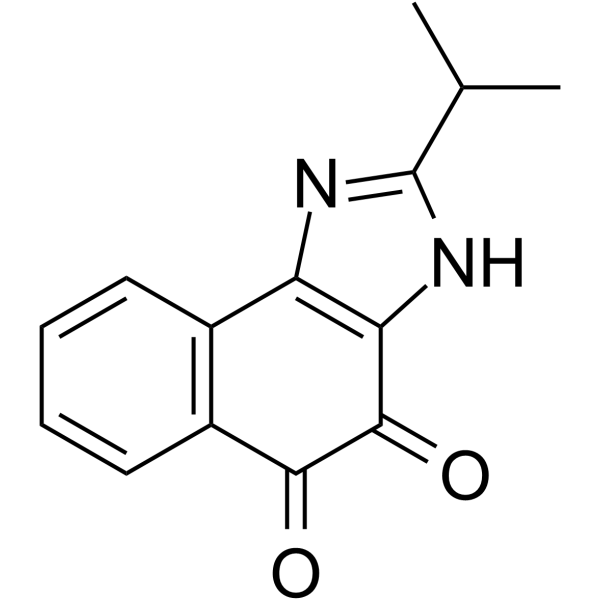
KL1333, a derivative of β-lapachone, is an orally available NAD+ modulator. KL1333 reacts with NAD(P)H:quinone oxidoreductase 1 (NQO1) as a substrate, resulting in increases in intracellular NAD+ levels via NADH oxidation. KL1333 improves energy metabolism and mitochondrial dysfunction in MELAS fibroblasts. KL1333 protects against Cisplatin-induced ototoxicity in mouse cochlear cultures .
loading...
    loading...
Cat. No.: HY-125027
CAS No.: 1430798-22-3
Purity:  99.70%
Synonyms: IB-DNQ
Target:  

Quinone Reductase

Research Areas:  

Cancer

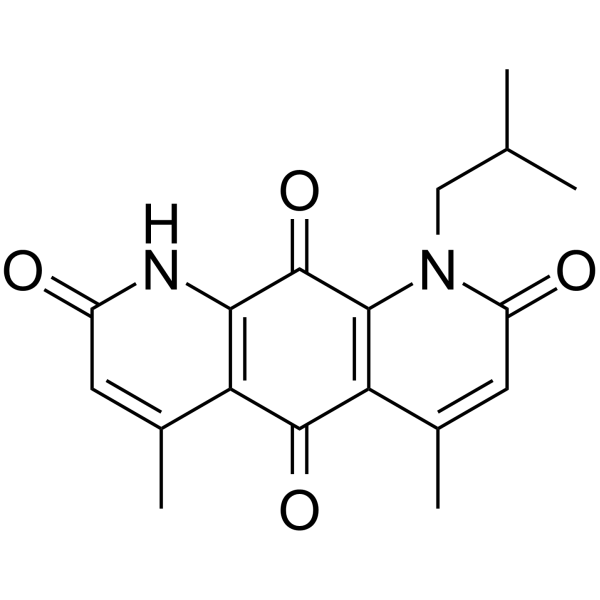
Isobutyl-deoxynyboquinone (IB-DNQ) is a selective substrate for NAD(P)H:quinone oxidoreductase (NQO1). Isobutyl-deoxynyboquinone can be used for the research of anticancer .
loading...
    loading...
Cat. No.: HY-108992
CAS No.: 96748-86-6
Purity:  99.21%
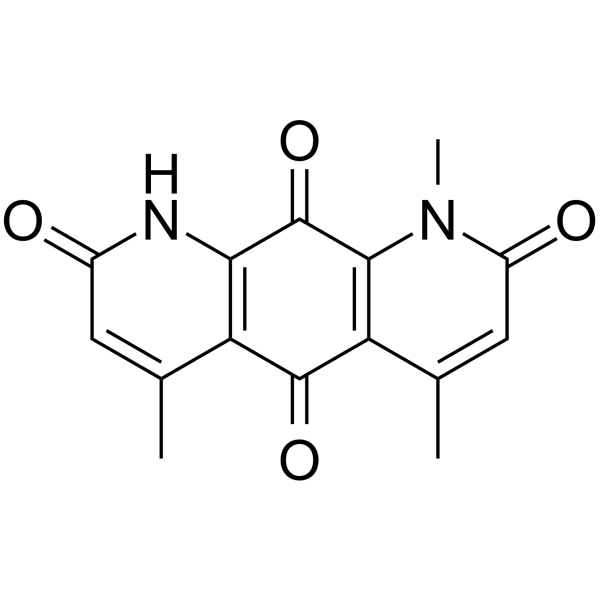
Deoxynyboquinone, an excellent NQO1 substrate, is a potent antineoplastic agent. Deoxynyboquinone induces apoptosis in cancer cell lines. Deoxynyboquinone kills cancer cells through oxidative stress and reactive oxygen species (ROS) formation .
loading...
    loading...
Cat. No.: HY-114315
CAS No.: 2304503-05-5
Purity:  98.02%
Target:  

Quinone Reductase

Research Areas:  

Cancer

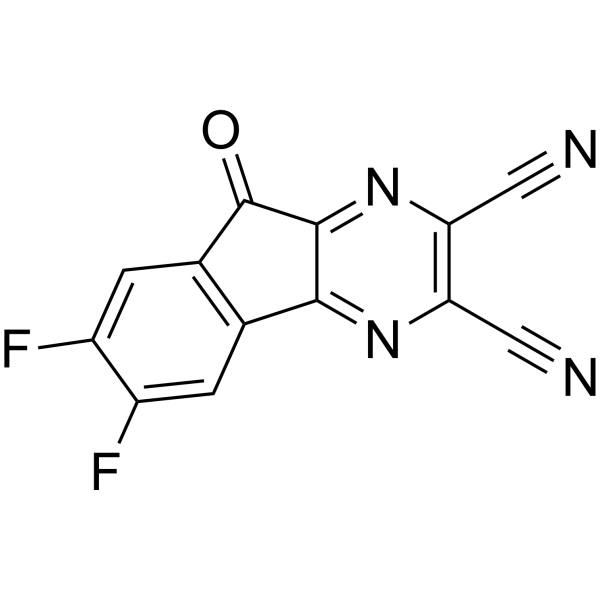
NQO1 substrate acts as an efficient NQO1 substrate and may be a new option for the treatment of NQO1-overexpresssing drug-resistant NSCLC .
loading...
    loading...
Cat. No.: HY-N16372
CAS No.: 1424195-39-0
Pronqodine A is an Indoleamine 2,3-Dioxygenase (IDO) inhibitor, with an IC50 of 131.5 nM. Pronqodine A inhibits bradykinin-induced release of PGE2, 6-keto-prostaglandin F, PGD2 and induces the production of reactive oxygen species (ROS) in human synovial sarcoma SW982 cells. Pronqodine A is a good substrate for human quinone reductase NQO1. Pronqodine A can be used for the study of inflammation .
loading...
    loading...
Cat. No.: HY-147795
CAS No.: 2453183-75-8
Nampt-IN-8 (Compound 10d) is an NAMPT inhibitor with an IC50 of 0.183 μM. Nampt-IN-8 is also a relatively good NQO1 substrate. Nampt-IN-8 induces cell apoptosis and ROS .
loading...
    loading...
Cat. No.: HY-170947
Target:  

STAT Quinone Reductase

Research Areas:  

Cancer

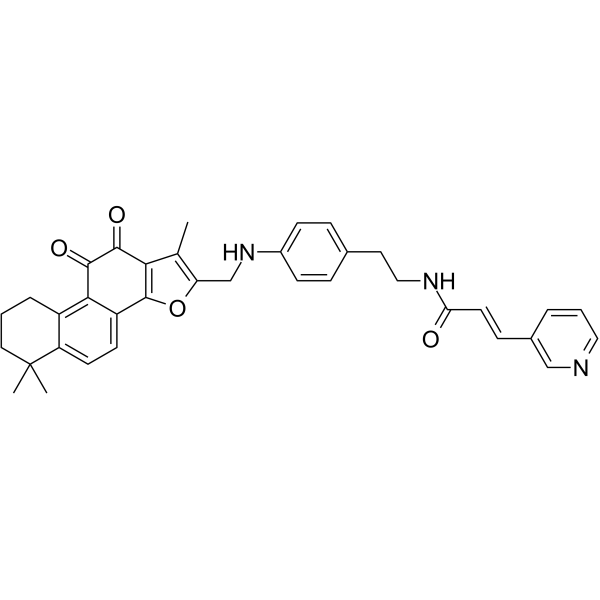
Antitumor agent-195 (compound 16c) is a dual targeting agent of STAT3 and NQO1. Antitumor agent-195 significantly inhibits phosphorylation of STAT3 at Tyr705 at a concentration of 1 μM and effectively induce Apoptosis in MDAMB-231 and MDA-MB-468 breast cancer cells. Antitumor agent-195 as a NQO1 substrate strongly increases ROS generation and causes severe DNA damage in a dose-dependent manner. Antitumor agent-195 shows encouraging anti-tumor efficacy in the MDA-MB-231 xenograft model .
loading...
    loading...
Cat. No.: HY-128895A
CAS No.: 1800406-26-1
KL1333 hydrochloride is an orally active NAD + modulator that reacts with NAD(P)H:quinone oxidoreductase 1 (NQO1) as a substrate, leading to increased intracellular NAD + levels through NADH oxidation. Elevated NAD + levels trigger activation of SIRT1 and AMPK, and subsequently activate PGC-1α. KL1333 hydrochloride improves energy metabolism and mitochondrial dysfunction in mitochondrial encephalomyopathy, lactic acidosis, and stroke-like episodes (MELAS) fibroblasts. KL1333 hydrochloride protects against cisplatin-induced ototoxicity in mouse cochlear cultures .
loading...
    loading...
Cat. No.: HY-108992R
CAS No.: 96748-86-6
Deoxynyboquinone (Standard) is the analytical standard of Deoxynyboquinone (HY-108992). This product is intended for research and analytical applications. Deoxynyboquinone, an excellent NQO1 substrate, is a potent antineoplastic agent. Deoxynyboquinone induces apoptosis in cancer cell lines. Deoxynyboquinone Kills cancer cells through oxidative stress and reactive oxygen species (ROS) formation .
loading...
    loading...
Cat. No.: HY-184706
CAS No.: 3126116-06-8
SHN7 is a selective HDAC1/HDAC6 inhibitor, NQO1 substrate and ROS inducer, with an IC50 of 30 nM against HDAC1 and an IC50 of 10 nM against HDAC6. SHN7 inhibits STAT3 with a Kd of 8.9 μM. SHN7 arrests the cell cycle at the G2/M phase and induces Apoptosis. SHN7 exhibits anti-tumor effects in triple-negative breast cancer (TNBC) xenograft models. SHN7 can be used for the research of triple-negative breast cancer .
loading...
    loading...

