Search Result
Results for "
PEG2
" in MedChemExpress (MCE) Product Catalog:
13
Biochemical Assay Reagents
1
Isotope-Labeled Compounds
| Cat. No. |
Product Name |
Target |
Research Areas |
Chemical Structure |
-
- HY-131872
-
|
Pomalidomide 4'-PEG2-acid
|
E3 Ligase Ligand-Linker Conjugates
|
Cancer
|
|
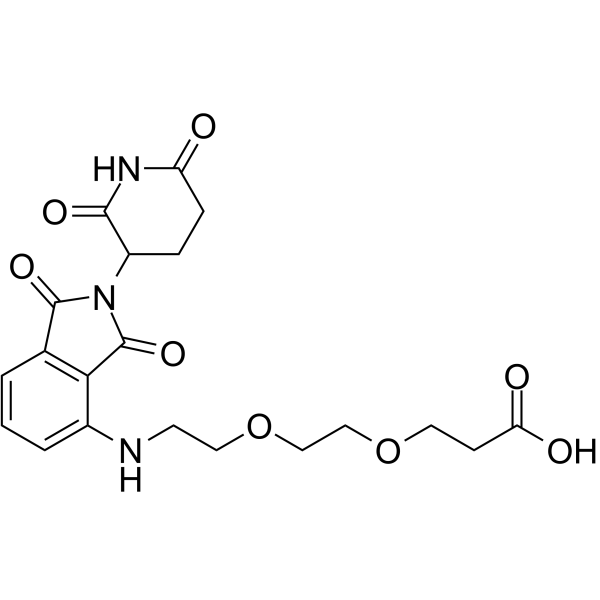
Pomalidomide-PEG2-COOH (Pomalidomide 4'-PEG2-acid) is a synthesized E3 ligase ligand-linker conjugate that incorporates the Pomalidomide based cereblon ligand and 2-unit PEG linker used in PROTAC technology .
|
-
-
- HY-128870
-
|
|
Drug-Linker Conjugates for ADC
|
Cancer
|
|
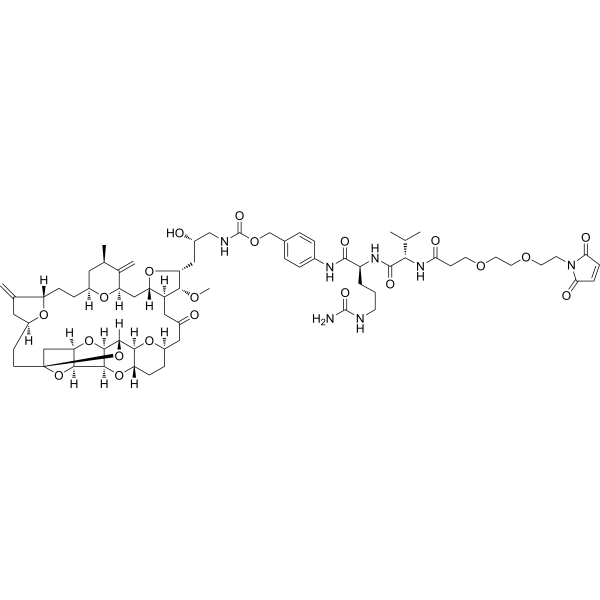
Mal-PEG2-VCP-Eribulin consists the ADCs linker (Mal-PEG2-VCP) and Eribulin (HY-13442). Eribulin is a mechanistically unique microtubule inhibitor and Eribulin inhibits the proliferation of cancer cells by binding microtubule proteins and microtubules. Mal-PEG2-VCP-Eribulin is an Eribulin-based agent for antibody conjugates [2] .
|
-
-
- HY-W051634
-
|
|
ADC Linker
PROTAC Linkers
|
Cancer
|
|
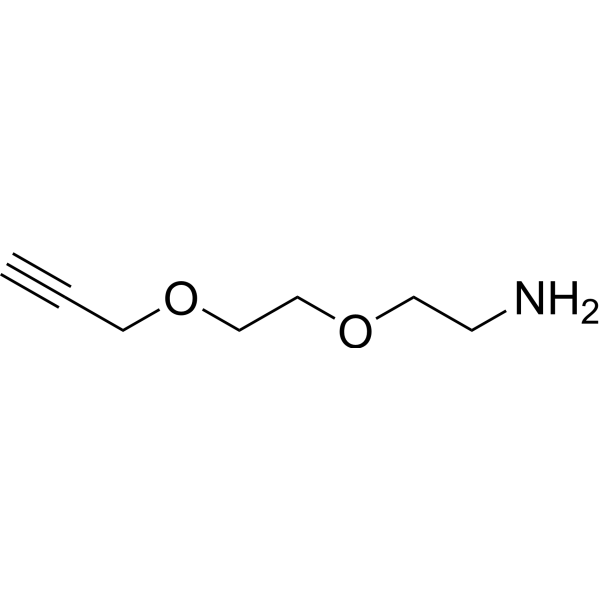
Propargyl-PEG2-amine is a non-cleavable ADC linker used in the synthesis of antibody-drug conjugates (ADCs). Propargyl-PEG2-amine is a PEG-based PROTAC linker can be used in the synthesis of PROTACs [2]. Propargyl-PEG2-amine is a click chemistry reagent, it contains an Alkyne group and can undergo copper-catalyzed azide-alkyne cycloaddition (CuAAc) with molecules containing Azide groups.
|
-
-
- HY-148865
-
|
|
Biochemical Assay Reagents
|
Others
|
|
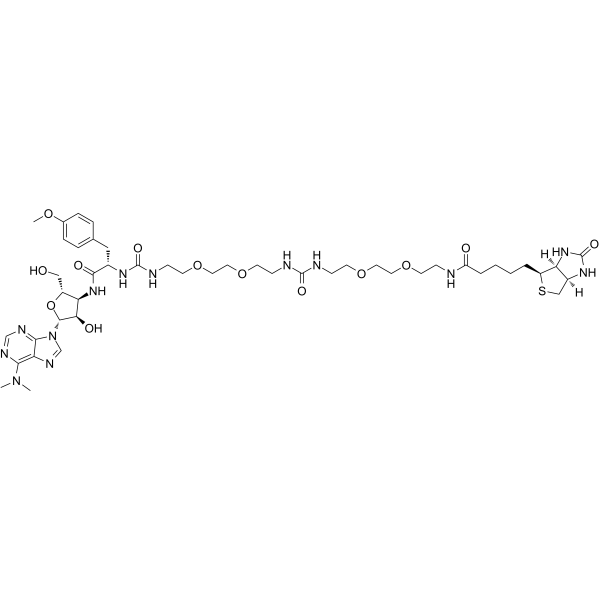
Puromycin-bis (PEG2-amide)-Biotin (Compound 3P) is a binding molecule. Puromycin-bis (PEG2-amide)-Biotin binds to ribosome-RNA complexes within single cells. Puromycin-bis (PEG2-amide)-Biotin is used for single-cell translatome sequencing .
|
-
-
- HY-130442
-
|
|
ADC Linker
PROTAC Linkers
|
Cancer
|
|
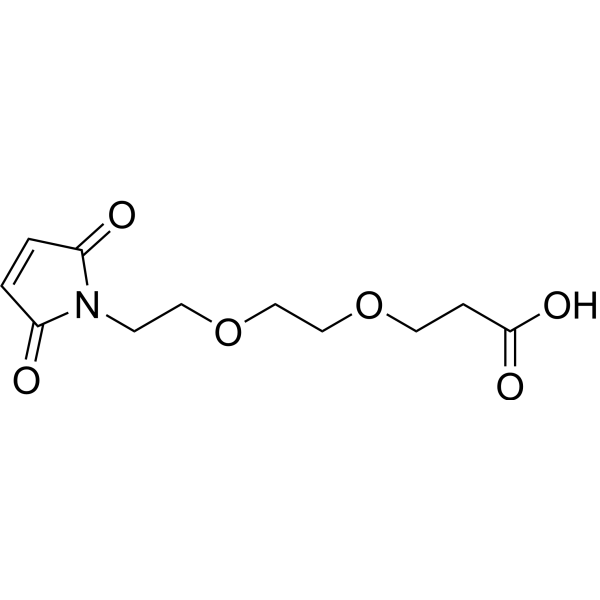
Mal-PEG2-acid is a non-cleavable ADC linker used in the synthesis of antibody-drug conjugates (ADCs). Mal-PEG2-acid can be conjugated to Tubulysin (HY-128914) and its derivative cytotoxic molecule . Mal-PEG2-acid is also a PROTAC linker that can be used in the synthesis of PROTACs.
|
-
-
- HY-113697
-
|
Mal-PEG2-AZD
|
PROTAC Linkers
|
Cancer
|
|
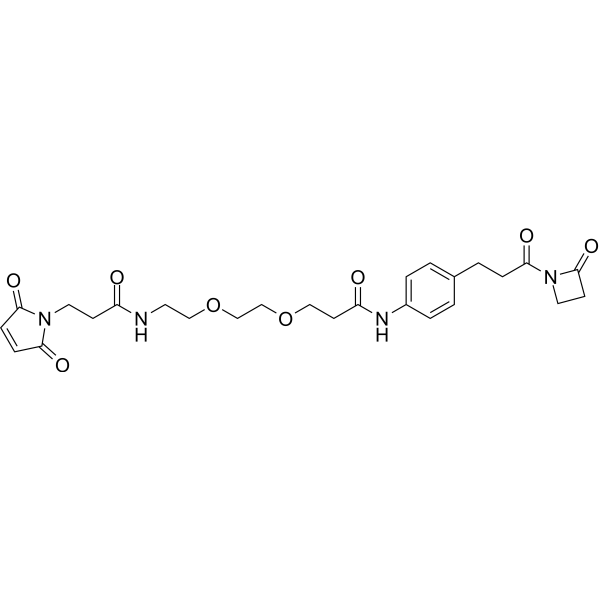
Mal-amido-PEG2-C2-amido-Ph-C2-CO-AZD (Mal-PEG2-AZD) is a PEG-based PROTAC linker that can be used in the synthesis of PROTACs .
|
-
-
- HY-W008429
-
|
|
ADC Linker
PROTAC Linkers
|
Cancer
|
|
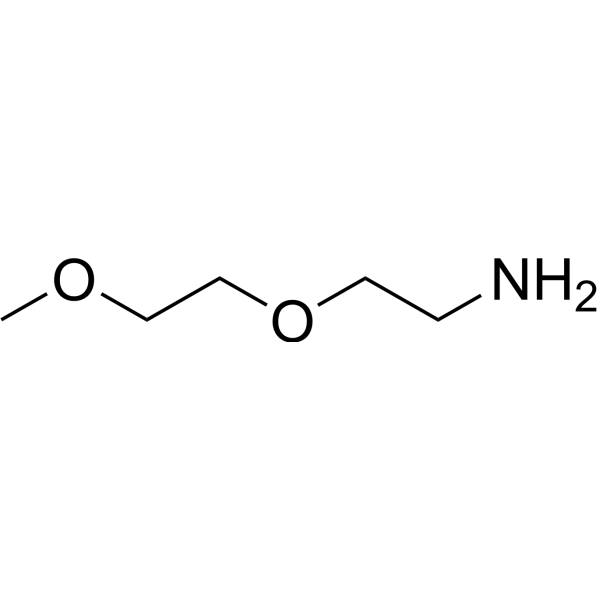
m-PEG2-Amine is a PEG-based PROTAC linker can be used in the synthesis of PROTACs. m-PEG2-Amine is a cleavable ADC linker used in the synthesis of antibody-drug conjugates (ADCs) .
|
-
-
- HY-W006445
-
|
|
ADC Linker
PROTAC Linkers
|
Cancer
|
|
N-Boc-PEG2-bromide is a PEG/Alkyl/ether-based PROTAC linker can be used in the synthesis of PROTACs. N-Boc-PEG2-bromide is a cleavable ADC linker used in the synthesis of antibody-drug conjugates (ADCs) .
|
-
-
- HY-W096164
-
|
|
PROTAC Linkers
|
Cancer
|
|
Propargyl-PEG2-bromide is a PEG-based PROTAC linker that can be used in the synthesis of PROTACs . Propargyl-PEG2-bromide is a click chemistry reagent, it contains an Alkyne group and can undergo copper-catalyzed azide-alkyne cycloaddition (CuAAc) with molecules containing Azide groups.
|
-
-
- HY-112559
-
|
|
PROTAC Linkers
|
Cancer
|
|
Bis-PEG2-acid is a PEG-based PROTAC linker can be used in the synthesis of PROTACs .
|
-
-
- HY-136133
-
|
|
ADC Linker
|
Cancer
|
|
NHS-PEG2-SS-PEG2-NHS is a cleavable 4 unit PEG ADC linker used in the synthesis of antibody-drug conjugates (ADCs) .
|
-
-
- HY-130541
-
|
|
PROTAC Linkers
|
Cancer
|
|
Propargyl-PEG2-OH is a PEG-based PROTAC linker can be used in the synthesis of Thalidomide-O-PEG2-propargyl (HY-126458) . Propargyl-PEG2-OH is a click chemistry reagent, it contains an Alkyne group and can undergo copper-catalyzed azide-alkyne cycloaddition (CuAAc) with molecules containing Azide groups.
|
-
-
- HY-156748
-
|
|
Drug-Linker Conjugates for ADC
Topoisomerase
|
Cancer
|
|
MC-PEG2-VA-PAB-Exatecan (Compound DL-18) is a Drug-Linker Conjugates for ADC. MC-PEG2-VA-PAB-Exatecan consists of Exatecan (HY-13631) and a linker. MC-PEG2-VA-PAB-Exatecan can be used for synthesis of ADCs .
|
-
-
- HY-126958
-
-
-
- HY-118764
-
|
|
ADC Linker
PROTAC Linkers
|
Cancer
|
|
Propargyl-PEG2-acid is a non-cleavable 2 unit PEG ADC linker used in the synthesis of antibody-drug conjugates (ADCs). Propargyl-PEG2-acid is also a PEG-based PROTAC linker that can be used in the synthesis of PROTACs . Propargyl-PEG2-acid is a click chemistry reagent, it contains an Alkyne group and can undergo copper-catalyzed azide-alkyne cycloaddition (CuAAc) with molecules containing Azide groups.
|
-
-
- HY-130162
-
|
|
PROTAC Linkers
|
Cancer
|
|
Tos-PEG2-O-Propargyl is a PEG-based PROTAC linker can be used in the synthesis of Thalidomide-O-PEG2-propargyl (HY-126458) . Tos-PEG2-O-Propargyl is a click chemistry reagent, it contains an Alkyne group and can undergo copper-catalyzed azide-alkyne cycloaddition (CuAAc) with molecules containing Azide groups.
|
-
-
- HY-114995
-
-
-
- HY-138524
-
|
|
PROTAC Linkers
|
Cancer
|
|
Thiol-PEG2-acid is a PEG-based PROTAC linker that can be used in the synthesis of PROTACs .
|
-
-
- HY-W067061
-
|
|
ADC Linker
PROTAC Linkers
|
Cancer
|
|
Hydroxy-PEG2-(CH2)2-Boc is a uncleavable ADC linker used in the synthesis of antibody-drug conjugates (ADCs). Hydroxy-PEG2-(CH2)2-Boc is extracted from patent WO2004008101A2 (compound 196) . Hydroxy-PEG2-(CH2)2-Boc is also a PROTAC linker that can be used in the synthesis of PROTACs.
|
-
-
- HY-118808
-
|
|
ADC Linker
PROTAC Linkers
|
Cancer
|
|
Propargyl-PEG2-NHBoc is a cleavable ADC linker used in the synthesis of antibody-drug conjugates (ADCs). Propargyl-PEG2-NHBoc is a PEG-based PROTAC linker can be used in the synthesis of PROTACs . Propargyl-PEG2-NHBoc is a click chemistry reagent, it contains an Alkyne group and can undergo copper-catalyzed azide-alkyne cycloaddition (CuAAc) with molecules containing Azide groups.
|
-
-
- HY-130328
-
|
|
ADC Linker
PROTAC Linkers
|
Cancer
|
|
NH-bis-PEG2 is a non-cleavable 2 unit PEG ADC linker used in the synthesis of antibody-drug conjugates (ADCs). NH-bis-PEG2 is also a PEG-based PROTAC linker that can be used in the synthesis of PROTACs.
|
-
-
- HY-W190932
-
|
|
Fluorescent Dye
|
Others
|
|
TAMRA-PEG2-Maleimide is a dye derivative of TAMRA (HY-135640) containing 4 PEG units. TAMRA-PEG2-Maleimide contains a maleimide group that can react with a thiol group to form a covalent bond.
|
-
-
- HY-W105666
-
|
Triglycol dichloride
|
PROTAC Linkers
|
Cancer
|
|
PEG2-Dichloride (Triglycol dichloride) is a PROTAC linker that can be used in the synthesis of PROTACs.
|
-
-
- HY-155327B
-
|
|
Fluorescent Dye
|
Others
|
|
Cy3-PEG2-endo-BCN bromide is the bromide salt form of Cy3-PEG2-endo-BCN (HY-155327). Cy3-PEG2-endo-BCN bromide is a dye derivative of Cyanine 3 (Cy3) (HY-D0822) containing 2 PEG units. Cy3-PEG2-endo-BCN bromide contains the lyophilic bidentate macrocyclic ligand endo-BCN, which can further synthesize macrocyclic complexes. In click chemistry, endo-BCN can react with molecules containing azide groups to form stable triazoles in the absence of catalysts .
|
-
-
- HY-138734
-
|
|
PROTAC Linkers
|
Cancer
|
|
Propargyl-PEG2-NHS ester is a PEG-based PROTAC linker that can be used in the synthesis of PROTACs . Propargyl-PEG2-NHS ester is a click chemistry reagent, it contains an Alkyne group and can undergo copper-catalyzed azide-alkyne cycloaddition (CuAAc) with molecules containing Azide groups.
|
-
-
- HY-43055
-
|
|
PROTAC Linkers
|
Cancer
|
|
Cl-PEG2-acid is a PEG-based PROTAC linker that can be used in the synthesis of PROTACs .
|
-
-
- HY-124380
-
|
|
PROTAC Linkers
|
Cancer
|
|
Hydroxy-PEG2-acid is a PEG-based PROTAC linker that can be used in the synthesis of PROTACs .
|
-
-
- HY-164181
-
-
-
- HY-W047691
-
-
-
- HY-P3502B
-
|
|
Complement System
|
Inflammation/Immunology
|
|
Zilucoplan (PEG2) is a Zilucoplan (HY-P3502) derivative, where the linker section replaces PEG24 by PEG2. Zilucoplan is a potent complement component 5 (C5) inhibitor .
|
-
-
- HY-161129
-
|
|
E3 Ligase Ligand-Linker Conjugates
|
Cancer
|
|
Lenalidomide 4'-PEG2-amine dihydrochloride is the Lenalidomide-based Cereblon ligand used in the recruitment of CRBN protein. Lenalidomide 4'-PEG2-amine dihydrochloride can be connected to the ligand for protein by a linker to form PROTAC .
|
-
-
- HY-139543
-
-
-
- HY-130231
-
|
|
PROTAC Linkers
|
Cancer
|
|
m-PEG2-acid is a PEG-based PROTAC linker can be used in the synthesis of PROTACs.
|
-
-
- HY-148549
-
-
-
- HY-W250654
-
-
-
- HY-W025724
-
-
-
- HY-42745
-
|
|
ADC Linker
PROTAC Linkers
|
Cancer
|
|
m-PEG2-Tos is a uncleavable ADC linker used in the synthesis of antibody-drug conjugates (ADCs). m-PEG2-Tos is also a PEG-based PROTAC linker that can be used in the synthesis of PROTACs.
|
-
-
- HY-W190842
-
|
|
Biochemical Assay Reagents
|
Others
|
|
m-PEG2-NHS ester is a PEG linker containing an NHS ester. The NHS ester of m-PEG2-NHS ester is used to label primary amines (-NH2) of proteins, amine-modified oligonucleotides and other amine-containing molecules. The hydrophilic PEG spacer effectively improves solubility in aqueous media. m-PEG2-NHS ester can be used in studies related to bioconjugation with ADC, proteins, peptides and other molecules .
|
-
-
- HY-W022204
-
|
|
PROTAC Linkers
|
Cancer
|
|
Thiol-PEG2-thiol is a PROTAC linker that can be used in the synthesis of PROTACs.
|
-
-
- HY-155322
-
|
|
Fluorescent Dye
|
Others
|
|
Cy3-PEG2-TCO is a dye derivative of Cyanine 3 (Cy3) (HY-D0822) containing 2 PEG units. Cy3-PEG2-TCO can use its own TCO group to perform an inverse electron demand Diels-Alder reaction (iEDDA) with molecules with Tetrazine groups.
|
-
-
- HY-133498
-
|
|
PROTAC Linkers
|
Cancer
|
|
HyNic-PEG2-DBCO is a PEG-based PROTAC linker that can be used in the synthesis of PROTACs . HyNic-PEG2-DBCO is a click chemistry reagent, it contains a DBCO group that can undergo strain-promoted alkyne-azide cycloaddition (SPAAC) with molecules containing Azide groups.
|
-
-
- HY-140283
-
|
|
PROTAC Linkers
|
Cancer
|
|
DBCO-PEG2-amine is a PEG-based PROTAC linker that can be used in the synthesis of PROTACs . DBCO-PEG2-amine is a click chemistry reagent, it contains a DBCO group that can undergo strain-promoted alkyne-azide cycloaddition (SPAAC) with molecules containing Azide groups.
|
-
-
- HY-140155
-
|
Methylamino-PEG2-t-butyl ester
|
PROTAC Linkers
|
Cancer
|
|
Methylamino-PEG2-Boc is a PEG-based PROTAC linker that can be used in the synthesis of PROTACs .
|
-
-
- HY-138476
-
|
|
PROTAC Linkers
|
Cancer
|
|
Benzyl-PEG2-ethoxyethane-PEG2 is a PEG-based PROTAC linker that can be used in the synthesis of PROTACs .
|
-
-
- HY-W762473
-
|
|
PROTAC Linkers
|
Cancer
|
|
Boc-NH-PEG2-CONH-PEG2-COOH is a PROTAC linker that can be used in the synthesis of PROTACs.
|
-
-
- HY-167759
-
|
Pomalidomide-PEG2-CH2COOH
|
E3 Ligase Ligand-Linker Conjugates
|
Cancer
|
|
Pomalidomide-PEG2-acetic acid (Pomalidomide-PEG2-CH2COOH) is the conjugate composed of a E3 ligase ligand and a linker. Pomalidomide-PEG2-acetic acid can be used for PROTAC synthesis .
|
-
-
- HY-140085
-
|
|
PROTAC Linkers
|
Cancer
|
|
N-(PEG2-C2-acid)-N-bis(PEG2-propargyl) is a PEG-based PROTAC linker that can be used in the synthesis of PROTACs . N-(PEG2-C2-acid)-N-bis(PEG2-propargyl) is a click chemistry reagent, it contains an Alkyne group and can undergo copper-catalyzed azide-alkyne cycloaddition (CuAAc) with molecules containing Azide groups.
|
-
-
- HY-W142428
-
|
Diethylene glycol monododecyl ether
|
Biochemical Assay Reagents
|
Others
|
|
PEG 2 lauryl ether can be used as an excipient. Pharmaceutical excipients, or pharmaceutical auxiliaries, refer to other chemical substances used in the pharmaceutical process other than pharmaceutical ingredients. Pharmaceutical excipients generally refer to inactive ingredients in pharmaceutical preparations, which can improve the stability, solubility and processability of pharmaceutical preparations. Pharmaceutical excipients also affect the absorption, distribution, metabolism, and elimination (ADME) processes of co-administered drugs .
|
-
-
- HY-133191
-
|
|
PROTAC Linkers
|
Infection
Cancer
|
|
Bis-propargyl-PEG2 is a PEG-based PROTAC linker can be used in the synthesis of PROTACs. Bis-propargyl-PEG2 is used for the synthesis of demethylvancomycin dimers [2]. Bis-propargyl-PEG2 is a click chemistry reagent, it contains an Alkyne group and can undergo copper-catalyzed azide-alkyne cycloaddition (CuAAc) with molecules containing Azide groups.
|
-
-
- HY-W096116
-
|
|
PROTAC Linkers
|
Cancer
|
|
PEG2-Cl is a PEG-based PROTAC linker that can be used in the synthesis of PROTACs .
|
-
- HY-D2142
-
|
|
Fluorescent Dye
|
Others
|
|
Cy5-PEG2-TCO is a fluorescent dye that reacts with tetrazines. Cy5-PEG2-TCO contains a TCO group that can undergo an inverse electron demand Diels-Alder reaction (iEDDA) with molecules containing a Tetrazine group.
|
-
- HY-W043937
-
-
- HY-140266
-
|
|
PROTAC Linkers
|
Cancer
|
|
DBCO-PEG2-acid is a PEG-based PROTAC linker that can be used in the synthesis of PROTACs . DBCO-PEG2-acid is a click chemistry reagent, it contains a DBCO group that can undergo strain-promoted alkyne-azide cycloaddition (SPAAC) with molecules containing Azide groups.
|
-
- HY-130557
-
|
|
PROTAC Linkers
|
Cancer
|
|
endo-BCN-PEG2-acid is a PEG-based PROTAC linker can be used in the synthesis of PROTACs. endo-BCN-PEG2-acid is a click chemistry reagent, it contains a BCN group that can undergo strain-promoted alkyne-azide cycloaddition (SPAAC) with molecules containing Azide groups.
|
-
- HY-W346199
-
-
- HY-140374
-
|
|
PROTAC Linkers
|
Cancer
|
|
Propargyl-PEG2-Tos is a PEG-based PROTAC linker that can be used in the synthesis of PROTACs . Propargyl-PEG2-Tos is a click chemistry reagent, it contains an Alkyne group and can undergo copper-catalyzed azide-alkyne cycloaddition (CuAAc) with molecules containing Azide groups.
|
-
- HY-159680
-
|
|
PROTAC Linkers
|
Cancer
|
|
OMs-PEG2-NHAlloc-PEG2-Boc is a PROTAC linker. OMs-PEG2-NHAlloc-PEG2-Boc can be used in synthesis PROTAC SMARCA2/4-degrader-28 (HY-162835) .
|
-
- HY-140083
-
|
|
PROTAC Linkers
|
Cancer
|
|
Propargyl-PEG2-N-bis(PEG2) is a PEG-based PROTAC linker that can be used in the synthesis of PROTACs . Propargyl-PEG2-N-bis(PEG2) is a click chemistry reagent, it contains an Alkyne group and can undergo copper-catalyzed azide-alkyne cycloaddition (CuAAc) with molecules containing Azide groups.
|
-
- HY-138475
-
|
|
PROTAC Linkers
|
Cancer
|
|
Boc-PEG2-ethoxyethane-PEG2-benzyl is a PEG-based PROTAC linker that can be used in the synthesis of PROTACs .
|
-
- HY-140112
-
|
|
ADC Linker
|
Cancer
|
|
Acid-PEG2-SS-PEG2-acid is a cleavable 4 unit PEG ADC linker used in the synthesis of antibody-drug conjugates (ADCs) .
|
-
- HY-140044
-
|
Propargyl-PEG2-NHMe
|
PROTAC Linkers
|
Cancer
|
|
Propargyl-PEG2-methylamine (Propargyl-PEG2-NHMe) is a PEG derivative containing a propargyl group and methylamine group. Propargyl-PEG2-methylamine is an PROTAC linker used in the synthesis of PROTACs. Propargyl-PEG2-methylamine is a click chemistry reagent, it contains an Alkyne group and can undergo copper-catalyzed azide-alkyne cycloaddition (CuAAc) with molecules containing Azide groups .
|
-
- HY-140093
-
|
|
PROTAC Linkers
|
Cancer
|
|
N-(PEG2-Boc)-N-bis(PEG2-propargyl) is a PEG-based PROTAC linker that can be used in the synthesis of PROTACs . N-(PEG2-Boc)-N-bis(PEG2-propargyl) is a click chemistry reagent, it contains an Alkyne group and can undergo copper-catalyzed azide-alkyne cycloaddition (CuAAc) with molecules containing Azide groups.
|
-
- HY-150202
-
-
- HY-136130
-
|
|
ADC Linker
|
Cancer
|
|
N,N-Bis(PEG2-alkyne)-N-amido-PEG2-thiol is a cleavable 4 unit PEG ADC linker used in the synthesis of antibody-drug conjugates (ADCs) . N,N-Bis(PEG2-alkyne)-N-amido-PEG2-thiol is a click chemistry reagent, it contains an Alkyne group and can undergo copper-catalyzed azide-alkyne cycloaddition (CuAAc) with molecules containing Azide groups.
|
-
- HY-W109760
-
|
|
PROTAC Linkers
|
Cancer
|
|
FmocNH-PEG2-CH2CONH-PEG2-CH2COOH is an optimized, extended PEG-like linker [1] .
|
-
- HY-161134
-
|
|
E3 Ligase Ligand-Linker Conjugates
|
Cancer
|
|
Lenalidomide 4'-PEG2-azide is the Lenalidomide-based Cereblon ligand used in the recruitment of CRBN protein. Lenalidomide 4'-PEG2-azide can be connected to the ligand for protein by a linker to form PROTAC .
|
-
- HY-132083
-
|
|
PROTAC Linkers
|
Cancer
|
|
Hydroxy-PEG2-CH2CH2COO-PEG2-propionic acid is a PEG-based PROTAC linker that can be used in the synthesis of PROTACs .
|
-
- HY-W105837
-
|
|
PROTAC Linkers
|
Cancer
|
|
PEG2-bis(Alkyne) is a PROTAC linker that can be used in the synthesis of PROTACs.
|
-
- HY-138436
-
|
|
PROTAC Linkers
|
Cancer
|
|
PEG2-ethyl acetate is a PEG-based PROTAC linker that can be used in the synthesis of PROTACs .
|
-
- HY-164210
-
|
|
ADC Linker
|
Cancer
|
|
DBCO-PEG2-C2-acid is an ADC Linker. DBCO-PEG2-C2-acid can be used to synthesize Antibody-Drug Conjugates (ADCs) .
|
-
- HY-156391
-
|
|
PROTAC Linkers
|
Cancer
|
|
TCO4-PEG2-Maleimide is a PROTAC linker and belongs to the PEG class. TCO4-PEG2-Maleimide contains TCO and Maleimide groups, which can undergo specific "click" reactions with tetrazine groups or thiol groups, or "mercapto-acrylamide" reactions.
|
-
- HY-W584533
-
|
|
E3 Ligase Ligand-Linker Conjugates
|
Cancer
|
|
VH032-PEG2-NH-BOC is a Boc-modified VH032 (HY-120217) that serves as a ligand for VHL and recruits von Hippel-Lindau (VHL) proteins. VH032-PEG2-NH-BOC will remove the protecting group under acidic conditions and be directly used for PROTAC molecule synthesis. VH032-PEG2-NH-BOC is a key intermediate in the synthesis of PROTAC based on VHL ligand.
|
-
- HY-136129
-
|
|
ADC Linker
|
Cancer
|
|
N,N-Bis(PEG2-N3)-N-amido-PEG2-thiol is a cleavable 4 unit PEG ADC linker used in the synthesis of antibody-drug conjugates (ADCs) . N,N-Bis(PEG2-N3)-N-amido-PEG2-thiol is a click chemistry reagent, it contains an Azide group and can undergo copper-catalyzed azide-alkyne cycloaddition reaction (CuAAc) with molecules containing Alkyne groups. It can also undergo strain-promoted alkyne-azide cycloaddition (SPAAC) reactions with molecules containing DBCO or BCN groups.
|
-
- HY-156389
-
|
|
PROTAC Linkers
|
Cancer
|
|
(R)-TCO4-PEG2-NH2 is a PROTAC linker and belongs to the PEG class. (R)-TCO4-PEG2-NH2 contains a TCO group that specifically "clicks" with the tetrazine group.
|
-
- HY-W251685
-
|
|
PROTAC Linkers
|
Cancer
|
|
MeOAc-PEG2-acid is a PROTAC linker that can be used in the synthesis of PROTACs.
|
-
- HY-140017
-
-
- HY-156391A
-
|
|
PROTAC Linkers
|
Cancer
|
|
TCO4-PEG2-Maleimide is a PROTAC linker and belongs to the PEG class. TCO4-PEG2-Maleimide contains TCO and Maleimide groups, which can undergo specific "click" reactions with tetrazine groups or thiol groups, or "mercapto-acrylamide" reactions.
|
-
- HY-126951
-
|
|
ADC Linker
PROTAC Linkers
|
Cancer
|
|
Aminooxy-PEG2-alcohol is a non-cleavable 2 unit PEG ADC linker used in the synthesis of antibody-drug conjugates (ADCs) . Aminooxy-PEG2-alcohol is also a PEG-based PROTAC linker that can be used in the synthesis of PROTACs [2].
|
-
- HY-155255
-
|
|
E3 Ligase Ligand-Linker Conjugates
Autophagy
Apoptosis
|
Cancer
|
|
Thalidomide-5-PEG2-NH2 hydrochloride is the Thalidomide (HY-10984)-based cereblon ligand used in the recruitment of CRBN protein.Thalidomide-5-PEG2-NH2 hydrochloride can be connected to the ligand for protein by a linker to form PROTACs .
|
-
- HY-156315
-
|
|
ADC Linker
|
Cancer
|
|
SCO-PEG2-NH2 is a cleavable ADC Linker containing 2 PEG units. SCO-PEG2-NH2 can be used as a copper-free click chemical reagent for catalyst-free click reactions.
|
-
- HY-112560
-
|
|
PROTAC Linkers
ADC Linker
|
Cancer
|
|
Bis-PEG2-PFP ester is also a non-cleavable 2 unit PEG ADC linker used in the synthesis of antibody-drug conjugates (ADCs) . Bis-PEG2-PFP ester is also a PEG-based PROTAC linker that can be used in the synthesis of PROTACs [2].
|
-
- HY-W044212
-
-
- HY-W249300
-
-
- HY-131228
-
-
- HY-W151019
-
|
|
PROTAC Linkers
|
Cancer
|
|
MeNH-PEG2-NHMe is a PROTAC linker that can be used in the synthesis of PROTACs.
|
-
- HY-130597
-
|
|
PROTAC Linkers
|
Cancer
|
|
Propargyl-PEG2-Boc is a PEG-based PROTAC linker that can be used in the synthesis of PROTACs . Propargyl-PEG2-Boc is a click chemistry reagent, it contains an Alkyne group and can undergo copper-catalyzed azide-alkyne cycloaddition (CuAAc) with molecules containing Azide groups.
|
-
- HY-130584
-
|
|
PROTAC Linkers
|
Cancer
|
|
Propargyl-PEG2-MS is a PEG-based PROTAC linker can be used in the synthesis of PROTACs . Propargyl-PEG2-MS is a click chemistry reagent, it contains an Alkyne group and can undergo copper-catalyzed azide-alkyne cycloaddition (CuAAc) with molecules containing Azide groups.
|
-
- HY-156303
-
|
|
Fluorescent Dye
|
Others
|
|
Coumarin-PEG2-TCO is a dye derivative of Coumarin (HY-N0709) containing 2 PEG units. Coumarin-PEG2-TCO utilizes its TCO group to undergo an inverse electron demand Diels-Alder reaction (iEDDA) with molecules bearing Tetrazine groups.
|
-
- HY-140277
-
|
|
PROTAC Linkers
|
Cancer
|
|
DBCO-PEG2-PFP ester is a PEG-based PROTAC linker that can be used in the synthesis of PROTACs. DBCO-PEG2-PFP ester is a click chemistry reagent, it contains a DBCO group that can undergo strain-promoted alkyne-azide cycloaddition (SPAAC) with molecules containing Azide groups .
|
-
- HY-W096142
-
|
|
PROTAC Linkers
|
Cancer
|
|
Benzyl-PEG2-acid is a PEG-based PROTAC linker that can be used in the synthesis of PROTACs .
|
-
- HY-140153
-
|
|
PROTAC Linkers
|
Cancer
|
|
Methylamino-PEG2-acid is a PEG-based PROTAC linker that can be used in the synthesis of PROTACs .
|
-
- HY-157008
-
|
|
ADC Linker
|
Cancer
|
|
(S)-TCO-PEG2-Maleimide is an ADC linker containing 2 PEG units. (S)-TCO-PEG2-Maleimide can use its own TCO group to perform an inverse electron demand Diels-Alder reaction (iEDDA) with molecules with Tetrazine groups.
|
-
- HY-141320
-
|
|
PROTAC Linkers
|
Cancer
|
|
PEG2-bis(phosphonic acid diethyl ester) is a PEG-based PROTAC linker that can be used in the synthesis of PROTACs .
|
-
- HY-W574509
-
|
|
Biochemical Assay Reagents
|
Cancer
|
|
Tos-PEG2-acid (compound 30) is a PEG linker containing a tosyl group and a terminal carboxylic acid. Tos-PEG2-acid can react with primary amine groups .
|
-
- HY-W1130371
-
|
|
Ligands for E3 Ligase
|
Cancer
|
|
Bis-PEG2-amine-Thalidomide hydrochloride is an E3 ubiquitin ligase cereblon (CRBN) ligand used to recruit the cereblon protein. Bis-PEG2-amine-Thalidomide hydrochloride can be linked to a target protein ligand via a linker to form a PROTAC.
|
-
- HY-29501
-
|
SH-PEG2-NH2
|
Biochemical Assay Reagents
|
Others
|
|
Thiol-PEG2-NH2 (SH-PEG2-NH2) is a PEG derivative consisting of a thiol (-SH), 2 PEG units, and NH2. Thiol is a highly reactive chemical group that can react specifically with a variety of molecules to form stable covalent bonds.
|
-
- HY-185153
-
|
|
Drug-Linker Conjugates for ADC
|
Cancer
|
|
MC-VC-PAB-DMEA-PEG2-Duocarmycin SA is a drug-linker conjugate for ADC. MC-VC-PAB-DMEA-PEG2-Duocarmycin SA can be coupled with Carlumab (HY-P99188) to form Anti-CCL2 (Carlumab)-MC-Vc-PAB-DMEA-PEG2-Duocarmycin SA (HY-171685).
|
-
- HY-W190745A
-
|
|
Biochemical Assay Reagents
|
Others
|
|
DNP-PEG2-NHS ester is a PEG derivative that contains DNP (2,4-dinitroaniline), two PEG units, and NHS ester. NHS ester can covalently bind to molecules with amino groups (such as proteins, antibodies, etc.). DNP-PEG2-NHS ester can be used for drug delivery.
|
-
- HY-W190891
-
-
- HY-161974
-
-
- HY-133497
-
|
|
PROTAC Linkers
|
Cancer
|
|
HyNic-PEG2-TCO is a PEG-based PROTAC linker that can be used in the synthesis of PROTACs . HyNic-PEG2-TCO is a click chemistry reagent, it contains a TCO group that can undergo an inverse electron demand Diels-Alder reaction (iEDDA) with molecules containing Tetrazine groups.
|
-
- HY-145593
-
|
|
ADC Linker
|
Cancer
|
|
Aminooxy-PEG2-BCN is a cleavable PEG ADC linker used in the synthesis of antibody-drug conjugates (ADCs) . Aminooxy-PEG2-BCN is a click chemistry reagent, it contains a BCN group that can undergo strain-promoted alkyne-azide cycloaddition (SPAAC) with molecules containing Azide groups.
|
-
- HY-175827
-
-
- HY-176807
-
|
|
Drug-Linker Conjugates for ADC
DNA Alkylator/Crosslinker
|
Cancer
|
|
DBCO-HS-PEG2-VA-PABC-SG3199 is a drug-linker conjugate for ADC. DBCO-HS-PEG2-VA-PABC-SG3199 consists of a SG3199 (HY-101161) based DNA small channel crosslinker and cleavable linker. DBCO-HS-PEG2-VA-PABC-SG3199 can be used for synthesis of ADCs .
|
-
- HY-D2122
-
|
|
Fluorescent Dye
|
Others
|
|
Cy3-PEG2-SCO is a dye derivative of Cyanine 3 (Cy3) (HY-D0822) containing 2 PEG units. Cy3-PEG2-SCO carries a SCO group that can be covalently bound to an amino group. SCO is often used to react with amino acid residues of proteins or peptides, particularly lysine.
|
-
- HY-D2153
-
|
|
Fluorescent Dye
|
Others
|
|
Cy5-PEG2-SCO is a dye derivative of Cyanine 5 (Cy5) (HY-D0821) containing 2 PEG units. Cy5-PEG2-SCO has a SCO group that can be covalently bonded to the amino group. SCO is often used to react with amino acid residues of proteins or peptides, particularly lysine.
|
-
- HY-156475
-
|
|
ADC Linker
|
Cancer
|
|
Me-Tet-PEG2-COOH is an ADC Linker containing 2 PEG units. Me-Tet-PEG2-COOH can use its own Tetrazine group to undergo a specific inverse electron demand Diels-Alder reaction (iEDDA) with compounds with TCO groups.
|
-
- HY-140067A
-
|
|
PROTAC Linkers
|
Cancer
|
|
endo-BCN-PEG2-NHS ester is a PEG-based PROTAC linker that can be used in the synthesis of PROTACs. endo-BCN-PEG2-NHS ester contains a BCN group that can undergo strain-promoted alkyne-azide cycloaddition (SPAAC) with molecules containing Azide groups .
|
-
- HY-156476
-
|
|
ADC Linker
|
Cancer
|
|
Me-Tet-PEG2-NHS is an ADC Linker containing 2 PEG units. Me-Tet-PEG2-NHS can utilize its own Tetrazine group to undergo a specific inverse electron demand Diels-Alder reaction (iEDDA) with compounds with TCO groups.
|
-
- HY-W096162
-
|
|
PROTAC Linkers
|
Cancer
|
|
NH2-PEG2-methyl acetate is a PEG-based PROTAC linker that can be used in the synthesis of PROTACs .
|
-
- HY-W096162A
-
|
|
PROTAC Linkers
|
Others
|
|
NH2-PEG2-methyl acetate is a PEG-based PROTAC linker that can be used in the synthesis of PROTACs .
|
-
- HY-132102
-
|
|
PROTAC Linkers
|
Cancer
|
|
Bis-CH2-PEG2-acid is a PEG-based PROTAC linker that can be used in the synthesis of PROTACs .
|
-
- HY-D2527
-
-
- HY-156315A
-
|
|
ADC Linker
|
Cancer
|
|
SCO-PEG2-NH2 formate is a cleavable ADC Linker containing 2 PEG units. SCO-PEG2-NH2 formate can be used as a copper-free click chemical reagent for catalyst-free click reactions.
|
-
- HY-W1130394
-
|
|
Ligands for E3 Ligase
|
Cancer
|
|
Thalidomide-O-amido-PEG2-Mal is an E3 ubiquitin ligase cereblon (CRBN) ligand used to recruit the cereblon protein. Thalidomide-O-amido-PEG2-Mal can be linked to a target protein ligand via a linker to form a PROTAC.
|
-
- HY-103603B
-
|
VH032-PEG2-NH2 dihydrochloride
|
E3 Ligase Ligand-Linker Conjugates
|
Cancer
|
|
(S,R,S)-AHPC-PEG2-NH2 dihydrochloride (VH032-PEG2-NH2 dihydrochloride) is a synthesized E3 ligase ligand-linker conjugate that incorporates the (S,R,S)-AHPC based VHL ligand and 2-unit PEG linker used in the synthesis of PROTACs .
|
-
- HY-D1867
-
|
|
Fluorescent Dye
|
Others
|
|
Sulfo-Cy3-PEG2-TCO disodium is a derivative of Cy3 (Cyanine3) (HY-D0822) dye containing sulfonate and TCO groups. The TCO groups of Sulfo-Cy3-PEG2-TCO disodium react with tetrazine functional groups in highly specific click chemistry to form covalent bonds. Thus, Sulfo-Cy3-PEG2-TCO disodium can be covalently bound to some biomolecules (especially antibodies, proteins, etc.) to track their location and dynamic changes in biological samples.
|
-
- HY-153795
-
|
|
Drug-Linker Conjugates for ADC
Topoisomerase
|
Cancer
|
|
Mal-PEG2-Gly-Gly-Phe-Gly-Exatecan is a bioactive drug-linker conjugate for ADC (Drug-Linker Conjugates for ADC). Mal-PEG2-Gly-Gly-Phe-Gly-Exatecan consists of Exatecan (HY-13631) and a linker. Mal-PEG2-Gly-Gly-Phe-Gly-Exatecan is applicable to ADC synthesis and cancer research. Exatecan acts as a DNA Topoisomerase I inhibitor .
|
-
- HY-W540192
-
|
|
ADC Linker
|
Cancer
|
|
SCO-PEG2-Maleimide is an ADC Linker containing 3 PEG units. SCO-PEG2-Maleimide can be used as a copper-free click chemical reagent for catalyst-free click reactions. Its maleimide group (-Maleimide) degrades in aqueous media and has been used in drug delivery studies.
|
-
- HY-202399
-
|
|
PROTAC Linkers
|
Others
|
|
TCO-PEG2-NHS ester is a PEG/Alkyl/ether-based PROTAC linker can be used in the synthesis of PROTACs. TCO-PEG2-NHS ester is a click chemistry reagent, it contains a TCO group that can undergo an inverse electron demand Diels-Alder reaction (iEDDA) with molecules containing Tetrazine groups .
|
-
- HY-176950
-
-
- HY-140408
-
|
|
PROTAC Linkers
|
Cancer
|
|
Bis-aminooxy-PEG2 is a PEG-based PROTAC linker that can be used in the synthesis of PROTACs .
|
-
- HY-151665
-
|
|
ADC Linker
|
Others
|
|
Alkyne-PEG2-iodide is a click chemistry reagent with terminal alkyne and alkyl iodide groups.
|
-
- HY-132069
-
|
|
ADC Linker
|
Cancer
|
|
Mal-PEG2-azide is a PEG ADC linker, can be used for ADC synthesis .
|
-
- HY-W010764
-
|
|
PROTAC Linkers
|
Cancer
|
|
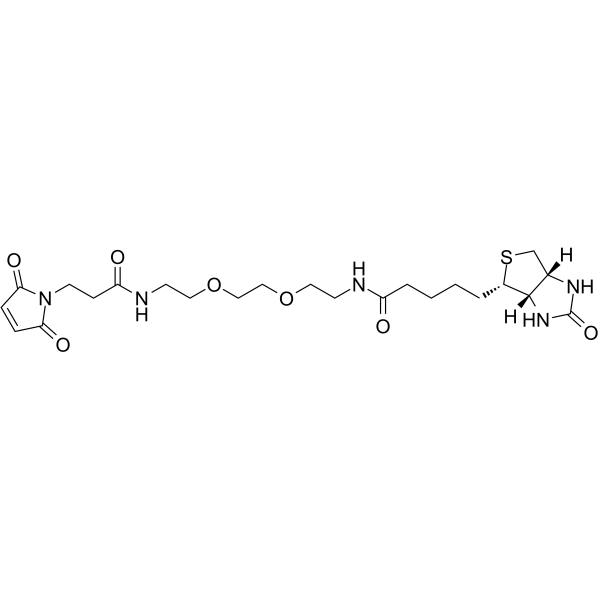
Biotin-PEG2-Mal is a PEG-based PROTAC linker can be used in the synthesis of PROTAC.
|
-
- HY-140421
-
|
|
PROTAC Linkers
|
Cancer
|
|
Boc-Aminooxy-PEG2 is a PEG-based PROTAC linker that can be used in the synthesis of PROTACs .
|
-
- HY-133366
-
|
|
PROTAC Linkers
|
Cancer
|
|
DBCO-NHCO-PEG2-amine is a PEG-based PROTAC linker that can be used in the synthesis of PROTACs . DBCO-NHCO-PEG2-amine is a click chemistry reagent, it contains a DBCO group that can undergo strain-promoted alkyne-azide cycloaddition (SPAAC) with molecules containing Azide groups.
|
-
- HY-133500
-
|
|
PROTAC Linkers
|
Cancer
|
|
Boc-HyNic-PEG2-alkyne is a PEG-based PROTAC linker that can be used in the synthesis of PROTACs . Boc-HyNic-PEG2-alkyne is a click chemistry reagent, it contains an Alkyne group and can undergo copper-catalyzed azide-alkyne cycloaddition (CuAAc) with molecules containing Azide groups.
|
-
- HY-135939
-
|
|
PROTAC Linkers
|
Cancer
|
|
DBCO-NHCO-PEG2-Biotin is a PEG-based PROTAC linker that can be used in the synthesis of PROTACs . DBCO-NHCO-PEG2-Biotin is a click chemistry reagent, it contains a DBCO group that can undergo strain-promoted alkyne-azide cycloaddition (SPAAC) with molecules containing Azide groups.
|
-
- HY-133502
-
|
|
PROTAC Linkers
|
Cancer
|
|
Boc-HyNic-PEG2-DBCO is a PEG-based PROTAC linker that can be used in the synthesis of PROTACs . Boc-HyNic-PEG2-DBCO is a click chemistry reagent, it contains a DBCO group that can undergo strain-promoted alkyne-azide cycloaddition (SPAAC) with molecules containing Azide groups.
|
-
- HY-140072
-
|
|
PROTAC Linkers
|
Cancer
|
|
endo-BCN-PEG2-PFP ester is a PEG-based PROTAC linker that can be used in the synthesis of PROTACs . endo-BCN-PEG2-PFP ester is a click chemistry reagent, it contains a BCN group that can undergo strain-promoted alkyne-azide cycloaddition (SPAAC) with molecules containing Azide groups.
|
-
- HY-W040168
-
|
|
ADC Linker
PROTAC Linkers
|
Cancer
|
|
Amino-PEG2-C2-acid is a cleavable 3 unit PEG ADC linker used in the synthesis of antibody-drug conjugates (ADCs). Amino-PEG2-C2-acid is also a PEG-based PROTAC linker that can be used in the synthesis of PROTACs .
|
-
- HY-D2098
-
|
|
Fluorescent Dye
|
Others
|
|
TAMRA-PEG2-NH2 is a dye derivative of TAMRA (HY-135640) containing 4 PEG units. TAMRA-PEG2-NH2 contains NH2 groups, which can undergo condensation reactions with carboxyl groups to form covalent bonds.
|
-
- HY-133372
-
|
|
PROTAC Linkers
|
Cancer
|
|
DBCO-NHCO-PEG2-maleimide is a PEG-based PROTAC linker that can be used in the synthesis of PROTACs . DBCO-NHCO-PEG2-maleimide is a click chemistry reagent, it contains a DBCO group that can undergo strain-promoted alkyne-azide cycloaddition (SPAAC) with molecules containing Azide groups.
|
-
- HY-140076
-
|
|
PROTAC Linkers
|
Cancer
|
|
endo-BCN-PEG2-alcohol is a PEG-based PROTAC linker that can be used in the synthesis of PROTACs . endo-BCN-PEG2-alcohol is a click chemistry reagent, it contains a BCN group that can undergo strain-promoted alkyne-azide cycloaddition (SPAAC) with molecules containing Azide groups.
|
-
- HY-140290
-
|
|
PROTAC Linkers
|
Cancer
|
|
DBCO-PEG2-NH-Boc is a PEG-based PROTAC linker that can be used in the synthesis of PROTACs . DBCO-PEG2-NH-Boc is a click chemistry reagent, it contains a DBCO group that can undergo strain-promoted alkyne-azide cycloaddition (SPAAC) with molecules containing Azide groups.
|
-
- HY-140088
-
|
|
PROTAC Linkers
|
Cancer
|
|
NH-bis(PEG2-propargyl) is a PEG-based PROTAC linker that can be used in the synthesis of PROTACs . NH-bis(PEG2-propargyl) is a click chemistry reagent, it contains an Alkyne group and can undergo copper-catalyzed azide-alkyne cycloaddition (CuAAc) with molecules containing Azide groups.
|
-
- HY-133375
-
|
|
PROTAC Linkers
|
Cancer
|
|
DBCO-NHCO-PEG2-NHS ester is a PEG-based PROTAC linker that can be used in the synthesis of PROTACs . DBCO-NHCO-PEG2-NHS ester is a click chemistry reagent, it contains a DBCO group that can undergo strain-promoted alkyne-azide cycloaddition (SPAAC) with molecules containing Azide groups.
|
-
- HY-140050
-
|
|
PROTAC Linkers
|
Cancer
|
|
Boc-aminooxy-PEG2-propargyl is a PEG-based PROTAC linker that can be used in the synthesis of PROTACs . Boc-aminooxy-PEG2-propargyl is a click chemistry reagent, it contains an Alkyne group and can undergo copper-catalyzed azide-alkyne cycloaddition (CuAAc) with molecules containing Azide groups.
|
-
- HY-130099
-
|
|
ADC Linker
|
Cancer
|
|
Ald-Ph-amido-PEG2 is a noncleavable ADC linker for antibody-drug conjugate .
|
-
- HY-W856397
-
-
- HY-W1130365
-
|
|
Ligands for E3 Ligase
|
Cancer
|
|
Thalidomide-Piperazine-PEG2-NH2 hydrochloride is an E3 ubiquitin ligase cereblon (CRBN) ligand used to recruit the cereblon protein. Thalidomide-Piperazine-PEG2-NH2 hydrochloride can be linked to a target protein ligand via a linker to form a PROTAC.
|
-
- HY-138396
-
|
|
PROTAC Linkers
|
Cancer
|
|
Rhodamine B PEG2-NH2 is a PEG-based PROTAC linker that can be used in the synthesis of PROTACs .
|
-
- HY-130222
-
|
|
ADC Linker
PROTAC Linkers
|
Cancer
|
|
Mal-PEG2-Val-Cit-PAB-OH is a cleavable ADC linker used in the synthesis of antibody-drug conjugates (ADCs). Mal-PEG2-Val-Cit-PAB-OH also can be used as a PROTAC linker that can be used in the synthesis of PROTACs.
|
-
- HY-130534
-
|
|
PROTAC Linkers
|
Cancer
|
|
Tos-PEG2-Boc is a PEG-based PROTAC linker that can be used in the synthesis of PROTACs .
|
-
- HY-133495
-
|
|
PROTAC Linkers
|
Cancer
|
|
Folate-PEG2-amine is a PEG-based PROTAC linker that can be used in the synthesis of PROTACs .
|
-
- HY-140742
-
|
|
PROTAC Linkers
|
Cancer
|
|
Benzyl-PEG2-amine is a PEG-based PROTAC linker that can be used in the synthesis of PROTACs .
|
-
- HY-140362
-
|
|
PROTAC Linkers
|
Cancer
|
|
m-PEG2-MS is a PEG-based PROTAC linker that can be used in the synthesis of PROTACs .
|
-
- HY-141337
-
|
|
PROTAC Linkers
|
Cancer
|
|
Lipoamido-PEG2-OH is a PEG-based PROTAC linker that can be used in the synthesis of PROTACs .
|
-
- HY-W096072
-
|
|
PROTAC Linkers
|
Cancer
|
|
Benzyl-PEG2-MS is a PEG-based PROTAC linker that can be used in the synthesis of PROTACs .
|
-
- HY-130589
-
|
|
PROTAC Linkers
|
Cancer
|
|
Bromo-PEG2-bromide is a PEG-based PROTAC linker can be used in the synthesis of PROTACs .
|
-
- HY-133277
-
|
|
PROTAC Linkers
|
Cancer
|
|
m-PEG2-Br is a PEG-based PROTAC linker that can be used in the synthesis of PROTACs .
|
-
- HY-132018
-
|
|
PROTAC Linkers
|
Cancer
|
|
Bromo-PEG2-NHS ester is a PEG-based PROTAC linker that can be used in the synthesis of PROTACs .
|
-
- HY-140382
-
|
|
PROTAC Linkers
|
Cancer
|
|
Ms-PEG2-MS is a PEG-based PROTAC linker that can be used in the synthesis of PROTACs .
|
-
- HY-130416
-
|
|
PROTAC Linkers
|
Cancer
|
|
Mal-PEG2-PFP ester is a Alkyl/ether-based PROTAC linker can be used in the synthesis of PROTACs.
|
-
- HY-138498
-
|
|
PROTAC Linkers
|
Cancer
|
|
F-PEG2-COOH is a PEG-based PROTAC linker that can be used in the synthesis of PROTACs .
|
-
- HY-133456
-
|
|
PROTAC Linkers
|
Cancer
|
|
Biotin-PEG2-aldehyde is a PEG-based PROTAC linker that can be used in the synthesis of PROTACs .
|
-
- HY-138479
-
|
|
PROTAC Linkers
|
Cancer
|
|
Benzyl-PEG2-ethanol is a PEG-based PROTAC linker that can be used in the synthesis of PROTACs .
|
-
- HY-141306
-
|
|
PROTAC Linkers
|
Cancer
|
|
m-PEG2-phosphonic acid is a PEG-based PROTAC linker that can be used in the synthesis of PROTACs .
|
-
- HY-W096145
-
|
|
PROTAC Linkers
|
Cancer
|
|
Chloro-PEG2-Boc is a PEG-based PROTAC linker that can be used in the synthesis of PROTACs .
|
-
- HY-W096071
-
|
|
PROTAC Linkers
|
Cancer
|
|
Bromo-PEG2-THP is a PEG-based PROTAC linker that can be used in the synthesis of PROTACs .
|
-
- HY-138404
-
|
|
PROTAC Linkers
|
Cancer
|
|
THP-PEG2-Mal is a PEG-based PROTAC linker that can be used in the synthesis of PROTACs .
|
-
- HY-W190843
-
|
|
PROTAC Linkers
|
Cancer
|
|
Bromo-PEG2-acetic acid is a PEG-based PROTAC linker that can be used in the synthesis of PROTACs .
|
-
- HY-W190968
-
|
|
PROTAC Linkers
|
Cancer
|
|
Cbz-PEG2-bromide is a PEG-based PROTAC linker that can be used in the synthesis of PROTACs .
|
-
- HY-132020
-
|
|
PROTAC Linkers
|
Cancer
|
|
Tos-PEG2-THP is a PEG-based PROTAC linker that can be used in the synthesis of PROTACs .
|
-
- HY-141213
-
|
|
PROTAC Linkers
|
Cancer
|
|
Bromo-PEG2-alcohol is a PEG-based PROTAC linker that can be used in the synthesis of PROTACs .
|
-
- HY-138412
-
|
|
PROTAC Linkers
|
Cancer
|
|
Bromoacetic-PEG2-NHS ester is a PEG-based PROTAC linker that can be used in the synthesis of PROTACs .
|
-
- HY-138430
-
|
|
PROTAC Linkers
|
Cancer
|
|
Mal-PEG2-NHS is a PEG-based PROTAC linker that can be used in the synthesis of PROTACs .
|
-
- HY-141177
-
|
|
PROTAC Linkers
|
Cancer
|
|
TCO-PEG2-amine is a PEG-based PROTAC linker can be used in the synthesis of PROTACs .
|
-
- HY-135911
-
|
|
PROTAC Linkers
|
Cancer
|
|
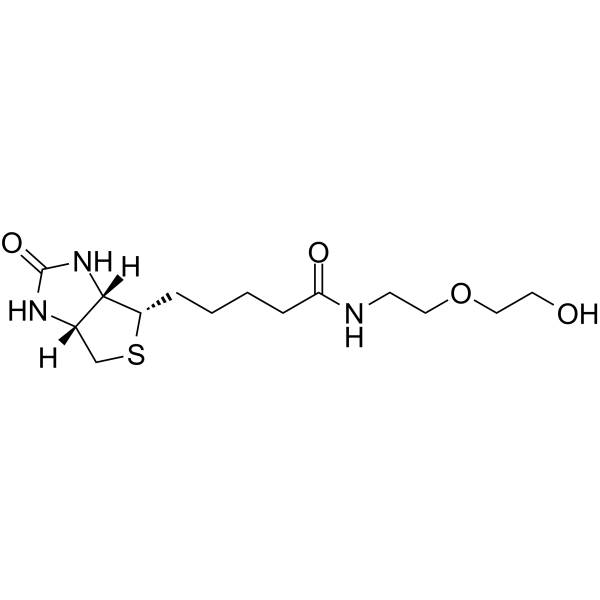
Biotin-PEG2-OH is a PEG-based PROTAC linker that can be used in the synthesis of PROTACs .
|
-
- HY-W012862
-
-
- HY-140173
-
|
|
PROTAC Linkers
|
Cancer
|
|
Boc-PEG2-sulfonic acid is a PEG-based PROTAC linker that can be used in the synthesis of PROTACs .
|
-
- HY-141297
-
|
|
PROTAC Linkers
|
Cancer
|
|
Bromo-PEG2-phosphonic acid is a PEG-based PROTAC linker that can be used in the synthesis of PROTACs .
|
-
- HY-132042
-
|
|
PROTAC Linkers
|
Cancer
|
|
Bromo-PEG2-MS is a PEG-based PROTAC linker that can be used in the synthesis of PROTACs .
|
-
- HY-134745
-
|
|
PROTAC Linkers
|
Cancer
|
|
DSPE-PEG2-mal is a PEG-based PROTAC linker that can be used in the synthesis of PROTACs .
|
-
- HY-134701
-
|
|
PROTAC Linkers
|
Cancer
|
|
Acetamido-PEG2-Br is a PEG-based PROTAC linker that can be used in the synthesis of PROTACs .
|
-
- HY-W043841
-
|
|
PROTAC Linkers
|
Cancer
|
|
Benzyl-PEG2-Tos is a PEG-based PROTAC linker that can be used in the synthesis of PROTACs .
|
-
- HY-140397
-
|
|
PROTAC Linkers
|
Cancer
|
|
m-PEG2-Amino is a PEG-based PROTAC linker that can be used in the synthesis of PROTACs .
|
-
- HY-130892
-
|
|
PROTAC Linkers
|
Cancer
|
|
(+)-Biotin-PEG2-hydrazide is a PEG-based PROTAC linker that can be used in the synthesis of PROTACs .
|
-
- HY-140968
-
|
|
PROTAC Linkers
|
Cancer
|
|
Mal-PEG2-alcohol is a PEG-based PROTAC linker that can be used in the synthesis of PROTACs .
|
-
- HY-W090623
-
|
|
PROTAC Linkers
|
Cancer
|
|
Tos-PEG2-OH is a PEG-based PROTAC linker that can be used in the synthesis of PROTACs .
|
-
- HY-140167
-
|
|
PROTAC Linkers
|
Cancer
|
|
Carboxy-PEG2-sulfonic acid is a PEG-based PROTAC linker that can be used in the synthesis of PROTACs .
|
-
- HY-108368R
-
|
|
Reference Standards
PROTAC Linkers
|
Cancer
|
|
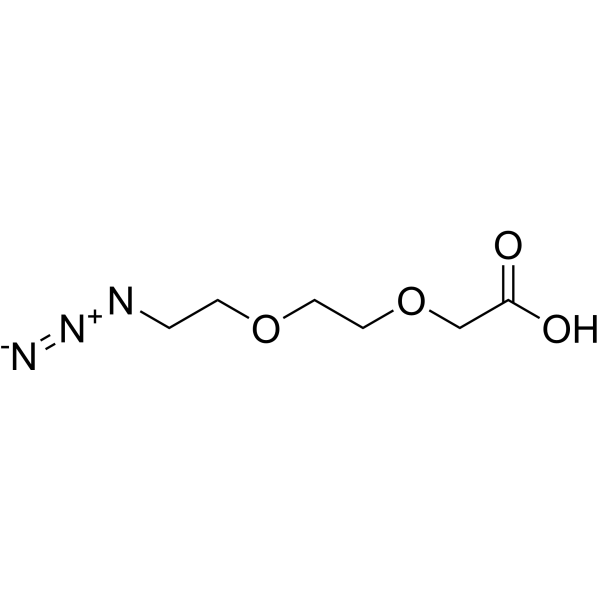
Azido-PEG2-CH2COOH (Standard) is the analytical standard of Azido-PEG2-CH2COOH (HY-108368). This product is intended for research and analytical applications. Azido-PEG2-CH2COOH is a PEG-based PROTAC linker can be used in the synthesis of PROTACs . Azido-PEG2-CH2COOH is a click chemistry reagent, it contains an Azide group and can undergo copper-catalyzed azide-alkyne cycloaddition reaction (CuAAc) with molecules containing Alkyne groups. It can also undergo strain-promoted alkyne-azide cycloaddition (SPAAC) reactions with molecules containing DBCO or BCN groups.
|
-
- HY-108368AR
-
|
|
ADC Linker
Reference Standards
|
Others
|
|
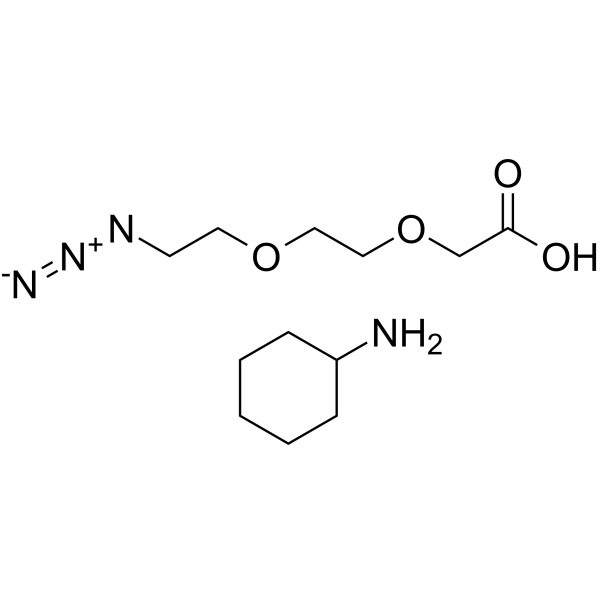
Azido-PEG2-CH2COOH CHA (Standard) is the analytical standard of Azido-PEG2-CH2COOH (CHA) (HY-108368A). This product is intended for research and analytical applications. Azido-PEG2-CH2COOH (CHA) is a azido-modified PEG2 acid, can be used as a click chemistry reagent . It contains an azide group and can undergo copper-catalyzed azide-alkyne cycloaddition (CuAAc) with molecules containing alkyne groups. It can also undergo ring strain-promoted alkyne-azide cycloaddition (SPAAC) with molecules containing DBCO or BCN groups.
|
-
- HY-177953
-
|
|
Drug-Linker Conjugates for ADC
c-Met/HGFR
|
Cancer
|
|
Mal-PEG2-Val-Arg-PABC-OMe-Eribulin (Compound L-1) is a drug-linker conjugate composed of O-Me Eribulin (HY-159576) and the linker Mal-PEG2-Val-Cit-PAB-OH (HY-130222). Mal-PEG2-Val-Arg-PABC-OMe-Eribulin can be used to synthesize anti-HER3/MET antibody-drug conjugates (ADCs) .
|
-
- HY-155325
-
|
|
Fluorescent Dye
|
Others
|
|
Cy3-PEG2-TCO4 is a dye derivative of Cyanine 3 (Cy3) (HY-D0822) containing 2 PEG units. Cy3-PEG2-TCO4 can use its own TCO group to perform the inverse electron demand Diels-Alder reaction (iEDDA) with molecules with Tetrazine groups.
|
-
- HY-D2145
-
|
|
Fluorescent Dye
|
Others
|
|
Cy5-PEG2-TCO4 is a dye derivative of Cyanine 5 (Cy5) (HY-D0821) containing 2 PEG units. Cy5-PEG2-TCO4 utilizes its own TCO group to undergo an inverse electron demand Diels-Alder reaction (iEDDA) with molecules bearing Tetrazine groups.
|
-
- HY-160072
-
|
|
Drug Intermediate
|
Cancer
|
|
Fmoc-NH-PEG2-NHS ester is an intermediate used in the synthesis of E-selectin antagonists [1] .
|
-
- HY-135085
-
|
|
PROTAC Linkers
|
Cancer
|
|
Thiol-C2-PEG2-OH is a PEG-based PROTAC linker that can be used in the synthesis of PROTACs .
|
-
- HY-157003
-
|
|
ADC Linker
|
Cancer
|
|
(S)-TCO-PEG2-NH2 is an ADC Linker containing 2 PEG units. (S)-TCO-PEG2-NH2 can use its own TCO group to perform an inverse electron demand Diels-Alder reaction (iEDDA) with molecules with Tetrazine groups.
|
-
- HY-42149
-
|
|
PROTAC Linkers
ADC Linker
|
Cancer
|
|
NH2-PEG2-C2-Boc is a PEG-based PROTAC linker that can be used in the synthesis of PROTACs . NH2-PEG2-C2-Boc is also a non-cleavable 2 unit PEG ADC linker used in the synthesis of antibody-drug conjugates (ADCs) [2].
|
-
- HY-126676
-
|
|
ADC Linker
PROTAC Linkers
|
Cancer
|
|
DBCO-(PEG2-Val-Cit-PAB)2 is a dual cleavable ADC linker for antibody-drug conjugates (ADCs). DBCO-(PEG2-Val-Cit-PAB)2 is also a PEG-based PROTAC linker that can be used in the synthesis of PROTACs. DBCO-(PEG2-Val-Cit-PAB)2 is a click chemistry reagent, it contains a DBCO group that can undergo strain-promoted alkyne-azide cycloaddition (SPAAC) with molecules containing Azide groups.
|
-
- HY-126690
-
|
|
Drug-Linker Conjugates for ADC
|
Cancer
|
|
DBCO-(PEG2-VC-PAB-MMAE)2 is made by MMAE conjugated to the cleavable DBCO-(PEG2-VC-PAB)2 linker. Monomethyl auristatin E (MMAE), a potent tubulin inhibitor, is a toxin payload in antibody agent conjugate . DBCO-(PEG2-VC-PAB-MMAE)2 is a click chemistry reagent, it contains a DBCO group that can undergo strain-promoted alkyne-azide cycloaddition (SPAAC) with molecules containing Azide groups.
|
-
- HY-156214
-
|
AP1867-PEG2-JQ1; AP-PEG2-JQ1
|
Epigenetic Reader Domain
|
Others
|
|
NICE-01 (AP1867-PEG2-JQ1; AP-PEG2-JQ1) is a bifunctional compound that bind to proteins in separate cellular compartments that can induce nuclear import of cytosolic cargoes, using nuclear-localized bromodomain-containing protein 4 (BRD4) as a “carrier” for co-import and nuclear trapping of cytosolic proteins .
|
-
- HY-117079
-
|
|
ADC Linker
PROTAC Linkers
|
Cancer
|
|
N-Boc-N-bis(PEG2-OH) is a PEG/Alkyl/ether-based PROTAC linker can be used in the synthesis of PROTACs. N-Boc-N-bis(PEG2-OH) is a cleavable ADC linker used in the synthesis of antibody-drug conjugates (ADCs) .
|
-
- HY-157515
-
|
|
E3 Ligase Ligand-Linker Conjugates
|
Cancer
|
|
Thalidomide 4'-ether-PEG2-azide is a click chemistry modified cereblon (CRBN) inhibitor Thalidomide (HY-14658). Thalidomide 4'-ether-PEG2-azide contains an azide group and can undergo copper-catalyzed azide-alkyne cycloaddition reaction (CuAAc) with molecules containing alkynyl groups. Thalidomide 4'-ether-PEG2-azide can be used as a ligand of E3 ubiquitin ligase and Linker conjugates (E3 Ligase Ligand-Linker Conjugates) for the synthesis of PROTACs .
|
-
- HY-113931
-
|
|
PROTAC Linkers
ADC Linker
|
Cancer
|
|
Aminooxy-PEG2-azide is a PEG-based PROTAC linker that can be used in the synthesis of PROTACs . Aminooxy-PEG2-azide is also a non-cleavable 2 unit PEG ADC linker used in the synthesis of antibody-drug conjugates (ADCs) [2]. Aminooxy-PEG2-azide is a click chemistry reagent, it contains an Azide group and can undergo copper-catalyzed azide-alkyne cycloaddition reaction (CuAAc) with molecules containing Alkyne groups. It can also undergo strain-promoted alkyne-azide cycloaddition (SPAAC) reactions with molecules containing DBCO or BCN groups.
|
-
- HY-151834
-
|
|
ADC Linker
|
Others
|
|
DBCO-PEG2-DBCO is a click chemistry reagent containing a DBCO group. DBCO-PEG2-DBCO is a PEG linker containing two terminal DBCO groups. The DBCO groups is commonly used for copper-free Click Chemistry reactions due to its strain promoted high energy. T Reagent grade, for research use only .
|
-
- HY-140213
-
|
N3-PEG2-CH2CH2NH2
|
PROTAC Linkers
ADC Linker
|
Cancer
|
|
Azido-PEG2-C2-amine (N3-PEG2-CH2CH2NH2) is a PEG-based PROTAC linker that can be used in the synthesis of PROTACs . Azido-PEG2-C2-amine is also a non-cleavable 2 unit PEG ADC linker used in the synthesis of antibody-drug conjugates (ADCs) [2]. Azido-PEG2-C2-amine is a click chemistry reagent, it contains an Azide group and can undergo copper-catalyzed azide-alkyne cycloaddition reaction (CuAAc) with molecules containing Alkyne groups. It can also undergo strain-promoted alkyne-azide cycloaddition (SPAAC) reactions with molecules containing DBCO or BCN groups.
|
-
- HY-138504
-
|
|
PROTAC Linkers
|
Cancer
|
|
Bis-PEG2-Boc is an alkyl/ether-based PROTAC linker that can be used in the synthesis of PROTACs .
|
-
- HY-130088
-
|
|
ADC Linker
|
Cancer
|
|
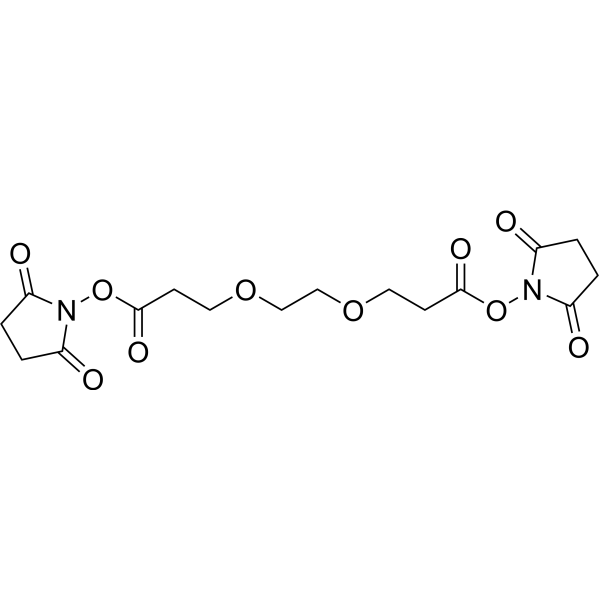
Bis-PEG2-NHS ester is a nonclaevable 2-unit PEG linker for antibody-agent-conjugation (ADC).
|
-
- HY-136273
-
|
|
E3 Ligase Ligand-Linker Conjugates
|
Cancer
|
|
A 410099.1 amide-PEG2-amine-Boc is a functionalized IAP ligand for PROTACs that incorporates an IAP ligand and an amide-PEG3 linker with terminal amine. A 410099.1 amide-PEG2-amine-Boc can conjugates with target protein ligands.
|
-
- HY-140078
-
|
|
ADC Linker
|
Cancer
|
|
bis-PEG2-endo-BCN is a cleavable 2 unit PEG ADC linker used in the synthesis of antibody-drug conjugates (ADCs) . bis-PEG2-endo-BCN is a click chemistry reagent, it contains a BCN group that can undergo strain-promoted alkyne-azide cycloaddition (SPAAC) with molecules containing Azide groups.
|
-
- HY-W190791
-
-
- HY-W072752
-
|
|
PROTAC Linkers
|
Cancer
|
|
endo-BCN-PEG2-NH2 is a PEG-based PROTAC linker that can be used in the synthesis of PROTACs . endo-BCN-PEG2-NH2 contains a BCN group that can undergo strain-promoted alkyne-azide cycloaddition (SPAAC) with molecules containing Azide groups.
|
-
- HY-140082
-
|
|
PROTAC Linkers
|
Cancer
|
|
Hydroxy-Amino-bis(PEG2-propargyl) is a PEG-based PROTAC linker that can be used in the synthesis of PROTACs . Hydroxy-Amino-bis(PEG2-propargyl) is a click chemistry reagent, it contains an Alkyne group and can undergo copper-catalyzed azide-alkyne cycloaddition (CuAAc) with molecules containing Azide groups.
|
-
- HY-W981123
-
|
|
PROTAC Linkers
|
Cancer
|
|
Boc-PEG2-but-1-yne is a PROTAC linker that can be used in the synthesis of PROTACs.
|
-
- HY-103603R
-
|
VH032-PEG2-NH2 hydrochloride (Standard); VHL Ligand-Linker Conjugates 3 hydrochloride (Standard); E3 ligase Ligand-Linker Conjugates 6 (Standard)
|
Reference Standards
E3 Ligase Ligand-Linker Conjugates
|
Cancer
|
|
(S,R,S)-AHPC-PEG2-NH2 hydrochloride (Standard) is the analytical standard of (S,R,S)-AHPC-PEG2-NH2 hydrochloride (HY-103603). This product is intended for research and analytical applications. (S,R,S)-AHPC-PEG2-NH2 hydrochloride (VH032-PEG2-NH2 hydrochloride) is a synthesized E3 ligase ligand-linker conjugate that incorporates the (S,R,S)-AHPC based VHL ligand and 2-unit PEG linker used in the synthesis of PROTACs .
|
-
- HY-W1130395
-
|
|
Ligands for E3 Ligase
|
Cancer
|
|
(S,R,S)-AHPC-PEG2-SH is a VHL ligand based on (S,R,S)-AHPC that recruits von Hippel-Lindau (VHL) protein. (S,R,S)-AHPC-PEG2-SH can be linked to a target protein ligand via a linker to form a PROTACs.
|
-
- HY-108371R
-
|
PROTAC Linker 1 (Standard)
|
Reference Standards
PROTAC Linkers
|
Cancer
|
|
Boc-C1-PEG2-C4-Cl (Standard) is the analytical standard of Boc-C1-PEG2-C4-Cl (HY-108371). This product is intended for research and analytical applications. Boc-C1-PEG2-C4-Cl (PROTAC Linker 1) is a PEG-based PROTAC linker can be used in the synthesis of PROTACs .
|
-
- HY-156302
-
|
|
Fluorescent Dye
|
Others
|
|
Coumarin-PEG2-endoBCN is a fluorescent dye containing a coumarin fluorophore and can be used as a click chemistry reagent .
|
-
- HY-140888
-
|
|
PROTAC Linkers
|
Cancer
|
|
Biotin-PEG2-NHS ester is a biotin-labeled, PEG-based PROTAC linker that can be used in the synthesis of PROTACs .
|
-
- HY-126504
-
|
|
ADC Linker
|
Cancer
|
|
Mal-PEG2-NHS ester is a nonclaevable ADC linker containing a Maleimide group, 2-unit PEG and an NHS ester.
|
-
- HY-149620
-
|
|
Fluorescent Dye
|
Others
|
|
Cy5-PEG2-exo-BCN is a dye derivative of Cyanine 5 (Cy5) (HY-D0821) containing 2 PEG units. Cy5-PEG2-exo-BCN contains the lyophilic bidentate macrocyclic ligand BCN, which can further synthesize macrocyclic complexes. In click chemistry, BCN reacts with molecules containing azide groups to form stable triazoles in the absence of catalysts.
|
-
- HY-163647
-
|
|
E3 Ligase Ligand-Linker Conjugates
|
Cancer
|
|
Lenalidomide-COCH-PEG2-azido is a synthesized E3 ligase ligand-linker conjugate that incorporates the Lenalidomide (HY-A0003) based cereblon ligand and a linker. Lenalidomide-COCH-PEG2-azido can be used in the synthesis of PROTAC AKR1C3 degrader-1 (HY-163609) .
|
-
- HY-103603AR
-
|
VH032-PEG2-NH2 (Standard); VHL Ligand-Linker Conjugates 3 (Standard); E3 ligase Ligand-Linker Conjugates 6 Free Base (Standard)
|
Reference Standards
E3 Ligase Ligand-Linker Conjugates
|
Cancer
|
|
(S,R,S)-AHPC-PEG2-NH2 (Standard) is the analytical standard of (S,R,S)-AHPC-PEG2-NH2 (HY-103603A). This product is intended for research and analytical applications. (S,R,S)-AHPC-PEG2-NH2 (VH032-PEG2-NH2) is a synthesized E3 ligase ligand-linker conjugate that incorporates the (S,R,S)-AHPC based VHL ligand and 2-unit PEG linker used in the synthesis of PROTACs .
|
-
- HY-138497
-
|
|
PROTAC Linkers
|
Cancer
|
|
F-PEG2-S-COOH is a PEG-based PROTAC linker that can be used in the synthesis of PROTACs .
|
-
- HY-W096144
-
|
|
PROTAC Linkers
|
Cancer
|
|
Acid-PEG2-ethyl propionate is a PEG-based PROTAC linker that can be used in the synthesis of PROTACs .
|
-
- HY-134731
-
|
|
PROTAC Linkers
|
Cancer
|
|
N-Ethylacetamide-PEG2-Br is a PEG-based PROTAC linker that can be used in the synthesis of PROTACs .
|
-
- HY-140390
-
|
|
PROTAC Linkers
|
Cancer
|
|
Boc-N-PEG2-MS is a PEG-based PROTAC linker that can be used in the synthesis of PROTACs .
|
-
- HY-134744
-
|
|
PROTAC Linkers
|
Cancer
|
|
Boc-Pyrrolidine-PEG2-COOH is a PEG-based PROTAC linker that can be used in the synthesis of PROTACs .
|
-
- HY-141172
-
|
|
PROTAC Linkers
|
Cancer
|
|
TCO-PEG2-Sulfo-NHS ester is a PEG-based PROTAC linker that can be used in the synthesis of PROTACs .
|
-
- HY-138462
-
|
|
PROTAC Linkers
|
Cancer
|
|
Methyl acetate-PEG2-propanol is a PEG-based PROTAC linker that can be used in the synthesis of PROTACs .
|
-
- HY-W008279
-
|
|
PROTAC Linkers
|
Cancer
|
|
Amino-PEG2-NH-Boc is a PEG-based PROTAC linker can be used in the synthesis of PROTACs .
|
-
- HY-138348
-
|
|
PROTAC Linkers
|
Cancer
|
|
THP-PEG2-methyl propionate is a PEG-based PROTAC linker that can be used in the synthesis of PROTACs .
|
-
- HY-141172A
-
|
|
PROTAC Linkers
|
Cancer
|
|
TCO-PEG2-Sulfo-NHS ester sodium is a PEG-based PROTAC linker that can be used in the synthesis of PROTACs .
|
-
- HY-134730
-
|
|
PROTAC Linkers
|
Cancer
|
|
N-Acetylpyrrolidine-PEG2-Br is a PEG-based PROTAC linker that can be used in the synthesis of PROTACs .
|
-
- HY-138493
-
|
|
PROTAC Linkers
|
Cancer
|
|
F-PEG2-S-Boc is a PEG-based PROTAC linker that can be used in the synthesis of PROTACs .
|
-
- HY-135798
-
|
|
PROTAC Linkers
|
Cancer
|
|
Tos-PEG2-NH-Boc is a PEG-based PROTAC linker that can be used in the synthesis of PROTACs .
|
-
- HY-132100
-
|
|
PROTAC Linkers
|
Cancer
|
|
Thiol-PEG2-t-butyl ester is a PEG-based PROTAC linker that can be used in the synthesis of PROTACs .
|
-
- HY-140628
-
|
|
PROTAC Linkers
|
Cancer
|
|
Ald-Ph-PEG2-Boc is a PEG-based PROTAC linker that can be used in the synthesis of PROTACs .
|
-
- HY-133507
-
|
|
PROTAC Linkers
|
Cancer
|
|
Mal-amide-PEG2-oxyamine is a PEG-based PROTAC linker that can be used in the synthesis of PROTACs .
|
-
- HY-130193
-
|
|
PROTAC Linkers
|
Cancer
|
|
Mal-PEG2-NH-Boc is a PEG-based PROTAC linker that can be used in the synthesis of PROTACs .
|
-
- HY-141345
-
|
|
PROTAC Linkers
|
Cancer
|
|
S-acetyl-PEG2-Boc is a PEG-based PROTAC linker that can be used in the synthesis of PROTACs .
|
-
- HY-130232
-
|
|
PROTAC Linkers
|
Cancer
|
|
Mal-amido-PEG2-TFP ester is a PEG-based PROTAC linker that can be used in the synthesis of PROTACs .
|
-
- HY-141299
-
|
|
PROTAC Linkers
|
Cancer
|
|
Bromo-PEG2-phosphonic acid diethyl ester is a PEG-based PROTAC linker that can be used in the synthesis of PROTACs .
|
-
- HY-138496
-
|
|
PROTAC Linkers
|
Cancer
|
|
F-PEG2-SO-COOH is a PEG-based PROTAC linker that can be used in the synthesis of PROTACs .
|
-
- HY-138398
-
|
|
PROTAC Linkers
|
Cancer
|
|
BOC-NH-PEG2-propene is a PEG-based PROTAC linker that can be used in the synthesis of PROTACs .
|
-
- HY-D2136
-
|
|
Fluorescent Dye
|
Others
|
|
Cy3-PEG2-Azide is a Cyanine 3 (Cy3) (HY-D0822) dye derivative containing 2 PEG units. Cy3-PEG2-Azide contains an azide group and can undergo copper-catalyzed azide-alkyne cycloaddition (CuAAc) with molecules containing alkyne groups. It can also undergo ring strain-promoted alkyne-azide cycloaddition (SPAAC) with molecules containing DBCO or BCN groups.
|
-
- HY-141199
-
|
|
PROTAC Linkers
|
Cancer
|
|
Bromoacetamido-C2-PEG2-NH-Boc is a PEG-based PROTAC linker that can be used in the synthesis of PROTACs .
|
-
- HY-170351
-
|
|
PROTAC Linkers
|
Cancer
|
|
NH2-PEG2-OMs is the linker, that could be used for synthesis of PROTAC degrader DDC-01-163 (HY-139997) .
|
-
- HY-158199
-
|
|
ADC Linker
|
Cancer
|
|
BCN-HS-PEG2-bis(PNP) (Compound 62) is a p-nitrophenyl-containing ADC linker that can be used to further couple ADC cytotoxins with peptide linkers. BCN-HS-PEG2-bis(PNP) can conjugate with vc-PABC-MMAE (HY-15162) to form Drug-Linker Conjugates for ADC .
|
-
- HY-103607R
-
|
VH032-PEG2-C4-Cl (Standard); VHL Ligand-Linker Conjugates 7 (Standard); E3 ligase Ligand-Linker Conjugates 10 (Standard)
|
Reference Standards
E3 Ligase Ligand-Linker Conjugates
|
Cancer
|
|
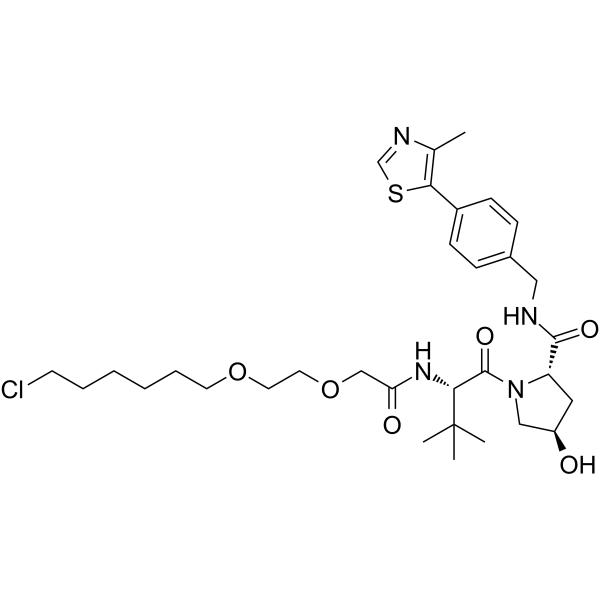
(S,R,S)-AHPC-PEG2-C4-Cl (Standard) is the analytical standard of (S,R,S)-AHPC-PEG2-C4-Cl (HY-103607). This product is intended for research and analytical applications. (S,R,S)-AHPC-PEG2-C4-Cl (VH032-PEG2-C4-Cl) is a conjugate of ligands for E3 and 13-atom-length linker. The connector of linker is Halogen group. (S,R,S)-AHPC-PEG2-C4-Cl incorporates the (S,R,S)-AHPC based VHL ligand and an alkyl/ether-based linker. (S,R,S)-AHPC-PEG2-C4-Cl is capable of inducing the degradation of GFP-HaloTag7 in cell-based assays .
|
-
- HY-W460248
-
|
|
PROTAC Linkers
|
Cancer
|
|
tert-Butyltrimethylsilane-PEG2-NH2 is a PROTAC linker that can be used in the synthesis of PROTACs.
|
-
- HY-171728
-
|
|
Liposome
|
Metabolic Disease
|
|
Azide-PEG2-amide-C14-COOH (Compound LP-379-p) is a lipid-containing compound. Azide-PEG2-amide-C14-COOH facilitates the delivery of oligonucleotide-based reagents to certain cell types or adipose tissue .
|
-
- HY-164146
-
|
|
Drug-Linker Conjugates for ADC
Microtubule/Tubulin
|
Cancer
|
|
BCN-HS-PEG2(vcPABC-MMAE)2 is a drug-linker conjugate for ADC consists an ADC linker and a tubulin polymerization inhibitor MMAE (HY-15162). BCN-HS-PEG2(vcPABC-MMAE)2 can be used in the synthesis of antibody-agent conjugates (ADCs) .
|
-
- HY-160094
-
|
|
Ligands for Target Protein for PROTAC
|
Cancer
|
|
BCN-sulfonamide-PEG2-sulfonamide-N-bis ethanol (compound 71) is a Ligands for Target Protein for PROTAC that contains a sulfonamide linker to increase the solubility of the linker-conjugate. BCN-sulfonamide-PEG2-sulfonamide-N-bis ethanol can be used to synthesize PROTACs with antitumor activity .
|
-
- HY-172302
-
|
|
Biochemical Assay Reagents
|
Others
|
|
Phthalimide-PEG2-Boc is a biochemical reagent that can be used as a biological material or organic compound for life science related research.
|
-
- HY-W580021
-
-
- HY-W800675
-
|
|
Biochemical Assay Reagents
|
Others
|
|
AZD-PEG2-azide is a biochemical reagent that can be used as a biological material or organic compound for life science related research.
|
-
- HY-W584524
-
|
|
E3 Ligase Ligand-Linker Conjugates
Autophagy
Apoptosis
|
Cancer
|
|
Thalidomide-4-NH-PEG2-COO(t-Bu) is a t-Bu modified Thalidomide (HY-14658), which acts as a Cereblon ligand to recruit CRBN protein. The t-Bu protecting group at the end of Thalidomide-4-NH-PEG2-COO(t-Bu) can be removed under acidic conditions to participate in the synthesis of PROTAC molecules. Thalidomide-4-NH-PEG2-COO(t-Bu) is a key intermediate in the synthesis of CRBN-based PROTAC molecules.
|
-
- HY-138777
-
|
|
E3 Ligase Ligand-Linker Conjugates
Autophagy
Apoptosis
|
Cancer
|
|
Thalidomide-Propargyne-PEG2-COOH is a synthesized E3 ligase ligand-linker conjugate that incorporates the Thalidomide based cereblon ligand and a linker used in PROTAC technology . Thalidomide-Propargyne-PEG2-COOH is a click chemistry reagent, it contains an Alkyne group and can undergo copper-catalyzed azide-alkyne cycloaddition (CuAAc) with molecules containing Azide groups.
|
-
- HY-141361
-
|
|
PROTAC Linkers
|
Cancer
|
|
(2-Pyridyldithio)-PEG2-Boc is a PEG-based PROTAC linker that can be used in the synthesis of PROTACs .
|
-
- HY-35261
-
|
|
PROTAC Linkers
|
Cancer
|
|
Mal-PEG2-NH2 is a PEG-based PROTAC linker that can be used in the synthesis of PROTACs .
|
-
- HY-113828
-
|
|
PROTAC Linkers
|
Cancer
|
|
Biotin-PEG2-C4-alkyne is a PEG-based PROTAC linker can be used in the synthesis of PROTACs. Biotin-PEG2-C4-alkyne is a click chemistry reagent, it contains an Alkyne group and can undergo copper-catalyzed azide-alkyne cycloaddition (CuAAc) with molecules containing Azide groups.
|
-
- HY-41922
-
|
|
PROTAC Linkers
|
Cancer
|
|
Propargyl-PEG2-CH2COOH is a PEG-based PROTAC linker that can be used in the synthesis of PROTACs . Propargyl-PEG2-CH2COOH is a click chemistry reagent, it contains an Alkyne group and can undergo copper-catalyzed azide-alkyne cycloaddition (CuAAc) with molecules containing Azide groups.
|
-
- HY-133503
-
|
|
PROTAC Linkers
|
Cancer
|
|
Mal-amide-PEG2-oxyamineBoc is a PEG-based PROTAC linker that can be used in the synthesis of PROTACs .
|
-
- HY-W583812
-
|
|
PROTAC Linkers
|
Cancer
|
|
Cbz-PEG2-prop-1-yne is a PROTAC linker that can be used in the synthesis of PROTACs.
|
-
- HY-140586
-
|
|
PROTAC Linkers
|
Cancer
|
|
N-Benzyl-N-bis-PEG2 is a PEG-based PROTAC linker that can be used in the synthesis of PROTACs .
|
-
- HY-155327
-
|
|
Fluorescent Dye
|
Others
|
|
Cy3-PEG2-endo-BCN is a dye derivative of Cyanine 3 (Cy3) (HY-D0822) containing 2 PEG units. Cy3-PEG2-endo-BCN contains the lyophilic bidentate macrocyclic ligand endo-BCN, which can further synthesize macrocyclic complexes. In click chemistry, endo-BCN can react with molecules containing azide groups to form stable triazoles in the absence of catalysts.
|
-
- HY-155327A
-
|
|
Fluorescent Dye
|
Others
|
|
Cy3-PEG2-exo-BCN is a dye derivative of Cyanine 3 (Cy3) (HY-D0822) containing 2 PEG units. Cy3-PEG2-exo-BCN contains the lyophilic bidentate macrocyclic ligand BCN, which can further synthesize macrocyclic complexes. In click chemistry, exo-BCN can react with molecules containing azide groups to form stable triazoles in the absence of catalysts.
|
-
- HY-172294
-
|
|
Biochemical Assay Reagents
|
Others
|
|
Mes-PEG2-CH2-t-butyl ester is a PEG linker consisting of a PEG2 linker for improved water-solubility of the compound and a t-butyl ester group which can be deprotected under acidic conditions. The mesylate serves as an excellent leaving group, offering all the advantages without the limitation of having an acidic proton that could react with nucleophiles.
|
-
- HY-140043
-
|
|
PROTAC Linkers
|
Cancer
|
|
N-Me-N-bis(PEG2-propargyl) is a PEG-based PROTAC linker that can be used in the synthesis of PROTACs . N-Me-N-bis(PEG2-propargyl) is a click chemistry reagent, it contains an Alkyne group and can undergo copper-catalyzed azide-alkyne cycloaddition (CuAAc) with molecules containing Azide groups.
|
-
- HY-140089
-
|
|
PROTAC Linkers
|
Cancer
|
|
N-Boc-N-bis(PEG2-propargyl) is a PEG-based PROTAC linker that can be used in the synthesis of PROTACs . N-Boc-N-bis(PEG2-propargyl) is a click chemistry reagent, it contains an Alkyne group and can undergo copper-catalyzed azide-alkyne cycloaddition (CuAAc) with molecules containing Azide groups.
|
-
- HY-140497A
-
|
HO-PEG2-CH2COONa
|
PROTAC Linkers
|
Cancer
|
|
Hydroxy-PEG2-CH2COONa is a PEG-based PROTAC linker that can be used in the synthesis of PROTACs .
|
-
- HY-171910
-
|
|
Asialoglycoprotein Receptor (ASGPR)
LYTACs
|
Others
|
|
tri(GalNAc-PEG2)-PEG4-cyclo(Ac-DCAW-{Arg(3F-Ph)-PEG2}-LGELVWCT) (Cys2-Cys12) is an asialoglycoprotein receptor (ASGPR) ligand that can be used for LYsosome TArgeting Chimera (LYTAC) research .
|
-
- HY-158343
-
|
|
E3 Ligase Ligand-Linker Conjugates
|
Cancer
|
|
Thalidomide-NH-PEG2-C2-CH2 is a conjugate of E3 ligase ligand and linker. Thalidomide-NH-PEG2-C2-CH2 is utilized for synthesis of PROTAC TEAD degrader-1 (HY-158342) .
|
-
- HY-132208
-
|
|
E3 Ligase Ligand-Linker Conjugates
|
Cancer
|
|
Pomalidomide 4'-PEG2-azide is a synthesized E3 ligase ligand-linker conjugate that incorporates the Pomalidomide based cereblon ligand and a linker used in PROTAC technology . Pomalidomide 4'-PEG2-azide is a click chemistry reagent, it contains an Azide group and can undergo copper-catalyzed azide-alkyne cycloaddition reaction (CuAAc) with molecules containing Alkyne groups. It can also undergo strain-promoted alkyne-azide cycloaddition (SPAAC) reactions with molecules containing DBCO or BCN groups.
|
-
- HY-42427
-
|
|
PROTAC Linkers
|
Cancer
|
|
NH2-PEG2-CH2-Boc is a PEG-based PROTAC linker that can be used in the synthesis of PROTACs .
|
-
- HY-103607
-
|
VH032-PEG2-C4-Cl; VHL Ligand-Linker Conjugates 7; E3 ligase Ligand-Linker Conjugates 10
|
E3 Ligase Ligand-Linker Conjugates
|
Cancer
|
|
(S,R,S)-AHPC-PEG2-C4-Cl (VH032-PEG2-C4-Cl) is a conjugate of ligands for E3 and 13-atom-length linker. The connector of linker is Halogen group. (S,R,S)-AHPC-PEG2-C4-Cl incorporates the (S,R,S)-AHPC based VHL ligand and an alkyl/ether-based linker. (S,R,S)-AHPC-PEG2-C4-Cl is capable of inducing the degradation of GFP-HaloTag7 in cell-based assays .
|
-
- HY-141362
-
|
|
PROTAC Linkers
|
Cancer
|
|
Bromo-PEG2-C2-acid is a PEG-based PROTAC linker that can be used in the synthesis of PROTACs .
|
-
- HY-148550
-
|
|
ADC Linker
|
Cancer
|
|
MC-PEG2-NH2 is a cleavable ADC linker used in the synthesis of antibody-drug conjugates (ADCs) .
|
-
- HY-141380
-
|
|
PROTAC Linkers
|
Cancer
|
|
Bromoacetamido-PEG2-C2-acid is a PEG-based PROTAC linker that can be used in the synthesis of PROTACs .
|
-
- HY-140934
-
|
|
PROTAC Linkers
|
Cancer
|
|
Biotin-PEG2-NH-Boc is a biotin-labeled, PEG-based PROTAC linker that can be used in the synthesis of PROTACs .
|
-
- HY-W339437
-
|
|
PROTAC Linkers
|
Cancer
|
|
NH2-C3-PEG2-NH2 is a PROTAC linker that can be used in the synthesis of PROTACs.
|
-
- HY-130531
-
|
|
PROTAC Linkers
|
Cancer
|
|
NH-bis(C2-PEG2-NH-Boc) is a PEG-based PROTAC linker that can be used in the synthesis of PROTACs .
|
-
- HY-140632
-
|
|
PROTAC Linkers
|
Cancer
|
|
Ald-Ph-amido-C2-PEG2-amine is a PEG-based PROTAC linker that can be used in the synthesis of PROTACs .
|
-
- HY-156319
-
|
|
ADC Linker
|
Cancer
|
|
BCN-exo-PEG2-NH2 is an ADC Linker containing 2 PEG units. BCN-exo-PEG2-NH2 contains the lyophilic bidentate macrocyclic ligand BCN, which can further synthesize macrocyclic complexes. In click chemistry, BCN reacts with molecules containing azide groups to form stable triazoles in the absence of catalysts.
|
-
- HY-133573
-
|
|
ADC Linker
|
Cancer
|
|
Cyclooctyne-O-amido-PEG2-PFP ester is a non-cleavable 2 unit PEG ADC linker used in the synthesis of antibody-drug conjugates (ADCs) . Cyclooctyne-O-amido-PEG2-PFP ester is a click chemistry reagent, it contains an Alkyne group and can undergo copper-catalyzed azide-alkyne cycloaddition (CuAAc) with molecules containing Azide groups.
|
-
- HY-403301
-
-
- HY-140529
-
|
|
PROTAC Linkers
|
Cancer
|
|
N-Mal-N-bis(PEG2-acid) is a PEG-based PROTAC linker that can be used in the synthesis of PROTACs .
|
-
- HY-138522
-
|
|
PROTAC Linkers
|
Cancer
|
|
NHS-bis-PEG2-amide-Mal is a PEG-based PROTAC linker that can be used in the synthesis of PROTACs .
|
-
- HY-138383
-
|
|
PROTAC Linkers
|
Cancer
|
|
CHO-C-PEG2-C-CHO is a PEG-based PROTAC linker that can be used in the synthesis of PROTACs .
|
-
- HY-140636
-
|
|
PROTAC Linkers
|
Cancer
|
|
Ald-Ph-PEG2-NH-Boc is a PEG-based PROTAC linker that can be used in the synthesis of PROTACs .
|
-
- HY-141198
-
|
|
PROTAC Linkers
|
Cancer
|
|
Boc-NH-PEG2-NH-Boc is a PEG-based PROTAC linker that can be used in the synthesis of PROTACs .
|
-
- HY-141008
-
|
|
PROTAC Linkers
|
Cancer
|
|
Tri(Mal-PEG2-amide)-amine is a PEG-based PROTAC linker that can be used in the synthesis of PROTACs .
|
-
- HY-141131
-
|
|
PROTAC Linkers
|
Cancer
|
|
Propargyl-PEG2-beta-D-glucose is a PEG-based PROTAC linker that can be used in the synthesis of PROTACs .
|
-
- HY-141016
-
|
|
PROTAC Linkers
|
Cancer
|
|
(S,R,S)-AHPC-PEG2-acid is a PEG-based PROTAC linker that can be used in the synthesis of PROTACs .
|
-
- HY-140538
-
|
|
PROTAC Linkers
|
Cancer
|
|
N-Boc-N-bis(PEG2-acid) is a PEG-based PROTAC linker that can be used in the synthesis of PROTACs .
|
-
- HY-117023
-
|
|
PROTAC Linkers
|
Cancer
|
|
m-PEG2-4-nitrophenyl carbonate is a PEG-based PROTAC linker that can be used in the synthesis of PROTACs .
|
-
- HY-W096094
-
|
|
PROTAC Linkers
|
Cancer
|
|
Fmoc-N-amido-PEG2-alcohol is a PEG-based PROTAC linker that can be used in the synthesis of PROTACs .
|
-
- HY-W044155
-
|
|
PROTAC Linkers
|
Cancer
|
|
Azido-PEG2-azide is a PEG-based PROTAC linker that can be used in the synthesis of PROTACs . Azido-PEG2-azide is a click chemistry reagent, it contains an Azide group and can undergo copper-catalyzed azide-alkyne cycloaddition reaction (CuAAc) with molecules containing Alkyne groups. It can also undergo strain-promoted alkyne-azide cycloaddition (SPAAC) reactions with molecules containing DBCO or BCN groups.
|
-
- HY-145715
-
|
|
E3 Ligase Ligand-Linker Conjugates
|
Cancer
|
|
Azido-PEG2-VHL is a multikinase degrader which can be used in the synthesis of PROTACs . Azido-PEG2-VHL is a click chemistry reagent, it contains an Azide group and can undergo copper-catalyzed azide-alkyne cycloaddition reaction (CuAAc) with molecules containing Alkyne groups. It can also undergo strain-promoted alkyne-azide cycloaddition (SPAAC) reactions with molecules containing DBCO or BCN groups.
|
-
- HY-140381
-
|
|
PROTAC Linkers
|
Cancer
|
|
Azide-PEG2-Ms is a PEG-based PROTAC linker that can be used in the synthesis of PROTACs . Azide-PEG2-Ms is a click chemistry reagent, it contains an Azide group and can undergo copper-catalyzed azide-alkyne cycloaddition reaction (CuAAc) with molecules containing Alkyne groups. It can also undergo strain-promoted alkyne-azide cycloaddition (SPAAC) reactions with molecules containing DBCO or BCN groups.
|
-
- HY-130578
-
|
|
PROTAC Linkers
|
Cancer
|
|
m-PEG2-azide is a PEG-based PROTAC linker can be used in the synthesis of PROTACs. m-PEG2-azide is a click chemistry reagent, it contains an Azide group and can undergo copper-catalyzed azide-alkyne cycloaddition reaction (CuAAc) with molecules containing Alkyne groups. It can also undergo strain-promoted alkyne-azide cycloaddition (SPAAC) reactions with molecules containing DBCO or BCN groups.
|
-
- HY-140797
-
|
|
PROTAC Linkers
|
Cancer
|
|
Azido-PEG2-alcohol is a PEG-based PROTAC linker that can be used in the synthesis of PROTACs . Azido-PEG2-alcohol is a click chemistry reagent, it contains an Azide group and can undergo copper-catalyzed azide-alkyne cycloaddition reaction (CuAAc) with molecules containing Alkyne groups. It can also undergo strain-promoted alkyne-azide cycloaddition (SPAAC) reactions with molecules containing DBCO or BCN groups.
|
-
- HY-138740
-
|
|
PROTAC Linkers
|
Cancer
|
|
Azido-PEG2-propargyl is a PEG-based PROTAC linker that can be used in the synthesis of PROTACs . Azido-PEG2-propargyl is a click chemistry reagent, it contains an Azide group and can undergo copper-catalyzed azide-alkyne cycloaddition reaction (CuAAc) with molecules containing Alkyne groups. It can also undergo strain-promoted alkyne-azide cycloaddition (SPAAC) reactions with molecules containing DBCO or BCN groups.
|
-
- HY-130188
-
|
|
PROTAC Linkers
|
Cancer
|
|
Benzyl-PEG2-azide is a PEG-based PROTAC linker can be used in the synthesis of PROTACs. Benzyl-PEG2-azide is a click chemistry reagent, it contains an Azide group and can undergo copper-catalyzed azide-alkyne cycloaddition reaction (CuAAc) with molecules containing Alkyne groups. It can also undergo strain-promoted alkyne-azide cycloaddition (SPAAC) reactions with molecules containing DBCO or BCN groups.
|
-
- HY-126957
-
|
|
PROTAC Linkers
|
Cancer
|
|
Biotin-PEG2-azide is a PEG-based PROTAC linker can be used in the synthesis of PROTACs. Biotin-PEG2-azide is a click chemistry reagent, it contains an Azide group and can undergo copper-catalyzed azide-alkyne cycloaddition reaction (CuAAc) with molecules containing Alkyne groups. It can also undergo strain-promoted alkyne-azide cycloaddition (SPAAC) reactions with molecules containing DBCO or BCN groups.
|
-
- HY-140617A
-
|
|
Biochemical Assay Reagents
|
Others
|
|
DNP-PEG2-azide is a PEG derivative that can be used for drug delivery and other research. DNP-PEG2-azide is a click chemistry reagent, it contains an Azide group and can undergo copper-catalyzed azide-alkyne cycloaddition reaction (CuAAc) with molecules containing Alkyne groups. It can also undergo strain-promoted alkyne-azide cycloaddition (SPAAC) reactions with molecules containing DBCO or BCN groups .
|
-
- HY-141092
-
|
|
PROTAC Linkers
|
Cancer
|
|
Pyrene-PEG2-azide is a PEG-based PROTAC linker that can be used in the synthesis of PROTACs . Pyrene-PEG2-azide is a click chemistry reagent, it contains an Azide group and can undergo copper-catalyzed azide-alkyne cycloaddition reaction (CuAAc) with molecules containing Alkyne groups. It can also undergo strain-promoted alkyne-azide cycloaddition (SPAAC) reactions with molecules containing DBCO or BCN groups.
|
-
- HY-103599R
-
|
VH032-PEG2-N3 (Standard); VHL Ligand-Linker Conjugates 6 (Standard); E3 ligase Ligand-Linker Conjugates 13 (Standard)
|
Reference Standards
E3 Ligase Ligand-Linker Conjugates
|
Cancer
|
|
(S,R,S)-AHPC-PEG2-N3 (Standard) is the analytical standard of (S,R,S)-AHPC-PEG2-N3 (HY-103599). This product is intended for research and analytical applications. (S,R,S)-AHPC-PEG2-N3 is a synthesized E3 ligase ligand-linker conjugate that incorporates the (S,R,S)-AHPC based VHL ligand and 2-unit PEG linker. (S,R,S)-AHPC-PEG2-N3 can be used for the synthesis of PROTACs .
|
-
- HY-164862
-
|
|
PROTAC Linkers
|
Others
|
|
N-(NHS ester-PEG2)-N-bis(PEG3-azide) is a PEG linker with an NHS ester group and two terminal azide groups. N-(NHS ester-PEG2)-N-bis(PEG3-azide) can be utilized in Click Chemistry .
|
-
- HY-140886
-
|
|
PROTAC Linkers
|
Cancer
|
|
1,1,1-Trifluoroethyl-PEG2-propargyl is a PEG-based PROTAC linker that can be used in the synthesis of PROTACs . 1,1,1-Trifluoroethyl-PEG2-propargyl is a click chemistry reagent, it contains an Alkyne group and can undergo copper-catalyzed azide-alkyne cycloaddition (CuAAc) with molecules containing Azide groups.
|
-
- HY-W588715A
-
|
|
Biochemical Assay Reagents
|
Others
|
|
Acid-PEG2-NHS ester is a PEG derivative composed of NHS ester, which can be conjugated to amino acids or other molecules containing amino groups.
|
-
- HY-130295
-
-
- HY-W800725
-
|
|
Biochemical Assay Reagents
|
Others
|
|
m-PEG2-DBCO is a monodisperse PEG reagents which can enable copper-free Click Chemistry through the reaction of DBCO with azide.
|
-
- HY-130084
-
|
|
ADC Linker
|
Cancer
|
|
Mal-PEG2-VCP-NB is a claevable ADC linker containing a Maleimide group, 2-unit PEG and a VCP NB.
|
-
- HY-W800685
-
-
- HY-137905
-
-
- HY-128833
-
|
PROTAC Linker 19
|
PROTAC Linkers
|
Cancer
|
|
Bis-NH2-PEG2 (PROTAC Linker 19) is a PEG-based PROTAC linker can be used in the synthesis of PROTACs .
|
-
- HY-159493
-
|
|
Polo-like Kinase (PLK)
|
Cancer
|
|
BI2536-PEG2-Halo is a bifunctional molecule containing a ligand for Halo tag and a Polo-like kinase 1 (PLK1) inhibitor BI-2536 (HY-50698). BI2536-PEG2-Halo inhibits the proliferation of 293T cells with Halo-p53R273H(FL)-mCherry tag (IC50=23 nM), exhibits selective toxicity against p53 mutant cancer cells .
|
-
- HY-136099
-
|
|
ADC Linker
|
Cancer
|
|
Bocaminooxyacetamide-PEG2-Azido is a cleavable 2 unit PEG ADC linker used in the synthesis of antibody-drug conjugates (ADCs) . Bocaminooxyacetamide-PEG2-Azido is a click chemistry reagent, it contains an Azide group and can undergo copper-catalyzed azide-alkyne cycloaddition reaction (CuAAc) with molecules containing Alkyne groups. It can also undergo strain-promoted alkyne-azide cycloaddition (SPAAC) reactions with molecules containing DBCO or BCN groups.
|
-
- HY-121507
-
|
|
PROTAC Linkers
|
Cancer
|
|
Hydroxy-PEG2-C2-sulfonic acid is a PEG-based PROTAC linker can be used in the synthesis of PROTACs.
|
-
- HY-134694
-
|
|
PROTAC Linkers
|
Cancer
|
|
Bromo-PEG2-NH2 hydrobromide is a PEG-based PROTAC linker that can be used in the synthesis of PROTACs .
|
-
- HY-145489
-
|
|
ADC Linker
|
Cancer
|
|
Mal-PEG2-Val-Cit-PABA is a cleavable ADC linker used in the synthesis of antibody-drug conjugates (ADCs) .
|
-
- HY-130172
-
|
|
PROTAC Linkers
|
Cancer
|
|
Benzyl-PEG2-CH2-Boc is a PEG-based PROTAC linker can be used in the synthesis of PROTACs.
|
-
- HY-35261A
-
|
|
PROTAC Linkers
|
Cancer
|
|
Mal-PEG2-NH2 (TFA) is a PEG-based PROTAC linker that can be used in the synthesis of PROTACs .
|
-
- HY-174947
-
|
|
Biochemical Assay Reagents
|
Others
|
|
DPPE-PEG2-mal is an amphiphilic phospholipid-modified polymer that can be used to prepare lipid nanoparticles or liposomes for targeted drug delivery applications .
|
-
- HY-D2099
-
|
|
Fluorescent Dye
|
Others
|
|
Coumarin-PEG2-SCO, a Coumarin (HY-N0709) deravitive, is a fluorescent dye, and can be used for labeling of small molecules and biomolecules .
|
-
- HY-134749
-
|
|
PROTAC Linkers
|
Cancer
|
|
Propargyl-PEG2-urea-C3-triethoxysilane is a PEG-based PROTAC linker that can be used in the synthesis of PROTACs . Propargyl-PEG2-urea-C3-triethoxysilane is a click chemistry reagent, it contains an Alkyne group and can undergo copper-catalyzed azide-alkyne cycloaddition (CuAAc) with molecules containing Azide groups.
|
-
- HY-135935
-
|
|
PROTAC Linkers
|
Cancer
|
|
DBCO-NHCO-PEG2-CH2COOH is a PEG-based PROTAC linker that can be used in the synthesis of PROTACs . DBCO-NHCO-PEG2-CH2COOH is a click chemistry reagent, it contains a DBCO group that can undergo strain-promoted alkyne-azide cycloaddition (SPAAC) with molecules containing Azide groups.
|
-
- HY-168019
-
-
- HY-131230
-
|
|
Target Protein Ligand-Linker Conjugates
|
Cancer
|
|
Desmorpholinyl Quizartinib-PEG2-COOH incorporates a ligand for FLT-3, and a PEG-based PROTAC linker. Desmorpholinyl Quizartinib-PEG2-COOH can be used in the synthesis of PROTAC FLT-3 degrader 1 (HY-114323). PROTAC FLT-3 degrader 1 is a PROTAC FLT-3 internal tandem duplication (ITD) degrader with an IC50 0.6 nM .
|
-
- HY-130485
-
|
|
ADC Linker
PROTAC Linkers
|
Cancer
|
|
Bromo-PEG2-C2-azide is a non-cleavable ADC linker used in the synthesis of antibody-drug conjugates (ADCs). Bromo-PEG2-C2-azide is also a PEG-based PROTAC linker that can be used in the synthesis of PROTACs . Bromo-PEG2-C2-azide is a click chemistry reagent, it contains an Azide group and can undergo copper-catalyzed azide-alkyne cycloaddition reaction (CuAAc) with molecules containing Alkyne groups. It can also undergo strain-promoted alkyne-azide cycloaddition (SPAAC) reactions with molecules containing DBCO or BCN groups.
|
-
- HY-135962
-
|
|
ADC Linker
|
Cancer
|
|
Boc-Aminooxy-PEG2-bromide is a cleavable 2 unit PEG ADC linker used in the synthesis of antibody-drug conjugates (ADCs) .
|
-
- HY-138508
-
|
|
ADC Linker
|
Cancer
|
|
Biotin-PEG2-methyl ethanethioate is a cleavable 2 unit PEG ADC linker used in the synthesis of antibody-drug conjugates (ADCs) .
|
-
- HY-171814
-
|
|
Drug-Linker Conjugates for ADC
N-myristoyltransferase
|
Cancer
|
|
Mal-PEG2-amide-C2-amide-Phenyl(β-D-glucuronide)-NMT-IN-7 (Compound DC-2) is a drug-linker conjugate for ADC. Mal-PEG2-amide-C2-amide-Phenyl(β-D-glucuronide)-NMT-IN-7 consists of a NMT inhibitor (HY-160945) and a stable and cleavable linker (Mal-PEG2-amide-C2-amide-Phenyl(β-D-glucuronide)). Mal-PEG2-amide-C2-amide-Phenyl(β-D-glucuronide)-NMT-IN-7 can be used for synthesis of ADCs .
|
-
- HY-103603
-
|
VH032-PEG2-NH2 hydrochloride; VHL Ligand-Linker Conjugates 3 hydrochloride; E3 ligase Ligand-Linker Conjugates 6
|
E3 Ligase Ligand-Linker Conjugates
|
Cancer
|
|
(S,R,S)-AHPC-PEG2-NH2 hydrochloride (VH032-PEG2-NH2 hydrochloride) is a synthesized E3 ligase ligand-linker conjugate that incorporates the (S,R,S)-AHPC based VHL ligand and 2-unit PEG linker used in the synthesis of PROTACs .
|
-
- HY-42151
-
|
|
PROTAC Linkers
|
Cancer
|
|
Mal-amido-PEG2-C2-acid is a PEG-based PROTAC linker that can be used in the synthesis of PROTACs .
|
-
- HY-W352966
-
|
|
ADC Linker
|
Cancer
|
|
Mal-PEG2-CH2COOH is an ADC linker used in the synthesis of antibody-drug conjugates (ADCs) .
|
-
- HY-140941
-
|
|
PROTAC Linkers
|
Cancer
|
|
Biotin-PEG2-C2-iodoacetamide is a PEG-based PROTAC linker that can be used in the synthesis of PROTACs .
|
-
- HY-134740
-
|
|
PROTAC Linkers
|
Cancer
|
|
Br-PEG2-oxazolidin-2-one is a PEG-based PROTAC linker that can be used in the synthesis of PROTACs .
|
-
- HY-140383
-
|
|
PROTAC Linkers
|
Cancer
|
|
Ms-PEG2-C2-Boc is a PEG-based PROTAC linker that can be used in the synthesis of PROTACs .
|
-
- HY-140497
-
|
|
PROTAC Linkers
|
Cancer
|
|
Hydroxy-PEG2-CH2COOH is a PEG-based PROTAC linker that can be used in the synthesis of PROTACs .
|
-
- HY-130467
-
|
|
PROTAC Linkers
|
Cancer
|
|
DNP-NH-PEG2-C2-acid is a PEG-based PROTAC linker can be used in the synthesis of PROTACs .
|
-
- HY-131955
-
|
|
ADC Linker
|
Cancer
|
|
Fmoc-aminooxy-PEG2-NH2 is a cleavable ADC linker used in the synthesis of antibody-drug conjugates (ADCs) .
|
-
- HY-138495
-
|
|
PROTAC Linkers
|
Cancer
|
|
F-PEG2-SO2-COOH is a PEG-based PROTAC linker that can be used in the synthesis of PROTACs .
|
-
- HY-135339
-
|
|
PROTAC Linkers
|
Cancer
|
|
Benzyl-PEG2-CH2COOH is a PEG-based PROTAC linker that can be used in the synthesis of PROTACs .
|
-
- HY-133069
-
|
|
PROTAC Linkers
|
Cancer
|
|
Tos-PEG2-C2-Boc is a PEG-based PROTAC linker that can be used in the synthesis of PROTACs .
|
-
- HY-141371
-
|
|
PROTAC Linkers
|
Cancer
|
|
Bromo-PEG2-CH2-Boc is a PEG-based PROTAC linker that can be used in the synthesis of PROTACs .
|
-
- HY-130532
-
|
|
PROTAC Linkers
|
Cancer
|
|
Tos-PEG2-CH2-Boc is a PEG-based PROTAC linker that can be used in the synthesis of PROTACs .
|
-
- HY-141386
-
|
|
PROTAC Linkers
|
Cancer
|
|
Bromoacetamido-PEG2-C2-NHS ester is a PEG-based PROTAC linker that can be used in the synthesis of PROTACs .
|
-
- HY-140480
-
|
|
PROTAC Linkers
|
Cancer
|
|
Acid-PEG2-C2-Boc is a PEG-based PROTAC linker that can be used in the synthesis of PROTACs .
|
-
- HY-140514
-
|
|
PROTAC Linkers
|
Cancer
|
|
NH-bis(PEG2-C2-acid) is a PEG-based PROTAC linker that can be used in the synthesis of PROTACs .
|
-
- HY-130415
-
|
|
PROTAC Linkers
|
Cancer
|
|
Tos-PEG2-CH2COOH is a PEG-based PROTAC linker that can be used in the synthesis of PROTACs .
|
-
- HY-176760
-
|
|
ADC Linker
|
Cancer
|
|
BCN-HS-PEG2-VA-PABC is a ADC linker that can be used in the synthesis of PL1601 (HY-47018) .
|
-
- HY-140964
-
|
|
PROTAC Linkers
|
Cancer
|
|
Mal-PEG2-C2-Boc is a PEG-based PROTAC linker that can be used in the synthesis of PROTACs .
|
-
- HY-141365
-
|
|
PROTAC Linkers
|
Cancer
|
|
Bromo-PEG2-C2-Boc is a PEG-based PROTAC linker that can be used in the synthesis of PROTACs .
|
-
- HY-140487
-
|
|
PROTAC Linkers
|
Cancer
|
|
Cbz-NH-PEG2-C2-acid is a PEG-based PROTAC linker that can be used in the synthesis of PROTACs .
|
-
- HY-164211
-
|
|
PROTAC Linkers
|
Others
|
|
DBCO-PEG2-OH is a functionalized polyethylene glycol (PEG) derivative that can be used to label azide-modified biomolecules spontaneously and as a component of drug carriers .
|
-
- HY-W800648
-
|
|
Biochemical Assay Reagents
|
Others
|
|
Mal-PEG2-Amide is a PEG linker with a maleimide group which can react with a thiol group to form a covalent bond, enabling the connection of biomolecule with a thiol.
|
-
- HY-108368A
-
|
|
ADC Linker
|
Others
|
|
Azido-PEG2-CH2COOH (CHA) is a azido-modified PEG2 acid, can be used as a click chemistry reagent . It contains an azide group and can undergo copper-catalyzed azide-alkyne cycloaddition (CuAAc) with molecules containing alkyne groups. It can also undergo ring strain-promoted alkyne-azide cycloaddition (SPAAC) with molecules containing DBCO or BCN groups.
|
-
- HY-171685
-
-
- HY-W112031
-
|
|
PROTAC Linkers
|
Cancer
|
|
OH-PEG2-C3-NH2 is a PROTAC linker that can be used in the synthesis of PROTACs.
|
-
- HY-140570
-
|
|
PROTAC Linkers
|
Cancer
|
|
N-Mal-N-bis(PEG2-amine) is a PEG-based PROTAC linker that can be used in the synthesis of PROTACs .
|
-
- HY-W336455
-
|
|
PROTAC Linkers
|
Cancer
|
|
Cbz-PEG2-C2-NH2 is a PROTAC linker that can be used in the synthesis of PROTACs.
|
-
- HY-140163
-
|
|
PROTAC Linkers
|
Cancer
|
|
N,N'-DME-N-PEG2-Boc is a PEG-based PROTAC linker that can be used in the synthesis of PROTACs .
|
-
- HY-140107
-
|
|
PROTAC Linkers
|
Cancer
|
|
Azidoethyl-SS-PEG2-Boc is a PEG-based PROTAC linker that can be used in the synthesis of PROTACs . Azidoethyl-SS-PEG2-Boc is a click chemistry reagent, it contains an Azide group and can undergo copper-catalyzed azide-alkyne cycloaddition reaction (CuAAc) with molecules containing Alkyne groups. It can also undergo strain-promoted alkyne-azide cycloaddition (SPAAC) reactions with molecules containing DBCO or BCN groups.
|
-
- HY-140816
-
|
|
PROTAC Linkers
|
Cancer
|
|
Azido-PEG2-hydrazide-Boc is a PEG-based PROTAC linker that can be used in the synthesis of PROTACs . Azido-PEG2-hydrazide-Boc is a click chemistry reagent, it contains an Azide group and can undergo copper-catalyzed azide-alkyne cycloaddition reaction (CuAAc) with molecules containing Alkyne groups. It can also undergo strain-promoted alkyne-azide cycloaddition (SPAAC) reactions with molecules containing DBCO or BCN groups.
|
-
- HY-130160
-
|
|
PROTAC Linkers
|
Cancer
|
|
Fluorescein-thiourea-PEG2-azide is a PEG-based PROTAC linker that can be used in the synthesis of PROTACs . Fluorescein-thiourea-PEG2-azide is a click chemistry reagent, it contains an Azide group and can undergo copper-catalyzed azide-alkyne cycloaddition reaction (CuAAc) with molecules containing Alkyne groups. It can also undergo strain-promoted alkyne-azide cycloaddition (SPAAC) reactions with molecules containing DBCO or BCN groups.
|
-
- HY-156320
-
|
|
ADC Linker
|
Cancer
|
|
BCN-exo-PEG2-maleimide is an ADC Linker containing 2 PEG units. BCN-exo-PEG2-maleimide contains the lyophilic bidentate macrocyclic ligand BCN, which allows for further synthesis of macrocyclic complexes. In click chemistry, BCN reacts with molecules containing azide groups to form stable triazoles in the absence of catalysts. Its maleimide group (-Maleimide) degrades in aqueous media and has been used in drug delivery studies.
|
-
- HY-103603A
-
|
VH032-PEG2-NH2 ; VHL Ligand-Linker Conjugates 3 ; E3 ligase Ligand-Linker Conjugates 6 Free Base
|
E3 Ligase Ligand-Linker Conjugates
|
Cancer
|
|
(S,R,S)-AHPC-PEG2-NH2 (VH032-PEG2-NH2) is a synthesized E3 ligase ligand-linker conjugate that incorporates the (S,R,S)-AHPC based VHL ligand and 2-unit PEG linker used in the synthesis of PROTACs .
|
-
- HY-148346
-
|
|
Drug-Linker Conjugates for ADC
STING
|
Cancer
|
|
STING agonist-20-Ala-amide-PEG2-C2-NH2 is an active scaffold comprising a stimulator of interferon genes (STING). STING agonist-20-Ala-amide-PEG2-C2-NH2 can be used to synthesize immune-stimulating antibody conjugate (ISAC). STING agonist-20-Ala-amide-PEG2-C2-NH2 can be used for the research of cancer .
|
-
- HY-130599
-
|
|
PROTAC Linkers
|
Cancer
|
|
Hydroxy-PEG2-CH2-Boc is a PEG/Alkyl/ether-based PROTAC linker can be used in the synthesis of PROTACs.
|
-
- HY-130488
-
|
|
PROTAC Linkers
|
Cancer
|
|
Hydroxy-PEG2-C2-PFP ester is a PEG/Alkyl/ether-based?PROTAC linker can be used in the synthesis of PROTACs.
|
-
- HY-156164
-
|
|
E3 Ligase Ligand-Linker Conjugates
Autophagy
Apoptosis
|
Cancer
|
|
Thalidomide-5-NH-PEG2-NH2 hydrochloride is a Thalidomide (HY-14658)-based cereblon ligand that recruits CRBN proteins. Thalidomide-5-NH-PEG2-NH2 hydrochloride can be connected to the target protein ligand through a linker to form a PROTAC molecule. For example, THAL-SNS-032 (HY-123937).
|
-
- HY-136089
-
|
|
ADC Linker
|
Cancer
|
|
Aminooxy-PEG2-bis-PEG3-BCN is a cleavable 5 unit PEG ADC linker used in the synthesis of antibody-drug conjugates (ADCs) . Aminooxy-PEG2-bis-PEG3-BCN is a click chemistry reagent, it contains a BCN group that can undergo strain-promoted alkyne-azide cycloaddition (SPAAC) with molecules containing Azide groups.
|
-
- HY-136060
-
|
|
ADC Linker
|
Cancer
|
|
Mal-PEG2-bis-PEG3-BCN is a cleavable 5 unit PEG ADC linker used in the synthesis of antibody-drug conjugates (ADCs) . Mal-PEG2-bis-PEG3-BCN is a click chemistry reagent, it contains a BCN group that can undergo strain-promoted alkyne-azide cycloaddition (SPAAC) with molecules containing Azide groups.
|
-
- HY-163219
-
-
- HY-131156
-
|
|
ADC Linker
|
Cancer
|
|
Mal-PEG2-Val-Cit-PABA-PNP is a cleavable ADC linker used in the synthesis of antibody-drug conjugates (ADCs) .
|
-
- HY-134705
-
|
|
PROTAC Linkers
|
Cancer
|
|
m-PEG2-amido-Ph-NH2 is a PEG-based PROTAC linker that can be used in the synthesis of PROTACs .
|
-
- HY-141004
-
|
|
PROTAC Linkers
|
Cancer
|
|
3,4-Dibromo-Mal-PEG2-amine is a PEG-based PROTAC linker that can be used in the synthesis of PROTACs .
|
-
- HY-W838953
-
-
- HY-140067
-
|
|
PROTAC Linkers
|
Cancer
|
|
endo-BCN-PEG2-C2-NHS ester is a PEG-based PROTAC linker can be used in the synthesis of PROTACs.
|
-
- HY-W096113
-
|
|
PROTAC Linkers
|
Cancer
|
|
m-PEG2-O-Ph-NH2 is a PEG-based PROTAC linker that can be used in the synthesis of PROTACs .
|
-
- HY-140543
-
|
|
PROTAC Linkers
|
Cancer
|
|
N-DBCO-N-bis(PEG2-C2-acid) is a PEG-based PROTAC linker that can be used in the synthesis of PROTACs . N-DBCO-N-bis(PEG2-C2-acid) is a click chemistry reagent, it contains a DBCO group that can undergo strain-promoted alkyne-azide cycloaddition (SPAAC) with molecules containing Azide groups.
|
-
- HY-140533
-
|
|
Biochemical Assay Reagents
|
Others
|
|
N-(Azido-PEG2)-N-biotin-PEG3-acid is a PEG derivative which contains biotin and carboxylic acid moieties. N-(Azido-PEG2)-N-biotin-PEG3-acid is a click chemistry reagent, it contains an Azide group and can undergo copper-catalyzed azide-alkyne cycloaddition reaction (CuAAc) with molecules containing Alkyne groups .
|
-
- HY-140545
-
|
|
Fluorescent Dye
|
Others
|
|
N-(Azido-PEG2)-N-fluorescein-PEG4-acid is a fluorescein lableing reagent containing anazide group and a carboxylic acid. N-(Azido-PEG2)-N-fluorescein-PEG4-acid is a click chemistry reagent. It contains an azide group and can undergo copper-catalyzed azide-alkyne cycloaddition (CuAAc) with molecules containing alkyne groups .
|
-
- HY-W040238
-
|
|
ADC Linker
PROTAC Linkers
|
Cancer
|
|
Fmoc-NH-PEG2-CH2CH2COOH is a cleavable ADC linker used in the synthesis of antibody-drug conjugates (ADCs). Fmoc-NH-PEG2-CH2CH2COOH is also a PEG-based PROTAC linker that can be used in the synthesis of PROTACs .
|
-
- HY-W018164
-
|
|
PROTAC Linkers
|
Cancer
|
|
Boc-NH-PEG2-CH2COOH (dicyclohexylamine) is a PROTAC linker that can be used in the synthesis of PROTACs.
|
-
- HY-140571
-
|
|
PROTAC Linkers
|
Cancer
|
|
N-Mal-N-bis(PEG2-NHS ester) is a PEG-based PROTAC linker that can be used in the synthesis of PROTACs .
|
-
- HY-172145
-
|
|
E3 Ligase Ligand-Linker Conjugates
|
Cancer
|
|
Thalidomide-O-COOH-NH2-C2-PEG2-NH-Boc is a conjugate of E3 ligase ligand and linker, which contains Thalidomide-based CEREBLON ligand and PEG inker. Thalidomide-O-COOH-NH2-C2-PEG2-NH-Boc can be used to synthesize PROTAC degrader JB300 (HY-137341) .
|
-
- HY-W004896
-
|
PROTAC Linker 11
|
PROTAC Linkers
|
Cancer
|
|
Boc-NH-PEG2 (PROTAC Linker 11) is a PEG-based PROTAC linker can be used in the synthesis of PROTACs .
|
-
- HY-140431
-
|
|
PROTAC Linkers
|
Cancer
|
|
t-Boc-Aminooxy-PEG2-azide is a PEG-based PROTAC linker that can be used in the synthesis of PROTACs . t-Boc-Aminooxy-PEG2-azide is a click chemistry reagent, it contains an Azide group and can undergo copper-catalyzed azide-alkyne cycloaddition reaction (CuAAc) with molecules containing Alkyne groups. It can also undergo strain-promoted alkyne-azide cycloaddition (SPAAC) reactions with molecules containing DBCO or BCN groups.
|
-
- HY-132099
-
|
|
PROTAC Linkers
|
Cancer
|
|
Fmoc-N-amido-PEG2-azide is a PEG-based PROTAC linker that can be used in the synthesis of PROTACs . Fmoc-N-amido-PEG2-azide is a click chemistry reagent, it contains an Azide group and can undergo copper-catalyzed azide-alkyne cycloaddition reaction (CuAAc) with molecules containing Alkyne groups. It can also undergo strain-promoted alkyne-azide cycloaddition (SPAAC) reactions with molecules containing DBCO or BCN groups.
|
-
- HY-140920
-
|
|
PROTAC Linkers
|
Cancer
|
|
UV Cleavable Biotin-PEG2-Azide is a PEG-based PROTAC linker that can be used in the synthesis of PROTACs . UV Cleavable Biotin-PEG2-Azide is a click chemistry reagent, it contains an Azide group and can undergo copper-catalyzed azide-alkyne cycloaddition reaction (CuAAc) with molecules containing Alkyne groups. It can also undergo strain-promoted alkyne-azide cycloaddition (SPAAC) reactions with molecules containing DBCO or BCN groups.
|
-
- HY-126510
-
|
|
ADC Linker
|
Cancer
|
|
MC-PEG2-C2- NHS ester is a nonclaevable 2-unit PEG linker used in the synthesis of antibody-drug conjugates (ADCs).
|
-
- HY-151769
-
|
|
ADC Linker
|
Others
|
|
TCO-PEG2-Sulfo-NHS ester-EDC Urea is a click chemistry reagent containing an azide group. TCO-PEG2-Sulfo-NHS ester is a PEG linker containing a TCO moiety and a sulfo-NHS ester moiety. The sulfo group makes this molecule soluble in waqueous buffer. This reagent can be used to label antibodies, proteins and other primary amine-containing macromolecules with TCO moiety. Reagent grade, for research use only . TCO-PEG2-Sulfo-NHS ester-EDC Urea is a click chemistry reagent, it contains a TCO group that can undergo an inverse electron demand Diels-Alder reaction (iEDDA) with molecules containing Tetrazine groups.
|
-
- HY-133539
-
|
|
ADC Linker
|
Cancer
|
|
Propargyl-C8-amido-PEG2-NHS ester is a non-cleavable 2 unit PEG ADC linker used in the synthesis of antibody-drug conjugates (ADCs) . Propargyl-C8-amido-PEG2-NHS ester is a click chemistry reagent, it contains an Alkyne group and can undergo copper-catalyzed azide-alkyne cycloaddition (CuAAc) with molecules containing Azide groups.
|
-
- HY-140593
-
|
|
PROTAC Linkers
|
Cancer
|
|
m-PEG3-S-PEG2-OH is a PEG-based PROTAC linker that can be used in the synthesis of PROTACs .
|
-
- HY-140190
-
|
|
PROTAC Linkers
|
Cancer
|
|
Amino-PEG2-(CH2)3COOH is a PEG-based PROTAC linker that can be used in the synthesis of PROTACs .
|
-
- HY-140426
-
|
|
PROTAC Linkers
|
Cancer
|
|
Boc-Aminooxy-PEG2-C2-amine is a PEG-based PROTAC linker that can be used in the synthesis of PROTACs .
|
-
- HY-W005056
-
|
|
PROTAC Linkers
|
Cancer
|
|
Boc-NH-PEG2-CH2COOH is a PEG-based PROTAC linker can be used in the synthesis of PROTACs .
|
-
- HY-130154
-
|
|
PROTAC Linkers
|
Cancer
|
|
Ald-Ph-amido-PEG2-C2-acid is a PEG-based PROTAC linker that can be used in the synthesis of PROTACs .
|
-
- HY-140415
-
|
|
PROTAC Linkers
|
Cancer
|
|
Boc-Aminooxy-PEG2-CH2COOH is a PEG-based PROTAC linker that can be used in the synthesis of PROTACs .
|
-
- HY-140222
-
|
|
PROTAC Linkers
|
Cancer
|
|
Amino-PEG2-C2-hydrazide-Boc is a PEG-based PROTAC linker that can be used in the synthesis of PROTACs .
|
-
- HY-135923
-
|
|
PROTAC Linkers
|
Cancer
|
|
Cbz-NH-PEG2-CH2COOH is a PEG-based PROTAC linker that can be used in the synthesis of PROTACs .
|
-
- HY-140452
-
|
|
PROTAC Linkers
|
Cancer
|
|
Azido-PEG2-C2-acid is a PEG-based PROTAC linker that can be used in the synthesis of PROTACs . Azido-PEG2-C2-acid is a click chemistry reagent, it contains an Azide group and can undergo copper-catalyzed azide-alkyne cycloaddition reaction (CuAAc) with molecules containing Alkyne groups. It can also undergo strain-promoted alkyne-azide cycloaddition (SPAAC) reactions with molecules containing DBCO or BCN groups.
|
-
- HY-156311
-
|
|
ADC Linker
|
Cancer
|
|
BCN-endo-PEG2-maleimide is an ADC Linker containing 4 PEG units. BCN-endo-PEG2-maleimide contains the lyophilic bidentate macrocyclic ligand endo-BCN, which can further synthesize macrocyclic complexes. In click chemistry, endo-BCN can react with molecules containing azide groups to form stable triazoles in the absence of catalysts. Its maleimide group (-Maleimide) degrades in aqueous media and has been used in drug delivery studies.
|
-
- HY-W021402
-
|
|
PROTAC Linkers
|
Cancer
|
|
Fmoc-NH-PEG2-C2-NH2 (hydrochloride) is a PROTAC linker that can be used in the synthesis of PROTACs.
|
-
- HY-141028
-
|
|
PROTAC Linkers
|
Cancer
|
|
N,N'-DME-N,N'-Bis-PEG2-acid is a PEG-based PROTAC linker that can be used in the synthesis of PROTACs .
|
-
- HY-140574
-
|
|
PROTAC Linkers
|
Cancer
|
|
N-Mal-N-bis(PEG2-NH-Boc) is a PEG-based PROTAC linker that can be used in the synthesis of PROTACs .
|
-
- HY-137537
-
|
|
E3 Ligase Ligand-Linker Conjugates
|
Cancer
|
|
Pomalidomide-PEG2-azide is a synthesized E3 ligase ligand-linker conjugate that incorporates the Pomalidomide based cereblon ligand and 2-unit PEG linker used in PROTAC technology . Pomalidomide-PEG2-azide is a click chemistry reagent, it contains an Azide group and can undergo copper-catalyzed azide-alkyne cycloaddition reaction (CuAAc) with molecules containing Alkyne groups. It can also undergo strain-promoted alkyne-azide cycloaddition (SPAAC) reactions with molecules containing DBCO or BCN groups.
|
-
- HY-181906
-
|
|
PROTACs
Reactive Oxygen Species (ROS)
CDK
|
Cancer
|
|
ZnPc-PEG2-VH032 is a VHL-pathway-dependent photodegradation targeting chimera (PDTAC) and cytotoxic agent. ZnPc-PEG2-VH032 (HY-120217) binds to the VHL ligand domain, and then specifically degrades VHL under light irradiation, a process independent of non-specific ROS-mediated protein damage. ZnPc-PEG2-VH032 uses Zinc phthalocyanine (HY-19204) as a photosensitizer, and generates ROS via type I and type II photodynamic pathways under 680 nm LED irradiation. On one hand, it targets and degrades the bound VHL protein through ROS; on the other hand, it exerts direct photodynamic cytotoxicity. Meanwhile, the degradation of VHL downregulates the phosphorylation level of CDK2/4, induces cell cycle arrest in tumor cells, further enhances the sensitivity of tumor cells to oxidative damage caused by ROS, and achieves a synergistic anti-tumor effect. ZnPc-PEG2-VH032 exerts significant in vivo efficacy in an orthotopic mouse model of non-muscle invasive bladder cancer (NMIBC) .
|
-
- HY-130094
-
|
|
ADC Linker
|
Cancer
|
|
NHPI-PEG2-C2-Pfp ester is a nonclaevable 2-unit PEG linker used in the synthesis of antibody-drug conjugates (ADCs).
|
-
- HY-130095
-
|
|
ADC Linker
|
Cancer
|
|
NHPI-PEG2-C2-NHS ester is a nonclaevable 2-unit PEG linker used in the synthesis of antibody-drug conjugates (ADCs).
|
-
- HY-141117
-
|
|
PROTAC Linkers
|
Cancer
|
|
Boc-NH-PEG2-C2-NHS ester is an alkyl/ether-based PROTAC linker that can be used in the synthesis of PROTACs .
|
-
- HY-140256
-
|
|
PROTAC Linkers
|
Cancer
|
|
NH-bis(PEG2-C2-Boc) is an alkyl/ether-based PROTAC linker that can be used in the synthesis of PROTACs .
|
-
- HY-W096132
-
|
|
PROTAC Linkers
|
Cancer
|
|
Dimethylamino-PEG2-C2-NH2 is a PEG-based PROTAC linker that can be used in the synthesis of PROTACs .
|
-
- HY-126527
-
|
|
ADC Linker
|
Cancer
|
|
N3-PEG2-C2-PFP ester is a nonclaevable 2-unit PEG linker used in the synthesis of antibody-drug conjugates (ADCs). N3-PEG2-C2-PFP ester is a click chemistry reagent, it contains an Azide group and can undergo copper-catalyzed azide-alkyne cycloaddition reaction (CuAAc) with molecules containing Alkyne groups. It can also undergo strain-promoted alkyne-azide cycloaddition (SPAAC) reactions with molecules containing DBCO or BCN groups.
|
-
- HY-126526
-
|
|
ADC Linker
|
Cancer
|
|
N3-PEG2-C2-NHS ester is a nonclaevable 2-unit PEG linker used in the synthesis of antibody-drug conjugates (ADCs). N3-PEG2-C2-NHS ester is a click chemistry reagent, it contains an Azide group and can undergo copper-catalyzed azide-alkyne cycloaddition reaction (CuAAc) with molecules containing Alkyne groups. It can also undergo strain-promoted alkyne-azide cycloaddition (SPAAC) reactions with molecules containing DBCO or BCN groups.
|
-
- HY-138772
-
-
- HY-138781
-
-
- HY-140086
-
|
|
PROTAC Linkers
|
Cancer
|
|
N-(Amino-PEG1)-N-bis(PEG2-propargyl) is a PEG-based PROTAC linker that can be used in the synthesis of PROTACs . N-(Amino-PEG1)-N-bis(PEG2-propargyl) is a click chemistry reagent, it contains an Alkyne group and can undergo copper-catalyzed azide-alkyne cycloaddition (CuAAc) with molecules containing Azide groups.
|
-
- HY-140090
-
|
|
PROTAC Linkers
|
Cancer
|
|
N-(Boc-PEG1)-N-bis(PEG2-propargyl) is a PEG-based PROTAC linker that can be used in the synthesis of PROTACs . N-(Boc-PEG1)-N-bis(PEG2-propargyl) is a click chemistry reagent, it contains an Alkyne group and can undergo copper-catalyzed azide-alkyne cycloaddition (CuAAc) with molecules containing Azide groups.
|
-
- HY-140569
-
|
|
PROTAC Linkers
|
Cancer
|
|
N-(PEG1-OH)-N-Boc-PEG2-propargyl is a PEG-based PROTAC linker that can be used in the synthesis of PROTACs . N-(PEG1-OH)-N-Boc-PEG2-propargyl is a click chemistry reagent, it contains an Alkyne group and can undergo copper-catalyzed azide-alkyne cycloaddition (CuAAc) with molecules containing Azide groups.
|
-
- HY-140091
-
|
|
PROTAC Linkers
|
Cancer
|
|
N-(Aminooxy-PEG2)-N-bis(PEG3-propargyl) is a PEG-based PROTAC linker that can be used in the synthesis of PROTACs . N-(Aminooxy-PEG2)-N-bis(PEG3-propargyl) is a click chemistry reagent, it contains an Alkyne group and can undergo copper-catalyzed azide-alkyne cycloaddition (CuAAc) with molecules containing Azide groups.
|
-
- HY-141005
-
|
|
PROTAC Linkers
|
Cancer
|
|
3,4-Dibromo-Mal-PEG2-N-Boc is a PEG-based PROTAC linker that can be used in the synthesis of PROTACs .
|
-
- HY-141072
-
|
|
PROTAC Linkers
|
Cancer
|
|
N-Methyl-N'-(hydroxy-PEG2)-Cy5 is a PEG-based PROTAC linker that can be used in the synthesis of PROTACs .
|
-
- HY-W039696
-
|
|
PROTAC Linkers
|
Cancer
|
|
H2N-PEG2-CH2COOH (hydrochloride) is a PROTAC linker that can be used in the synthesis of PROTACs.
|
-
- HY-W876255
-
|
|
PROTAC Linkers
|
Cancer
|
|
BocNH-PEG2-CH2CH2NHMe is a PROTAC linker that can be used in the synthesis of PROTACs.
|
-
- HY-141004A
-
|
|
PROTAC Linkers
|
Cancer
|
|
3,4-Dibromo-Mal-PEG2-amine TFA is a PEG-based PROTAC linker that can be used in the synthesis of PROTACs .
|
-
- HY-135927A
-
|
|
PROTAC Linkers
|
Cancer
|
|
H2N-PEG2-CH2COOtBu (hydrochloride) is a PROTAC linker that can be used in the synthesis of PROTACs.
|
-
- HY-140793
-
|
|
PROTAC Linkers
|
Cancer
|
|
Azido-PEG2-C1-Boc is a PEG-based PROTAC linker that can be used in the synthesis of PROTACs . Azido-PEG2-C1-Boc is a click chemistry reagent, it contains an Azide group and can undergo copper-catalyzed azide-alkyne cycloaddition reaction (CuAAc) with molecules containing Alkyne groups. It can also undergo strain-promoted alkyne-azide cycloaddition (SPAAC) reactions with molecules containing DBCO or BCN groups.
|
-
- HY-108368
-
|
|
PROTAC Linkers
|
Cancer
|
|
Azido-PEG2-CH2COOH is a PEG-based PROTAC linker can be used in the synthesis of PROTACs . Azido-PEG2-CH2COOH is a click chemistry reagent, it contains an Azide group and can undergo copper-catalyzed azide-alkyne cycloaddition reaction (CuAAc) with molecules containing Alkyne groups. It can also undergo strain-promoted alkyne-azide cycloaddition (SPAAC) reactions with molecules containing DBCO or BCN groups.
|
-
- HY-138470
-
|
|
PROTAC Linkers
|
Cancer
|
|
Azido-PEG2-C6-Cl is a PEG-based PROTAC linker that can be used in the synthesis of PROTACs . Azido-PEG2-C6-Cl is a click chemistry reagent, it contains an Azide group and can undergo copper-catalyzed azide-alkyne cycloaddition reaction (CuAAc) with molecules containing Alkyne groups. It can also undergo strain-promoted alkyne-azide cycloaddition (SPAAC) reactions with molecules containing DBCO or BCN groups.
|
-
- HY-133501
-
|
|
PROTAC Linkers
|
Cancer
|
|
Boc-HyNic-PEG2-N3 is a PEG-based PROTAC linker that can be used in the synthesis of PROTACs . Boc-HyNic-PEG2-N3 is a click chemistry reagent, it contains an Azide group and can undergo copper-catalyzed azide-alkyne cycloaddition reaction (CuAAc) with molecules containing Alkyne groups. It can also undergo strain-promoted alkyne-azide cycloaddition (SPAAC) reactions with molecules containing DBCO or BCN groups.
|
-
- HY-140164
-
|
|
PROTAC Linkers
|
Cancer
|
|
Azido-PEG2-C2-sulfonic acid is a PEG-based PROTAC linker that can be used in the synthesis of PROTACs . Azido-PEG2-C2-sulfonic acid is a click chemistry reagent, it contains an Azide group and can undergo copper-catalyzed azide-alkyne cycloaddition reaction (CuAAc) with molecules containing Alkyne groups. It can also undergo strain-promoted alkyne-azide cycloaddition (SPAAC) reactions with molecules containing DBCO or BCN groups.
|
-
- HY-138471
-
|
|
PROTAC Linkers
|
Cancer
|
|
Azido-PEG2-C6-OH is a PEG-based PROTAC linker that can be used in the synthesis of PROTACs . Azido-PEG2-C6-OH is a click chemistry reagent, it contains an Azide group and can undergo copper-catalyzed azide-alkyne cycloaddition reaction (CuAAc) with molecules containing Alkyne groups. It can also undergo strain-promoted alkyne-azide cycloaddition (SPAAC) reactions with molecules containing DBCO or BCN groups.
|
-
- HY-140776
-
|
|
PROTAC Linkers
|
Cancer
|
|
Azido-PEG2-C2-Boc is a PEG-based PROTAC linker that can be used in the synthesis of PROTACs . Azido-PEG2-C2-Boc is a click chemistry reagent, it contains an Azide group and can undergo copper-catalyzed azide-alkyne cycloaddition reaction (CuAAc) with molecules containing Alkyne groups. It can also undergo strain-promoted alkyne-azide cycloaddition (SPAAC) reactions with molecules containing DBCO or BCN groups.
|
-
- HY-117042
-
|
|
PROTAC Linkers
|
Cancer
|
|
Biotin-PEG2-C6-azide is a PEG-based PROTAC linker can be used in the synthesis of PROTAC. Biotin-PEG2-C6-azide is a click chemistry reagent, it contains an Azide group and can undergo copper-catalyzed azide-alkyne cycloaddition reaction (CuAAc) with molecules containing Alkyne groups. It can also undergo strain-promoted alkyne-azide cycloaddition (SPAAC) reactions with molecules containing DBCO or BCN groups.
|
-
- HY-151768
-
|
|
ADC Linker
|
Others
|
|
H2N-PEG2-N3 (TosOH) is a click chemistry reagent containing an Azide. N3-PEG2-Amine is used as a Click-chemistry linker in various applications . It contains an azide group and can undergo copper-catalyzed azide-alkyne cycloaddition (CuAAc) with molecules containing alkyne groups. It can also undergo ring strain-promoted alkyne-azide cycloaddition (SPAAC) with molecules containing DBCO or BCN groups.
|
-
- HY-138792
-
|
|
E3 Ligase Ligand-Linker Conjugates
|
Cancer
|
|
Glutarimide-Isoindolinone-NH-PEG2-COOH is a synthesized E3 ligase ligand-linker conjugate that incorporates a cereblon ligand and a linker used in PROTAC technology .
|
-
- HY-126881
-
|
|
PROTAC Linkers
|
Cancer
|
|
Fmoc-PEG2-CH2CH2-NHS ester is a PEG-based PROTAC linker that can be used in the synthesis of PROTACs .
|
-
- HY-103599
-
|
VH032-PEG2-N3; VHL Ligand-Linker Conjugates 6; E3 ligase Ligand-Linker Conjugates 13
|
E3 Ligase Ligand-Linker Conjugates
|
Cancer
|
|
(S,R,S)-AHPC-PEG2-N3 is a synthesized E3 ligase ligand-linker conjugate that incorporates the (S,R,S)-AHPC based VHL ligand and 2-unit PEG linker. (S,R,S)-AHPC-PEG2-N3 can be used for the synthesis of PROTACs .
|
-
- HY-133484
-
-
- HY-130202
-
|
|
PROTAC Linkers
|
Cancer
|
|
Ald-Ph-amido-PEG2-C2-Boc is a PEG-based PROTAC linker that can be used in the synthesis of PROTACs .
|
-
- HY-W096080
-
|
|
PROTAC Linkers
|
Cancer
|
|
t-Butyl acetate-PEG2-CH2COOH is a PEG-based PROTAC linker that can be used in the synthesis of PROTACs .
|
-
- HY-140585
-
|
|
PROTAC Linkers
|
Cancer
|
|
N-DBCO-N-bis(PEG2-C2-NHS ester) is a PEG-based PROTAC linker that can be used in the synthesis of PROTACs . N-DBCO-N-bis(PEG2-C2-NHS ester) is a click chemistry reagent, it contains a DBCO group that can undergo strain-promoted alkyne-azide cycloaddition (SPAAC) with molecules containing Azide groups.
|
-
- HY-148346A
-
|
|
Drug-Linker Conjugates for ADC
STING
|
Cancer
|
|
STING agonist-20-Ala-amide-PEG2-C2-NH2 (Compound 30b) TFA is an active scaffold comprising a stimulator of interferon genes (STING). STING agonist-20-Ala-amide-PEG2-C2-NH2 TFA can be used to synthesize immune-stimulating antibody conjugate (ISAC). STING agonist-20-Ala-amide-PEG2-C2-NH2 TFA can be used for the research of cancer .
|
-
- HY-W190912
-
|
|
Biochemical Assay Reagents
|
Others
|
|
AZD-PEG2-PFP is a PEG linker containing an AZD group and a PFP ester group, an activated ester that reacts with primary amines to form amide bonds. The hydrophilic PEG spacer increases solubility in aqueous media.
|
-
- HY-140845
-
|
|
PROTAC Linkers
|
Cancer
|
|
1,1,1-Trifluoroethyl-PEG2-azide is a PEG-based PROTAC linker that can be used in the synthesis of PROTACs . 1,1,1-Trifluoroethyl-PEG2-azide is a click chemistry reagent, it contains an Azide group and can undergo copper-catalyzed azide-alkyne cycloaddition reaction (CuAAc) with molecules containing Alkyne groups. It can also undergo strain-promoted alkyne-azide cycloaddition (SPAAC) reactions with molecules containing DBCO or BCN groups.
|
-
- HY-130103
-
|
|
ADC Linker
|
Cancer
|
|
Ald-Ph-amido-PEG2-C2-Pfp ester is a nonclaevable 2-unit PEG linker for antibody-agent-conjugation (ADC).
|
-
- HY-130104
-
|
|
ADC Linker
|
Cancer
|
|
Ald-Ph-amido-PEG2-C2-NHS ester is a nonclaevable 2-unit PEG linker for antibody-agent-conjugation (ADC).
|
-
- HY-169236
-
|
|
PROTAC Linkers
|
Cancer
|
|
COOH-C-PEG2-NHCO-C2-COOH is a PROTAC linker that is used to synthesize PCC16 chloride (HY-169232) .
|
-
- HY-W096118
-
|
|
PROTAC Linkers
|
Cancer
|
|
m-PEG2-O-Ph-3-NH2 is a PEG-based PROTAC linker that can be used in the synthesis of PROTACs .
|
-
- HY-W190914
-
|
|
Biochemical Assay Reagents
|
Others
|
|
TCO-PEG2-TCO is a homebifunctional reagent containing TCO moiety at both ends of the molecule. TCO group specifically and efficiently reacts with tetrazine. The hydrophilic PEG linker increases the solubility of compounds in aqueous media.
|
-
- HY-W800678
-
|
|
Biochemical Assay Reagents
|
Others
|
|
Bromoacetamido-PEG2-AZD is a PEG linker containing an AZD group and a bromide group which is a very good leaving group for nucleophilic substitution reactions. The hydrophilic PEG spacer increases solubility in aqueous media.
|
-
- HY-170350
-
-
- HY-140094
-
|
|
PROTAC Linkers
|
Cancer
|
|
N-(Propargyl-PEG2)-N-Boc-PEG3-t-butyl ester is a PEG-based PROTAC linker that can be used in the synthesis of PROTACs . N-(Propargyl-PEG2)-N-Boc-PEG3-t-butyl ester is a click chemistry reagent, it contains an Alkyne group and can undergo copper-catalyzed azide-alkyne cycloaddition (CuAAc) with molecules containing Azide groups.
|
-
- HY-169088
-
-
- HY-126458
-
|
E3 ligase Ligand-Linker Conjugates 32
|
E3 Ligase Ligand-Linker Conjugates
Autophagy
Apoptosis
|
Cancer
|
|
Thalidomide-O-PEG2-propargyl (E3 ligase Ligand-Linker Conjugates 32) is an E3 ligase ligand-linker conjugate. Thalidomide-O-PEG2-propargyl is also a click chemistry reagent containing an alkyne group, which can undergo copper-catalyzed azide-alkyne cycloaddition (CuAAC) with molecules bearing an azide group .
|
-
- HY-W591353
-
|
|
E3 Ligase Ligand-Linker Conjugates
|
Cancer
|
|
Thalidomide-5-(PEG2-amine) is a PROTAC building block that contains an E3 ligase ligand substituted with a terminal amine group. The amine group can react with NHS ester group or carboxylic acid in the presence of EDC or HATU. The PEG spacer improves water solubility.
|
-
- HY-140147
-
|
|
ADC Linker
|
Cancer
|
|
Mal-amido-PEG2-Val-Cit-PAB-PNP is a cleavable 2 unit PEG ADC linker used in the synthesis of antibody-drug conjugates (ADCs) .
|
-
- HY-140146
-
|
|
ADC Linker
|
Cancer
|
|
Mal-amido-PEG2-Val-Cit-PAB-OH is a cleavable 2 unit PEG ADC linker used in the synthesis of antibody-drug conjugates (ADCs) .
|
-
- HY-W043725
-
|
|
PROTAC Linkers
|
Cancer
|
|
m-PEG2-CH2CH2COOH is PEG-based based PROTAC linker can be used in the synthesis of PROTACs.
|
-
- HY-135927
-
|
|
PROTAC Linkers
|
Cancer
|
|
H2N-PEG2-CH2COOtBu is a PEG-based PROTAC linker that can be used in the synthesis of PROTACs .
|
-
- HY-W006524
-
|
|
PROTAC Linkers
|
Cancer
|
|
H2N-PEG2-CH2COOH is a PEG-based PROTAC linker can be used in the synthesis of PROTACs .
|
-
- HY-132120
-
|
|
PROTAC Linkers
|
Cancer
|
|
Amino-PEG2-CH2CH2-SH (hydrochloride) is a PEG-based PROTAC linker that can be used in the synthesis of PROTACs .
|
-
- HY-141254
-
|
|
PROTAC Linkers
|
Cancer
|
|
N-(Boc-PEG3)-N-bis(PEG2-alcohol) is a PEG-based PROTAC linker that can be used in the synthesis of PROTACs .
|
-
- HY-143830
-
|
|
PROTAC Linkers
|
Cancer
|
|
t-Boc-N-amido-PEG2-C6-Cl is a PEG-based PROTAC linker that can be used in the synthesis of PROTACs .
|
-
- HY-140576
-
|
|
PROTAC Linkers
|
Cancer
|
|
N-Mal-N-bis(PEG2-C2-Boc) is a PEG-based PROTAC linker that can be used in the synthesis of PROTACs .
|
-
- HY-138858A
-
|
|
E3 Ligase Ligand-Linker Conjugates
|
Cancer
|
|
Thalidomide-amido-PEG2-NH2 hydrochloride is a synthesized E3 ligase ligand-linker conjugate that incorporates the Thalidomide based cereblon ligand and a linker used in PROTAC technology .
|
-
- HY-138858
-
|
|
E3 Ligase Ligand-Linker Conjugates
|
Cancer
|
|
Thalidomide-amido-PEG2-NH2 is a synthesized E3 ligase ligand-linker conjugate that incorporates the Thalidomide based cereblon ligand and a linker used in PROTAC technology .
|
-
- HY-138788
-
-
- HY-108371
-
|
PROTAC Linker 1
|
PROTAC Linkers
|
Cancer
|
|
Boc-C1-PEG2-C4-Cl (PROTAC Linker 1) is a PEG-based PROTAC linker can be used in the synthesis of PROTACs .
|
-
- HY-133484B
-
-
- HY-W190786
-
|
|
Biochemical Assay Reagents
|
Others
|
|
Bromoacetamido-PEG2-azide is a heterobifunctional PEG linker containing a reactive bromoacetamido and a terminal azide.The bromoacetamidogroup is a very reactive group for nucleophilic substitution. The azide group can react with alkyne, BCN, DBCO via Click Chemistry.
|
-
- HY-141240
-
|
Methyl 3-[2-(2-hydroxyethoxy)ethoxy]propanoate
|
PROTAC Linkers
|
Cancer
|
|
Hydroxy-PEG2-C2-methyl ester is a PEG-based PROTAC linker that can be used in the synthesis of PROTACs .
|
-
- HY-181043
-
|
|
E3 Ligase Ligand-Linker Conjugates
|
Cancer
|
|
CRBN ligand-895-PEG2-N3 (Compound 15) is a synthetic E3 ligase linker conjugate that can be used for the synthesis of PROTACs, such as PROTAC HDAC8 Degrader-4 (HY-181024) .
|
-
- HY-174235
-
|
|
E3 Ligase Ligand-Linker Conjugates
|
Infection
|
|
Thalidomide-OCH2-amide-PEG2-C2-Boc is an E3 ligase ligand-linker conjugate containing a cereblon (CRBN) ligand for E3 ubiquitin ligase and a linker. Thalidomide-OCH2-amide-PEG2-C2-Boc can be used to synthesize PROTAC SARS-CoV-2 Degrader-1 (HY-174233) .
|
-
- HY-140092
-
|
|
PROTAC Linkers
|
Cancer
|
|
N-(t-Boc-Aminooxy-PEG2)-N-bis(PEG3-propargyl) is a PEG-based PROTAC linker that can be used in the synthesis of PROTACs . N-(t-Boc-Aminooxy-PEG2)-N-bis(PEG3-propargyl) is a click chemistry reagent, it contains an Alkyne group and can undergo copper-catalyzed azide-alkyne cycloaddition (CuAAc) with molecules containing Azide groups.
|
-
- HY-141035
-
|
|
PROTAC Linkers
|
Cancer
|
|
N-(m-PEG4)-N'-(PEG2-acid)-Cy5 is a PEG-based PROTAC linker that can be used in the synthesis of PROTACs .
|
-
- HY-151827
-
|
|
ADC Linker
|
Others
|
|
DBCO-PEG2-NHS ester is a click chemistry reagent containing an azide group. DBCO-PEG2-NHS ester is a click chemistry PEG reagent containing NHS ester that is able to react specifically and efficiently with primary amines (e.g. the side chain of lysine residues or aminosilane-coated surfaces) at neutral or slightly basic condition to form a covalent bond. The hydrophilic PEG spacer arm improves water solubility and provides a long and flexible connection that minimizes steric hindrance involved with ligation. DBCO is commonly used for copper-free Click Chemistry reactions. Reagent grade, for research use only .
|
-
- HY-W615095
-
|
|
Biochemical Assay Reagents
|
Others
|
|
Biotin-PEG2-alkyne is a short PEG linker featuring a biotin group and a terminal alkyne. Biotin is useful for affinity-based applications such as pull-down assays while terminal alkynes are used in copper (I) click chemistry with azides.
|
-
- HY-140525
-
|
|
PROTAC Linkers
|
Cancer
|
|
N-(Azido-PEG2)-N-Boc-PEG4-acid is a PEG-based PROTAC linker that can be used in the synthesis of PROTACs . N-(Azido-PEG2)-N-Boc-PEG4-acid is a click chemistry reagent, it contains an Azide group and can undergo copper-catalyzed azide-alkyne cycloaddition reaction (CuAAc) with molecules containing Alkyne groups. It can also undergo strain-promoted alkyne-azide cycloaddition (SPAAC) reactions with molecules containing DBCO or BCN groups.
|
-
- HY-140544
-
|
|
PROTAC Linkers
|
Cancer
|
|
N-(Azido-PEG2)-N-Fluorescein-PEG3-acid is a PEG-based PROTAC linker that can be used in the synthesis of PROTACs . N-(Azido-PEG2)-N-Fluorescein-PEG3-acid is a click chemistry reagent, it contains an Azide group and can undergo copper-catalyzed azide-alkyne cycloaddition reaction (CuAAc) with molecules containing Alkyne groups. It can also undergo strain-promoted alkyne-azide cycloaddition (SPAAC) reactions with molecules containing DBCO or BCN groups.
|
-
- HY-140524
-
|
|
PROTAC Linkers
|
Cancer
|
|
N-(Azido-PEG2)-N-Boc-PEG3-acid is a PEG-based PROTAC linker that can be used in the synthesis of PROTACs . N-(Azido-PEG2)-N-Boc-PEG3-acid is a click chemistry reagent, it contains an Azide group and can undergo copper-catalyzed azide-alkyne cycloaddition reaction (CuAAc) with molecules containing Alkyne groups. It can also undergo strain-promoted alkyne-azide cycloaddition (SPAAC) reactions with molecules containing DBCO or BCN groups.
|
-
- HY-140834
-
|
|
PROTAC Linkers
|
Cancer
|
|
Boc-N-Amido-PEG2-C2-azide is a PEG-based PROTAC linker that can be used in the synthesis of PROTACs . Boc-N-Amido-PEG2-C2-azide is a click chemistry reagent, it contains an Azide group and can undergo copper-catalyzed azide-alkyne cycloaddition reaction (CuAAc) with molecules containing Alkyne groups. It can also undergo strain-promoted alkyne-azide cycloaddition (SPAAC) reactions with molecules containing DBCO or BCN groups.
|
-
- HY-140521
-
|
|
PROTAC Linkers
|
Cancer
|
|
N-(Acid-PEG2)-N-bis(PEG3-azide) is a PEG-based PROTAC linker that can be used in the synthesis of PROTACs . N-(Acid-PEG2)-N-bis(PEG3-azide) is a click chemistry reagent, it contains an Azide group and can undergo copper-catalyzed azide-alkyne cycloaddition reaction (CuAAc) with molecules containing Alkyne groups. It can also undergo strain-promoted alkyne-azide cycloaddition (SPAAC) reactions with molecules containing DBCO or BCN groups.
|
-
- HY-126514
-
|
|
ADC Linker
|
Cancer
|
|
Propargyl-O-C1-amido-PEG2-C2-NHS ester is a nonclaevable 2-unit PEG linker for antibody-agent-conjugation (ADC). Propargyl-O-C1-amido-PEG2-C2-NHS ester is a click chemistry reagent, it contains an Alkyne group and can undergo copper-catalyzed azide-alkyne cycloaddition (CuAAc) with molecules containing Azide groups.
|
-
- HY-176380
-
-
- HY-W877850
-
|
|
ADC Linker
|
Cancer
|
|
Mal-C5-N-bis(PEG2-C2-acid) is an ADC linker used in the synthesis of antibody-drug conjugates (ADCs) .
|
-
- HY-130860
-
|
|
PROTAC Linkers
|
Cancer
|
|
Mal-NH-PEG2-CH2CH2COOPFP ester is a PEG-based PROTAC linker that can be used in the synthesis of PROTACs .
|
-
- HY-W025812
-
|
|
PROTAC Linkers
|
Cancer
|
|
Boc-NH-PEG2-CH2CH2COOH is a PEG-based PROTAC linker can be used in the synthesis of PROTAC .
|
-
- HY-134739
-
|
|
PROTAC Linkers
|
Cancer
|
|
N-Ethyl-333-trifluoro-N-methylpropanamide-PEG2-Br is a PEG-based PROTAC linker that can be used in the synthesis of PROTACs .
|
-
- HY-138788A
-
-
- HY-112617B
-
-
- HY-141073
-
|
|
PROTAC Linkers
|
Cancer
|
|
N-(m-PEG4)-N'-(hydroxy-PEG2)-Cy5 is a PEG-based PROTAC linker that can be used in the synthesis of PROTACs .
|
-
- HY-W190836
-
|
|
Biochemical Assay Reagents
|
Others
|
|
Azide-PEG2-Tos is a small PEG linker featuring an azide and a tosylate. Tosylates are good leaving groups which are easily displaced by nucleophiles while azide is a click chemistry handle which is used to react with terminal alkynes or strained cyclooctynes.
|
-
- HY-141248
-
|
|
PROTAC Linkers
|
Cancer
|
|
2-(Azido-PEG2-amido)-13-propandiol is a PEG-based PROTAC linker that can be used in the synthesis of PROTACs . 2-(Azido-PEG2-amido)-1,3-propandiol is a click chemistry reagent, it contains an Azide group and can undergo copper-catalyzed azide-alkyne cycloaddition reaction (CuAAc) with molecules containing Alkyne groups. It can also undergo strain-promoted alkyne-azide cycloaddition (SPAAC) reactions with molecules containing DBCO or BCN groups.
|
-
- HY-169237
-
-
- HY-W190910
-
|
|
Biochemical Assay Reagents
|
Others
|
|
AZD-PEG2-acid is a PEG linker containing an AZD group and a terminal carboxylic acid. The hydrophilic PEG spacer increases solubility in aqueous media. The terminal carboxylic acid can react with primary amine groups in the presence of activators (e.g. EDC, or HATU) to form a stable amide bond.
|
-
- HY-W040289
-
|
|
ADC Linker
|
Cancer
|
|
Mal-amido-PEG2-NHS ester is a nonclaevable ADC linker containing a maleimide group and an NHS ester. The NHS ester can be used to label the primary amines (-NH2) of proteins, amine-modified oligonucleotides, and other amine-containing molecules [2].
|
-
- HY-140867
-
|
|
PROTAC Linkers
|
Cancer
|
|
N-(Azido-PEG2)-N-bis(PEG4-Boc) is a PEG-based PROTAC linker that can be used in the synthesis of PROTACs . N-(Azido-PEG2)-N-bis(PEG4-Boc) is a click chemistry reagent, it contains an Azide group and can undergo copper-catalyzed azide-alkyne cycloaddition reaction (CuAAc) with molecules containing Alkyne groups. It can also undergo strain-promoted alkyne-azide cycloaddition (SPAAC) reactions with molecules containing DBCO or BCN groups.
|
-
- HY-140087
-
|
|
PROTAC Linkers
|
Cancer
|
|
N-(Amino-PEG2)-N-bis(PEG3-azide) is a PEG-based PROTAC linker that can be used in the synthesis of PROTACs . N-(Amino-PEG2)-N-bis(PEG3-azide) is a click chemistry reagent, it contains an Azide group and can undergo copper-catalyzed azide-alkyne cycloaddition reaction (CuAAc) with molecules containing Alkyne groups. It can also undergo strain-promoted alkyne-azide cycloaddition (SPAAC) reactions with molecules containing DBCO or BCN groups.
|
-
- HY-140560
-
|
|
PROTAC Linkers
|
Cancer
|
|
N-(Azido-PEG2)-N-Boc-PEG4-NHS ester is a PEG-based PROTAC linker that can be used in the synthesis of PROTACs . N-(Azido-PEG2)-N-Boc-PEG4-NHS ester is a click chemistry reagent, it contains an Azide group and can undergo copper-catalyzed azide-alkyne cycloaddition reaction (CuAAc) with molecules containing Alkyne groups. It can also undergo strain-promoted alkyne-azide cycloaddition (SPAAC) reactions with molecules containing DBCO or BCN groups.
|
-
- HY-140563
-
|
|
PROTAC Linkers
|
Cancer
|
|
N-(Azido-PEG2)-N-Boc-PEG4-Boc is a PEG-based PROTAC linker that can be used in the synthesis of PROTACs . N-(Azido-PEG2)-N-Boc-PEG4-Boc is a click chemistry reagent, it contains an Azide group and can undergo copper-catalyzed azide-alkyne cycloaddition reaction (CuAAc) with molecules containing Alkyne groups. It can also undergo strain-promoted alkyne-azide cycloaddition (SPAAC) reactions with molecules containing DBCO or BCN groups.
|
-
- HY-140562
-
|
|
PROTAC Linkers
|
Cancer
|
|
N-(Azido-PEG2)-N-Boc-PEG3-Boc is a PEG-based PROTAC linker that can be used in the synthesis of PROTACs . N-(Azido-PEG2)-N-Boc-PEG3-Boc is a click chemistry reagent, it contains an Azide group and can undergo copper-catalyzed azide-alkyne cycloaddition reaction (CuAAc) with molecules containing Alkyne groups. It can also undergo strain-promoted alkyne-azide cycloaddition (SPAAC) reactions with molecules containing DBCO or BCN groups.
|
-
- HY-140872
-
|
|
PROTAC Linkers
|
Cancer
|
|
N-(Boc-PEG2)-N-bis(PEG3-azide) is a PEG-based PROTAC linker that can be used in the synthesis of PROTACs . N-(Boc-PEG2)-N-bis(PEG3-azide) is a click chemistry reagent, it contains an Azide group and can undergo copper-catalyzed azide-alkyne cycloaddition reaction (CuAAc) with molecules containing Alkyne groups. It can also undergo strain-promoted alkyne-azide cycloaddition (SPAAC) reactions with molecules containing DBCO or BCN groups.
|
-
- HY-140559
-
|
|
PROTAC Linkers
|
Cancer
|
|
N-(Azido-PEG2)-N-Boc-PEG3-NHS ester is a PEG-based PROTAC linker that can be used in the synthesis of PROTACs . N-(Azido-PEG2)-N-Boc-PEG3-NHS ester is a click chemistry reagent, it contains an Azide group and can undergo copper-catalyzed azide-alkyne cycloaddition reaction (CuAAc) with molecules containing Alkyne groups. It can also undergo strain-promoted alkyne-azide cycloaddition (SPAAC) reactions with molecules containing DBCO or BCN groups.
|
-
- HY-D2111
-
|
|
Fluorescent Dye
|
Others
|
|
TAMRA-PEG2-N3 is a TAMRA (HY-135640) dye derivative containing 4 PEG units. TAMRA-PEG2-N3 undergoes copper-catalyzed azide-alkyne cycloaddition (CuAAc) with molecules containing an alkynyl group (N3). It also undergoes strain-promoted alkyne-azide cycloaddition (SPAAC) with molecules containing DBCO or BCN groups. It contains an azide group and can undergo copper-catalyzed azide-alkyne cycloaddition (CuAAc) with molecules containing alkyne groups. It can also undergo ring strain-promoted alkyne-azide cycloaddition (SPAAC) with molecules containing DBCO or BCN groups.
|
-
- HY-W793100
-
|
|
Biochemical Assay Reagents
|
Others
|
|
Endo-BCN-PEG2-Biotin is a PEG linker containing a BCN group and a terminal carboxylic acid. The BCN groupis very reactive with azide-tagged molecules. The amino group is reactive with carboxylic acids, activated NHS esters, carbonyls (ketone, aldehyde) etc.
|
-
- HY-W800662
-
|
|
Biochemical Assay Reagents
|
Others
|
|
Bromo-PEG2-methyl ester is a PEG linker containing a bromide moiety and a methyl ester. The bromide (Br) is a very good leaving group for nucleophilic substitution reactions. The hydrophilic PEG spacer increases solubility in aqueous media. Methyl ester can be hydrolyzed under strong basic condition.
|
-
- HY-141045
-
|
|
PROTAC Linkers
|
Cancer
|
|
N-(m-PEG4)-N'-(PEG2-NHS ester)-Cy5 is a PEG-based PROTAC linker that can be used in the synthesis of PROTACs .
|
-
- HY-140101
-
|
|
ADC Linker
|
Cancer
|
|
Azido-C2-SS-PEG2-C2-acid is a cleavable 2 unit PEG ADC linker used in the synthesis of antibody-drug conjugates (ADCs) . Azido-C2-SS-PEG2-C2-acid is a click chemistry reagent, it contains an Azide group and can undergo copper-catalyzed azide-alkyne cycloaddition reaction (CuAAc) with molecules containing Alkyne groups. It can also undergo strain-promoted alkyne-azide cycloaddition (SPAAC) reactions with molecules containing DBCO or BCN groups.
|
-
- HY-129703B
-
|
Thalidomide-NH-PEG2-C2-NH2 hydrochloride
|
E3 Ligase Ligand-Linker Conjugates
Autophagy
Apoptosis
|
Cancer
|
|
Thalidomide-PEG2-C2-NH2 hydrochloride is a synthesized E3 ligase ligand-linker conjugate that incorporates the Thalidomide based cereblon ligand and 2-unit PEG linker used in PROTAC technology .
|
-
- HY-129703
-
-
- HY-135912
-
|
|
PROTAC Linkers
|
Cancer
|
|
Biotin-PEG2-CH2CH2N3 is a PEG-based PROTAC linker that can be used in the synthesis of PROTACs . Biotin-PEG2-CH2CH2N3 is a click chemistry reagent, it contains an Azide group and can undergo copper-catalyzed azide-alkyne cycloaddition reaction (CuAAc) with molecules containing Alkyne groups. It can also undergo strain-promoted alkyne-azide cycloaddition (SPAAC) reactions with molecules containing DBCO or BCN groups.
|
-
- HY-W008474
-
|
PROTAC Linker 13
|
PROTAC Linkers
|
Cancer
|
|
Boc-NH-PEG2-C2-NH2 (PROTAC Linker 13) is a PEG-based PROTAC linker can be used in the synthesis of PROTACs .
|
-
- HY-157182
-
|
|
Biochemical Assay Reagents
|
Cancer
|
|
DNP-PEG2-NHCO-C2-DBCO is a clickable hapten that bears a dinitrophenyl (DNP) moiety as the antibody‐recruiting motif at one end, a polyethylene glycol chain as a spacer and a dibenzocyclooctene at the other end for the SPAAC chemistry .
|
-
- HY-141062
-
|
|
PROTAC Linkers
|
Cancer
|
|
N-Methyl-N'-(azido-PEG2-C5)-Cy5 is a PEG-based PROTAC linker that can be used in the synthesis of PROTACs . N-Methyl-N'-(azido-PEG2-C5)-Cy5 is a click chemistry reagent, it contains an Azide group and can undergo copper-catalyzed azide-alkyne cycloaddition reaction (CuAAc) with molecules containing Alkyne groups. It can also undergo strain-promoted alkyne-azide cycloaddition (SPAAC) reactions with molecules containing DBCO or BCN groups.
|
-
- HY-162948
-
|
|
E3 Ligase Ligand-Linker Conjugates
|
Cancer
|
|
(S,R,S)-AHPC-PEG2-C5-N3 is a synthesized E3 ligase ligand-linker conjugate. (S,R,S)-AHPC-PEG2-C5-N3 is a click chemistry reagent, it contains an Azide group and can undergo copper-catalyzed azide-alkyne cycloaddition reaction (CuAAc) with molecules containing Alkyne groups. It can also undergo strain-promoted alkyne-azide cycloaddition (SPAAC) reactions with molecules containing DBCO or BCN groups .
|
-
- HY-140247
-
|
|
PROTAC Linkers
|
Cancer
|
|
N-(Azido-PEG3)-N-(PEG2-amine)-PEG3-acid is a PEG-based PROTAC linker that can be used in the synthesis of PROTACs . N-(Azido-PEG3)-N-(PEG2-amine)-PEG3-acid is a click chemistry reagent, it contains an Azide group and can undergo copper-catalyzed azide-alkyne cycloaddition reaction (CuAAc) with molecules containing Alkyne groups. It can also undergo strain-promoted alkyne-azide cycloaddition (SPAAC) reactions with molecules containing DBCO or BCN groups.
|
-
- HY-129703A
-
-
- HY-P10946
-
|
|
Radionuclide-Drug Conjugates (RDCs)
|
Cancer
|
|
FAP targeting peptide-PEG2 conjugate (Example A1) is the peptide (HY-P10945) and linker conjugate of Unlabeled FXX489 (HY-P10944). Unlabeled FXX489 is a fibroblast activation protein (FAP)-targeting ligand [2].
|
-
- HY-W800723
-
|
|
Biochemical Assay Reagents
|
Others
|
|
Methyltetrazine-PEG2-DBCO is a TCO reactive reagent with a DBCO group and water-soluble PEG spacer. This reagent can be used to convert azido-containing peptides or proteins into tetrazine-modified peptides or protein without catalyst or axillary reagents. DBCO is commonly used for copper-free Click Chemistry reactions.
|
-
- HY-W153502
-
|
|
Biochemical Assay Reagents
|
Others
|
|
MeNH-PEG2-OH is a PEG linker containing a hydroxyl group with a methylamine group. The hydrophilic PEG spacer increases solubility in aqueous media. The hydroxyl group enables further derivatization or replacement with other reactive functional groups. The methylamine group is reactive with carboxylic acids, carbonyls (ketone, aldehyde) etc.
|
-
- HY-157737A
-
|
|
PROTAC Linkers
ADC Linker
|
Cancer
|
|
GVSKYG-PEG2-azide (hydrochloride) is a click chemistry reagent, it contains an Azide group and can undergo copper-catalyzed azide-alkyne cycloaddition reaction (CuAAc) with molecules containing Alkyne groups. Strain-promoted alkyne-azide cycloaddition (SPAAC) can also occur with molecules containing DBCO or BCN groups.
|
-
- HY-129126
-
NC9
1 Publications Verification
Cbz-Lys(Acr)-PEG2-dansyl
|
Glutaminase
Microtubule/Tubulin
|
Others
|
|
NC9 (Cbz-Lys(Acr)-PEG2-dansyl) is an irreversible transglutaminase (TG) inhibitor. NC9 inhibits osteoblast differentiation and mineralization. NC9 destabilizes microtubules. NC9 can be used for the research of osteoblast differentiation .
|
-
- HY-138855A
-
-
- HY-138855
-
-
- HY-W800669
-
|
|
PROTAC Linkers
|
Cancer
|
|
(S, R, S)-AHPC-PEG2-NHS ester is a synthetic PROTAC linker that incorporatess an E3 ligase ligand with a PEG linker to empower PROTAC medicine chemistry. NHS ester is reactive with amine moiety. The hydrophilic PEG spacer increases its aqueous solubility.
|
-
- HY-176390
-
|
|
PROTAC Linkers
|
Others
|
|
Adamantan-C-amide-PEG2-C2-amine (Compound 8) is a PEG-based PROTAC linker that can be used in the synthesis of PROTACs, such as PROTAC β-NF-JQ1 (HY-130256) .
|
-
- HY-125887
-
|
PROTAC Linker 30
|
PROTAC Linkers
|
Cancer
|
|
Boc-NH-PEG2-C2-amido-C4-acid (PROTAC Linker 30) is a PEG-based PROTAC linker can be used in the synthesis of PROTACs .
|
-
- HY-141287
-
|
|
PROTAC Linkers
|
Cancer
|
|
N-(Azido-PEG3)-N-(PEG2-NH-Boc)-PEG3-acid is a PEG-based PROTAC linker that can be used in the synthesis of PROTACs . N-(Azido-PEG3)-N-(PEG2-NH-Boc)-PEG3-acid is a click chemistry reagent, it contains an Azide group and can undergo copper-catalyzed azide-alkyne cycloaddition reaction (CuAAc) with molecules containing Alkyne groups. It can also undergo strain-promoted alkyne-azide cycloaddition (SPAAC) reactions with molecules containing DBCO or BCN groups.
|
-
- HY-157737
-
|
|
PROTAC Linkers
ADC Linker
|
Cancer
|
|
GVSKYG-PEG2-azide (TFA) is a click chemistry reagent, it contains an Azide group and can undergo copper-catalyzed azide-alkyne cycloaddition reaction (CuAAc) with molecules containing Alkyne groups. Strain-promoted alkyne-azide cycloaddition (SPAAC) can also occur with molecules containing DBCO or BCN groups.
|
-
- HY-141069
-
|
|
PROTAC Linkers
|
Cancer
|
|
N-(m-PEG4)-N'-(Biotin-PEG2-amido-PEG4)-Cy5 is a PEG-based PROTAC linker that can be used in the synthesis of PROTACs .
|
-
- HY-176389
-
-
- HY-W800750
-
|
|
Biochemical Assay Reagents
|
Others
|
|
TCO-PEG2-acid is a click chemistry linker containing a TCO (trans-cycloctene) and a terminal carboxylic acid. The terminal carboxylic acid can react with primary amine groups in the presence of activators such as EDC. TCO reagent is highly reactive with tetrazine in an inverse electron demand Diels Alder (IEDDA) reaction followed by a retro-DA reaction. The hydrophilic PEG spacer increases solubility in aqueous media.
|
-
- HY-168643
-
|
|
E3 Ligase Ligand-Linker Conjugates
|
Cancer
|
|
Me-(S,R,S)-AHPC-PEG2-OTs is a conjugate of E3 ligase ligand and linker (E3 Ligase Ligand-Linker Conjugates) used in the synthesis of PROTAC HIF-1α degrader-1 (HY-168641) .
|
-
- HY-103603C
-
|
|
E3 Ligase Ligand-Linker Conjugates
Drug Isomer
|
Cancer
|
|
(S,S,S)-AHPC-PEG2-NH2 is an isomer of Compound 15b. Compound 15b is a conjugate of a VHL ligand and linker. Compound 15b can be used to synthesize PROTAC. Compound 15b can be used in leukemia research .
|
-
- HY-164212
-
|
|
ADC Linker
|
Cancer
|
|
DBCO-PEG2-C2-acid is an ADC Linker. DBCO-PEG2-C2-acid can be used to synthesize Antibody-Drug Conjugates (ADCs) .
|
-
- HY-164367
-
-
- HY-43192
-
|
2-(2-((6-Chlorohexyl)oxy)ethoxy)ethan-1-ol
|
Drug Intermediate
|
Others
|
|
Ho-peg2-(ch2)6-Cl (2-(2-((6-Chlorohexyl)oxy)ethoxy)ethan-1-ol) is a drug intermediate for synthesis of various active compounds.
|
-
- HY-112617
-
-
- HY-W800649
-
|
|
Biochemical Assay Reagents
|
Others
|
|
Aminooxy-PEG2-amine hydrochloride (compound L3) is an aqueous soluble crosslinker. The aminooxy group can be used in bioconjugation. It reacts with an aldehyde to form an oxime bond, if a reductant is used, it will form a hydroxylamine linkage. The amino group is reactive with carboxylic acids, activated NHS esters, carbonyls (ketone, aldehyde) etc. Aminooxy compounds are very reactive and sensitive; they cannot be stored for long term .
|
-
- HY-176478
-
|
|
ADC Linker
|
Cancer
|
|
PAB-(PEG4-Me)-Cit-Val-PEG2-amide-C2-MC is an ADC linker that can be combined with the TLR7/8 agonist (HY-170770) for the synthesis of a linker-payload conjugate .
|
-
- HY-42488
-
|
|
ADC Linker
PROTAC Linkers
|
Cancer
|
|
Hydroxy-PEG2-(CH2)2-Boc is a uncleavable ADC linker used in the synthesis of antibody-drug conjugates (ADCs). Hydroxy-PEG2-(CH2)2-Boc is extracted from patent WO2004008101A2 (compound 196) . Hydroxy-PEG2-(CH2)2-Boc is also a PROTAC linker that can be used in the synthesis of PROTACs.
|
-
- HY-W1052510
-
|
|
Biochemical Assay Reagents
|
Others
|
|
N3-PEG2-CH2CO2-NHS is a PEG derivative containing an azide group and an NHS ester. The azide group can react with alkyne, BCN, DBCO via Click Chemistry to yield a stable triazole linkage. The NHS ester can be used to label the primary amines (-NH2) of proteins, amine-modified oligonucleotides, and other amine-containing molecules.
|
-
- HY-172287
-
|
|
ADC Linker
|
Cancer
|
|
DBCO-PEG2-Val-Cit-PAB-MMAE is an ADC linker featuring a DBCO group, a Val-Cit dipeptide, a PAB motif, and an MMAE warhead. The DBCO group is a click chemistry handle which readily reacts with azide groups, while the Val-Cit is a protease-cleavable dipeptide which releases the MMAE warhead into cells via an elimination mechanism.
|
-
- HY-47018
-
|
BCN-HS-PEG2-VA-PABC-SG3199
|
ADC Linker
|
Others
|
|
PL1601 (BCN-HS-PEG2-VA-PABC-SG3199) is a pyrrolobenzodiazepine that can be used as a agent linker of antibody-drug conjugates (ADC) . PL1601 is a click chemistry reagent, it contains a BCN group that can undergo strain-promoted alkyne-azide cycloaddition (SPAAC) with molecules containing Azide groups.
|
-
- HY-W096120B
-
|
|
Biochemical Assay Reagents
|
Others
|
|
Azide-PEG2-Desthiobiotin is a PEG derivative consisting of desthiobiotin, 2 PEG units, and an azide group. Biotin can form a stable non-covalent bond with streptavidin. It contains an azide group and can undergo copper-catalyzed azide-alkyne cycloaddition (CuAAc) with molecules containing alkyne groups. It can also undergo ring strain-driven alkyne-azide cycloaddition (SPAAC) with molecules containing DBCO or BCN groups .
|
-
- HY-176202
-
|
|
Drug-Linker Conjugates for ADC
|
Cancer
|
|
TLR7/8 agonist 12-PAB-(PEG4-Me)-Cit-Val-PEG2-amide-C2-MC (compound LIV1-IMC (12) linker-payload) is a linker-payload conjugate, used in the synthesis of antibody-drug conjugates (ADCs).TLR7/8 agonist 12-PAB-(PEG4-Me)-Cit-Val-PEG2-amide-C2-MC contains TLR7/8 agonist (HY-170770) (ADC payload) and a linker (HY-176478) .
|
-
- HY-W190920
-
|
|
Biochemical Assay Reagents
|
Others
|
|
t-Butoxycarbonyl-PEG2-NHS ester has a t-Boc protecting group and an NHS ester moiety. The t-butyl group can be deprotected under acidic conditions. NHS ester can react specifically and efficiently with primary amines such as the side chain of lysine residues or aminosilane-coated surfaces at neutral or slightly basic condition to form a covalent bond. The hydrophilic PEG linker increases the water solubility of the compound in aqueous media.
|
-
- HY-130853
-
|
|
E3 Ligase Ligand-Linker Conjugates
Autophagy
Apoptosis
|
Cancer
|
|
Thalidomide-NH-PEG2-C2-NH-Boc is a synthesized?E3 ligase ligand-linker conjugate?that incorporates the?Thalidomide?based cereblon ligand and a PEG linker used for dBRD9 (compound 6) synthesis. dBRD9 is a selective BRD9 probe PROTAC degrader for the study of BAF complex biology .
|
-
- HY-176422
-
-
- HY-400361
-
|
|
Biochemical Assay Reagents
|
Others
|
|
BocNH-PEG2-CH2COONHS ester is a PEG linker containing a terminal carboxylic acid and Boc-protected amino group. The hydrophilic PEG spacer increases solubility in aqueous media. The terminal carboxylic acid can react with primary amine groups in the presence of activators (e.g. EDC, HATU) to form a stable amide bond. The Boc group can be deprotected under mild acidic conditions to form the free amine.
|
-
- HY-157275
-
|
|
ADC Linker
|
Cancer
|
|
Gly-Gly-Gly-PEG2-azide is an ADC linker used in the synthesis of antibody-drug conjugates (ADCs) . Gly-Gly-Gly-PEG4-azide is a click chemistry reagent, it contains an Azide group and can undergo copper-catalyzed azide-alkyne cycloaddition reaction (CuAAc) with molecules containing Alkyne groups. It can also undergo strain-promoted alkyne-azide cycloaddition (SPAAC) reactions with molecules containing DBCO or BCN groups.
|
-
- HY-W190928
-
|
|
Biochemical Assay Reagents
|
Others
|
|
2-(Azido-PEG2-amido)-1,3-bis-(tert-butyldimethylsilanoxy)propane is a PEG linker containing a TBDMS acid labile, alcohol protecting group. The azide group is able to participate in copper-catalyzed Click Chemistry reactions with alkynes, DBCO and BCN to generate triazole linkages. The hydrophilic PEG linker increases the solubility properties of compounds in aqueous media.
|
-
- HY-145254
-
|
|
Toll-like Receptor (TLR)
|
Inflammation/Immunology
|
|
Tri(TLR4-IN-C34-PEG2-amide-PEG1)-amide-C3-COOH is a linker that incorporates TLR4 inhibitor TLR4-IN-C34. TLR4-IN-C34 inhibits TLR4 in enterocytes and macrophages, and reduces systemic inflammation in mouse models of endotoxemia and necrotizing enterocolitis .
|
-
- HY-112617A
-
-
- HY-125883
-
|
Cereblon Ligand-Linker Conjugates 20; E3 Ligase Ligand-Linker Conjugates 53
|
E3 Ligase Ligand-Linker Conjugates
|
Cancer
|
|
Pomalidomide-amido-C4-amido-PEG2-C2-NH-Boc is a synthesized E3 ligase ligand-linker conjugate that incorporates the Pomalidomide based cereblon ligand and 2-unit PEG linker used in PROTAC technology.
|
-
- HY-W800621
-
|
|
ADC Linker
|
Cancer
|
|
Fmoc-PEG2-Val-Cit-PAB-OH is an enzyme-cleavable ADC linker featuring a Boc-protected amine, a hydrophilic PEG spacer, and a Val-Cit-PAB dipeptide. The benzylic alcohol on the PAB can be used to attach with reactive groups such as PNP for conjugation with drug payloads. The Fmoc protecting group may be removed with piperidine to reveal a primary amine for use in coupling reactions to form amides. The Val-Cit-PAB is cleaved by cellular proteases for efficient release of payloads to the cell.
|
-
- HY-W800624
-
|
|
ADC Linker
|
Cancer
|
|
Boc-PEG2-Val-Cit-PAB-OH is an enzyme-cleavable ADC linker featuring a Boc-protected amine, a hydrophilic PEG spacer, and a Val-Cit-PAB dipeptide. The benzylic alcohol on the PAB can be used to attach with reactive groups such as PNP for conjugation with drug payloads. The Boc protecting group may be removed with acid to reveal a primary amine which may be used in coupling reactions to form amides. The Val-Cit-PAB is cleaved by cellular proteases for efficient release of payloads to the cell.
|
-
- HY-W007713
-
|
Fmoc-NH-PEG2-CH2COOH
|
ADC Linker
PROTAC Linkers
|
Cancer
|
|
Fmoc-8-amino-3,6-dioxaoctanoic acid (Fmoc-NH-PEG2-CH2COOH) is a cleavable ADC linker used in the synthesis of antibody-drug conjugates (ADCs). Fmoc-8-amino-3,6-dioxaoctanoic acid is also a PEG-based PROTAC linker that can be used in the synthesis of PROTACs .
|
-
- HY-D1312
-
|
|
Biochemical Assay Reagents
|
Others
|
|
Pyrene azide 2 is a compound derived from pyreneacetic acid, connecting a fluorescent pyrene molecule by a PEG2 linker. The PEG units improve the water solubility of the compound.
|
-
- HY-180924
-
|
|
E3 Ligase Ligand-Linker Conjugates
|
Others
|
|
(4R,5S)-Nutlin carboxylic acid-NHC2-PEG2-N3 is a synthesized E3 ligase ligand-linker conjugate that incorporates the (4R,5S)-Nutlin carboxylic acid based MDM2 ligand and a linker used in PROTAC technology. (4R,5S)-Nutlin carboxylic acid-NHC2-PEG1-N3 can be connected to the ligand for protein by a linker to form PROTAC EZH2 Degrader-30 (HY-181359) .
|
-
- HY-177414
-
|
|
Antibody-Drug Conjugates (ADCs)
EGFR
|
Inflammation/Immunology
Cancer
|
|
BB-1701 is an anti-HER2 antibody-drug conjugate (ADC). BB-1701 is composed of a humanized anti-HER2 antibody (Trastuzumab) (HY-P9907), a linker (Mal-PEG2-VCP), a microtubule inhibitor (Eribulin) (HY-13442), and the drug-linker conjugate for ADC is Mal-PEG2-VCP-Eribulin (HY-128870). BB-1701 has a potent cytotoxicity and bystander effects on tumors with heterogeneous target expression. BB-1701 significantly induces immunogenic cell death and the activation of the immune .
|
-
- HY-172144
-
|
|
PROTACs
Aurora Kinase
|
Cancer
|
|
JB300 is a highly selective Aurora A degrader based on PROTAC technology (DC50=30 nM). JB300 can be used for tumor research. JB300 consists of PROTAC target protein ligand MK-5108 (HY-13252) (pink part), E3 ligase ligand Thalidomide-O-COOH (HY-103597) (blue part) and PROTAC Linker Boc-NH-PEG2-C2-NH2 (HY-W008474) (black part), of which the conjugate of E3 ubiquitin ligase ligand + Linker is Thalidomide-O-COOH-NH2-C2-PEG2-NH-Boc (HY-172145) .
|
-
- HY-W440681
-
|
|
Liposome
|
Others
|
|
C13-112-tri-tail is a cationic lipid-like compound containing a polar amino alcohol head group, three hydrophobic carbon-13 tails, and a PEG2 linker. C13-112-tri-tail can be formulated into a lipid nanoparticle (LNP).
|
-
- HY-W440683
-
|
|
Liposome
|
Others
|
|
C13-112-tetra-tail is a cationic lipid-like compound containing a polar amino alcohol head group, four hydrophobic carbon-13 tails, and a PEG2 linker. C13-112-tetra-tail can be formulated into a lipid nanoparticle (LNP).
|
-
- HY-144999
-
|
|
Wee1
|
Cancer
|
|
LEB-03-146 is a WEE1 DUBTAC (deubiquitinase-targeting chimera) linking AZD1775 (Adavosertib) to the OTUB1 recruiter EN523 through a PEG2 linker. LEB-03-146 shows significant WEE1 stabilization in HEP3B hepatoma cancer cells .
|
-
- HY-W800760
-
|
|
E3 Ligase Ligand-Linker Conjugates
|
Cancer
|
|
(S, R, S)-AHPC-PEG6-Tos is a combination of a von Hippel-Lindau (VHL)-recruiting ligand and PEGylated crosslinker with a tosyl group. The tosyl group is a good leaving group for nucleophilic substitution reactions. (S, R, S)-AHPC-PEG2-Tos is useful for synthesis of PROTAC compounds and molecules for targeted protein degradation.
|
-
- HY-181312
-
|
|
E3 Ligase Ligand-Linker Conjugates
|
Others
|
|
CRBN ligand-225-C5-O-C5-NH2 is an E3 ligase CRBN ligand-linker conjugate. (S,R,S)-AHPC-Me-amide-C-O-PEG2-COOH can be used to synthesize PROTAC CCT400028 (HY-181311) .
|
-
- HY-177973
-
-
- HY-177541
-
|
|
Drug-Linker Conjugates for ADC
Microtubule/Tubulin
|
Cancer
|
|
Ledadotin is a drug-linker conjugate for ADC. Ledadotin consists of a Microtubule inhibitor (Auristatin F-hydroxypropylamide) (HY-P5191) and a linker (BCN-PEG2-Gly-NH-tri(βAla-GGGG-Ser(mPEG8)-βAla-γGlu-Ala)) (HY-177562). Ledadotin can be used for synthesis of ADC Emiltatug ledadotin (HY-177542) .
|
-
- HY-P10896
-
|
|
Bombesin Receptor
|
Cancer
|
|
NOTA-P2-RM26 is an antagonist of Bombesin (HY-P0195) analogs, and the gastrin-releasing peptide receptor (GRPR/BB2) is a molecular target for prostate cancer visualization. NOTA-P2-RM26 is labeled with 111In and 68Ga for prostate cancer imaging studies using PET and SPECT/CT .
|
-
- HY-P10392AF
-
|
|
Wnt
β-catenin
|
Cancer
|
|
fStAx-35R TFA is the hydrocarbon-stapled peptide. fStAx-35R TFA inhibits Wnt/β-catenin signaling pathway by disrupting the β-catenin-TCF interaction. fStAx-35R TFA can be used in cancer research .
|
-
- HY-P11625
-
|
|
RXFP Receptor
|
Cardiovascular Disease
|
|
R9-13 is a fatty acid-conjugated relaxin and an agonist of LGR7 (RXFP1). R9-13 induces sustained pubic symphysis elongation in estrogen-pretreated mice. R9-13 exhibits long-acting pharmacokinetic profiles in rodents, with in vivo activity lasting up to one week after administration. R9-13 can be used in studies related to acute heart failure .
|
-
- HY-169232
-
|
|
PROTACs
|
Cancer
|
|
PCC16 chloride is a CRBN-based cp-PCC with an IC50 value of 102 nM for the degradation of DHHC3. PCC16 chloride has antitumor activity. (Target protein ligand: HY-169235, linker: HY-169236, E3 ligase ligand: HY-10984) .
|
-
- HY-P99612
-
|
MORAb-202
|
Antibody-Drug Conjugates (ADCs)
|
Cancer
|
|
Farletuzumab ecteribulin (MORAb-202) is an antibody-drug conjugate (ADC), consisting of the humanized anti-human folate receptor alpha (FRA) antibody Farletuzumab (HY-P99153) conjugated via reduced interchain disulfide bonds to Mal-PEG2-Val-Cit-PAB-eribulin. Farletuzumab ecteribulin has a agent-to-antibody ratio of 4.0. Farletuzumab ecteribulin is highly cytotoxic to FRA-positive cells in vitro. Farletuzumab ecteribulin has potent antitumor activity.
|
-
- HY-161972
-
|
|
HyT
Ferroptosis
Glutathione Peroxidase
|
Cancer
|
|
ZX782 is a HyT GPX4 degrader and a ferroptosis inducer, which induces GPX4 degradation and significantly increases lipid ROS accumulation in HT1080 cells. ZX782 can be used to treat AD by reducing the size and/or number of brain amyloid plaques and by inhibiting the spread of IL-1beta-positive microglial-like cells around amyloid plaques. ZX782 is labeled with hydrophobic benzyl alcohol (HBA) and appears bright blue under acidic conditions, which can be used for quantitative determination . ZX782 is composed of target protein ligand (red part) ML-210 (HY-100003), PROTAC linker (black part) Bromo-PEG2-CH2-Boc (HY-141371) and Hty molecule (blue part) Adamantan-1-ylmethanamine (HY-W037848). The conjugate consisting of Hyt and linker parts is Adamantan-C-amide-PEG2-C-Br (HY-161974), and the activity control of the target protein ligand is Hydroxyl-ML-210 (HY-161973).
|
-
- HY-P11596
-
|
|
Integrin
|
Cancer
|
|
NOTA-Asp2-αvβ6L is an integrin αvβ6 binder with selective accumulation in αvβ6-positive pancreatic cancer cells and tumors. NOTA-Asp2-αvβ6L can be used as a PET/CT tracer for imaging pancreatic ductal adenocarcinoma (PDAC) .
|
-
- HY-P11830
-
-
- HY-P3252AS
-
|
|
Isotope-Labeled Compounds
Complement System
|
Inflammation/Immunology
|
|
Pegcetacoplan- 13C3, 15N TFA is the 13C- and 15N-labeled Pegcetacoplan TFA. Pegcetacoplan is a pegylated complement C3/C3b inhibitor. Pegcetacoplan acts by specifically binding to and inhibiting C3 and C3b, thereby suppressing the complement cascade at its proximal stage. Pegcetacoplan is not a known inhibitor or inducer of CYP450 isoenzymes. Pegcetacoplan can be used for the research of complement-mediated diseases, including paroxysmal nocturnal hemoglobinuria (PNH) and age-related macular degeneration (AMD).
|
-
- HY-131864A
-
|
|
PROTACs
EGFR
|
Cancer
|
|
SJF-1528 (PROTAC 1) hemihydrate is a potent EGFR PROTAC degrader with DC50 values of 39.2 nM and 736.2 nM for wild-type EGFR in OVCAR8 cells and Exon 20 Ins mutant EGFR in HeLa cells. SJF-1528 hemihydrate also degrades HER2. SJF-1528 hemihydrate promotes ubiquitination and degradation of EGFR and can be used in breast cancer research (Pink: ligand for target protein (HY-159047); Black: linker Tos-PEG2-CH2-Boc (HY-130532); Blue: ligand for E3 ligase (S,R,S)-AHPC (HY-125845)) .
|
-
- HY-131864
-
|
|
PROTACs
EGFR
|
Cancer
|
|
SJF-1528 (PROTAC 1) is a potent EGFR PROTAC degrader with DC50 values of 39.2 nM and 736.2 nM for wild-type EGFR in OVCAR8 cells and Exon 20 Ins mutant EGFR in HeLa cells. SJF-1528 also degrades HER2. SJF-1528 promotes ubiquitination and degradation of EGFR and can be used in breast cancer research (Pink: ligand for target protein (HY-159047); Black: linker Tos-PEG2-CH2-Boc (HY-130532); Blue: ligand for E3 ligase (S,R,S)-AHPC (HY-125845)) .
|
-
- HY-180555
-
|
|
PROTACs
STING
|
Inflammation/Immunology
Cancer
|
|
SN38-(PEG)2-Pom-α is a selective PROTAC RPL15 degrader. SN38-(PEG)2-Pom-α induces ubiquitin-mediated degradation of RPL15 without affecting TOP1. SN38-(PEG)2-Pom-α induces damage-associated molecular pattern (DAMP) secretion from cancer cells, which activated cGAS-STING signaling in dendritic cells. SN38-(PEG)2-Pom-α enhances anti-PD-1 immunotherapy in a murine melanoma tumor model expressing human CRBN. SN38-(PEG)2-Pom-α can be used for melanoma research .
|
-
- HY-N15973
-
|
|
Biochemical Assay Reagents
|
Others
|
|
DSPE PEG2k-OH ammonium is a hydroxyl-terminated PEGylated phospholipid. The hydrophobic tail allows for the encapsulation and aggregation of other hydrophobic drugs, and the hydroxyl terminus is suitable for further reactions. DSPE PEG2k-OH ammonium can be used to prepare liposomes or lipid nanoparticles .
|
-
- HY-142533
-
|
|
Biochemical Assay Reagents
|
Cancer
|
|
HL-PEG2k is a second near-infrared Ru(II) polypyridyl complex. HL-PEG2k exhibits a wavelength bathochromic shift, enhanced photothermal conversion efficiency (41.77%), and an antineoplastic effect against glioma. HL-PEG2k displays a superior biocompatibility and thus can be a potential theranostic platform to combat the growth and recurrence of tumors .
|
-
- HY-P10909
-
|
MBX 2109
|
Thyroid Hormone Receptor
|
Endocrinology
|
|
Canvuparatide (MBX 2109) is a prodrug for parathyroid hormone (PTH) peptide that releases the bioactive PTH[1-32] peptide agonist that retains a fatty acylated lysine (Lys33) at the C-terminus, thereby extending the halflife of Canvuparatide. Canvuparatide can be used for the symptoms of hypoparathyroidism such as hypocalcemia and hyperphosphatemia .
|
-
- HY-N16323
-
|
|
Biochemical Assay Reagents
|
Others
|
|
DSPE-PEG2K-triGalNAc (II) ammonium is a functionalized PEG lipid that consists of a DSPE unit conjugated to a triGalNAc. DSPE-PEG2K-triGalNAc (II) ammonium can be used to prepare lipid nanoparticles for drug delivery.
|
-
- HY-RS16571
-
|
|
Small Interfering RNA (siRNA)
|
Others
|
|
Igf2 Mouse Pre-designed siRNA Set A contains three designed siRNAs for Igf2 gene (Mouse), as well as a negative control, a positive control, and a FAM-labeled negative control.
|
-
Igf2 Mouse Pre-designed siRNA Set A
- HY-N16321
-
|
|
Biochemical Assay Reagents
|
Others
|
|
C18:0 DG-PEG2K-triGalNAc is a functionalized PEG lipid that consists of a C18:0 DG unit conjugated to a triGalNAc. C18:0 DG-PEG2K-triGalNAc can be used to prepare lipid nanoparticles for drug delivery.
|
-
- HY-N15956
-
|
|
Liposome
|
Others
|
|
DMG-PEG(2k)-DBCO is a Clickable PEG lipid containing a DBCO group. DSPE-PEG8-DBCO can be used to prepare lipid nanoparticles for drug delivery.
|
-
- HY-N15903
-
|
|
Biochemical Assay Reagents
|
Others
|
|
DSPE-PEG2k-tri Mannose ammonium is a trimannose-DSPE-conjugated PEG derivative that can be used to synthesize lipid nanoparticles for drug delivery.
|
-
- HY-N15951
-
|
|
Biochemical Assay Reagents
|
Others
|
|
C16 Ceramide-suc-PEG2K-maleimide is functionalized PEG lipid that can be used to synthesize lipid nanoparticles for drug delivery.
|
-
- HY-103608R
-
|
VHL Ligand-Linker Conjugates 11 (Standard); E3 ligase Ligand-Linker Conjugates 11 (Standard)
|
Reference Standards
E3 Ligase Ligand-Linker Conjugates
|
Cancer
|
|
(S,R,S)-AHPC-(C3-PEG)2-C6-Cl (Standard) is the analytical standard of (S,R,S)-AHPC-(C3-PEG)2-C6-Cl (HY-103608). This product is intended for research and analytical applications. (S,R,S)-AHPC-(C3-PEG)2-C6-Cl is a small molecule HaloPROTAC that incorporates the (S,R,S)-AHPC based VHL ligand and 2-unit PEG linker. (S,R,S)-AHPC-(C3-PEG)2-C6-Cl is capable of inducing the degradation of GFP-HaloTag7 in cell-based assays .
|
-
- HY-103608
-
|
VHL Ligand-Linker Conjugates 11; E3 ligase Ligand-Linker Conjugates 11
|
E3 Ligase Ligand-Linker Conjugates
|
Cancer
|
|
(S,R,S)-AHPC-(C3-PEG)2-C6-Cl is a small molecule HaloPROTAC that incorporates the (S,R,S)-AHPC based VHL ligand and 2-unit PEG linker. (S,R,S)-AHPC-(C3-PEG)2-C6-Cl is capable of inducing the degradation of GFP-HaloTag7 in cell-based assays .
|
-
- HY-112600
-
|
Cereblon Ligand-Linker Conjugates 12; E3 Ligase Ligand-Linker Conjugates 23
|
E3 Ligase Ligand-Linker Conjugates
Autophagy
Apoptosis
|
Cancer
|
|
Thalidomide-O-amido-PEG1-(C1-PEG)2-C2-NH2 is a synthesized E3 ligase ligand-linker conjugate that incorporates the Thalidomide based cereblon ligand and a linker used in PROTAC technology .
|
-
- HY-112600A
-
|
Cereblon Ligand-Linker Conjugates 12 TFA; E3 Ligase Ligand-Linker Conjugates 23 TFA
|
E3 Ligase Ligand-Linker Conjugates
Autophagy
Apoptosis
|
Cancer
|
|
Thalidomide-O-amido-PEG1-(C1-PEG)2-C2-NH2 TFA is a synthesized E3 ligase ligand-linker conjugate that incorporates the Thalidomide based cereblon ligand and 3-unit PEG linker used in PROTAC technology.
|
-
- HY-W924949
-
|
|
E3 Ligase Ligand-Linker Conjugates
|
Others
|
|
Pomalidomide-PEG3-OH (compound 53a) is an E3 Ligase Ligand-Linker Conjugates consisting of a pomalidomide (HY-10984)-based cereblon ligand and a 2-unit PEG linker .
|
-
- HY-175447
-
-
- HY-126916
-
|
THP-PEG2-OH
|
PROTAC Linkers
|
Cancer
|
|
Tetrahydropyranyldiethyleneglycol is a PEG-based PROTAC linker that can be used in the synthesis of PROTACs .
|
-
- HY-402409
-
|
|
DNA/RNA Synthesis
Phosphoramidites
|
Others
|
|
2-Cyanoethyl (2-(2-(2-(2,2,2-trifluoroacetamido)ethoxy)ethoxy)ethyl) diisopropylphosphoramidite is a phosphoramidite that can be used in the synthesis of oligonucleotides.
|
-
- HY-W947216
-
-
- HY-137346
-
|
(S,R,S)-AHPC-Me-PEG2-dabrafenib
|
PROTACs
LIM Kinase (LIMK)
CDK
|
Cancer
|
|
DD-03-156 is a potent and selective degrader of CDK17 and LIMK2. The selectivity and potency of DD-03-156 is exquisite and makes an advanced starting point for the development of a chemical probe for the degradation of CDK17 (Blue: VHL ligand (HY-112078), Black: linker HY-124380 (HY-124380);Pink: BRAF inhibitor (HY-14660)) .
|
-
- HY-140927
-
|
UV Cleavable Biotin-PEG2-alkyne
|
PROTAC Linkers
|
Cancer
|
|
Azido-C3-UV-biotin is a PEG-based PROTAC linker that can be used in the synthesis of PROTACs . Azido-C3-UV-biotin is a click chemistry reagent, it contains an Alkyne group and can undergo copper-catalyzed azide-alkyne cycloaddition (CuAAc) with molecules containing Azide groups.
|
-
- HY-157950
-
|
|
Liposome
|
Cancer
|
|
DSPE-PEG2K-triGalNAc ammonium is a polar lipid composed of DSPE and tri-N-acetylgalactosamine that can be used to construct liposomes target to asialoglycoprotein receptor (ASGPR).
|
-
- HY-W010948
-
|
Diethylene glycol di(p-toluenesulfonate); Bis-Tos-PEG2
|
PROTAC Linkers
|
Cancer
|
|
Diethylene glycol bis(p-toluenesulfonate) is a PEG-based PROTAC linker that can be used in the synthesis of PROTACs .
|
-
| Cat. No. |
Product Name |
Type |
-
- HY-W190932
-
|
|
Fluorescent Dye
|
|
TAMRA-PEG2-Maleimide is a dye derivative of TAMRA (HY-135640) containing 4 PEG units. TAMRA-PEG2-Maleimide contains a maleimide group that can react with a thiol group to form a covalent bond.
|
-
- HY-D2527
-
|
|
Fluorescent Dye
|
|
Biotin-PEG4-amide-PEG2-C6-Cl is a biotinylated PEG4-amide-PEG2-C6-Cl.
|
-
- HY-155322
-
|
|
Fluorescent Dye
|
|
Cy3-PEG2-TCO is a dye derivative of Cyanine 3 (Cy3) (HY-D0822) containing 2 PEG units. Cy3-PEG2-TCO can use its own TCO group to perform an inverse electron demand Diels-Alder reaction (iEDDA) with molecules with Tetrazine groups.
|
-
- HY-D2142
-
|
|
Fluorescent Dye
|
|
Cy5-PEG2-TCO is a fluorescent dye that reacts with tetrazines. Cy5-PEG2-TCO contains a TCO group that can undergo an inverse electron demand Diels-Alder reaction (iEDDA) with molecules containing a Tetrazine group.
|
-
- HY-149620
-
|
|
Fluorescent Dye
|
|
Cy5-PEG2-exo-BCN is a dye derivative of Cyanine 5 (Cy5) (HY-D0821) containing 2 PEG units. Cy5-PEG2-exo-BCN contains the lyophilic bidentate macrocyclic ligand BCN, which can further synthesize macrocyclic complexes. In click chemistry, BCN reacts with molecules containing azide groups to form stable triazoles in the absence of catalysts.
|
-
- HY-155327
-
|
|
Fluorescent Dye
|
|
Cy3-PEG2-endo-BCN is a dye derivative of Cyanine 3 (Cy3) (HY-D0822) containing 2 PEG units. Cy3-PEG2-endo-BCN contains the lyophilic bidentate macrocyclic ligand endo-BCN, which can further synthesize macrocyclic complexes. In click chemistry, endo-BCN can react with molecules containing azide groups to form stable triazoles in the absence of catalysts.
|
-
- HY-D2111
-
|
|
Fluorescent Dye
|
|
TAMRA-PEG2-N3 is a TAMRA (HY-135640) dye derivative containing 4 PEG units. TAMRA-PEG2-N3 undergoes copper-catalyzed azide-alkyne cycloaddition (CuAAc) with molecules containing an alkynyl group (N3). It also undergoes strain-promoted alkyne-azide cycloaddition (SPAAC) with molecules containing DBCO or BCN groups. It contains an azide group and can undergo copper-catalyzed azide-alkyne cycloaddition (CuAAc) with molecules containing alkyne groups. It can also undergo ring strain-promoted alkyne-azide cycloaddition (SPAAC) with molecules containing DBCO or BCN groups.
|
-
- HY-177414
-
|
|
Fluorescent Dye
|
|
BB-1701 is an anti-HER2 antibody-drug conjugate (ADC). BB-1701 is composed of a humanized anti-HER2 antibody (Trastuzumab) (HY-P9907), a linker (Mal-PEG2-VCP), a microtubule inhibitor (Eribulin) (HY-13442), and the drug-linker conjugate for ADC is Mal-PEG2-VCP-Eribulin (HY-128870). BB-1701 has a potent cytotoxicity and bystander effects on tumors with heterogeneous target expression. BB-1701 significantly induces immunogenic cell death and the activation of the immune .
|
-
- HY-156303
-
|
|
Fluorescent Dye
|
|
Coumarin-PEG2-TCO is a dye derivative of Coumarin (HY-N0709) containing 2 PEG units. Coumarin-PEG2-TCO utilizes its TCO group to undergo an inverse electron demand Diels-Alder reaction (iEDDA) with molecules bearing Tetrazine groups.
|
-
- HY-D2122
-
|
|
Fluorescent Dye
|
|
Cy3-PEG2-SCO is a dye derivative of Cyanine 3 (Cy3) (HY-D0822) containing 2 PEG units. Cy3-PEG2-SCO carries a SCO group that can be covalently bound to an amino group. SCO is often used to react with amino acid residues of proteins or peptides, particularly lysine.
|
-
- HY-D2153
-
|
|
Fluorescent Dye
|
|
Cy5-PEG2-SCO is a dye derivative of Cyanine 5 (Cy5) (HY-D0821) containing 2 PEG units. Cy5-PEG2-SCO has a SCO group that can be covalently bonded to the amino group. SCO is often used to react with amino acid residues of proteins or peptides, particularly lysine.
|
-
- HY-D1867
-
|
|
Fluorescent Dye
|
|
Sulfo-Cy3-PEG2-TCO disodium is a derivative of Cy3 (Cyanine3) (HY-D0822) dye containing sulfonate and TCO groups. The TCO groups of Sulfo-Cy3-PEG2-TCO disodium react with tetrazine functional groups in highly specific click chemistry to form covalent bonds. Thus, Sulfo-Cy3-PEG2-TCO disodium can be covalently bound to some biomolecules (especially antibodies, proteins, etc.) to track their location and dynamic changes in biological samples.
|
-
- HY-D2098
-
|
|
Fluorescent Dye
|
|
TAMRA-PEG2-NH2 is a dye derivative of TAMRA (HY-135640) containing 4 PEG units. TAMRA-PEG2-NH2 contains NH2 groups, which can undergo condensation reactions with carboxyl groups to form covalent bonds.
|
-
- HY-155325
-
|
|
Fluorescent Dye
|
|
Cy3-PEG2-TCO4 is a dye derivative of Cyanine 3 (Cy3) (HY-D0822) containing 2 PEG units. Cy3-PEG2-TCO4 can use its own TCO group to perform the inverse electron demand Diels-Alder reaction (iEDDA) with molecules with Tetrazine groups.
|
-
- HY-D2145
-
|
|
Fluorescent Dye
|
|
Cy5-PEG2-TCO4 is a dye derivative of Cyanine 5 (Cy5) (HY-D0821) containing 2 PEG units. Cy5-PEG2-TCO4 utilizes its own TCO group to undergo an inverse electron demand Diels-Alder reaction (iEDDA) with molecules bearing Tetrazine groups.
|
-
- HY-156302
-
|
|
Fluorescent Dye
|
|
Coumarin-PEG2-endoBCN is a fluorescent dye containing a coumarin fluorophore and can be used as a click chemistry reagent .
|
-
- HY-D2136
-
|
|
Fluorescent Dye
|
|
Cy3-PEG2-Azide is a Cyanine 3 (Cy3) (HY-D0822) dye derivative containing 2 PEG units. Cy3-PEG2-Azide contains an azide group and can undergo copper-catalyzed azide-alkyne cycloaddition (CuAAc) with molecules containing alkyne groups. It can also undergo ring strain-promoted alkyne-azide cycloaddition (SPAAC) with molecules containing DBCO or BCN groups.
|
-
- HY-155327A
-
|
|
Fluorescent Dye
|
|
Cy3-PEG2-exo-BCN is a dye derivative of Cyanine 3 (Cy3) (HY-D0822) containing 2 PEG units. Cy3-PEG2-exo-BCN contains the lyophilic bidentate macrocyclic ligand BCN, which can further synthesize macrocyclic complexes. In click chemistry, exo-BCN can react with molecules containing azide groups to form stable triazoles in the absence of catalysts.
|
-
- HY-D2099
-
|
|
Fluorescent Dye
|
|
Coumarin-PEG2-SCO, a Coumarin (HY-N0709) deravitive, is a fluorescent dye, and can be used for labeling of small molecules and biomolecules .
|
-
- HY-D1312
-
|
|
Fluorescent Dye
|
|
Pyrene azide 2 is a compound derived from pyreneacetic acid, connecting a fluorescent pyrene molecule by a PEG2 linker. The PEG units improve the water solubility of the compound.
|
| Cat. No. |
Product Name |
Type |
-
- HY-W047691
-
|
Acryloyl-PEG2-OH
|
Biochemical Assay Reagents
|
|
Allyl-PEG2-OH (Acryloyl-PEG2-OH) is a PEG derivative that can be used for drug delivery and other research .
|
-
- HY-W588715A
-
|
|
Biochemical Assay Reagents
|
|
Acid-PEG2-NHS ester is a PEG derivative composed of NHS ester, which can be conjugated to amino acids or other molecules containing amino groups.
|
-
- HY-174947
-
|
|
Biochemical Assay Reagents
|
|
DPPE-PEG2-mal is an amphiphilic phospholipid-modified polymer that can be used to prepare lipid nanoparticles or liposomes for targeted drug delivery applications .
|
-
- HY-W096120B
-
|
|
Biochemical Assay Reagents
|
|
Azide-PEG2-Desthiobiotin is a PEG derivative consisting of desthiobiotin, 2 PEG units, and an azide group. Biotin can form a stable non-covalent bond with streptavidin. It contains an azide group and can undergo copper-catalyzed azide-alkyne cycloaddition (CuAAc) with molecules containing alkyne groups. It can also undergo ring strain-driven alkyne-azide cycloaddition (SPAAC) with molecules containing DBCO or BCN groups .
|
-
- HY-W440681
-
|
|
Biochemical Assay Reagents
|
|
C13-112-tri-tail is a cationic lipid-like compound containing a polar amino alcohol head group, three hydrophobic carbon-13 tails, and a PEG2 linker. C13-112-tri-tail can be formulated into a lipid nanoparticle (LNP).
|
-
- HY-W440683
-
|
|
Biochemical Assay Reagents
|
|
C13-112-tetra-tail is a cationic lipid-like compound containing a polar amino alcohol head group, four hydrophobic carbon-13 tails, and a PEG2 linker. C13-112-tetra-tail can be formulated into a lipid nanoparticle (LNP).
|
-
- HY-29501
-
|
SH-PEG2-NH2
|
Biochemical Assay Reagents
|
|
Thiol-PEG2-NH2 (SH-PEG2-NH2) is a PEG derivative consisting of a thiol (-SH), 2 PEG units, and NH2. Thiol is a highly reactive chemical group that can react specifically with a variety of molecules to form stable covalent bonds.
|
-
- HY-W190745A
-
|
|
Biochemical Assay Reagents
|
|
DNP-PEG2-NHS ester is a PEG derivative that contains DNP (2,4-dinitroaniline), two PEG units, and NHS ester. NHS ester can covalently bind to molecules with amino groups (such as proteins, antibodies, etc.). DNP-PEG2-NHS ester can be used for drug delivery.
|
-
- HY-W190891
-
-
- HY-W190791
-
-
- HY-140617A
-
|
|
Biochemical Assay Reagents
|
|
DNP-PEG2-azide is a PEG derivative that can be used for drug delivery and other research. DNP-PEG2-azide is a click chemistry reagent, it contains an Azide group and can undergo copper-catalyzed azide-alkyne cycloaddition reaction (CuAAc) with molecules containing Alkyne groups. It can also undergo strain-promoted alkyne-azide cycloaddition (SPAAC) reactions with molecules containing DBCO or BCN groups .
|
-
- HY-W838953
-
-
- HY-W793100
-
|
|
Biochemical Assay Reagents
|
|
Endo-BCN-PEG2-Biotin is a PEG linker containing a BCN group and a terminal carboxylic acid. The BCN groupis very reactive with azide-tagged molecules. The amino group is reactive with carboxylic acids, activated NHS esters, carbonyls (ketone, aldehyde) etc.
|
| Cat. No. |
Product Name |
Target |
Research Area |
-
- HY-P10392AF
-
|
|
Wnt
β-catenin
|
Cancer
|
|
fStAx-35R TFA is the hydrocarbon-stapled peptide. fStAx-35R TFA inhibits Wnt/β-catenin signaling pathway by disrupting the β-catenin-TCF interaction. fStAx-35R TFA can be used in cancer research .
|
-
- HY-P10909
-
|
MBX 2109
|
Thyroid Hormone Receptor
|
Endocrinology
|
|
Canvuparatide (MBX 2109) is a prodrug for parathyroid hormone (PTH) peptide that releases the bioactive PTH[1-32] peptide agonist that retains a fatty acylated lysine (Lys33) at the C-terminus, thereby extending the halflife of Canvuparatide. Canvuparatide can be used for the symptoms of hypoparathyroidism such as hypocalcemia and hyperphosphatemia .
|
-
- HY-P10896
-
|
|
Bombesin Receptor
|
Cancer
|
|
NOTA-P2-RM26 is an antagonist of Bombesin (HY-P0195) analogs, and the gastrin-releasing peptide receptor (GRPR/BB2) is a molecular target for prostate cancer visualization. NOTA-P2-RM26 is labeled with 111In and 68Ga for prostate cancer imaging studies using PET and SPECT/CT .
|
-
- HY-P10946
-
|
|
Radionuclide-Drug Conjugates (RDCs)
|
Cancer
|
|
FAP targeting peptide-PEG2 conjugate (Example A1) is the peptide (HY-P10945) and linker conjugate of Unlabeled FXX489 (HY-P10944). Unlabeled FXX489 is a fibroblast activation protein (FAP)-targeting ligand [2].
|
-
- HY-169232
-
|
|
PROTACs
|
Cancer
|
|
PCC16 chloride is a CRBN-based cp-PCC with an IC50 value of 102 nM for the degradation of DHHC3. PCC16 chloride has antitumor activity. (Target protein ligand: HY-169235, linker: HY-169236, E3 ligase ligand: HY-10984) .
|
-
- HY-157737A
-
|
|
PROTAC Linkers
ADC Linker
|
Cancer
|
|
GVSKYG-PEG2-azide (hydrochloride) is a click chemistry reagent, it contains an Azide group and can undergo copper-catalyzed azide-alkyne cycloaddition reaction (CuAAc) with molecules containing Alkyne groups. Strain-promoted alkyne-azide cycloaddition (SPAAC) can also occur with molecules containing DBCO or BCN groups.
|
-
- HY-157737
-
|
|
PROTAC Linkers
ADC Linker
|
Cancer
|
|
GVSKYG-PEG2-azide (TFA) is a click chemistry reagent, it contains an Azide group and can undergo copper-catalyzed azide-alkyne cycloaddition reaction (CuAAc) with molecules containing Alkyne groups. Strain-promoted alkyne-azide cycloaddition (SPAAC) can also occur with molecules containing DBCO or BCN groups.
|
-
- HY-P11625
-
|
|
RXFP Receptor
|
Cardiovascular Disease
|
|
R9-13 is a fatty acid-conjugated relaxin and an agonist of LGR7 (RXFP1). R9-13 induces sustained pubic symphysis elongation in estrogen-pretreated mice. R9-13 exhibits long-acting pharmacokinetic profiles in rodents, with in vivo activity lasting up to one week after administration. R9-13 can be used in studies related to acute heart failure .
|
-
- HY-P11596
-
|
|
Integrin
|
Cancer
|
|
NOTA-Asp2-αvβ6L is an integrin αvβ6 binder with selective accumulation in αvβ6-positive pancreatic cancer cells and tumors. NOTA-Asp2-αvβ6L can be used as a PET/CT tracer for imaging pancreatic ductal adenocarcinoma (PDAC) .
|
-
- HY-P11830
-
-
- HY-P3252AS
-
|
|
Isotope-Labeled Compounds
Complement System
|
Inflammation/Immunology
|
|
Pegcetacoplan- 13C3, 15N TFA is the 13C- and 15N-labeled Pegcetacoplan TFA. Pegcetacoplan is a pegylated complement C3/C3b inhibitor. Pegcetacoplan acts by specifically binding to and inhibiting C3 and C3b, thereby suppressing the complement cascade at its proximal stage. Pegcetacoplan is not a known inhibitor or inducer of CYP450 isoenzymes. Pegcetacoplan can be used for the research of complement-mediated diseases, including paroxysmal nocturnal hemoglobinuria (PNH) and age-related macular degeneration (AMD).
|
| Cat. No. |
Product Name |
Category |
Target |
Chemical Structure |
-
- HY-N16321
-
|
|
Lipid
|
Biochemical Assay Reagents
|
|
C18:0 DG-PEG2K-triGalNAc is a functionalized PEG lipid that consists of a C18:0 DG unit conjugated to a triGalNAc. C18:0 DG-PEG2K-triGalNAc can be used to prepare lipid nanoparticles for drug delivery.
|
-
-
- HY-N15973
-
|
|
Lipid
|
Biochemical Assay Reagents
|
|
DSPE PEG2k-OH ammonium is a hydroxyl-terminated PEGylated phospholipid. The hydrophobic tail allows for the encapsulation and aggregation of other hydrophobic drugs, and the hydroxyl terminus is suitable for further reactions. DSPE PEG2k-OH ammonium can be used to prepare liposomes or lipid nanoparticles .
|
-
-
- HY-N15903
-
|
|
Lipid
|
Biochemical Assay Reagents
|
|
DSPE-PEG2k-tri Mannose ammonium is a trimannose-DSPE-conjugated PEG derivative that can be used to synthesize lipid nanoparticles for drug delivery.
|
-
-
- HY-N16323
-
|
|
Lipid
|
Biochemical Assay Reagents
|
|
DSPE-PEG2K-triGalNAc (II) ammonium is a functionalized PEG lipid that consists of a DSPE unit conjugated to a triGalNAc. DSPE-PEG2K-triGalNAc (II) ammonium can be used to prepare lipid nanoparticles for drug delivery.
|
-
-
- HY-N15951
-
|
|
Lipid
|
Biochemical Assay Reagents
|
|
C16 Ceramide-suc-PEG2K-maleimide is functionalized PEG lipid that can be used to synthesize lipid nanoparticles for drug delivery.
|
-
| Cat. No. |
Product Name |
Chemical Structure |
-
- HY-P3252AS
-
|
|
|
Pegcetacoplan- 13C3, 15N TFA is the 13C- and 15N-labeled Pegcetacoplan TFA. Pegcetacoplan is a pegylated complement C3/C3b inhibitor. Pegcetacoplan acts by specifically binding to and inhibiting C3 and C3b, thereby suppressing the complement cascade at its proximal stage. Pegcetacoplan is not a known inhibitor or inducer of CYP450 isoenzymes. Pegcetacoplan can be used for the research of complement-mediated diseases, including paroxysmal nocturnal hemoglobinuria (PNH) and age-related macular degeneration (AMD).
|
-
| Cat. No. |
Product Name |
|
Classification |
-
- HY-140213
-
|
N3-PEG2-CH2CH2NH2
|
|
PROTAC Synthesis
ADC Synthesis
Azide
|
|
Azido-PEG2-C2-amine (N3-PEG2-CH2CH2NH2) is a PEG-based PROTAC linker that can be used in the synthesis of PROTACs . Azido-PEG2-C2-amine is also a non-cleavable 2 unit PEG ADC linker used in the synthesis of antibody-drug conjugates (ADCs) [2]. Azido-PEG2-C2-amine is a click chemistry reagent, it contains an Azide group and can undergo copper-catalyzed azide-alkyne cycloaddition reaction (CuAAc) with molecules containing Alkyne groups. It can also undergo strain-promoted alkyne-azide cycloaddition (SPAAC) reactions with molecules containing DBCO or BCN groups.
|
-
- HY-W051634
-
|
|
|
PROTAC Synthesis
Alkynes
ADC Synthesis
|
|
Propargyl-PEG2-amine is a non-cleavable ADC linker used in the synthesis of antibody-drug conjugates (ADCs). Propargyl-PEG2-amine is a PEG-based PROTAC linker can be used in the synthesis of PROTACs [2]. Propargyl-PEG2-amine is a click chemistry reagent, it contains an Alkyne group and can undergo copper-catalyzed azide-alkyne cycloaddition (CuAAc) with molecules containing Azide groups.
|
-
- HY-151834
-
|
|
|
DBCO
|
|
DBCO-PEG2-DBCO is a click chemistry reagent containing a DBCO group. DBCO-PEG2-DBCO is a PEG linker containing two terminal DBCO groups. The DBCO groups is commonly used for copper-free Click Chemistry reactions due to its strain promoted high energy. T Reagent grade, for research use only .
|
-
- HY-W072752
-
|
|
|
BCN
|
|
endo-BCN-PEG2-NH2 is a PEG-based PROTAC linker that can be used in the synthesis of PROTACs . endo-BCN-PEG2-NH2 contains a BCN group that can undergo strain-promoted alkyne-azide cycloaddition (SPAAC) with molecules containing Azide groups.
|
-
- HY-126690
-
|
|
|
DBCO
|
|
DBCO-(PEG2-VC-PAB-MMAE)2 is made by MMAE conjugated to the cleavable DBCO-(PEG2-VC-PAB)2 linker. Monomethyl auristatin E (MMAE), a potent tubulin inhibitor, is a toxin payload in antibody agent conjugate . DBCO-(PEG2-VC-PAB-MMAE)2 is a click chemistry reagent, it contains a DBCO group that can undergo strain-promoted alkyne-azide cycloaddition (SPAAC) with molecules containing Azide groups.
|
-
- HY-140797
-
|
|
|
Azide
PROTAC Synthesis
|
|
Azido-PEG2-alcohol is a PEG-based PROTAC linker that can be used in the synthesis of PROTACs . Azido-PEG2-alcohol is a click chemistry reagent, it contains an Azide group and can undergo copper-catalyzed azide-alkyne cycloaddition reaction (CuAAc) with molecules containing Alkyne groups. It can also undergo strain-promoted alkyne-azide cycloaddition (SPAAC) reactions with molecules containing DBCO or BCN groups.
|
-
- HY-130485
-
|
|
|
PROTAC Synthesis
ADC Synthesis
Azide
|
|
Bromo-PEG2-C2-azide is a non-cleavable ADC linker used in the synthesis of antibody-drug conjugates (ADCs). Bromo-PEG2-C2-azide is also a PEG-based PROTAC linker that can be used in the synthesis of PROTACs . Bromo-PEG2-C2-azide is a click chemistry reagent, it contains an Azide group and can undergo copper-catalyzed azide-alkyne cycloaddition reaction (CuAAc) with molecules containing Alkyne groups. It can also undergo strain-promoted alkyne-azide cycloaddition (SPAAC) reactions with molecules containing DBCO or BCN groups.
|
-
- HY-W096164
-
|
|
|
PROTAC Synthesis
Alkynes
|
|
Propargyl-PEG2-bromide is a PEG-based PROTAC linker that can be used in the synthesis of PROTACs . Propargyl-PEG2-bromide is a click chemistry reagent, it contains an Alkyne group and can undergo copper-catalyzed azide-alkyne cycloaddition (CuAAc) with molecules containing Azide groups.
|
-
- HY-130541
-
|
|
|
Alkynes
PROTAC Synthesis
|
|
Propargyl-PEG2-OH is a PEG-based PROTAC linker can be used in the synthesis of Thalidomide-O-PEG2-propargyl (HY-126458) . Propargyl-PEG2-OH is a click chemistry reagent, it contains an Alkyne group and can undergo copper-catalyzed azide-alkyne cycloaddition (CuAAc) with molecules containing Azide groups.
|
-
- HY-118764
-
|
|
|
Alkynes
PROTAC Synthesis
ADC Synthesis
|
|
Propargyl-PEG2-acid is a non-cleavable 2 unit PEG ADC linker used in the synthesis of antibody-drug conjugates (ADCs). Propargyl-PEG2-acid is also a PEG-based PROTAC linker that can be used in the synthesis of PROTACs . Propargyl-PEG2-acid is a click chemistry reagent, it contains an Alkyne group and can undergo copper-catalyzed azide-alkyne cycloaddition (CuAAc) with molecules containing Azide groups.
|
-
- HY-130162
-
|
|
|
PROTAC Synthesis
Alkynes
|
|
Tos-PEG2-O-Propargyl is a PEG-based PROTAC linker can be used in the synthesis of Thalidomide-O-PEG2-propargyl (HY-126458) . Tos-PEG2-O-Propargyl is a click chemistry reagent, it contains an Alkyne group and can undergo copper-catalyzed azide-alkyne cycloaddition (CuAAc) with molecules containing Azide groups.
|
-
- HY-113931
-
|
|
|
Azide
ADC Synthesis
PROTAC Synthesis
|
|
Aminooxy-PEG2-azide is a PEG-based PROTAC linker that can be used in the synthesis of PROTACs . Aminooxy-PEG2-azide is also a non-cleavable 2 unit PEG ADC linker used in the synthesis of antibody-drug conjugates (ADCs) [2]. Aminooxy-PEG2-azide is a click chemistry reagent, it contains an Azide group and can undergo copper-catalyzed azide-alkyne cycloaddition reaction (CuAAc) with molecules containing Alkyne groups. It can also undergo strain-promoted alkyne-azide cycloaddition (SPAAC) reactions with molecules containing DBCO or BCN groups.
|
-
- HY-159493
-
|
|
|
Azide
|
|
BI2536-PEG2-Halo is a bifunctional molecule containing a ligand for Halo tag and a Polo-like kinase 1 (PLK1) inhibitor BI-2536 (HY-50698). BI2536-PEG2-Halo inhibits the proliferation of 293T cells with Halo-p53R273H(FL)-mCherry tag (IC50=23 nM), exhibits selective toxicity against p53 mutant cancer cells .
|
-
- HY-118808
-
|
|
|
Alkynes
ADC Synthesis
PROTAC Synthesis
|
|
Propargyl-PEG2-NHBoc is a cleavable ADC linker used in the synthesis of antibody-drug conjugates (ADCs). Propargyl-PEG2-NHBoc is a PEG-based PROTAC linker can be used in the synthesis of PROTACs . Propargyl-PEG2-NHBoc is a click chemistry reagent, it contains an Alkyne group and can undergo copper-catalyzed azide-alkyne cycloaddition (CuAAc) with molecules containing Azide groups.
|
-
- HY-138734
-
|
|
|
PROTAC Synthesis
Alkynes
|
|
Propargyl-PEG2-NHS ester is a PEG-based PROTAC linker that can be used in the synthesis of PROTACs . Propargyl-PEG2-NHS ester is a click chemistry reagent, it contains an Alkyne group and can undergo copper-catalyzed azide-alkyne cycloaddition (CuAAc) with molecules containing Azide groups.
|
-
- HY-140076
-
|
|
|
PROTAC Synthesis
BCN
|
|
endo-BCN-PEG2-alcohol is a PEG-based PROTAC linker that can be used in the synthesis of PROTACs . endo-BCN-PEG2-alcohol is a click chemistry reagent, it contains a BCN group that can undergo strain-promoted alkyne-azide cycloaddition (SPAAC) with molecules containing Azide groups.
|
-
- HY-141177
-
|
|
|
TCO
|
|
TCO-PEG2-amine is a PEG-based PROTAC linker can be used in the synthesis of PROTACs .
|
-
- HY-132208
-
|
|
|
Azide
|
|
Pomalidomide 4'-PEG2-azide is a synthesized E3 ligase ligand-linker conjugate that incorporates the Pomalidomide based cereblon ligand and a linker used in PROTAC technology . Pomalidomide 4'-PEG2-azide is a click chemistry reagent, it contains an Azide group and can undergo copper-catalyzed azide-alkyne cycloaddition reaction (CuAAc) with molecules containing Alkyne groups. It can also undergo strain-promoted alkyne-azide cycloaddition (SPAAC) reactions with molecules containing DBCO or BCN groups.
|
-
- HY-126957
-
|
|
|
PROTAC Synthesis
Azide
|
|
Biotin-PEG2-azide is a PEG-based PROTAC linker can be used in the synthesis of PROTACs. Biotin-PEG2-azide is a click chemistry reagent, it contains an Azide group and can undergo copper-catalyzed azide-alkyne cycloaddition reaction (CuAAc) with molecules containing Alkyne groups. It can also undergo strain-promoted alkyne-azide cycloaddition (SPAAC) reactions with molecules containing DBCO or BCN groups.
|
-
- HY-140072
-
|
|
|
PROTAC Synthesis
BCN
|
|
endo-BCN-PEG2-PFP ester is a PEG-based PROTAC linker that can be used in the synthesis of PROTACs . endo-BCN-PEG2-PFP ester is a click chemistry reagent, it contains a BCN group that can undergo strain-promoted alkyne-azide cycloaddition (SPAAC) with molecules containing Azide groups.
|
-
- HY-140078
-
|
|
|
ADC Synthesis
BCN
|
|
bis-PEG2-endo-BCN is a cleavable 2 unit PEG ADC linker used in the synthesis of antibody-drug conjugates (ADCs) . bis-PEG2-endo-BCN is a click chemistry reagent, it contains a BCN group that can undergo strain-promoted alkyne-azide cycloaddition (SPAAC) with molecules containing Azide groups.
|
-
- HY-W044155
-
|
|
|
PROTAC Synthesis
Azide
|
|
Azido-PEG2-azide is a PEG-based PROTAC linker that can be used in the synthesis of PROTACs . Azido-PEG2-azide is a click chemistry reagent, it contains an Azide group and can undergo copper-catalyzed azide-alkyne cycloaddition reaction (CuAAc) with molecules containing Alkyne groups. It can also undergo strain-promoted alkyne-azide cycloaddition (SPAAC) reactions with molecules containing DBCO or BCN groups.
|
-
- HY-130160
-
|
|
|
Azide
PROTAC Synthesis
|
|
Fluorescein-thiourea-PEG2-azide is a PEG-based PROTAC linker that can be used in the synthesis of PROTACs . Fluorescein-thiourea-PEG2-azide is a click chemistry reagent, it contains an Azide group and can undergo copper-catalyzed azide-alkyne cycloaddition reaction (CuAAc) with molecules containing Alkyne groups. It can also undergo strain-promoted alkyne-azide cycloaddition (SPAAC) reactions with molecules containing DBCO or BCN groups.
|
-
- HY-156320
-
|
|
|
BCN
|
|
BCN-exo-PEG2-maleimide is an ADC Linker containing 2 PEG units. BCN-exo-PEG2-maleimide contains the lyophilic bidentate macrocyclic ligand BCN, which allows for further synthesis of macrocyclic complexes. In click chemistry, BCN reacts with molecules containing azide groups to form stable triazoles in the absence of catalysts. Its maleimide group (-Maleimide) degrades in aqueous media and has been used in drug delivery studies.
|
-
- HY-155322
-
|
|
|
Labeling and Fluorescence Imaging
TCO
|
|
Cy3-PEG2-TCO is a dye derivative of Cyanine 3 (Cy3) (HY-D0822) containing 2 PEG units. Cy3-PEG2-TCO can use its own TCO group to perform an inverse electron demand Diels-Alder reaction (iEDDA) with molecules with Tetrazine groups.
|
-
- HY-133498
-
|
|
|
DBCO
PROTAC Synthesis
|
|
HyNic-PEG2-DBCO is a PEG-based PROTAC linker that can be used in the synthesis of PROTACs . HyNic-PEG2-DBCO is a click chemistry reagent, it contains a DBCO group that can undergo strain-promoted alkyne-azide cycloaddition (SPAAC) with molecules containing Azide groups.
|
-
- HY-140283
-
|
|
|
PROTAC Synthesis
DBCO
|
|
DBCO-PEG2-amine is a PEG-based PROTAC linker that can be used in the synthesis of PROTACs . DBCO-PEG2-amine is a click chemistry reagent, it contains a DBCO group that can undergo strain-promoted alkyne-azide cycloaddition (SPAAC) with molecules containing Azide groups.
|
-
- HY-145593
-
|
|
|
BCN
ADC Synthesis
|
|
Aminooxy-PEG2-BCN is a cleavable PEG ADC linker used in the synthesis of antibody-drug conjugates (ADCs) . Aminooxy-PEG2-BCN is a click chemistry reagent, it contains a BCN group that can undergo strain-promoted alkyne-azide cycloaddition (SPAAC) with molecules containing Azide groups.
|
-
- HY-135939
-
|
|
|
DBCO
PROTAC Synthesis
|
|
DBCO-NHCO-PEG2-Biotin is a PEG-based PROTAC linker that can be used in the synthesis of PROTACs . DBCO-NHCO-PEG2-Biotin is a click chemistry reagent, it contains a DBCO group that can undergo strain-promoted alkyne-azide cycloaddition (SPAAC) with molecules containing Azide groups.
|
-
- HY-140050
-
|
|
|
PROTAC Synthesis
Alkynes
|
|
Boc-aminooxy-PEG2-propargyl is a PEG-based PROTAC linker that can be used in the synthesis of PROTACs . Boc-aminooxy-PEG2-propargyl is a click chemistry reagent, it contains an Alkyne group and can undergo copper-catalyzed azide-alkyne cycloaddition (CuAAc) with molecules containing Azide groups.
|
-
- HY-141172
-
|
|
|
TCO
|
|
TCO-PEG2-Sulfo-NHS ester is a PEG-based PROTAC linker that can be used in the synthesis of PROTACs .
|
-
- HY-158199
-
|
|
|
BCN
|
|
BCN-HS-PEG2-bis(PNP) (Compound 62) is a p-nitrophenyl-containing ADC linker that can be used to further couple ADC cytotoxins with peptide linkers. BCN-HS-PEG2-bis(PNP) can conjugate with vc-PABC-MMAE (HY-15162) to form Drug-Linker Conjugates for ADC .
|
-
- HY-108368A
-
|
|
|
Azide
|
|
Azido-PEG2-CH2COOH (CHA) is a azido-modified PEG2 acid, can be used as a click chemistry reagent . It contains an azide group and can undergo copper-catalyzed azide-alkyne cycloaddition (CuAAc) with molecules containing alkyne groups. It can also undergo ring strain-promoted alkyne-azide cycloaddition (SPAAC) with molecules containing DBCO or BCN groups.
|
-
- HY-140085
-
|
|
|
PROTAC Synthesis
Alkynes
|
|
N-(PEG2-C2-acid)-N-bis(PEG2-propargyl) is a PEG-based PROTAC linker that can be used in the synthesis of PROTACs . N-(PEG2-C2-acid)-N-bis(PEG2-propargyl) is a click chemistry reagent, it contains an Alkyne group and can undergo copper-catalyzed azide-alkyne cycloaddition (CuAAc) with molecules containing Azide groups.
|
-
- HY-133191
-
|
|
|
Alkynes
PROTAC Synthesis
|
|
Bis-propargyl-PEG2 is a PEG-based PROTAC linker can be used in the synthesis of PROTACs. Bis-propargyl-PEG2 is used for the synthesis of demethylvancomycin dimers [2]. Bis-propargyl-PEG2 is a click chemistry reagent, it contains an Alkyne group and can undergo copper-catalyzed azide-alkyne cycloaddition (CuAAc) with molecules containing Azide groups.
|
-
- HY-D2142
-
|
|
|
TCO
Labeling and Fluorescence Imaging
|
|
Cy5-PEG2-TCO is a fluorescent dye that reacts with tetrazines. Cy5-PEG2-TCO contains a TCO group that can undergo an inverse electron demand Diels-Alder reaction (iEDDA) with molecules containing a Tetrazine group.
|
-
- HY-140266
-
|
|
|
PROTAC Synthesis
DBCO
|
|
DBCO-PEG2-acid is a PEG-based PROTAC linker that can be used in the synthesis of PROTACs . DBCO-PEG2-acid is a click chemistry reagent, it contains a DBCO group that can undergo strain-promoted alkyne-azide cycloaddition (SPAAC) with molecules containing Azide groups.
|
-
- HY-130557
-
|
|
|
BCN
PROTAC Synthesis
|
|
endo-BCN-PEG2-acid is a PEG-based PROTAC linker can be used in the synthesis of PROTACs. endo-BCN-PEG2-acid is a click chemistry reagent, it contains a BCN group that can undergo strain-promoted alkyne-azide cycloaddition (SPAAC) with molecules containing Azide groups.
|
-
- HY-140374
-
|
|
|
PROTAC Synthesis
Alkynes
|
|
Propargyl-PEG2-Tos is a PEG-based PROTAC linker that can be used in the synthesis of PROTACs . Propargyl-PEG2-Tos is a click chemistry reagent, it contains an Alkyne group and can undergo copper-catalyzed azide-alkyne cycloaddition (CuAAc) with molecules containing Azide groups.
|
-
- HY-175827
-
|
|
|
Alkynes
|
|
MK-5108-NH-PEG2-alkyne is a Aurora kinase A (AURKA) inhibitor. MK-5108-NH-PEG2-alkyne can be used for synthesis of PROTAC AURKA degrader 1 (HY-175830) .
|
-
- HY-126676
-
|
|
|
PROTAC Synthesis
ADC Synthesis
DBCO
|
|
DBCO-(PEG2-Val-Cit-PAB)2 is a dual cleavable ADC linker for antibody-drug conjugates (ADCs). DBCO-(PEG2-Val-Cit-PAB)2 is also a PEG-based PROTAC linker that can be used in the synthesis of PROTACs. DBCO-(PEG2-Val-Cit-PAB)2 is a click chemistry reagent, it contains a DBCO group that can undergo strain-promoted alkyne-azide cycloaddition (SPAAC) with molecules containing Azide groups.
|
-
- HY-149620
-
|
|
|
Labeling and Fluorescence Imaging
BCN
|
|
Cy5-PEG2-exo-BCN is a dye derivative of Cyanine 5 (Cy5) (HY-D0821) containing 2 PEG units. Cy5-PEG2-exo-BCN contains the lyophilic bidentate macrocyclic ligand BCN, which can further synthesize macrocyclic complexes. In click chemistry, BCN reacts with molecules containing azide groups to form stable triazoles in the absence of catalysts.
|
-
- HY-41922
-
|
|
|
PROTAC Synthesis
Alkynes
|
|
Propargyl-PEG2-CH2COOH is a PEG-based PROTAC linker that can be used in the synthesis of PROTACs . Propargyl-PEG2-CH2COOH is a click chemistry reagent, it contains an Alkyne group and can undergo copper-catalyzed azide-alkyne cycloaddition (CuAAc) with molecules containing Azide groups.
|
-
- HY-155327
-
|
|
|
Labeling and Fluorescence Imaging
BCN
|
|
Cy3-PEG2-endo-BCN is a dye derivative of Cyanine 3 (Cy3) (HY-D0822) containing 2 PEG units. Cy3-PEG2-endo-BCN contains the lyophilic bidentate macrocyclic ligand endo-BCN, which can further synthesize macrocyclic complexes. In click chemistry, endo-BCN can react with molecules containing azide groups to form stable triazoles in the absence of catalysts.
|
-
- HY-156319
-
|
|
|
BCN
|
|
BCN-exo-PEG2-NH2 is an ADC Linker containing 2 PEG units. BCN-exo-PEG2-NH2 contains the lyophilic bidentate macrocyclic ligand BCN, which can further synthesize macrocyclic complexes. In click chemistry, BCN reacts with molecules containing azide groups to form stable triazoles in the absence of catalysts.
|
-
- HY-141131
-
|
|
|
Alkynes
|
|
Propargyl-PEG2-beta-D-glucose is a PEG-based PROTAC linker that can be used in the synthesis of PROTACs .
|
-
- HY-176760
-
|
|
|
BCN
|
|
BCN-HS-PEG2-VA-PABC is a ADC linker that can be used in the synthesis of PL1601 (HY-47018) .
|
-
- HY-140083
-
|
|
|
Alkynes
PROTAC Synthesis
|
|
Propargyl-PEG2-N-bis(PEG2) is a PEG-based PROTAC linker that can be used in the synthesis of PROTACs . Propargyl-PEG2-N-bis(PEG2) is a click chemistry reagent, it contains an Alkyne group and can undergo copper-catalyzed azide-alkyne cycloaddition (CuAAc) with molecules containing Azide groups.
|
-
- HY-140093
-
|
|
|
Alkynes
PROTAC Synthesis
|
|
N-(PEG2-Boc)-N-bis(PEG2-propargyl) is a PEG-based PROTAC linker that can be used in the synthesis of PROTACs . N-(PEG2-Boc)-N-bis(PEG2-propargyl) is a click chemistry reagent, it contains an Alkyne group and can undergo copper-catalyzed azide-alkyne cycloaddition (CuAAc) with molecules containing Azide groups.
|
-
- HY-136130
-
|
|
|
ADC Synthesis
Alkynes
|
|
N,N-Bis(PEG2-alkyne)-N-amido-PEG2-thiol is a cleavable 4 unit PEG ADC linker used in the synthesis of antibody-drug conjugates (ADCs) . N,N-Bis(PEG2-alkyne)-N-amido-PEG2-thiol is a click chemistry reagent, it contains an Alkyne group and can undergo copper-catalyzed azide-alkyne cycloaddition (CuAAc) with molecules containing Azide groups.
|
- HY-161134
-
|
|
|
Azide
|
|
Lenalidomide 4'-PEG2-azide is the Lenalidomide-based Cereblon ligand used in the recruitment of CRBN protein. Lenalidomide 4'-PEG2-azide can be connected to the ligand for protein by a linker to form PROTAC .
|
- HY-164210
-
|
|
|
DBCO
|
|
DBCO-PEG2-C2-acid is an ADC Linker. DBCO-PEG2-C2-acid can be used to synthesize Antibody-Drug Conjugates (ADCs) .
|
- HY-156391
-
|
|
|
TCO
|
|
TCO4-PEG2-Maleimide is a PROTAC linker and belongs to the PEG class. TCO4-PEG2-Maleimide contains TCO and Maleimide groups, which can undergo specific "click" reactions with tetrazine groups or thiol groups, or "mercapto-acrylamide" reactions.
|
- HY-136129
-
|
|
|
Azide
ADC Synthesis
|
|
N,N-Bis(PEG2-N3)-N-amido-PEG2-thiol is a cleavable 4 unit PEG ADC linker used in the synthesis of antibody-drug conjugates (ADCs) . N,N-Bis(PEG2-N3)-N-amido-PEG2-thiol is a click chemistry reagent, it contains an Azide group and can undergo copper-catalyzed azide-alkyne cycloaddition reaction (CuAAc) with molecules containing Alkyne groups. It can also undergo strain-promoted alkyne-azide cycloaddition (SPAAC) reactions with molecules containing DBCO or BCN groups.
|
- HY-156389
-
|
|
|
TCO
|
|
(R)-TCO4-PEG2-NH2 is a PROTAC linker and belongs to the PEG class. (R)-TCO4-PEG2-NH2 contains a TCO group that specifically "clicks" with the tetrazine group.
|
- HY-156391A
-
|
|
|
TCO
|
|
TCO4-PEG2-Maleimide is a PROTAC linker and belongs to the PEG class. TCO4-PEG2-Maleimide contains TCO and Maleimide groups, which can undergo specific "click" reactions with tetrazine groups or thiol groups, or "mercapto-acrylamide" reactions.
|
- HY-130597
-
|
|
|
Alkynes
PROTAC Synthesis
|
|
Propargyl-PEG2-Boc is a PEG-based PROTAC linker that can be used in the synthesis of PROTACs . Propargyl-PEG2-Boc is a click chemistry reagent, it contains an Alkyne group and can undergo copper-catalyzed azide-alkyne cycloaddition (CuAAc) with molecules containing Azide groups.
|
- HY-130584
-
|
|
|
Alkynes
PROTAC Synthesis
|
|
Propargyl-PEG2-MS is a PEG-based PROTAC linker can be used in the synthesis of PROTACs . Propargyl-PEG2-MS is a click chemistry reagent, it contains an Alkyne group and can undergo copper-catalyzed azide-alkyne cycloaddition (CuAAc) with molecules containing Azide groups.
|
- HY-156303
-
|
|
|
Labeling and Fluorescence Imaging
TCO
|
|
Coumarin-PEG2-TCO is a dye derivative of Coumarin (HY-N0709) containing 2 PEG units. Coumarin-PEG2-TCO utilizes its TCO group to undergo an inverse electron demand Diels-Alder reaction (iEDDA) with molecules bearing Tetrazine groups.
|
- HY-140277
-
|
|
|
DBCO
|
|
DBCO-PEG2-PFP ester is a PEG-based PROTAC linker that can be used in the synthesis of PROTACs. DBCO-PEG2-PFP ester is a click chemistry reagent, it contains a DBCO group that can undergo strain-promoted alkyne-azide cycloaddition (SPAAC) with molecules containing Azide groups .
|
- HY-157008
-
|
|
|
TCO
ADC Synthesis
|
|
(S)-TCO-PEG2-Maleimide is an ADC linker containing 2 PEG units. (S)-TCO-PEG2-Maleimide can use its own TCO group to perform an inverse electron demand Diels-Alder reaction (iEDDA) with molecules with Tetrazine groups.
|
- HY-133497
-
|
|
|
PROTAC Synthesis
TCO
|
|
HyNic-PEG2-TCO is a PEG-based PROTAC linker that can be used in the synthesis of PROTACs . HyNic-PEG2-TCO is a click chemistry reagent, it contains a TCO group that can undergo an inverse electron demand Diels-Alder reaction (iEDDA) with molecules containing Tetrazine groups.
|
- HY-156475
-
|
|
|
ADC Synthesis
Tetrazine
|
|
Me-Tet-PEG2-COOH is an ADC Linker containing 2 PEG units. Me-Tet-PEG2-COOH can use its own Tetrazine group to undergo a specific inverse electron demand Diels-Alder reaction (iEDDA) with compounds with TCO groups.
|
- HY-156476
-
|
|
|
Tetrazine
ADC Synthesis
|
|
Me-Tet-PEG2-NHS is an ADC Linker containing 2 PEG units. Me-Tet-PEG2-NHS can utilize its own Tetrazine group to undergo a specific inverse electron demand Diels-Alder reaction (iEDDA) with compounds with TCO groups.
|
- HY-151665
-
|
|
|
Alkynes
|
|
Alkyne-PEG2-iodide is a click chemistry reagent with terminal alkyne and alkyl iodide groups.
|
- HY-133372
-
|
|
|
DBCO
PROTAC Synthesis
|
|
DBCO-NHCO-PEG2-maleimide is a PEG-based PROTAC linker that can be used in the synthesis of PROTACs . DBCO-NHCO-PEG2-maleimide is a click chemistry reagent, it contains a DBCO group that can undergo strain-promoted alkyne-azide cycloaddition (SPAAC) with molecules containing Azide groups.
|
- HY-140088
-
|
|
|
Alkynes
PROTAC Synthesis
|
|
NH-bis(PEG2-propargyl) is a PEG-based PROTAC linker that can be used in the synthesis of PROTACs . NH-bis(PEG2-propargyl) is a click chemistry reagent, it contains an Alkyne group and can undergo copper-catalyzed azide-alkyne cycloaddition (CuAAc) with molecules containing Azide groups.
|
- HY-133366
-
|
|
|
PROTAC Synthesis
DBCO
|
|
DBCO-NHCO-PEG2-amine is a PEG-based PROTAC linker that can be used in the synthesis of PROTACs . DBCO-NHCO-PEG2-amine is a click chemistry reagent, it contains a DBCO group that can undergo strain-promoted alkyne-azide cycloaddition (SPAAC) with molecules containing Azide groups.
|
- HY-133500
-
|
|
|
Alkynes
PROTAC Synthesis
|
|
Boc-HyNic-PEG2-alkyne is a PEG-based PROTAC linker that can be used in the synthesis of PROTACs . Boc-HyNic-PEG2-alkyne is a click chemistry reagent, it contains an Alkyne group and can undergo copper-catalyzed azide-alkyne cycloaddition (CuAAc) with molecules containing Azide groups.
|
- HY-133502
-
|
|
|
PROTAC Synthesis
DBCO
|
|
Boc-HyNic-PEG2-DBCO is a PEG-based PROTAC linker that can be used in the synthesis of PROTACs . Boc-HyNic-PEG2-DBCO is a click chemistry reagent, it contains a DBCO group that can undergo strain-promoted alkyne-azide cycloaddition (SPAAC) with molecules containing Azide groups.
|
- HY-140290
-
|
|
|
PROTAC Synthesis
DBCO
|
|
DBCO-PEG2-NH-Boc is a PEG-based PROTAC linker that can be used in the synthesis of PROTACs . DBCO-PEG2-NH-Boc is a click chemistry reagent, it contains a DBCO group that can undergo strain-promoted alkyne-azide cycloaddition (SPAAC) with molecules containing Azide groups.
|
- HY-133375
-
|
|
|
DBCO
PROTAC Synthesis
|
|
DBCO-NHCO-PEG2-NHS ester is a PEG-based PROTAC linker that can be used in the synthesis of PROTACs . DBCO-NHCO-PEG2-NHS ester is a click chemistry reagent, it contains a DBCO group that can undergo strain-promoted alkyne-azide cycloaddition (SPAAC) with molecules containing Azide groups.
|
- HY-155325
-
|
|
|
Labeling and Fluorescence Imaging
TCO
|
|
Cy3-PEG2-TCO4 is a dye derivative of Cyanine 3 (Cy3) (HY-D0822) containing 2 PEG units. Cy3-PEG2-TCO4 can use its own TCO group to perform the inverse electron demand Diels-Alder reaction (iEDDA) with molecules with Tetrazine groups.
|
- HY-D2145
-
|
|
|
TCO
Labeling and Fluorescence Imaging
|
|
Cy5-PEG2-TCO4 is a dye derivative of Cyanine 5 (Cy5) (HY-D0821) containing 2 PEG units. Cy5-PEG2-TCO4 utilizes its own TCO group to undergo an inverse electron demand Diels-Alder reaction (iEDDA) with molecules bearing Tetrazine groups.
|
- HY-157003
-
|
|
|
ADC Synthesis
TCO
|
|
(S)-TCO-PEG2-NH2 is an ADC Linker containing 2 PEG units. (S)-TCO-PEG2-NH2 can use its own TCO group to perform an inverse electron demand Diels-Alder reaction (iEDDA) with molecules with Tetrazine groups.
|
- HY-157515
-
|
|
|
Azide
|
|
Thalidomide 4'-ether-PEG2-azide is a click chemistry modified cereblon (CRBN) inhibitor Thalidomide (HY-14658). Thalidomide 4'-ether-PEG2-azide contains an azide group and can undergo copper-catalyzed azide-alkyne cycloaddition reaction (CuAAc) with molecules containing alkynyl groups. Thalidomide 4'-ether-PEG2-azide can be used as a ligand of E3 ubiquitin ligase and Linker conjugates (E3 Ligase Ligand-Linker Conjugates) for the synthesis of PROTACs .
|
- HY-140082
-
|
|
|
Alkynes
PROTAC Synthesis
|
|
Hydroxy-Amino-bis(PEG2-propargyl) is a PEG-based PROTAC linker that can be used in the synthesis of PROTACs . Hydroxy-Amino-bis(PEG2-propargyl) is a click chemistry reagent, it contains an Alkyne group and can undergo copper-catalyzed azide-alkyne cycloaddition (CuAAc) with molecules containing Azide groups.
|
- HY-156302
-
- HY-163647
-
|
|
|
Azide
|
|
Lenalidomide-COCH-PEG2-azido is a synthesized E3 ligase ligand-linker conjugate that incorporates the Lenalidomide (HY-A0003) based cereblon ligand and a linker. Lenalidomide-COCH-PEG2-azido can be used in the synthesis of PROTAC AKR1C3 degrader-1 (HY-163609) .
|
- HY-141172A
-
|
|
|
PROTAC Synthesis
TCO
|
|
TCO-PEG2-Sulfo-NHS ester sodium is a PEG-based PROTAC linker that can be used in the synthesis of PROTACs .
|
- HY-D2136
-
|
|
|
Azide
Labeling and Fluorescence Imaging
|
|
Cy3-PEG2-Azide is a Cyanine 3 (Cy3) (HY-D0822) dye derivative containing 2 PEG units. Cy3-PEG2-Azide contains an azide group and can undergo copper-catalyzed azide-alkyne cycloaddition (CuAAc) with molecules containing alkyne groups. It can also undergo ring strain-promoted alkyne-azide cycloaddition (SPAAC) with molecules containing DBCO or BCN groups.
|
- HY-113828
-
|
|
|
PROTAC Synthesis
Alkynes
|
|
Biotin-PEG2-C4-alkyne is a PEG-based PROTAC linker can be used in the synthesis of PROTACs. Biotin-PEG2-C4-alkyne is a click chemistry reagent, it contains an Alkyne group and can undergo copper-catalyzed azide-alkyne cycloaddition (CuAAc) with molecules containing Azide groups.
|
- HY-155327A
-
|
|
|
Labeling and Fluorescence Imaging
BCN
|
|
Cy3-PEG2-exo-BCN is a dye derivative of Cyanine 3 (Cy3) (HY-D0822) containing 2 PEG units. Cy3-PEG2-exo-BCN contains the lyophilic bidentate macrocyclic ligand BCN, which can further synthesize macrocyclic complexes. In click chemistry, exo-BCN can react with molecules containing azide groups to form stable triazoles in the absence of catalysts.
|
- HY-140089
-
|
|
|
Alkynes
PROTAC Synthesis
|
|
N-Boc-N-bis(PEG2-propargyl) is a PEG-based PROTAC linker that can be used in the synthesis of PROTACs . N-Boc-N-bis(PEG2-propargyl) is a click chemistry reagent, it contains an Alkyne group and can undergo copper-catalyzed azide-alkyne cycloaddition (CuAAc) with molecules containing Azide groups.
|
- HY-140043
-
|
|
|
Alkynes
PROTAC Synthesis
|
|
N-Me-N-bis(PEG2-propargyl) is a PEG-based PROTAC linker that can be used in the synthesis of PROTACs . N-Me-N-bis(PEG2-propargyl) is a click chemistry reagent, it contains an Alkyne group and can undergo copper-catalyzed azide-alkyne cycloaddition (CuAAc) with molecules containing Azide groups.
|
- HY-140381
-
|
|
|
Azide
PROTAC Synthesis
|
|
Azide-PEG2-Ms is a PEG-based PROTAC linker that can be used in the synthesis of PROTACs . Azide-PEG2-Ms is a click chemistry reagent, it contains an Azide group and can undergo copper-catalyzed azide-alkyne cycloaddition reaction (CuAAc) with molecules containing Alkyne groups. It can also undergo strain-promoted alkyne-azide cycloaddition (SPAAC) reactions with molecules containing DBCO or BCN groups.
|
- HY-130578
-
|
|
|
Azide
PROTAC Synthesis
|
|
m-PEG2-azide is a PEG-based PROTAC linker can be used in the synthesis of PROTACs. m-PEG2-azide is a click chemistry reagent, it contains an Azide group and can undergo copper-catalyzed azide-alkyne cycloaddition reaction (CuAAc) with molecules containing Alkyne groups. It can also undergo strain-promoted alkyne-azide cycloaddition (SPAAC) reactions with molecules containing DBCO or BCN groups.
|
- HY-130188
-
|
|
|
Azide
PROTAC Synthesis
|
|
Benzyl-PEG2-azide is a PEG-based PROTAC linker can be used in the synthesis of PROTACs. Benzyl-PEG2-azide is a click chemistry reagent, it contains an Azide group and can undergo copper-catalyzed azide-alkyne cycloaddition reaction (CuAAc) with molecules containing Alkyne groups. It can also undergo strain-promoted alkyne-azide cycloaddition (SPAAC) reactions with molecules containing DBCO or BCN groups.
|
- HY-145715
-
|
|
|
Azide
|
|
Azido-PEG2-VHL is a multikinase degrader which can be used in the synthesis of PROTACs . Azido-PEG2-VHL is a click chemistry reagent, it contains an Azide group and can undergo copper-catalyzed azide-alkyne cycloaddition reaction (CuAAc) with molecules containing Alkyne groups. It can also undergo strain-promoted alkyne-azide cycloaddition (SPAAC) reactions with molecules containing DBCO or BCN groups.
|
- HY-138740
-
|
|
|
Alkynes
Azide
PROTAC Synthesis
|
|
Azido-PEG2-propargyl is a PEG-based PROTAC linker that can be used in the synthesis of PROTACs . Azido-PEG2-propargyl is a click chemistry reagent, it contains an Azide group and can undergo copper-catalyzed azide-alkyne cycloaddition reaction (CuAAc) with molecules containing Alkyne groups. It can also undergo strain-promoted alkyne-azide cycloaddition (SPAAC) reactions with molecules containing DBCO or BCN groups.
|
- HY-141092
-
|
|
|
Azide
PROTAC Synthesis
|
|
Pyrene-PEG2-azide is a PEG-based PROTAC linker that can be used in the synthesis of PROTACs . Pyrene-PEG2-azide is a click chemistry reagent, it contains an Azide group and can undergo copper-catalyzed azide-alkyne cycloaddition reaction (CuAAc) with molecules containing Alkyne groups. It can also undergo strain-promoted alkyne-azide cycloaddition (SPAAC) reactions with molecules containing DBCO or BCN groups.
|
- HY-140886
-
|
|
|
Alkynes
PROTAC Synthesis
|
|
1,1,1-Trifluoroethyl-PEG2-propargyl is a PEG-based PROTAC linker that can be used in the synthesis of PROTACs . 1,1,1-Trifluoroethyl-PEG2-propargyl is a click chemistry reagent, it contains an Alkyne group and can undergo copper-catalyzed azide-alkyne cycloaddition (CuAAc) with molecules containing Azide groups.
|
- HY-136099
-
|
|
|
Azide
ADC Synthesis
|
|
Bocaminooxyacetamide-PEG2-Azido is a cleavable 2 unit PEG ADC linker used in the synthesis of antibody-drug conjugates (ADCs) . Bocaminooxyacetamide-PEG2-Azido is a click chemistry reagent, it contains an Azide group and can undergo copper-catalyzed azide-alkyne cycloaddition reaction (CuAAc) with molecules containing Alkyne groups. It can also undergo strain-promoted alkyne-azide cycloaddition (SPAAC) reactions with molecules containing DBCO or BCN groups.
|
- HY-134749
-
|
|
|
Alkynes
PROTAC Synthesis
|
|
Propargyl-PEG2-urea-C3-triethoxysilane is a PEG-based PROTAC linker that can be used in the synthesis of PROTACs . Propargyl-PEG2-urea-C3-triethoxysilane is a click chemistry reagent, it contains an Alkyne group and can undergo copper-catalyzed azide-alkyne cycloaddition (CuAAc) with molecules containing Azide groups.
|
- HY-135935
-
|
|
|
DBCO
PROTAC Synthesis
|
|
DBCO-NHCO-PEG2-CH2COOH is a PEG-based PROTAC linker that can be used in the synthesis of PROTACs . DBCO-NHCO-PEG2-CH2COOH is a click chemistry reagent, it contains a DBCO group that can undergo strain-promoted alkyne-azide cycloaddition (SPAAC) with molecules containing Azide groups.
|
- HY-164211
-
|
|
|
DBCO
|
|
DBCO-PEG2-OH is a functionalized polyethylene glycol (PEG) derivative that can be used to label azide-modified biomolecules spontaneously and as a component of drug carriers .
|
- HY-140107
-
|
|
|
PROTAC Synthesis
Azide
|
|
Azidoethyl-SS-PEG2-Boc is a PEG-based PROTAC linker that can be used in the synthesis of PROTACs . Azidoethyl-SS-PEG2-Boc is a click chemistry reagent, it contains an Azide group and can undergo copper-catalyzed azide-alkyne cycloaddition reaction (CuAAc) with molecules containing Alkyne groups. It can also undergo strain-promoted alkyne-azide cycloaddition (SPAAC) reactions with molecules containing DBCO or BCN groups.
|
- HY-140816
-
|
|
|
Azide
PROTAC Synthesis
|
|
Azido-PEG2-hydrazide-Boc is a PEG-based PROTAC linker that can be used in the synthesis of PROTACs . Azido-PEG2-hydrazide-Boc is a click chemistry reagent, it contains an Azide group and can undergo copper-catalyzed azide-alkyne cycloaddition reaction (CuAAc) with molecules containing Alkyne groups. It can also undergo strain-promoted alkyne-azide cycloaddition (SPAAC) reactions with molecules containing DBCO or BCN groups.
|
- HY-132069
-
|
|
|
Azide
|
|
Mal-PEG2-azide is a PEG ADC linker, can be used for ADC synthesis .
|
- HY-W800725
-
|
|
|
DBCO
|
|
m-PEG2-DBCO is a monodisperse PEG reagents which can enable copper-free Click Chemistry through the reaction of DBCO with azide.
|
- HY-136089
-
|
|
|
ADC Synthesis
BCN
|
|
Aminooxy-PEG2-bis-PEG3-BCN is a cleavable 5 unit PEG ADC linker used in the synthesis of antibody-drug conjugates (ADCs) . Aminooxy-PEG2-bis-PEG3-BCN is a click chemistry reagent, it contains a BCN group that can undergo strain-promoted alkyne-azide cycloaddition (SPAAC) with molecules containing Azide groups.
|
- HY-136060
-
|
|
|
BCN
ADC Synthesis
|
|
Mal-PEG2-bis-PEG3-BCN is a cleavable 5 unit PEG ADC linker used in the synthesis of antibody-drug conjugates (ADCs) . Mal-PEG2-bis-PEG3-BCN is a click chemistry reagent, it contains a BCN group that can undergo strain-promoted alkyne-azide cycloaddition (SPAAC) with molecules containing Azide groups.
|
- HY-140543
-
|
|
|
DBCO
PROTAC Synthesis
|
|
N-DBCO-N-bis(PEG2-C2-acid) is a PEG-based PROTAC linker that can be used in the synthesis of PROTACs . N-DBCO-N-bis(PEG2-C2-acid) is a click chemistry reagent, it contains a DBCO group that can undergo strain-promoted alkyne-azide cycloaddition (SPAAC) with molecules containing Azide groups.
|
- HY-140533
-
|
|
|
Azide
|
|
N-(Azido-PEG2)-N-biotin-PEG3-acid is a PEG derivative which contains biotin and carboxylic acid moieties. N-(Azido-PEG2)-N-biotin-PEG3-acid is a click chemistry reagent, it contains an Azide group and can undergo copper-catalyzed azide-alkyne cycloaddition reaction (CuAAc) with molecules containing Alkyne groups .
|
- HY-140545
-
|
|
|
Azide
|
|
N-(Azido-PEG2)-N-fluorescein-PEG4-acid is a fluorescein lableing reagent containing anazide group and a carboxylic acid. N-(Azido-PEG2)-N-fluorescein-PEG4-acid is a click chemistry reagent. It contains an azide group and can undergo copper-catalyzed azide-alkyne cycloaddition (CuAAc) with molecules containing alkyne groups .
|
- HY-140431
-
|
|
|
Azide
PROTAC Synthesis
|
|
t-Boc-Aminooxy-PEG2-azide is a PEG-based PROTAC linker that can be used in the synthesis of PROTACs . t-Boc-Aminooxy-PEG2-azide is a click chemistry reagent, it contains an Azide group and can undergo copper-catalyzed azide-alkyne cycloaddition reaction (CuAAc) with molecules containing Alkyne groups. It can also undergo strain-promoted alkyne-azide cycloaddition (SPAAC) reactions with molecules containing DBCO or BCN groups.
|
- HY-132099
-
|
|
|
PROTAC Synthesis
Azide
|
|
Fmoc-N-amido-PEG2-azide is a PEG-based PROTAC linker that can be used in the synthesis of PROTACs . Fmoc-N-amido-PEG2-azide is a click chemistry reagent, it contains an Azide group and can undergo copper-catalyzed azide-alkyne cycloaddition reaction (CuAAc) with molecules containing Alkyne groups. It can also undergo strain-promoted alkyne-azide cycloaddition (SPAAC) reactions with molecules containing DBCO or BCN groups.
|
- HY-140920
-
|
|
|
PROTAC Synthesis
Azide
|
|
UV Cleavable Biotin-PEG2-Azide is a PEG-based PROTAC linker that can be used in the synthesis of PROTACs . UV Cleavable Biotin-PEG2-Azide is a click chemistry reagent, it contains an Azide group and can undergo copper-catalyzed azide-alkyne cycloaddition reaction (CuAAc) with molecules containing Alkyne groups. It can also undergo strain-promoted alkyne-azide cycloaddition (SPAAC) reactions with molecules containing DBCO or BCN groups.
|
- HY-151769
-
|
|
|
TCO
Labeling and Fluorescence Imaging
|
|
TCO-PEG2-Sulfo-NHS ester-EDC Urea is a click chemistry reagent containing an azide group. TCO-PEG2-Sulfo-NHS ester is a PEG linker containing a TCO moiety and a sulfo-NHS ester moiety. The sulfo group makes this molecule soluble in waqueous buffer. This reagent can be used to label antibodies, proteins and other primary amine-containing macromolecules with TCO moiety. Reagent grade, for research use only . TCO-PEG2-Sulfo-NHS ester-EDC Urea is a click chemistry reagent, it contains a TCO group that can undergo an inverse electron demand Diels-Alder reaction (iEDDA) with molecules containing Tetrazine groups.
|
- HY-133539
-
|
|
|
Alkynes
ADC Synthesis
|
|
Propargyl-C8-amido-PEG2-NHS ester is a non-cleavable 2 unit PEG ADC linker used in the synthesis of antibody-drug conjugates (ADCs) . Propargyl-C8-amido-PEG2-NHS ester is a click chemistry reagent, it contains an Alkyne group and can undergo copper-catalyzed azide-alkyne cycloaddition (CuAAc) with molecules containing Azide groups.
|
- HY-140452
-
|
|
|
PROTAC Synthesis
Azide
|
|
Azido-PEG2-C2-acid is a PEG-based PROTAC linker that can be used in the synthesis of PROTACs . Azido-PEG2-C2-acid is a click chemistry reagent, it contains an Azide group and can undergo copper-catalyzed azide-alkyne cycloaddition reaction (CuAAc) with molecules containing Alkyne groups. It can also undergo strain-promoted alkyne-azide cycloaddition (SPAAC) reactions with molecules containing DBCO or BCN groups.
|
- HY-156311
-
|
|
|
ADC Synthesis
BCN
|
|
BCN-endo-PEG2-maleimide is an ADC Linker containing 4 PEG units. BCN-endo-PEG2-maleimide contains the lyophilic bidentate macrocyclic ligand endo-BCN, which can further synthesize macrocyclic complexes. In click chemistry, endo-BCN can react with molecules containing azide groups to form stable triazoles in the absence of catalysts. Its maleimide group (-Maleimide) degrades in aqueous media and has been used in drug delivery studies.
|
- HY-137537
-
|
|
|
Azide
|
|
Pomalidomide-PEG2-azide is a synthesized E3 ligase ligand-linker conjugate that incorporates the Pomalidomide based cereblon ligand and 2-unit PEG linker used in PROTAC technology . Pomalidomide-PEG2-azide is a click chemistry reagent, it contains an Azide group and can undergo copper-catalyzed azide-alkyne cycloaddition reaction (CuAAc) with molecules containing Alkyne groups. It can also undergo strain-promoted alkyne-azide cycloaddition (SPAAC) reactions with molecules containing DBCO or BCN groups.
|
- HY-126527
-
|
|
|
ADC Synthesis
Azide
|
|
N3-PEG2-C2-PFP ester is a nonclaevable 2-unit PEG linker used in the synthesis of antibody-drug conjugates (ADCs). N3-PEG2-C2-PFP ester is a click chemistry reagent, it contains an Azide group and can undergo copper-catalyzed azide-alkyne cycloaddition reaction (CuAAc) with molecules containing Alkyne groups. It can also undergo strain-promoted alkyne-azide cycloaddition (SPAAC) reactions with molecules containing DBCO or BCN groups.
|
- HY-126526
-
|
|
|
Azide
ADC Synthesis
|
|
N3-PEG2-C2-NHS ester is a nonclaevable 2-unit PEG linker used in the synthesis of antibody-drug conjugates (ADCs). N3-PEG2-C2-NHS ester is a click chemistry reagent, it contains an Azide group and can undergo copper-catalyzed azide-alkyne cycloaddition reaction (CuAAc) with molecules containing Alkyne groups. It can also undergo strain-promoted alkyne-azide cycloaddition (SPAAC) reactions with molecules containing DBCO or BCN groups.
|
- HY-140086
-
|
|
|
PROTAC Synthesis
Alkynes
|
|
N-(Amino-PEG1)-N-bis(PEG2-propargyl) is a PEG-based PROTAC linker that can be used in the synthesis of PROTACs . N-(Amino-PEG1)-N-bis(PEG2-propargyl) is a click chemistry reagent, it contains an Alkyne group and can undergo copper-catalyzed azide-alkyne cycloaddition (CuAAc) with molecules containing Azide groups.
|
- HY-140090
-
|
|
|
PROTAC Synthesis
Alkynes
|
|
N-(Boc-PEG1)-N-bis(PEG2-propargyl) is a PEG-based PROTAC linker that can be used in the synthesis of PROTACs . N-(Boc-PEG1)-N-bis(PEG2-propargyl) is a click chemistry reagent, it contains an Alkyne group and can undergo copper-catalyzed azide-alkyne cycloaddition (CuAAc) with molecules containing Azide groups.
|
- HY-140569
-
|
|
|
PROTAC Synthesis
Alkynes
|
|
N-(PEG1-OH)-N-Boc-PEG2-propargyl is a PEG-based PROTAC linker that can be used in the synthesis of PROTACs . N-(PEG1-OH)-N-Boc-PEG2-propargyl is a click chemistry reagent, it contains an Alkyne group and can undergo copper-catalyzed azide-alkyne cycloaddition (CuAAc) with molecules containing Azide groups.
|
- HY-140091
-
|
|
|
PROTAC Synthesis
Alkynes
|
|
N-(Aminooxy-PEG2)-N-bis(PEG3-propargyl) is a PEG-based PROTAC linker that can be used in the synthesis of PROTACs . N-(Aminooxy-PEG2)-N-bis(PEG3-propargyl) is a click chemistry reagent, it contains an Alkyne group and can undergo copper-catalyzed azide-alkyne cycloaddition (CuAAc) with molecules containing Azide groups.
|
- HY-140793
-
|
|
|
Azide
PROTAC Synthesis
|
|
Azido-PEG2-C1-Boc is a PEG-based PROTAC linker that can be used in the synthesis of PROTACs . Azido-PEG2-C1-Boc is a click chemistry reagent, it contains an Azide group and can undergo copper-catalyzed azide-alkyne cycloaddition reaction (CuAAc) with molecules containing Alkyne groups. It can also undergo strain-promoted alkyne-azide cycloaddition (SPAAC) reactions with molecules containing DBCO or BCN groups.
|
- HY-108368
-
|
|
|
Azide
PROTAC Synthesis
|
|
Azido-PEG2-CH2COOH is a PEG-based PROTAC linker can be used in the synthesis of PROTACs . Azido-PEG2-CH2COOH is a click chemistry reagent, it contains an Azide group and can undergo copper-catalyzed azide-alkyne cycloaddition reaction (CuAAc) with molecules containing Alkyne groups. It can also undergo strain-promoted alkyne-azide cycloaddition (SPAAC) reactions with molecules containing DBCO or BCN groups.
|
- HY-138470
-
|
|
|
PROTAC Synthesis
Azide
|
|
Azido-PEG2-C6-Cl is a PEG-based PROTAC linker that can be used in the synthesis of PROTACs . Azido-PEG2-C6-Cl is a click chemistry reagent, it contains an Azide group and can undergo copper-catalyzed azide-alkyne cycloaddition reaction (CuAAc) with molecules containing Alkyne groups. It can also undergo strain-promoted alkyne-azide cycloaddition (SPAAC) reactions with molecules containing DBCO or BCN groups.
|
- HY-133501
-
|
|
|
Azide
PROTAC Synthesis
|
|
Boc-HyNic-PEG2-N3 is a PEG-based PROTAC linker that can be used in the synthesis of PROTACs . Boc-HyNic-PEG2-N3 is a click chemistry reagent, it contains an Azide group and can undergo copper-catalyzed azide-alkyne cycloaddition reaction (CuAAc) with molecules containing Alkyne groups. It can also undergo strain-promoted alkyne-azide cycloaddition (SPAAC) reactions with molecules containing DBCO or BCN groups.
|
- HY-140164
-
|
|
|
PROTAC Synthesis
Azide
|
|
Azido-PEG2-C2-sulfonic acid is a PEG-based PROTAC linker that can be used in the synthesis of PROTACs . Azido-PEG2-C2-sulfonic acid is a click chemistry reagent, it contains an Azide group and can undergo copper-catalyzed azide-alkyne cycloaddition reaction (CuAAc) with molecules containing Alkyne groups. It can also undergo strain-promoted alkyne-azide cycloaddition (SPAAC) reactions with molecules containing DBCO or BCN groups.
|
- HY-138471
-
|
|
|
Azide
PROTAC Synthesis
|
|
Azido-PEG2-C6-OH is a PEG-based PROTAC linker that can be used in the synthesis of PROTACs . Azido-PEG2-C6-OH is a click chemistry reagent, it contains an Azide group and can undergo copper-catalyzed azide-alkyne cycloaddition reaction (CuAAc) with molecules containing Alkyne groups. It can also undergo strain-promoted alkyne-azide cycloaddition (SPAAC) reactions with molecules containing DBCO or BCN groups.
|
- HY-140776
-
|
|
|
PROTAC Synthesis
Azide
|
|
Azido-PEG2-C2-Boc is a PEG-based PROTAC linker that can be used in the synthesis of PROTACs . Azido-PEG2-C2-Boc is a click chemistry reagent, it contains an Azide group and can undergo copper-catalyzed azide-alkyne cycloaddition reaction (CuAAc) with molecules containing Alkyne groups. It can also undergo strain-promoted alkyne-azide cycloaddition (SPAAC) reactions with molecules containing DBCO or BCN groups.
|
- HY-117042
-
|
|
|
Azide
PROTAC Synthesis
|
|
Biotin-PEG2-C6-azide is a PEG-based PROTAC linker can be used in the synthesis of PROTAC. Biotin-PEG2-C6-azide is a click chemistry reagent, it contains an Azide group and can undergo copper-catalyzed azide-alkyne cycloaddition reaction (CuAAc) with molecules containing Alkyne groups. It can also undergo strain-promoted alkyne-azide cycloaddition (SPAAC) reactions with molecules containing DBCO or BCN groups.
|
- HY-151768
-
|
|
|
Azide
|
|
H2N-PEG2-N3 (TosOH) is a click chemistry reagent containing an Azide. N3-PEG2-Amine is used as a Click-chemistry linker in various applications . It contains an azide group and can undergo copper-catalyzed azide-alkyne cycloaddition (CuAAc) with molecules containing alkyne groups. It can also undergo ring strain-promoted alkyne-azide cycloaddition (SPAAC) with molecules containing DBCO or BCN groups.
|
- HY-103599
-
|
VH032-PEG2-N3; VHL Ligand-Linker Conjugates 6; E3 ligase Ligand-Linker Conjugates 13
|
|
Azide
|
|
(S,R,S)-AHPC-PEG2-N3 is a synthesized E3 ligase ligand-linker conjugate that incorporates the (S,R,S)-AHPC based VHL ligand and 2-unit PEG linker. (S,R,S)-AHPC-PEG2-N3 can be used for the synthesis of PROTACs .
|
- HY-140585
-
|
|
|
DBCO
PROTAC Synthesis
|
|
N-DBCO-N-bis(PEG2-C2-NHS ester) is a PEG-based PROTAC linker that can be used in the synthesis of PROTACs . N-DBCO-N-bis(PEG2-C2-NHS ester) is a click chemistry reagent, it contains a DBCO group that can undergo strain-promoted alkyne-azide cycloaddition (SPAAC) with molecules containing Azide groups.
|
- HY-140845
-
|
|
|
Azide
PROTAC Synthesis
|
|
1,1,1-Trifluoroethyl-PEG2-azide is a PEG-based PROTAC linker that can be used in the synthesis of PROTACs . 1,1,1-Trifluoroethyl-PEG2-azide is a click chemistry reagent, it contains an Azide group and can undergo copper-catalyzed azide-alkyne cycloaddition reaction (CuAAc) with molecules containing Alkyne groups. It can also undergo strain-promoted alkyne-azide cycloaddition (SPAAC) reactions with molecules containing DBCO or BCN groups.
|
- HY-140094
-
|
|
|
Alkynes
PROTAC Synthesis
|
|
N-(Propargyl-PEG2)-N-Boc-PEG3-t-butyl ester is a PEG-based PROTAC linker that can be used in the synthesis of PROTACs . N-(Propargyl-PEG2)-N-Boc-PEG3-t-butyl ester is a click chemistry reagent, it contains an Alkyne group and can undergo copper-catalyzed azide-alkyne cycloaddition (CuAAc) with molecules containing Azide groups.
|
- HY-126458
-
|
E3 ligase Ligand-Linker Conjugates 32
|
|
Alkynes
PROTAC Synthesis
|
|
Thalidomide-O-PEG2-propargyl (E3 ligase Ligand-Linker Conjugates 32) is an E3 ligase ligand-linker conjugate. Thalidomide-O-PEG2-propargyl is also a click chemistry reagent containing an alkyne group, which can undergo copper-catalyzed azide-alkyne cycloaddition (CuAAC) with molecules bearing an azide group .
|
- HY-181043
-
|
|
|
Azide
|
|
CRBN ligand-895-PEG2-N3 (Compound 15) is a synthetic E3 ligase linker conjugate that can be used for the synthesis of PROTACs, such as PROTAC HDAC8 Degrader-4 (HY-181024) .
|
- HY-140092
-
|
|
|
PROTAC Synthesis
Alkynes
|
|
N-(t-Boc-Aminooxy-PEG2)-N-bis(PEG3-propargyl) is a PEG-based PROTAC linker that can be used in the synthesis of PROTACs . N-(t-Boc-Aminooxy-PEG2)-N-bis(PEG3-propargyl) is a click chemistry reagent, it contains an Alkyne group and can undergo copper-catalyzed azide-alkyne cycloaddition (CuAAc) with molecules containing Azide groups.
|
- HY-151827
-
|
|
|
DBCO
|
|
DBCO-PEG2-NHS ester is a click chemistry reagent containing an azide group. DBCO-PEG2-NHS ester is a click chemistry PEG reagent containing NHS ester that is able to react specifically and efficiently with primary amines (e.g. the side chain of lysine residues or aminosilane-coated surfaces) at neutral or slightly basic condition to form a covalent bond. The hydrophilic PEG spacer arm improves water solubility and provides a long and flexible connection that minimizes steric hindrance involved with ligation. DBCO is commonly used for copper-free Click Chemistry reactions. Reagent grade, for research use only .
|
- HY-140525
-
|
|
|
Azide
PROTAC Synthesis
|
|
N-(Azido-PEG2)-N-Boc-PEG4-acid is a PEG-based PROTAC linker that can be used in the synthesis of PROTACs . N-(Azido-PEG2)-N-Boc-PEG4-acid is a click chemistry reagent, it contains an Azide group and can undergo copper-catalyzed azide-alkyne cycloaddition reaction (CuAAc) with molecules containing Alkyne groups. It can also undergo strain-promoted alkyne-azide cycloaddition (SPAAC) reactions with molecules containing DBCO or BCN groups.
|
- HY-140544
-
|
|
|
Azide
PROTAC Synthesis
|
|
N-(Azido-PEG2)-N-Fluorescein-PEG3-acid is a PEG-based PROTAC linker that can be used in the synthesis of PROTACs . N-(Azido-PEG2)-N-Fluorescein-PEG3-acid is a click chemistry reagent, it contains an Azide group and can undergo copper-catalyzed azide-alkyne cycloaddition reaction (CuAAc) with molecules containing Alkyne groups. It can also undergo strain-promoted alkyne-azide cycloaddition (SPAAC) reactions with molecules containing DBCO or BCN groups.
|
- HY-140524
-
|
|
|
Azide
PROTAC Synthesis
|
|
N-(Azido-PEG2)-N-Boc-PEG3-acid is a PEG-based PROTAC linker that can be used in the synthesis of PROTACs . N-(Azido-PEG2)-N-Boc-PEG3-acid is a click chemistry reagent, it contains an Azide group and can undergo copper-catalyzed azide-alkyne cycloaddition reaction (CuAAc) with molecules containing Alkyne groups. It can also undergo strain-promoted alkyne-azide cycloaddition (SPAAC) reactions with molecules containing DBCO or BCN groups.
|
- HY-140834
-
|
|
|
PROTAC Synthesis
Azide
|
|
Boc-N-Amido-PEG2-C2-azide is a PEG-based PROTAC linker that can be used in the synthesis of PROTACs . Boc-N-Amido-PEG2-C2-azide is a click chemistry reagent, it contains an Azide group and can undergo copper-catalyzed azide-alkyne cycloaddition reaction (CuAAc) with molecules containing Alkyne groups. It can also undergo strain-promoted alkyne-azide cycloaddition (SPAAC) reactions with molecules containing DBCO or BCN groups.
|
- HY-140521
-
|
|
|
Azide
PROTAC Synthesis
|
|
N-(Acid-PEG2)-N-bis(PEG3-azide) is a PEG-based PROTAC linker that can be used in the synthesis of PROTACs . N-(Acid-PEG2)-N-bis(PEG3-azide) is a click chemistry reagent, it contains an Azide group and can undergo copper-catalyzed azide-alkyne cycloaddition reaction (CuAAc) with molecules containing Alkyne groups. It can also undergo strain-promoted alkyne-azide cycloaddition (SPAAC) reactions with molecules containing DBCO or BCN groups.
|
- HY-126514
-
|
|
|
Alkynes
ADC Synthesis
|
|
Propargyl-O-C1-amido-PEG2-C2-NHS ester is a nonclaevable 2-unit PEG linker for antibody-agent-conjugation (ADC). Propargyl-O-C1-amido-PEG2-C2-NHS ester is a click chemistry reagent, it contains an Alkyne group and can undergo copper-catalyzed azide-alkyne cycloaddition (CuAAc) with molecules containing Azide groups.
|
- HY-W190836
-
|
|
|
Azide
|
|
Azide-PEG2-Tos is a small PEG linker featuring an azide and a tosylate. Tosylates are good leaving groups which are easily displaced by nucleophiles while azide is a click chemistry handle which is used to react with terminal alkynes or strained cyclooctynes.
|
- HY-141248
-
|
|
|
Azide
PROTAC Synthesis
|
|
2-(Azido-PEG2-amido)-13-propandiol is a PEG-based PROTAC linker that can be used in the synthesis of PROTACs . 2-(Azido-PEG2-amido)-1,3-propandiol is a click chemistry reagent, it contains an Azide group and can undergo copper-catalyzed azide-alkyne cycloaddition reaction (CuAAc) with molecules containing Alkyne groups. It can also undergo strain-promoted alkyne-azide cycloaddition (SPAAC) reactions with molecules containing DBCO or BCN groups.
|
- HY-140867
-
|
|
|
Azide
PROTAC Synthesis
|
|
N-(Azido-PEG2)-N-bis(PEG4-Boc) is a PEG-based PROTAC linker that can be used in the synthesis of PROTACs . N-(Azido-PEG2)-N-bis(PEG4-Boc) is a click chemistry reagent, it contains an Azide group and can undergo copper-catalyzed azide-alkyne cycloaddition reaction (CuAAc) with molecules containing Alkyne groups. It can also undergo strain-promoted alkyne-azide cycloaddition (SPAAC) reactions with molecules containing DBCO or BCN groups.
|
- HY-140087
-
|
|
|
PROTAC Synthesis
Azide
|
|
N-(Amino-PEG2)-N-bis(PEG3-azide) is a PEG-based PROTAC linker that can be used in the synthesis of PROTACs . N-(Amino-PEG2)-N-bis(PEG3-azide) is a click chemistry reagent, it contains an Azide group and can undergo copper-catalyzed azide-alkyne cycloaddition reaction (CuAAc) with molecules containing Alkyne groups. It can also undergo strain-promoted alkyne-azide cycloaddition (SPAAC) reactions with molecules containing DBCO or BCN groups.
|
- HY-140560
-
|
|
|
PROTAC Synthesis
Azide
|
|
N-(Azido-PEG2)-N-Boc-PEG4-NHS ester is a PEG-based PROTAC linker that can be used in the synthesis of PROTACs . N-(Azido-PEG2)-N-Boc-PEG4-NHS ester is a click chemistry reagent, it contains an Azide group and can undergo copper-catalyzed azide-alkyne cycloaddition reaction (CuAAc) with molecules containing Alkyne groups. It can also undergo strain-promoted alkyne-azide cycloaddition (SPAAC) reactions with molecules containing DBCO or BCN groups.
|
- HY-140563
-
|
|
|
Azide
PROTAC Synthesis
|
|
N-(Azido-PEG2)-N-Boc-PEG4-Boc is a PEG-based PROTAC linker that can be used in the synthesis of PROTACs . N-(Azido-PEG2)-N-Boc-PEG4-Boc is a click chemistry reagent, it contains an Azide group and can undergo copper-catalyzed azide-alkyne cycloaddition reaction (CuAAc) with molecules containing Alkyne groups. It can also undergo strain-promoted alkyne-azide cycloaddition (SPAAC) reactions with molecules containing DBCO or BCN groups.
|
- HY-140562
-
|
|
|
PROTAC Synthesis
Azide
|
|
N-(Azido-PEG2)-N-Boc-PEG3-Boc is a PEG-based PROTAC linker that can be used in the synthesis of PROTACs . N-(Azido-PEG2)-N-Boc-PEG3-Boc is a click chemistry reagent, it contains an Azide group and can undergo copper-catalyzed azide-alkyne cycloaddition reaction (CuAAc) with molecules containing Alkyne groups. It can also undergo strain-promoted alkyne-azide cycloaddition (SPAAC) reactions with molecules containing DBCO or BCN groups.
|
- HY-140872
-
|
|
|
Azide
PROTAC Synthesis
|
|
N-(Boc-PEG2)-N-bis(PEG3-azide) is a PEG-based PROTAC linker that can be used in the synthesis of PROTACs . N-(Boc-PEG2)-N-bis(PEG3-azide) is a click chemistry reagent, it contains an Azide group and can undergo copper-catalyzed azide-alkyne cycloaddition reaction (CuAAc) with molecules containing Alkyne groups. It can also undergo strain-promoted alkyne-azide cycloaddition (SPAAC) reactions with molecules containing DBCO or BCN groups.
|
- HY-140559
-
|
|
|
PROTAC Synthesis
Azide
|
|
N-(Azido-PEG2)-N-Boc-PEG3-NHS ester is a PEG-based PROTAC linker that can be used in the synthesis of PROTACs . N-(Azido-PEG2)-N-Boc-PEG3-NHS ester is a click chemistry reagent, it contains an Azide group and can undergo copper-catalyzed azide-alkyne cycloaddition reaction (CuAAc) with molecules containing Alkyne groups. It can also undergo strain-promoted alkyne-azide cycloaddition (SPAAC) reactions with molecules containing DBCO or BCN groups.
|
- HY-D2111
-
|
|
|
Azide
Labeling and Fluorescence Imaging
|
|
TAMRA-PEG2-N3 is a TAMRA (HY-135640) dye derivative containing 4 PEG units. TAMRA-PEG2-N3 undergoes copper-catalyzed azide-alkyne cycloaddition (CuAAc) with molecules containing an alkynyl group (N3). It also undergoes strain-promoted alkyne-azide cycloaddition (SPAAC) with molecules containing DBCO or BCN groups. It contains an azide group and can undergo copper-catalyzed azide-alkyne cycloaddition (CuAAc) with molecules containing alkyne groups. It can also undergo ring strain-promoted alkyne-azide cycloaddition (SPAAC) with molecules containing DBCO or BCN groups.
|
- HY-140101
-
|
|
|
ADC Synthesis
Azide
|
|
Azido-C2-SS-PEG2-C2-acid is a cleavable 2 unit PEG ADC linker used in the synthesis of antibody-drug conjugates (ADCs) . Azido-C2-SS-PEG2-C2-acid is a click chemistry reagent, it contains an Azide group and can undergo copper-catalyzed azide-alkyne cycloaddition reaction (CuAAc) with molecules containing Alkyne groups. It can also undergo strain-promoted alkyne-azide cycloaddition (SPAAC) reactions with molecules containing DBCO or BCN groups.
|
- HY-135912
-
|
|
|
Azide
PROTAC Synthesis
|
|
Biotin-PEG2-CH2CH2N3 is a PEG-based PROTAC linker that can be used in the synthesis of PROTACs . Biotin-PEG2-CH2CH2N3 is a click chemistry reagent, it contains an Azide group and can undergo copper-catalyzed azide-alkyne cycloaddition reaction (CuAAc) with molecules containing Alkyne groups. It can also undergo strain-promoted alkyne-azide cycloaddition (SPAAC) reactions with molecules containing DBCO or BCN groups.
|
- HY-157182
-
|
|
|
DBCO
|
|
DNP-PEG2-NHCO-C2-DBCO is a clickable hapten that bears a dinitrophenyl (DNP) moiety as the antibody‐recruiting motif at one end, a polyethylene glycol chain as a spacer and a dibenzocyclooctene at the other end for the SPAAC chemistry .
|
- HY-141062
-
|
|
|
PROTAC Synthesis
Azide
|
|
N-Methyl-N'-(azido-PEG2-C5)-Cy5 is a PEG-based PROTAC linker that can be used in the synthesis of PROTACs . N-Methyl-N'-(azido-PEG2-C5)-Cy5 is a click chemistry reagent, it contains an Azide group and can undergo copper-catalyzed azide-alkyne cycloaddition reaction (CuAAc) with molecules containing Alkyne groups. It can also undergo strain-promoted alkyne-azide cycloaddition (SPAAC) reactions with molecules containing DBCO or BCN groups.
|
- HY-162948
-
|
|
|
Azide
|
|
(S,R,S)-AHPC-PEG2-C5-N3 is a synthesized E3 ligase ligand-linker conjugate. (S,R,S)-AHPC-PEG2-C5-N3 is a click chemistry reagent, it contains an Azide group and can undergo copper-catalyzed azide-alkyne cycloaddition reaction (CuAAc) with molecules containing Alkyne groups. It can also undergo strain-promoted alkyne-azide cycloaddition (SPAAC) reactions with molecules containing DBCO or BCN groups .
|
- HY-140247
-
|
|
|
PROTAC Synthesis
Azide
|
|
N-(Azido-PEG3)-N-(PEG2-amine)-PEG3-acid is a PEG-based PROTAC linker that can be used in the synthesis of PROTACs . N-(Azido-PEG3)-N-(PEG2-amine)-PEG3-acid is a click chemistry reagent, it contains an Azide group and can undergo copper-catalyzed azide-alkyne cycloaddition reaction (CuAAc) with molecules containing Alkyne groups. It can also undergo strain-promoted alkyne-azide cycloaddition (SPAAC) reactions with molecules containing DBCO or BCN groups.
|
- HY-W800723
-
|
|
|
DBCO
|
|
Methyltetrazine-PEG2-DBCO is a TCO reactive reagent with a DBCO group and water-soluble PEG spacer. This reagent can be used to convert azido-containing peptides or proteins into tetrazine-modified peptides or protein without catalyst or axillary reagents. DBCO is commonly used for copper-free Click Chemistry reactions.
|
- HY-141287
-
|
|
|
Azide
PROTAC Synthesis
|
|
N-(Azido-PEG3)-N-(PEG2-NH-Boc)-PEG3-acid is a PEG-based PROTAC linker that can be used in the synthesis of PROTACs . N-(Azido-PEG3)-N-(PEG2-NH-Boc)-PEG3-acid is a click chemistry reagent, it contains an Azide group and can undergo copper-catalyzed azide-alkyne cycloaddition reaction (CuAAc) with molecules containing Alkyne groups. It can also undergo strain-promoted alkyne-azide cycloaddition (SPAAC) reactions with molecules containing DBCO or BCN groups.
|
- HY-157737
-
|
|
|
Azide
|
|
GVSKYG-PEG2-azide (TFA) is a click chemistry reagent, it contains an Azide group and can undergo copper-catalyzed azide-alkyne cycloaddition reaction (CuAAc) with molecules containing Alkyne groups. Strain-promoted alkyne-azide cycloaddition (SPAAC) can also occur with molecules containing DBCO or BCN groups.
|
- HY-164212
-
|
|
|
DBCO
|
|
DBCO-PEG2-C2-acid is an ADC Linker. DBCO-PEG2-C2-acid can be used to synthesize Antibody-Drug Conjugates (ADCs) .
|
- HY-W1052510
-
|
|
|
Azide
|
|
N3-PEG2-CH2CO2-NHS is a PEG derivative containing an azide group and an NHS ester. The azide group can react with alkyne, BCN, DBCO via Click Chemistry to yield a stable triazole linkage. The NHS ester can be used to label the primary amines (-NH2) of proteins, amine-modified oligonucleotides, and other amine-containing molecules.
|
- HY-172287
-
|
|
|
DBCO
|
|
DBCO-PEG2-Val-Cit-PAB-MMAE is an ADC linker featuring a DBCO group, a Val-Cit dipeptide, a PAB motif, and an MMAE warhead. The DBCO group is a click chemistry handle which readily reacts with azide groups, while the Val-Cit is a protease-cleavable dipeptide which releases the MMAE warhead into cells via an elimination mechanism.
|
- HY-47018
-
|
BCN-HS-PEG2-VA-PABC-SG3199
|
|
BCN
ADC Synthesis
|
|
PL1601 (BCN-HS-PEG2-VA-PABC-SG3199) is a pyrrolobenzodiazepine that can be used as a agent linker of antibody-drug conjugates (ADC) . PL1601 is a click chemistry reagent, it contains a BCN group that can undergo strain-promoted alkyne-azide cycloaddition (SPAAC) with molecules containing Azide groups.
|
- HY-157275
-
|
|
|
Azide
ADC Synthesis
|
|
Gly-Gly-Gly-PEG2-azide is an ADC linker used in the synthesis of antibody-drug conjugates (ADCs) . Gly-Gly-Gly-PEG4-azide is a click chemistry reagent, it contains an Azide group and can undergo copper-catalyzed azide-alkyne cycloaddition reaction (CuAAc) with molecules containing Alkyne groups. It can also undergo strain-promoted alkyne-azide cycloaddition (SPAAC) reactions with molecules containing DBCO or BCN groups.
|
- HY-W190928
-
|
|
|
Azide
|
|
2-(Azido-PEG2-amido)-1,3-bis-(tert-butyldimethylsilanoxy)propane is a PEG linker containing a TBDMS acid labile, alcohol protecting group. The azide group is able to participate in copper-catalyzed Click Chemistry reactions with alkynes, DBCO and BCN to generate triazole linkages. The hydrophilic PEG linker increases the solubility properties of compounds in aqueous media.
|
- HY-D1312
-
|
|
|
Azide
|
|
Pyrene azide 2 is a compound derived from pyreneacetic acid, connecting a fluorescent pyrene molecule by a PEG2 linker. The PEG units improve the water solubility of the compound.
|
- HY-180924
-
|
|
|
Azide
|
|
(4R,5S)-Nutlin carboxylic acid-NHC2-PEG2-N3 is a synthesized E3 ligase ligand-linker conjugate that incorporates the (4R,5S)-Nutlin carboxylic acid based MDM2 ligand and a linker used in PROTAC technology. (4R,5S)-Nutlin carboxylic acid-NHC2-PEG1-N3 can be connected to the ligand for protein by a linker to form PROTAC EZH2 Degrader-30 (HY-181359) .
|
- HY-W947216
-
- HY-140927
-
|
UV Cleavable Biotin-PEG2-alkyne
|
|
Alkynes
PROTAC Synthesis
|
|
Azido-C3-UV-biotin is a PEG-based PROTAC linker that can be used in the synthesis of PROTACs . Azido-C3-UV-biotin is a click chemistry reagent, it contains an Alkyne group and can undergo copper-catalyzed azide-alkyne cycloaddition (CuAAc) with molecules containing Azide groups.
|
| Cat. No. |
Product Name |
|
Classification |
-
- HY-157950
-
|
|
|
Pegylated Lipids
|
|
DSPE-PEG2K-triGalNAc ammonium is a polar lipid composed of DSPE and tri-N-acetylgalactosamine that can be used to construct liposomes target to asialoglycoprotein receptor (ASGPR).
|
-
- HY-N15956
-
|
|
|
Pegylated Lipids
|
|
DMG-PEG(2k)-DBCO is a Clickable PEG lipid containing a DBCO group. DSPE-PEG8-DBCO can be used to prepare lipid nanoparticles for drug delivery.
|
-
- HY-164181
-
-
- HY-W142428
-
|
Diethylene glycol monododecyl ether
|
|
Emulsifiers
|
|
PEG 2 lauryl ether can be used as an excipient. Pharmaceutical excipients, or pharmaceutical auxiliaries, refer to other chemical substances used in the pharmaceutical process other than pharmaceutical ingredients. Pharmaceutical excipients generally refer to inactive ingredients in pharmaceutical preparations, which can improve the stability, solubility and processability of pharmaceutical preparations. Pharmaceutical excipients also affect the absorption, distribution, metabolism, and elimination (ADME) processes of co-administered drugs .
|
-
- HY-W440681
-
|
|
|
Cationic Lipids
|
|
C13-112-tri-tail is a cationic lipid-like compound containing a polar amino alcohol head group, three hydrophobic carbon-13 tails, and a PEG2 linker. C13-112-tri-tail can be formulated into a lipid nanoparticle (LNP).
|
-
- HY-W440683
-
|
|
|
Cationic Lipids
|
|
C13-112-tetra-tail is a cationic lipid-like compound containing a polar amino alcohol head group, four hydrophobic carbon-13 tails, and a PEG2 linker. C13-112-tetra-tail can be formulated into a lipid nanoparticle (LNP).
|
-
- HY-RS16571
-
|
|
|
siRNAs
Mouse Pre-designed siRNA Sets
|
|
Igf2 Mouse Pre-designed siRNA Set A contains three designed siRNAs for Igf2 gene (Mouse), as well as a negative control, a positive control, and a FAM-labeled negative control.
|
-
- HY-171728
-
|
|
|
Pegylated Lipids
|
|
Azide-PEG2-amide-C14-COOH (Compound LP-379-p) is a lipid-containing compound. Azide-PEG2-amide-C14-COOH facilitates the delivery of oligonucleotide-based reagents to certain cell types or adipose tissue .
|
-
- HY-402409
-
|
|
|
Phosphoramidites
Other Phosphoramidite
|
|
2-Cyanoethyl (2-(2-(2-(2,2,2-trifluoroacetamido)ethoxy)ethoxy)ethyl) diisopropylphosphoramidite is a phosphoramidite that can be used in the synthesis of oligonucleotides.
|
Your information is safe with us. * Required Fields.
Inquiry Information
- Product Name:
- Cat. No.:
- Quantity:
- MCE Japan Authorized Agent:

