20 Results for "

PEI

" in MedChemExpress (MCE) Product Catalog:
Products (20)

20 Results for "PEI" in MCE Product Catalog:

57
57 Cited Publications
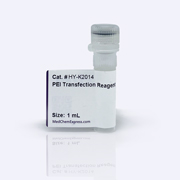
Cat. No.: HY-K2014

MCE PEI Transfection Reagent is designed based on 25 kDa PEI. It has high-efficiency, low-toxicity, strong-stability, and is suitable for many cell types, such as HEK-293、HEK-293T、CHO-K1、COS-1、COS-7、NIH/3T3、Sf9、HepG2 and HeLa et, even some hard-to-transfect cells. It can also be applied to large-scale recombinant protein expression and virus production. The 1 mL is defined as the base specification. All larger sizes correspond to incremental volumes of this base.

Cat. No.: HY-W250110E
CAS No.: 9002-98-6
Synonyms: PEI (branched) (MW 25000)
Polyethylenimine (branched) is a commonly used non-viral DNA transfection reagent. Polyethylenimine (branched) (MW 25000) binds to plasmid DNA .
Cat. No.: HY-W250110I
CAS No.: 9002-98-6
Synonyms: PEI (branched) (MW 10000)
Polyethylenimine (branched) (MW 10000) (PEI (branched) (MW 10000)) is a cationic polymer widely used as a nonviral nucleotide delivery reagent .
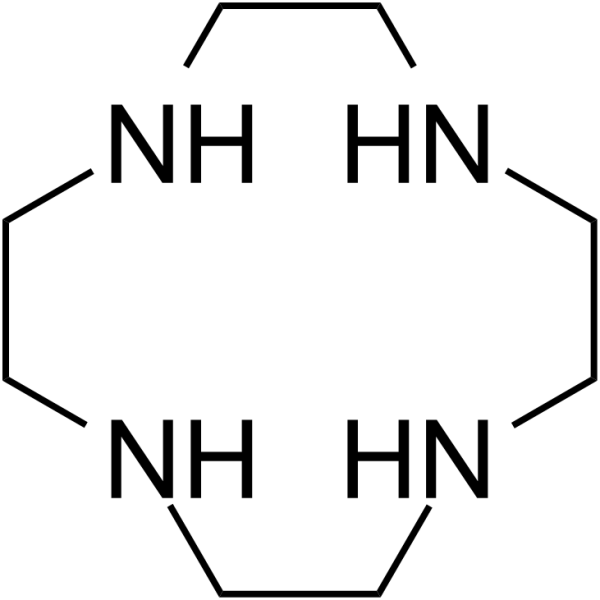
Cat. No.: HY-W007656
CAS No.: 294-90-6
Cyclen is a macrocyclic tetraamine chelating agent. Cyclen is the aza analogue of crown ether, used as a precursor for MRI contrast agents, and is an intermediate for the preparation of effective macrocyclic chelates. Cyclen is employed as a structural regulator through interfacial polymerization of polyethleneimine (PEI) and trimesoyl chloride (TMC) to develop polyamide NF membrane with efficient Li +/Mg 2+ separation performance. Cyclen has specific cavity structure and exhibits selective coordination properties for Li + ions [1][2].
Cat. No.: HY-D2839
m-PEG10000-PEI-Cy5 is a fluorescent dye composed of polyethylene glycol (PEG), Cy5 (HY-D0821) and Polyethyleneimine (PEI). m-PEG10000-PEI-Cy5 can be used for fluorescent labeling and imaging .
Cat. No.: HY-D2846A
m-PEG2000-PEI2000-Cy5 is a fluorescent dye composed of CY5 (HY-D0821), methoxypolyethylene glycol (mPEG), and polyethyleneimine (PEI). m-PEG2000-PEI2000-Cy5 is used for gene delivery, nanodrug delivery, cell imaging and biosensing and bioanalysis (Ex/Em=633/670 nm).
Cat. No.: HY-D2846
m-PEG-PEI800-Cy5 is a fluorescent dye composed of CY5 (HY-D0821), methoxypolyethylene glycol (mPEG), and polyethyleneimine (PEI). m-PEG-PEI8800-Cy5 is used for gene delivery, nanodrug delivery, cell imaging and biosensing and bioanalysis (Ex/Em = 633/670 nm).
Cat. No.: HY-D2837
mPEG-PEI-Cy5 (MW 2000) is a fluorescent dye composed of polyethylene glycol (PEG), FITC (HY-66019) and a Biotin (HY-B0511). mPEG-PEI-Cy5 (MW 2000) can be used for fluorescent labeling and imaging .
Cat. No.: HY-D2846B
m-PEG5000-PEI5000-Cy5 is a fluorescent dye composed of CY5 (HY-D0821), methoxypolyethylene glycol (mPEG), and polyethyleneimine (PEI). m-PEG5000-PEI5000-Cy5 is used for gene delivery, nanodrug delivery, cell imaging and biosensing and bioanalysis (Ex/Em=633/670 nm).
Cat. No.: HY-184606
PEI stabilized gold nanoclusters (PEI-Au NCs) are nanomaterials combining gold nanoclusters and polyethyleneimine. They consist of a few to dozens of gold atoms forming the core of the gold nanoclusters, while polyethyleneimine (PEI), a positively charged hyperbranched polyamine, is selected as the end-capping agent, encapsulating the surface of the gold nanoclusters. PEI-Au NCs have gained widespread application due to their high luminescence properties and stability over a wide pH range. Furthermore, their good biocompatibility and ease of surface modification or functionalization make them attractive for many biomedical applications.
Cat. No.: HY-D2835
mPEG-PEI-Cy5 (MW 1000) is a fluorescent dye composed of polyethylene glycol (PEG), FITC (HY-66019) and a Biotin (HY-B0511). mPEG-PEI-Cy5 (MW 1000) can be used for fluorescent labeling and imaging .
Cat. No.: HY-D2838
mPEG-PEI-Cy5 (MW 5000) is a fluorescent dye composed of polyethylene glycol (PEG), FITC (HY-66019) and a Biotin (HY-B0511). mPEG-PEI-Cy5 (MW 5000) can be used for fluorescent labeling and imaging .
Cat. No.: HY-184625
Polyethyleneimine (PEI)-modified magnetic iron(III) oxide (Fe3O4) nanoparticles are a composite nanomaterial that combines the properties of magnetic nanoparticles and polyethyleneimine. Polyethyleneimine is a highly branched polymer with a high density of amino groups. These amino groups stabilize the Fe3O4 nanoparticles and provide sites for further functionalization. The amino groups of PEI impart a high surface positive charge to the Fe3O4 nanoparticles, which helps enhance their interaction with negatively charged cell membranes.
Cat. No.: HY-184619
Due to their unique physical and chemical properties, noble metal nanoparticles, represented by platinum, gold, silver, and palladium, have been extensively studied by many scientists. Palladium is a noble metal belonging to the platinum group elements. Its elemental form is a silvery-white transition metal, soft in texture and possessing good ductility and malleability. Palladium nanoparticles, due to their unique physical, chemical, and electronic properties, have shown remarkable application potential in multiple fields. PEI surface modification of palladium nanoparticles can significantly improve their dispersibility, stability, and biocompatibility, and facilitate further coupling with other biomolecules or fluorescent molecules.
Cat. No.: HY-P11591
CAS No.: 3110124-60-9
Synonyms: PSMA-DOTA-PEI2
Domaines de recherche:  

Cancer

PDI2 (PSMA-DOTA-PEI2) is a prostate-specific membrane antigen (PSMA) ligand that acts as a tumor retention agent, renal uptake reducer, imaging agent and antitumor agent, applicable in SPECT diagnostic imaging and radiotheranostics. PDI2 specifically binds to PSMA on prostate cancer cells, enters cells via clathrin-dependent endocytosis, and exhibits higher tumor retention rate and lower renal uptake level. PDI2 is applicable in research related to prostate cancer and castration-resistant metastatic prostate cancer .
Cat. No.: HY-N16069
CAS No.: 60701-97-5
Target:  

Others

Domaines de recherche:  

Metabolic Disease

2-18:1 Lyso PEis a lysophosphatidylethanolamine.
15:0-18:1 PE
0 Images
9-Octadecenoic acid (9Z)-, (1R)-1-[[[(2-aminoethoxy)hydroxyphosphinyl]oxy]methyl]-2-[(1-oxopentadecyl)oxy]ethyl ester
Cat. No.: HY-W725579
CAS No.: 2135440-13-8
Synonyms: 1-Pentadecanoyl-2-oleoyl-sn-glycero-3-phosphoethanolamine; PE (15:0/18:1(9Z))
15:0-18:1 PEis a phosphatidylethanolamine.
Cat. No.: HY-W007656R
CAS No.: 294-90-6
Cyclen (Standard) is the analytical standard substance of Cyclen. This product is used for research and analytical applications. Cyclen is a macrocyclic tetrathiolate chelating agent. Cyclen is a nitrogen-containing analogue of crown ethers and can be used as a precursor for MRI contrast agents, as well as an intermediate for preparing highly efficient macrocyclic chelates. As a structural regulator, Cyclen can be prepared into polyamide nanofiltration membranes with efficient Li +/Mg 2+ separation performance through the interfacial polymerization of polyethyleneimine (PEI) and meta-benzotriazole chloride (TMC). Cyclen has a unique cavity structure and exhibits selective coordination properties for Li + ions .
Cat. No.: HY-184626
Thiol-modified magnetite nanoparticles are prepared via high-temperature pyrolysis and surface-modified with thiol functional groups. Magnetite is widely used in magnetic resonance imaging, magnetic separation, targeted drug delivery, tumor hyperthermia, cell labeling and separation, as a contrast agent, and in retinal detachment repair surgery due to its stable properties, good biocompatibility, high strength, and lack of toxicity. It is also used as a catalyst carrier, microwave absorbing material, and magnetic recording material. Xianfeng has developed numerous derivatives of magnetite, including oleic acid-modified magnetite, magnetite with different PEG ends, DMSA-modified magnetite, polylysine-modified magnetite, carboxylated dextran-modified magnetite nanoparticles, streptavidin-modified magnetite particles, thiol-modified magnetite magnetic nanoparticles, and polyethyleneimine (PEI)-modified magnetic magnetite nanoparticles, among others.
Cat. No.: HY-184620
Ferric oxide (Fe3O4) is widely used in magnetic resonance imaging (MRI), magnetic separation, targeted drug delivery, tumor hyperthermia, cell labeling and separation, and as a contrast agent and enhancement agent in retinal detachment repair surgery due to its stable material properties, good biocompatibility, high strength, and lack of toxic side effects. It is also used as a catalyst carrier, microwave absorbing material, and magnetic recording material. Xianfeng has developed numerous derivatives of ferric oxide, including oleic acid-modified ferric oxide, PEG-terminated ferric oxide, DMSA-modified ferric oxide, polylysine-modified ferric oxide, carboxylated dextran-modified ferric oxide nanoparticles, streptavidin-modified ferric oxide particles, thiol-modified ferric oxide magnetic nanoparticles, and polyethyleneimine (PEI)-modified magnetic ferric oxide nanoparticles, among others. This wide range of modifications provides numerous options for subsequent experiments.
  • 1

