
14 Results for "

Pyruvate carboxylase

" in MedChemExpress (MCE) Product Catalog:
Products (14)

14 Results for "Pyruvate carboxylase" in MCE Product Catalog:

Cat. No.: HY-P2989
CAS No.: 9014-19-1
Target:  

Endogenous Metabolite

Research Areas:  

Metabolic Disease Cancer

Pyruvate carboxylase is a key mitochondrial anaplerotic enzyme that catalyzes the conversion of pyruvate to oxaloacetate. Pyruvate carboxylase not only maintains tricarboxylic acid cycle activity and redox homeostasis, but also drives hepatic gluconeogenesis and fatty acid synthesis. The activity of Pyruvate carboxylase is upregulated in insulin-resistant states, exacerbating hepatic glucose production. Pyruvate carboxylase also shows significantly enhanced expression in early-stage non-small cell lung cancer (NSCLC). Pyruvate carboxylase promotes tumor proliferation by supporting nucleotide and lipid synthesis, and its functional deficiency cannot be compensated by glutaminolysis. Pyruvate carboxylase can be used in the research of prediabetes type 2 and NSCLC .
loading...
    loading...
2
2 Cited Publications
Cat. No.: HY-142684
CAS No.: 70205-50-4
Purity:  99.43%
Research Areas:  

Cancer

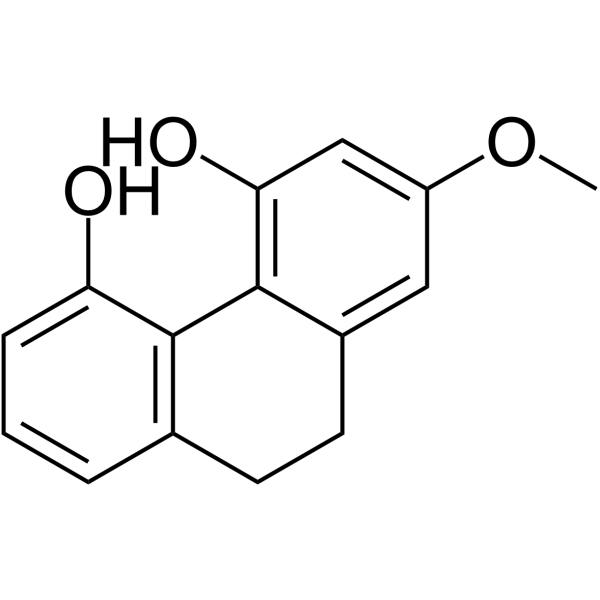
Pyruvate Carboxylase-IN-1 (compound 37) is a potent pyruvate carboxylase inhibitor with antiproliferative activity. The IC50 values ​​of pyruvate carboxylase-IN-1 against PC in cell lysates and cells are 0.204 and 0.104 μM, respectively .
loading...
    loading...
1
1 Cited Publications
Cat. No.: HY-142870
CAS No.: 1802650-31-2
Purity:  98.70%
Research Areas:  

Cancer

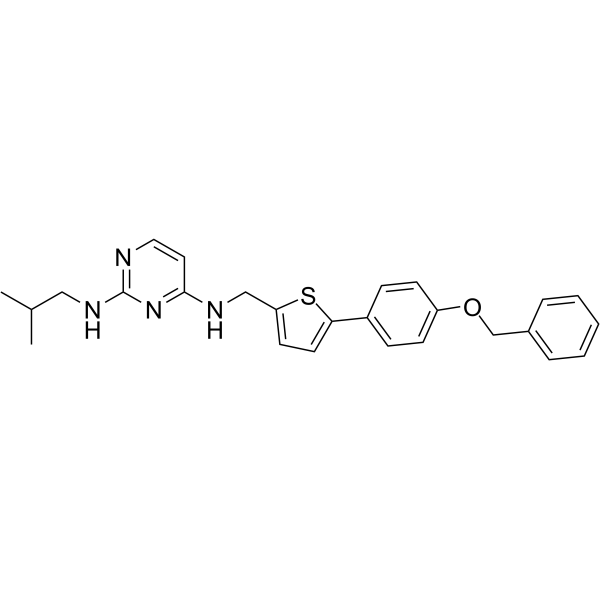
ZY-444 is an anti-cancer agent, targeting pyruvate carboxylase (PC). ZY-444 suppresses the Wnt/β-catenin/Snail signaling pathway by blocking nuclear translocation of β-catenin. ZY-444 selectively inhibits proliferation, migration, and invasion and induces apoptosis in cancer cells. ZY-444 exhibits potent anti-tumor in cancer mouse models. ZY-444 can be used for the study of breast cancer, lung cancer (NSCLC), prostate cancer and iodine-refractory thyroid cancer .
loading...
    loading...
Cat. No.: HY-163771
CAS No.: 3047101-14-1
Research Areas:  

Metabolic Disease

Pyruvate Carboxylase-IN-5 (compound 6m) is a pyruvate carboxylase inhibitor with high selectivity and permeability. Pyruvate carboxylase is a mitochondrial enzyme that catalyzes the carboxylation of pyruvate to oxaloacetate, a process that plays an important role in maintaining steady-state levels of Krebs cycle intermediates, which are precursors for the synthesis of biomacromolecules such as amino acids, fatty acids, and glucose .
loading...
    loading...
Cat. No.: HY-161627
CAS No.: 2919975-48-5
Anemoside A3-methyl 6-aminohexanoate is an orally effective pyruvate carboxylase (PC) inhibitor with a Kd value of 10.1 μM against human PC. Anemoside A3-methyl 6-aminohexanoate exerts its function through the PC/NF-κB/NLRP3 inflammasome axis. Anemoside A3-methyl 6-aminohexanoate significantly alleviates symptoms of DSS (HY-116282C)-induced colitis in mice. Anemoside A3-methyl 6-aminohexanoate can be used in colitis-related research .
loading...
    loading...
Cat. No.: HY-161679S
Pyruvate Carboxylase-IN-3 (Compd 36) is a potent Pyruvate Carboxylase inhibitor. Pyruvate Carboxylase-IN-3 inhibits hepatocellular carcinoma cells activity with an IC50 of 4.3 μM .
loading...
    loading...
Cat. No.: HY-161680
CAS No.: 2369048-06-4
Research Areas:  

Cancer

Pyruvate Carboxylase-IN-4 (Compd 8V) is a potent and competitive Pyruvate Carboxylase inhibitor with an IC50 of 4.3 μM .
loading...
    loading...
Cat. No.: HY-161681
CAS No.: 16409-13-5
Target:  

Guanylate Cyclase

Research Areas:  

Metabolic Disease

Formycin triphosphate is a fluorescent analogue of ATP which on binding to enzyme active sites exhibits enhanced fluorescence. Formycin triphosphate is an ATP-competitive chicken liver pyruvate carboxylase inhibitor. Formycin triphosphate potentiates atrial natriuretic factor (ANF)-stimulated guanylate cyclase activity with an EC50 at about 90 μM and inhibits ATP-stimulated guanylate cyclase activity with an IC50 at about 100 μM .
loading...
    loading...
Cat. No.: HY-E70394
CAS No.: 75179-85-0
Synonyms: Acetonyl-coenzyme A
S-Acetonyl-CoA (Acetonyl-coenzyme A) is a non-reactive structural analog of acetyl-CoA that acts as a competitive inhibitor against multiple target enzymes. S-Acetonyl-CoA lacks the characteristic thioester group of acetyl-CoA, retaining only a thioether structure. S-Acetonyl-CoA competes with acetyl-CoA for binding to citrate synthase, phosphate transacetylase, carnitine acetyltransferase, and N-myristoyltransferase 1. S-Acetonyl-CoA serves as a reagent for investigating acetyl-CoA-dependent physiological processes .
loading...
    loading...
Cat. No.: HY-178040
Insecticidal agent 26 (Compound A11), a spiro insecticidal agent, is a dual-functional inhibitor of pest Acetyl-CoA carboxylase (ACC) and Pyruvate carboxylase (PC). Insecticidal agent 26 has potent insecticidal activity against Sogatella furcifera with a LC50 of 11.0  μg/mL, with significant biosafety to bees. Insecticidal agent 26 can be used for management of white-backed planthoppers (WBPs) .
loading...
    loading...
Cat. No.: HY-137912
CAS No.: 387372-17-0
Target:  

Drug Metabolite

Research Areas:  

Endocrinology Cancer

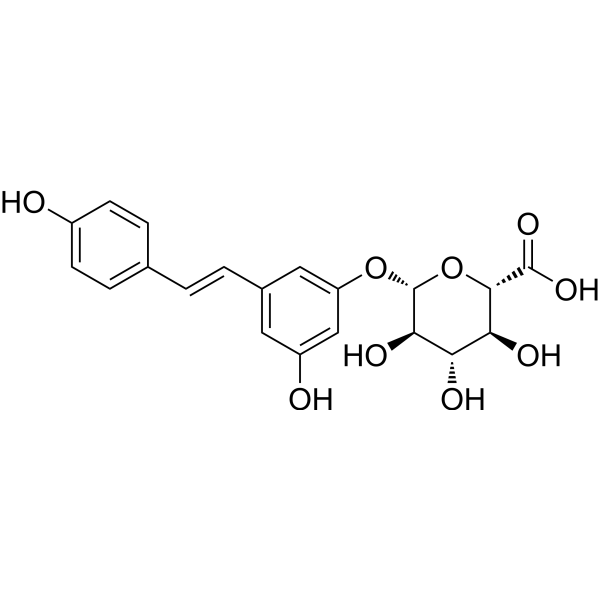
trans-Resveratrol-3-O-β-D-Glucuronide is an active metabolite of trans-resveratrol. trans-Resveratrol-3-O-β-D-Glucuronide reduces the proliferation of several intestinal cancer cell line. trans-Resveratrol-3-O-β-D-Glucuronide increases pyruvate production in livers .
loading...
    loading...
Cat. No.: HY-P82315
Synonyms: PC; Pyruvate carboxylase; mitochondrial; Pyruvic carboxylase; PCB

Host:  

Rabbit

Application:  

WB, ICC/IF

Reactivity:  

Human, Mouse, Rat

loading...
    loading...
Cat. No.: HY-P810906
Synonyms: Pyruvic carboxylase, PCB, PC

Host:  

Rabbit

Application:  

WB, IHC-P, ICC/IF

Reactivity:  

Human, Mouse, Rat

loading...
    loading...
Cat. No.: HY-184448
CAS No.: 2963747-43-3
CIB-Q22 is a potent pyruvate carboxylase (PC) inhibitor with an IC50 of 1.74 nM. CIB-Q22 suppresses hepatocellular carcinoma (HCC) cell proliferation, migration, and invasion. CIB-Q22 induces apoptosis and ferroptosis, promotes mitochondrial oxidative stress and dysfunction, inhibits glycolysis and anaplerotic flux, and reverses epithelial-mesenchymal transition (EMT). CIB-Q22 can be used for the study of hepatocellular carcinoma .
loading...
    loading...
  • 1

