13 Results for "

Serum analysis

" in MedChemExpress (MCE) Product Catalog:
Products (13)

13 Results for "Serum analysis" in MCE Product Catalog:

  • Targets Recommended:
1
1 Cited Publications
Cat. No.: HY-158742
CAS No.: 2171036-89-6
Purity:  99.30%
Synonyms: GL13; SBB-A-B
Target:  

Tyrosinase

Research Areas:  

Others

SBB-Analogue (GL13) Biotin (GL13; SBB-A-B) consists of a Sudan Black B (SBB) (HY-D0213) derivative conjugated with biotin. SBB-Analogue (GL13) Biotin potently detects senescent cells and eliminates the drawback of false-positive staining caused by serum starvation and cell fusion in SA-β-gal assays. SBB-Analogue (GL13) Biotin can be used in flow cytometry, immunofluorescence analysis, and other applications .
loading...
    loading...
1
1 Cited Publications
Cat. No.: HY-15929
CAS No.: 14348-40-4
Synonyms: 2,4,6-Tribromo-3-hydroxybenzoic acid
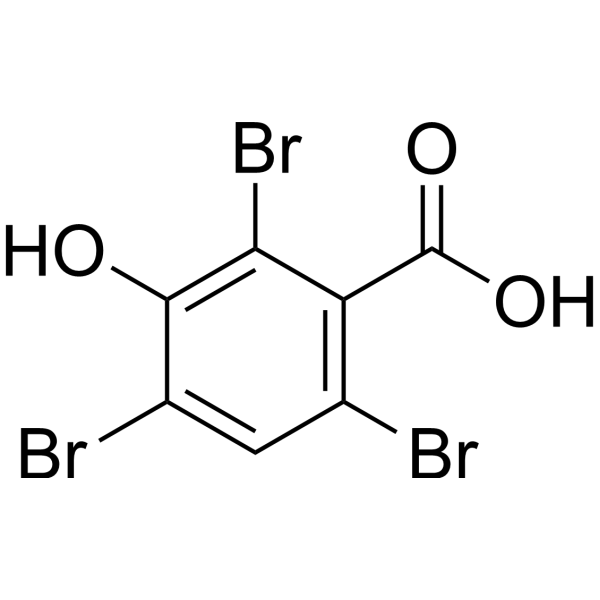
TBHBA (2,4,6-Tribromo-3-hydroxybenzoic acid) is a chemical colorimetric agent and nanomaterial surface modifier. TBHBA can react with some oxidants (such as H2O2) to generate high-absorbance quinoneimine dyes, which enhance the sensitivity of HDL cholesterol enzymatic determination. TBHBA can be used as a bromine-containing coupling agent to modify the surface of silica nanoparticles through esterification reaction. Thereby, organic flame retardant groups are introduced to improve the thermal stability and flame retardant properties of nanocomposites. TBHBA can be used in clinical biochemical testing (such as serum lipoprotein analysis) and the preparation of flame-retardant polymer nanocomposites .
loading...
    loading...
Cat. No.: HY-W040144
CAS No.: 76-60-8
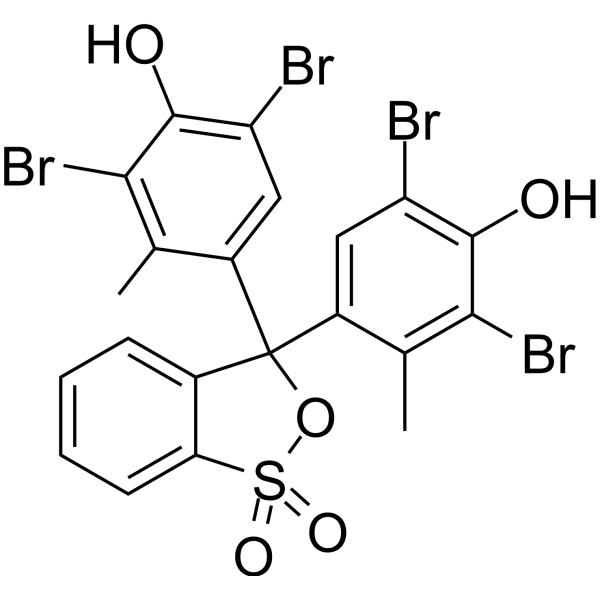
Bromocresol green is a pH-sensitive triphenylmethane dye commonly used for the determination of protein and albumin in serum. Bromocresol green is a bio-based dye with a yellow-green to blue-green color. Bromocresol green turns yellow (λmax=435 nm, protonated form) when placed in acidic solution (e.g. pH=4.15), and turns blue in basic solution (λmax=615 nm, deprotonated form). Bromocresol green is widely used as a pH indicator in the field of biochemical analysis. In addition, Bromocresol green is also used to detect the concentration of molecules such as creatinine, and to judge the viability of cells .
loading...
    loading...
Cat. No.: HY-32876
CAS No.: 16133-25-8
Research Areas:  

Others

Pyridine-3-sulfonyl chloride is a sulfonyl chlorination derivatization reagent for steroidal estrogens. Pyridine-3-sulfonyl chloride reacts with estrogens to form pyridine-3-sulfonyl derivatives, which generate abundant analyte-specific fragment ions upon collision-induced dissociation. Pyridine-3-sulfonyl chloride facilitates quantitative LC-ESI-MS/MS analysis of estrogens in serum and water matrices .
loading...
    loading...
Cat. No.: HY-W540687
CAS No.: 58902-60-6
Disialyloctasaccharide is a class of biochemical reagents used in glycobiology research. Disialyloctasaccharide serves as an internal standard for serum glycomics analysis, including absolute quantification of N-glycans and quantification of serum sialylated glycans via MALDI-TOF/MS. Disialyloctasaccharide can be applied to research related to hepatocellular carcinoma .
loading...
    loading...
Cat. No.: HY-P60128
CAS No.: 943235-73-2
Target:  

Peptides

Research Areas:  

Others

TTP is a generic surrogate peptide. TTP can be used for quantitative analysis of a recombinanthuman immunoglobulin G1 (hIgG1) in rat serum .
loading...
    loading...
Cat. No.: HY-35556
CAS No.: 947-73-9
Target:  

Fluorescent Dye

9-Aminophenanthrene is a type of polycyclic aromatic amine compound, which can be used as a fluorescent labeling reagent for free fatty acids (FFA) .
loading...
    loading...
Cat. No.: HY-165095
CAS No.: 74257-22-0
Synonyms: 1,2-Palmitolein-3-palmitin; TG(16:1/16:1/16:0)
Target:  

Others

Research Areas:  

Others

1,2-Dipalmitoleoyl-3-palmitoyl-rac-glycerol (1,2-Palmitolein-3-palmitin) is a triglyceride used for serum lipidomics analysis by liquid chromatography-mass spectrometry. This method can effectively separate and detect lipids in positive and negative ionization modes and has certain performance in the identification and characterization of serum triglycerides.
loading...
    loading...
Cat. No.: HY-121535
CAS No.: 116476-16-5
Research Areas:  

Others

Levosemotiadil, an S-isomer of semotiadil, exhibits stronger binding affinity to human serum albumin (HSA) compared to its R-isomer counterpart. This study utilized high-performance frontal analysis (HPFA) to demonstrate that levosemotiadil binds approximately three times more strongly to HSA than semotiadil. The binding parameters were evaluated using Scatchard analysis, revealing specific interactions with the diazepam binding site on HSA. The presence of diazepam decreased the binding affinity of both enantiomers, while warfarin did not alter their binding characteristics. These findings highlight levosemotiadil's potential as a Ca- and Na-channel blocker with significant binding preferences for HSA, crucial for understanding its pharmacokinetics and therapeutic effects .
loading...
    loading...
Cat. No.: HY-K1063

MCE Exosome Isolation and Purification Kit provides a simple and effective method to isolate and purify intact exosomes from plasma and serum that can be used for electron microscope analysis, NTA analysis, WB, qPCR, etc.


loading...
    loading...
Cat. No.: HY-187271S
[U- 15N]-ApoA1 is the 15N-labeled ApoA1. Reduced serum levels of apolipoprotein A1 (ApoA1) are closely associated with cardiovascular diseases, such as coronary heart disease. This isotope can be used in NMR studies to investigate disease mechanisms and in mass spectrometry analysis.
loading...
    loading...
Cat. No.: HY-D3274
PE-Cy5 is a tandem fluorescent dye commonly used in flow cytometry, immunofluorescence, and cell biology research. It is formed by the covalent linkage of two fluorescent molecules, namely phycoerythrin and CY5. PE-Cy5 binds to human FcγRI (CD64), and this binding can be blocked by human pooled serum, anti-CD64 monoclonal antibodies targeting the ligand-binding region, or aggregated IgG. PE-Cy5 supports three-color flow cytometry analysis, and whole blood staining can partially reduce its non-specific binding (Ex/Em = 450-500 nm/665 nm) .
loading...
    loading...
Cat. No.: HY-179631
Target:  

Apoptosis

Research Areas:  

Cancer

2DG-ODDA is a 2-deoxyglucose (2-DG) (HY-13966) derivative with potent antitumor activity. 2DG-ODDA induces apoptosis, and reduces ATP production. 2DG-ODDA is taken up through both fatty acid and glucose transporters and is cleaved by α-Mannosidase (HY-P2950), releases 2DG to inhibit N-glycosylation and disrupt cellular metabolism. 2DG-ODDA inhibits tumor growth in a 4T1 mouse model. 2DG-ODDA can be used for the research of triple-negative breast cancer (TNBC) .
loading...
    loading...
  • 1

