1. Search Result
Search Result
Results for "

Staphylococcus aureus ClpP

" in MedChemExpress (MCE) Product Catalog:

10

Inhibitors & Agonists

5

Natural
Products

Targets Recommended:
Cat. No. Product Name Target Research Areas Chemical Structure
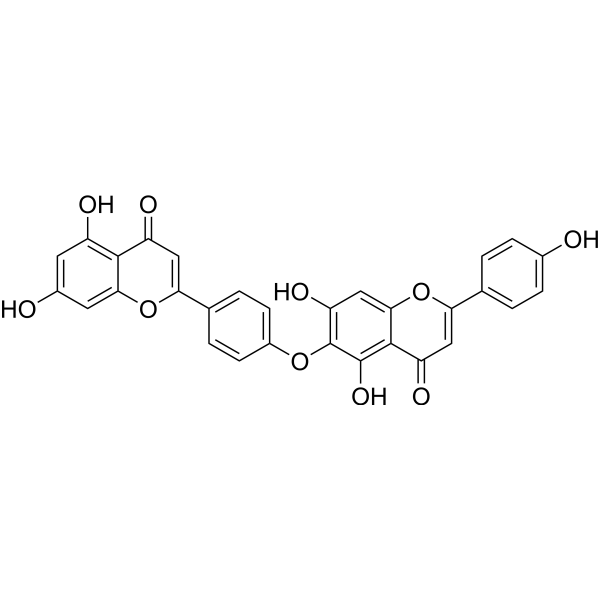
  • HY-N2360
    Hinokiflavone
    5+ Cited Publications

    E1/E2/E3 Enzyme Apoptosis MMP ClpP Infection Inflammation/Immunology Cancer
    Hinokiflavone is a novel modulator of pre-mRNA splicing activity extracted from plants with anti-inflammatory, anti-tumor and antiviral activities. Hinokiflavone is also a potent inhibitor for matrix metalloproteinases (MMPs). Hinokiflavone attenuates the virulence of Methicillin (HY-121544)-resistant staphylococcus aureus by inhibiting caseinolytic protease P (ClpP) with an IC50 value of 34.36 mg/mL. Hinokiflavone induces apoptosis via the reactive oxygen species-mitochondria-mediated apoptotic pathway and inhibits tumor cell migration and invasion. Hinokiflavone is a SUMO protease inhibitor against sentrin-specific protease 1 (SENP1) activity .
    Hinokiflavone
  • HY-N1181
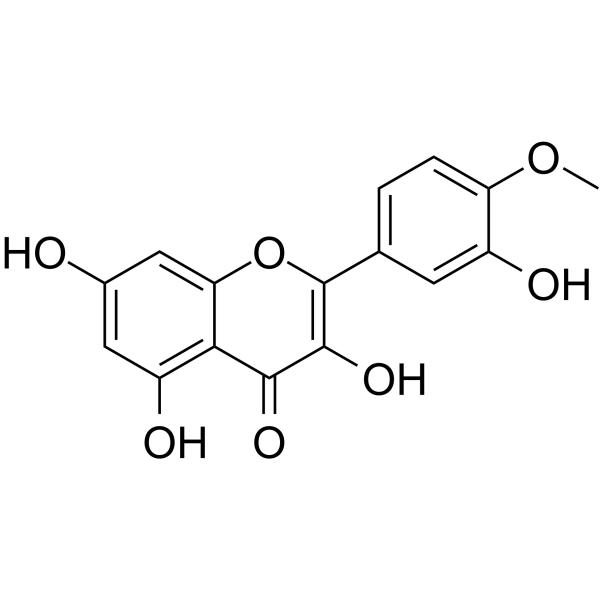
    Tamarixetin
    2 Publications Verification

    4'-O-Methyl Quercetin

    Endogenous Metabolite ClpP Bacterial Apoptosis Akt Interleukin Related COX JNK p38 MAPK Reactive Oxygen Species (ROS) Infection Cardiovascular Disease Inflammation/Immunology Cancer
    Tamarixetin (4'-O-Methyl Quercetin) is an orally active natural flavonoid derivative of quercetin and caseinolytic protease p (ClpP) inhibitor with anti-inflammatory, antioxidant and antitumor effects. Tamarixetin inhibits the hydrolytic activity of ClpP to the fluorescent substrate Suc-LY-AMC with an IC50 of 49.73 μM, which can be used for the study of Staphylococcus aureus infection. Tamarixetin inhibits tumor cell growth, induces apoptosis, and cell cycle arrest. Tamarixetin prevents cardiac hypertrophy by inhibiting the NFAT and AKT pathways .
    Tamarixetin
  • HY-N1181R

    4'-O-Methyl Quercetin (Standard)

    Reference Standards Endogenous Metabolite ClpP Bacterial Apoptosis Akt Interleukin Related COX JNK p38 MAPK Reactive Oxygen Species (ROS) Infection Cardiovascular Disease Inflammation/Immunology Cancer
    Tamarixetin (Standard) is the analytical standard of Tamarixetin. This product is intended for research and analytical applications. Tamarixetin (4'-O-Methyl Quercetin) is an orally active natural flavonoid derivative of quercetin and caseinolytic protease p (ClpP) inhibitor with anti-inflammatory, antioxidant and antitumor effects. Tamarixetin inhibits the hydrolytic activity of ClpP to the fluorescent substrate Suc-LY-AMC with an IC50 of 49.73 μM, which can be used for the study of Staphylococcus aureus infection. Tamarixetin inhibits tumor cell growth, induces apoptosis, and cell cycle arrest. Tamarixetin prevents cardiac hypertrophy by inhibiting the NFAT and AKT pathways .
    Tamarixetin (Standard)
  • HY-152096

    ClpP Bacterial Infection
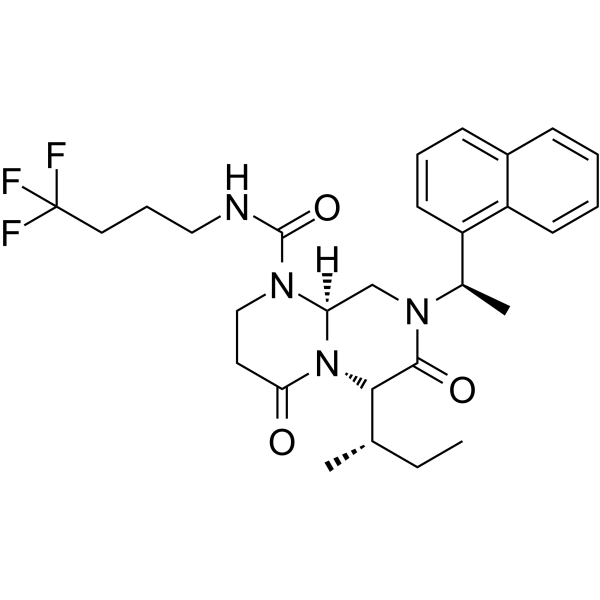
    (R)-ZG197 is a highly selective Staphylococcus aureus Caseinolytic protease P (SaClpP) activator with an EC50 of 1.5 μM. (R)-ZG197 also activates Homo sapiens ClpP (HsClpP) with an EC50 of 31.4 μM .
    (R)-ZG197
  • HY-178912

    Reactive Oxygen Species (ROS) Bacterial ClpP Infection Inflammation/Immunology
    Anti-MRSA agent 39 is an orally active ClpX modulator that binds Staphylococcus aureus caseinolytic protease X (SaClpX) with high affinity (Kd = 3.6 μM). Anti-MRSA agent 39 exerts antibacterial effects through temperature-dependent inhibition of cell division. Anti-MRSA agent 39 elicits profound metabolic dysregulation in methicillin-resistant Staphylococcus aureus (MRSA), manifesting as significantly reduced ATP levels, elevated reactive oxygen species (ROS), and decreased NAD+/NADH ratio, and accelerates bacterial lysis rates in MRSA ATCC 33591. Anti-MRSA agent 39 significantly increases the proportion of MRSA cells in the mitotic phase, and the cells exhibit obvious morphological abnormalities. Anti-MRSA agent 39 can be used for the study of invasive MRSA infections .
    Anti-MRSA agent 39
  • HY-N2360R

    Reference Standards E1/E2/E3 Enzyme Apoptosis MMP ClpP Infection Inflammation/Immunology Cancer
    Hinokiflavone is a novel modulator of pre-mRNA splicing activity extracted from plants with anti-inflammatory, anti-tumor and antiviral activities. Hinokiflavone is also a potent inhibitor for matrix metalloproteinases (MMPs). Hinokiflavone attenuates the virulence of Methicillin (HY-121544)-resistant staphylococcus aureus by inhibiting caseinolytic protease P (ClpP) with an IC50 value of 34.36 mg/mL. Hinokiflavone induces apoptosis via the reactive oxygen species-mitochondria-mediated apoptotic pathway and inhibits tumor cell migration and invasion. Hinokiflavone is a SUMO protease inhibitor against sentrin-specific protease 1 (SENP1) activity .
    Hinokiflavone (Standard)
  • HY-174985

    Bacterial Infection
    Anti-MRSA agent 32 (Compound 26) is an orally active and selective SaClpP (Staphylococcus aureus ClpP protease) activator with an EC50 value of 0.98 μM. Anti-MRSA agent 32 activates SaClpP to abnormally degrade bacterial proteins, inhibiting the proliferation of Staphylococcus aureus. Anti-MRSA agent 32 promotes wound healing in a murine skin infection model. Anti-MRSA agent 32 is promising for research of infectious diseases such as methicillin-resistant Staphylococcus aureus (MRSA) infections .
    Anti-MRSA agent 32
  • HY-182033

    Bacterial ClpP Infection
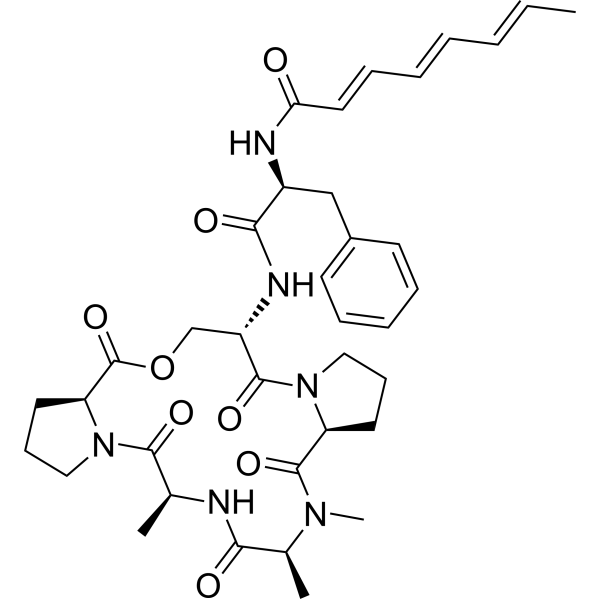
    ClpP agonist 1 is a Staphylococcus aureus ClpP (SaClpP) agonist with an EC50 of 1.44 μM, Kd values of 2.95 μM (isothermal titration calorimetry) and 18 μM (bio-layer interferometry), and a low drug resistance frequency. ClpP agonist 1 reduces bacterial load, shrinks infected area and improves histopathological outcomes in a mouse skin infection model. ClpP agonist 1 can be used for the research of Methicillin (HY-121544)-resistant Staphylococcus aureus (MRSA) skin infections .
    ClpP agonist 1
  • HY-170398

    Antibiotic Bacterial Infection
    ZG297 is an agonist for Staphylococcus aureus ClpP (SaClpP ) with an EC50 of 0.26 μM. ZG297 degrades SaFtsZ, inhibits the bacterial cell division, thereby exhibiting antistaphylococcal activity, that inhibits S. aureus 8325-4 strains and MRSA strains with MIC of 0.063-256 μg/mL. ZG297 exhibits anti-infectious efficacy in mouse models .
    ZG297
  • HY-125524

    Bacterial Infection
    Antibacterial agent 199 (Compound 2) is an activator for caseinolytic protease (ClpP) with a Kd of 0.7 μM. Antibacterial agent 199 exhibits antibacterial efficacy against Gram-positive strains Staphylococcus aureus, Streptococcus pneumoniae and Gram-negative strain Neisseria meningitidis, with MICs of 16, 0.5 and 0.5 μg/mL, respectively .
    Antibacterial agent 199

Inquiry Online

Your information is safe with us. * Required Fields.

Salutation


Country or Region *

Applicant Name *


Organization Name *

Department *


Email Address *


Product Name *

Cat. No.


Requested quantity *

Phone Number *


Remarks

Inquiry Online

Inquiry Information

Product Name:
Cat. No.:
Quantity:
MCE Japan Authorized Agent:

