5 Results for "

azide-modified biomolecules

" in MedChemExpress (MCE) Product Catalog:
Products (5)

5 Results for "azide-modified biomolecules" in MCE Product Catalog:

1
1 Cited Publications
Cat. No.: HY-D2171A
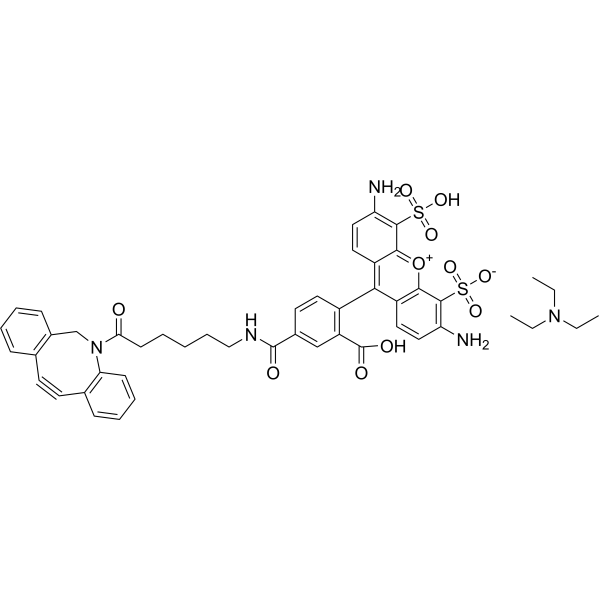
AF488 DBCO ditriethylamineis a fluorescent dye and also a click chemistry reagent that can label azide-containing biomolecules. AF488 DBCO ditriethylaminemediates the coupling reaction with azide-modified 2'-OMe RNA oligonucleotides. DBCO is a bioorthogonal partner of azides and enables covalent coupling without copper (Ex/Em = 470/520 nm) .
loading...
    loading...
Cat. No.: HY-D2171
AF488 DBCO is a fluorescent dye and also a click chemistry reagent that can label azide-containing biomolecules. AF488 DBCO mediates the coupling reaction with azide-modified 2'-OMe RNA oligonucleotides. DBCO is a bioorthogonal partner of azides and enables covalent coupling without copper (Ex/Em = 470/520 nm) .
loading...
    loading...
Cat. No.: HY-164211
CAS No.: 2181837-96-5
Target:  

PROTAC Linkers

Research Areas:  

Others

DBCO-PEG2-OH is a functionalized polyethylene glycol (PEG) derivative that can be used to label azide-modified biomolecules spontaneously and as a component of drug carriers .
loading...
    loading...
Cat. No.: HY-D2758
CAS No.: 1911598-65-6
TAMRA DBCO, 5-isomer is a derivative of TAMRA fluorescent isomer with a DBCO functional group. TAMRA DBCO, 5-isomer undergoes strain-promoted azide-alkyne cycloaddition (SPAAC) under copper-free catalytic conditions. TAMRA DBCO, 5-isomer serves as a FRET acceptor for FAM fluorophores. TAMRA DBCO, 5-isomer can label proteins, peptides, nucleic acids and all azide-modified biomolecules, and is suitable for fluorescence imaging and flow cytometry to quantify intracellular SPAAC reactions .
loading...
    loading...
Cat. No.: HY-D3570
Target:  

Fluorescent Dye

Research Areas:  

Others

AF405 DBCO is a blue fluorescent dye derivative containing a dibenzocyclooctyne (DBCO) group. AF405 DBCO reacts rapidly with azide-labeled biomolecules at room temperature without the need for a metal catalyst, enabling copper-free click chemistry (SPAAC) for applications in live-cell imaging, flow cytometry, super-resolution microscopy, and other research fields .
loading...
    loading...

