



AF488 DBCO
Based on 1 publication(s) in Google Scholar
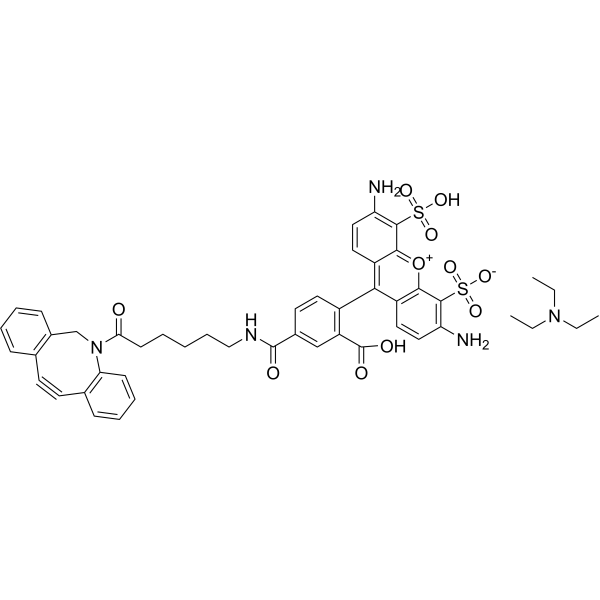
AF488 DBCO is a fluorescent dye and also a click chemistry reagent that can label azide-containing biomolecules. AF488 DBCO mediates the coupling reaction with azide-modified 2'-OMe RNA oligonucleotides. DBCO is a bioorthogonal partner of azides and enables covalent coupling without copper (Ex/Em = 470/520 nm).
Nur für Forschungszwecke. Wir verkaufen nicht an Patienten.
- Reinheit : 95.05%
- Formel: C48H49N5O11S2
- Molecular Weight:936.06
-
Speicherung:
-20°C, sealed storage, away from moisture and light, under nitrogen
* In solvent : -80°C, 6 months; -20°C, 1 month (sealed storage, away from moisture and light, under nitrogen)

To place orders, for customer services and technical support, please contact: MedChemExpress USA
Tel: 609-228-6898 E-mail: [email protected] [email protected]


-
 Biologische Aktivität
-
Chemical Information
-
Lösungsmittel & Löslichkeit
- Protokoll
- Reinheit & Dokumentation
- Verweise
-
 Help & FAQs


Publications Citing Use of MedChemExpress (MCE) AF488 DBCO
More

Biologische Aktivität
Beschreibung
In Vitro
AF488 DBCO (100 nmol; 24 h) efficiently conjugates with azido-RNA-S in a 24-hour room temperature reaction, producing a product separable by size exclusion high-performance liquid chromatography[1].
MedChemExpress (MCE) has not independently confirmed the accuracy of these methods. They are for reference only.


Chemical Information
-
Appearance Solid
-
Molecular Weight 936.06
-
Formel C48H49N5O11S2
-
Color Orange to red
-
SMILES
O=C(O)C1=C(C=CC(C(NCCCCCC(N2CC3=C(C#CC4=C2C=CC=C4)C=CC=C3)=O)=O)=C1)C5=C(C6=[O+]C7=C5C=CC(N)=C7S(=O)([O-])=O)C=CC(N)=C6S(=O)(O)=O.CCN(CC)CC
-
Versand
Room temperature in continental US; may vary elsewhere.
-
Speicherung
-20°C, sealed storage, away from moisture and light, under nitrogen
* In solvent : -80°C, 6 months; -20°C, 1 month (sealed storage, away from moisture and light, under nitrogen)


Publications (1)
-
Journal Impact Factor
-
Most Recent
-
Bioact Mater
Dynamic matrix engineering promotes nascent protein deposition to drive cell migration and expedite Re-epithelization in chronic wound. [Abstract]2025 Oct 28:56:455-467. PMID: 41216373


Lösungsmittel & Löslichkeit
In Vitro:
DMSO : 4.68 mg/mL (5.00 mM; Need ultrasonic and warming; Hygroscopic DMSO has a significant impact on the solubility of product, please use newly opened DMSO)
Please refer to the solubility information to select the appropriate solvent. Once prepared, please aliquot and store the solution to prevent product inactivation from repeated freeze-thaw cycles.
Storage method and period of stock solution: -80°C, 6 months; -20°C, 1 month (sealed storage, away from moisture and light, under nitrogen). When stored at -80°C, please use it within 6 months. When stored at -20°C, please use it within 1 month.
Please refer to the solubility information to select the appropriate solvent. Once prepared, please aliquot and store the solution to prevent product inactivation from repeated freeze-thaw cycles.
Storage method and period of stock solution: -80°C, 6 months; -20°C, 1 month (sealed storage, away from moisture and light, under nitrogen). When stored at -80°C, please use it within 6 months. When stored at -20°C, please use it within 1 month.
Konzentration (Stammlösung) × Volumen (Stammlösung) = Konzentration (Ziellösung) × Volumen (Ziellösung)


Reinheit & Dokumentation
-
Data Sheet (272 KB)
-
SDS (252 KB)
- English - EN (252 KB)
- Français - FR (252 KB)
- Deutsch - DE (252 KB)
- Norwegian - NO (252 KB)
- Español - ES (252 KB)
- Swedish - SV (252 KB)
- Italian - IT (252 KB)
- Korean - KR (252 KB)
- Portuguese - PT (252 KB)
-
Handling Instructions (2659 KB)
Verweise


Complete Stock Solution Preparation Table
Please refer to the solubility information to select the appropriate solvent. Once prepared, please aliquot and store the solution to prevent product inactivation from repeated freeze-thaw cycles.
Storage method and period of stock solution: -80°C, 6 months; -20°C, 1 month (sealed storage, away from moisture and light, under nitrogen). When stored at -80°C, please use it within 6 months. When stored at -20°C, please use it within 1 month.
| Optional Solvent | Concentration Solvent Mass | 1 mg | 5 mg | 10 mg | 25 mg |
|---|---|---|---|---|---|
| DMSO | 1 mM | 1.0683 mL | 5.3415 mL | 10.6831 mL | 26.7077 mL |


AF488 DBCO Related Classifications
HY-D2171 Related Classifications
 Powered by Bioz