1. Search Result
Search Result
Results for "

bipolar depression

" in MedChemExpress (MCE) Product Catalog:

11

Inhibitors & Agonists

1

Isotope-Labeled Compounds

Cat. No. Product Name Target Research Areas Chemical Structure
  • HY-17637

    ITI-007

    Dopamine Receptor 5-HT Receptor Neurological Disease Cancer
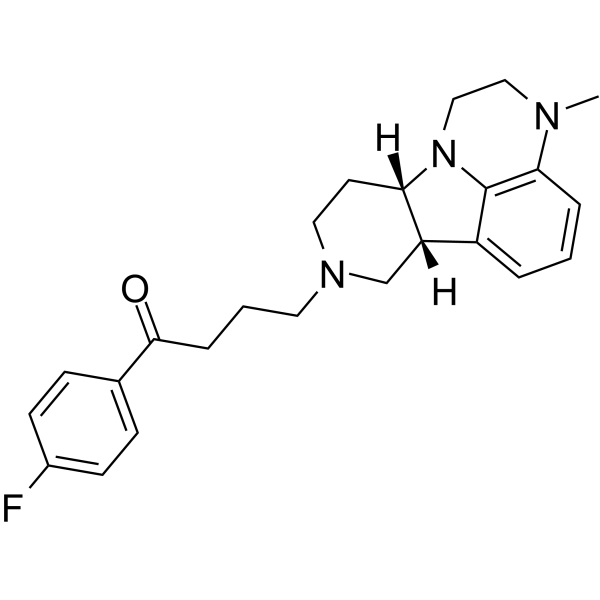
    Lumateperone (ITI-007) is an orally active 5-HT2A receptor antagonist (Ki = 0.54 nM), a partial agonist of presynaptic D2 receptors and an antagonist of postsynaptic D2 receptors (Ki = 32 nM), and a dopamine D1 receptor modulator. Lumateperone has anticancer activity and can also be used for the study of schizophrenia and bipolar depression .
    Lumateperone
  • HY-G0002

    Drug Metabolite Dopamine Receptor 5-HT Receptor Neurological Disease
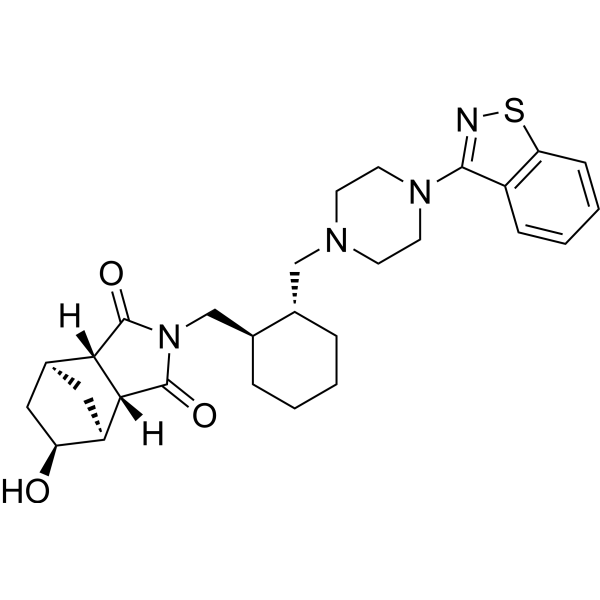
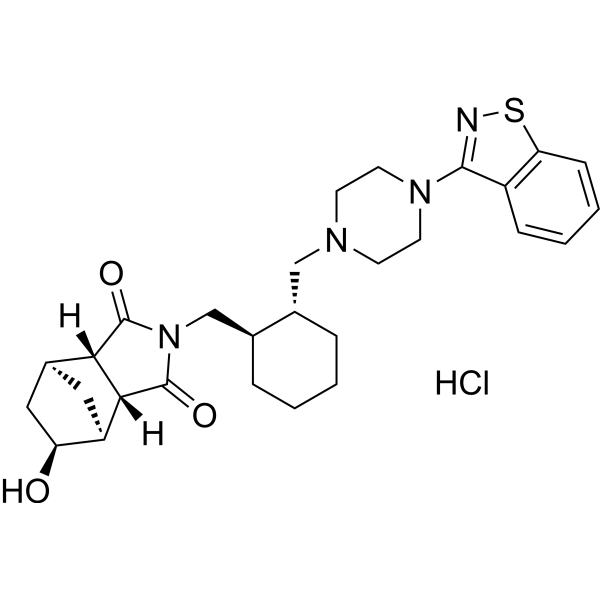
    Lurasidone metabolite 14326 is a minor active metabolite of Lurasidone (HY-B0032A) generated via metabolism by CYP3A4. Lurasidone metabolite 14326 shares similar receptor-binding properties with Lurasidone, acting as an antagonist of the dopamine D2 receptor (dopamine D2 receptor), an antagonist of the serotonin 5-HT2A and 5-HT7 receptors (5-HT2A and 5-HT7 receptor), and a partial agonist of the serotonin 5-HT1A receptor. Lurasidone metabolite 14326 can be used in the research of schizophrenia and bipolar depression .
    Lurasidone metabolite 14326
  • HY-W039283

    MCHR1 (GPR24) Neurological Disease Cancer
    MCH-1 antagonist 2 (l-BROMO-2,4-DIFLUORO-5-NITROBEN-ZENE) is a melanin concentrating hormone-1 (MCH1) receptor-selective 4-aryl piperidine. MCH-1 antagonist 2 can be used for the research of depression, anxiety, obesity, urge incontinence, urinary incontinence, major depression, bipolar disorder, agoraphobia, specific phobia, social phobia, obsessive-compulsive disorder, post-traumatic stress disorder, acute stress disorder, urinary frequency, urinary urgency, nocturia, enuresis, bulimia, bulimia nervosa, anorexia nervosa, major depressive disorder, dysthymic disorder, bipolar 1 and 2 disorders, schizoaffective disorder, cognitive disorders with depressed mood, personality disorders, insomnia, hypersomnia, narcolepsy, circadian rhythm sleep disorder, nightmare disorder, sleep terror disorder, sleepwalking disorder, panic disorder, social anxiety disorder, generalized anxiety disorder, overactive bladder .
    MCH-1 antagonist 2
  • HY-G0003A

    (S)-Hydroxy Iloperidone; VHX-896

    Drug Metabolite Dopamine Receptor 5-HT Receptor Neurological Disease
    Milsaperidone ((S)-Hydroxy Iloperidone) is an active metabolite of the antipsychotic agent Iloperidone (HY-17410). Milsaperidone is a dopamine D2 and 5-HT2A receptor antagonist. Milsaperidone rapidly converts to Iloperidone when taken orally. Milsaperidone can be used in the research of mental illnesses such as depression .
    Milsaperidone
  • HY-121778

    Melitracene; N 7001; Trausabun

    5-HT Receptor Neurological Disease
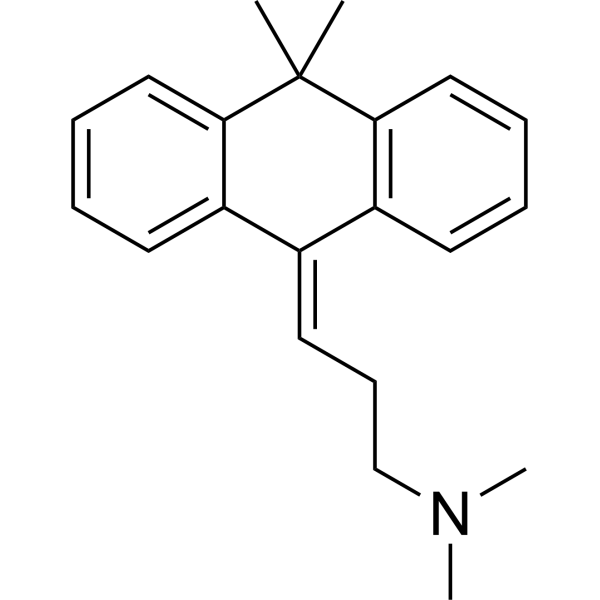
    Melitracen (Melitracene) is an orally active tricyclic antidepressant and it is also a bipolar thymoleptic with activating properties. Melitracen inhibits 3H-5-HT and 14H-5-HT with IC50s of 670 nM and 5500 nM, respectively. Melitracen can be used for the research of depression and anxiety .
    Melitracen
  • HY-17637R

    ITI-007 (Standard)

    Dopamine Receptor 5-HT Receptor Reference Standards Neurological Disease Cancer
    Lumateperone (Standard) is the analytical standard of Lumateperone. This product is intended for research and analytical applications. Lumateperone (ITI-007) is an orally active 5-HT2A receptor antagonist (Ki = 0.54 nM), a partial agonist of presynaptic D2 receptors and an antagonist of postsynaptic D2 receptors (Ki = 32 nM), and a dopamine D1 receptor modulator. Lumateperone has anticancer activity and can also be used for the study of schizophrenia and bipolar depression .
    Lumateperone (Standard)
  • HY-17637S2

    ITI-007-d4

    Isotope-Labeled Compounds Dopamine Receptor 5-HT Receptor Neurological Disease Cancer
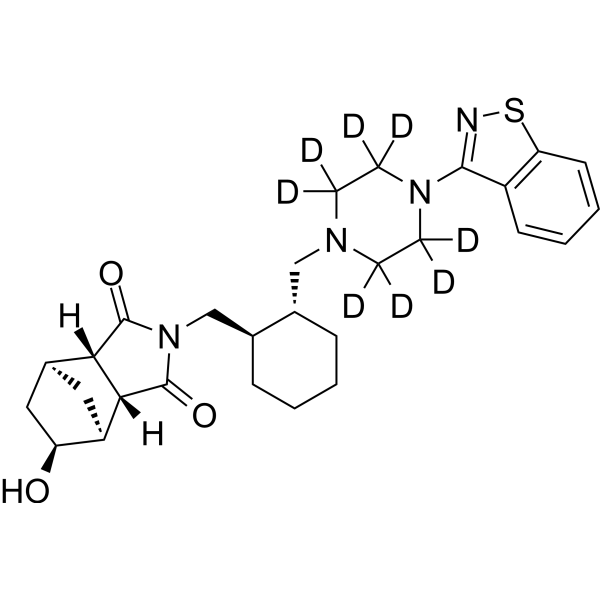
    Lumateperone-d4 (ITI-007-d4) is deuterium labeled Lumateperone. Lumateperone (ITI-007) is an orally active 5-HT2A receptor antagonist (Ki = 0.54 nM), a partial agonist of presynaptic D2 receptors and an antagonist of postsynaptic D2 receptors (Ki = 32 nM), and a dopamine D1 receptor modulator. Lumateperone has anticancer activity and can also be used for the study of schizophrenia and bipolar depression .
    Lumateperone-d4
  • HY-W052508R

    N-Desalkylquetiapine (Standard)

    5-HT Receptor Reference Standards Neurological Disease
    Norquetiapine is an antidepressant and neuroprotective agent and is the active metabolic component of Quetiapine (HY-14544). Norquetiapine is also a partial 5-HT1A receptor agonist, and a presynaptic α2, 5-HT2C and 5-HT7 b> Receptor antagonist. Norquetiapine can also selectively inhibit norepinephrine transporter (NET), inhibit norepinephrine reuptake, and has potential inhibitory effects on bipolar depression, major depressive disorder, and generalized anxiety disorder. Norquetiapine demonstrated in vivo activity in forced swimming in mice and learned helplessness tests in rats .
    Norquetiapine (Standard)
  • HY-14545B

    5-HT Receptor Dopamine Receptor Neurological Disease
    SEP4199 is an orally active 5-HT7 receptor ligand, with a Ki value of 66 nM for human 5-HT7R and 16 nM for human D2R. SEP4199 mediates antidepressant effects. SEP4199 is applicable for the research of bipolar depression .
    SEP-4199
  • HY-179725

    5-HT Receptor Dopamine Receptor Neurological Disease
    PZ-1129 is a selective 5-HT7 receptor ligand with a Ki of 7 nM. PZ-1129 shows Ki values of 159 and 24 nM for 5-HT1A receptor and D2 receptor. PZ-1129 can inhibit the constitutive cAMP production mediated by the Gs signaling pathway (EC50 = 13.7 nM). PZ-1129 can be used for the research of emotional disorders, such as depression and bipolar disorder .
    PZ-1129
  • HY-179724A

    5-HT Receptor Dopamine Receptor MMP Potassium Channel Neurological Disease
    PZ-1657 hydrochloride (Compound 57) is a potent, selective and orally active 5-HT7 receptor inverse agonist with a Ki of 5 nM. PZ-1657 hydrochloride can inhibit the constitutive cAMP production mediated by the Gs signaling pathway (EC50 = 2.93 nM). PZ-1657 hydrochloride can significantly reduce the MMP-9 activity mediated by 5-HT7 receptors in the hippocampus of mice, and the effect is comparable to that of SB-269970 (HY-15370). PZ-1657 hydrochloride can reverse the cognitive deficits observed in the rat novel object recognition test induced by Phencyclidine without affecting the animals' spontaneous activities. PZ-1657 hydrochloride can be used for the research of emotional disorders, such as depression and bipolar disorder .
    PZ-1657 hydrochloride

Inquiry Online

Your information is safe with us. * Required Fields.

Salutation


Country or Region *

Applicant Name *


Organization Name *

Department *


Email Address *


Product Name *

Cat. No.


Requested quantity *

Phone Number *


Remarks

Inquiry Online

Inquiry Information

Product Name:
Cat. No.:
Quantity:
MCE Japan Authorized Agent:

