8 Results for "

constipation disorder

" in MedChemExpress (MCE) Product Catalog:
Products (8)

8 Results for "constipation disorder" in MCE Product Catalog:

5
5 Cited Publications
Cat. No.: HY-17638
CAS No.: 666843-10-3
Synonyms: DSP-3235 free base; KGA-3235 free base; GSK-1614235 free base
Target:  

SGLT

Research Areas:  

Metabolic Disease

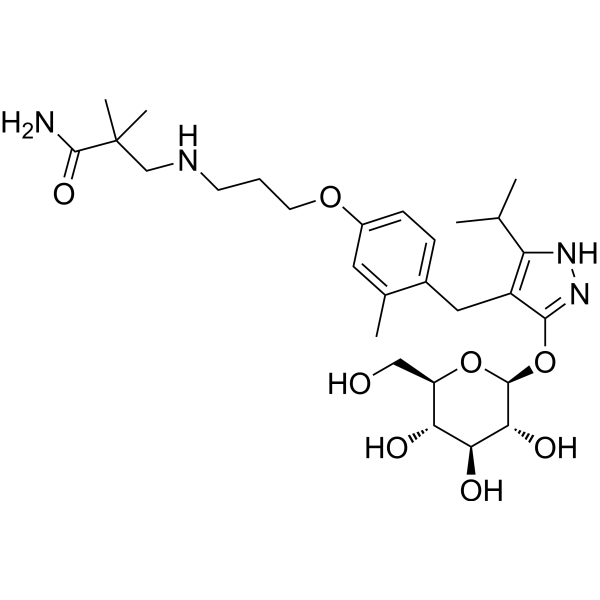
Mizagliflozin (DSP-3235 free base) is a potent, orally active and selective SGLT1 inhibitor, with a Ki of 27 nM for human SGLT1. Mizagliflozin displays 303-fold selectivity over SGLT2. Mizagliflozin is used as an antidiabetic agent that can modify postprandial blood glucose excursion. Mizagliflozin also exhibits potential in the amelioration of chronic constipation .
loading...
    loading...
2
2 Cited Publications
Cat. No.: HY-B2132
CAS No.: 61-54-1
Synonyms: 3-(2-Aminoethyl)indole~2-(3-Indolyl)ethylamine
Tryptamine is a selective, blood-brain-penetrating 5-HT4 receptor agonist (EC50=1-3 mM) and an endogenous ligand of the aryl hydrocarbon receptor (AHR) (Kd=10-50 nM). Tryptamine promotes intestinal anion secretion and fluid transport by activating G protein-coupled receptors (GPCRs) and accelerates gastrointestinal motility. Tryptamine regulates Th17/Treg balance to inhibit neuroinflammation, competitively binds to 5-HT receptors to regulate central nervous system activity, and participates in temperature regulation and spinal reflex regulation as a neuromodulator. Tryptamine can be used to study intestinal motility disorders such as functional constipation, and has shown significant efficacy in multiple sclerosis models .
loading...
    loading...
1
1 Cited Publications
Cat. No.: HY-W012734
CAS No.: 3105-95-1
Synonyms: H-HoPro-OH
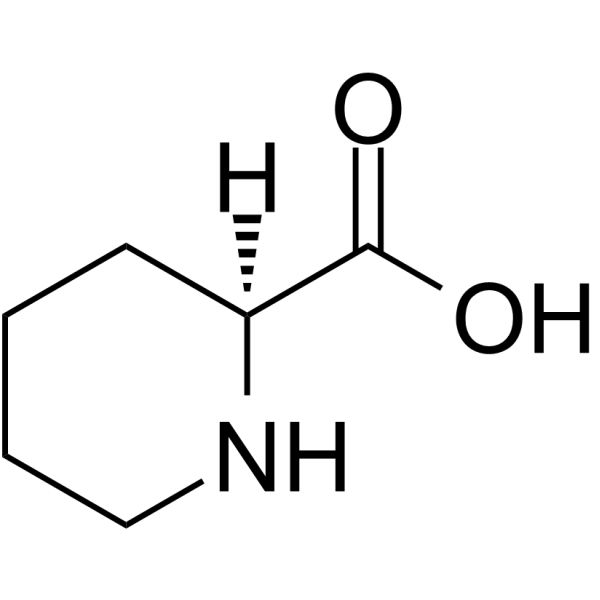
L-Pipecolic acid (H-HoPro-OH) is an oral active metabolite of Lysine and can accumulate in the bodily fluids of infants with autosomal inherited diseases, such as Zellweger syndrome and neonatal adrenal insufficiency. L-Pipecolic acid can promote muscle cell health and growth by enhancing protein synthesis, and plays a role in promoting gut health. L-Pipecolic acid holds promise for research in the fields of metabolic disorders, muscle growth disorders, and intestinal diseases .
loading...
    loading...
1
1 Cited Publications
Cat. No.: HY-144401
CAS No.: 1369412-66-7
Purity:  99.18%
Target:  

Motilin Receptor

Research Areas:  

Metabolic Disease

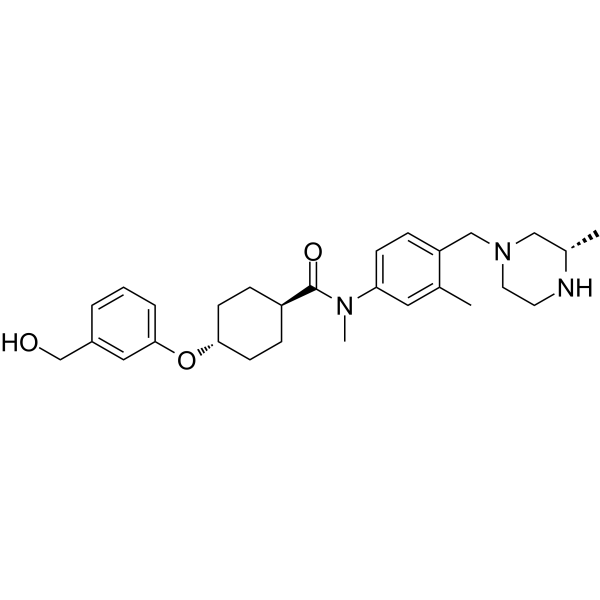
DS-3801b is a potent and non-macrolide agonist of GPR38. DS-3801b is expected to be novel gastrointestinal prokinetic agents for the research of functional gastrointestinal disorders such as gastroparesis and chronic constipation .
loading...
    loading...
Cat. No.: HY-154636
CAS No.: 8012-95-1
Research Areas:  

Endocrinology

Liquid Paraffin is a petroleum-derived mixture of saturated hydrocarbons and an orally active fecal lubricant. Liquid Paraffin is widely used in studies of constipation and fecal incontinence in children through its lubricating effect and the osmotic effect generated by its conversion to hydroxy fatty acids. Liquid Paraffin has high safety, is non-carcinogenic, and does not affect fat-soluble vitamin levels with long-term use. Liquid Paraffin does not cause abdominal pain or electrolyte disorders, but may lead to lipoid pneumonia and granulomas caused by rectal administration. Liquid Paraffin can also be used as a phase change material for thermal energy storage, or combined with nanoparticles to form a protective boundary film to reduce mechanical wear .
loading...
    loading...
Cat. No.: HY-W012734R
CAS No.: 3105-95-1
Synonyms: H-HoPro-OH (Standard)
L-Pipecolic acid (Standard) is an analytical standard of L-Pipecolic acid. This product is used for research and analytical applications. L-Pipecolic acid (H-HoPro-OH) is an oral active metabolite of Lysine and can accumulate in the bodily fluids of infants with autosomal inherited diseases, such as Zellweger syndrome and neonatal adrenal insufficiency. L-Pipecolic acid can promote muscle cell health and growth by enhancing protein synthesis, and plays a role in promoting gut health. L-Pipecolic acid holds promise for research in the fields of metabolic disorders, muscle growth disorders, and intestinal diseases .
loading...
    loading...
Cat. No.: HY-117749
CAS No.: 14008-48-1
Synonyms: WY 8138; DB09219 acetate
Bisoxatin (WY 8138; DB09219) acetate is a laxative agent. Bisoxatin acetate is a stimulant for intestinal peristalsis and has the potential for the research of constipation disorder .
loading...
    loading...
Cat. No.: HY-17638A
CAS No.: 1169392-27-1
Synonyms: DSP-3235 (sebacate); KGA-3235 (sebacate); GSK-1614235 (sebacate)
Target:  

SGLT

Research Areas:  

Neurological Disease

Mizagliflozin sebacate (DSP-3235 sebacate) is a sodium-glucose cotransporter inhibitor with activity in improving vascular cognitive impairment caused by small vessel disease. Mizagliflozin sebacate improves blood flow and reverses vascular cognitive impairment by inhibiting neuronal SGLT1 activity. Mizagliflozin sebacate also showed the ability to increase the survival rate of IL-1β-treated PC12HS cells. Mizagliflozin sebacate promotes improvements in spatial learning and memory caused by small vessel disease in mouse models .
loading...
    loading...

