9 Results for "

disproportionation

" in MedChemExpress (MCE) Product Catalog:
Products (9)

9 Results for "disproportionation" in MCE Product Catalog:

16
16 Publications Verification
Cat. No.: HY-W001187
CAS No.: 2564-83-2
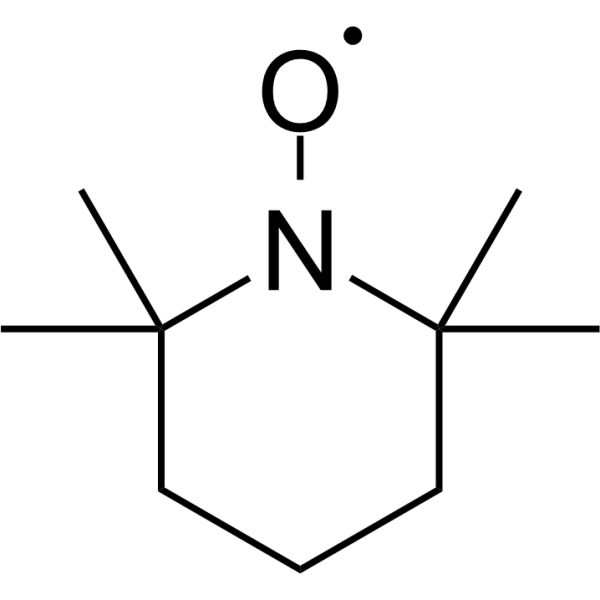
Tempo is a nitric oxide radical and a selective scavenger of ROS in mitochondria. Tempo is also an organocatalyst that disproportionates superoxide and oxidizes primary alcohols to aldehydes in a catalytic cycle. Tempo has mutagenic and antioxidant effects and can induceDNA strand breaks. Tempo also exerts cytotoxic and mutagenic properties in mouse lymphoma cells .
loading...
    loading...
8
8 Cited Publications
Cat. No.: HY-15908
CAS No.: 979-88-4
Purity:  99.52%
Synonyms: Disodium bicinchoninate
Research Areas:  

Others

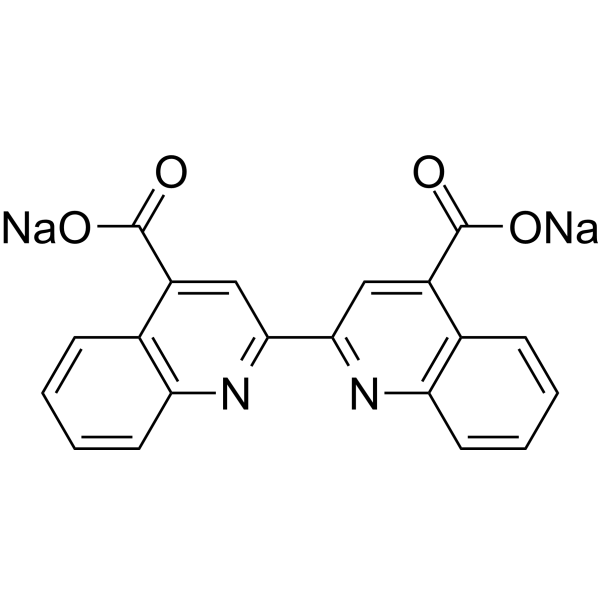
BCA is a chelating agent targeting Cu I. BCA forms a water-soluble complex with Cu I at a 2:1 stoichiometric ratio, which not only inhibits its oxidation and disproportionation reactions, but also mediates the Cu I-catalyzed azide-alkyne cycloaddition click chemistry reaction to achieve bioconjugation of fluorophores or biotin with functionalized proteins. BCA chelates Cu + from proteins that reduce Cu 2+, forming a purple compound detectable by colorimetry, and thus is used to determine the total protein concentration in solution. BCA is a potential small-molecule candidate for AHAS inhibitors .
loading...
    loading...
8
8 Cited Publications
Cat. No.: HY-W004599
CAS No.: 1245-13-2
Research Areas:  

Others

Bicinchoninic acid is a chelating agent targeting Cu I. Bicinchoninic acid forms a water-soluble complex with Cu I at a 2:1 stoichiometric ratio, which not only inhibits its oxidation and disproportionation reactions, but also mediates the Cu I-catalyzed azide-alkyne cycloaddition click chemistry reaction to achieve bioconjugation of fluorophores or biotin with functionalized proteins. Bicinchoninic acid chelates Cu + from proteins that reduce Cu 2+, forming a purple compound detectable by colorimetry, and thus is used to determine the total protein concentration in solution. Bicinchoninic acid is a potential small-molecule candidate for AHAS inhibitors .
loading...
    loading...
8
8 Cited Publications
Cat. No.: HY-15908A
CAS No.: 63451-34-3
Research Areas:  

Others

Dipotassium [2,2'-biquinoline]-4,4'-dicarboxylate is a chelating agent targeting Cu I. Dipotassium [2,2'-biquinoline]-4,4'-dicarboxylate forms a water-soluble complex with Cu I at a 2:1 stoichiometric ratio, which not only inhibits its oxidation and disproportionation reactions, but also mediates the Cu I-catalyzed azide-alkyne cycloaddition click chemistry reaction to achieve bioconjugation of fluorophores or biotin with functionalized proteins. Dipotassium [2,2'-biquinoline]-4,4'-dicarboxylate chelates Cu + from proteins that reduce Cu 2+, forming a purple compound detectable by colorimetry, and thus is used to determine the total protein concentration in solution. Dipotassium [2,2'-biquinoline]-4,4'-dicarboxylate is a potential small-molecule candidate for AHAS inhibitors .
loading...
    loading...
Cat. No.: HY-15932
CAS No.: 82692-93-1
Synonyms: TOOS sodium salt
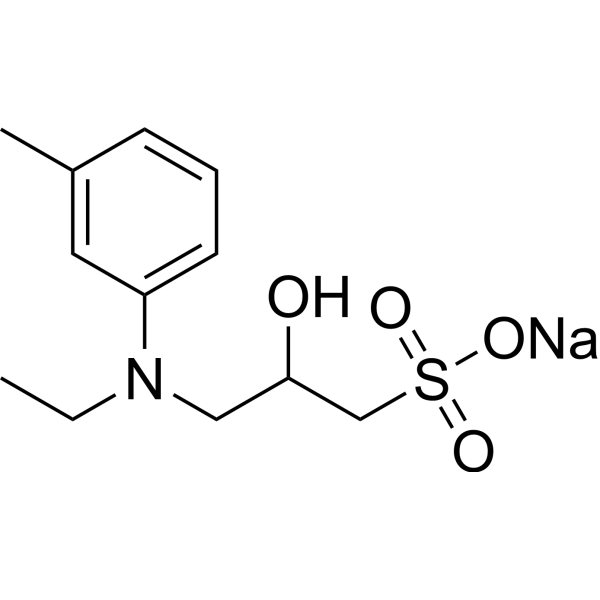
TOOS (TOOS sodium salt) is a highly water-soluble aniline derivative widely used in diagnostics and biological experiments. TOOS can be combined with 3-methyl-2-benzothiazolinone hydrazone hydrochloride (MBTH) to form a chromogenic system to measure oxidase activity. In the MBTH-TOOS chromogenic system, MBTH is catalytically oxidized to produce (-NH) free radicals, which react with TOOS to form colorless compounds. Furthermore, the colorless compound undergoes a disproportionation reaction to produce a blue-violet quinoid compound .
loading...
    loading...
Cat. No.: HY-N11424
CAS No.: 17459-92-6
Bilirubin diglucuronide is a bilirubin glycoside conjugate with a 1-O-acyl β-D-glucuronide structure. Bilirubin diglucuronide is the major conjugated bilirubin (HY-N0323) and predominant pigment excreted in the bile of adult humans, rats, dogs and cats. Bilirubin diglucuronide is mainly synthesized via UDP-glucuronosyltransferase-mediated transfer of glucuronic acid from UDP-glucuronic acid to bilirubin monoglucuronide, or via enzymatic disproportionation of two moles of bilirubin monoglucuronide (predominantly producing the IXα configuration). In addition, Bilirubin diglucuronide can also be synthesized from bilirubin or its monoglucuronide in a UDP-glucuronic acid-dependent manner. Pretreatment with phenobarbital significantly enhances the formation process of Bilirubin diglucuronide .
loading...
    loading...
Cat. No.: HY-Y1668
CAS No.: 630-19-3
Synonyms: Pivalic aldehyde; Pivalaldehyde
Research Areas:  

Others

Trimethylacetaldehyde (Pivalic aldehyde; Pivalaldehyde) is an inhibitor of E. coli betaine aldehyde dehydrogenase (ALDH) with a Ki of 4.5 mM. Trimethylacetaldehyde serves as a substrate for Drosophila melanogaster alcohol dehydrogenase (AdhS), undergoing oxidation and disproportionation reactions with the release of NADH, and also forms an inactive binary enzyme-aldehyde complex via a compulsory ordered reaction mechanism .
loading...
    loading...
Cat. No.: HY-W012472
CAS No.: 717-74-8
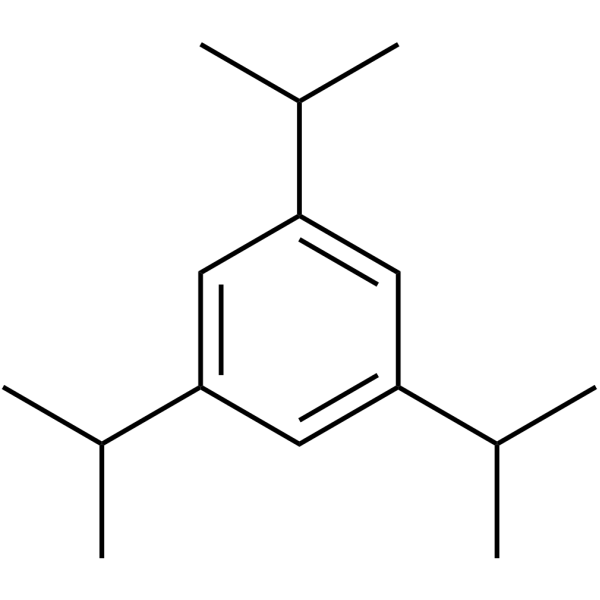
1,3,5-Triisopropylbenzene is a symmetric aromatic hydrocarbon compound. 1,3,5-Triisopropylbenzene serves as a saturated crosslinker to participate in the "inverse vulcanization" reaction of elemental sulfur. 1,3,5-Triisopropylbenzene acts as a probe molecule to evaluate the external surface acidity and accessibility of zeolite materials. 1,3,5-Triisopropylbenzene is also used as fuel and fuel additive, lubricant and lubricant additive, as well as micelle swelling agent .
loading...
    loading...
Cat. No.: HY-W001187R
CAS No.: 2564-83-2
Tempo (Standard) is the analytical standard of Tempo. This product is intended for research and analytical applications. Tempo is a nitric oxide radical and a selective scavenger of ROS in mitochondria. Tempo is also an organocatalyst that disproportionates superoxide and oxidizes primary alcohols to aldehydes in a catalytic cycle. Tempo has mutagenic and antioxidant effects and can induceDNA strand breaks. Tempo also exerts cytotoxic and mutagenic properties in mouse lymphoma cells [4].
loading...
    loading...