



Dipotassium [2,2'-biquinoline]-4,4'-dicarboxylate
Based on 8 publication(s) in Google Scholar
Dipotassium [2,2'-biquinoline]-4,4'-dicarboxylate is a chelating agent targeting CuI. Dipotassium [2,2'-biquinoline]-4,4'-dicarboxylate forms a water-soluble complex with CuI at a 2:1 stoichiometric ratio, which not only inhibits its oxidation and disproportionation reactions, but also mediates the CuI-catalyzed azide-alkyne cycloaddition click chemistry reaction to achieve bioconjugation of fluorophores or biotin with functionalized proteins. Dipotassium [2,2'-biquinoline]-4,4'-dicarboxylate chelates Cu+ from proteins that reduce Cu2+, forming a purple compound detectable by colorimetry, and thus is used to determine the total protein concentration in solution. Dipotassium [2,2'-biquinoline]-4,4'-dicarboxylate is a potential small-molecule candidate for AHAS inhibitors.
For research use only. We do not sell to patients.
- CAS No.: 63451-34-3
- Formula: C20H10K2N2O4
- Molecular Weight:420.50
-
Storage:
RT, protect from light, stored under nitrogen.
In solvent -80°C, 1 year , -20°C, 6 months
![Dipotassium [2,2'-biquinoline]-4,4'-dicarboxylate Chemical Structure](https://file.medchemexpress.com/product_pic/hy-15908a.gif "Click to View Dipotassium [2,2'-biquinoline]-4,4'-dicarboxylate Chemical Structure")

To place orders, for customer services and technical support, please contact: MedChemExpress USA
Tel: 609-228-6898 E-mail: [email protected] [email protected]


-
 Biological Activity
-
Chemical Information
- Protocols
- Purity & Documentation
- References
-
 Help & FAQs


-
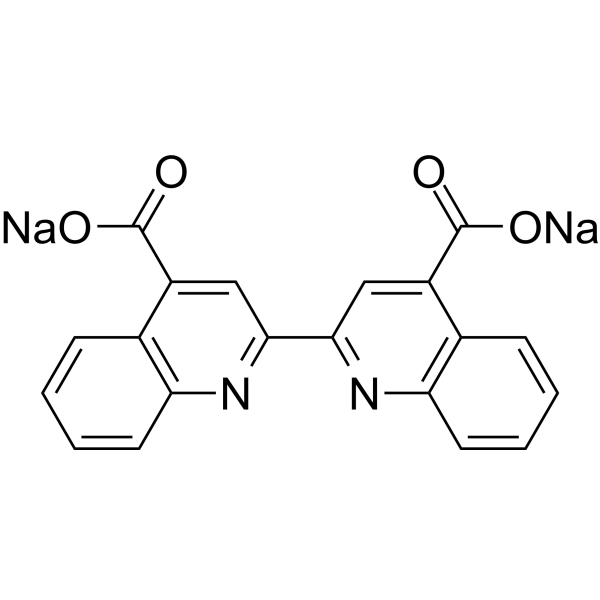
HY-15908
BCACu(I) Chelator -

HY-D0020
2,2'-BipyridineMetal Chelating Ligand -
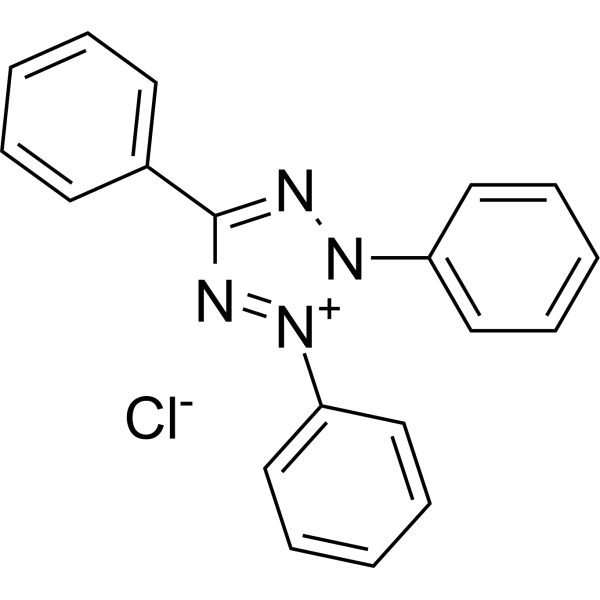
HY-D0714
Tetrazolium RedBiochemical Assay Reagent -

HY-D0020R
2,2'-Bipyridine (Standard)Metal Chelating Ligand -
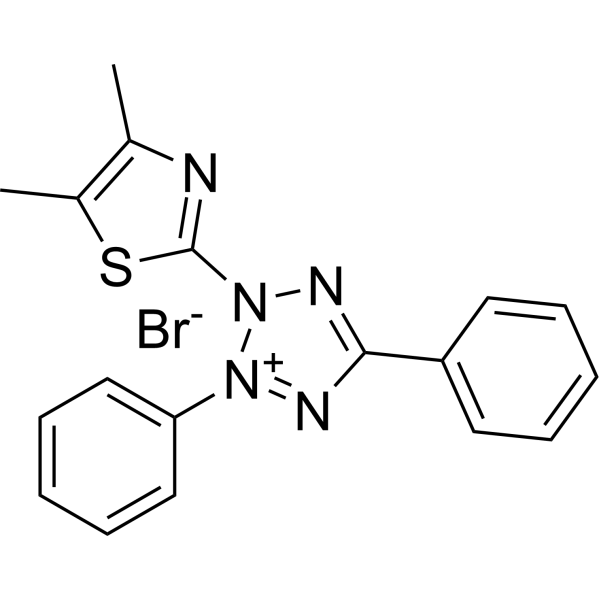
HY-15924
Thiazolyl BlueCytotoxicity Detection Reagent -
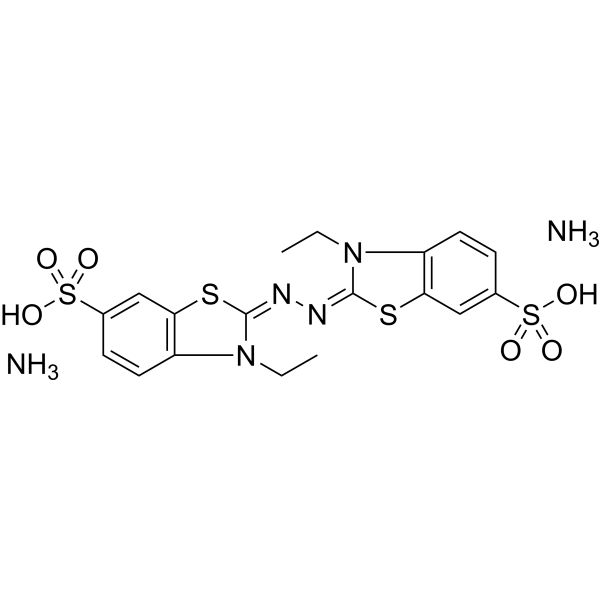
HY-15902
ABTS diammonium saltHRP Substrate -

HY-W034959
4,4'-Dimethyl-2,2'-biquinolineMetal-organic Framework -

HY-W034955
2,2'-Bi(1,8-naphthyridine)Metal-organic Framework -

HY-DY1086
Thiazolyl Blue (solution)Cytotoxicity Detection Reagent
Publications Citing Use of MedChemExpress (MCE) Dipotassium [2,2'-biquinoline]-4,4'-dicarboxylate
More- Adv Funct Mater. 2024 Mar 14.
- Cardiovasc Diabetol. 2019 Feb 2;18(1):15. [Abstract]
- Mater Today Bio. 2025 Feb 20:31:101598. [Abstract]
- Nano Today. 2025 Jun.
- Nano Today. 2025 Jun.
- Biologics. 2024 May 23:18:129-142. [Abstract]
- J Cancer. 2021 Feb 22;12(8):2243-2257. [Abstract]
- J Oncol. 2022 Aug 11;2022:5824617. [Abstract]


Biological Activity
Description
In Vitro
Dipotassium [2,2'-biquinoline]-4,4'-dicarboxylate (BCA) acts as a Cu (I) chelating stabilizer in CuI-catalyzed azide-alkyne cycloaddition reactions[1].
Dipotassium [2,2'-biquinoline]-4,4'-dicarboxylate (BCA) enables quantitative analysis of carbohydrates in three types of soil extracellular polymeric substance (EPS) extracts[2].
Dipotassium [2,2'-biquinoline]-4,4'-dicarboxylate (Compound 8) is a potential small-molecule candidate inhibitor of AHAS identified via virtual screening. It exhibits only 1.4 % inhibitory effect on rapeseed root growth at a concentration of 100 μg/mL, and shows no inhibitory activity at 10 μg/mL[3].
Dipotassium [2,2'-biquinoline]-4,4'-dicarboxylate (BCA) is a core reagent in commonly used BCA protein quantification methods. Under alkaline conditions, protein complexes with Cu2+ and is reduced to Cu+. Dipotassium [2,2'-biquinoline]-4,4'-dicarboxylate then binds with Cu+ to form a purple-blue complex. The absorbance of this complex is directly proportional to the protein concentration[4].
MedChemExpress (MCE) has not independently confirmed the accuracy of these methods. They are for reference only. Further protocols information, click here.


Chemical Information
-
CAS No. 63451-34-3
-
Appearance Solid
-
Molecular Weight 420.50
-
Formula C20H10K2N2O4
-
SMILES
O=C(C1=CC(C2=CC(C(O[K])=O)=C3C=CC=CC3=N2)=NC4=C1C=CC=C4)O[K]
-
Shipping
Room temperature in continental US; may vary elsewhere.
-
Storage
RT, protect from light, stored under nitrogen
In solvent -80°C 1 year -20°C 6 months


Publications (8)
-
Journal Impact Factor
-
Most Recent
-
-
Cardiovasc Diabetol
SGLT2 inhibition with empagliflozin attenuates myocardial oxidative stress and fibrosis in diabetic mice heart. [Abstract]2019 Feb 2;18(1):15. PMID: 30710997 -
Mater Today Bio
A metal-polyphenol network-based iron supplement with improved stability and reduced gastrointestinal toxicity for iron deficiency anemia therapy. [Abstract]2025 Feb 20:31:101598. PMID: 40070867 -
-
-
Biologics
LncRNA GAS5 Modulates the Progression of Glioma Through Repressing miR-135b-5p and Upregulating APC. [Abstract]2024 May 23:18:129-142. PMID: 38817552 -
J Cancer
MMP9 and IGFBP1 Regulate Tumor Immune and Drive Tumor Progression in Clear Cell Renal Cell Carcinoma. [Abstract]2021 Feb 22;12(8):2243-2257. PMID: 33758602 -
J Oncol
Metformin Exhibits an Attractive Antineoplastic Effect on Human Endometrial Cancer by Regulating the Hippo Signaling Pathway. [Abstract]2022 Aug 11;2022:5824617. PMID: 36226249

Protocols
-
EdU Incorporation Assay (Click Chemistry-Based DNA Synthesis Measurement)
The EdU incorporation assay measures DNA synthesis by adding the thymidine analog 5-ethynyl-2′-deoxyuridine to cells or tissues, where it is incorporated into newly synthesized DNA during S phase. Incorporated EdU is detected by copper-catalyzed azide-alkyne cycloaddition, in which a fluorescent azide covalently reacts with the ethynyl group on EdU, allowing S-phase cells to be detected by fluorescence microscopy, flow cytometry, or high-content imaging. EdU detection does not require DNA denaturation or anti-BrdU antibody access, which preserves sample structure and improves compatibility with immunostaining and multiparameter cytometry compared with BrdU-based detection. EdU can be cytotoxic in a cell-type- and exposure-dependent manner, so pulse duration, concentration, and continuous-labeling designs should be validated for each cell type.
-
Enzyme-Linked Immunosorbent Assay (ELISA)
Enzyme-linked immunosorbent assay (ELISA) is a biochemical technology widely used to detect and quantify proteins, antibodies, hormones and other biomolecules. This method uses enzyme-labeled antibodies or antigens to specifically bind to the test substance, and generates a measurable signal through an enzyme-catalyzed reaction. ELISA has the characteristics of high sensitivity, specificity and high-throughput, and is suitable for medical diagnosis, biomedical research and drug development and other fields.
-
Protein Extraction
Protein extraction uses physical, chemical or biological methods, such as ultrasonic disruption, salting out, cell lysis, electrophoresis, etc., to destroy the cell membrane structure and to separate the proteins from different components according to their characteristics.


Purity & Documentation
-
Data Sheet (293 KB)
-
SDS (393 KB)
- English - EN (393 KB)
- Français - FR (393 KB)
- Deutsch - DE (393 KB)
- Norwegian - NO (393 KB)
- Español - ES (393 KB)
- Swedish - SV (393 KB)
- Italian - IT (393 KB)
- Korean - KR (393 KB)
- Portuguese - PT (393 KB)
-
Handling Instructions (2659 KB)
References

Calculators
Concentration (start) × Volume (start) = Concentration (final) × Volume (final)


Dipotassium [2,2'-biquinoline]-4,4'-dicarboxylate Related Classifications
HY-15908A Related Classifications
 Powered by Bioz