



1,3,5-Triisopropylbenzene

Based on 1 Customer Validation
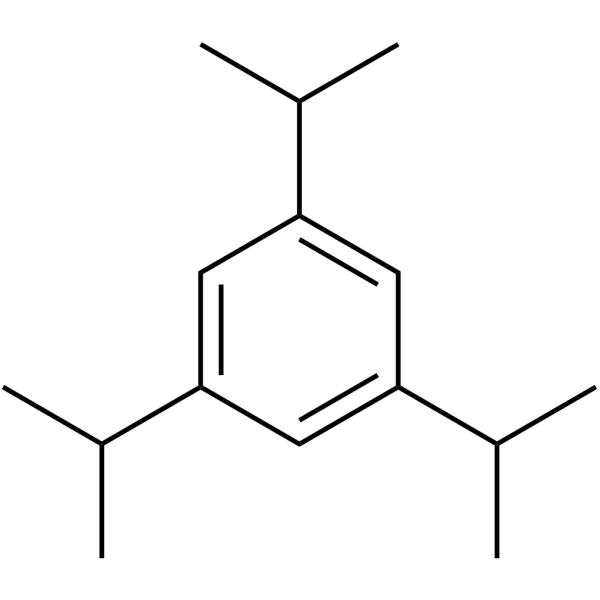
1,3,5-Triisopropylbenzene is a symmetric aromatic hydrocarbon compound. 1,3,5-Triisopropylbenzene serves as a saturated crosslinker to participate in the "inverse vulcanization" reaction of elemental sulfur. 1,3,5-Triisopropylbenzene acts as a probe molecule to evaluate the external surface acidity and accessibility of zeolite materials. 1,3,5-Triisopropylbenzene is also used as fuel and fuel additive, lubricant and lubricant additive, as well as micelle swelling agent.
For research use only. We do not sell to patients.
- Purity : 98.70%
- CAS No.: 717-74-8
- Formula: C15H24
- Molecular Weight:204.36
-
Storage:Pure form -20°C, 3 years , 4°C, 2 years ; In solvent -80°C, 6 months , -20°C, 1 month

To place orders, for customer services and technical support, please contact: MedChemExpress USA
Tel: 609-228-6898 E-mail: [email protected] [email protected]


-
 Biological Activity
-
Chemical Information
-
Solvent & Solubility
- Purity & Documentation
- References
-
 Help & FAQs


-

HY-W008814
DiphenylmethaneDrug Intermediate -
HY-W012019
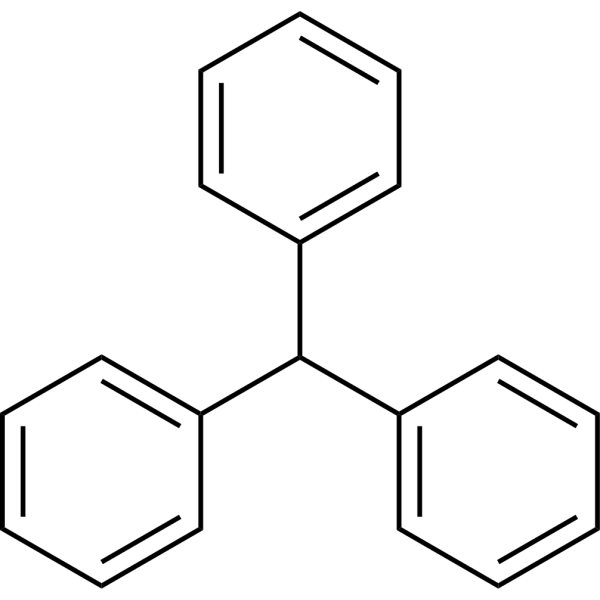
TriphenylmethaneBiochemical Reagent -

HY-78004
BibenzylDibenzyl Compound -

HY-W012857
4-MethylethylbenzeneAromatic Hydrocarbon -

HY-W040301
4-tert-ButyltolueneDrug Intermediate -

HY-W008338
1-EthylnaphthaleneBiochemical Reagent -

HY-W012589
tert-PentylbenzeneFungal Metabolite -

HY-W016470
9,10-Dihydrophenanthrene9,10-Phenanthrenequinone Analogue


Biological Activity
Description
In Vitro
1,3,5-Triisopropylbenzene undergoes inverse vulcanization with elemental sulfur via S8 ring-opening, hydrogen abstraction by sulfur radicals, and carbon-sulfur radical coupling, accompanied by minor cyclization and oxidation side reactions[1].
Catalytic cracking of 1,3,5-Triisopropylbenzene produces m-diisopropylbenzene, isopropylbenzene and benzene, accompanied by side reactions such as disproportionation, isomerization, and deep cracking that generates ethylbenzene and toluene[2].
MedChemExpress (MCE) has not independently confirmed the accuracy of these methods. They are for reference only.


Chemical Information
-
CAS No. 717-74-8
-
Appearance Liquid (Density: 0.845 g/cm3)
-
Molecular Weight 204.36
-
Formula C15H24
-
Color Colorless to light yellow
-
SMILES
CC(C)C1=CC(=CC(=C1)C(C)C)C(C)C
-
Shipping
Room temperature in continental US; may vary elsewhere.
-
Storage
Pure form -20°C 3 years 4°C 2 years In solvent -80°C 6 months -20°C 1 month


Solvent & Solubility
In Vitro:
DMSO : 100 mg/mL (489.33 mM; Need ultrasonic; Hygroscopic DMSO has a significant impact on the solubility of product, please use newly opened DMSO)
Please refer to the solubility information to select the appropriate solvent. Once prepared, please aliquot and store the solution to prevent product inactivation from repeated freeze-thaw cycles.
Storage method and period of stock solution: -80°C, 6 months; -20°C, 1 month. When stored at -80°C, please use it within 6 months. When stored at -20°C, please use it within 1 month.
Please refer to the solubility information to select the appropriate solvent. Once prepared, please aliquot and store the solution to prevent product inactivation from repeated freeze-thaw cycles.
Storage method and period of stock solution: -80°C, 6 months; -20°C, 1 month. When stored at -80°C, please use it within 6 months. When stored at -20°C, please use it within 1 month.
Concentration (start) × Volume (start) = Concentration (final) × Volume (final)
In Vivo:
Select the appropriate dissolution method based on your experimental animal and administration route.
- For the following dissolution methods, please ensure to first prepare a clear stock solution using an In Vitro approach and then sequentially add co-solvents:
- To ensure reliable experimental results, the clarified stock solution can be appropriately stored based on storage conditions. As for the working solution for In Vivo experiments, it is recommended to prepare freshly and use it on the same day.
- The percentages shown for the solvents indicate their volumetric ratio in the final prepared solution. If precipitation or phase separation occurs during preparation, heat and/or sonication can be used to aid dissolution.
In Vivo Dissolution Calculator
Please enter the basic information of animal experiments:
-
-
-
-
Recommended: Prepare an additional quantity of animals to account for potential losses during experiments.
Please enter your animal formula composition:
-
%DMSO +
Recommended: Keep the proportion of DMSO in working solution below 2% if your animal is weak.
-
%+
-
+%Tween-80 + +
-
%Saline +
The co-solvents required include: DMSO, . All of co-solvents are available by MedChemExpress (MCE). , Tween 80. All of co-solvents are available by MedChemExpress (MCE).
Working solution concentration: 0.22 mg/mL
Method for preparing stock solution: mg drug dissolved in μL DMSO. Stock solution concentration: mg/mL.
1. Take μL DMSO stock solution;
2. Add μL .
μL , mix evenly;
3. Then add μL Tween 80, mix evenly;
4. Then add μL
Please ensure that the stock solution in the first step is dissolved to a clear state, and add co-solvents in sequence. You can use ultrasonic heating (ultrasonic cleaner, recommended frequency 20-40 kHz), vortexing, etc. to assist dissolution.


Purity & Documentation
-
Data Sheet (281 KB)
-
SDS (393 KB)
- English - EN (393 KB)
- Français - FR (393 KB)
- Deutsch - DE (393 KB)
- Norwegian - NO (393 KB)
- Español - ES (393 KB)
- Swedish - SV (393 KB)
- Italian - IT (393 KB)
- Korean - KR (393 KB)
- Portuguese - PT (393 KB)
-
Handling Instructions (2659 KB)
References
[1]. Lai YS, et al. Reaction between 1,3,5-Triisopropylbenzene and Elemental Sulfur Extending the Scope of Reagents in Inverse Vulcanization. Macromol Rapid Commun. 2023;44(8):e2300014. [Content Brief]
[2]. Vinh TQ, et al. Effect of Porous Structure and Acidity of ZSM-5/SBA-15 Catalyst on 1,3,5-Triisopropylbenzene Cracking Catalytic Activity. J Nanosci Nanotechnol. 2018;18(2):1396-1402. [Content Brief]


Complete Stock Solution Preparation Table
Please refer to the solubility information to select the appropriate solvent. Once prepared, please aliquot and store the solution to prevent product inactivation from repeated freeze-thaw cycles.
Storage method and period of stock solution: -80°C, 6 months; -20°C, 1 month. When stored at -80°C, please use it within 6 months. When stored at -20°C, please use it within 1 month.
| Optional Solvent | Concentration Solvent Mass | 1 mg | 5 mg | 10 mg | 25 mg |
|---|---|---|---|---|---|
| DMSO | 1 mM | 4.8933 mL | 24.4666 mL | 48.9333 mL | 122.3331 mL |
| 5 mM | 0.9787 mL | 4.8933 mL | 9.7867 mL | 24.4666 mL | |
| 10 mM | 0.4893 mL | 2.4467 mL | 4.8933 mL | 12.2333 mL | |
| 15 mM | 0.3262 mL | 1.6311 mL | 3.2622 mL | 8.1555 mL | |
| 20 mM | 0.2447 mL | 1.2233 mL | 2.4467 mL | 6.1167 mL | |
| 25 mM | 0.1957 mL | 0.9787 mL | 1.9573 mL | 4.8933 mL | |
| 30 mM | 0.1631 mL | 0.8156 mL | 1.6311 mL | 4.0778 mL | |
| 40 mM | 0.1223 mL | 0.6117 mL | 1.2233 mL | 3.0583 mL | |
| 50 mM | 0.0979 mL | 0.4893 mL | 0.9787 mL | 2.4467 mL | |
| 60 mM | 0.0816 mL | 0.4078 mL | 0.8156 mL | 2.0389 mL | |
| 80 mM | 0.0612 mL | 0.3058 mL | 0.6117 mL | 1.5292 mL | |
| 100 mM | 0.0489 mL | 0.2447 mL | 0.4893 mL | 1.2233 mL |


1,3,5-Triisopropylbenzene Related Classifications
HY-W012472 Related Classifications
 Powered by Bioz