1. Search Result
Search Result
Results for "

hydrogen atom transfer

" in MedChemExpress (MCE) Product Catalog:

8

Inhibitors & Agonists

3

Biochemical Assay Reagents

4

Natural
Products

Targets Recommended:
Cat. No. Product Name Target Research Areas Chemical Structure
  • HY-W196368

    COX SARS-CoV Infection Inflammation/Immunology Cancer
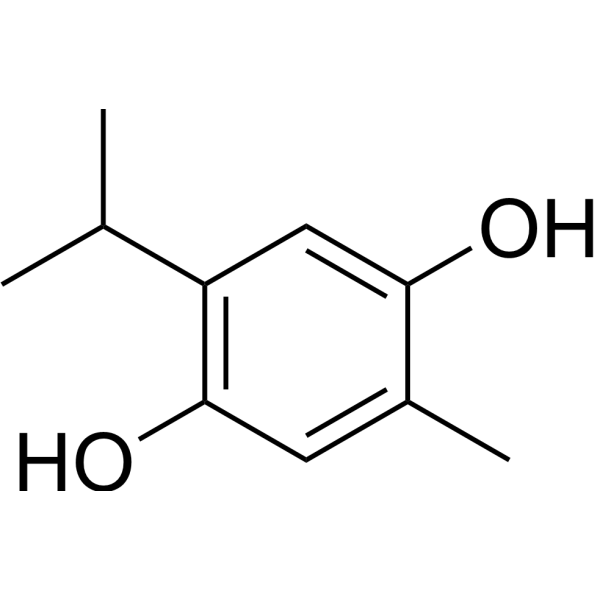
    Thymohydroquinone is a COX-2 inhibitor and anti-SARS-CoV-2 agent that induces cytotoxicity, antiproliferative effects and inhibits tumor growth. Thymohydroquinone cannot scavenge superoxide radicals via σ (hydrogen atom transfer) and π-π attacks with superoxide anions. Thymohydroquinone can be used in research related to squamous cell carcinoma, fibrosarcoma and coronavirus disease 2019 (SARS-CoV-2 infection) .
    Thymohydroquinone
  • HY-Y0396

    Biochemical Assay Reagents Survivin Bcl-2 Family Caspase Apoptosis mTOR Akt Cancer
    N-Hydroxyphthalimide is a blocking agent and catalyst. N-Hydroxyphthalimide promotes oxidation reactions by generating PINO free radicals and activating hydrogen atom transfer processes. N-Hydroxyphthalimide reduces the expression of anti-apoptotic proteins Survivin and Bcl-xL and activates caspase 9 and caspase 3. N-Hydroxyphthalimide induces Apoptosis. N-Hydroxyphthalimide inhibits the phosphorylation of mTOR (Ser2448, Ser2481) and Akt (Ser473). N-Hydroxyphthalimide has anticancer effects against breast and colon cancer .
    N-Hydroxyphthalimide
  • HY-W129155

    Drug Intermediate Others
    9,10-Dihydroacridine is a chain-terminating antioxidant that can inhibit lipid peroxidation by capturing peroxide free radicals (LOO•) .
    9,10-Dihydroacridine
  • HY-W787537

    LBB

    Biochemical Assay Reagents Others
    Leucoberbelin blue I (LBB) is a leuco base that is oxidized by manganese through a hydrogen atom transfer reaction forming a colored complex. Leucoberbelin blue I can be used to quantify or confirm the Mn (II) oxides formation .
    Leucoberbelin blue I
  • HY-N10516

    Bacterial Others
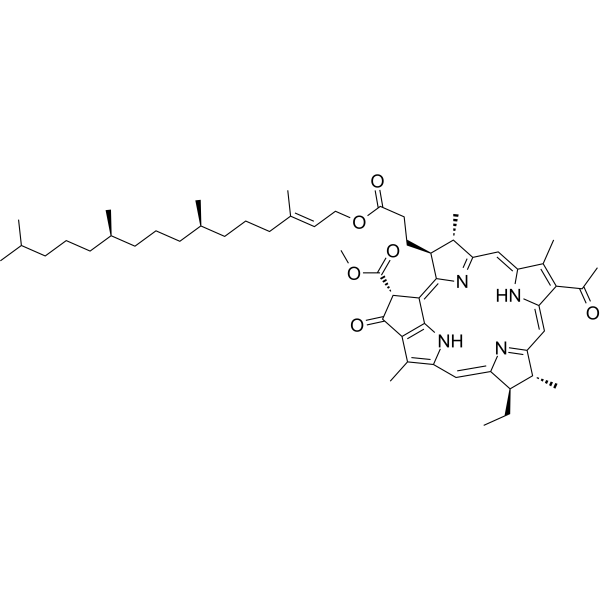
    Bacteriopheophytin, a photosynthetic pigment, is a bacterial demagnetised chlorophyll composed of bacterial chlorophyll in which two hydrogen atoms replace the magnesium center. Bacteriopheophytin acts as an electron acceptor in the purple bacterial reaction center (RC) and is involved in electron transfer .
    Bacteriopheophytin
  • HY-Y0396R

    Biochemical Assay Reagents Reference Standards Survivin Bcl-2 Family Caspase Apoptosis mTOR Akt Others
    N-Hydroxyphthalimide (Standard) is the analytical standard of N-Hydroxyphthalimide (HY-Y0396). This product is intended for research and analytical applications. N-Hydroxyphthalimide is a blocking agent and catalyst. N-Hydroxyphthalimide promotes oxidation reactions by generating PINO free radicals and activating hydrogen atom transfer processes. N-Hydroxyphthalimide reduces the expression of anti-apoptotic proteins Survivin and Bcl-xL and activates caspase 9 and caspase 3. N-Hydroxyphthalimide induces Apoptosis. N-Hydroxyphthalimide inhibits the phosphorylation of mTOR (Ser2448, Ser2481) and Akt (Ser473). N-Hydroxyphthalimide has anticancer effects against breast and colon cancer .
    N-Hydroxyphthalimide (Standard)
  • HY-N17779

    TNF Receptor Reactive Oxygen Species (ROS) Inflammation/Immunology
    3-O-Caffeoyl-5-O-feruloylquinic acid is a quinic acid-based phenolic compound that can be isolated from Eryngium bourgatii. 3-O-Caffeoyl-5-O-feruloylquinic acid regulates free radical scavenging and inflammatory pathways, exerting antioxidant activity through electron transfer and hydrogen atom transfer mechanisms. It also inhibits TNF-α-induced reactive oxygen species (ROS) production and the production of monocyte chemoattractant protein-1 (MCP-1) and its transcripts in human umbilical vein endothelial cells (HUVECs).
    3-O-Caffeoyl-5-O-feruloylquinic acid
  • HY-N19720

    Drug Derivative Parasite Infection
    Bractein is a natural aurone flavonoid with potential antioxidant activity. Bractein shows in vitro antileishmanial activity and inhibits promastigotes and intracellular amastigotes of Leishmania donovani. Bractein exhibits no obvious cytotoxicity against mammalian macrophages with an EC50 value > 25.0 μg/mL. Bractein can be used for the research of Leishmania .
    Bractein

Inquiry Online

Your information is safe with us. * Required Fields.

Salutation


Country or Region *

Applicant Name *


Organization Name *

Department *


Email Address *


Product Name *

Cat. No.


Requested quantity *

Phone Number *


Remarks

Inquiry Online

Inquiry Information

Product Name:
Cat. No.:
Quantity:
MCE Japan Authorized Agent:

