14 Results for "

indole ring

" in MedChemExpress (MCE) Product Catalog:
Products (14)

14 Results for "indole ring" in MCE Product Catalog:

Cat. No.: HY-107486
CAS No.: 56377-79-8
Purity:  97.05%
Synonyms: Multhiomycin; RP 9671
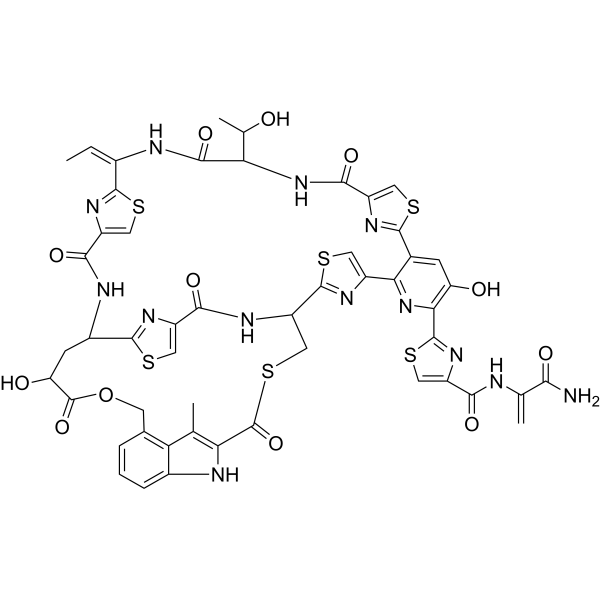
Nosiheptide (Multhiomycin), a thiopeptide antibiotic produced by Streptomyces actuosus, inhibits bacterial protein synthesis and bears a unique indole side ring system and regiospecific hydroxyl groups on the characteristic macrocyclic core. Nosiheptide has been widely used as a feed additive for animal growth .
loading...
    loading...
Cat. No.: HY-W048688
CAS No.: 1334509-86-2
Research Areas:  

Others

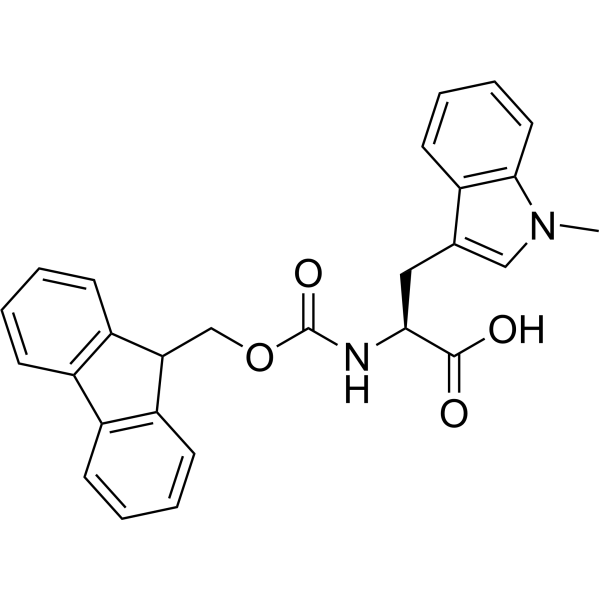
Fmoc-Trp(Me)-OH is an amino acid derivative. Fmoc-Trp(Me)-OH is formed by introducing a methyl group onto the nitrogen atom (N-1 position) of the indole ring of tryptophan (Trp) and protecting the amino group with Fmoc (9-fluorenylmethyloxycarbonyl). Fmoc-Trp(Me)-OH can be used in the synthesis of proteins or peptides .
loading...
    loading...
Cat. No.: HY-W012848
CAS No.: 618-36-0
Synonyms: DL-α-Methylbenzylamine
Target:  

Endogenous Metabolite

Research Areas:  

Neurological Disease Cancer

1-Phenylethanamine is a potential central nervous system stimulant and a related compound of β-phenylethylamine. Due to the replacement of its benzene ring with an indole group, its brain glycogenolytic activity is significantly reduced. Therefore, 1-Phenylethanamine can be used to study the impact of the chemical structure of phenylethylamine derivatives on central nervous system activity. In addition, 1-Phenylethanamine can also be used to synthesize the tyrosine kinase (tyrosine kinase) inhibitor CLM3 (HY-164413) .
loading...
    loading...
Cat. No.: HY-N10117
CAS No.: 138250-72-3
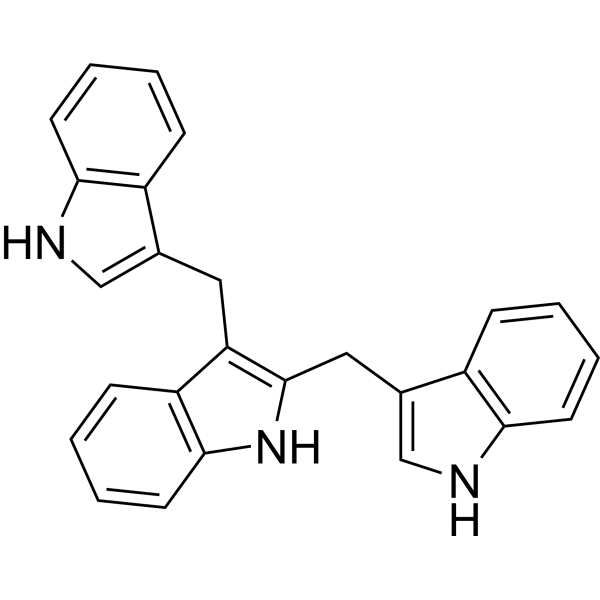
2,3-Bis(3-indolylmethyl)indole significantly suppresses RANKL-induced osteoclast formation, actin ring formation, and bone resorption in a concentration-dependent manner.
loading...
    loading...
Cat. No.: HY-107486R
CAS No.: 56377-79-8
Synonyms: Multhiomycin (Standard); RP 9671 (Standard)
Nosiheptide (Standard) is the analytical standard of Nosiheptide. This product is intended for research and analytical applications. Nosiheptide (Multhiomycin), a thiopeptide antibiotic produced by Streptomyces actuosus, inhibits bacterial protein synthesis and bears a unique indole side ring system and regiospecific hydroxyl groups on the characteristic macrocyclic core. Nosiheptide has been widely used as a feed additive for animal growth .
loading...
    loading...
Cat. No.: HY-30156
CAS No.: 10592-27-5
Synonyms: 7-Azaindoline
Research Areas:  

Others

2,3-Dihydro-7-azaindole (7-Azaindoline) is a cyclic secondary amine substrate with a fused aromatic ring, which serves as a substrate for hydrogenation reactions. 2,3-Dihydro-7-azaindole undergoes amidation with methyl pyrazine-2-carboxylate under the catalysis of lipase from Pseudomonas stutzeri. 2,3-Dihydro-7-azaindole is often used as an intermediate in organic synthesis, for example, in the preparation of indole compounds .
loading...
    loading...
Cat. No.: HY-W007509
CAS No.: 5192-03-0
Synonyms: 5-Aminoindole
1H-Indol-5-amine (5-Aminoindole) is an organic compound containing an indole ring structure and belongs to the class of indole derivatives. 1H-Indol-5-amine can serve as a key intermediate for the synthesis of other active compounds .
loading...
    loading...
Cat. No.: HY-115004
CAS No.: 1006604-91-6
Target:  

FAAH

Research Areas:  

Neurological Disease

MM-433593 is a potent and selective inhibitor of fatty acid amide hydrolase-1 (FAAH-1) that is orally administered to inhibit pain, inflammation, and related disorders. Pharmacokinetic studies of MM-433593 in macaques revealed a biphasic elimination profile with a rapid distribution phase and a slower elimination phase, with a systemic clearance of 8-11 mL/min/kg. MM-433593 exhibits moderate oral bioavailability (14-21%) and its metabolism primarily involves oxidation of the methyl group on the indole ring, resulting in a variety of sulfate, glucuronide, or glutathione-conjugated metabolites .
loading...
    loading...
Cat. No.: HY-N19716
CAS No.: 34427-31-1
Austamide is an indole alkaloid found in cultures of Aspergillus ustus. Austamide undergoes biosynthesis via the classical mevalonate pathway with nonface-selective reverse prenylation of its indole ring .
loading...
    loading...
Cat. No.: HY-N19254
CAS No.: 3000-36-0
Shepherdine, a harmala-type indole and tetrahydro-β-carboline alkaloid, is an antioxidant. Shepherdine scavenges free radicals via single electron transfer from its indole ring, forming an indolyl cation or neutral radical, and may convert to aromatic β-carbolines during this process. Shepherdine can be used for research on antioxidant activity .
loading...
    loading...
Cat. No.: HY-186139
CAS No.: 2133853-85-5
Synonyms: TrpdU CEP
Research Areas:  

Others

Trp-dU Phosphoramidite (TrpdU CEP) is a phosphoramidite monomer modified with a tryptophan moiety (Trp, indole ring) attached via a linker to the C5 position of 2'-deoxyuridine (dU), used for solid-phase oligonucleotide synthesis.
loading...
    loading...
Cat. No.: HY-N19001
CAS No.: 720-00-3
(rac)-5-Hydroxykynurenine is a urinary metabolite. (rac)-5-Hydroxykynurenine is generated via indole ring oxidative cleavage of 5-hydroxytryptophan (HY-N0122) catalyzed by indoleamine 2,3-dioxygenase .
loading...
    loading...
Cat. No.: HY-W115741S
CAS No.: 474267-40-8
Synonyms: (±)-1-Phenylethylamine-d3; DL-alpha-Methylbenzylamine-d3
1-Phenylethanamine-d3 ((±)-1-Phenylethylamine-d3) is the deuterium labeled 1-Phenylethanamine (HY-W012848). 1-Phenylethanamine is a potential central nervous system stimulant and a related compound of β-phenylethylamine. Due to the replacement of its benzene ring with an indole group, its brain glycogenolytic activity is significantly reduced. Therefore, 1-Phenylethanamine can be used to study the impact of the chemical structure of phenylethylamine derivatives on central nervous system activity. In addition, 1-Phenylethanamine can also be used to synthesize the tyrosine kinase (tyrosine kinase) inhibitor CLM3 (HY-164413).
loading...
    loading...
Cat. No.: HY-D3120
CAS No.: 2246946-53-0
Target:  

Fluorescent Dye

Research Areas:  

Others

LysoAIE2 is a Fluorescent probe for lysosomal viscosity detection and live-cell imaging. Its detection mechanism relies on the aggregation-induced emission effect: it exhibits only weak fluorescence in non-viscous media; in viscous environments, restricted intramolecular motion inhibits non-radiative energy dissipation pathways, thereby significantly enhancing fluorescence intensity. It achieves specific targeting of lysosomes through the proton acceptor property of its indole ring structure, while its hydroxyl group endows it with excellent water solubility. This probe is basically unaffected by microenvironmental polarity and pH within the range of pH 4.0 to pH 8.0, which avoids interference from these factors in viscosity measurement. LysoAIE2 has an emission wavelength of 570 nm. It can be used to monitor lysosomal viscosity changes during processes such as Dexamethasone (HY-14648)-induced lysosomal migration and starvation-induced mitophagy in live cells; at concentrations up to 40 μM, cell viability remains above 80%, demonstrating excellent biocompatibility .
loading...
    loading...
  • 1

