Search Result
Results for "
mPEG
" in MedChemExpress (MCE) Product Catalog:
196
Biochemical Assay Reagents
| Cat. No. |
Product Name |
Target |
Research Areas |
Chemical Structure |
-
- HY-W020780
-
|
mPEG5000-Maleimide
|
Biochemical Assay Reagents
|
Cancer
|
|
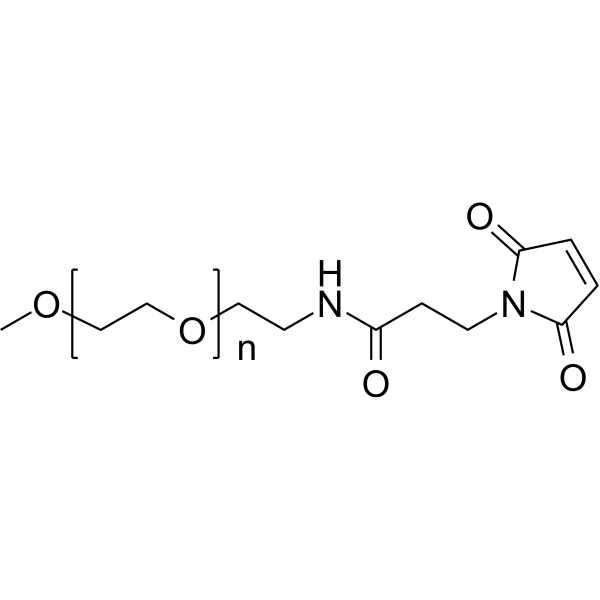
mPEG5000-Mal (mPEG5000-Maleimide) is a PEG-derived selective covalent binding agent for sulfhydryl groups (RSGs), which can form irreversible thioether bonds with sulfhydryl groups under near-neutral conditions via the maleimide group. The mechanism of action of mPEG5000-Mal can be divided into two categories: firstly, as an enzyme modifier, it binds to target proteins through hydrophobic interactions, hydrogen bonds, and van der Waals forces, altering the protein's secondary structure; secondly, as a nanoparticle surface modifier, it covalently binds to sulfhydryl groups on the surface of red blood cells, changing the surface properties and morphology of the red blood cells, leading to their phagocytosis by macrophages of the reticuloendothelial system. mPEG5000-Mal can react with free cysteine in proteins, increasing the apparent molecular weight of the modified protein by 10-15 kDa for detection purposes. mPEG5000-Mal can enhance the thermal stability and catalytic activity of enzymes, and improve the macrophage targeting of nanoparticles, enabling targeted drug delivery. mPEG5000-Mal can be applied in enzyme engineering research in the food industry and in oncology, assisting radiotherapy by inhibiting tumor-associated macrophage infiltration and enhancing anti-tumor immune responses .
|
-
-
- HY-124011
-
|
|
PROTAC Linkers
|
Cancer
|
|
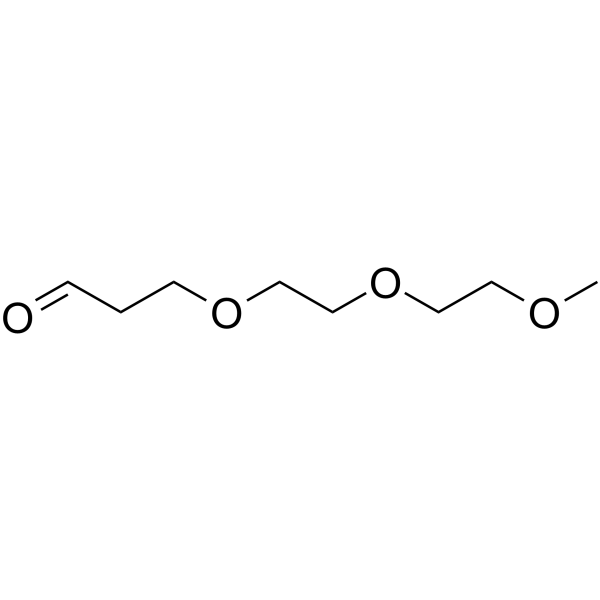
m-PEG3-aldehyde is a PEG-based PROTAC linker can be used in the synthesis of PROTACs.
|
-
-
- HY-140679
-
|
mPEG20000-NH2
|
Biochemical Assay Reagents
|
Cancer
|
|
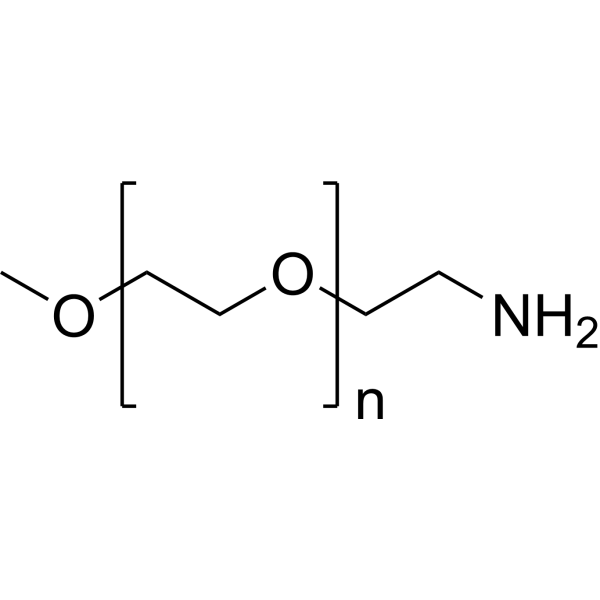
mPEG20000-amine (mPEG20000-NH2) is a class of functionalized polymers composed of a methoxy-terminated polyethylene glycol backbone and a terminal primary amine group. mPEG20000-amine serves as an important intermediate for constructing functionalized nanocarriers, modifying proteins or polypeptides, and developing novel drug delivery systems.
|
-
-
- HY-140677
-
|
mPEG5000-NH2
|
Biochemical Assay Reagents
|
Cancer
|
|
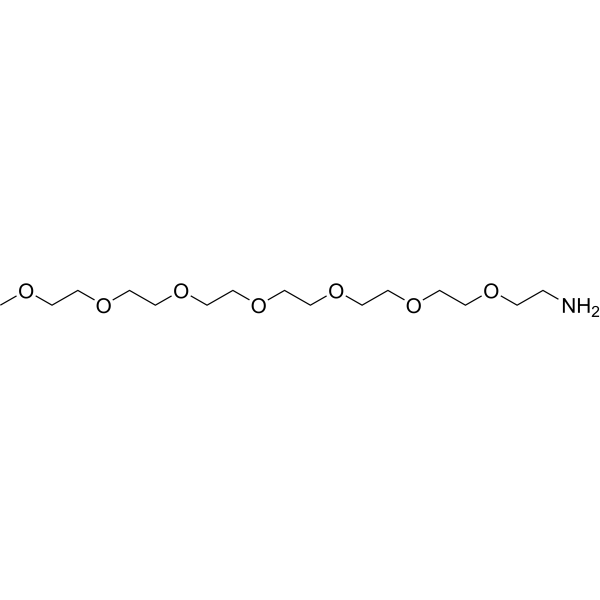
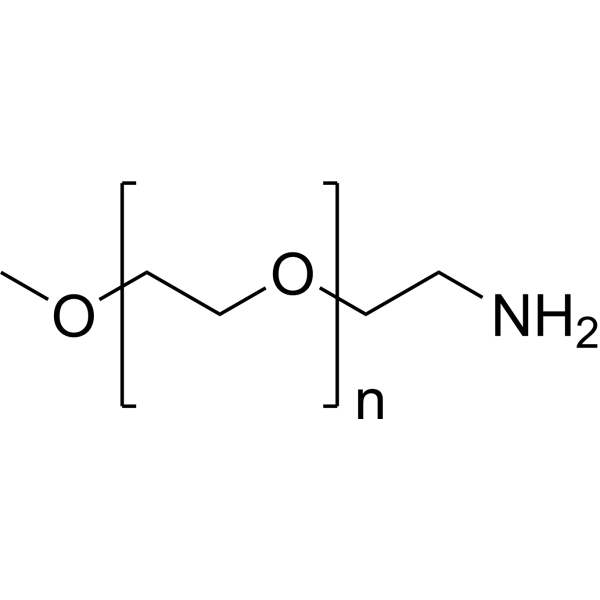
mPEG5000-amine (mPEG5000-NH2) is a class of functionalized polymers composed of a methoxy-terminated polyethylene glycol backbone and a terminal primary amine group. mPEG5000-amine serves as an important intermediate for constructing functionalized nanocarriers, modifying proteins or polypeptides, and developing novel drug delivery systems.
|
-
-
- HY-140676
-
|
mPEG2000-NH2
|
Biochemical Assay Reagents
|
Cancer
|
|
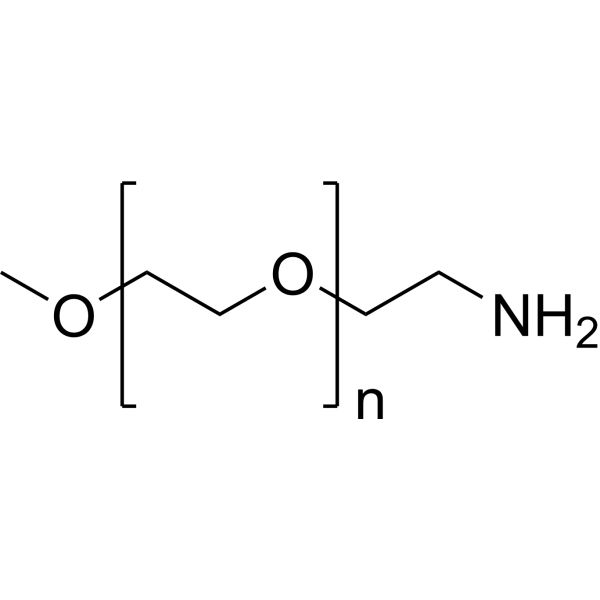
mPEG2000-amine (mPEG2000-NH2) is a class of functionalized polymers composed of a methoxy-terminated polyethylene glycol backbone and a terminal primary amine group. mPEG2000-amine serves as an important intermediate for constructing functionalized nanocarriers, modifying proteins or polypeptides, and developing novel drug delivery systems.
|
-
-
- HY-155882
-
|
mPEG750-NH2
|
Biochemical Assay Reagents
|
Cancer
|
|
mPEG750-amine (mPEG750-NH2) is a chemical modification reagent for nanoparticles, capable of covalently binding to Ad-PVA to form Ad-PVA-PEG polymers. mPEG750-amine stabilizes gene delivery complexes by providing steric hindrance, reducing particle aggregation, while enhancing the water solubility and serum stability of the complex, reducing carrier cytotoxicity, and assisting in the efficient condensation of pDNA by cationic components to form nanoparticles that can be endocytosed by cells. mPEG750-amine can also be used to synthesize folate-conjugated polymer micelles for encapsulating the anticancer agent Camptothecin (HY-16560). Folate-conjugated polymer micelles are effective carriers for poorly soluble anticancer drugs, capable of avoiding macrophages and acting through folate receptor (FR)-mediated endocytosis to target tumor cells. mPEG750-amine can be applied to research in the field of non-viral gene delivery, as a component of gene delivery vectors, facilitating the safe and efficient delivery of nucleic acid drugs to target cells .
|
-
-
- HY-140675
-
|
mPEG1000-NH2
|
Biochemical Assay Reagents
|
Cancer
|
|
mPEG1000-amine (mPEG1000-NH2) is a class of functionalized polymers composed of a methoxy-terminated polyethylene glycol backbone and a terminal primary amine group. mPEG1000-amine serves as an important intermediate for constructing functionalized nanocarriers, modifying proteins or polypeptides, and developing novel drug delivery systems.
|
-
-
- HY-W1048558A
-
|
mPEG2000-COOH
|
Biochemical Assay Reagents
|
Others
|
|
mPEG2000-CM (mPEG2000-COOH) is a carboxyl-terminated monomethoxy polyethylene glycol. mPEG2000-CM bears a reactive carboxyl group (-COOH) at its structural terminal site, which can form stable amide bonds with amino groups and ester bonds with hydroxyl groups. mPEG2000-CM binds to PCA-g-PCL copolymers via electrostatic interaction to form polyion complex micelles with a hydrophilic PEG surface, which enhances the stability of micelles in aqueous media. mPEG2000-CM can be used for drug delivery .
|
-
-
- HY-155881
-
|
mPEG550-NH2
|
Biochemical Assay Reagents
|
Cancer
|
|
mPEG550-amine (mPEG550-NH2) is a class of functionalized polymers composed of a methoxy-terminated polyethylene glycol backbone and a terminal primary amine group. mPEG550-amine serves as an important intermediate for constructing functionalized nanocarriers, modifying proteins or polypeptides, and developing novel drug delivery systems.
|
-
-
- HY-148775A
-
|
|
Biochemical Assay Reagents
|
Others
|
|
mPEG-PLGA (21500-26500) is a biodegradable polymer composed of methoxypolyethylene glycol (mPEG) and poly (lactic-co-glycolic acid) (PLGA). mPEG-PLGA (21500-26500) is applicable for drug delivery systems .
|
-
-
- HY-140692
-
|
|
PROTAC Linkers
|
Cancer
|
|
mPEG20000-Mal is a PEG-based PROTAC linker that can be used in the synthesis of PROTACs .
|
-
-
- HY-W1048918A
-
|
mPEG5000-COOH
|
Biochemical Assay Reagents
|
Others
|
|
mPEG5000-CM (mPEG5000-COOH) has a reactive carboxyl group (-COOH) attached to the terminal site of the structure, which can form a stable amide bond with the amino group or an ester bond with the hydroxyl group. mPEG5000-CM can be used for drug delivery .
|
-
-
- HY-400145
-
|
|
PROTAC Linkers
|
Others
|
|
mPEG45-Epoxide is a PEG derivative containing polyether units. mPEG45-Epoxide can be used to synthesize PROTAC molecules .
|
-
-
- HY-400147
-
|
|
PROTAC Linkers
|
Cancer
|
|
mPEG45-diol is a PEG derivative containing polyether units. mPEG45-Epoxide is a PROTAC linker can be used to synthesize PROTAC molecules .
|
-
-
- HY-140691
-
|
|
PROTAC Linkers
|
Cancer
|
|
mPEG10000-Mal is a PEG-based PROTAC linker that can be used in the synthesis of PROTACs .
|
-
-
- HY-164077
-
-
-
- HY-W020780C
-
|
mPEG3400-Maleimide
|
Biochemical Assay Reagents
|
Others
|
|
mPEG3400-Mal is a PEG derivative used for thiol pegylation of protein molecules. Its maleimide group (-Mal) degrades in aqueous media and finds application in drug delivery studies.
|
-
-
- HY-W1123932A
-
|
mPEG2000-Folate
|
Biochemical Assay Reagents
|
Others
|
|
mPEG2000-FA (mPEG2000-Folate) is a polyethylene glycol derivative of Folic acid (HY-16637). Folic acid has a high affinity for folate receptors and can be used for cell membrane receptors for targeted drug delivery .
|
-
-
- HY-W888521
-
-
-
- HY-155921
-
|
mPEG5000-Aldehyde
|
Biochemical Assay Reagents
|
Others
|
|
mPEG5000-CHO participates in the formation of a three-dimensional porous scaffold which carries active substances to form a delivery vehicle. The -CHO functional group interacts with the -NH2 functional group of the chitosan chain to form a glutaraldehyde-type adduct to functionalize mPEG. This functionalization and cross-linking can affect the rigidity of the delivery system, allowing slow release of the cross-linked conjugate system.
|
-
-
- HY-W888515
-
|
|
Biochemical Assay Reagents
|
Others
|
|
mPEG-PCL is a biodegradable, biocompatible, and semi-crystalline copolymer having a very low glass transition temperature. mPEG-PCL can be used as synthetic material for biomedical and drug delivery .
|
-
-
- HY-159866
-
|
mPEG2000-Cholesterol
|
Liposome
|
Others
|
|
mPEG2000-CLS (mPEG2000-Cholesterol) is a PEGylated form of Cholesterol (HY-N0322). mPEG2000-CLS can be used to prepare liposome or nanoparticle .
|
-
-
- HY-W1049085C
-
|
mPEG20000-Succinimidyl Succinate ester
|
Biochemical Assay Reagents
|
Others
|
|
mPEG20000-SS (mPEG20000-Succinimidyl Succinate ester) is a mPEG-NHS ester reagent with a C2 aliphatic ester bond between PEG and NHS ester. mPEG20000-SS can be used for drug delivery .
|
-
-
- HY-W1049085D
-
|
mPEG40000-Succinimidyl Succinate ester
|
Biochemical Assay Reagents
|
Others
|
|
mPEG40000-SS (mPEG40000-Succinimidyl Succinate ester) is a mPEG-NHS ester reagent with a C2 aliphatic ester bond between PEG and NHS ester. mPEG40000-SS can be used for drug delivery .
|
-
-
- HY-W1049085A
-
|
mPEG5000-Succinimidyl Succinate ester
|
Biochemical Assay Reagents
|
Others
|
|
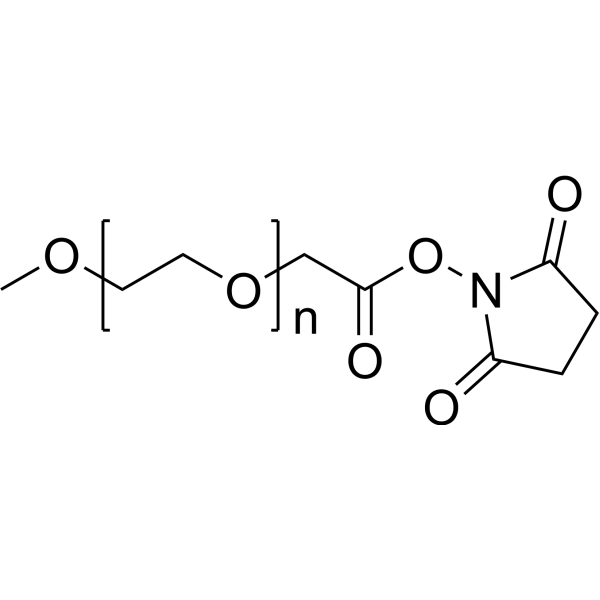
mPEG5000-SS (mPEG5000-Succinimidyl Succinate ester) is a mPEG-NHS ester reagent with a C2 aliphatic ester bond between PEG and NHS ester. mPEG5000-SS can be used for drug delivery .
|
-
-
- HY-W1048918
-
|
mPEG1000-COOH
|
Biochemical Assay Reagents
|
Others
|
|
mPEG1000-CM (mPEG1000-COOH) has a reactive carboxyl group (-COOH) attached to the terminal site of the structure, which can form a stable amide bond with the amino group or an ester bond with the hydroxyl group. mPEG1000-CM can be used for drug delivery .
|
-
-
- HY-W1123932
-
|
mPEG1000-Folate
|
Biochemical Assay Reagents
|
Others
|
|
mPEG1000-FA (mPEG1000-Folate) is a polyethylene glycol derivative of Folic acid (HY-16637). Folic acid has a high affinity for folate receptors and can be used for cell membrane receptors for targeted drug delivery .
|
-
-
- HY-164076
-
|
|
Biochemical Assay Reagents
|
Others
|
|
mPEG-Epoxide is an activated polyethylene glycol (mPEG) derivative, which is achieved by converting the hydroxyl groups of mPEG into reactive epoxy groups. mPEG-Epoxide is a mild PEGylation reagent that reacts with amino groups in peptides and proteins to form stable secondary amine bonds. mPEG-Epoxide can be used in protein engineering and biomaterials research .
|
-
-
- HY-W888514
-
|
mPEG-propionaldehyde
|
Biochemical Assay Reagents
|
Others
|
|
mPEG-CHO (mPEG-propionaldehyde) is a polyethylene glycol (PEG) derivative with a propionaldehyde group. Propionaldehyde is a highly reactive functional group that can covalently bind to amino, sulfhydryl and other functional groups .
|
-
-
- HY-W020780A
-
|
mPEG350-Maleimide
|
Biochemical Assay Reagents
|
Others
|
|
mPEG350-Mal is a PEG derivative used for thiol PEGylation of protein molecules. Its maleimide group (-Mal) degrades in aqueous media and finds application in drug delivery studies.
|
-
-
- HY-W020780B
-
|
mPEG750-Maleimide
|
Biochemical Assay Reagents
|
Others
|
|
mPEG750-Mal is a PEG derivative used for thiol pegylation of protein molecules. Its maleimide group (-Mal) degrades in aqueous media and finds application in drug delivery studies.
|
-
-
- HY-155922
-
|
mPEG10000-Aldehyde
|
Biochemical Assay Reagents
|
Others
|
|
mPEG10000-CHO participates in the formation of a three-dimensional porous scaffold which carries active substances to form a delivery vehicle. The -CHO functional group interacts with the -NH2 functional group of the chitosan chain to form a glutaraldehyde-type adduct to functionalize mPEG. This functionalization and cross-linking can affect the rigidity of the delivery system, allowing slow release of the cross-linked conjugate system.
|
-
-
- HY-155919
-
|
mPEG2000-Aldehyde
|
Biochemical Assay Reagents
|
Others
|
|
mPEG2000-CHO participates in the formation of a three-dimensional porous scaffold which carries active substances to form a delivery vehicle. The -CHO functional group interacts with the -NH2 functional group of the chitosan chain to form a glutaraldehyde-type adduct to functionalize mPEG. This functionalization and cross-linking can affect the rigidity of the delivery system, allowing slow release of the cross-linked conjugate system.
|
-
-
- HY-155918
-
|
mPEG1000-Aldehyde
|
Biochemical Assay Reagents
|
Others
|
|
mPEG1000-CHO participates in the formation of a three-dimensional porous scaffold that carries active substances to form a delivery vehicle. The -CHO functional group interacts with the -NH2 functional group of the chitosan chain to form a glutaraldehyde-type adduct to functionalize mPEG. This functionalization and cross-linking can affect the rigidity of the delivery system, allowing slow release of the cross-linked conjugate system.
|
-
-
- HY-W591489A
-
-
-
- HY-174933A
-
-
-
- HY-W1049085B
-
|
mPEG10000-Succinimidyl Succinate ester
|
Biochemical Assay Reagents
|
Others
|
|
mPEG10000-SS (mPEG10000-Succinimidyl Succinate ester) is a mPEG-NHS ester reagent with a C2 aliphatic ester bond between PEG and NHS ester. mPEG10000-SS can be used for drug delivery .
|
-
-
- HY-W1049085E
-
|
mPEG2000-Succinimidyl Succinate ester
|
Biochemical Assay Reagents
|
Others
|
|
mPEG2000-SS (mPEG2000-Succinimidyl Succinate ester) is a mPEG-NHS ester reagent with a C2 aliphatic ester bond between PEG and NHS ester. mPEG2000-SS can be used for drug delivery .
|
-
-
- HY-W1049085
-
|
mPEG1000-Succinimidyl Succinate ester
|
Biochemical Assay Reagents
|
Others
|
|
mPEG1000-SS (mPEG1000-Succinimidyl Succinate ester) is a mPEG-NHS ester reagent with a C2 aliphatic ester bond between PEG and NHS ester. mPEG1000-SS can be used for drug delivery .
|
-
-
- HY-W190757
-
|
mPEG14-OH
|
Biochemical Assay Reagents
|
Others
|
|
mPEG14-Alcohol (mPEG14-OH) is a PEG derivative with a hydroxyl (OH) functional group that can be used for drug delivery .
|
-
-
- HY-W1048918B
-
|
mPEG10000-COOH
|
Biochemical Assay Reagents
|
Others
|
|
mPEG10000-CM (mPEG10000-COOH) has a reactive carboxyl group (-COOH) attached to the terminal site of the structure, which can form a stable amide bond with the amino group or an ester bond with the hydroxyl group. mPEG10000-CM can be used for drug delivery .
|
-
-
- HY-W1048918C
-
|
mPEG20000-COOH
|
Biochemical Assay Reagents
|
Others
|
|
mPEG20000-CM (mPEG20000-COOH) has a reactive carboxyl group (-COOH) attached to the terminal site of the structure, which can form a stable amide bond with the amino group or an ester bond with the hydroxyl group. mPEG20000-CM can be used for drug delivery .
|
-
-
- HY-W1048918D
-
|
mPEG40000-COOH
|
Biochemical Assay Reagents
|
Others
|
|
mPEG40000-CM (mPEG40000-COOH) has a reactive carboxyl group (-COOH) attached to the terminal site of the structure, which can form a stable amide bond with the amino group or an ester bond with the hydroxyl group. mPEG40000-CM can be used for drug delivery .
|
-
-
- HY-W1048918E
-
|
mPEG3400-COOH
|
Biochemical Assay Reagents
|
Others
|
|
mPEG3400-CM (mPEG3400-COOH) has a reactive carboxyl group (-COOH) attached to the terminal site of the structure, which can form a stable amide bond with the amino group or an ester bond with the hydroxyl group. mPEG3400-CM can be used for drug delivery .
|
-
-
- HY-W1123932B
-
|
mPEG5000-Folate
|
Biochemical Assay Reagents
|
Others
|
|
mPEG5000-FA (mPEG5000-Folate) is a polyethylene glycol derivative of Folic acid (HY-16637). Folic acid has a high affinity for folate receptors and can be used for cell membrane receptors for targeted drug delivery .
|
-
-
- HY-155885
-
|
mPEG40000-NH2
|
Biochemical Assay Reagents
|
Others
|
|
mPEG40000-amine (mPEG40000-NH2) is a monofunctional polyPEG with a terminal amine. The coupling between NHS ester and amine produces a stable amide bond. The amine moieties is also reactive with carboxyl in the presence of activating agent .
|
-
-
- HY-176278B
-
|
|
Biochemical Assay Reagents
|
Others
|
|
mPEG3400-LA is a linear block copolymer consisting of methoxy polyethylene glycol (mPEG) capped at one end and Lactic Acid (LA). mPEG3400-LA can be used for drug delivery .
|
-
-
- HY-176278A
-
|
|
Biochemical Assay Reagents
|
Others
|
|
mPEG2000-LA is a linear block copolymer consisting of methoxy polyethylene glycol (mPEG) capped at one end and Lactic Acid (LA). mPEG2000-LA can be used for drug delivery .
|
-
-
- HY-176278C
-
|
|
Biochemical Assay Reagents
|
Others
|
|
mPEG5000-LA is a linear block copolymer consisting of methoxy polyethylene glycol (mPEG) capped at one end and Lactic Acid (LA). mPEG5000-LA can be used for drug delivery .
|
-
-
- HY-176278
-
|
|
Biochemical Assay Reagents
|
Others
|
|
mPEG1000-LA is a linear block copolymer consisting of methoxy polyethylene glycol (mPEG) capped at one end and Lactic Acid (LA). mPEG1000-LA can be used for drug delivery .
|
-
- HY-W1049085H
-
|
mPEG-Succinimidyl Succinate ester (MW 3400)
|
Biochemical Assay Reagents
|
Others
|
|
mPEG-SS (MW 3400) (mPEG-Succinimidyl Succinate ester (MW 3400)) is a mPEG-NHS ester reagent with a C2 aliphatic ester bond between PEG and NHS ester. mPEG-SS (MW 3400) can be used for drug delivery .
|
-
- HY-183019J
-
|
|
Biochemical Assay Reagents
|
Others
|
|
mPEG20000-Mannose is a polymeric derivative formed by the chemical coupling of methoxy polyethylene glycol (mPEG) and mannose. mPEG20000-Mannose combines the biocompatibility of polyethylene glycol with the specificity of mannose in biorecognition, and is widely used in fields such as biomaterial modification and targeted delivery systems.
|
-
- HY-183019K
-
|
|
Biochemical Assay Reagents
|
Others
|
|
mPEG30000-Mannose is a polymeric derivative formed by the chemical coupling of methoxy polyethylene glycol (mPEG) and mannose. mPEG30000-Mannose combines the biocompatibility of polyethylene glycol with the specificity of mannose in biorecognition, and is widely used in fields such as biomaterial modification and targeted delivery systems.
|
-
- HY-183019
-
|
|
Biochemical Assay Reagents
|
Others
|
|
mPEG300-Mannose is a polymeric derivative formed by the chemical coupling of methoxy polyethylene glycol (mPEG) and mannose. mPEG300-Mannose combines the biocompatibility of polyethylene glycol with the specificity of mannose in biorecognition, and is widely used in fields such as biomaterial modification and targeted delivery systems.
|
-
- HY-183019E
-
|
|
Biochemical Assay Reagents
|
Others
|
|
mPEG2000-Mannose is a polymeric derivative formed by the chemical coupling of methoxy polyethylene glycol (mPEG) and mannose. mPEG2000-Mannose combines the biocompatibility of polyethylene glycol with the specificity of mannose in biorecognition, and is widely used in fields such as biomaterial modification and targeted delivery systems.
|
-
- HY-183019C
-
|
|
Biochemical Assay Reagents
|
Others
|
|
mPEG750-Mannose is a polymeric derivative formed by the chemical coupling of methoxy polyethylene glycol (mPEG) and mannose. mPEG750-Mannose combines the biocompatibility of polyethylene glycol with the specificity of mannose in biorecognition, and is widely used in fields such as biomaterial modification and targeted delivery systems.
|
-
- HY-183019B
-
|
|
Biochemical Assay Reagents
|
Others
|
|
mPEG550-Mannose is a polymeric derivative formed by the chemical coupling of methoxy polyethylene glycol (mPEG) and mannose. mPEG550-Mannose combines the biocompatibility of polyethylene glycol with the specificity of mannose in biorecognition, and is widely used in fields such as biomaterial modification and targeted delivery systems.
|
-
- HY-183019H
-
|
|
Biochemical Assay Reagents
|
Others
|
|
mPEG5000-Mannose is a polymeric derivative formed by the chemical coupling of methoxy polyethylene glycol (mPEG) and mannose. mPEG5000-Mannose combines the biocompatibility of polyethylene glycol with the specificity of mannose in biorecognition, and is widely used in fields such as biomaterial modification and targeted delivery systems.
|
-
- HY-183019D
-
|
|
Biochemical Assay Reagents
|
Others
|
|
mPEG1000-Mannose is a polymeric derivative formed by the chemical coupling of methoxy polyethylene glycol (mPEG) and mannose. mPEG1000-Mannose combines the biocompatibility of polyethylene glycol with the specificity of mannose in biorecognition, and is widely used in fields such as biomaterial modification and targeted delivery systems.
|
-
- HY-183019A
-
|
|
Biochemical Assay Reagents
|
Others
|
|
mPEG500-Mannose is a polymeric derivative formed by the chemical coupling of methoxy polyethylene glycol (mPEG) and mannose. mPEG500-Mannose combines the biocompatibility of polyethylene glycol with the specificity of mannose in biorecognition, and is widely used in fields such as biomaterial modification and targeted delivery systems.
|
-
- HY-183019I
-
|
|
Biochemical Assay Reagents
|
Others
|
|
mPEG10000-Mannose is a polymeric derivative formed by the chemical coupling of methoxy polyethylene glycol (mPEG) and mannose. mPEG10000-Mannose combines the biocompatibility of polyethylene glycol with the specificity of mannose in biorecognition, and is widely used in fields such as biomaterial modification and targeted delivery systems.
|
-
- HY-W1052148C
-
|
|
Biochemical Assay Reagents
|
Others
|
|
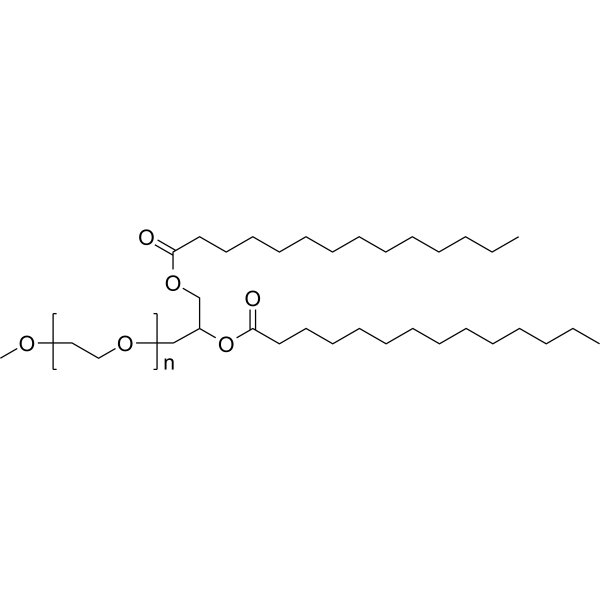
mPEG550-DMG is a PEGylated phospholipid containing DMG. mPEG550-DMG combines the membrane fusion capability of DMG with the stealth properties of PEG, and can be used for applications such as constructing targeted drug delivery systems and liposome preparation.
|
-
- HY-112764C
-
|
|
Biochemical Assay Reagents
|
Others
|
|
mPEG500-DMG is a PEGylated phospholipid containing DMG. mPEG500-DMG combines the membrane fusion capability of DMG with the stealth properties of PEG, and can be used for applications such as constructing targeted drug delivery systems and liposome preparation.
|
-
- HY-W591381E
-
|
|
Biochemical Assay Reagents
|
Others
|
|
mPEG1000-DSG is a PEGylated phospholipid containing DSG. mPEG1000-DSG combines the membrane fusion capability of DSG with the stealth properties of PEG, and can be used for applications such as constructing targeted drug delivery systems and liposome preparation.
|
-
- HY-112764E
-
|
|
Biochemical Assay Reagents
|
Others
|
|
mPEG30000-DMG is a PEGylated phospholipid containing DMG. mPEG30000-DMG combines the membrane fusion capability of DMG with the stealth properties of PEG, and can be used for applications such as constructing targeted drug delivery systems and liposome preparation.
|
-
- HY-W591381B
-
|
|
Biochemical Assay Reagents
|
Others
|
|
mPEG500-DSG is a PEGylated phospholipid containing DSG. mPEG500-DSG combines the membrane fusion capability of DSG with the stealth properties of PEG, and can be used for applications such as constructing targeted drug delivery systems and liposome preparation.
|
-
- HY-W1048624B
-
|
|
Biochemical Assay Reagents
|
Others
|
|
mPEG10000-DSG is a PEGylated phospholipid containing DSG. mPEG10000-DSG combines the membrane fusion capability of DSG with the stealth properties of PEG, and can be used for applications such as constructing targeted drug delivery systems and liposome preparation.
|
-
- HY-174972B
-
|
|
Biochemical Assay Reagents
|
Others
|
|
mPEG350-DPPE is a PEGylated phospholipid containing DPPE. mPEG350-DPPE combines the membrane fusion capability of DPPE with the stealth properties of PEG, and can be used for applications such as constructing targeted drug delivery systems and liposome preparation.
|
-
- HY-W1048624A
-
|
|
Biochemical Assay Reagents
|
Others
|
|
mPEG5000-DSG is a PEGylated phospholipid containing DSG. mPEG5000-DSG combines the membrane fusion capability of DSG with the stealth properties of PEG, and can be used for applications such as constructing targeted drug delivery systems and liposome preparation.
|
-
- HY-174972D
-
|
|
Biochemical Assay Reagents
|
Others
|
|
mPEG550-DPPE is a PEGylated phospholipid containing DPPE. mPEG550-DPPE combines the membrane fusion capability of DPPE with the stealth properties of PEG, and can be used for applications such as constructing targeted drug delivery systems and liposome preparation.
|
-
- HY-W1052148B
-
|
|
Biochemical Assay Reagents
|
Others
|
|
mPEG10000-DMG is a PEGylated phospholipid containing DMG. mPEG10000-DMG combines the membrane fusion capability of DMG with the stealth properties of PEG, and can be used for applications such as constructing targeted drug delivery systems and liposome preparation.
|
-
- HY-W1052192B
-
|
|
Biochemical Assay Reagents
|
Others
|
|
mPEG20000-DMPE is a PEGylated phospholipid containing DMPE. mPEG20000-DMPE combines the membrane fusion capability of DMPE with the stealth properties of PEG, and can be used for applications such as constructing targeted drug delivery systems and liposome preparation.
|
-
- HY-W1049054C
-
|
|
Biochemical Assay Reagents
|
Others
|
|
mPEG20000-DMG is a PEGylated phospholipid containing DMG. mPEG20000-DMG combines the membrane fusion capability of DMG with the stealth properties of PEG, and can be used for applications such as constructing targeted drug delivery systems and liposome preparation.
|
-
- HY-W591381C
-
|
|
Biochemical Assay Reagents
|
Others
|
|
mPEG550-DSG is a PEGylated phospholipid containing DSG. mPEG550-DSG combines the membrane fusion capability of DSG with the stealth properties of PEG, and can be used for applications such as constructing targeted drug delivery systems and liposome preparation.
|
-
- HY-W1052192C
-
|
|
Biochemical Assay Reagents
|
Others
|
|
mPEG30000-DMPE is a PEGylated phospholipid containing DMPE. mPEG30000-DMPE combines the membrane fusion capability of DMPE with the stealth properties of PEG, and can be used for applications such as constructing targeted drug delivery systems and liposome preparation.
|
-
- HY-112764D
-
|
|
Biochemical Assay Reagents
|
Others
|
|
mPEG750-DMG is a PEGylated phospholipid containing DMG. mPEG750-DMG combines the membrane fusion capability of DMG with the stealth properties of PEG, and can be used for applications such as constructing targeted drug delivery systems and liposome preparation.
|
-
- HY-174972C
-
|
|
Biochemical Assay Reagents
|
Others
|
|
mPEG500-DPPE is a PEGylated phospholipid containing DPPE. mPEG500-DPPE combines the membrane fusion capability of DPPE with the stealth properties of PEG, and can be used for applications such as constructing targeted drug delivery systems and liposome preparation.
|
-
- HY-174972H
-
|
|
Biochemical Assay Reagents
|
Others
|
|
mPEG10000-DPPE is a PEGylated phospholipid containing DPPE. mPEG10000-DPPE combines the membrane fusion capability of DPPE with the stealth properties of PEG, and can be used for applications such as constructing targeted drug delivery systems and liposome preparation.
|
-
- HY-W1052148D
-
|
|
Biochemical Assay Reagents
|
Others
|
|
mPEG1000-DMG is a PEGylated phospholipid containing DMG. mPEG1000-DMG combines the membrane fusion capability of DMG with the stealth properties of PEG, and can be used for applications such as constructing targeted drug delivery systems and liposome preparation.
|
-
- HY-W1048624C
-
|
|
Biochemical Assay Reagents
|
Others
|
|
mPEG20000-DSG is a PEGylated phospholipid containing DSG. mPEG20000-DSG combines the membrane fusion capability of DSG with the stealth properties of PEG, and can be used for applications such as constructing targeted drug delivery systems and liposome preparation.
|
-
- HY-W591381H
-
|
|
Biochemical Assay Reagents
|
Others
|
|
mPEG30000-DSG is a PEGylated phospholipid containing DSG. mPEG30000-DSG combines the membrane fusion capability of DSG with the stealth properties of PEG, and can be used for applications such as constructing targeted drug delivery systems and liposome preparation.
|
-
- HY-174972E
-
|
|
Biochemical Assay Reagents
|
Others
|
|
mPEG750-DPPE is a PEGylated phospholipid containing DPPE. mPEG750-DPPE combines the membrane fusion capability of DPPE with the stealth properties of PEG, and can be used for applications such as constructing targeted drug delivery systems and liposome preparation.
|
-
- HY-174972J
-
|
|
Biochemical Assay Reagents
|
Others
|
|
mPEG30000-DPPE is a PEGylated phospholipid containing DPPE. mPEG30000-DPPE combines the membrane fusion capability of DPPE with the stealth properties of PEG, and can be used for applications such as constructing targeted drug delivery systems and liposome preparation.
|
-
- HY-112764B
-
|
|
Biochemical Assay Reagents
|
Others
|
|
mPEG350-DMG is a PEGylated phospholipid containing DMG. mPEG350-DMG combines the membrane fusion capability of DMG with the stealth properties of PEG, and can be used for applications such as constructing targeted drug delivery systems and liposome preparation.
|
-
- HY-W591381D
-
|
|
Biochemical Assay Reagents
|
Others
|
|
mPEG750-DSG is a PEGylated phospholipid containing DSG. mPEG750-DSG combines the membrane fusion capability of DSG with the stealth properties of PEG, and can be used for applications such as constructing targeted drug delivery systems and liposome preparation.
|
-
- HY-W1052192A
-
|
|
Biochemical Assay Reagents
|
Others
|
|
mPEG10000-DMPE is a PEGylated phospholipid containing DMPE. mPEG10000-DMPE combines the membrane fusion capability of DMPE with the stealth properties of PEG, and can be used for applications such as constructing targeted drug delivery systems and liposome preparation.
|
-
- HY-W591381A
-
|
|
Biochemical Assay Reagents
|
Others
|
|
mPEG350-DSG is a PEGylated phospholipid containing DSG. mPEG350-DSG combines the membrane fusion capability of DSG with the stealth properties of PEG, and can be used for applications such as constructing targeted drug delivery systems and liposome preparation.
|
-
- HY-155923
-
|
mPEG20000-Aldehyde
|
Biochemical Assay Reagents
|
Others
|
|
mPEG20000-CHO participates in the formation of a three-dimensional porous scaffold which carries active substances to form a delivery vehicle. The -CHO functional group interacts with the -NH2 functional group of the chitosan chain to form a glutaraldehyde-type adduct to functionalize mPEG. This functionalization and cross-linking can affect the rigidity of the delivery system, allowing slow release of the cross-linked conjugate system.
|
-
- HY-W804458
-
-
- HY-W591489B
-
-
- HY-W591489
-
-
- HY-W591489C
-
-
- HY-179911
-
|
|
Liposome
|
Others
|
|
mPEG2000-DLG is a PEG-based lipid that can be used to formulate lipid nanoparticles for drug delivery.
|
-
- HY-179895
-
-
- HY-W590593A
-
-
- HY-179910
-
|
|
Liposome
|
Others
|
|
mPEG2000-DCG is a PEG-based lipid that can be used to formulate lipid nanoparticles for drug delivery.
|
-
- HY-W590593B
-
-
- HY-174972I
-
|
|
Biochemical Assay Reagents
|
Others
|
|
mPEG20000-DPPE is a PEGylated phospholipid containing DPPE. DOPE-mPEG750 combines the membrane fusion capability of DPPE with the stealth properties of PEG, and can be used for applications such as constructing targeted drug delivery systems and liposome preparation.
|
-
- HY-174886
-
-
- HY-174933B
-
-
- HY-174933C
-
-
- HY-174933
-
-
- HY-158255A
-
|
|
Biochemical Assay Reagents
|
Others
|
|
mPEG-PLGA (22500-26500) is a biodegradable polymer composed of methyl polyethylene glycol (mPEG) and poly(lactic-co-glycolic acid) (PLGA). mPEG-PLGA (22500-26500) can be used in drug delivery systems .
|
-
- HY-W591424
-
|
mPEG2000-SC; mPEG2000-Succinimidyl ester
|
Biochemical Assay Reagents
MMP
|
Cancer
|
|
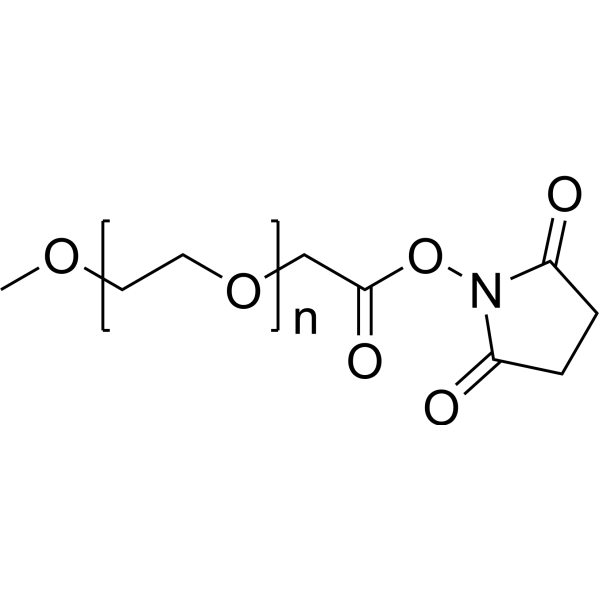
m-PEG2000-NHS ester (mPEG2000-SC) is a reagent with both cell adhesion inhibition and peptide conjugation functions. The NHS ester group of m-PEG2000-NHS ester forms stable amide bonds with primary amine-containing molecules (e.g., the N-terminus of MMP-2-cleavable octapeptide) to generate mPEG-peptide intermediates for liposome surface modification. When m-PEG2000-NHS ester is immobilized on a cystamine-modified gold surface, it can construct an in vitro model for cell adhesion kinetic studies, and higher PEG density and thicker layers correlate with lower cell adhesion rates. m-PEG2000-NHS ester can synthesize MMP-2-responsive PEGylated lipid conjugates to achieve MMP-triggered dePEGylation in the tumor microenvironment. m-PEG2000-NHS ester can be used in studies related to colon cancer and other conditions .
|
-
- HY-W1048567
-
|
|
Biochemical Assay Reagents
|
Others
|
|
mPEG1000-SCM is a high quality amine-reactive PEG product with a stable non-degradable functional group between the PEG polymer chain and the NHS ester .
|
-
- HY-W020780D
-
|
|
Biochemical Assay Reagents
|
Others
|
|
mPEG40000-Mal is a thiol-reactive PEG derivative that can be used to selectively modify proteins, peptides, or any other surface with available thiol groups .
|
-
- HY-W1048567B
-
|
|
Biochemical Assay Reagents
|
Others
|
|
mPEG5000-SCM is a high quality amine-reactive PEG product with a stable non-degradable functional group between the PEG polymer chain and the NHS ester .
|
-
- HY-W1048567E
-
|
|
Biochemical Assay Reagents
|
Others
|
|
mPEG40000-SCM is a high quality amine-reactive PEG product with a stable non-degradable functional group between the PEG polymer chain and the NHS ester .
|
-
- HY-W1048567D
-
|
|
Biochemical Assay Reagents
|
Others
|
|
mPEG20000-SCM is a high quality amine-reactive PEG product with a stable non-degradable functional group between the PEG polymer chain and the NHS ester .
|
-
- HY-W1048567C
-
|
|
Biochemical Assay Reagents
|
Others
|
|
mPEG10000-SCM is a high quality amine-reactive PEG product with a stable non-degradable functional group between the PEG polymer chain and the NHS ester .
|
-
- HY-W1048567A
-
|
|
Biochemical Assay Reagents
|
Others
|
|
mPEG2000-SCM is a high quality amine-reactive PEG product with a stable non-degradable functional group between the PEG polymer chain and the NHS ester .
|
-
- HY-W1048567H
-
|
|
Biochemical Assay Reagents
|
Others
|
|
mPEG3400-SCM is a high quality amine-reactive PEG product with a stable non-degradable functional group between the PEG polymer chain and the NHS ester .
|
-
- HY-W591469
-
|
|
Biochemical Assay Reagents
|
Others
|
|
mPEG1000-Mal is a thiol-reactive PEG derivative that can be used to selectively modify proteins, peptides, or any other surface with available thiol groups .
|
-
- HY-172536
-
|
mPEG30000-SC; mPEG30000-Succinimidyl ester
|
Biochemical Assay Reagents
|
Others
|
|
m-PEG30000-NHS ester (mPEG30000-SC) can be used to modify active molecules and improve their antigenicity, immunogenicity, and help prepare injection preparations. The modification of serine protease lumbrokinase (LK) by m-PEG-NHS ester does not affect its strong fibrinolytic and thrombolytic activities, and has good application prospects .
|
-
- HY-174955
-
|
|
Biochemical Assay Reagents
|
Others
|
|
mPEG1000-Silane is a PEG derivative containing silane that can be used to modify glass, silicon or other surfaces by reacting the hydroxyl groups with ethoxy (methoxy) silane .
|
-
- HY-174955A
-
|
|
Biochemical Assay Reagents
|
Others
|
|
mPEG2000-Silane is a PEG derivative containing silane that can be used to modify glass, silicon or other surfaces by reacting the hydroxyl groups with ethoxy (methoxy) silane .
|
-
- HY-174955B
-
|
|
Biochemical Assay Reagents
|
Others
|
|
mPEG5000-Silane is a PEG derivative containing silane that can be used to modify glass, silicon or other surfaces by reacting the hydroxyl groups with ethoxy (methoxy) silane .
|
-
- HY-W1049092
-
|
|
Biochemical Assay Reagents
|
Others
|
|
mPEG2000-N3 can be used to modify proteins, peptides, and other materials. The azide group can react with alkynes in aqueous solution catalyzed by copper. It can also be easily reduced to an amine group. PEGylation can increase solubility and stability and reduce the immunogenicity of peptides and proteins. mPEG2000-N3 can also inhibit the nonspecific binding of charged molecules to the modified surface .
|
-
- HY-W1049092D
-
|
|
Biochemical Assay Reagents
|
Others
|
|
mPEG40000-N3 can be used to modify proteins, peptides, and other materials. The azide group can react with alkynes in aqueous solution catalyzed by copper. It can also be easily reduced to an amine group. PEGylation can increase solubility and stability and reduce the immunogenicity of peptides and proteins. mPEG40000-N3 can also inhibit the nonspecific binding of charged molecules to the modified surface .
|
-
- HY-W1049092H
-
|
|
Biochemical Assay Reagents
|
Others
|
|
mPEG3400-N3 can be used to modify proteins, peptides, and other materials. The azide group can react with alkynes in aqueous solution catalyzed by copper. It can also be easily reduced to an amine group. PEGylation can increase solubility and stability and reduce the immunogenicity of peptides and proteins. mPEG3400-N3 can also inhibit the nonspecific binding of charged molecules to the modified surface .
|
-
- HY-W1049092C
-
|
|
Biochemical Assay Reagents
|
Others
|
|
mPEG20000-N3 can be used to modify proteins, peptides, and other materials. The azide group can react with alkynes in aqueous solution catalyzed by copper. It can also be easily reduced to an amine group. PEGylation can increase solubility and stability and reduce the immunogenicity of peptides and proteins. mPEG20000-N3 can also inhibit the nonspecific binding of charged molecules to the modified surface .
|
-
- HY-W1049092A
-
|
|
Biochemical Assay Reagents
|
Others
|
|
mPEG5000-N3 can be used to modify proteins, peptides, and other materials. The azide group can react with alkynes in aqueous solution catalyzed by copper. It can also be easily reduced to an amine group. PEGylation can increase solubility and stability and reduce the immunogenicity of peptides and proteins. mPEG5000-N3 can also inhibit the nonspecific binding of charged molecules to the modified surface .
|
-
- HY-W1049092E
-
|
|
Biochemical Assay Reagents
|
Others
|
|
mPEG1000-N3 can be used to modify proteins, peptides, and other materials. The azide group can react with alkynes in aqueous solution catalyzed by copper. It can also be easily reduced to an amine group. PEGylation can increase solubility and stability and reduce the immunogenicity of peptides and proteins. mPEG1000-N3 can also inhibit the nonspecific binding of charged molecules to the modified surface .
|
-
- HY-W1049092B
-
|
|
Biochemical Assay Reagents
|
Others
|
|
mPEG10000-N3 can be used to modify proteins, peptides, and other materials. The azide group can react with alkynes in aqueous solution catalyzed by copper. It can also be easily reduced to an amine group. PEGylation can increase solubility and stability and reduce the immunogenicity of peptides and proteins. mPEG10000-N3 can also inhibit the nonspecific binding of charged molecules to the modified surface .
|
-
- HY-174962B
-
|
|
Biochemical Assay Reagents
|
Others
|
|
mPEG5000-Biotin is a biotin-conjugated PEG derivative used for biotinylation of biomolecules or other surfaces. Biotin can be detected by biotin/streptavidin binding assays and is widely used for molecular target detection .
|
-
- HY-174365D
-
|
|
Biochemical Assay Reagents
|
Others
|
|
mPEG10000-NPC is an important PEG derivative whose reactive groups can be used to modify proteins, peptides or any other compounds with available amino groups at lysine residues or N-terminus .
|
-
- HY-174962A
-
|
|
Biochemical Assay Reagents
|
Others
|
|
mPEG2000-Biotin is a biotin-conjugated PEG derivative used for biotinylation of biomolecules or other surfaces. Biotin can be detected by biotin/streptavidin binding assays and is widely used for molecular target detection .
|
-
- HY-174365B
-
|
|
Biochemical Assay Reagents
|
Others
|
|
mPEG3400-NPC is an important PEG derivative whose reactive groups can be used to modify proteins, peptides or any other compounds with available amino groups at lysine residues or N-terminus .
|
-
- HY-174365E
-
|
|
Biochemical Assay Reagents
|
Others
|
|
mPEG40000-NPC is an important PEG derivative whose reactive groups can be used to modify proteins, peptides or any other compounds with available amino groups at lysine residues or N-terminus .
|
-
- HY-174365
-
|
|
Biochemical Assay Reagents
|
Others
|
|
mPEG1000-NPC is an important PEG derivative whose reactive groups can be used to modify proteins, peptides or any other compounds with available amino groups at lysine residues or N-terminus .
|
-
- HY-174365C
-
|
|
Biochemical Assay Reagents
|
Others
|
|
mPEG5000-NPC is an important PEG derivative whose reactive groups can be used to modify proteins, peptides or any other compounds with available amino groups at lysine residues or N-terminus .
|
-
- HY-174365A
-
|
|
Biochemical Assay Reagents
|
Others
|
|
mPEG2000-NPC is an important PEG derivative whose reactive groups can be used to modify proteins, peptides or any other compounds with available amino groups at lysine residues or N-terminus .
|
-
- HY-174962
-
|
|
Biochemical Assay Reagents
|
Others
|
|
mPEG1000-Biotin is a biotin-conjugated PEG derivative used for biotinylation of biomolecules or other surfaces. Biotin can be detected by biotin/streptavidin binding assays and is widely used for molecular target detection .
|
-
- HY-155884
-
|
mPEG4000-NH2
|
Biochemical Assay Reagents
|
Cancer
|
|
mPEG4000-amine can be used to synthesize folate-conjugated polymer micelles for encapsulating anticancer agent 9-nitrocamptothecin (HY-16560). folate-conjugated polymer micelles are effective carriers of insoluble anticancer drugs, which can avoid macrophages and play a role in endocytosis of tumor cells mediated by folate receptors (FR).
|
-
- HY-155880
-
|
mPEG350-NH2
|
Biochemical Assay Reagents
|
Cancer
|
|
mPEG350-amine can synthesize folate-conjugated polymer micelles for encapsulation of anticancer agent 9-nitrocamptothecin (HY-16560). folate-conjugated polymer micelles are effective carriers of insoluble anticancer drugs, which can avoid macrophages and play a role in endocytosis of tumor cells mediated by folate receptors (FR).
|
-
- HY-155883
-
|
mPEG3400-NH2
|
Biochemical Assay Reagents
|
Cancer
|
|
mPEG3400-amine can synthesize folate-conjugated polymer micelles for encapsulation of anticancer agent 9-nitrocamptothecin (HY-16560). folate-conjugated polymer micelles are effective carriers of insoluble anticancer drugs, which can avoid macrophages and play a role in endocytosis of tumor cells mediated by folate receptors (FR).
|
-
- HY-179320
-
|
|
Biochemical Assay Reagents
|
Others
|
|
mPEG-Amide-tri(DPCA) is a PEG-DPCA conjugate that can self-assemble into a supramolecular polymer hydrogel with nanofiber structures. mPEG-Amide-tri(DPCA) supramolecular polymer hydrogel exhibits shear-thinning behavior for injectable delivery, high drug loading, and degrades in vivo to release only DPCA and PEG. mPEG-Amide-tri(DPCA) supramolecular polymer hydrogel induces in vivo earhole regeneration in adult non-healing mice. mPEG-Amide-tri(DPCA) can be used for tissue regeneration research .
|
-
- HY-140706A
-
|
mPEG40000-SH
|
Biochemical Assay Reagents
|
Others
|
|
m-PEG40000-thiol (mPEG40000-SH) can modify DNA thiolation and is used in the synthesis of gold nanorods (AuNRs) .
|
-
- HY-155877N
-
|
|
Biochemical Assay Reagents
|
Others
|
|
mPEG-DSPE (MW 5000) sodium is a PEG lipid that can improve the delivery efficiency and tissue specificity of poorly soluble drugs. mPEG-DSPE (MW 5000) sodium can be used in drug delivery research .
|
-
- HY-W1049091B
-
|
|
Biochemical Assay Reagents
|
Others
|
|
mPEG10000-Alkyne is a PEG derivative. The alkynyl group can react with azide in aqueous solution under the catalysis of monovalent copper. Polyethylene glycol derivatives can increase the solubility and stability of drugs, reduce the immunogenicity of peptides, and have good biocompatibility .
|
-
- HY-W1049091D
-
|
|
Biochemical Assay Reagents
|
Others
|
|
mPEG40000-Alkyne is a PEG derivative. The alkynyl group can react with azide in aqueous solution under the catalysis of monovalent copper. Polyethylene glycol derivatives can increase the solubility and stability of drugs, reduce the immunogenicity of peptides, and have good biocompatibility .
|
-
- HY-W1049091A
-
|
|
Biochemical Assay Reagents
|
Others
|
|
mPEG5000-Alkyne is a PEG derivative. The alkynyl group can react with azide in aqueous solution under the catalysis of monovalent copper. Polyethylene glycol derivatives can increase the solubility and stability of drugs, reduce the immunogenicity of peptides, and have good biocompatibility .
|
-
- HY-W1049105
-
|
|
Biochemical Assay Reagents
|
Others
|
|
mPEG2000-Alkyne is a PEG derivative. The alkynyl group can react with azide in aqueous solution under the catalysis of monovalent copper. Polyethylene glycol derivatives can increase the solubility and stability of drugs, reduce the immunogenicity of peptides, and have good biocompatibility .
|
-
- HY-W1049091
-
|
|
Biochemical Assay Reagents
|
Others
|
|
mPEG1000-Alkyne is a PEG derivative. The alkynyl group can react with azide in aqueous solution under the catalysis of monovalent copper. Polyethylene glycol derivatives can increase the solubility and stability of drugs, reduce the immunogenicity of peptides, and have good biocompatibility .
|
-
- HY-W1049091C
-
|
|
Biochemical Assay Reagents
|
Others
|
|
mPEG20000-Alkyne is a PEG derivative. The alkynyl group can react with azide in aqueous solution under the catalysis of monovalent copper. Polyethylene glycol derivatives can increase the solubility and stability of drugs, reduce the immunogenicity of peptides, and have good biocompatibility .
|
-
- HY-W1049091E
-
|
|
Biochemical Assay Reagents
|
Others
|
|
mPEG3400-Alkyne is a PEG derivative. The alkynyl group can react with azide in aqueous solution under the catalysis of monovalent copper. Polyethylene glycol derivatives can increase the solubility and stability of drugs, reduce the immunogenicity of peptides, and have good biocompatibility .
|
-
- HY-166983
-
|
|
Biochemical Assay Reagents
|
Others
|
|
m-PEG5000-DMG is a PEG lipid that can improve the delivery efficiency and tissue specificity of poorly soluble drugs. m-PEG5000-DMG can be used in drug delivery research .
|
-
- HY-157745
-
|
mPEG40000-SC; mPEG40000-Succinimidyl ester
|
Biochemical Assay Reagents
|
Others
|
|
m-PEG-NHS ester (mPEG-SC; mPEG-Succinimidyl ester) (MW 40000) is a polyethylene glycol derivative. m-PEG-NHS ester serves as a modifying agent that reacts with free amino groups on the surface of protein or polypeptide molecules to form stable amide bonds, thereby covalently linking PEG chains to biomacromolecules, improving their antigenicity and immunogenicity, and facilitating the preparation of injectable formulations .
|
-
- HY-140700
-
|
mPEG20000-SC; mPEG20000-Succinimidyl ester
|
PROTAC Linkers
|
Cancer
|
|
m-PEG20000-NHS ester is a PEG-based PROTAC linker that can be used in the synthesis of PROTACs .
|
-
- HY-140699
-
|
mPEG10000-SC; mPEG10000-Succinimidyl ester
|
PROTAC Linkers
|
Cancer
|
|
m-PEG10000-NHS ester is a PEG-based PROTAC linker that can be used in the synthesis of PROTACs .
|
-
- HY-140698
-
|
mPEG5000-SC; mPEG5000-Succinimidyl ester
|
PROTAC Linkers
|
Cancer
|
|
m-PEG5000-NHS ester is a PEG-based PROTAC linker that can be used in the synthesis of PROTACs .
|
-
- HY-158255
-
|
|
Biochemical Assay Reagents
|
Others
|
|
mPEG-PLGA (2000-80000) (LA/GA 50:50) is a copolymer, which consists of hydrophilic mPEG and biodegradable PLGA (molar ratio is 50:50) with a molecular weight of 2000 (mPEG) + 80000 (PLGA). mPEG-PLGA (2000-80000) (LA/GA 50:50) forms nanoparticles or microparticles, which is stable in aqueous solution at different pH values and elevated temperatures as well as in serum. mPEG-PLGA (2000-80000) (LA/GA 50:50) is utilized as carrier material in drug delivery systems .
|
-
- HY-W591332
-
|
|
Liposome
|
Cancer
|
|
mPEG2000-DMPE is a PEGylated 1,2-Dimyristoyl-sn-glycero-3-phosphoethanolamine (14:0 PE) compound with a methyl group at the other end of the PEG chain. The PEG polymer exhibits amphiphatic behavior and helps to form stable micelles in an aqueous solution. It can be used to prepare nanoparticles or liposomes for targeted drug delivery applications.
|
-
- HY-W1049075A
-
|
|
Biochemical Assay Reagents
|
Others
|
|
mPEG5000-pALD is an important unilaterally active PEG derivative whose reactive groups can react with amines, peptides and the N-termini of proteins to form imines containing C=N double bonds, which can be further reduced. Polyethylene glycol aldehyde or ketone derivatives can be used for reversible PEGylation by reacting with hydrazine or hydrazine to form hydrolyzed acylhydrazone bonds .
|
-
- HY-W1049075C
-
|
|
Biochemical Assay Reagents
|
Others
|
|
mPEG20000-pALD is an important unilaterally active PEG derivative whose reactive groups can react with amines, peptides and the N-termini of proteins to form imines containing C=N double bonds, which can be further reduced. Polyethylene glycol aldehyde or ketone derivatives can be used for reversible PEGylation by reacting with hydrazine or hydrazine to form hydrolyzed acylhydrazone bonds .
|
-
- HY-W1049075B
-
|
|
Biochemical Assay Reagents
|
Others
|
|
mPEG10000-Pald is an important unilaterally active PEG derivative whose reactive groups can react with amines, peptides and the N-termini of proteins to form imines containing C=N double bonds, which can be further reduced. Polyethylene glycol aldehyde or ketone derivatives can be used for reversible PEGylation by reacting with hydrazine or hydrazine to form hydrolyzed acylhydrazone bonds .
|
-
- HY-W1049075D
-
|
|
Biochemical Assay Reagents
|
Others
|
|
mPEG40000-pALD is an important unilaterally active PEG derivative whose reactive groups can react with amines, peptides and the N-termini of proteins to form imines containing C=N double bonds, which can be further reduced. Polyethylene glycol aldehyde or ketone derivatives can be used for reversible PEGylation by reacting with hydrazine or hydrazine to form hydrolyzed acylhydrazone bonds .
|
-
- HY-W591332A
-
|
|
Biochemical Assay Reagents
|
Others
|
|
mPEG1000-DMPE is a PEGylated 1,2-Dimyristoyl-sn-glycero-3-phosphoethanolamine (14:0 PE) compound with a methyl group at the?other?end of the PEG chain. The PEG polymer exhibits amphiphatic behavior and helps to form stable micelles in an aqueous solution. It can be used to prepare nanoparticles or liposomes for targeted drug delivery applications .
|
-
- HY-W1049075
-
|
|
Biochemical Assay Reagents
|
Others
|
|
mPEG1000-pALD is an important unilaterally active PEG derivative whose reactive groups can react with amines, peptides and the N-termini of proteins to form imines containing C=N double bonds, which can be further reduced. Polyethylene glycol aldehyde or ketone derivatives can be used for reversible PEGylation by reacting with hydrazine or hydrazine to form hydrolyzed acylhydrazone bonds .
|
-
- HY-W591476B
-
|
mPEG750-SH
|
Biochemical Assay Reagents
|
Others
|
|
m-PEG750-thiol modifies DNA thiolation for the synthesis of gold nanorods (AuNRs). Thiolated DNA can be loaded onto AuNR by the mPEG-SH/Tween 20 assisted method (Tween 20 and mPEG-SH repeatedly displace CTAB on the AuNR surface). DNA AuNRs have been widely used in nanostructure assembly, gene therapy, biosensing, and drug delivery.
|
-
- HY-W591476A
-
|
mPEG3400-SH
|
Biochemical Assay Reagents
|
Others
|
|
m-PEG3400-thiol modifies DNA thiolation for the synthesis of gold nanorods (AuNRs). Thiolated DNA can be loaded onto AuNR by the mPEG-SH/Tween 20 assisted method (Tween 20 and mPEG-SH repeatedly displace CTAB on the AuNR surface). DNA AuNRs have been widely used in nanostructure assembly, gene therapy, biosensing, and drug delivery.
|
-
- HY-W591476C
-
|
mPEG550-SH
|
Biochemical Assay Reagents
|
Others
|
|
m-PEG550-thiol modifies DNA thiolation for the synthesis of gold nanorods (AuNRs). Thiolated DNA can be loaded onto AuNR by the mPEG-SH/Tween 20 assisted method (Tween 20 and mPEG-SH repeatedly displace CTAB on the AuNR surface). DNA AuNRs have been widely used in nanostructure assembly, gene therapy, biosensing, and drug delivery.
|
-
- HY-W591476D
-
|
mPEG350-SH
|
Biochemical Assay Reagents
|
Others
|
|
m-PEG350-thiol modifies DNA thiolation for the synthesis of gold nanorods (AuNRs). Thiolated DNA can be loaded onto AuNR by the mPEG-SH/Tween 20 assisted method (Tween 20 and mPEG-SH repeatedly displace CTAB on the AuNR surface). DNA AuNRs have been widely used in nanostructure assembly, gene therapy, biosensing, and drug delivery.
|
-
- HY-RS20991
-
|
|
Small Interfering RNA (siRNA)
|
Others
|
|
Mpeg1 Mouse Pre-designed siRNA Set A contains three designed siRNAs for Mpeg1 gene (Mouse), as well as a negative control, a positive control, and a FAM-labeled negative control.
|
-
Mpeg1 Mouse Pre-designed siRNA Set A
- HY-RS27508
-
|
|
Small Interfering RNA (siRNA)
|
Others
|
|
Mpeg1 Rat Pre-designed siRNA Set A contains three designed siRNAs for Mpeg1 gene (Rat), as well as a negative control, a positive control, and a FAM-labeled negative control.
|
-
Mpeg1 Rat Pre-designed siRNA Set A
- HY-RS08610
-
|
|
Small Interfering RNA (siRNA)
|
Others
|
|
MPEG1 Human Pre-designed siRNA Set A contains three designed siRNAs for MPEG1 gene (Human), as well as a negative control, a positive control, and a FAM-labeled negative control.
|
-
MPEG1 Human Pre-designed siRNA Set A
- HY-174972A
-
|
|
Biochemical Assay Reagents
|
Others
|
|
mPEG-DPPE (MW 5000) is an amphiphilic phospholipid-modified polymer that can be used to prepare lipid nanoparticles or liposomes for targeted drug delivery applications .
|
-
- HY-174972
-
|
|
Biochemical Assay Reagents
|
Others
|
|
mPEG-DPPE (MW 1000) is an amphiphilic phospholipid-modified polymer that can be used to prepare lipid nanoparticles or liposomes for targeted drug delivery applications .
|
-
- HY-W1111591
-
|
mPEG350-Hydroxy; Polyethylene glycol monomethyl ether 350
|
Biochemical Assay Reagents
|
Others
|
|
m-PEG350-OH (mPEG350-Hydroxy) is a derivative of polyethylene glycol (PEG) that can be used for drug delivery .
|
-
- HY-140696D
-
|
mPEG10000-Hydroxy; Polyethylene glycol monomethyl ether 10000
|
Environmental Pollutants
PROTAC Linkers
|
Infection
|
|
m-PEG10000-OH (mPEG10000-Hydroxy; Polyethylene glycol monomethyl ether 10000) is a hydroxyl-terminated methoxylated polyethylene glycol (PEG-based) compound that serves as a linker for PROTACs. m-PEG10000-OH is applicable to research on healthcare-associated infections .
|
-
- HY-174365H
-
|
|
Biochemical Assay Reagents
|
Others
|
|
mPEG-NPC (MW 20000) is an important PEG derivative whose reactive groups can be used to modify proteins, peptides or any other compounds with available amino groups at lysine residues or N-terminus .
|
-
- HY-140709
-
|
mPEG20000-SH
|
PROTAC Linkers
|
Cancer
|
|
m-PEG20000-thiol is a PEG-based PROTAC linker that can be used in the synthesis of PROTACs .
|
-
- HY-140707
-
|
mPEG5000-SH
|
PROTAC Linkers
|
Cancer
|
|
m-PEG5000-thiol is a PEG-based PROTAC linker that can be used in the synthesis of PROTACs .
|
-
- HY-140708
-
|
mPEG10000-SH
|
PROTAC Linkers
|
Cancer
|
|
m-PEG10000-thiol is a PEG-based PROTAC linker that can be used in the synthesis of PROTACs .
|
-
- HY-140706
-
|
mPEG2000-SH
|
PROTAC Linkers
|
Cancer
|
|
m-PEG2000-thiol is a PEG-based PROTAC linker that can be used in the synthesis of PROTACs .
|
-
- HY-W590593
-
|
|
Liposome
|
Cancer
|
|
mPEG-Cholesterol,MW 2000 is a PEG derivative which self-assembles in water to form micelle-like structure. The cholesterol tail can be used to encapsulate hydrophobic drugs while the PEG chain ehances the water solubility of the micelles.
|
-
- HY-140696H
-
|
mPEG750-Hydroxy; Polyethylene glycol monomethyl ether 750
|
Biochemical Assay Reagents
|
Cancer
|
|
m-PEG750-OH (mPEG750-Hydroxy) is a monomethoxypolyethylene glycol and also a macroinitiator for organocatalytic ring-opening polymerization of aliphatic cyclic carbonate monomers. m-PEG750-OH can participate in the synthesis of amphiphilic block copolymers. Amphiphilic block copolymers can be used to prepare nanoscale micelles for active drug delivery .
|
-
- HY-140697
-
|
mPEG5000-Hydroxy; Polyethylene glycol monomethyl ether 5000
|
Environmental Pollutants
PROTAC Linkers
|
Cancer
|
|
m-PEG5000-OH (mPEG5000-Hydroxy) is a monomethoxypolyethylene glycol and also a macroinitiator for organocatalytic ring-opening polymerization of aliphatic cyclic carbonate monomers. m-PEG1000-OH can participate in the synthesis of amphiphilic block copolymers. Amphiphilic block copolymers can be used to prepare nanoscale micelles for active drug delivery .
|
-
- HY-140696B
-
|
mPEG550-Hydroxy; Polyethylene glycol monomethyl ether 550
|
Environmental Pollutants
Biochemical Assay Reagents
|
Cancer
|
|
m-PEG550-OH (mPEG550-Hydroxy) is a monomethoxypolyethylene glycol and also a macroinitiator for organocatalytic ring-opening polymerization of aliphatic cyclic carbonate monomers. m-PEG550-OH can participate in the synthesis of amphiphilic block copolymers. Amphiphilic block copolymers can be used to prepare nanoscale micelles for active drug delivery .
|
-
- HY-140696E
-
|
mPEG1000-Hydroxy; Polyethylene glycol monomethyl ether 1000
|
Environmental Pollutants
Biochemical Assay Reagents
|
Cancer
|
|
m-PEG1000-OH (mPEG1000-Hydroxy) is a monomethoxypolyethylene glycol and also a macroinitiator for organocatalytic ring-opening polymerization of aliphatic cyclic carbonate monomers. m-PEG1000-OH can participate in the synthesis of amphiphilic block copolymers. Amphiphilic block copolymers can be used to prepare nanoscale micelles for active drug delivery .
|
-
- HY-155909A
-
|
mPEG1000-SC; mPEG1000-Succinimidyl ester
|
Biochemical Assay Reagents
|
Others
|
|
m-PEG1000-NHS ester can be used to modify active molecules and improve their antigenicity, immunogenicity, and help prepare injection preparations. The modification of serine protease lumbrokinase (LK) by m-PEG-NHS ester does not affect its strong fibrinolytic and thrombolytic activities, and has good application prospects.
|
-
- HY-155909C
-
|
mPEG350-SC; mPEG350-Succinimidyl ester
|
Biochemical Assay Reagents
|
Others
|
|
m-PEG350-NHS ester can be used to modify active molecules and improve their antigenicity, immunogenicity, and help prepare injection preparations. The modification of serine protease lumbrokinase (LK) by m-PEG-NHS ester does not affect its strong fibrinolytic and thrombolytic activities, and has good application prospects.
|
-
- HY-155909B
-
|
mPEG550-SC; mPEG550-Succinimidyl ester
|
Biochemical Assay Reagents
|
Others
|
|
m-PEG550-NHS ester can be used to modify active molecules and improve their antigenicity, immunogenicity, and help prepare injection preparations. The modification of serine protease lumbrokinase (LK) by m-PEG-NHS ester does not affect its strong fibrinolytic and thrombolytic activities, and has good application prospects.
|
-
- HY-155909
-
|
mPEG3400-SC; mPEG3400-Succinimidyl ester
|
Biochemical Assay Reagents
|
Others
|
|
m-PEG3400-NHS ester can be used to modify active molecules and improve their antigenicity, immunogenicity, and help prepare injection preparations. The modification of serine protease lumbrokinase (LK) by m-PEG-NHS ester does not affect its strong fibrinolytic and thrombolytic activities, and has good application prospects.
|
-
- HY-W591476
-
|
mPEG1000-SH
|
Biochemical Assay Reagents
|
Others
|
|
m-PEG1000-thiol is a surface modifier that can modify DNA thiolation and is used in the synthesis of gold nanorods (AuNR). m-PEG1000-thiol can load thiolated DNA onto AuNR, form a covalent bond with the surface of gold nanoparticles through the thiol group, and stabilize the nanoparticles by the steric hindrance effect of the polyethylene glycol chain, preventing aggregation and enhancing its biocompatibility. m-PEG1000-thiol can also provide a platform for the subsequent coupling of biomolecules (such as DNA, antibodies) by replacing surfactants (such as CTAB) on the surface of nanoparticles, thereby exerting its activity in promoting the functionalization of nanomaterials [2].
|
-
- HY-W1049075E
-
|
|
Biochemical Assay Reagents
|
Others
|
|
mPEG-pALD (MW 2000) is an important unilaterally active PEG derivative whose reactive groups can react with amines, peptides and the N-termini of proteins to form imines containing C=N double bonds, which can be further reduced. Polyethylene glycol aldehyde or ketone derivatives can be used for reversible PEGylation by reacting with hydrazine or hydrazine to form hydrolyzed acylhydrazone bonds .
|
-
- HY-W1049075H
-
|
|
Biochemical Assay Reagents
|
Others
|
|
mPEG-pALD (MW 3400) is an important unilaterally active PEG derivative whose reactive groups can react with amines, peptides and the N-termini of proteins to form imines containing C=N double bonds, which can be further reduced. Polyethylene glycol aldehyde or ketone derivatives can be used for reversible PEGylation by reacting with hydrazine or hydrazine to form hydrolyzed acylhydrazone bonds .
|
-
- HY-139819
-
|
|
Biochemical Assay Reagents
|
Others
|
|
MPEG-PLA (PEG MW 3000 & PLA MW 50,000) is a block copolymer, which can be used to preparenanoparticles for targeted drug delivery .
|
-
- HY-140696
-
-
- HY-140696C
-
|
mPEG20000-Hydroxy; Polyethylene glycol monomethyl ether 20000
|
PROTAC Linkers
|
Cancer
|
|
m-PEG20000-OH can be used as a macroinitiator to participate in the synthesis of amphiphilic block copolymers. Nanoscale micelles can be prepared by using amphiphilic block copolymers to deliver active drugs. Paclitaxel (HY-B0015), a hydrophobic anticancer agent encapsulated in micelles, has stronger activity in killing cancer cells than free Paclitaxel. And it preferentially accumulates in tumor tissue with only limited distribution in healthy organs.
|
-
- HY-140678
-
|
mPEG10000-NH2
|
PROTAC Linkers
|
Cancer
|
|
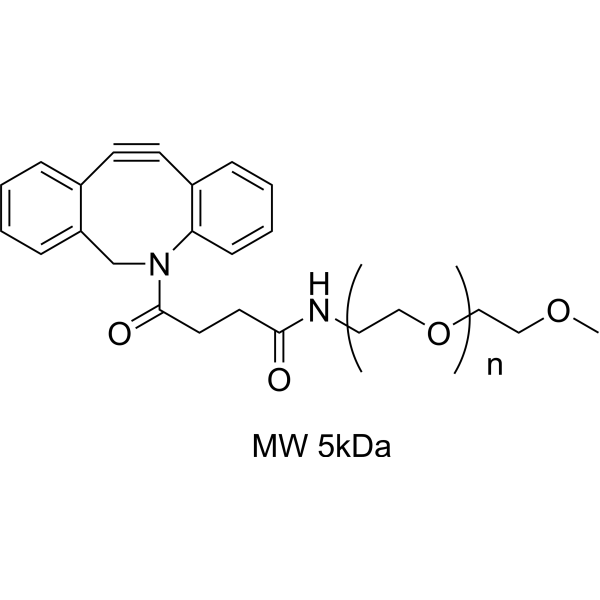
DBCO-PEG10000-Amine (DBCO-PEG10000-NH2) is a polyethylene glycol derivative containing dibenzocyclooctyne. DBCO-PEG-Amine is a universal, modular "bridge molecule": it forms stable covalent linkage with target materials (e.g., MSN or polymers) via the amino group at one end, while the DBCO group at the other end enables efficient, specific, and biocompatible click chemical conjugation with any azide-bearing biological entities (e.g., bacteria, cells) in subsequent steps .
|
-
- HY-112764
-
mPEG2000-DMG
Maximum Cited Publications
21 Publications Verification
|
Liposome
|
Metabolic Disease
|
|
DMG-PEG 2000 is used for the preparation of liposome for siRNA delivery with improved transfection efficiency in vitro. DMG-PEG 2000 is also used for the lipid nanoparticle for an oral plasmid DNA delivery approach in vivo through a facile surface modification to improve the mucus permeability and delivery efficiency of the nanoparticles .
|
-
- HY-167000
-
|
m-PEG10000-VS
|
Biochemical Assay Reagents
|
Others
|
|
m-PEG10000-Vinylsulfone (m-PEG10000-VS) is a PEG derivative that modulates the release of drugs from microparticle systems for parenteral administration. m-PEG10000-Vinylsulfone can be used in drug delivery studies .
|
-
- HY-166998
-
|
m-PEG5000-VS
|
Biochemical Assay Reagents
|
Others
|
|
m-PEG5000-Vinylsulfone (m-PEG5000-VS) is a PEG derivative that modulates the release of drugs from microparticle systems for parenteral administration. m-PEG5000-Vinylsulfone can be used in drug delivery studies .
|
-
- HY-166999
-
|
m-PEG20000-VS
|
Biochemical Assay Reagents
|
Others
|
|
m-PEG20000-Vinylsulfone (m-PEG20000-VS) is a PEG derivative that modulates the release of drugs from microparticle systems for parenteral administration. m-PEG20000-Vinylsulfone can be used in drug delivery studies .
|
-
- HY-166980
-
|
|
Biochemical Assay Reagents
|
Others
|
|
m-PEG-DPPE (MW 2000) is a PEG lipid that can improve the delivery efficiency and tissue specificity of poorly soluble drugs. m-PEG-DPPE (MW 2000) can be used in drug delivery research .
|
-
- HY-W1120833
-
-
- HY-W440925
-
|
|
Biochemical Assay Reagents
|
Others
|
|
m-PEG5000-DSPE sodium is a PEG lipid that can improve the delivery efficiency and tissue specificity of poorly soluble drugs. m-PEG5000-DSPE sodium can be used in drug delivery research .
|
-
- HY-W440922
-
|
|
Biochemical Assay Reagents
|
Others
|
|
m-PEG1000-DSPE sodium is a PEG lipid that can improve the delivery efficiency and tissue specificity of poorly soluble drugs. m-PEG1000-DSPE sodium can be used in drug delivery research .
|
-
- HY-W440924
-
|
|
Biochemical Assay Reagents
|
Others
|
|
m-PEG3000-DSPE sodium is a PEG lipid that can improve the delivery efficiency and tissue specificity of poorly soluble drugs. m-PEG3000-DSPE sodium can be used in drug delivery research .
|
-
- HY-D2846B
-
|
|
Fluorescent Dye
|
Others
|
|
m-PEG5000-PEI5000-Cy5 is a fluorescent dye composed of CY5 (HY-D0821), methoxypolyethylene glycol (mPEG), and polyethyleneimine (PEI). m-PEG5000-PEI5000-Cy5 is used for gene delivery, nanodrug delivery, cell imaging and biosensing and bioanalysis (Ex/Em=633/670 nm).
|
-
- HY-D2846A
-
|
|
Fluorescent Dye
|
Others
|
|
m-PEG2000-PEI2000-Cy5 is a fluorescent dye composed of CY5 (HY-D0821), methoxypolyethylene glycol (mPEG), and polyethyleneimine (PEI). m-PEG2000-PEI2000-Cy5 is used for gene delivery, nanodrug delivery, cell imaging and biosensing and bioanalysis (Ex/Em=633/670 nm).
|
-
- HY-130528
-
|
|
ADC Linker
PROTAC Linkers
|
Cancer
|
|
m-PEG7-MS is a PEG-based PROTAC linker can be used in the synthesis of PROTACs. m-PEG7-MS is a cleavable ADC linker used in the synthesis of antibody-drug conjugates (ADCs) .
|
-
- HY-130408
-
|
|
ADC Linker
PROTAC Linkers
|
Cancer
|
|
m-PEG6-Amine is a PEG-based PROTAC linker can be used in the synthesis of PROTACs. m-PEG6-Amine is a cleavable ADC linker used in the synthesis of antibody-drug conjugates (ADCs) .
|
-
- HY-130457
-
|
|
ADC Linker
PROTAC Linkers
|
Cancer
|
|
m-PEG4-MS is a PEG-based PROTAC linker can be used in the synthesis of PROTACs. m-PEG4-MS is a cleavable ADC linker used in the synthesis of antibody-drug conjugates (ADCs) .
|
-
- HY-W018174
-
|
|
ADC Linker
PROTAC Linkers
|
Cancer
|
|
m-PEG3-Amine is a PEG-based PROTAC linker can be used in the synthesis of PROTACs. m-PEG3-Amine is a cleavable ADC linker used in the synthesis of antibody-drug conjugates (ADCs) .
|
-
- HY-120237
-
|
|
ADC Linker
PROTAC Linkers
|
Cancer
|
|
m-PEG7-Amine is a PEG-based PROTAC linker can be used in the synthesis of PROTACs. m-PEG7-Amine is a cleavable ADC linker used in the synthesis of antibody-drug conjugates (ADCs) .
|
-
- HY-116186
-
|
|
ADC Linker
PROTAC Linkers
|
Cancer
|
|
m-PEG5-MS is a PEG-based PROTAC linker can be used in the synthesis of PROTACs. m-PEG5-MS is a cleavable ADC linker used in the synthesis of antibody-drug conjugates (ADCs) .
|
-
- HY-W040214
-
|
|
ADC Linker
PROTAC Linkers
|
Cancer
|
|
m-PEG4-Amine is a PEG-based PROTAC linker can be used in the synthesis of PROTACs. m-PEG4-Amine is a cleavable ADC linker used in the synthesis of antibody-drug conjugates (ADCs) .
|
-
- HY-W008429
-
|
|
ADC Linker
PROTAC Linkers
|
Cancer
|
|
m-PEG2-Amine is a PEG-based PROTAC linker can be used in the synthesis of PROTACs. m-PEG2-Amine is a cleavable ADC linker used in the synthesis of antibody-drug conjugates (ADCs) .
|
-
- HY-42745
-
|
|
ADC Linker
PROTAC Linkers
|
Cancer
|
|
m-PEG2-Tos is a uncleavable ADC linker used in the synthesis of antibody-drug conjugates (ADCs). m-PEG2-Tos is also a PEG-based PROTAC linker that can be used in the synthesis of PROTACs.
|
-
- HY-130571
-
|
|
ADC Linker
PROTAC Linkers
|
Cancer
|
|
m-PEG9-Amine is a PEG-based PROTAC linker can be used in the synthesis of PROTACs. m-PEG9-Amine is a cleavable ADC linker used in the synthesis of antibody-drug conjugates (ADCs) .
|
-
- HY-117031
-
|
|
ADC Linker
PROTAC Linkers
|
Cancer
|
|
m-PEG8-MS is a PEG-based PROTAC linker can be used in the synthesis of PROTACs. m-PEG8-MS is a cleavable ADC linker used in the synthesis of antibody-drug conjugates (ADCs) .
|
-
- HY-W040222
-
|
|
ADC Linker
PROTAC Linkers
|
Cancer
|
|
m-PEG11-Amino is a cleavable ADC linker used in the synthesis of antibody-drug conjugates (ADCs). m-PEG11-Amine is also a PEG-based PROTAC linker that can be used in the synthesis of PROTACs .
|
-
- HY-130161
-
|
|
ADC Linker
PROTAC Linkers
|
Cancer
|
|
m-PEG4-Br is a cleavable ADC linker used in the synthesis of antibody-drug conjugate (ADC) for Trastuzumab (HY-P9907). m-PEG4-Br is placed distally from the monomethyl auristatin E (MMAE) payload to yield an ADC with altered hydrophilicity, antigen binding, and in vitro potency . m-PEG4-Br also can be used as a PROTAC linker that can be used in the synthesis of PROTACs.
|
-
- HY-W190842
-
|
|
Biochemical Assay Reagents
|
Others
|
|
m-PEG2-NHS ester is a PEG linker containing an NHS ester. The NHS ester of m-PEG2-NHS ester is used to label primary amines (-NH2) of proteins, amine-modified oligonucleotides and other amine-containing molecules. The hydrophilic PEG spacer effectively improves solubility in aqueous media. m-PEG2-NHS ester can be used in studies related to bioconjugation with ADC, proteins, peptides and other molecules .
|
-
- HY-140501
-
|
|
ADC Linker
PROTAC Linkers
|
Cancer
|
|
m-PEG11-acid is a non-cleavable 11 unit PEG ADC linker used in the synthesis of antibody-drug conjugates (ADCs) . m-PEG11-acid is also a PEG-based PROTAC linker that can be used in the synthesis of PROTACs .
|
-
- HY-140500
-
|
|
ADC Linker
PROTAC Linkers
|
Cancer
|
|
m-PEG10-acid is a non-cleavable 10 unit PEG ADC linker used in the synthesis of antibody-drug conjugates (ADCs) . m-PEG10-acid is also a PEG-based PROTAC linker that can be used in the synthesis of PROTACs .
|
-
- HY-D2838
-
|
|
Fluorescent Dye
|
Others
|
|
mPEG-PEI-Cy5 (MW 5000) is a fluorescent dye composed of polyethylene glycol (PEG), FITC (HY-66019) and a Biotin (HY-B0511). mPEG-PEI-Cy5 (MW 5000) can be used for fluorescent labeling and imaging .
|
-
- HY-D2835
-
|
|
Fluorescent Dye
|
Others
|
|
mPEG-PEI-Cy5 (MW 1000) is a fluorescent dye composed of polyethylene glycol (PEG), FITC (HY-66019) and a Biotin (HY-B0511). mPEG-PEI-Cy5 (MW 1000) can be used for fluorescent labeling and imaging .
|
-
- HY-141395
-
|
|
ADC Linker
PROTAC Linkers
|
Cancer
|
|
m-PEG4-Boc is a cleavable 4 unit PEG ADC linker used in the synthesis of antibody-drug conjugates (ADCs) . m-PEG4-Boc is also a PEG-based PROTAC linker that can be used in the synthesis of PROTACs .
|
-
- HY-133066
-
|
|
PROTAC Linkers
ADC Linker
|
Inflammation/Immunology
Cancer
|
|
m-PEG6-NHS ester is a non-cleavable 6 unit PEG ADC linker used in the synthesis of antibody-drug conjugates (ADCs). m-PEG6-NHS ester is a PEG/Alkyl/ether-based PROTAC linker can be used in the synthesis of PROTACs.
|
-
- HY-D2837
-
|
|
Fluorescent Dye
|
Others
|
|
mPEG-PEI-Cy5 (MW 2000) is a fluorescent dye composed of polyethylene glycol (PEG), FITC (HY-66019) and a Biotin (HY-B0511). mPEG-PEI-Cy5 (MW 2000) can be used for fluorescent labeling and imaging .
|
-
- HY-114661
-
|
|
PROTAC Linkers
|
Cancer
|
|
m-PEG4-Tos is a derivative of silybin ethers, extracted from patent CN105037337A (compound III-b). m-PEG4-Tos is a PEG-based PROTAC linker can be used in the synthesis of Silymarin (HY-W043277) .
|
-
- HY-140226
-
|
|
ADC Linker
PROTAC Linkers
|
Cancer
|
|
m-PEG10-amine is a non-cleavable 10 unit PEG ADC linker used in the synthesis of antibody-drug conjugates (ADCs) . m-PEG10-amine is also a PEG-based PROTAC linker that can be used in the synthesis of PROTACs .
|
-
- HY-W042501
-
|
|
PROTAC Linkers
|
Cancer
|
|
m-PEG5-Tos is a derivative of silybin ethers, extracted from patent CN105037337A (compound III-c). m-PEG5-Tos is a PEG-based PROTAC linker can be used in the synthesis of Silymarin (HY-W043277) .
|
-
- HY-141220
-
|
|
PROTAC Linkers
ADC Linker
|
Cancer
|
|
m-PEG12-OH is a PEG-based PROTAC linker that can be used in the synthesis of PROTACs . m-PEG12-OH is also a non-cleavable 12 unit PEG ADC linker used in the synthesis of antibody-drug conjugates (ADCs) .
|
-
- HY-140227
-
|
|
PROTAC Linkers
ADC Linker
|
Cancer
|
|
m-PEG12-amine is a PEG-based PROTAC linker that can be used in the synthesis of PROTACs . m-PEG12-amine is also a non-cleavable 12 unit PEG ADC linker used in the synthesis of antibody-drug conjugates (ADCs) .
|
-
- HY-130150
-
|
|
PROTAC Linkers
ADC Linker
|
Inflammation/Immunology
Cancer
|
|
m-PEG5-succinimidyl carbonate is a non-cleavable 5 unit PEG ADC linker used in the synthesis of antibody-drug conjugates (ADCs). m-PEG5-succinimidyl carbonate is a PEG/Alkyl/ether-based PROTAC linker can be used in the synthesis of PROTACs.
|
-
- HY-D2839
-
|
|
Fluorescent Dye
|
Others
|
|
m-PEG10000-PEI-Cy5 is a fluorescent dye composed of polyethylene glycol (PEG), Cy5 (HY-D0821) and Polyethyleneimine (PEI). m-PEG10000-PEI-Cy5 can be used for fluorescent labeling and imaging .
|
-
- HY-113921
-
|
|
PROTAC Linkers
|
Cancer
|
|
m-PEG4-propargyl is a PEG-based PROTAC linker can be used in the synthesis of PROTACs. m-PEG4-propargyl is a click chemistry reagent, it contains an Alkyne group and can undergo copper-catalyzed azide-alkyne cycloaddition (CuAAc) with molecules containing Azide groups.
|
-
- HY-130901
-
|
|
PROTAC Linkers
|
Cancer
|
|
m-PEG25-Propargyl is a PEG-based PROTAC linker that can be used in the synthesis of PROTACs . m-PEG25-Propargyl is a click chemistry reagent, it contains an Alkyne group and can undergo copper-catalyzed azide-alkyne cycloaddition (CuAAc) with molecules containing Azide groups.
|
-
- HY-140317
-
|
|
PROTAC Linkers
|
Cancer
|
|
m-PEG12-DBCO is a PEG-based PROTAC linker that can be used in the synthesis of PROTACs . m-PEG12-DBCO is a click chemistry reagent, it contains a DBCO group that can undergo strain-promoted alkyne-azide cycloaddition (SPAAC) with molecules containing Azide groups.
|
-
- HY-130902
-
|
|
PROTAC Linkers
|
Cancer
|
|
m-PEG37-Propargyl is a PEG-based PROTAC linker that can be used in the synthesis of PROTACs . m-PEG37-Propargyl is a click chemistry reagent, it contains an Alkyne group and can undergo copper-catalyzed azide-alkyne cycloaddition (CuAAc) with molecules containing Azide groups.
|
-
- HY-138719
-
|
|
PROTAC Linkers
|
Cancer
|
|
m-PEG5-Propyne is a PEG-based PROTAC linker that can be used in the synthesis of PROTACs . m-PEG5-Propyne is a click chemistry reagent, it contains an Alkyne group and can undergo copper-catalyzed azide-alkyne cycloaddition (CuAAc) with molecules containing Azide groups.
|
-
- HY-140316
-
|
|
PROTAC Linkers
|
Cancer
|
|
m-PEG8-DBCO is a PEG-based PROTAC linker that can be used in the synthesis of PROTACs . m-PEG8-DBCO is a click chemistry reagent, it contains a DBCO group that can undergo strain-promoted alkyne-azide cycloaddition (SPAAC) with molecules containing Azide groups.
|
-
- HY-141218
-
|
Decaethylene glycol monomethyl ether
|
ADC Linker
PROTAC Linkers
|
Cancer
|
|
m-PEG10-alcohol (Decaethylene glycol monomethyl ether) is a non-cleavable 10 unit PEG ADC linker used in the synthesis of antibody-drug conjugates (ADCs) . m-PEG10-alcohol is also a PEG-based PROTAC linker that can be used in the synthesis of PROTACs .
|
-
- HY-120537
-
|
|
ADC Linker
PROTAC Linkers
|
Cancer
|
|
m-PEG5-CH2COOH is a non-cleavable ADC linker used in the synthesis of antibody-drug conjugates (ADCs). m-PEG5-CH2COOH is also a PEG-based PROTAC linker that can be used in the synthesis of PROTACs .
|
-
- HY-140315
-
|
|
PROTAC Linkers
|
Cancer
|
|
m-PEG4-NH-DBCO is a PEG-based PROTAC linker that can be used in the synthesis of PROTACs . m-PEG4-NH-DBCO is a click chemistry reagent, it contains a DBCO group that can undergo strain-promoted alkyne-azide cycloaddition (SPAAC) with molecules containing Azide groups.
|
-
- HY-135932
-
|
|
PROTAC Linkers
|
Cancer
|
|
m-PEG8-O-alkyne is a PEG-based PROTAC linker that can be used in the synthesis of PROTACs . m-PEG8-O-alkyne is a click chemistry reagent, it contains an Alkyne group and can undergo copper-catalyzed azide-alkyne cycloaddition (CuAAc) with molecules containing Azide groups.
|
-
- HY-130231
-
|
|
PROTAC Linkers
|
Cancer
|
|
m-PEG2-acid is a PEG-based PROTAC linker can be used in the synthesis of PROTACs.
|
-
- HY-W040195
-
|
|
PROTAC Linkers
|
Cancer
|
|
m-PEG5-acid is a PEG-based PROTAC linker can be used in the synthesis of PROTACs.
|
-
- HY-135820
-
|
|
PROTAC Linkers
|
Cancer
|
|
m-PEG12-acid is a PEG-based PROTAC linker that can be used in the synthesis of PROTACs .
|
-
- HY-124323
-
|
|
PROTAC Linkers
|
Cancer
|
|
m-PEG4-NHS ester is a PEG-based PROTAC linker can be used in the synthesis of PROTACs.
|
-
- HY-130554
-
|
|
PROTAC Linkers
|
Cancer
|
|
m-PEG9-phosphonic acid is a PEG-based PROTAC linker can be used in the synthesis of PROTACs.
|
-
- HY-130657
-
|
|
PROTAC Linkers
|
Cancer
|
|
m-PEG5-nitrile is a PEG-based PROTAC linker can be used in the synthesis of PROTACs.
|
-
- HY-140499
-
|
|
PROTAC Linkers
|
Cancer
|
|
m-PEG9-acid is a PEG-based PROTAC linker that can be used in the synthesis of PROTACs .
|
-
- HY-143815
-
|
|
PROTAC Linkers
|
Cancer
|
|
m-PEG18-acid is a PEG-based PROTAC linker that can be used in the synthesis of PROTACs .
|
-
- HY-135796
-
-
- HY-133064
-
|
|
PROTAC Linkers
|
Cancer
|
|
m-PEG3-NHS ester is a PEG-based PROTAC linker can be used in the synthesis of PROTACs.
|
-
- HY-122413
-
|
|
PROTAC Linkers
|
Cancer
|
|
m-PEG7-NHS ester is a PEG-based PROTAC linker can be used in the synthesis of PROTACs.
|
-
- HY-133324
-
|
|
PROTAC Linkers
|
Cancer
|
|
m-PEG37-acid is a PEG-based PROTAC linker that can be used in the synthesis of PROTACs .
|
-
- HY-133323
-
|
|
PROTAC Linkers
|
Cancer
|
|
m-PEG24-acid is a PEG-based PROTAC linker that can be used in the synthesis of PROTACs .
|
-
- HY-140502
-
|
|
PROTAC Linkers
|
Cancer
|
|
m-PEG17-acid is a PEG-based PROTAC linker that can be used in the synthesis of PROTACs .
|
-
- HY-130938
-
|
|
PROTAC Linkers
|
Cancer
|
|
m-PEG25-acid is a PEG-based PROTAC linker that can be used in the synthesis of PROTACs .
|
-
- HY-133322
-
|
|
PROTAC Linkers
|
Cancer
|
|
m-PEG21-acid is a PEG-based PROTAC linker that can be used in the synthesis of PROTACs .
|
-
- HY-130446
-
|
|
PROTAC Linkers
|
Cancer
|
|
m-PEG9-NHS ester is a PEG-based PROTAC linker can be used in the synthesis of PROTACs.
|
-
- HY-133325
-
|
|
PROTAC Linkers
|
Cancer
|
|
m-PEG49-acid is a PEG-based PROTAC linker that can be used in the synthesis of PROTACs .
|
-
- HY-133065
-
|
|
PROTAC Linkers
|
Cancer
|
|
m-PEG5-NHS ester is a PEG-based PROTAC linker can be used in the synthesis of PROTACs.
|
-
- HY-133279
-
|
|
PROTAC Linkers
|
Cancer
|
|
m-PEG11-Br is a PEG-based PROTAC linker that can be used in the synthesis of PROTACs .
|
-
- HY-133345
-
|
|
PROTAC Linkers
|
Cancer
|
|
m-PEG7-Hydrazide is a PEG-based PROTAC linker that can be used in the synthesis of PROTACs .
|
-
- HY-140984
-
|
|
PROTAC Linkers
|
Cancer
|
|
m-PEG24-Mal is a PEG-based PROTAC linker that can be used in the synthesis of PROTACs .
|
-
- HY-140695
-
|
|
PROTAC Linkers
|
Cancer
|
|
m-PEG2000-Aminooxy is a PEG-based PROTAC linker that can be used in the synthesis of PROTACs .
|
-
- HY-141399
-
|
|
PROTAC Linkers
|
Cancer
|
|
m-PEG10-Boc is a PEG-based PROTAC linker can be used in the synthesis of PROTACs .
|
-
- HY-138449
-
|
|
PROTAC Linkers
|
Cancer
|
|
m-PEG6-Boc is a PEG-based PROTAC linker that can be used in the synthesis of PROTACs .
|
-
- HY-141222
-
|
|
PROTAC Linkers
|
Cancer
|
|
m-PEG16-alcohol is a PEG-based PROTAC linker can be used in the synthesis of PROTACs .
|
-
- HY-138428
-
|
|
PROTAC Linkers
|
Cancer
|
|
m-PEG9-Mal is a PEG-based PROTAC linker that can be used in the synthesis of PROTACs .
|
-
- HY-130830
-
|
|
PROTAC Linkers
|
Cancer
|
|
m-PEG24-NHS ester is a PEG-based PROTAC linker that can be used in the synthesis of PROTACs .
|
-
- HY-133278
-
|
|
PROTAC Linkers
|
Cancer
|
|
m-PEG10-Br is a PEG-based PROTAC linker that can be used in the synthesis of PROTACs .
|
-
- HY-138382
-
|
|
PROTAC Linkers
|
Cancer
|
|
m-PEG4-PFP ester is a PEG-based PROTAC linker that can be used in the synthesis of PROTACs .
|
-
- HY-141400
-
|
|
PROTAC Linkers
|
Cancer
|
|
m-PEG12-Boc is a PEG-based PROTAC linker can be used in the synthesis of PROTACs .
|
-
- HY-140362
-
|
|
PROTAC Linkers
|
Cancer
|
|
m-PEG2-MS is a PEG-based PROTAC linker that can be used in the synthesis of PROTACs .
|
-
- HY-141109
-
|
|
PROTAC Linkers
|
Cancer
|
|
m-PEG25-NHS ester is a PEG-based PROTAC linker that can be used in the synthesis of PROTACs .
|
-
- HY-133289
-
|
|
PROTAC Linkers
|
Cancer
|
|
m-PEG48-OH is a PEG-based PROTAC linker that can be used in the synthesis of PROTACs .
|
-
- HY-141408
-
|
|
PROTAC Linkers
|
Cancer
|
|
m-PEG5-triethoxysilane is a PEG-based PROTAC linker can be used in the synthesis of PROTACs .
|
-
- HY-133344
-
|
|
PROTAC Linkers
|
Cancer
|
|
m-PEG3-Hydrazide is a PEG-based PROTAC linker that can be used in the synthesis of PROTACs .
|
-
- HY-141106
-
|
|
PROTAC Linkers
|
Cancer
|
|
m-PEG12-NHS ester is a PEG-based PROTAC linker that can be used in the synthesis of PROTACs .
|
-
- HY-130336
-
|
|
PROTAC Linkers
|
Cancer
|
|
m-PEG6-Tos is a PEG-based PROTAC linker that can be used in the synthesis of PROTACs .
|
-
- HY-140620
-
|
|
PROTAC Linkers
|
Cancer
|
|
m-PEG4-aldehyde is a PEG-based PROTAC linker that can be used in the synthesis of PROTACs .
|
-
- HY-140674
-
|
|
PROTAC Linkers
|
Cancer
|
|
m-PEG5000-Butyraldehyde is a PEG-based PROTAC linker that can be used in the synthesis of PROTACs .
|
-
- HY-138424
-
|
|
PROTAC Linkers
|
Cancer
|
|
m-PEG15-amine is a PEG-based PROTAC linker that can be used in the synthesis of PROTACs .
|
-
- HY-135940
-
|
|
PROTAC Linkers
|
Cancer
|
|
m-PEG3-Mal is a PEG-based PROTAC linker that can be used in the synthesis of PROTACs .
|
-
- HY-140171
-
|
|
PROTAC Linkers
|
Cancer
|
|
m-PEG5-sulfonic acid is a PEG-based PROTAC linker that can be used in the synthesis of PROTACs .
|
-
- HY-141217
-
|
O-Methyl-heptaethylene glycol
|
PROTAC Linkers
|
Cancer
|
|
m-PEG7-alcohol is a PEG-based PROTAC linker that can be used in the synthesis of PROTACs .
|
-
- HY-140951
-
|
|
PROTAC Linkers
|
Cancer
|
|
m-PEG12-DSPE is a PEG-based PROTAC linker that can be used in the synthesis of PROTACs .
|
-
- HY-161020
-
|
|
PROTAC Linkers
|
Others
|
|
m-PEG12-Ots is a PEG-based PROTAC linker that can be used in the synthesis of PROTACs .
|
-
- HY-141224
-
|
|
PROTAC Linkers
|
Cancer
|
|
m-PEG23-alcohol is a PEG-based PROTAC linker can be used in the synthesis of PROTACs .
|
-
- HY-W096153
-
|
|
PROTAC Linkers
|
Cancer
|
|
m-PEG3-phosphonic acid is a PEG-based PROTAC linker that can be used in the synthesis of PROTACs .
|
-
- HY-133351
-
|
|
PROTAC Linkers
|
Cancer
|
|
m-PEG25-Hydrazide is a PEG-based PROTAC linker that can be used in the synthesis of PROTACs .
|
-
- HY-140703
-
|
|
PROTAC Linkers
|
Cancer
|
|
m-PEG2000-triethoxysilane is a PEG-based PROTAC linker that can be used in the synthesis of PROTACs .
|
-
- HY-140983
-
|
|
PROTAC Linkers
|
Cancer
|
|
m-PEG12-Mal is a PEG-based PROTAC linker that can be used in the synthesis of PROTACs .
|
-
- HY-133348
-
|
|
PROTAC Linkers
|
Cancer
|
|
m-PEG12-Hydrazide is a PEG-based PROTAC linker that can be used in the synthesis of PROTACs .
|
-
- HY-133281
-
|
|
PROTAC Linkers
|
Cancer
|
|
m-PEG16-Br is a PEG-based PROTAC linker that can be used in the synthesis of PROTACs .
|
-
- HY-133277
-
|
|
PROTAC Linkers
|
Cancer
|
|
m-PEG2-Br is a PEG-based PROTAC linker that can be used in the synthesis of PROTACs .
|
-
- HY-133282
-
|
|
PROTAC Linkers
|
Cancer
|
|
m-PEG24-Br is a PEG-based PROTAC linker that can be used in the synthesis of PROTACs .
|
-
- HY-140672
-
|
|
PROTAC Linkers
|
Cancer
|
|
m-PEG20000-acrylate is a PEG-based PROTAC linker that can be used in the synthesis of PROTACs .
|
-
- HY-140505
-
|
|
PROTAC Linkers
|
Cancer
|
|
m-PEG3-Propanoyl chloride is a PEG-based PROTAC linker that can be used in the synthesis of PROTACs .
|
-
- HY-133287
-
|
|
PROTAC Linkers
|
Cancer
|
|
m-PEG36-OH is a PEG-based PROTAC linker that can be used in the synthesis of PROTACs .
|
-
- HY-140673
-
|
|
PROTAC Linkers
|
Cancer
|
|
m-PEG30000-acrylate is a PEG-based PROTAC linker that can be used in the synthesis of PROTACs .
|
-
- HY-133284
-
|
|
PROTAC Linkers
|
Cancer
|
|
m-PEG48-Br is a PEG-based PROTAC linker that can be used in the synthesis of PROTACs .
|
-
- HY-141308
-
|
|
PROTAC Linkers
|
Cancer
|
|
m-PEG5-phosphonic acid is a PEG-based PROTAC linker that can be used in the synthesis of PROTACs .
|
-
- HY-141226
-
|
|
PROTAC Linkers
|
Cancer
|
|
m-PEG36-alcohol is a PEG-based PROTAC linker that can be used in the synthesis of PROTACs .
|
-
- HY-133276
-
|
|
PROTAC Linkers
|
Cancer
|
|
m-PEG7-Br is a PEG-based PROTAC linker that can be used in the synthesis of PROTACs .
|
-
- HY-135921
-
|
|
PROTAC Linkers
|
Cancer
|
|
m-PEG5-Hydrazide is a PEG-based PROTAC linker that can be used in the synthesis of PROTACs .
|
-
- HY-141398
-
|
Methyl-PEG9-t-butyl ester
|
PROTAC Linkers
|
Cancer
|
|
m-PEG9-Boc is a PEG-based PROTAC linker can be used in the synthesis of PROTACs .
|
-
- HY-133272
-
|
|
PROTAC Linkers
|
Cancer
|
|
m-PEG5-SH is a PEG-based PROTAC linker that can be used in the synthesis of PROTACs .
|
-
- HY-141331
-
|
|
PROTAC Linkers
|
Cancer
|
|
m-PEG12-Thiol is a PEG-based PROTAC linker that can be used in the synthesis of PROTACs .
|
-
- HY-141107
-
|
|
PROTAC Linkers
|
Cancer
|
|
m-PEG13-NHS ester is a PEG-based PROTAC linker that can be used in the synthesis of PROTACs .
|
-
- HY-133350
-
|
|
PROTAC Linkers
|
Cancer
|
|
m-PEG17-Hydrazide is a PEG-based PROTAC linker that can be used in the synthesis of PROTACs .
|
-
- HY-140360
-
|
|
PROTAC Linkers
|
Cancer
|
|
m-PEG10-Tos is a PEG-based PROTAC linker can be used in the synthesis of PROTACs .
|
-
- HY-140704
-
|
|
PROTAC Linkers
|
Cancer
|
|
m-PEG5000-triethoxysilane is a PEG-based PROTAC linker that can be used in the synthesis of PROTACs .
|
-
- HY-141307
-
|
|
PROTAC Linkers
|
Cancer
|
|
m-PEG4-phosphonic acid is a PEG-based PROTAC linker that can be used in the synthesis of PROTACs .
|
-
- HY-140229
-
|
|
PROTAC Linkers
|
Cancer
|
|
m-PEG36-amine is a PEG-based PROTAC linker that can be used in the synthesis of PROTACs .
|
-
- HY-140693
-
|
|
PROTAC Linkers
|
Cancer
|
|
m-PEG30000-mal is a PEG-based PROTAC linker that can be used in the synthesis of PROTACs .
|
-
- HY-138420
-
|
|
PROTAC Linkers
|
Cancer
|
|
m-PEG7-Silane is a PEG-based PROTAC linker that can be used in the synthesis of PROTACs .
|
-
- HY-140398
-
|
|
PROTAC Linkers
|
Cancer
|
|
m-PEG3-Aminooxy is a PEG-based PROTAC linker can be used in the synthesis of PROTACs .
|
-
- HY-141306
-
|
|
PROTAC Linkers
|
Cancer
|
|
m-PEG2-phosphonic acid is a PEG-based PROTAC linker that can be used in the synthesis of PROTACs .
|
-
- HY-140363
-
|
|
PROTAC Linkers
|
Cancer
|
|
m-PEG3-OMs is a PEG-based PROTAC linker that can be used in the synthesis of PROTACs .
|
-
- HY-133349
-
|
|
PROTAC Linkers
|
Cancer
|
|
m-PEG13-Hydrazide is a PEG-based PROTAC linker that can be used in the synthesis of PROTACs .
|
-
- HY-140170
-
|
|
PROTAC Linkers
|
Cancer
|
|
m-PEG4-sulfonic acid is a PEG-based PROTAC linker that can be used in the synthesis of PROTACs .
|
-
- HY-133270
-
|
|
PROTAC Linkers
|
Cancer
|
|
m-PEG10-SH is a PEG-based PROTAC linker that can be used in the synthesis of PROTACs .
|
-
- HY-138427
-
|
|
PROTAC Linkers
|
Cancer
|
|
m-PEG18-Mal is a PEG-based PROTAC linker that can be used in the synthesis of PROTACs .
|
-
- HY-141403
-
|
|
PROTAC Linkers
|
Cancer
|
|
m-PEG37-hydrazide is a PEG-based PROTAC linker can be used in the synthesis of PROTACs .
|
-
- HY-133347
-
|
|
PROTAC Linkers
|
Cancer
|
|
m-PEG11-Hydrazide is a PEG-based PROTAC linker that can be used in the synthesis of PROTACs .
|
-
- HY-141397
-
|
Methyl-peg8-t-butyl ester
|
PROTAC Linkers
|
Cancer
|
|
m-PEG8-Boc is a PEG-based PROTAC linker that can be used in the synthesis of PROTACs .
|
-
- HY-140986
-
|
|
PROTAC Linkers
|
Cancer
|
|
m-PEG48-Mal is a PEG-based PROTAC linker that can be used in the synthesis of PROTACs .
|
-
- HY-130829
-
|
|
PROTAC Linkers
|
Cancer
|
|
m-PEG15-NHS ester is a PEG-based PROTAC linker that can be used in the synthesis of PROTACs .
|
-
- HY-138314
-
|
|
PROTAC Linkers
|
Cancer
|
|
m-PEG16-COOH is a PEG-based PROTAC linker that can be used in the synthesis of PROTACs .
|
-
- HY-141376
-
|
|
PROTAC Linkers
|
Cancer
|
|
m-PEG6-Br is a PEG-based PROTAC linker can be used in the synthesis of PROTACs .
|
-
- HY-133280
-
|
|
PROTAC Linkers
|
Cancer
|
|
m-PEG9-SH is a PEG-based PROTAC linker that can be used in the synthesis of PROTACs .
|
-
- HY-133269
-
|
|
PROTAC Linkers
|
Cancer
|
|
m-PEG11-SH is a PEG-based PROTAC linker that can be used in the synthesis of PROTACs .
|
-
- HY-133326
-
|
|
PROTAC Linkers
|
Cancer
|
|
m-PEG16-Mal is a PEG-based PROTAC linker that can be used in the synthesis of PROTACs .
|
-
- HY-141401
-
|
|
PROTAC Linkers
|
Cancer
|
|
m-PEG13-Boc is a PEG-based PROTAC linker can be used in the synthesis of PROTACs .
|
-
- HY-141105
-
|
|
PROTAC Linkers
|
Cancer
|
|
m-PEG11-NHS ester is a PEG-based PROTAC linker that can be used in the synthesis of PROTACs .
|
-
- HY-141219
-
|
|
PROTAC Linkers
|
Cancer
|
|
m-PEG11-OH is a PEG-based PROTAC linker can be used in the synthesis of PROTACs .
|
-
- HY-140985
-
|
|
PROTAC Linkers
|
Cancer
|
|
m-PEG36-Mal is a PEG-based PROTAC linker that can be used in the synthesis of PROTACs .
|
-
- HY-133274
-
|
|
PROTAC Linkers
|
Cancer
|
|
m-PEG16-SH is a PEG-based PROTAC linker that can be used in the synthesis of PROTACs .
|
-
- HY-W052006
-
|
|
PROTAC Linkers
|
Cancer
|
|
m-PEG7-thiol is a PEG-based PROTAC linker that can be used in the synthesis of PROTACs .
|
-
- HY-141329
-
|
|
PROTAC Linkers
|
Cancer
|
|
m-PEG6-thiol is a PEG-based PROTAC linker that can be used in the synthesis of PROTACs .
|
-
- HY-138718
-
|
|
PROTAC Linkers
|
Cancer
|
|
m-PEG14-NHS ester is a PEG-based PROTAC linker that can be used in the synthesis of PROTACs .
|
-
- HY-140361
-
|
|
PROTAC Linkers
|
Cancer
|
|
m-PEG11-Tos is a PEG-based PROTAC linker that can be used in the synthesis of PROTACs .
|
-
- HY-130148
-
|
|
PROTAC Linkers
|
Cancer
|
|
m-PEG8-Br is a PEG-based PROTAC linker that can be used in the synthesis of PROTACs .
|
-
- HY-140952
-
|
|
PROTAC Linkers
|
Cancer
|
|
m-PEG24-DSPE is a PEG-based PROTAC linker that can be used in the synthesis of PROTACs .
|
-
- HY-140230
-
|
|
PROTAC Linkers
|
Cancer
|
|
m-PEG48-amine is a PEG-based PROTAC linker that can be used in the synthesis of PROTACs .
|
-
- HY-141104
-
|
|
PROTAC Linkers
|
Cancer
|
|
m-PEG10-NHS ester is a PEG-based PROTAC linker that can be used in the synthesis of PROTACs .
|
-
- HY-W190959
-
|
|
PROTAC Linkers
|
Cancer
|
|
m-PEG15-acetic acid is a PEG-based PROTAC linker that can be used in the synthesis of PROTACs .
|
-
- HY-140694
-
|
|
PROTAC Linkers
|
Cancer
|
|
m-PEG20000-NPC is a PEG-based PROTAC linker that can be used in the synthesis of PROTACs .
|
-
- HY-133283
-
|
|
PROTAC Linkers
|
Cancer
|
|
m-PEG36-Br is a PEG-based PROTAC linker that can be used in the synthesis of PROTACs .
|
-
- HY-133346
-
|
|
PROTAC Linkers
|
Cancer
|
|
m-PEG9-Hydrazide is a PEG-based PROTAC linker that can be used in the synthesis of PROTACs .
|
-
- HY-140359
-
|
|
PROTAC Linkers
|
Cancer
|
|
m-PEG7-Tos is a PEG-based PROTAC linker that can be used in the synthesis of PROTACs .
|
-
- HY-140705
-
|
|
PROTAC Linkers
|
Cancer
|
|
m-PEG2000-Tos is a PEG-based PROTAC linker that can be used in the synthesis of PROTACs .
|
-
- HY-141223
-
|
|
PROTAC Linkers
|
Cancer
|
|
m-PEG19-alcohol is a PEG-based PROTAC linker can be used in the synthesis of PROTACs .
|
-
- HY-140702
-
|
|
PROTAC Linkers
|
Cancer
|
|
m-PEG1000-triethoxysilane is a PEG-based PROTAC linker that can be used in the synthesis of PROTACs .
|
-
- HY-141221
-
|
|
PROTAC Linkers
|
Cancer
|
|
m-PEG15-alcohol is a PEG-based PROTAC linker can be used in the synthesis of PROTACs .
|
-
- HY-130513
-
|
|
PROTAC Linkers
|
Cancer
|
|
m-PEG7-Boc is a PEG-based PROTAC linker can be used in the synthesis of PROTACs .
|
-
- HY-140950
-
-
- HY-140710
-
|
|
PROTAC Linkers
|
Cancer
|
|
m-PEG5000-Tresyl is a PEG-based PROTAC linker that can be used in the synthesis of PROTACs .
|
-
- HY-141225
-
|
|
PROTAC Linkers
|
Cancer
|
|
m-PEG24-alcohol is a PEG-based PROTAC linker that can be used in the synthesis of PROTACs .
|
-
- HY-141378
-
|
|
PROTAC Linkers
|
Cancer
|
|
m-PEG12-Br is a PEG-based PROTAC linker that can be used in the synthesis of PROTACs .
|
-
- HY-141375
-
|
|
PROTAC Linkers
|
Cancer
|
|
m-PEG5-Br is a PEG-based PROTAC linker can be used in the synthesis of PROTACs .
|
-
- HY-133275
-
|
|
PROTAC Linkers
|
Cancer
|
|
m-PEG24-SH is a PEG-based PROTAC linker that can be used in the synthesis of PROTACs .
|
-
- HY-140982
-
|
|
PROTAC Linkers
|
Cancer
|
|
m-PEG8-Mal is a PEG-based PROTAC linker that can be used in the synthesis of PROTACs .
|
-
- HY-W096138
-
|
|
PROTAC Linkers
|
Cancer
|
|
m-PEG20-alcohol is a PEG-based PROTAC linker that can be used in the synthesis of PROTACs .
|
-
- HY-141402
-
|
|
PROTAC Linkers
|
Cancer
|
|
m-PEG4-Hydrazide is a PEG-based PROTAC linker can be used in the synthesis of PROTACs .
|
-
- HY-140670
-
|
|
PROTAC Linkers
|
Cancer
|
|
m-PEG2000-acrylate is a PEG-based PROTAC linker that can be used in the synthesis of PROTACs .
|
-
- HY-133271
-
|
|
PROTAC Linkers
|
Cancer
|
|
m-PEG4-SH is a PEG-based PROTAC linker that can be used in the synthesis of PROTACs .
|
-
- HY-140364
-
|
|
PROTAC Linkers
|
Cancer
|
|
m-PEG6-MS is a PEG-based PROTAC linker that can be used in the synthesis of PROTACs .
|
-
- HY-130903
-
|
|
PROTAC Linkers
|
Cancer
|
|
m-PEG49-NHS ester is a PEG-based PROTAC linker that can be used in the synthesis of PROTACs .
|
-
- HY-138448
-
|
|
PROTAC Linkers
|
Cancer
|
|
m-PEG750-Br is a PEG-based PROTAC linker that can be used in the synthesis of PROTACs .
|
-
- HY-141396
-
|
|
PROTAC Linkers
|
Cancer
|
|
m-PEG5-Boc is a PEG-based PROTAC linker can be used in the synthesis of PROTACs .
|
-
- HY-141110
-
|
|
PROTAC Linkers
|
Cancer
|
|
m-PEG37-NHS ester is a PEG-based PROTAC linker that can be used in the synthesis of PROTACs .
|
-
- HY-140397
-
|
|
PROTAC Linkers
|
Cancer
|
|
m-PEG2-Amino is a PEG-based PROTAC linker that can be used in the synthesis of PROTACs .
|
-
- HY-135922
-
|
|
PROTAC Linkers
|
Cancer
|
|
m-PEG6-Hydrazide is a PEG-based PROTAC linker that can be used in the synthesis of PROTACs .
|
-
- HY-133273
-
|
|
PROTAC Linkers
|
Cancer
|
|
m-PEG3-SH is a PEG-based PROTAC linker that can be used in the synthesis of PROTACs .
|
-
- HY-141377
-
|
|
PROTAC Linkers
|
Cancer
|
|
m-PEG9-Br is a PEG-based PROTAC linker that can be used in the synthesis of PROTACs .
|
-
- HY-141330
-
|
|
PROTAC Linkers
|
Cancer
|
|
m-PEG8-thiol is a PEG-based PROTAC linker that can be used in the synthesis of PROTACs .
|
-
- HY-140671
-
|
|
PROTAC Linkers
|
Cancer
|
|
m-PEG10000-acrylate is a PEG-based PROTAC linker that can be used in the synthesis of PROTACs .
|
-
- HY-141108
-
|
|
PROTAC Linkers
|
Cancer
|
|
m-PEG17-NHS ester is a PEG-based PROTAC linker that can be used in the synthesis of PROTACs .
|
-
- HY-140689
-
|
|
PROTAC Linkers
|
Cancer
|
|
m-PEG2000-mal is a PEG-based PROTAC linker that can be used in the synthesis of PROTACs .
|
-
- HY-134743
-
|
|
PROTAC Linkers
|
Cancer
|
|
m-PEG21-OH is a PEG-based PROTAC linker that can be used in the synthesis of PROTACs .
|
-
- HY-130185
-
|
|
ADC Linker
PROTAC Linkers
|
Cancer
|
|
m-PEG7-CH2CH2CHO is a non-cleavable ADC linker used in the synthesis of antibody-drug conjugates (ADCs). m-PEG7-CH2CH2CHO is also a PEG-based PROTAC linker that can be used in the synthesis of PROTACs.
|
-
- HY-W067509
-
|
|
ADC Linker
PROTAC Linkers
|
Cancer
|
|
m-PEG3-CH2CH2COOH is a non-cleavable ADC linker used in the synthesis of antibody-drug conjugates (ADCs). m-PEG3-CH2CH2COOH is also a PEG-based PROTAC linker that can be used in the synthesis of PROTACs.
|
-
- HY-W035376
-
|
|
ADC Linker
PROTAC Linkers
|
Cancer
|
|
m-PEG6-CH2CH2CHO is a non-cleavable ADC linker used in the synthesis of antibody-drug conjugates (ADCs). m-PEG6-CH2CH2CHO is also a PEG-based PROTAC linker that can be used in the synthesis of PROTACs.
|
-
- HY-130151
-
|
|
ADC Linker
PROTAC Linkers
|
Cancer
|
|
m-PEG7-CH2CH2COOH is a non-cleavable ADC linker used in the synthesis of antibody-drug conjugates (ADCs). m-PEG7-CH2CH2COOH is also a PEG-based PROTAC linker that can be used in the synthesis of PROTACs.
|
-
- HY-W040236
-
-
- HY-140504
-
|
3-(m-PEG12-ethoxycarbonyl)propanoic acid
|
PROTAC Linkers
|
Cancer
|
|
m-PEG12-COO-propanoic acid is a PEG-based PROTAC linker that can be used in the synthesis of PROTACs .
|
-
- HY-130548
-
|
|
PROTAC Linkers
|
Cancer
|
|
m-PEG6-2-methylacrylate is a PEG-based PROTAC linker can be used in the synthesis of PROTACs .
|
-
- HY-141114
-
|
|
PROTAC Linkers
|
Cancer
|
|
m-PEG8-succinimidyl carbonate is a PEG-based PROTAC linker that can be used in the synthesis of PROTACs .
|
-
- HY-138732
-
|
|
PROTAC Linkers
|
Cancer
|
|
m-PEG5-amino-Mal is a PEG-based PROTAC linker that can be used in the synthesis of PROTACs .
|
-
- HY-141313
-
|
|
PROTAC Linkers
|
Cancer
|
|
m-PEG9-phosphonic acid ethyl ester is a PEG-based PROTAC linker that can be used in the synthesis of PROTACs .
|
-
- HY-141312
-
|
|
PROTAC Linkers
|
Cancer
|
|
m-PEG5-phosphonic acid ethyl ester is a PEG-based PROTAC linker that can be used in the synthesis of PROTACs .
|
-
- HY-140621
-
|
|
PROTAC Linkers
|
Cancer
|
|
m-PEG3-0-benzaldehyde is a PEG-based PROTAC linker that can be used in the synthesis of PROTACs .
|
-
- HY-141113
-
|
|
PROTAC Linkers
|
Cancer
|
|
m-PEG4-O-NHS ester is a PEG-based PROTAC linker that can be used in the synthesis of PROTACs .
|
-
- HY-130141
-
|
|
PROTAC Linkers
|
Cancer
|
|
m-PEG6-amino-Mal is a PEG-based PROTAC linker that can be used in the synthesis of PROTACs .
|
-
- HY-141112
-
|
|
PROTAC Linkers
|
Cancer
|
|
m-PEG3-succinimidyl carbonate is a PEG-based PROTAC linker can be used in the synthesis of PROTACs .
|
-
- HY-140701
-
|
|
PROTAC Linkers
|
Cancer
|
|
m-PEG5000-Succinimidyl Succinate is a PEG-based PROTAC linker that can be used in the synthesis of PROTACs .
|
-
- HY-141201
-
|
|
PROTAC Linkers
|
Cancer
|
|
m-PEG3-aminooxy-Boc is a PEG-based PROTAC linker that can be used in the synthesis of PROTACs .
|
-
- HY-114512
-
|
|
PROTAC Linkers
|
Cancer
|
|
m-PEG1-NHS ester is a PEG/Alkyl/ether-based PROTAC linker can be used in the synthesis of PROTACs.
|
-
- HY-141111
-
|
|
PROTAC Linkers
|
Cancer
|
|
m-PEG8-ethoxycarbonyl--NHS ester is a PEG-based PROTAC linker that can be used in the synthesis of PROTACs .
|
-
- HY-140503
-
|
|
PROTAC Linkers
|
Cancer
|
|
m-PEG8-ethoxycarbonyl-propanoic acid is a PEG-based PROTAC linker that can be used in the synthesis of PROTACs .
|
-
- HY-141311
-
|
|
PROTAC Linkers
|
Cancer
|
|
m-PEG4-phosphonic acid ethyl ester is a PEG-based PROTAC linker that can be used in the synthesis of PROTACs .
|
-
- HY-130181
-
|
|
PROTAC Linkers
|
Cancer
|
|
m-PEG4-amino-Mal is a PEG-based PROTAC linker that can be used in the synthesis of PROTACs .
|
-
- HY-135824
-
|
|
PROTAC Linkers
|
Cancer
|
|
m-PEG12-2-methylacrylate is a PEG-based PROTAC linker that can be used in the synthesis of PROTACs .
|
-
- HY-141351
-
|
|
PROTAC Linkers
|
Cancer
|
|
m-PEG3-S-Acetyl is a PEG-based PROTAC linker that can be used in the synthesis of PROTACs .
|
-
- HY-140594
-
|
|
PROTAC Linkers
|
Cancer
|
|
m-PEG3-S-PEG4-propargyl is a PEG-based PROTAC linker can be used in the synthesis of PROTACs . m-PEG3-S-PEG4-propargyl is a click chemistry reagent, it contains an Alkyne group and can undergo copper-catalyzed azide-alkyne cycloaddition (CuAAc) with molecules containing Azide groups.
|
-
- HY-140608
-
|
|
PROTAC Linkers
|
Cancer
|
|
m-PEG3-Sulfone-PEG4-propargyl is a PEG-based PROTAC linker that can be used in the synthesis of PROTACs . m-PEG3-Sulfone-PEG4-propargyl is a click chemistry reagent, it contains an Alkyne group and can undergo copper-catalyzed azide-alkyne cycloaddition (CuAAc) with molecules containing Azide groups.
|
-
- HY-140680
-
|
|
PROTAC Linkers
|
Cancer
|
|
m-PEG20000-Lys-NHS ester is an alkyl/ether-based PROTAC linker that can be used in the synthesis of PROTACs .
|
-
- HY-140681
-
|
|
PROTAC Linkers
|
Cancer
|
|
m-PEG40000-Lys-NHS ester is an alkyl/ether-based PROTAC linker that can be used in the synthesis of PROTACs .
|
-
- HY-141406
-
|
|
PROTAC Linkers
|
Cancer
|
|
m-PEG5-2-methylacrylate is a PEG- and Alkyl/ester-based PROTAC linker can be used in the synthesis of PROTACs .
|
-
- HY-141405
-
|
|
PROTAC Linkers
|
Cancer
|
|
m-PEG7-4-nitrophenyl carbonate is a PEG-based PROTAC linker that can be used in the synthesis of PROTACs .
|
-
- HY-158348
-
-
- HY-133288
-
|
|
PROTAC Linkers
|
Cancer
|
|
m-PEG16-NH2 is a PEG-based PROTAC linker that can be used in the synthesis of PROTACs .
|
-
- HY-117023
-
|
|
PROTAC Linkers
|
Cancer
|
|
m-PEG2-4-nitrophenyl carbonate is a PEG-based PROTAC linker that can be used in the synthesis of PROTACs .
|
-
- HY-130404
-
|
|
PROTAC Linkers
|
Cancer
|
|
m-PEG3-Boc is a PEG- and Alkyl/ether-based PROTAC linker can be used in the synthesis of PROTACs .
|
-
- HY-140228
-
|
|
PROTAC Linkers
|
Cancer
|
|
m-PEG24-NH2 is a PEG-based PROTAC linker that can be used in the synthesis of PROTACs .
|
-
- HY-140225
-
|
|
PROTAC Linkers
|
Cancer
|
|
m-PEG5-NH2 is a PEG-based PROTAC linker that can be used in the synthesis of PROTACs .
|
-
- HY-124011A
-
|
|
PROTAC Linkers
|
Cancer
|
|
m-PEG3-aldehyde (stabilized with BHT) is a PROTAC linker that belongs to the PEG class and can be used in the synthesis of PROTACs .
|
-
- HY-130137
-
|
|
PROTAC Linkers
|
Cancer
|
|
m-PEG8-C10-phosphonic acid is a PEG-based PROTAC linker can be used in the synthesis of PROTACs.
|
-
- HY-140607
-
|
|
PROTAC Linkers
|
Cancer
|
|
m-PEG3-Sulfone-PEG3 is a PEG-based PROTAC linker that can be used in the synthesis of PROTACs .
|
-
- HY-140507
-
|
|
PROTAC Linkers
|
Cancer
|
|
m-PEG4-CH2-acid is a PEG-based PROTAC linker can be used in the synthesis of PROTACs .
|
-
- HY-117191
-
|
|
PROTAC Linkers
|
Cancer
|
|
m-PEG3-CH2-alcohol is a PEG-based PROTAC linker can be used in the synthesis of PROTACs.
|
-
- HY-130145
-
|
|
PROTAC Linkers
|
Cancer
|
|
m-PEG8-CH2COOH is a PEG--based PROTAC linker can be used in the synthesis of PROTACs.
|
-
- HY-133286
-
|
|
PROTAC Linkers
|
Cancer
|
|
m-PEG9-CH2COOH is a PEG-based PROTAC linker that can be used in the synthesis of PROTACs .
|
-
- HY-134705
-
|
|
PROTAC Linkers
|
Cancer
|
|
m-PEG2-amido-Ph-NH2 is a PEG-based PROTAC linker that can be used in the synthesis of PROTACs .
|
-
- HY-130445
-
|
|
PROTAC Linkers
|
Cancer
|
|
m-PEG3-CH2COOH is a PEG-based based PROTAC linker can be used in the synthesis of PROTACs.
|
-
- HY-140508
-
|
|
PROTAC Linkers
|
Cancer
|
|
m-PEG12-NH-C2-acid is a PEG-based PROTAC linker that can be used in the synthesis of PROTACs .
|
-
- HY-133285
-
|
|
PROTAC Linkers
|
Cancer
|
|
m-PEG10-CH2COOH is a PEG-based PROTAC linker that can be used in the synthesis of PROTACs .
|
-
- HY-140605
-
|
|
PROTAC Linkers
|
Cancer
|
|
m-PEG3-Sulfone-PEG3-acid is a PEG-based PROTAC linker that can be used in the synthesis of PROTACs .
|
-
- HY-W043277
-
|
|
PROTAC Linkers
|
Cancer
|
|
m-PEG3-Tos is a PEG-based PROTAC linker can be used in the synthesis of Silymarin (HY-W043277) .
|
-
- HY-133058
-
|
|
PROTAC Linkers
|
Cancer
|
|
m-PEG7-CH2-OH a PEG-based based PROTAC linker can be used in the synthesis of PROTACs.
|
-
- HY-138312
-
|
|
PROTAC Linkers
|
Cancer
|
|
m-PEG1000-CH2COOH is a PEG-based PROTAC linker that can be used in the synthesis of PROTACs .
|
-
- HY-W096113
-
|
|
PROTAC Linkers
|
Cancer
|
|
m-PEG2-O-Ph-NH2 is a PEG-based PROTAC linker that can be used in the synthesis of PROTACs .
|
-
- HY-140686
-
|
|
PROTAC Linkers
|
Cancer
|
|
m-PEG2000-CH2COOH is a PEG-based PROTAC linker that can be used in the synthesis of PROTACs .
|
-
- HY-117041
-
|
|
PROTAC Linkers
|
Cancer
|
|
m-PEG4-CH2-aldehyde is a PEG-based based PROTAC linker can be used in the synthesis of PROTACs.
|
-
- HY-133057
-
|
|
PROTAC Linkers
|
Cancer
|
|
m-PEG4-CH2-alcohol is PEG-based based PROTAC linker can be used in the synthesis of PROTACs.
|
-
- HY-140688
-
|
|
PROTAC Linkers
|
Cancer
|
|
m-PEG20000-CH2COOH is a PEG-based PROTAC linker that can be used in the synthesis of PROTACs .
|
-
- HY-130478
-
|
|
PROTAC Linkers
|
Cancer
|
|
m-PEG4-CH2COOH is a PEG-based based PROTAC linker can be used in the synthesis of PROTACs.
|
-
- HY-140687
-
|
|
PROTAC Linkers
|
Cancer
|
|
m-PEG5000-CH2COOH is a PEG-based PROTAC linker that can be used in the synthesis of PROTACs .
|
-
- HY-135936
-
|
|
PROTAC Linkers
|
Cancer
|
|
m-PEG9-C4-SH is a PEG-based PROTAC linker that can be used in the synthesis of PROTACs .
|
-
- HY-W019793
-
-
- HY-140832
-
|
|
PROTAC Linkers
|
Cancer
|
|
m-PEG24-azide is a PEG-based PROTAC linker that can be used in the synthesis of PROTACs . m-PEG24-azide is a click chemistry reagent, it contains an Azide group and can undergo copper-catalyzed azide-alkyne cycloaddition reaction (CuAAc) with molecules containing Alkyne groups. It can also undergo strain-promoted alkyne-azide cycloaddition (SPAAC) reactions with molecules containing DBCO or BCN groups.
|
-
- HY-140829
-
|
|
PROTAC Linkers
|
Cancer
|
|
m-PEG11-azide is a PEG-based PROTAC linker that can be used in the synthesis of PROTACs . m-PEG11-azide is a click chemistry reagent, it contains an Azide group and can undergo copper-catalyzed azide-alkyne cycloaddition reaction (CuAAc) with molecules containing Alkyne groups. It can also undergo strain-promoted alkyne-azide cycloaddition (SPAAC) reactions with molecules containing DBCO or BCN groups.
|
-
- HY-140833
-
|
|
PROTAC Linkers
|
Cancer
|
|
m-PEG36-azide is a PEG-based PROTAC linker that can be used in the synthesis of PROTACs . m-PEG36-azide is a click chemistry reagent, it contains an Azide group and can undergo copper-catalyzed azide-alkyne cycloaddition reaction (CuAAc) with molecules containing Alkyne groups. It can also undergo strain-promoted alkyne-azide cycloaddition (SPAAC) reactions with molecules containing DBCO or BCN groups.
|
-
- HY-140830
-
|
|
PROTAC Linkers
|
Cancer
|
|
m-PEG12-azide is a PEG-based PROTAC linker that can be used in the synthesis of PROTACs . m-PEG12-azide is a click chemistry reagent, it contains an Azide group and can undergo copper-catalyzed azide-alkyne cycloaddition reaction (CuAAc) with molecules containing Alkyne groups. It can also undergo strain-promoted alkyne-azide cycloaddition (SPAAC) reactions with molecules containing DBCO or BCN groups.
|
-
- HY-138717
-
|
|
PROTAC Linkers
|
Cancer
|
|
m-PEG13-azide is a PEG-based PROTAC linker that can be used in the synthesis of PROTACs. m-PEG13-azide is a click chemistry reagent, it contains an Azide group and can undergo copper-catalyzed azide-alkyne cycloaddition reaction (CuAAc) with molecules containing Alkyne groups. It can also undergo strain-promoted alkyne-azide cycloaddition (SPAAC) reactions with molecules containing DBCO or BCN groups.
|
-
- HY-130578
-
|
|
PROTAC Linkers
|
Cancer
|
|
m-PEG2-azide is a PEG-based PROTAC linker can be used in the synthesis of PROTACs. m-PEG2-azide is a click chemistry reagent, it contains an Azide group and can undergo copper-catalyzed azide-alkyne cycloaddition reaction (CuAAc) with molecules containing Alkyne groups. It can also undergo strain-promoted alkyne-azide cycloaddition (SPAAC) reactions with molecules containing DBCO or BCN groups.
|
-
- HY-140683
-
|
|
PROTAC Linkers
|
Cancer
|
|
m-PEG5000-azide is a PEG-based PROTAC linker that can be used in the synthesis of PROTACs . m-PEG5000-azide is a click chemistry reagent, it contains an Azide group and can undergo copper-catalyzed azide-alkyne cycloaddition reaction (CuAAc) with molecules containing Alkyne groups. It can also undergo strain-promoted alkyne-azide cycloaddition (SPAAC) reactions with molecules containing DBCO or BCN groups.
|
-
- HY-140827
-
|
|
PROTAC Linkers
|
Cancer
|
|
m-PEG3-azide is a PEG-based PROTAC linker that can be used in the synthesis of PROTACs . m-PEG3-azide is a click chemistry reagent, it contains an Azide group and can undergo copper-catalyzed azide-alkyne cycloaddition reaction (CuAAc) with molecules containing Alkyne groups. It can also undergo strain-promoted alkyne-azide cycloaddition (SPAAC) reactions with molecules containing DBCO or BCN groups.
|
-
- HY-130204
-
|
|
PROTAC Linkers
|
Cancer
|
|
m-PEG8-azide is a PEG-based PROTAC linker can be used in the synthesis of PROTACs. m-PEG8-azide is a click chemistry reagent, it contains an Azide group and can undergo copper-catalyzed azide-alkyne cycloaddition reaction (CuAAc) with molecules containing Alkyne groups. It can also undergo strain-promoted alkyne-azide cycloaddition (SPAAC) reactions with molecules containing DBCO or BCN groups.
|
-
- HY-140684
-
|
|
PROTAC Linkers
|
Cancer
|
|
m-PEG10000-azide is a PEG-based PROTAC linker that can be used in the synthesis of PROTACs . m-PEG10000-azide is a click chemistry reagent, it contains an Azide group and can undergo copper-catalyzed azide-alkyne cycloaddition reaction (CuAAc) with molecules containing Alkyne groups. It can also undergo strain-promoted alkyne-azide cycloaddition (SPAAC) reactions with molecules containing DBCO or BCN groups.
|
-
- HY-140682
-
|
|
PROTAC Linkers
|
Cancer
|
|
m-PEG2000-azide is a PEG-based PROTAC linker that can be used in the synthesis of PROTACs . m-PEG2000-azide is a click chemistry reagent, it contains an Azide group and can undergo copper-catalyzed azide-alkyne cycloaddition reaction (CuAAc) with molecules containing Alkyne groups. It can also undergo strain-promoted alkyne-azide cycloaddition (SPAAC) reactions with molecules containing DBCO or BCN groups.
|
-
- HY-138716
-
|
|
PROTAC Linkers
|
Cancer
|
|
m-PEG9-azide is a PEG-based PROTAC linker can be used in the synthesis of PROTACs. m-PEG9-azide is a click chemistry reagent, it contains an Azide group and can undergo copper-catalyzed azide-alkyne cycloaddition reaction (CuAAc) with molecules containing Alkyne groups. It can also undergo strain-promoted alkyne-azide cycloaddition (SPAAC) reactions with molecules containing DBCO or BCN groups.
|
-
- HY-130424
-
|
|
PROTAC Linkers
|
Cancer
|
|
m-PEG10-azide a PEG-based PROTAC linker can be used in the synthesis of PROTACs. m-PEG10-azide is a click chemistry reagent, it contains an Azide group and can undergo copper-catalyzed azide-alkyne cycloaddition reaction (CuAAc) with molecules containing Alkyne groups. It can also undergo strain-promoted alkyne-azide cycloaddition (SPAAC) reactions with molecules containing DBCO or BCN groups.
|
-
- HY-140685
-
|
|
PROTAC Linkers
|
Cancer
|
|
m-PEG20000-azide is a PEG-based PROTAC linker that can be used in the synthesis of PROTACs . m-PEG20000-azide is a click chemistry reagent, it contains an Azide group and can undergo copper-catalyzed azide-alkyne cycloaddition reaction (CuAAc) with molecules containing Alkyne groups. It can also undergo strain-promoted alkyne-azide cycloaddition (SPAAC) reactions with molecules containing DBCO or BCN groups.
|
-
- HY-140831
-
|
|
PROTAC Linkers
|
Cancer
|
|
m-PEG16-azide is a PEG-based PROTAC linker that can be used in the synthesis of PROTACs . m-PEG16-azide is a click chemistry reagent, it contains an Azide group and can undergo copper-catalyzed azide-alkyne cycloaddition reaction (CuAAc) with molecules containing Alkyne groups. It can also undergo strain-promoted alkyne-azide cycloaddition (SPAAC) reactions with molecules containing DBCO or BCN groups.
|
-
- HY-130168
-
|
|
PROTAC Linkers
|
Cancer
|
|
m-PEG5-azide is a PEG-based PROTAC linker can be used in the synthesis of PROTACs. m-PEG5-azide is a click chemistry reagent, it contains an Azide group and can undergo copper-catalyzed azide-alkyne cycloaddition reaction (CuAAc) with molecules containing Alkyne groups. It can also undergo strain-promoted alkyne-azide cycloaddition (SPAAC) reactions with molecules containing DBCO or BCN groups.
|
-
- HY-130561
-
|
|
PROTAC Linkers
|
Cancer
|
|
m-PEG7-azide is a PEG-based PROTAC linker can be used in the synthesis of PROTACs. m-PEG7-azide is a click chemistry reagent, it contains an Azide group and can undergo copper-catalyzed azide-alkyne cycloaddition reaction (CuAAc) with molecules containing Alkyne groups. It can also undergo strain-promoted alkyne-azide cycloaddition (SPAAC) reactions with molecules containing DBCO or BCN groups.
|
-
- HY-140593
-
|
|
PROTAC Linkers
|
Cancer
|
|
m-PEG3-S-PEG2-OH is a PEG-based PROTAC linker that can be used in the synthesis of PROTACs .
|
-
- HY-141309
-
|
|
PROTAC Linkers
|
Cancer
|
|
m-PEG4-(CH2)6-Phosphonic acid is a PEG-based PROTAC linker that can be used in the synthesis of PROTACs .
|
-
- HY-140506
-
|
|
PROTAC Linkers
|
Cancer
|
|
m-PEG6-O-CH2COOH is a PEG-based PROTAC linker that can be used in the synthesis of PROTACs .
|
-
- HY-141310
-
|
|
PROTAC Linkers
|
Cancer
|
|
m-PEG6-(CH2)6-Phosphonic acid is a PEG-based PROTAC linker that can be used in the synthesis of PROTACs .
|
-
- HY-140609
-
|
|
PROTAC Linkers
|
Cancer
|
|
m-PEG3-Sulfone-PEG3-Boc is a PEG-based PROTAC linker that can be used in the synthesis of PROTACs .
|
-
- HY-W800725
-
|
|
Biochemical Assay Reagents
|
Others
|
|
m-PEG2-DBCO is a monodisperse PEG reagents which can enable copper-free Click Chemistry through the reaction of DBCO with azide.
|
-
- HY-138532
-
|
|
PROTAC Linkers
|
Cancer
|
|
m-PEG8-amide-C10-Thiol is a PEG-based PROTAC linker that can be used in the synthesis of PROTACs .
|
-
- HY-141314
-
|
|
PROTAC Linkers
|
Cancer
|
|
m-PEG4-C6-phosphonic acid ethyl ester is a PEG-based PROTAC linker that can be used in the synthesis of PROTACs .
|
-
- HY-141407
-
|
|
PROTAC Linkers
|
Cancer
|
|
m-PEG3-amido-C3-triethoxysilane is a PEG-based PROTAC linker can be used in the synthesis of PROTACs .
|
-
- HY-W879004
-
|
|
Biochemical Assay Reagents
|
Others
|
|
m-PEG16-NHS ester is a PEG derivative composed of an NHS ester that can be conjugated to amino acids or other molecules containing amino groups .
|
-
- HY-141315
-
|
|
PROTAC Linkers
|
Cancer
|
|
m-PEG6-C6-phosphonic acid ethyl ester is a PEG-based PROTAC linker that can be used in the synthesis of PROTACs .
|
-
- HY-141404
-
|
|
PROTAC Linkers
|
Cancer
|
|
m-PEG4-CH2-methyl ester is a PEG- and Alkyl/ester-based PROTAC linker can be used in the synthesis of PROTACs .
|
-
- HY-115374
-
|
|
ADC Linker
|
Inflammation/Immunology
Cancer
|
|
m-PEG6-azide is a non-cleavable 6 unit PEG ADC linker used in the synthesis of antibody-drug conjugates (ADCs). m-PEG6-azide is a click chemistry reagent, it contains an Azide group and can undergo copper-catalyzed azide-alkyne cycloaddition reaction (CuAAc) with molecules containing Alkyne groups. It can also undergo strain-promoted alkyne-azide cycloaddition (SPAAC) reactions with molecules containing DBCO or BCN groups.
|
-
- HY-141316
-
|
|
PROTAC Linkers
|
Cancer
|
|
m-PEG8-(CH2)12-phosphonic acid ethyl ester is a PEG-based PROTAC linker that can be used in the synthesis of PROTACs .
|
-
- HY-W096118
-
|
|
PROTAC Linkers
|
Cancer
|
|
m-PEG2-O-Ph-3-NH2 is a PEG-based PROTAC linker that can be used in the synthesis of PROTACs .
|
-
- HY-140596
-
|
|
PROTAC Linkers
|
Cancer
|
|
m-PEG3-S-PEG3-Boc is a PEG- and Alkyl/ether -based PROTAC linker can be used in the synthesis of PROTACs .
|
-
- HY-W040239
-
|
|
PROTAC Linkers
|
Cancer
|
|
m-PEG6-CH2CH2COOH is a PEG-based based PROTAC linker can be used in the synthesis of PROTACs.
|
-
- HY-W043840
-
|
|
PROTAC Linkers
|
Cancer
|
|
m-PEG5-CH2CH2COOH is a PEG-based based PROTAC linker can be used in the synthesis of PROTACs.
|
-
- HY-W043725
-
|
|
PROTAC Linkers
|
Cancer
|
|
m-PEG2-CH2CH2COOH is PEG-based based PROTAC linker can be used in the synthesis of PROTACs.
|
-
- HY-140121
-
|
|
ADC Linker
|
Cancer
|
|
m-PEG6-SS-PEG6-methyl is a cleavable 12 unit PEG ADC linker used in the synthesis of antibody-drug conjugates (ADCs) .
|
-
- HY-140595
-
|
|
PROTAC Linkers
|
Cancer
|
|
m-PEG3-S-PEG1-C2-Boc is a PEG-based PROTAC linker that can be used in the synthesis of PROTACs .
|
-
- HY-164706
-
|
|
Drug-Linker Conjugates for ADC
|
Cancer
|
|
m-PEG6-Lys-Mal-Toxophore-quinoline is a drug-linker conjugate for ADC and can be used for ADC synthesis. The payload is a NAMPT inhibitor (HY-164760) .
|
-
- HY-140606
-
|
|
PROTAC Linkers
|
Cancer
|
|
m-PEG3-Sulfone-PEG3-azide is a PEG-based PROTAC linker that can be used in the synthesis of PROTACs . m-PEG3-Sulfone-PEG3-azide is a click chemistry reagent, it contains an Azide group and can undergo copper-catalyzed azide-alkyne cycloaddition reaction (CuAAc) with molecules containing Alkyne groups. It can also undergo strain-promoted alkyne-azide cycloaddition (SPAAC) reactions with molecules containing DBCO or BCN groups.
|
-
- HY-140828
-
|
13-Azido-2,5,8,11-tetraoxatridecane
|
PROTAC Linkers
|
Cancer
|
|
m-PEG4-azide (13-Azido-2,5,8,11-tetraoxatridecane) is a PEG-based PROTAC linker can be used in the synthesis of PROTACs . m-PEG4-azide is a click chemistry reagent, it contains an Azide group and can undergo copper-catalyzed azide-alkyne cycloaddition reaction (CuAAc) with molecules containing Alkyne groups. It can also undergo strain-promoted alkyne-azide cycloaddition (SPAAC) reactions with molecules containing DBCO or BCN groups.
|
-
- HY-W591314
-
|
|
Biochemical Assay Reagents
|
Others
|
|
m-PEG11-Ms is a PEG linker featuring a methoxy cap and a mesylate group. The methoxy cap is inert while the mesylate is a good leaving group which is easily displaced by nucleophiles such as alcohols and amines.
|
-
- HY-172511
-
|
|
Biochemical Assay Reagents
|
Others
|
|
m-PEG9-4-nitrophenyl carbonate serves as a PEG linker containing a nitrophenyl carbonate, which is readily displaced by amine nucleophiles to form carbamate bonds under mild conditions. The PEG9 chain bolsters the water solublity of the compound.
|
-
- HY-W190752
-
|
|
Biochemical Assay Reagents
|
Others
|
|
m-PEG13-acid is a PEG linker containing a terminal carboxylic acid. The terminal carboxylic acid can react with primary amine groups in the presence of activators (e.g. EDC, or HATU) to form a stable amide bond. The hydrophilic PEG spacer increases solubility in aqueous media.
|
-
- HY-W598230A
-
|
|
Biochemical Assay Reagents
|
Others
|
|
m-PEG2000-NH2 hydrochloride is a barrier permeation compound involved in the preparation of hybrid gels with adsorption and size exclusion chromatography (AdSEC) properties. m-PEG-NH2 helps AdSEC gels separate from complex biological mixtures such as blood, urine, sweat, and tears.
|
-
- HY-D2846
-
|
|
Fluorescent Dye
|
Others
|
|
m-PEG-PEI800-Cy5 is a fluorescent dye composed of CY5 (HY-D0821), methoxypolyethylene glycol (mPEG), and polyethyleneimine (PEI). m-PEG-PEI8800-Cy5 is used for gene delivery, nanodrug delivery, cell imaging and biosensing and bioanalysis (Ex/Em = 633/670 nm).
|
-
- HY-165156
-
|
1,2-DPPE-mPEG(2000)
|
Liposome
|
Others
|
|
DPPE-MPEG 2000 (1,2-DPPE-MPEG(2000)) is a PEG-modified lipids. DPPE-MPEG 2000 can reduce the nonspecific adsorption of protein and prolong circulation time in vivo .
|
-
- HY-D2840C
-
|
|
Fluorescent Dye
|
Others
|
|
FITC-mPEG1000 is a fluorescent dye composed of methoxypolyethylene glycol (mPEG) and FITC (HY-66019). FITC-mPEG1000 can be used for fluorescent labeling and imaging .
|
-
- HY-D2840H
-
|
|
Fluorescent Dye
|
Others
|
|
FITC-mPEG10000 is a fluorescent dye composed of methoxypolyethylene glycol (mPEG) and FITC (HY-66019). FITC-mPEG10000 can be used for fluorescent labeling and imaging .
|
-
- HY-D2840E
-
|
|
Fluorescent Dye
|
Others
|
|
FITC-mPEG5000 is a fluorescent dye composed of methoxypolyethylene glycol (mPEG) and FITC (HY-66019). FITC-mPEG5000 can be used for fluorescent labeling and imaging .
|
-
- HY-D2840
-
|
|
Fluorescent Dye
|
Others
|
|
FITC-mPEG350 is a fluorescent dye composed of methoxypolyethylene glycol (mPEG) and FITC (HY-66019). FITC-mPEG350 can be used for fluorescent labeling and imaging .
|
-
- HY-D2840A
-
|
|
Fluorescent Dye
|
Others
|
|
FITC-mPEG550 is a fluorescent dye composed of methoxypolyethylene glycol (mPEG) and FITC (HY-66019). FITC-mPEG550 can be used for fluorescent labeling and imaging .
|
-
- HY-D2840D
-
|
|
Fluorescent Dye
|
Others
|
|
FITC-mPEG2000 is a fluorescent dye composed of methoxypolyethylene glycol (mPEG) and FITC (HY-66019). FITC-mPEG2000 can be used for fluorescent labeling and imaging .
|
-
- HY-D2840B
-
|
|
Fluorescent Dye
|
Others
|
|
FITC-mPEG750 is a fluorescent dye composed of methoxypolyethylene glycol (mPEG) and FITC (HY-66019). FITC-mPEG750 can be used for fluorescent labeling and imaging .
|
-
- HY-D2840I
-
|
|
Fluorescent Dye
|
Others
|
|
FITC-mPEG20000 is a fluorescent dye composed of methoxypolyethylene glycol (mPEG) and FITC (HY-66019). FITC-mPEG20000 can be used for fluorescent labeling and imaging .
|
-
- HY-179837
-
|
|
Liposome
|
Metabolic Disease
|
|
DPPE-mPEG sodium is a lipid that can be used to prepare lipid nanoparticles (LNPs) for drug delivery.
|
-
- HY-W440988D
-
|
|
Biochemical Assay Reagents
|
Others
|
|
DOPE-mPEG750 is a PEGylated phospholipid containing DOPE. DOPE-mPEG750 combines the membrane fusion capabilities of DOPE with the stealth properties of PEG, playing a crucial role in mRNA vaccines, long-circulating liposomes, and drug delivery systems.
|
-
- HY-W440988E
-
|
|
Biochemical Assay Reagents
|
Others
|
|
DOPE-mPEG10000 is a PEGylated phospholipid containing DOPE. DOPE-mPEG10000 combines the membrane fusion capabilities of DOPE with the stealth properties of PEG, playing a crucial role in mRNA vaccines, long-circulating liposomes, and drug delivery systems.
|
-
- HY-W440988H
-
|
|
Biochemical Assay Reagents
|
Others
|
|
DOPE-mPEG20000 is a PEGylated phospholipid containing DOPE. DOPE-mPEG20000 combines the membrane fusion capabilities of DOPE with the stealth properties of PEG, playing a crucial role in mRNA vaccines, long-circulating liposomes, and drug delivery systems.
|
-
- HY-W440988I
-
|
|
Biochemical Assay Reagents
|
Others
|
|
DOPE-mPEG30000 is a PEGylated phospholipid containing DOPE. DOPE-mPEG30000 combines the membrane fusion capabilities of DOPE with the stealth properties of PEG, playing a crucial role in mRNA vaccines, long-circulating liposomes, and drug delivery systems.
|
-
- HY-W440988A
-
|
|
Biochemical Assay Reagents
|
Others
|
|
DOPE-mPEG350 is a PEGylated phospholipid containing DOPE. DOPE-mPEG350 combines the membrane fusion capabilities of DOPE with the stealth properties of PEG, playing a crucial role in mRNA vaccines, long-circulating liposomes, and drug delivery systems.
|
-
- HY-W440988B
-
|
|
Biochemical Assay Reagents
|
Others
|
|
DOPE-mPEG500 is a PEGylated phospholipid containing DOPE. DOPE-mPEG500 combines the membrane fusion capabilities of DOPE with the stealth properties of PEG, playing a crucial role in mRNA vaccines, long-circulating liposomes, and drug delivery systems.
|
-
- HY-W440988C
-
|
|
Biochemical Assay Reagents
|
Others
|
|
DOPE-mPEG550 is a PEGylated phospholipid containing DOPE. DOPE-mPEG550 combines the membrane fusion capabilities of DOPE with the stealth properties of PEG, playing a crucial role in mRNA vaccines, long-circulating liposomes, and drug delivery systems.
|
-
- HY-180453
-
|
|
Drug Intermediate
|
Endocrinology
|
|
Transient pfp-activated mPEG-linker reagent (Compound 17b) is a kind of transient pfp-activated mPEG linker agent. Transient pfp-activated mPEG-linker reagent can be used for the study of growth hormone deficiency .
|
-
- HY-166979
-
|
|
Biochemical Assay Reagents
|
Others
|
|
Stearic acid-mPEG2000 is a PEG lipid that can improve the delivery efficiency and tissue specificity of poorly soluble drugs. Stearic acid-mPEG2000 can be used in drug delivery research .
|
-
- HY-W440932
-
|
|
Biochemical Assay Reagents
|
Others
|
|
Stearic acid-mPEG5000 is a PEG lipid that can improve the delivery efficiency and tissue specificity of poorly soluble drugs. Stearic acid-mPEG5000 can be used in drug delivery research .
|
-
- HY-W440930
-
|
|
Biochemical Assay Reagents
|
Others
|
|
Stearic acid-mPEG1000 is a PEG lipid that can improve the delivery efficiency and tissue specificity of poorly soluble drugs. Stearic acid-mPEG1000 can be used in drug delivery research .
|
-
- HY-W440942
-
|
|
Biochemical Assay Reagents
|
Others
|
|
Pentacosadiynoic acid-mPEG2000 is a PEG lipid that can improve the delivery efficiency and tissue specificity of poorly soluble drugs. Pentacosadiynoic acid-mPEG2000 can be used in drug delivery research .
|
-
- HY-W440943
-
|
|
Biochemical Assay Reagents
|
Others
|
|
Pentacosadiynoic acid-mPEG5000 is a PEG lipid that can improve the delivery efficiency and tissue specificity of poorly soluble drugs. Pentacosadiynoic acid-mPEG5000 can be used in drug delivery research .
|
-
- HY-W440941
-
|
|
Biochemical Assay Reagents
|
Others
|
|
Pentacosadiynoic acid-mPEG1000 is a PEG lipid that can improve the delivery efficiency and tissue specificity of poorly soluble drugs. Pentacosadiynoic acid-mPEG1000 can be used in drug delivery research .
|
-
- HY-179260A
-
|
|
Biochemical Assay Reagents
|
Others
|
|
PDLLA3000-mPEG2000, PDI≤1.25 is an amphiphilic block copolymer composed of methoxy poly(ethylene glycol) and poly(D,L-lactide). PDLLA3000-mPEG2000, PDI≤1.25 functions as a self-assembled polymeric micelle component to enhance aqueous solubility and oral bioavailability in bioactive substances. PDLLA3000-mPEG2000, PDI≤1.25 can be used in the study of drug delivery .
|
-
- HY-W440988
-
|
|
Liposome
|
Others
|
|
DOPE-mPEG2000 is a phospholipid polydisperse PEG (or DOPE liposome), can be used for preparation of targeted delivery of liposomal drug and giant unilamellar vesicles (GUVs). DOPE-mPEG2000 significantly reduces the pH-sensitivity of the liposome in a concentration dependent manner .
|
-
- HY-140322
-
|
|
PROTAC Linkers
|
Cancer
|
|
DBCO-Mpeg30000 is a PEG-based PROTAC linker that can be used in the synthesis of PROTACs . DBCO-Mpeg30000 is a click chemistry reagent, it contains a DBCO group that can undergo strain-promoted alkyne-azide cycloaddition (SPAAC) with molecules containing Azide groups.
|
-
- HY-W440987
-
|
|
Biochemical Assay Reagents
|
Others
|
|
DOPE-mPEG1000 is a phospholipid. Phospholipids have good biocompatibility and significant amphiphilic characteristics, making them the main and suitable dosage form or excipient in drug formulations to achieve better therapeutic effects. DOPE-mPEG1000 can be used in drug delivery research .
|
-
- HY-140320
-
|
|
PROTAC Linkers
|
Cancer
|
|
DBCO-mPEG10000 is a PEG-based PROTAC linker that can be used in the synthesis of PROTACs . DBCO-mPEG10000 is a click chemistry reagent, it contains a DBCO group that can undergo strain-promoted alkyne-azide cycloaddition (SPAAC) with molecules containing Azide groups.
|
-
- HY-W440989
-
|
|
Biochemical Assay Reagents
|
Others
|
|
DOPE-mPEG5000 is a phospholipid. Phospholipids have good biocompatibility and significant amphiphilic characteristics, making them the main and suitable dosage form or excipient in drug formulations, thereby achieving better therapeutic effects. DOPE-mPEG5000can be used in drug delivery research .
|
-
- HY-N16236
-
-
- HY-N16317
-
-
- HY-N16298
-
-
- HY-N16312
-
-
- HY-N15843
-
|
|
Liposome
|
Others
|
|
Chol-mPEG2000 is a PEG lipid containing cholesterol and can be used to prepare lipid nanoparticles for drug delivery.
|
-
- HY-144013
-
|
DSPE-mPEG2000 ammonium; 1,2-Distearoyl-sn-glycero-3-phosphoethanolamine-N-[methoxy(polyethylene glycol)-2000] ammonium
|
Liposome
|
Others
|
|
18:0 mPEG2000 PE (DSPE-mPEG2000) ammonium is a polyethyleneglycol/phosphatidyl-ethanolamine conjugate. 18:0 mPEG2000 PE ammonium can be used for drug delivery .
|
-
- HY-W1052697
-
|
|
Liposome
|
Metabolic Disease
|
|
(R)-DPPE-mPEG(2000) is a lipid that can be used to prepare lipid nanoparticles (LNPs) for drug delivery.
|
-
- HY-W1130412
-
|
|
Liposome
|
Others
|
|
DLPE-mPEG2000 is an amphiphilic phospholipid-modified polymer that can be used to prepare lipid nanoparticles or liposomes for targeted drug delivery applications .
|
-
- HY-112760
-
|
DSPE-mPEG2000 sodium; 1,2-Distearoyl-sn-glycero-3-phosphoethanolamine-N-[methoxy(polyethylene glycol)-2000] sodium
|
Liposome
|
Others
|
|
18:0 mPEG2000 PE (DSPE-mPEG2000) sodium is a conjugate of phospholipid and polyethylene glycol, and it can serve as an important PEG lipid component in lipid nanoparticles (LNPs). 18:0 mPEG2000 PE sodium can be used in the research of gene transfection, drug carriers and drug delivery .
|
-
- HY-140318
-
|
|
PROTAC Linkers
|
Cancer
|
|
DBCO-mPEG (MW 2kDa) is a PEG-based PROTAC linker that can be used in the synthesis of PROTACs . DBCO-mPEG (MW 2kDa) is a click chemistry reagent, it contains a DBCO group that can undergo strain-promoted alkyne-azide cycloaddition (SPAAC) with molecules containing Azide groups.
|
-
- HY-140319
-
|
|
PROTAC Linkers
|
Cancer
|
|
DBCO-mPEG (MW 5kDa) is a PEG-based PROTAC linker that can be used in the synthesis of PROTACs . DBCO-mPEG (MW 5kDa) is a click chemistry reagent, it contains a DBCO group that can undergo strain-promoted alkyne-azide cycloaddition (SPAAC) with molecules containing Azide groups.
|
-
- HY-404346
-
-
- HY-142978
-
|
DSPE-mPEG2000; 1,2-Distearoyl-sn-glycero-3-phosphoethanolamine-N-[methoxy(polyethylene glycol)-2000]
|
Liposome
|
Others
|
|
18:0 mPEG2000 PE (DSPE-mPEG2000) ammonium is a kind of amphiphilic polymer material. 18:0 mPEG2000 PE ammonium combines hydrophobic lipids (18:0 stearic acid chain) with hydrophilic polyethylene glycol (2 kDa) chains to form amphiphilic molecules, which are used to construct stable liposomes/nanoparticles, thereby enhancing drug delivery, prolonging circulation time, and achieving targeted effects through its functional terminal groups (usually biotin or carboxyl groups). 18:0 mPEG2000 PE ammonium can be used for the research of nanoprobes and drug delivery .
|
-
- HY-144013H
-
|
DSPE-mPEG5000 ammonium; 1,2-Distearoyl-sn-glycero-3-phosphoethanolamine-N-[methoxy(polyethylene glycol)-5000] ammonium
|
Liposome
|
Cancer
|
|
18:0 mPEG5000 PE (DSPE-mPEG5000) ammonium is a kind of amphiphilic polymer material. 18:0 mPEG5000 PE ammonium combines hydrophobic lipids (18:0 stearic acid chain) with hydrophilic polyethylene glycol (5 kDa) chains to form amphiphilic molecules, which are used to construct stable liposomes/nanoparticles, thereby enhancing drug delivery, prolonging circulation time, and achieving targeted effects through its functional terminal groups (usually biotin or carboxyl groups). 18:0 mPEG5000 PE ammonium can be used for the research of nanoprobes and drug delivery .
|
-
- HY-W879006
-
|
|
Biochemical Assay Reagents
|
Others
|
|
N-Boc-N'-(mPEG24)-L-Lysine-OH is a biochemical reagent that can be used as a biological material or organic compound for life science related research.
|
-
- HY-144013B
-
|
DSPE-mPEG550 ammonium; 1,2-Distearoyl-sn-glycero-3-phosphoethanolamine-N-[methoxy(polyethylene glycol)-550] ammonium
|
Biochemical Assay Reagents
Liposome
|
Others
|
|
18:0 mPEG550 PE (ammonium) is a PEG lipid functional end group used in the synthesis of liposomes (LPs) for the design of conjugated polymeric nanoparticles. Through biotin modification and carboxyl terminus, lipid nanoparticles (LNPs) further coupling with other biomolecules can be achieved. Functionalized nanoparticles can be used for targeted labeling of specific cellular proteins. With streptavidin as a linker, biotinylated PEG lipid-conjugated polymer nanoparticles are able to bind to biotinylated antibodies on cell surface receptors, yielding the utility of fluorescence-based imaging and sensing.
|
-
- HY-144013A
-
|
DSPE-mPEG350 ammonium; 1,2-Distearoyl-sn-glycero-3-phosphoethanolamine-N-[methoxy(polyethylene glycol)-350] ammonium
|
Liposome
|
Others
|
|
18:0 mPEG350 PE (ammonium) is a PEG lipid functional end group used in the synthesis of liposomes (LPs) for the design of conjugated polymer nanoparticles. Through biotin modification and carboxyl terminus, lipid nanoparticles (LNPs) further coupling with other biomolecules can be achieved. Functionalized nanoparticles can be used for targeted labeling of specific cellular proteins. With streptavidin as a linker, biotinylated PEG lipid-conjugated polymer nanoparticles are able to bind to biotinylated antibodies on cell surface receptors, yielding the utility of fluorescence-based imaging and sensing.
|
-
- HY-144013D
-
|
DSPE-mPEG1000 ammonium; 1,2-Distearoyl-sn-glycero-3-phosphoethanolamine-N-[methoxy(polyethylene glycol)-1000] ammonium
|
Liposome
|
Others
|
|
18:0 mPEG1000 PE (ammonium) is a PEG lipid functional end group used in the synthesis of liposomes (LPs) for the design of conjugated polymeric nanoparticles. Through biotin modification and carboxyl terminus, lipid nanoparticles (LNPs) further coupling with other biomolecules can be achieved. Functionalized nanoparticles can be used for targeted labeling of specific cellular proteins. With streptavidin as a linker, biotinylated PEG lipid-conjugated polymer nanoparticles are able to bind to biotinylated antibodies on cell surface receptors, yielding the utility of fluorescence-based imaging and sensing.
|
-
- HY-144013E
-
|
DSPE-mPEG3000 ammonium; 1,2-Distearoyl-sn-glycero-3-phosphoethanolamine-N-[methoxy(polyethylene glycol)-3000] ammonium
|
Liposome
|
Others
|
|
18:0 mPEG3000 PE (ammonium) is a PEG lipid functional end group used in the synthesis of liposomes (LPs) for the design of conjugated polymeric nanoparticles. Through biotin modification and carboxyl terminus, lipid nanoparticles (LNPs) further coupling with other biomolecules can be achieved. Functionalized nanoparticles can be used for targeted labeling of specific cellular proteins. With streptavidin as a linker, biotinylated PEG lipid-conjugated polymer nanoparticles are able to bind to biotinylated antibodies on cell surface receptors, yielding the utility of fluorescence-based imaging and sensing.
|
-
- HY-144013C
-
|
DSPE-mPEG750 ammonium; 1,2-Distearoyl-sn-glycero-3-phosphoethanolamine-N-[methoxy(polyethylene glycol)-750] ammonium
|
Biochemical Assay Reagents
Liposome
|
Others
|
|
18:0 mPEG750 PE (ammonium) is a PEG lipid functional end group used in the synthesis of liposomes (LPs) for the design of conjugated polymeric nanoparticles. Through biotin modification and carboxyl terminus, lipid nanoparticles (LNPs) further coupling with other biomolecules can be achieved. Functionalized nanoparticles can be used for targeted labeling of specific cellular proteins. With streptavidin as a linker, biotinylated PEG lipid-conjugated polymer nanoparticles are able to bind to biotinylated antibodies on cell surface receptors, yielding the utility of fluorescence-based imaging and sensing.
|
-
- HY-N16296
-
|
|
Fluorescent Dye
|
Others
|
|
Cy7.5 NHS ester chloride is a fluorescent dye. Cy7.5 NHS ester chloride can be conjugated to mPEG-b-PDPA to form a mPEG-b-PDPA-Cy7.5 fluorescent copolymer. Cy7.5 NHS ester chloride can be used for fluorescent imaging study (Ex/Em = 780/820 nm) .
|
-
- HY-D1567
-
|
|
Fluorescent Dye
|
Others
|
|
Cy7.5 NHS ester is a fluorescent dye. Cy7.5 NHS ester can be conjugated to mPEG-b-PDPA to form a mPEG-b-PDPA-Cy7.5 fluorescent copolymer. Cy7.5 NHS ester can be used for fluorescent imaging study (Ex/Em = 780/820 nm) .
|
-
- HY-141124
-
|
|
PROTAC Linkers
|
Cancer
|
|
NHS-PEG4-(m-PEG4)3-ester is a PEG-based PROTAC linker that can be used in the synthesis of PROTACs .
|
-
- HY-141125
-
|
|
PROTAC Linkers
|
Cancer
|
|
NHS-PEG4-(m-PEG12)3-ester is a PEG-based PROTAC linker that can be used in the synthesis of PROTACs .
|
-
- HY-177541
-
|
|
Drug-Linker Conjugates for ADC
Microtubule/Tubulin
|
Cancer
|
|
Ledadotin is a drug-linker conjugate for ADC. Ledadotin consists of a Microtubule inhibitor (Auristatin F-hydroxypropylamide) (HY-P5191) and a linker (BCN-PEG2-Gly-NH-tri(βAla-GGGG-Ser(mPEG8)-βAla-γGlu-Ala)) (HY-177562). Ledadotin can be used for synthesis of ADC Emiltatug ledadotin (HY-177542) .
|
-
- HY-160113E
-
|
|
Biochemical Assay Reagents
|
Others
|
|
Sodium phosphate buffer 0.1M, pH 8.0 is an aqueous sodium phosphate buffer with a concentration of 0.1M and a pH value of 8.0. Sodium phosphate buffer 0.1M, pH 8.0 can be used for the preparation of hydrated micellar membranes, the construction of pH-sensitive nanocarriers, and the maintenance of stable environmental conditions for pH-cleavable PEG-Hz-PE micelles. Sodium phosphate buffer 0.1M, pH 8.0 can also serve as a universal solvent, reaction medium and eluent, and is widely applied in experimental processes such as antibody thiolation, nanoparticle purification and cross-linking reactions .
|
-
- HY-179313
-
|
|
Biochemical Assay Reagents
|
Others
|
|
PEG-DPCA conjugate 1 is a PEG-DPCA conjugate that can co-assemble with mPEG-Amide-tri(DPCA) (HY-179320) into a supramolecular polymer hydrogel with nanofiber structures. The supramolecular polymer hydrogel exhibits shear-thinning behavior for injectable delivery, high drug loading, and degrades in vivo to release only DPCA and PEG, induces in vivo earhole regeneration in adult non-healing mice. PEG-DPCA conjugate 1 can be used for tissue regeneration research .
|
-
| Cat. No. |
Product Name |
Type |
-
- HY-D1567
-
|
|
Fluorescent Dyes
|
|
Cy7.5 NHS ester is a fluorescent dye. Cy7.5 NHS ester can be conjugated to mPEG-b-PDPA to form a mPEG-b-PDPA-Cy7.5 fluorescent copolymer. Cy7.5 NHS ester can be used for fluorescent imaging study (Ex/Em = 780/820 nm) .
|
-
- HY-D2840D
-
|
|
Fluorescent Dyes
|
|
FITC-mPEG2000 is a fluorescent dye composed of methoxypolyethylene glycol (mPEG) and FITC (HY-66019). FITC-mPEG2000 can be used for fluorescent labeling and imaging .
|
-
- HY-D2840E
-
|
|
Fluorescent Dyes
|
|
FITC-mPEG5000 is a fluorescent dye composed of methoxypolyethylene glycol (mPEG) and FITC (HY-66019). FITC-mPEG5000 can be used for fluorescent labeling and imaging .
|
-
- HY-D2839
-
|
|
Fluorescent Dyes
|
|
m-PEG10000-PEI-Cy5 is a fluorescent dye composed of polyethylene glycol (PEG), Cy5 (HY-D0821) and Polyethyleneimine (PEI). m-PEG10000-PEI-Cy5 can be used for fluorescent labeling and imaging .
|
-
- HY-D2840H
-
|
|
Fluorescent Dyes
|
|
FITC-mPEG10000 is a fluorescent dye composed of methoxypolyethylene glycol (mPEG) and FITC (HY-66019). FITC-mPEG10000 can be used for fluorescent labeling and imaging .
|
-
- HY-D2840I
-
|
|
Fluorescent Dyes
|
|
FITC-mPEG20000 is a fluorescent dye composed of methoxypolyethylene glycol (mPEG) and FITC (HY-66019). FITC-mPEG20000 can be used for fluorescent labeling and imaging .
|
-
- HY-D2840A
-
|
|
Fluorescent Dyes
|
|
FITC-mPEG550 is a fluorescent dye composed of methoxypolyethylene glycol (mPEG) and FITC (HY-66019). FITC-mPEG550 can be used for fluorescent labeling and imaging .
|
-
- HY-D2840C
-
|
|
Fluorescent Dyes
|
|
FITC-mPEG1000 is a fluorescent dye composed of methoxypolyethylene glycol (mPEG) and FITC (HY-66019). FITC-mPEG1000 can be used for fluorescent labeling and imaging .
|
-
- HY-D2840
-
|
|
Fluorescent Dyes
|
|
FITC-mPEG350 is a fluorescent dye composed of methoxypolyethylene glycol (mPEG) and FITC (HY-66019). FITC-mPEG350 can be used for fluorescent labeling and imaging .
|
-
- HY-D2846A
-
|
|
Fluorescent Dyes
|
|
m-PEG2000-PEI2000-Cy5 is a fluorescent dye composed of CY5 (HY-D0821), methoxypolyethylene glycol (mPEG), and polyethyleneimine (PEI). m-PEG2000-PEI2000-Cy5 is used for gene delivery, nanodrug delivery, cell imaging and biosensing and bioanalysis (Ex/Em=633/670 nm).
|
-
- HY-D2837
-
|
|
Fluorescent Dyes
|
|
mPEG-PEI-Cy5 (MW 2000) is a fluorescent dye composed of polyethylene glycol (PEG), FITC (HY-66019) and a Biotin (HY-B0511). mPEG-PEI-Cy5 (MW 2000) can be used for fluorescent labeling and imaging .
|
-
- HY-D2846
-
|
|
Fluorescent Dyes
|
|
m-PEG-PEI800-Cy5 is a fluorescent dye composed of CY5 (HY-D0821), methoxypolyethylene glycol (mPEG), and polyethyleneimine (PEI). m-PEG-PEI8800-Cy5 is used for gene delivery, nanodrug delivery, cell imaging and biosensing and bioanalysis (Ex/Em = 633/670 nm).
|
-
- HY-D2840B
-
|
|
Fluorescent Dyes
|
|
FITC-mPEG750 is a fluorescent dye composed of methoxypolyethylene glycol (mPEG) and FITC (HY-66019). FITC-mPEG750 can be used for fluorescent labeling and imaging .
|
-
- HY-D2846B
-
|
|
Fluorescent Dyes
|
|
m-PEG5000-PEI5000-Cy5 is a fluorescent dye composed of CY5 (HY-D0821), methoxypolyethylene glycol (mPEG), and polyethyleneimine (PEI). m-PEG5000-PEI5000-Cy5 is used for gene delivery, nanodrug delivery, cell imaging and biosensing and bioanalysis (Ex/Em=633/670 nm).
|
-
- HY-D2838
-
|
|
Fluorescent Dyes
|
|
mPEG-PEI-Cy5 (MW 5000) is a fluorescent dye composed of polyethylene glycol (PEG), FITC (HY-66019) and a Biotin (HY-B0511). mPEG-PEI-Cy5 (MW 5000) can be used for fluorescent labeling and imaging .
|
-
- HY-D2835
-
|
|
Fluorescent Dyes
|
|
mPEG-PEI-Cy5 (MW 1000) is a fluorescent dye composed of polyethylene glycol (PEG), FITC (HY-66019) and a Biotin (HY-B0511). mPEG-PEI-Cy5 (MW 1000) can be used for fluorescent labeling and imaging .
|
| Cat. No. |
Product Name |
Type |
-
- HY-W020780
-
|
mPEG5000-Maleimide
|
Biochemical Assay Reagents
|
|
mPEG5000-Mal (mPEG5000-Maleimide) is a PEG-derived selective covalent binding agent for sulfhydryl groups (RSGs), which can form irreversible thioether bonds with sulfhydryl groups under near-neutral conditions via the maleimide group. The mechanism of action of mPEG5000-Mal can be divided into two categories: firstly, as an enzyme modifier, it binds to target proteins through hydrophobic interactions, hydrogen bonds, and van der Waals forces, altering the protein's secondary structure; secondly, as a nanoparticle surface modifier, it covalently binds to sulfhydryl groups on the surface of red blood cells, changing the surface properties and morphology of the red blood cells, leading to their phagocytosis by macrophages of the reticuloendothelial system. mPEG5000-Mal can react with free cysteine in proteins, increasing the apparent molecular weight of the modified protein by 10-15 kDa for detection purposes. mPEG5000-Mal can enhance the thermal stability and catalytic activity of enzymes, and improve the macrophage targeting of nanoparticles, enabling targeted drug delivery. mPEG5000-Mal can be applied in enzyme engineering research in the food industry and in oncology, assisting radiotherapy by inhibiting tumor-associated macrophage infiltration and enhancing anti-tumor immune responses .
|
-
- HY-140679
-
|
mPEG20000-NH2
|
Biochemical Assay Reagents
|
|
mPEG20000-amine (mPEG20000-NH2) is a class of functionalized polymers composed of a methoxy-terminated polyethylene glycol backbone and a terminal primary amine group. mPEG20000-amine serves as an important intermediate for constructing functionalized nanocarriers, modifying proteins or polypeptides, and developing novel drug delivery systems.
|
-
- HY-140677
-
|
mPEG5000-NH2
|
Biochemical Assay Reagents
|
|
mPEG5000-amine (mPEG5000-NH2) is a class of functionalized polymers composed of a methoxy-terminated polyethylene glycol backbone and a terminal primary amine group. mPEG5000-amine serves as an important intermediate for constructing functionalized nanocarriers, modifying proteins or polypeptides, and developing novel drug delivery systems.
|
-
- HY-140676
-
|
mPEG2000-NH2
|
Biochemical Assay Reagents
|
|
mPEG2000-amine (mPEG2000-NH2) is a class of functionalized polymers composed of a methoxy-terminated polyethylene glycol backbone and a terminal primary amine group. mPEG2000-amine serves as an important intermediate for constructing functionalized nanocarriers, modifying proteins or polypeptides, and developing novel drug delivery systems.
|
-
- HY-155882
-
|
mPEG750-NH2
|
Biochemical Assay Reagents
|
|
mPEG750-amine (mPEG750-NH2) is a chemical modification reagent for nanoparticles, capable of covalently binding to Ad-PVA to form Ad-PVA-PEG polymers. mPEG750-amine stabilizes gene delivery complexes by providing steric hindrance, reducing particle aggregation, while enhancing the water solubility and serum stability of the complex, reducing carrier cytotoxicity, and assisting in the efficient condensation of pDNA by cationic components to form nanoparticles that can be endocytosed by cells. mPEG750-amine can also be used to synthesize folate-conjugated polymer micelles for encapsulating the anticancer agent Camptothecin (HY-16560). Folate-conjugated polymer micelles are effective carriers for poorly soluble anticancer drugs, capable of avoiding macrophages and acting through folate receptor (FR)-mediated endocytosis to target tumor cells. mPEG750-amine can be applied to research in the field of non-viral gene delivery, as a component of gene delivery vectors, facilitating the safe and efficient delivery of nucleic acid drugs to target cells .
|
-
- HY-W591424
-
|
mPEG2000-SC; mPEG2000-Succinimidyl ester
|
Biochemical Assay Reagents
|
|
m-PEG2000-NHS ester (mPEG2000-SC) is a reagent with both cell adhesion inhibition and peptide conjugation functions. The NHS ester group of m-PEG2000-NHS ester forms stable amide bonds with primary amine-containing molecules (e.g., the N-terminus of MMP-2-cleavable octapeptide) to generate mPEG-peptide intermediates for liposome surface modification. When m-PEG2000-NHS ester is immobilized on a cystamine-modified gold surface, it can construct an in vitro model for cell adhesion kinetic studies, and higher PEG density and thicker layers correlate with lower cell adhesion rates. m-PEG2000-NHS ester can synthesize MMP-2-responsive PEGylated lipid conjugates to achieve MMP-triggered dePEGylation in the tumor microenvironment. m-PEG2000-NHS ester can be used in studies related to colon cancer and other conditions .
|
-
- HY-140675
-
|
mPEG1000-NH2
|
Biochemical Assay Reagents
|
|
mPEG1000-amine (mPEG1000-NH2) is a class of functionalized polymers composed of a methoxy-terminated polyethylene glycol backbone and a terminal primary amine group. mPEG1000-amine serves as an important intermediate for constructing functionalized nanocarriers, modifying proteins or polypeptides, and developing novel drug delivery systems.
|
-
- HY-W1048558A
-
|
mPEG2000-COOH
|
Biochemical Assay Reagents
|
|
mPEG2000-CM (mPEG2000-COOH) is a carboxyl-terminated monomethoxy polyethylene glycol. mPEG2000-CM bears a reactive carboxyl group (-COOH) at its structural terminal site, which can form stable amide bonds with amino groups and ester bonds with hydroxyl groups. mPEG2000-CM binds to PCA-g-PCL copolymers via electrostatic interaction to form polyion complex micelles with a hydrophilic PEG surface, which enhances the stability of micelles in aqueous media. mPEG2000-CM can be used for drug delivery .
|
-
- HY-155881
-
|
mPEG550-NH2
|
Biochemical Assay Reagents
|
|
mPEG550-amine (mPEG550-NH2) is a class of functionalized polymers composed of a methoxy-terminated polyethylene glycol backbone and a terminal primary amine group. mPEG550-amine serves as an important intermediate for constructing functionalized nanocarriers, modifying proteins or polypeptides, and developing novel drug delivery systems.
|
-
- HY-W1048918A
-
|
mPEG5000-COOH
|
Biochemical Assay Reagents
|
|
mPEG5000-CM (mPEG5000-COOH) has a reactive carboxyl group (-COOH) attached to the terminal site of the structure, which can form a stable amide bond with the amino group or an ester bond with the hydroxyl group. mPEG5000-CM can be used for drug delivery .
|
-
- HY-W020780D
-
|
|
Biochemical Assay Reagents
|
|
mPEG40000-Mal is a thiol-reactive PEG derivative that can be used to selectively modify proteins, peptides, or any other surface with available thiol groups .
|
-
- HY-W020780C
-
|
mPEG3400-Maleimide
|
Biochemical Assay Reagents
|
|
mPEG3400-Mal is a PEG derivative used for thiol pegylation of protein molecules. Its maleimide group (-Mal) degrades in aqueous media and finds application in drug delivery studies.
|
-
- HY-W1123932A
-
|
mPEG2000-Folate
|
Biochemical Assay Reagents
|
|
mPEG2000-FA (mPEG2000-Folate) is a polyethylene glycol derivative of Folic acid (HY-16637). Folic acid has a high affinity for folate receptors and can be used for cell membrane receptors for targeted drug delivery .
|
-
- HY-155921
-
|
mPEG5000-Aldehyde
|
Biochemical Assay Reagents
|
|
mPEG5000-CHO participates in the formation of a three-dimensional porous scaffold which carries active substances to form a delivery vehicle. The -CHO functional group interacts with the -NH2 functional group of the chitosan chain to form a glutaraldehyde-type adduct to functionalize mPEG. This functionalization and cross-linking can affect the rigidity of the delivery system, allowing slow release of the cross-linked conjugate system.
|
-
- HY-174955B
-
|
|
Biochemical Assay Reagents
|
|
mPEG5000-Silane is a PEG derivative containing silane that can be used to modify glass, silicon or other surfaces by reacting the hydroxyl groups with ethoxy (methoxy) silane .
|
-
- HY-174955A
-
|
|
Biochemical Assay Reagents
|
|
mPEG2000-Silane is a PEG derivative containing silane that can be used to modify glass, silicon or other surfaces by reacting the hydroxyl groups with ethoxy (methoxy) silane .
|
-
- HY-W1049085C
-
|
mPEG20000-Succinimidyl Succinate ester
|
Biochemical Assay Reagents
|
|
mPEG20000-SS (mPEG20000-Succinimidyl Succinate ester) is a mPEG-NHS ester reagent with a C2 aliphatic ester bond between PEG and NHS ester. mPEG20000-SS can be used for drug delivery .
|
-
- HY-W1049085D
-
|
mPEG40000-Succinimidyl Succinate ester
|
Biochemical Assay Reagents
|
|
mPEG40000-SS (mPEG40000-Succinimidyl Succinate ester) is a mPEG-NHS ester reagent with a C2 aliphatic ester bond between PEG and NHS ester. mPEG40000-SS can be used for drug delivery .
|
-
- HY-W1049085A
-
|
mPEG5000-Succinimidyl Succinate ester
|
Biochemical Assay Reagents
|
|
mPEG5000-SS (mPEG5000-Succinimidyl Succinate ester) is a mPEG-NHS ester reagent with a C2 aliphatic ester bond between PEG and NHS ester. mPEG5000-SS can be used for drug delivery .
|
-
- HY-W1048918
-
|
mPEG1000-COOH
|
Biochemical Assay Reagents
|
|
mPEG1000-CM (mPEG1000-COOH) has a reactive carboxyl group (-COOH) attached to the terminal site of the structure, which can form a stable amide bond with the amino group or an ester bond with the hydroxyl group. mPEG1000-CM can be used for drug delivery .
|
-
- HY-W1123932
-
|
mPEG1000-Folate
|
Biochemical Assay Reagents
|
|
mPEG1000-FA (mPEG1000-Folate) is a polyethylene glycol derivative of Folic acid (HY-16637). Folic acid has a high affinity for folate receptors and can be used for cell membrane receptors for targeted drug delivery .
|
-
- HY-W020780A
-
|
mPEG350-Maleimide
|
Biochemical Assay Reagents
|
|
mPEG350-Mal is a PEG derivative used for thiol PEGylation of protein molecules. Its maleimide group (-Mal) degrades in aqueous media and finds application in drug delivery studies.
|
-
- HY-W020780B
-
|
mPEG750-Maleimide
|
Biochemical Assay Reagents
|
|
mPEG750-Mal is a PEG derivative used for thiol pegylation of protein molecules. Its maleimide group (-Mal) degrades in aqueous media and finds application in drug delivery studies.
|
-
- HY-155922
-
|
mPEG10000-Aldehyde
|
Biochemical Assay Reagents
|
|
mPEG10000-CHO participates in the formation of a three-dimensional porous scaffold which carries active substances to form a delivery vehicle. The -CHO functional group interacts with the -NH2 functional group of the chitosan chain to form a glutaraldehyde-type adduct to functionalize mPEG. This functionalization and cross-linking can affect the rigidity of the delivery system, allowing slow release of the cross-linked conjugate system.
|
-
- HY-155919
-
|
mPEG2000-Aldehyde
|
Biochemical Assay Reagents
|
|
mPEG2000-CHO participates in the formation of a three-dimensional porous scaffold which carries active substances to form a delivery vehicle. The -CHO functional group interacts with the -NH2 functional group of the chitosan chain to form a glutaraldehyde-type adduct to functionalize mPEG. This functionalization and cross-linking can affect the rigidity of the delivery system, allowing slow release of the cross-linked conjugate system.
|
-
- HY-155918
-
|
mPEG1000-Aldehyde
|
Biochemical Assay Reagents
|
|
mPEG1000-CHO participates in the formation of a three-dimensional porous scaffold that carries active substances to form a delivery vehicle. The -CHO functional group interacts with the -NH2 functional group of the chitosan chain to form a glutaraldehyde-type adduct to functionalize mPEG. This functionalization and cross-linking can affect the rigidity of the delivery system, allowing slow release of the cross-linked conjugate system.
|
-
- HY-W591489A
-
-
- HY-174933A
-
|
|
Biochemical Assay Reagents
|
|
mPEG10000-TCO is a PEG derivative composed of trans-cyclooctene (TCO) and polyPEG, which can be used for drug delivery .
|
-
- HY-174933C
-
|
|
Biochemical Assay Reagents
|
|
mPEG40000-TCO is a PEG derivative composed of trans-cyclooctene (TCO) and polyPEG, which can be used for drug delivery .
|
-
- HY-174933
-
|
|
Biochemical Assay Reagents
|
|
mPEG5000-TCO is a PEG derivative composed of trans-cyclooctene (TCO) and polyPEG, which can be used for drug delivery .
|
-
- HY-W1048567E
-
|
|
Biochemical Assay Reagents
|
|
mPEG40000-SCM is a high quality amine-reactive PEG product with a stable non-degradable functional group between the PEG polymer chain and the NHS ester .
|
-
- HY-W1048567A
-
|
|
Biochemical Assay Reagents
|
|
mPEG2000-SCM is a high quality amine-reactive PEG product with a stable non-degradable functional group between the PEG polymer chain and the NHS ester .
|
-
- HY-W1048567H
-
|
|
Biochemical Assay Reagents
|
|
mPEG3400-SCM is a high quality amine-reactive PEG product with a stable non-degradable functional group between the PEG polymer chain and the NHS ester .
|
-
- HY-174955
-
|
|
Biochemical Assay Reagents
|
|
mPEG1000-Silane is a PEG derivative containing silane that can be used to modify glass, silicon or other surfaces by reacting the hydroxyl groups with ethoxy (methoxy) silane .
|
-
- HY-W1049085B
-
|
mPEG10000-Succinimidyl Succinate ester
|
Biochemical Assay Reagents
|
|
mPEG10000-SS (mPEG10000-Succinimidyl Succinate ester) is a mPEG-NHS ester reagent with a C2 aliphatic ester bond between PEG and NHS ester. mPEG10000-SS can be used for drug delivery .
|
-
- HY-W1049085E
-
|
mPEG2000-Succinimidyl Succinate ester
|
Biochemical Assay Reagents
|
|
mPEG2000-SS (mPEG2000-Succinimidyl Succinate ester) is a mPEG-NHS ester reagent with a C2 aliphatic ester bond between PEG and NHS ester. mPEG2000-SS can be used for drug delivery .
|
-
- HY-W1049085
-
|
mPEG1000-Succinimidyl Succinate ester
|
Biochemical Assay Reagents
|
|
mPEG1000-SS (mPEG1000-Succinimidyl Succinate ester) is a mPEG-NHS ester reagent with a C2 aliphatic ester bond between PEG and NHS ester. mPEG1000-SS can be used for drug delivery .
|
-
- HY-W190757
-
|
mPEG14-OH
|
Biochemical Assay Reagents
|
|
mPEG14-Alcohol (mPEG14-OH) is a PEG derivative with a hydroxyl (OH) functional group that can be used for drug delivery .
|
-
- HY-W1048918B
-
|
mPEG10000-COOH
|
Biochemical Assay Reagents
|
|
mPEG10000-CM (mPEG10000-COOH) has a reactive carboxyl group (-COOH) attached to the terminal site of the structure, which can form a stable amide bond with the amino group or an ester bond with the hydroxyl group. mPEG10000-CM can be used for drug delivery .
|
-
- HY-W1048918C
-
|
mPEG20000-COOH
|
Biochemical Assay Reagents
|
|
mPEG20000-CM (mPEG20000-COOH) has a reactive carboxyl group (-COOH) attached to the terminal site of the structure, which can form a stable amide bond with the amino group or an ester bond with the hydroxyl group. mPEG20000-CM can be used for drug delivery .
|
-
- HY-W1048918D
-
|
mPEG40000-COOH
|
Biochemical Assay Reagents
|
|
mPEG40000-CM (mPEG40000-COOH) has a reactive carboxyl group (-COOH) attached to the terminal site of the structure, which can form a stable amide bond with the amino group or an ester bond with the hydroxyl group. mPEG40000-CM can be used for drug delivery .
|
-
- HY-W1048918E
-
|
mPEG3400-COOH
|
Biochemical Assay Reagents
|
|
mPEG3400-CM (mPEG3400-COOH) has a reactive carboxyl group (-COOH) attached to the terminal site of the structure, which can form a stable amide bond with the amino group or an ester bond with the hydroxyl group. mPEG3400-CM can be used for drug delivery .
|
-
- HY-W1123932B
-
|
mPEG5000-Folate
|
Biochemical Assay Reagents
|
|
mPEG5000-FA (mPEG5000-Folate) is a polyethylene glycol derivative of Folic acid (HY-16637). Folic acid has a high affinity for folate receptors and can be used for cell membrane receptors for targeted drug delivery .
|
-
- HY-155885
-
|
mPEG40000-NH2
|
Biochemical Assay Reagents
|
|
mPEG40000-amine (mPEG40000-NH2) is a monofunctional polyPEG with a terminal amine. The coupling between NHS ester and amine produces a stable amide bond. The amine moieties is also reactive with carboxyl in the presence of activating agent .
|
-
- HY-176278B
-
|
|
Biochemical Assay Reagents
|
|
mPEG3400-LA is a linear block copolymer consisting of methoxy polyethylene glycol (mPEG) capped at one end and Lactic Acid (LA). mPEG3400-LA can be used for drug delivery .
|
-
- HY-176278A
-
|
|
Biochemical Assay Reagents
|
|
mPEG2000-LA is a linear block copolymer consisting of methoxy polyethylene glycol (mPEG) capped at one end and Lactic Acid (LA). mPEG2000-LA can be used for drug delivery .
|
-
- HY-176278C
-
|
|
Biochemical Assay Reagents
|
|
mPEG5000-LA is a linear block copolymer consisting of methoxy polyethylene glycol (mPEG) capped at one end and Lactic Acid (LA). mPEG5000-LA can be used for drug delivery .
|
-
- HY-176278
-
|
|
Biochemical Assay Reagents
|
|
mPEG1000-LA is a linear block copolymer consisting of methoxy polyethylene glycol (mPEG) capped at one end and Lactic Acid (LA). mPEG1000-LA can be used for drug delivery .
|
-
- HY-W1049085H
-
|
mPEG-Succinimidyl Succinate ester (MW 3400)
|
Biochemical Assay Reagents
|
|
mPEG-SS (MW 3400) (mPEG-Succinimidyl Succinate ester (MW 3400)) is a mPEG-NHS ester reagent with a C2 aliphatic ester bond between PEG and NHS ester. mPEG-SS (MW 3400) can be used for drug delivery .
|
-
- HY-183019J
-
|
|
Biochemical Assay Reagents
|
|
mPEG20000-Mannose is a polymeric derivative formed by the chemical coupling of methoxy polyethylene glycol (mPEG) and mannose. mPEG20000-Mannose combines the biocompatibility of polyethylene glycol with the specificity of mannose in biorecognition, and is widely used in fields such as biomaterial modification and targeted delivery systems.
|
- HY-183019K
-
|
|
Biochemical Assay Reagents
|
|
mPEG30000-Mannose is a polymeric derivative formed by the chemical coupling of methoxy polyethylene glycol (mPEG) and mannose. mPEG30000-Mannose combines the biocompatibility of polyethylene glycol with the specificity of mannose in biorecognition, and is widely used in fields such as biomaterial modification and targeted delivery systems.
|
- HY-183019
-
|
|
Biochemical Assay Reagents
|
|
mPEG300-Mannose is a polymeric derivative formed by the chemical coupling of methoxy polyethylene glycol (mPEG) and mannose. mPEG300-Mannose combines the biocompatibility of polyethylene glycol with the specificity of mannose in biorecognition, and is widely used in fields such as biomaterial modification and targeted delivery systems.
|
- HY-183019E
-
|
|
Biochemical Assay Reagents
|
|
mPEG2000-Mannose is a polymeric derivative formed by the chemical coupling of methoxy polyethylene glycol (mPEG) and mannose. mPEG2000-Mannose combines the biocompatibility of polyethylene glycol with the specificity of mannose in biorecognition, and is widely used in fields such as biomaterial modification and targeted delivery systems.
|
- HY-183019C
-
|
|
Biochemical Assay Reagents
|
|
mPEG750-Mannose is a polymeric derivative formed by the chemical coupling of methoxy polyethylene glycol (mPEG) and mannose. mPEG750-Mannose combines the biocompatibility of polyethylene glycol with the specificity of mannose in biorecognition, and is widely used in fields such as biomaterial modification and targeted delivery systems.
|
- HY-183019B
-
|
|
Biochemical Assay Reagents
|
|
mPEG550-Mannose is a polymeric derivative formed by the chemical coupling of methoxy polyethylene glycol (mPEG) and mannose. mPEG550-Mannose combines the biocompatibility of polyethylene glycol with the specificity of mannose in biorecognition, and is widely used in fields such as biomaterial modification and targeted delivery systems.
|
- HY-183019H
-
|
|
Biochemical Assay Reagents
|
|
mPEG5000-Mannose is a polymeric derivative formed by the chemical coupling of methoxy polyethylene glycol (mPEG) and mannose. mPEG5000-Mannose combines the biocompatibility of polyethylene glycol with the specificity of mannose in biorecognition, and is widely used in fields such as biomaterial modification and targeted delivery systems.
|
- HY-183019D
-
|
|
Biochemical Assay Reagents
|
|
mPEG1000-Mannose is a polymeric derivative formed by the chemical coupling of methoxy polyethylene glycol (mPEG) and mannose. mPEG1000-Mannose combines the biocompatibility of polyethylene glycol with the specificity of mannose in biorecognition, and is widely used in fields such as biomaterial modification and targeted delivery systems.
|
- HY-183019A
-
|
|
Biochemical Assay Reagents
|
|
mPEG500-Mannose is a polymeric derivative formed by the chemical coupling of methoxy polyethylene glycol (mPEG) and mannose. mPEG500-Mannose combines the biocompatibility of polyethylene glycol with the specificity of mannose in biorecognition, and is widely used in fields such as biomaterial modification and targeted delivery systems.
|
- HY-183019I
-
|
|
Biochemical Assay Reagents
|
|
mPEG10000-Mannose is a polymeric derivative formed by the chemical coupling of methoxy polyethylene glycol (mPEG) and mannose. mPEG10000-Mannose combines the biocompatibility of polyethylene glycol with the specificity of mannose in biorecognition, and is widely used in fields such as biomaterial modification and targeted delivery systems.
|
- HY-W1052148C
-
|
|
Biochemical Assay Reagents
|
|
mPEG550-DMG is a PEGylated phospholipid containing DMG. mPEG550-DMG combines the membrane fusion capability of DMG with the stealth properties of PEG, and can be used for applications such as constructing targeted drug delivery systems and liposome preparation.
|
- HY-112764C
-
|
|
Biochemical Assay Reagents
|
|
mPEG500-DMG is a PEGylated phospholipid containing DMG. mPEG500-DMG combines the membrane fusion capability of DMG with the stealth properties of PEG, and can be used for applications such as constructing targeted drug delivery systems and liposome preparation.
|
- HY-W591381E
-
|
|
Biochemical Assay Reagents
|
|
mPEG1000-DSG is a PEGylated phospholipid containing DSG. mPEG1000-DSG combines the membrane fusion capability of DSG with the stealth properties of PEG, and can be used for applications such as constructing targeted drug delivery systems and liposome preparation.
|
- HY-112764E
-
|
|
Biochemical Assay Reagents
|
|
mPEG30000-DMG is a PEGylated phospholipid containing DMG. mPEG30000-DMG combines the membrane fusion capability of DMG with the stealth properties of PEG, and can be used for applications such as constructing targeted drug delivery systems and liposome preparation.
|
- HY-W591381B
-
|
|
Biochemical Assay Reagents
|
|
mPEG500-DSG is a PEGylated phospholipid containing DSG. mPEG500-DSG combines the membrane fusion capability of DSG with the stealth properties of PEG, and can be used for applications such as constructing targeted drug delivery systems and liposome preparation.
|
- HY-W1048624B
-
|
|
Biochemical Assay Reagents
|
|
mPEG10000-DSG is a PEGylated phospholipid containing DSG. mPEG10000-DSG combines the membrane fusion capability of DSG with the stealth properties of PEG, and can be used for applications such as constructing targeted drug delivery systems and liposome preparation.
|
- HY-174972B
-
|
|
Biochemical Assay Reagents
|
|
mPEG350-DPPE is a PEGylated phospholipid containing DPPE. mPEG350-DPPE combines the membrane fusion capability of DPPE with the stealth properties of PEG, and can be used for applications such as constructing targeted drug delivery systems and liposome preparation.
|
- HY-W1048624A
-
|
|
Biochemical Assay Reagents
|
|
mPEG5000-DSG is a PEGylated phospholipid containing DSG. mPEG5000-DSG combines the membrane fusion capability of DSG with the stealth properties of PEG, and can be used for applications such as constructing targeted drug delivery systems and liposome preparation.
|
- HY-174972D
-
|
|
Biochemical Assay Reagents
|
|
mPEG550-DPPE is a PEGylated phospholipid containing DPPE. mPEG550-DPPE combines the membrane fusion capability of DPPE with the stealth properties of PEG, and can be used for applications such as constructing targeted drug delivery systems and liposome preparation.
|
- HY-W1052148B
-
|
|
Biochemical Assay Reagents
|
|
mPEG10000-DMG is a PEGylated phospholipid containing DMG. mPEG10000-DMG combines the membrane fusion capability of DMG with the stealth properties of PEG, and can be used for applications such as constructing targeted drug delivery systems and liposome preparation.
|
- HY-W1052192B
-
|
|
Biochemical Assay Reagents
|
|
mPEG20000-DMPE is a PEGylated phospholipid containing DMPE. mPEG20000-DMPE combines the membrane fusion capability of DMPE with the stealth properties of PEG, and can be used for applications such as constructing targeted drug delivery systems and liposome preparation.
|
- HY-W1049054C
-
|
|
Biochemical Assay Reagents
|
|
mPEG20000-DMG is a PEGylated phospholipid containing DMG. mPEG20000-DMG combines the membrane fusion capability of DMG with the stealth properties of PEG, and can be used for applications such as constructing targeted drug delivery systems and liposome preparation.
|
- HY-W591381C
-
|
|
Biochemical Assay Reagents
|
|
mPEG550-DSG is a PEGylated phospholipid containing DSG. mPEG550-DSG combines the membrane fusion capability of DSG with the stealth properties of PEG, and can be used for applications such as constructing targeted drug delivery systems and liposome preparation.
|
- HY-W1052192C
-
|
|
Biochemical Assay Reagents
|
|
mPEG30000-DMPE is a PEGylated phospholipid containing DMPE. mPEG30000-DMPE combines the membrane fusion capability of DMPE with the stealth properties of PEG, and can be used for applications such as constructing targeted drug delivery systems and liposome preparation.
|
- HY-112764D
-
|
|
Biochemical Assay Reagents
|
|
mPEG750-DMG is a PEGylated phospholipid containing DMG. mPEG750-DMG combines the membrane fusion capability of DMG with the stealth properties of PEG, and can be used for applications such as constructing targeted drug delivery systems and liposome preparation.
|
- HY-174972C
-
|
|
Biochemical Assay Reagents
|
|
mPEG500-DPPE is a PEGylated phospholipid containing DPPE. mPEG500-DPPE combines the membrane fusion capability of DPPE with the stealth properties of PEG, and can be used for applications such as constructing targeted drug delivery systems and liposome preparation.
|
- HY-174972H
-
|
|
Biochemical Assay Reagents
|
|
mPEG10000-DPPE is a PEGylated phospholipid containing DPPE. mPEG10000-DPPE combines the membrane fusion capability of DPPE with the stealth properties of PEG, and can be used for applications such as constructing targeted drug delivery systems and liposome preparation.
|
- HY-W1052148D
-
|
|
Biochemical Assay Reagents
|
|
mPEG1000-DMG is a PEGylated phospholipid containing DMG. mPEG1000-DMG combines the membrane fusion capability of DMG with the stealth properties of PEG, and can be used for applications such as constructing targeted drug delivery systems and liposome preparation.
|
- HY-W1048624C
-
|
|
Biochemical Assay Reagents
|
|
mPEG20000-DSG is a PEGylated phospholipid containing DSG. mPEG20000-DSG combines the membrane fusion capability of DSG with the stealth properties of PEG, and can be used for applications such as constructing targeted drug delivery systems and liposome preparation.
|
- HY-W591381H
-
|
|
Biochemical Assay Reagents
|
|
mPEG30000-DSG is a PEGylated phospholipid containing DSG. mPEG30000-DSG combines the membrane fusion capability of DSG with the stealth properties of PEG, and can be used for applications such as constructing targeted drug delivery systems and liposome preparation.
|
- HY-174972E
-
|
|
Biochemical Assay Reagents
|
|
mPEG750-DPPE is a PEGylated phospholipid containing DPPE. mPEG750-DPPE combines the membrane fusion capability of DPPE with the stealth properties of PEG, and can be used for applications such as constructing targeted drug delivery systems and liposome preparation.
|
- HY-174972J
-
|
|
Biochemical Assay Reagents
|
|
mPEG30000-DPPE is a PEGylated phospholipid containing DPPE. mPEG30000-DPPE combines the membrane fusion capability of DPPE with the stealth properties of PEG, and can be used for applications such as constructing targeted drug delivery systems and liposome preparation.
|
- HY-112764B
-
|
|
Biochemical Assay Reagents
|
|
mPEG350-DMG is a PEGylated phospholipid containing DMG. mPEG350-DMG combines the membrane fusion capability of DMG with the stealth properties of PEG, and can be used for applications such as constructing targeted drug delivery systems and liposome preparation.
|
- HY-W591381D
-
|
|
Biochemical Assay Reagents
|
|
mPEG750-DSG is a PEGylated phospholipid containing DSG. mPEG750-DSG combines the membrane fusion capability of DSG with the stealth properties of PEG, and can be used for applications such as constructing targeted drug delivery systems and liposome preparation.
|
- HY-W1052192A
-
|
|
Biochemical Assay Reagents
|
|
mPEG10000-DMPE is a PEGylated phospholipid containing DMPE. mPEG10000-DMPE combines the membrane fusion capability of DMPE with the stealth properties of PEG, and can be used for applications such as constructing targeted drug delivery systems and liposome preparation.
|
- HY-W591381A
-
|
|
Biochemical Assay Reagents
|
|
mPEG350-DSG is a PEGylated phospholipid containing DSG. mPEG350-DSG combines the membrane fusion capability of DSG with the stealth properties of PEG, and can be used for applications such as constructing targeted drug delivery systems and liposome preparation.
|
- HY-155923
-
|
mPEG20000-Aldehyde
|
Biochemical Assay Reagents
|
|
mPEG20000-CHO participates in the formation of a three-dimensional porous scaffold which carries active substances to form a delivery vehicle. The -CHO functional group interacts with the -NH2 functional group of the chitosan chain to form a glutaraldehyde-type adduct to functionalize mPEG. This functionalization and cross-linking can affect the rigidity of the delivery system, allowing slow release of the cross-linked conjugate system.
|
- HY-W804458
-
- HY-W591489B
-
- HY-W591489
-
- HY-W591489C
-
- HY-W590593A
-
|
|
Biochemical Assay Reagents
|
|
mPEG1000-Cholesterol is a PEG derivative containing cholesterol and can be used for drug delivery and other research.
|
- HY-W590593B
-
|
|
Biochemical Assay Reagents
|
|
mPEG5000-Cholesterol is a PEG derivative containing cholesterol and can be used for drug delivery and other research.
|
- HY-174972I
-
|
|
Biochemical Assay Reagents
|
|
mPEG20000-DPPE is a PEGylated phospholipid containing DPPE. DOPE-mPEG750 combines the membrane fusion capability of DPPE with the stealth properties of PEG, and can be used for applications such as constructing targeted drug delivery systems and liposome preparation.
|
- HY-174886
-
|
|
Biochemical Assay Reagents
|
|
mPEG40-Alcohol is a PEG derivative with a hydroxyl (OH) functional group that can be used for drug delivery .
|
- HY-174933B
-
|
|
Biochemical Assay Reagents
|
|
mPEG20000-TCO is a PEG derivative composed of trans-cyclooctene (TCO) and polyPEG, which can be used for drug delivery .
|
- HY-W591469
-
|
|
Biochemical Assay Reagents
|
|
mPEG1000-Mal is a thiol-reactive PEG derivative that can be used to selectively modify proteins, peptides, or any other surface with available thiol groups .
|
- HY-W1048567
-
|
|
Biochemical Assay Reagents
|
|
mPEG1000-SCM is a high quality amine-reactive PEG product with a stable non-degradable functional group between the PEG polymer chain and the NHS ester .
|
- HY-W1048567B
-
|
|
Biochemical Assay Reagents
|
|
mPEG5000-SCM is a high quality amine-reactive PEG product with a stable non-degradable functional group between the PEG polymer chain and the NHS ester .
|
- HY-W1048567D
-
|
|
Biochemical Assay Reagents
|
|
mPEG20000-SCM is a high quality amine-reactive PEG product with a stable non-degradable functional group between the PEG polymer chain and the NHS ester .
|
- HY-W1048567C
-
|
|
Biochemical Assay Reagents
|
|
mPEG10000-SCM is a high quality amine-reactive PEG product with a stable non-degradable functional group between the PEG polymer chain and the NHS ester .
|
- HY-W1049092
-
|
|
Biochemical Assay Reagents
|
|
mPEG2000-N3 can be used to modify proteins, peptides, and other materials. The azide group can react with alkynes in aqueous solution catalyzed by copper. It can also be easily reduced to an amine group. PEGylation can increase solubility and stability and reduce the immunogenicity of peptides and proteins. mPEG2000-N3 can also inhibit the nonspecific binding of charged molecules to the modified surface .
|
- HY-W1049092D
-
|
|
Biochemical Assay Reagents
|
|
mPEG40000-N3 can be used to modify proteins, peptides, and other materials. The azide group can react with alkynes in aqueous solution catalyzed by copper. It can also be easily reduced to an amine group. PEGylation can increase solubility and stability and reduce the immunogenicity of peptides and proteins. mPEG40000-N3 can also inhibit the nonspecific binding of charged molecules to the modified surface .
|
- HY-W1049092H
-
|
|
Biochemical Assay Reagents
|
|
mPEG3400-N3 can be used to modify proteins, peptides, and other materials. The azide group can react with alkynes in aqueous solution catalyzed by copper. It can also be easily reduced to an amine group. PEGylation can increase solubility and stability and reduce the immunogenicity of peptides and proteins. mPEG3400-N3 can also inhibit the nonspecific binding of charged molecules to the modified surface .
|
- HY-W1049092C
-
|
|
Biochemical Assay Reagents
|
|
mPEG20000-N3 can be used to modify proteins, peptides, and other materials. The azide group can react with alkynes in aqueous solution catalyzed by copper. It can also be easily reduced to an amine group. PEGylation can increase solubility and stability and reduce the immunogenicity of peptides and proteins. mPEG20000-N3 can also inhibit the nonspecific binding of charged molecules to the modified surface .
|
- HY-W1049092A
-
|
|
Biochemical Assay Reagents
|
|
mPEG5000-N3 can be used to modify proteins, peptides, and other materials. The azide group can react with alkynes in aqueous solution catalyzed by copper. It can also be easily reduced to an amine group. PEGylation can increase solubility and stability and reduce the immunogenicity of peptides and proteins. mPEG5000-N3 can also inhibit the nonspecific binding of charged molecules to the modified surface .
|
- HY-W1049092E
-
|
|
Biochemical Assay Reagents
|
|
mPEG1000-N3 can be used to modify proteins, peptides, and other materials. The azide group can react with alkynes in aqueous solution catalyzed by copper. It can also be easily reduced to an amine group. PEGylation can increase solubility and stability and reduce the immunogenicity of peptides and proteins. mPEG1000-N3 can also inhibit the nonspecific binding of charged molecules to the modified surface .
|
- HY-W1049092B
-
|
|
Biochemical Assay Reagents
|
|
mPEG10000-N3 can be used to modify proteins, peptides, and other materials. The azide group can react with alkynes in aqueous solution catalyzed by copper. It can also be easily reduced to an amine group. PEGylation can increase solubility and stability and reduce the immunogenicity of peptides and proteins. mPEG10000-N3 can also inhibit the nonspecific binding of charged molecules to the modified surface .
|
- HY-174962B
-
|
|
Biochemical Assay Reagents
|
|
mPEG5000-Biotin is a biotin-conjugated PEG derivative used for biotinylation of biomolecules or other surfaces. Biotin can be detected by biotin/streptavidin binding assays and is widely used for molecular target detection .
|
- HY-174365D
-
|
|
Biochemical Assay Reagents
|
|
mPEG10000-NPC is an important PEG derivative whose reactive groups can be used to modify proteins, peptides or any other compounds with available amino groups at lysine residues or N-terminus .
|
- HY-174962A
-
|
|
Biochemical Assay Reagents
|
|
mPEG2000-Biotin is a biotin-conjugated PEG derivative used for biotinylation of biomolecules or other surfaces. Biotin can be detected by biotin/streptavidin binding assays and is widely used for molecular target detection .
|
- HY-174365B
-
|
|
Biochemical Assay Reagents
|
|
mPEG3400-NPC is an important PEG derivative whose reactive groups can be used to modify proteins, peptides or any other compounds with available amino groups at lysine residues or N-terminus .
|
- HY-174365E
-
|
|
Biochemical Assay Reagents
|
|
mPEG40000-NPC is an important PEG derivative whose reactive groups can be used to modify proteins, peptides or any other compounds with available amino groups at lysine residues or N-terminus .
|
- HY-174365
-
|
|
Biochemical Assay Reagents
|
|
mPEG1000-NPC is an important PEG derivative whose reactive groups can be used to modify proteins, peptides or any other compounds with available amino groups at lysine residues or N-terminus .
|
- HY-174365C
-
|
|
Biochemical Assay Reagents
|
|
mPEG5000-NPC is an important PEG derivative whose reactive groups can be used to modify proteins, peptides or any other compounds with available amino groups at lysine residues or N-terminus .
|
- HY-174365A
-
|
|
Biochemical Assay Reagents
|
|
mPEG2000-NPC is an important PEG derivative whose reactive groups can be used to modify proteins, peptides or any other compounds with available amino groups at lysine residues or N-terminus .
|
- HY-174962
-
|
|
Biochemical Assay Reagents
|
|
mPEG1000-Biotin is a biotin-conjugated PEG derivative used for biotinylation of biomolecules or other surfaces. Biotin can be detected by biotin/streptavidin binding assays and is widely used for molecular target detection .
|
- HY-155884
-
|
mPEG4000-NH2
|
Biochemical Assay Reagents
|
|
mPEG4000-amine can be used to synthesize folate-conjugated polymer micelles for encapsulating anticancer agent 9-nitrocamptothecin (HY-16560). folate-conjugated polymer micelles are effective carriers of insoluble anticancer drugs, which can avoid macrophages and play a role in endocytosis of tumor cells mediated by folate receptors (FR).
|
- HY-155880
-
|
mPEG350-NH2
|
Biochemical Assay Reagents
|
|
mPEG350-amine can synthesize folate-conjugated polymer micelles for encapsulation of anticancer agent 9-nitrocamptothecin (HY-16560). folate-conjugated polymer micelles are effective carriers of insoluble anticancer drugs, which can avoid macrophages and play a role in endocytosis of tumor cells mediated by folate receptors (FR).
|
- HY-155883
-
|
mPEG3400-NH2
|
Biochemical Assay Reagents
|
|
mPEG3400-amine can synthesize folate-conjugated polymer micelles for encapsulation of anticancer agent 9-nitrocamptothecin (HY-16560). folate-conjugated polymer micelles are effective carriers of insoluble anticancer drugs, which can avoid macrophages and play a role in endocytosis of tumor cells mediated by folate receptors (FR).
|
- HY-140706A
-
|
mPEG40000-SH
|
Biochemical Assay Reagents
|
|
m-PEG40000-thiol (mPEG40000-SH) can modify DNA thiolation and is used in the synthesis of gold nanorods (AuNRs) .
|
- HY-W1049091B
-
|
|
Biochemical Assay Reagents
|
|
mPEG10000-Alkyne is a PEG derivative. The alkynyl group can react with azide in aqueous solution under the catalysis of monovalent copper. Polyethylene glycol derivatives can increase the solubility and stability of drugs, reduce the immunogenicity of peptides, and have good biocompatibility .
|
- HY-W1049091D
-
|
|
Biochemical Assay Reagents
|
|
mPEG40000-Alkyne is a PEG derivative. The alkynyl group can react with azide in aqueous solution under the catalysis of monovalent copper. Polyethylene glycol derivatives can increase the solubility and stability of drugs, reduce the immunogenicity of peptides, and have good biocompatibility .
|
- HY-W1049091A
-
|
|
Biochemical Assay Reagents
|
|
mPEG5000-Alkyne is a PEG derivative. The alkynyl group can react with azide in aqueous solution under the catalysis of monovalent copper. Polyethylene glycol derivatives can increase the solubility and stability of drugs, reduce the immunogenicity of peptides, and have good biocompatibility .
|
- HY-W1049105
-
|
|
Biochemical Assay Reagents
|
|
mPEG2000-Alkyne is a PEG derivative. The alkynyl group can react with azide in aqueous solution under the catalysis of monovalent copper. Polyethylene glycol derivatives can increase the solubility and stability of drugs, reduce the immunogenicity of peptides, and have good biocompatibility .
|
- HY-W1049091
-
|
|
Biochemical Assay Reagents
|
|
mPEG1000-Alkyne is a PEG derivative. The alkynyl group can react with azide in aqueous solution under the catalysis of monovalent copper. Polyethylene glycol derivatives can increase the solubility and stability of drugs, reduce the immunogenicity of peptides, and have good biocompatibility .
|
- HY-W1049091C
-
|
|
Biochemical Assay Reagents
|
|
mPEG20000-Alkyne is a PEG derivative. The alkynyl group can react with azide in aqueous solution under the catalysis of monovalent copper. Polyethylene glycol derivatives can increase the solubility and stability of drugs, reduce the immunogenicity of peptides, and have good biocompatibility .
|
- HY-W1049091E
-
|
|
Biochemical Assay Reagents
|
|
mPEG3400-Alkyne is a PEG derivative. The alkynyl group can react with azide in aqueous solution under the catalysis of monovalent copper. Polyethylene glycol derivatives can increase the solubility and stability of drugs, reduce the immunogenicity of peptides, and have good biocompatibility .
|
- HY-166983
-
|
|
Biochemical Assay Reagents
|
|
m-PEG5000-DMG is a PEG lipid that can improve the delivery efficiency and tissue specificity of poorly soluble drugs. m-PEG5000-DMG can be used in drug delivery research .
|
- HY-140700
-
|
mPEG20000-SC; mPEG20000-Succinimidyl ester
|
Biochemical Assay Reagents
|
|
m-PEG20000-NHS ester is a PEG-based PROTAC linker that can be used in the synthesis of PROTACs .
|
- HY-140699
-
|
mPEG10000-SC; mPEG10000-Succinimidyl ester
|
Biochemical Assay Reagents
|
|
m-PEG10000-NHS ester is a PEG-based PROTAC linker that can be used in the synthesis of PROTACs .
|
- HY-140698
-
|
mPEG5000-SC; mPEG5000-Succinimidyl ester
|
Biochemical Assay Reagents
|
|
m-PEG5000-NHS ester is a PEG-based PROTAC linker that can be used in the synthesis of PROTACs .
|
- HY-W1049075A
-
|
|
Biochemical Assay Reagents
|
|
mPEG5000-pALD is an important unilaterally active PEG derivative whose reactive groups can react with amines, peptides and the N-termini of proteins to form imines containing C=N double bonds, which can be further reduced. Polyethylene glycol aldehyde or ketone derivatives can be used for reversible PEGylation by reacting with hydrazine or hydrazine to form hydrolyzed acylhydrazone bonds .
|
- HY-W1049075C
-
|
|
Biochemical Assay Reagents
|
|
mPEG20000-pALD is an important unilaterally active PEG derivative whose reactive groups can react with amines, peptides and the N-termini of proteins to form imines containing C=N double bonds, which can be further reduced. Polyethylene glycol aldehyde or ketone derivatives can be used for reversible PEGylation by reacting with hydrazine or hydrazine to form hydrolyzed acylhydrazone bonds .
|
- HY-W1049075B
-
|
|
Biochemical Assay Reagents
|
|
mPEG10000-Pald is an important unilaterally active PEG derivative whose reactive groups can react with amines, peptides and the N-termini of proteins to form imines containing C=N double bonds, which can be further reduced. Polyethylene glycol aldehyde or ketone derivatives can be used for reversible PEGylation by reacting with hydrazine or hydrazine to form hydrolyzed acylhydrazone bonds .
|
- HY-W1049075D
-
|
|
Biochemical Assay Reagents
|
|
mPEG40000-pALD is an important unilaterally active PEG derivative whose reactive groups can react with amines, peptides and the N-termini of proteins to form imines containing C=N double bonds, which can be further reduced. Polyethylene glycol aldehyde or ketone derivatives can be used for reversible PEGylation by reacting with hydrazine or hydrazine to form hydrolyzed acylhydrazone bonds .
|
- HY-W591332A
-
|
|
Biochemical Assay Reagents
|
|
mPEG1000-DMPE is a PEGylated 1,2-Dimyristoyl-sn-glycero-3-phosphoethanolamine (14:0 PE) compound with a methyl group at the?other?end of the PEG chain. The PEG polymer exhibits amphiphatic behavior and helps to form stable micelles in an aqueous solution. It can be used to prepare nanoparticles or liposomes for targeted drug delivery applications .
|
- HY-W1049075
-
|
|
Biochemical Assay Reagents
|
|
mPEG1000-pALD is an important unilaterally active PEG derivative whose reactive groups can react with amines, peptides and the N-termini of proteins to form imines containing C=N double bonds, which can be further reduced. Polyethylene glycol aldehyde or ketone derivatives can be used for reversible PEGylation by reacting with hydrazine or hydrazine to form hydrolyzed acylhydrazone bonds .
|
- HY-W591476B
-
|
mPEG750-SH
|
Biochemical Assay Reagents
|
|
m-PEG750-thiol modifies DNA thiolation for the synthesis of gold nanorods (AuNRs). Thiolated DNA can be loaded onto AuNR by the mPEG-SH/Tween 20 assisted method (Tween 20 and mPEG-SH repeatedly displace CTAB on the AuNR surface). DNA AuNRs have been widely used in nanostructure assembly, gene therapy, biosensing, and drug delivery.
|
- HY-W591476A
-
|
mPEG3400-SH
|
Biochemical Assay Reagents
|
|
m-PEG3400-thiol modifies DNA thiolation for the synthesis of gold nanorods (AuNRs). Thiolated DNA can be loaded onto AuNR by the mPEG-SH/Tween 20 assisted method (Tween 20 and mPEG-SH repeatedly displace CTAB on the AuNR surface). DNA AuNRs have been widely used in nanostructure assembly, gene therapy, biosensing, and drug delivery.
|
- HY-W591476C
-
|
mPEG550-SH
|
Biochemical Assay Reagents
|
|
m-PEG550-thiol modifies DNA thiolation for the synthesis of gold nanorods (AuNRs). Thiolated DNA can be loaded onto AuNR by the mPEG-SH/Tween 20 assisted method (Tween 20 and mPEG-SH repeatedly displace CTAB on the AuNR surface). DNA AuNRs have been widely used in nanostructure assembly, gene therapy, biosensing, and drug delivery.
|
- HY-W591476D
-
|
mPEG350-SH
|
Biochemical Assay Reagents
|
|
m-PEG350-thiol modifies DNA thiolation for the synthesis of gold nanorods (AuNRs). Thiolated DNA can be loaded onto AuNR by the mPEG-SH/Tween 20 assisted method (Tween 20 and mPEG-SH repeatedly displace CTAB on the AuNR surface). DNA AuNRs have been widely used in nanostructure assembly, gene therapy, biosensing, and drug delivery.
|
- HY-174972A
-
|
|
Biochemical Assay Reagents
|
|
mPEG-DPPE (MW 5000) is an amphiphilic phospholipid-modified polymer that can be used to prepare lipid nanoparticles or liposomes for targeted drug delivery applications .
|
- HY-174972
-
|
|
Biochemical Assay Reagents
|
|
mPEG-DPPE (MW 1000) is an amphiphilic phospholipid-modified polymer that can be used to prepare lipid nanoparticles or liposomes for targeted drug delivery applications .
|
- HY-W1111591
-
|
mPEG350-Hydroxy; Polyethylene glycol monomethyl ether 350
|
Biochemical Assay Reagents
|
|
m-PEG350-OH (mPEG350-Hydroxy) is a derivative of polyethylene glycol (PEG) that can be used for drug delivery .
|
- HY-140696D
-
|
mPEG10000-Hydroxy; Polyethylene glycol monomethyl ether 10000
|
Biochemical Assay Reagents
|
|
m-PEG10000-OH (mPEG10000-Hydroxy; Polyethylene glycol monomethyl ether 10000) is a hydroxyl-terminated methoxylated polyethylene glycol (PEG-based) compound that serves as a linker for PROTACs. m-PEG10000-OH is applicable to research on healthcare-associated infections .
|
- HY-174365H
-
|
|
Biochemical Assay Reagents
|
|
mPEG-NPC (MW 20000) is an important PEG derivative whose reactive groups can be used to modify proteins, peptides or any other compounds with available amino groups at lysine residues or N-terminus .
|
- HY-140696H
-
|
mPEG750-Hydroxy; Polyethylene glycol monomethyl ether 750
|
Biochemical Assay Reagents
|
|
m-PEG750-OH (mPEG750-Hydroxy) is a monomethoxypolyethylene glycol and also a macroinitiator for organocatalytic ring-opening polymerization of aliphatic cyclic carbonate monomers. m-PEG750-OH can participate in the synthesis of amphiphilic block copolymers. Amphiphilic block copolymers can be used to prepare nanoscale micelles for active drug delivery .
|
- HY-140696B
-
|
mPEG550-Hydroxy; Polyethylene glycol monomethyl ether 550
|
Biochemical Assay Reagents
|
|
m-PEG550-OH (mPEG550-Hydroxy) is a monomethoxypolyethylene glycol and also a macroinitiator for organocatalytic ring-opening polymerization of aliphatic cyclic carbonate monomers. m-PEG550-OH can participate in the synthesis of amphiphilic block copolymers. Amphiphilic block copolymers can be used to prepare nanoscale micelles for active drug delivery .
|
- HY-140696E
-
|
mPEG1000-Hydroxy; Polyethylene glycol monomethyl ether 1000
|
Biochemical Assay Reagents
|
|
m-PEG1000-OH (mPEG1000-Hydroxy) is a monomethoxypolyethylene glycol and also a macroinitiator for organocatalytic ring-opening polymerization of aliphatic cyclic carbonate monomers. m-PEG1000-OH can participate in the synthesis of amphiphilic block copolymers. Amphiphilic block copolymers can be used to prepare nanoscale micelles for active drug delivery .
|
- HY-155909A
-
|
mPEG1000-SC; mPEG1000-Succinimidyl ester
|
Biochemical Assay Reagents
|
|
m-PEG1000-NHS ester can be used to modify active molecules and improve their antigenicity, immunogenicity, and help prepare injection preparations. The modification of serine protease lumbrokinase (LK) by m-PEG-NHS ester does not affect its strong fibrinolytic and thrombolytic activities, and has good application prospects.
|
- HY-155909C
-
|
mPEG350-SC; mPEG350-Succinimidyl ester
|
Biochemical Assay Reagents
|
|
m-PEG350-NHS ester can be used to modify active molecules and improve their antigenicity, immunogenicity, and help prepare injection preparations. The modification of serine protease lumbrokinase (LK) by m-PEG-NHS ester does not affect its strong fibrinolytic and thrombolytic activities, and has good application prospects.
|
- HY-155909B
-
|
mPEG550-SC; mPEG550-Succinimidyl ester
|
Biochemical Assay Reagents
|
|
m-PEG550-NHS ester can be used to modify active molecules and improve their antigenicity, immunogenicity, and help prepare injection preparations. The modification of serine protease lumbrokinase (LK) by m-PEG-NHS ester does not affect its strong fibrinolytic and thrombolytic activities, and has good application prospects.
|
- HY-155909
-
|
mPEG3400-SC; mPEG3400-Succinimidyl ester
|
Biochemical Assay Reagents
|
|
m-PEG3400-NHS ester can be used to modify active molecules and improve their antigenicity, immunogenicity, and help prepare injection preparations. The modification of serine protease lumbrokinase (LK) by m-PEG-NHS ester does not affect its strong fibrinolytic and thrombolytic activities, and has good application prospects.
|
- HY-W591476
-
|
mPEG1000-SH
|
Biochemical Assay Reagents
|
|
m-PEG1000-thiol is a surface modifier that can modify DNA thiolation and is used in the synthesis of gold nanorods (AuNR). m-PEG1000-thiol can load thiolated DNA onto AuNR, form a covalent bond with the surface of gold nanoparticles through the thiol group, and stabilize the nanoparticles by the steric hindrance effect of the polyethylene glycol chain, preventing aggregation and enhancing its biocompatibility. m-PEG1000-thiol can also provide a platform for the subsequent coupling of biomolecules (such as DNA, antibodies) by replacing surfactants (such as CTAB) on the surface of nanoparticles, thereby exerting its activity in promoting the functionalization of nanomaterials [2].
|
- HY-W1049075E
-
|
|
Biochemical Assay Reagents
|
|
mPEG-pALD (MW 2000) is an important unilaterally active PEG derivative whose reactive groups can react with amines, peptides and the N-termini of proteins to form imines containing C=N double bonds, which can be further reduced. Polyethylene glycol aldehyde or ketone derivatives can be used for reversible PEGylation by reacting with hydrazine or hydrazine to form hydrolyzed acylhydrazone bonds .
|
- HY-W1049075H
-
|
|
Biochemical Assay Reagents
|
|
mPEG-pALD (MW 3400) is an important unilaterally active PEG derivative whose reactive groups can react with amines, peptides and the N-termini of proteins to form imines containing C=N double bonds, which can be further reduced. Polyethylene glycol aldehyde or ketone derivatives can be used for reversible PEGylation by reacting with hydrazine or hydrazine to form hydrolyzed acylhydrazone bonds .
|
- HY-140696C
-
|
mPEG20000-Hydroxy; Polyethylene glycol monomethyl ether 20000
|
Biochemical Assay Reagents
|
|
m-PEG20000-OH can be used as a macroinitiator to participate in the synthesis of amphiphilic block copolymers. Nanoscale micelles can be prepared by using amphiphilic block copolymers to deliver active drugs. Paclitaxel (HY-B0015), a hydrophobic anticancer agent encapsulated in micelles, has stronger activity in killing cancer cells than free Paclitaxel. And it preferentially accumulates in tumor tissue with only limited distribution in healthy organs.
|
- HY-140678
-
|
mPEG10000-NH2
|
Biochemical Assay Reagents
|
|
DBCO-PEG10000-Amine (DBCO-PEG10000-NH2) is a polyethylene glycol derivative containing dibenzocyclooctyne. DBCO-PEG-Amine is a universal, modular "bridge molecule": it forms stable covalent linkage with target materials (e.g., MSN or polymers) via the amino group at one end, while the DBCO group at the other end enables efficient, specific, and biocompatible click chemical conjugation with any azide-bearing biological entities (e.g., bacteria, cells) in subsequent steps .
|
- HY-112764
-
mPEG2000-DMG
Maximum Cited Publications
21 Publications Verification
|
Biochemical Assay Reagents
|
|
DMG-PEG 2000 is used for the preparation of liposome for siRNA delivery with improved transfection efficiency in vitro. DMG-PEG 2000 is also used for the lipid nanoparticle for an oral plasmid DNA delivery approach in vivo through a facile surface modification to improve the mucus permeability and delivery efficiency of the nanoparticles .
|
- HY-167000
-
|
m-PEG10000-VS
|
Biochemical Assay Reagents
|
|
m-PEG10000-Vinylsulfone (m-PEG10000-VS) is a PEG derivative that modulates the release of drugs from microparticle systems for parenteral administration. m-PEG10000-Vinylsulfone can be used in drug delivery studies .
|
- HY-166998
-
|
m-PEG5000-VS
|
Biochemical Assay Reagents
|
|
m-PEG5000-Vinylsulfone (m-PEG5000-VS) is a PEG derivative that modulates the release of drugs from microparticle systems for parenteral administration. m-PEG5000-Vinylsulfone can be used in drug delivery studies .
|
- HY-166999
-
|
m-PEG20000-VS
|
Biochemical Assay Reagents
|
|
m-PEG20000-Vinylsulfone (m-PEG20000-VS) is a PEG derivative that modulates the release of drugs from microparticle systems for parenteral administration. m-PEG20000-Vinylsulfone can be used in drug delivery studies .
|
- HY-166980
-
|
|
Biochemical Assay Reagents
|
|
m-PEG-DPPE (MW 2000) is a PEG lipid that can improve the delivery efficiency and tissue specificity of poorly soluble drugs. m-PEG-DPPE (MW 2000) can be used in drug delivery research .
|
- HY-W440925
-
|
|
Biochemical Assay Reagents
|
|
m-PEG5000-DSPE sodium is a PEG lipid that can improve the delivery efficiency and tissue specificity of poorly soluble drugs. m-PEG5000-DSPE sodium can be used in drug delivery research .
|
- HY-W440922
-
|
|
Biochemical Assay Reagents
|
|
m-PEG1000-DSPE sodium is a PEG lipid that can improve the delivery efficiency and tissue specificity of poorly soluble drugs. m-PEG1000-DSPE sodium can be used in drug delivery research .
|
- HY-W440924
-
|
|
Biochemical Assay Reagents
|
|
m-PEG3000-DSPE sodium is a PEG lipid that can improve the delivery efficiency and tissue specificity of poorly soluble drugs. m-PEG3000-DSPE sodium can be used in drug delivery research .
|
- HY-W879004
-
|
|
Biochemical Assay Reagents
|
|
m-PEG16-NHS ester is a PEG derivative composed of an NHS ester that can be conjugated to amino acids or other molecules containing amino groups .
|
- HY-W598230A
-
|
|
Biochemical Assay Reagents
|
|
m-PEG2000-NH2 hydrochloride is a barrier permeation compound involved in the preparation of hybrid gels with adsorption and size exclusion chromatography (AdSEC) properties. m-PEG-NH2 helps AdSEC gels separate from complex biological mixtures such as blood, urine, sweat, and tears.
|
- HY-W440988D
-
|
|
Biochemical Assay Reagents
|
|
DOPE-mPEG750 is a PEGylated phospholipid containing DOPE. DOPE-mPEG750 combines the membrane fusion capabilities of DOPE with the stealth properties of PEG, playing a crucial role in mRNA vaccines, long-circulating liposomes, and drug delivery systems.
|
- HY-W440988E
-
|
|
Biochemical Assay Reagents
|
|
DOPE-mPEG10000 is a PEGylated phospholipid containing DOPE. DOPE-mPEG10000 combines the membrane fusion capabilities of DOPE with the stealth properties of PEG, playing a crucial role in mRNA vaccines, long-circulating liposomes, and drug delivery systems.
|
- HY-W440988H
-
|
|
Biochemical Assay Reagents
|
|
DOPE-mPEG20000 is a PEGylated phospholipid containing DOPE. DOPE-mPEG20000 combines the membrane fusion capabilities of DOPE with the stealth properties of PEG, playing a crucial role in mRNA vaccines, long-circulating liposomes, and drug delivery systems.
|
- HY-W440988I
-
|
|
Biochemical Assay Reagents
|
|
DOPE-mPEG30000 is a PEGylated phospholipid containing DOPE. DOPE-mPEG30000 combines the membrane fusion capabilities of DOPE with the stealth properties of PEG, playing a crucial role in mRNA vaccines, long-circulating liposomes, and drug delivery systems.
|
- HY-W440988A
-
|
|
Biochemical Assay Reagents
|
|
DOPE-mPEG350 is a PEGylated phospholipid containing DOPE. DOPE-mPEG350 combines the membrane fusion capabilities of DOPE with the stealth properties of PEG, playing a crucial role in mRNA vaccines, long-circulating liposomes, and drug delivery systems.
|
- HY-W440988B
-
|
|
Biochemical Assay Reagents
|
|
DOPE-mPEG500 is a PEGylated phospholipid containing DOPE. DOPE-mPEG500 combines the membrane fusion capabilities of DOPE with the stealth properties of PEG, playing a crucial role in mRNA vaccines, long-circulating liposomes, and drug delivery systems.
|
- HY-W440988C
-
|
|
Biochemical Assay Reagents
|
|
DOPE-mPEG550 is a PEGylated phospholipid containing DOPE. DOPE-mPEG550 combines the membrane fusion capabilities of DOPE with the stealth properties of PEG, playing a crucial role in mRNA vaccines, long-circulating liposomes, and drug delivery systems.
|
- HY-166979
-
|
|
Biochemical Assay Reagents
|
|
Stearic acid-mPEG2000 is a PEG lipid that can improve the delivery efficiency and tissue specificity of poorly soluble drugs. Stearic acid-mPEG2000 can be used in drug delivery research .
|
- HY-W440932
-
|
|
Biochemical Assay Reagents
|
|
Stearic acid-mPEG5000 is a PEG lipid that can improve the delivery efficiency and tissue specificity of poorly soluble drugs. Stearic acid-mPEG5000 can be used in drug delivery research .
|
- HY-W440930
-
|
|
Biochemical Assay Reagents
|
|
Stearic acid-mPEG1000 is a PEG lipid that can improve the delivery efficiency and tissue specificity of poorly soluble drugs. Stearic acid-mPEG1000 can be used in drug delivery research .
|
- HY-W440942
-
|
|
Biochemical Assay Reagents
|
|
Pentacosadiynoic acid-mPEG2000 is a PEG lipid that can improve the delivery efficiency and tissue specificity of poorly soluble drugs. Pentacosadiynoic acid-mPEG2000 can be used in drug delivery research .
|
- HY-W440943
-
|
|
Biochemical Assay Reagents
|
|
Pentacosadiynoic acid-mPEG5000 is a PEG lipid that can improve the delivery efficiency and tissue specificity of poorly soluble drugs. Pentacosadiynoic acid-mPEG5000 can be used in drug delivery research .
|
- HY-W440941
-
|
|
Biochemical Assay Reagents
|
|
Pentacosadiynoic acid-mPEG1000 is a PEG lipid that can improve the delivery efficiency and tissue specificity of poorly soluble drugs. Pentacosadiynoic acid-mPEG1000 can be used in drug delivery research .
|
- HY-179260A
-
|
|
Biochemical Assay Reagents
|
|
PDLLA3000-mPEG2000, PDI≤1.25 is an amphiphilic block copolymer composed of methoxy poly(ethylene glycol) and poly(D,L-lactide). PDLLA3000-mPEG2000, PDI≤1.25 functions as a self-assembled polymeric micelle component to enhance aqueous solubility and oral bioavailability in bioactive substances. PDLLA3000-mPEG2000, PDI≤1.25 can be used in the study of drug delivery .
|
- HY-W440988
-
|
|
Biochemical Assay Reagents
|
|
DOPE-mPEG2000 is a phospholipid polydisperse PEG (or DOPE liposome), can be used for preparation of targeted delivery of liposomal drug and giant unilamellar vesicles (GUVs). DOPE-mPEG2000 significantly reduces the pH-sensitivity of the liposome in a concentration dependent manner .
|
- HY-W440987
-
|
|
Biochemical Assay Reagents
|
|
DOPE-mPEG1000 is a phospholipid. Phospholipids have good biocompatibility and significant amphiphilic characteristics, making them the main and suitable dosage form or excipient in drug formulations to achieve better therapeutic effects. DOPE-mPEG1000 can be used in drug delivery research .
|
- HY-W440989
-
|
|
Biochemical Assay Reagents
|
|
DOPE-mPEG5000 is a phospholipid. Phospholipids have good biocompatibility and significant amphiphilic characteristics, making them the main and suitable dosage form or excipient in drug formulations, thereby achieving better therapeutic effects. DOPE-mPEG5000can be used in drug delivery research .
|
- HY-144013
-
|
DSPE-mPEG2000 ammonium; 1,2-Distearoyl-sn-glycero-3-phosphoethanolamine-N-[methoxy(polyethylene glycol)-2000] ammonium
|
Biochemical Assay Reagents
|
|
18:0 mPEG2000 PE (DSPE-mPEG2000) ammonium is a polyethyleneglycol/phosphatidyl-ethanolamine conjugate. 18:0 mPEG2000 PE ammonium can be used for drug delivery .
|
- HY-W1130412
-
|
|
Biochemical Assay Reagents
|
|
DLPE-mPEG2000 is an amphiphilic phospholipid-modified polymer that can be used to prepare lipid nanoparticles or liposomes for targeted drug delivery applications .
|
- HY-112760
-
|
DSPE-mPEG2000 sodium; 1,2-Distearoyl-sn-glycero-3-phosphoethanolamine-N-[methoxy(polyethylene glycol)-2000] sodium
|
Biochemical Assay Reagents
|
|
18:0 mPEG2000 PE (DSPE-mPEG2000) sodium is a conjugate of phospholipid and polyethylene glycol, and it can serve as an important PEG lipid component in lipid nanoparticles (LNPs). 18:0 mPEG2000 PE sodium can be used in the research of gene transfection, drug carriers and drug delivery .
|
- HY-142978
-
|
DSPE-mPEG2000; 1,2-Distearoyl-sn-glycero-3-phosphoethanolamine-N-[methoxy(polyethylene glycol)-2000]
|
Biochemical Assay Reagents
|
|
18:0 mPEG2000 PE (DSPE-mPEG2000) ammonium is a kind of amphiphilic polymer material. 18:0 mPEG2000 PE ammonium combines hydrophobic lipids (18:0 stearic acid chain) with hydrophilic polyethylene glycol (2 kDa) chains to form amphiphilic molecules, which are used to construct stable liposomes/nanoparticles, thereby enhancing drug delivery, prolonging circulation time, and achieving targeted effects through its functional terminal groups (usually biotin or carboxyl groups). 18:0 mPEG2000 PE ammonium can be used for the research of nanoprobes and drug delivery .
|
- HY-144013H
-
|
DSPE-mPEG5000 ammonium; 1,2-Distearoyl-sn-glycero-3-phosphoethanolamine-N-[methoxy(polyethylene glycol)-5000] ammonium
|
Biochemical Assay Reagents
|
|
18:0 mPEG5000 PE (DSPE-mPEG5000) ammonium is a kind of amphiphilic polymer material. 18:0 mPEG5000 PE ammonium combines hydrophobic lipids (18:0 stearic acid chain) with hydrophilic polyethylene glycol (5 kDa) chains to form amphiphilic molecules, which are used to construct stable liposomes/nanoparticles, thereby enhancing drug delivery, prolonging circulation time, and achieving targeted effects through its functional terminal groups (usually biotin or carboxyl groups). 18:0 mPEG5000 PE ammonium can be used for the research of nanoprobes and drug delivery .
|
- HY-144013B
-
|
DSPE-mPEG550 ammonium; 1,2-Distearoyl-sn-glycero-3-phosphoethanolamine-N-[methoxy(polyethylene glycol)-550] ammonium
|
Biochemical Assay Reagents
|
|
18:0 mPEG550 PE (ammonium) is a PEG lipid functional end group used in the synthesis of liposomes (LPs) for the design of conjugated polymeric nanoparticles. Through biotin modification and carboxyl terminus, lipid nanoparticles (LNPs) further coupling with other biomolecules can be achieved. Functionalized nanoparticles can be used for targeted labeling of specific cellular proteins. With streptavidin as a linker, biotinylated PEG lipid-conjugated polymer nanoparticles are able to bind to biotinylated antibodies on cell surface receptors, yielding the utility of fluorescence-based imaging and sensing.
|
- HY-144013A
-
|
DSPE-mPEG350 ammonium; 1,2-Distearoyl-sn-glycero-3-phosphoethanolamine-N-[methoxy(polyethylene glycol)-350] ammonium
|
Biochemical Assay Reagents
|
|
18:0 mPEG350 PE (ammonium) is a PEG lipid functional end group used in the synthesis of liposomes (LPs) for the design of conjugated polymer nanoparticles. Through biotin modification and carboxyl terminus, lipid nanoparticles (LNPs) further coupling with other biomolecules can be achieved. Functionalized nanoparticles can be used for targeted labeling of specific cellular proteins. With streptavidin as a linker, biotinylated PEG lipid-conjugated polymer nanoparticles are able to bind to biotinylated antibodies on cell surface receptors, yielding the utility of fluorescence-based imaging and sensing.
|
- HY-144013D
-
|
DSPE-mPEG1000 ammonium; 1,2-Distearoyl-sn-glycero-3-phosphoethanolamine-N-[methoxy(polyethylene glycol)-1000] ammonium
|
Biochemical Assay Reagents
|
|
18:0 mPEG1000 PE (ammonium) is a PEG lipid functional end group used in the synthesis of liposomes (LPs) for the design of conjugated polymeric nanoparticles. Through biotin modification and carboxyl terminus, lipid nanoparticles (LNPs) further coupling with other biomolecules can be achieved. Functionalized nanoparticles can be used for targeted labeling of specific cellular proteins. With streptavidin as a linker, biotinylated PEG lipid-conjugated polymer nanoparticles are able to bind to biotinylated antibodies on cell surface receptors, yielding the utility of fluorescence-based imaging and sensing.
|
- HY-144013E
-
|
DSPE-mPEG3000 ammonium; 1,2-Distearoyl-sn-glycero-3-phosphoethanolamine-N-[methoxy(polyethylene glycol)-3000] ammonium
|
Biochemical Assay Reagents
|
|
18:0 mPEG3000 PE (ammonium) is a PEG lipid functional end group used in the synthesis of liposomes (LPs) for the design of conjugated polymeric nanoparticles. Through biotin modification and carboxyl terminus, lipid nanoparticles (LNPs) further coupling with other biomolecules can be achieved. Functionalized nanoparticles can be used for targeted labeling of specific cellular proteins. With streptavidin as a linker, biotinylated PEG lipid-conjugated polymer nanoparticles are able to bind to biotinylated antibodies on cell surface receptors, yielding the utility of fluorescence-based imaging and sensing.
|
- HY-144013C
-
|
DSPE-mPEG750 ammonium; 1,2-Distearoyl-sn-glycero-3-phosphoethanolamine-N-[methoxy(polyethylene glycol)-750] ammonium
|
Biochemical Assay Reagents
|
|
18:0 mPEG750 PE (ammonium) is a PEG lipid functional end group used in the synthesis of liposomes (LPs) for the design of conjugated polymeric nanoparticles. Through biotin modification and carboxyl terminus, lipid nanoparticles (LNPs) further coupling with other biomolecules can be achieved. Functionalized nanoparticles can be used for targeted labeling of specific cellular proteins. With streptavidin as a linker, biotinylated PEG lipid-conjugated polymer nanoparticles are able to bind to biotinylated antibodies on cell surface receptors, yielding the utility of fluorescence-based imaging and sensing.
|
- HY-160113E
-
|
|
Biochemical Assay Reagents
|
|
Sodium phosphate buffer 0.1M, pH 8.0 is an aqueous sodium phosphate buffer with a concentration of 0.1M and a pH value of 8.0. Sodium phosphate buffer 0.1M, pH 8.0 can be used for the preparation of hydrated micellar membranes, the construction of pH-sensitive nanocarriers, and the maintenance of stable environmental conditions for pH-cleavable PEG-Hz-PE micelles. Sodium phosphate buffer 0.1M, pH 8.0 can also serve as a universal solvent, reaction medium and eluent, and is widely applied in experimental processes such as antibody thiolation, nanoparticle purification and cross-linking reactions .
|
| Cat. No. |
Product Name |
Target |
Research Area |
-
- HY-P10277
-
|
Transcon PTH; ACP-014
|
Peptides
|
Endocrinology
|
|
Palopegteriparatide (Transcon PTH) is a prodrug of parathyroid hormone PTH 1-34, which can maintain normal and stable calcium concentrations without the need for calcium and active vitamin D replacement. Palopegteriparatide can be used in research on hypoparathyroidism .
|
| Cat. No. |
Product Name |
Category |
Target |
Chemical Structure |
| Cat. No. |
Product Name |
|
Classification |
-
- HY-140318
-
|
|
|
PROTAC Synthesis
DBCO
|
|
DBCO-mPEG (MW 2kDa) is a PEG-based PROTAC linker that can be used in the synthesis of PROTACs . DBCO-mPEG (MW 2kDa) is a click chemistry reagent, it contains a DBCO group that can undergo strain-promoted alkyne-azide cycloaddition (SPAAC) with molecules containing Azide groups.
|
-
- HY-140317
-
|
|
|
PROTAC Synthesis
DBCO
|
|
m-PEG12-DBCO is a PEG-based PROTAC linker that can be used in the synthesis of PROTACs . m-PEG12-DBCO is a click chemistry reagent, it contains a DBCO group that can undergo strain-promoted alkyne-azide cycloaddition (SPAAC) with molecules containing Azide groups.
|
-
- HY-140828
-
|
13-Azido-2,5,8,11-tetraoxatridecane
|
|
PROTAC Synthesis
Azide
|
|
m-PEG4-azide (13-Azido-2,5,8,11-tetraoxatridecane) is a PEG-based PROTAC linker can be used in the synthesis of PROTACs . m-PEG4-azide is a click chemistry reagent, it contains an Azide group and can undergo copper-catalyzed azide-alkyne cycloaddition reaction (CuAAc) with molecules containing Alkyne groups. It can also undergo strain-promoted alkyne-azide cycloaddition (SPAAC) reactions with molecules containing DBCO or BCN groups.
|
-
- HY-W1049092
-
|
|
|
Azide
|
|
mPEG2000-N3 can be used to modify proteins, peptides, and other materials. The azide group can react with alkynes in aqueous solution catalyzed by copper. It can also be easily reduced to an amine group. PEGylation can increase solubility and stability and reduce the immunogenicity of peptides and proteins. mPEG2000-N3 can also inhibit the nonspecific binding of charged molecules to the modified surface .
|
-
- HY-140319
-
|
|
|
DBCO
PROTAC Synthesis
|
|
DBCO-mPEG (MW 5kDa) is a PEG-based PROTAC linker that can be used in the synthesis of PROTACs . DBCO-mPEG (MW 5kDa) is a click chemistry reagent, it contains a DBCO group that can undergo strain-promoted alkyne-azide cycloaddition (SPAAC) with molecules containing Azide groups.
|
-
- HY-140683
-
|
|
|
PROTAC Synthesis
Azide
|
|
m-PEG5000-azide is a PEG-based PROTAC linker that can be used in the synthesis of PROTACs . m-PEG5000-azide is a click chemistry reagent, it contains an Azide group and can undergo copper-catalyzed azide-alkyne cycloaddition reaction (CuAAc) with molecules containing Alkyne groups. It can also undergo strain-promoted alkyne-azide cycloaddition (SPAAC) reactions with molecules containing DBCO or BCN groups.
|
-
- HY-140827
-
|
|
|
PROTAC Synthesis
Azide
|
|
m-PEG3-azide is a PEG-based PROTAC linker that can be used in the synthesis of PROTACs . m-PEG3-azide is a click chemistry reagent, it contains an Azide group and can undergo copper-catalyzed azide-alkyne cycloaddition reaction (CuAAc) with molecules containing Alkyne groups. It can also undergo strain-promoted alkyne-azide cycloaddition (SPAAC) reactions with molecules containing DBCO or BCN groups.
|
-
- HY-140322
-
|
|
|
PROTAC Synthesis
DBCO
|
|
DBCO-Mpeg30000 is a PEG-based PROTAC linker that can be used in the synthesis of PROTACs . DBCO-Mpeg30000 is a click chemistry reagent, it contains a DBCO group that can undergo strain-promoted alkyne-azide cycloaddition (SPAAC) with molecules containing Azide groups.
|
-
- HY-140315
-
|
|
|
DBCO
PROTAC Synthesis
|
|
m-PEG4-NH-DBCO is a PEG-based PROTAC linker that can be used in the synthesis of PROTACs . m-PEG4-NH-DBCO is a click chemistry reagent, it contains a DBCO group that can undergo strain-promoted alkyne-azide cycloaddition (SPAAC) with molecules containing Azide groups.
|
-
- HY-140830
-
|
|
|
PROTAC Synthesis
Azide
|
|
m-PEG12-azide is a PEG-based PROTAC linker that can be used in the synthesis of PROTACs . m-PEG12-azide is a click chemistry reagent, it contains an Azide group and can undergo copper-catalyzed azide-alkyne cycloaddition reaction (CuAAc) with molecules containing Alkyne groups. It can also undergo strain-promoted alkyne-azide cycloaddition (SPAAC) reactions with molecules containing DBCO or BCN groups.
|
-
- HY-115374
-
|
|
|
Azide
ADC Synthesis
|
|
m-PEG6-azide is a non-cleavable 6 unit PEG ADC linker used in the synthesis of antibody-drug conjugates (ADCs). m-PEG6-azide is a click chemistry reagent, it contains an Azide group and can undergo copper-catalyzed azide-alkyne cycloaddition reaction (CuAAc) with molecules containing Alkyne groups. It can also undergo strain-promoted alkyne-azide cycloaddition (SPAAC) reactions with molecules containing DBCO or BCN groups.
|
-
- HY-140832
-
|
|
|
PROTAC Synthesis
Azide
|
|
m-PEG24-azide is a PEG-based PROTAC linker that can be used in the synthesis of PROTACs . m-PEG24-azide is a click chemistry reagent, it contains an Azide group and can undergo copper-catalyzed azide-alkyne cycloaddition reaction (CuAAc) with molecules containing Alkyne groups. It can also undergo strain-promoted alkyne-azide cycloaddition (SPAAC) reactions with molecules containing DBCO or BCN groups.
|
-
- HY-W1049105
-
|
|
|
Alkynes
|
|
mPEG2000-Alkyne is a PEG derivative. The alkynyl group can react with azide in aqueous solution under the catalysis of monovalent copper. Polyethylene glycol derivatives can increase the solubility and stability of drugs, reduce the immunogenicity of peptides, and have good biocompatibility .
|
-
- HY-140320
-
|
|
|
PROTAC Synthesis
DBCO
|
|
DBCO-mPEG10000 is a PEG-based PROTAC linker that can be used in the synthesis of PROTACs . DBCO-mPEG10000 is a click chemistry reagent, it contains a DBCO group that can undergo strain-promoted alkyne-azide cycloaddition (SPAAC) with molecules containing Azide groups.
|
-
- HY-113921
-
|
|
|
PROTAC Synthesis
Alkynes
|
|
m-PEG4-propargyl is a PEG-based PROTAC linker can be used in the synthesis of PROTACs. m-PEG4-propargyl is a click chemistry reagent, it contains an Alkyne group and can undergo copper-catalyzed azide-alkyne cycloaddition (CuAAc) with molecules containing Azide groups.
|
-
- HY-130204
-
|
|
|
PROTAC Synthesis
Azide
|
|
m-PEG8-azide is a PEG-based PROTAC linker can be used in the synthesis of PROTACs. m-PEG8-azide is a click chemistry reagent, it contains an Azide group and can undergo copper-catalyzed azide-alkyne cycloaddition reaction (CuAAc) with molecules containing Alkyne groups. It can also undergo strain-promoted alkyne-azide cycloaddition (SPAAC) reactions with molecules containing DBCO or BCN groups.
|
-
- HY-130168
-
|
|
|
Azide
PROTAC Synthesis
|
|
m-PEG5-azide is a PEG-based PROTAC linker can be used in the synthesis of PROTACs. m-PEG5-azide is a click chemistry reagent, it contains an Azide group and can undergo copper-catalyzed azide-alkyne cycloaddition reaction (CuAAc) with molecules containing Alkyne groups. It can also undergo strain-promoted alkyne-azide cycloaddition (SPAAC) reactions with molecules containing DBCO or BCN groups.
|
-
- HY-140685
-
|
|
|
PROTAC Synthesis
Azide
|
|
m-PEG20000-azide is a PEG-based PROTAC linker that can be used in the synthesis of PROTACs . m-PEG20000-azide is a click chemistry reagent, it contains an Azide group and can undergo copper-catalyzed azide-alkyne cycloaddition reaction (CuAAc) with molecules containing Alkyne groups. It can also undergo strain-promoted alkyne-azide cycloaddition (SPAAC) reactions with molecules containing DBCO or BCN groups.
|
-
- HY-W1049092H
-
|
|
|
Azide
|
|
mPEG3400-N3 can be used to modify proteins, peptides, and other materials. The azide group can react with alkynes in aqueous solution catalyzed by copper. It can also be easily reduced to an amine group. PEGylation can increase solubility and stability and reduce the immunogenicity of peptides and proteins. mPEG3400-N3 can also inhibit the nonspecific binding of charged molecules to the modified surface .
|
-
- HY-W1049092E
-
|
|
|
Azide
|
|
mPEG1000-N3 can be used to modify proteins, peptides, and other materials. The azide group can react with alkynes in aqueous solution catalyzed by copper. It can also be easily reduced to an amine group. PEGylation can increase solubility and stability and reduce the immunogenicity of peptides and proteins. mPEG1000-N3 can also inhibit the nonspecific binding of charged molecules to the modified surface .
|
-
- HY-W1049091C
-
|
|
|
Alkynes
|
|
mPEG20000-Alkyne is a PEG derivative. The alkynyl group can react with azide in aqueous solution under the catalysis of monovalent copper. Polyethylene glycol derivatives can increase the solubility and stability of drugs, reduce the immunogenicity of peptides, and have good biocompatibility .
|
-
- HY-138719
-
|
|
|
Alkynes
PROTAC Synthesis
|
|
m-PEG5-Propyne is a PEG-based PROTAC linker that can be used in the synthesis of PROTACs . m-PEG5-Propyne is a click chemistry reagent, it contains an Alkyne group and can undergo copper-catalyzed azide-alkyne cycloaddition (CuAAc) with molecules containing Azide groups.
|
-
- HY-130901
-
|
|
|
Alkynes
PROTAC Synthesis
|
|
m-PEG25-Propargyl is a PEG-based PROTAC linker that can be used in the synthesis of PROTACs . m-PEG25-Propargyl is a click chemistry reagent, it contains an Alkyne group and can undergo copper-catalyzed azide-alkyne cycloaddition (CuAAc) with molecules containing Azide groups.
|
-
- HY-130902
-
|
|
|
PROTAC Synthesis
Alkynes
|
|
m-PEG37-Propargyl is a PEG-based PROTAC linker that can be used in the synthesis of PROTACs . m-PEG37-Propargyl is a click chemistry reagent, it contains an Alkyne group and can undergo copper-catalyzed azide-alkyne cycloaddition (CuAAc) with molecules containing Azide groups.
|
-
- HY-140316
-
|
|
|
PROTAC Synthesis
DBCO
|
|
m-PEG8-DBCO is a PEG-based PROTAC linker that can be used in the synthesis of PROTACs . m-PEG8-DBCO is a click chemistry reagent, it contains a DBCO group that can undergo strain-promoted alkyne-azide cycloaddition (SPAAC) with molecules containing Azide groups.
|
-
- HY-135932
-
|
|
|
Alkynes
PROTAC Synthesis
|
|
m-PEG8-O-alkyne is a PEG-based PROTAC linker that can be used in the synthesis of PROTACs . m-PEG8-O-alkyne is a click chemistry reagent, it contains an Alkyne group and can undergo copper-catalyzed azide-alkyne cycloaddition (CuAAc) with molecules containing Azide groups.
|
-
- HY-140594
-
|
|
|
Alkynes
PROTAC Synthesis
|
|
m-PEG3-S-PEG4-propargyl is a PEG-based PROTAC linker can be used in the synthesis of PROTACs . m-PEG3-S-PEG4-propargyl is a click chemistry reagent, it contains an Alkyne group and can undergo copper-catalyzed azide-alkyne cycloaddition (CuAAc) with molecules containing Azide groups.
|
-
- HY-140608
-
|
|
|
Alkynes
PROTAC Synthesis
|
|
m-PEG3-Sulfone-PEG4-propargyl is a PEG-based PROTAC linker that can be used in the synthesis of PROTACs . m-PEG3-Sulfone-PEG4-propargyl is a click chemistry reagent, it contains an Alkyne group and can undergo copper-catalyzed azide-alkyne cycloaddition (CuAAc) with molecules containing Azide groups.
|
-
- HY-138717
-
|
|
|
Azide
PROTAC Synthesis
|
|
m-PEG13-azide is a PEG-based PROTAC linker that can be used in the synthesis of PROTACs. m-PEG13-azide is a click chemistry reagent, it contains an Azide group and can undergo copper-catalyzed azide-alkyne cycloaddition reaction (CuAAc) with molecules containing Alkyne groups. It can also undergo strain-promoted alkyne-azide cycloaddition (SPAAC) reactions with molecules containing DBCO or BCN groups.
|
-
- HY-130578
-
|
|
|
PROTAC Synthesis
Azide
|
|
m-PEG2-azide is a PEG-based PROTAC linker can be used in the synthesis of PROTACs. m-PEG2-azide is a click chemistry reagent, it contains an Azide group and can undergo copper-catalyzed azide-alkyne cycloaddition reaction (CuAAc) with molecules containing Alkyne groups. It can also undergo strain-promoted alkyne-azide cycloaddition (SPAAC) reactions with molecules containing DBCO or BCN groups.
|
-
- HY-130424
-
|
|
|
PROTAC Synthesis
Azide
|
|
m-PEG10-azide a PEG-based PROTAC linker can be used in the synthesis of PROTACs. m-PEG10-azide is a click chemistry reagent, it contains an Azide group and can undergo copper-catalyzed azide-alkyne cycloaddition reaction (CuAAc) with molecules containing Alkyne groups. It can also undergo strain-promoted alkyne-azide cycloaddition (SPAAC) reactions with molecules containing DBCO or BCN groups.
|
-
- HY-140831
-
|
|
|
PROTAC Synthesis
Azide
|
|
m-PEG16-azide is a PEG-based PROTAC linker that can be used in the synthesis of PROTACs . m-PEG16-azide is a click chemistry reagent, it contains an Azide group and can undergo copper-catalyzed azide-alkyne cycloaddition reaction (CuAAc) with molecules containing Alkyne groups. It can also undergo strain-promoted alkyne-azide cycloaddition (SPAAC) reactions with molecules containing DBCO or BCN groups.
|
-
- HY-140829
-
|
|
|
PROTAC Synthesis
Azide
|
|
m-PEG11-azide is a PEG-based PROTAC linker that can be used in the synthesis of PROTACs . m-PEG11-azide is a click chemistry reagent, it contains an Azide group and can undergo copper-catalyzed azide-alkyne cycloaddition reaction (CuAAc) with molecules containing Alkyne groups. It can also undergo strain-promoted alkyne-azide cycloaddition (SPAAC) reactions with molecules containing DBCO or BCN groups.
|
-
- HY-140833
-
|
|
|
Azide
PROTAC Synthesis
|
|
m-PEG36-azide is a PEG-based PROTAC linker that can be used in the synthesis of PROTACs . m-PEG36-azide is a click chemistry reagent, it contains an Azide group and can undergo copper-catalyzed azide-alkyne cycloaddition reaction (CuAAc) with molecules containing Alkyne groups. It can also undergo strain-promoted alkyne-azide cycloaddition (SPAAC) reactions with molecules containing DBCO or BCN groups.
|
-
- HY-140684
-
|
|
|
PROTAC Synthesis
Azide
|
|
m-PEG10000-azide is a PEG-based PROTAC linker that can be used in the synthesis of PROTACs . m-PEG10000-azide is a click chemistry reagent, it contains an Azide group and can undergo copper-catalyzed azide-alkyne cycloaddition reaction (CuAAc) with molecules containing Alkyne groups. It can also undergo strain-promoted alkyne-azide cycloaddition (SPAAC) reactions with molecules containing DBCO or BCN groups.
|
-
- HY-140682
-
|
|
|
Azide
PROTAC Synthesis
|
|
m-PEG2000-azide is a PEG-based PROTAC linker that can be used in the synthesis of PROTACs . m-PEG2000-azide is a click chemistry reagent, it contains an Azide group and can undergo copper-catalyzed azide-alkyne cycloaddition reaction (CuAAc) with molecules containing Alkyne groups. It can also undergo strain-promoted alkyne-azide cycloaddition (SPAAC) reactions with molecules containing DBCO or BCN groups.
|
-
- HY-138716
-
|
|
|
Azide
PROTAC Synthesis
|
|
m-PEG9-azide is a PEG-based PROTAC linker can be used in the synthesis of PROTACs. m-PEG9-azide is a click chemistry reagent, it contains an Azide group and can undergo copper-catalyzed azide-alkyne cycloaddition reaction (CuAAc) with molecules containing Alkyne groups. It can also undergo strain-promoted alkyne-azide cycloaddition (SPAAC) reactions with molecules containing DBCO or BCN groups.
|
-
- HY-130561
-
|
|
|
PROTAC Synthesis
Azide
|
|
m-PEG7-azide is a PEG-based PROTAC linker can be used in the synthesis of PROTACs. m-PEG7-azide is a click chemistry reagent, it contains an Azide group and can undergo copper-catalyzed azide-alkyne cycloaddition reaction (CuAAc) with molecules containing Alkyne groups. It can also undergo strain-promoted alkyne-azide cycloaddition (SPAAC) reactions with molecules containing DBCO or BCN groups.
|
-
- HY-140606
-
|
|
|
PROTAC Synthesis
Azide
|
|
m-PEG3-Sulfone-PEG3-azide is a PEG-based PROTAC linker that can be used in the synthesis of PROTACs . m-PEG3-Sulfone-PEG3-azide is a click chemistry reagent, it contains an Azide group and can undergo copper-catalyzed azide-alkyne cycloaddition reaction (CuAAc) with molecules containing Alkyne groups. It can also undergo strain-promoted alkyne-azide cycloaddition (SPAAC) reactions with molecules containing DBCO or BCN groups.
|
-
- HY-W1049092D
-
|
|
|
Azide
|
|
mPEG40000-N3 can be used to modify proteins, peptides, and other materials. The azide group can react with alkynes in aqueous solution catalyzed by copper. It can also be easily reduced to an amine group. PEGylation can increase solubility and stability and reduce the immunogenicity of peptides and proteins. mPEG40000-N3 can also inhibit the nonspecific binding of charged molecules to the modified surface .
|
-
- HY-W1049092C
-
|
|
|
Azide
|
|
mPEG20000-N3 can be used to modify proteins, peptides, and other materials. The azide group can react with alkynes in aqueous solution catalyzed by copper. It can also be easily reduced to an amine group. PEGylation can increase solubility and stability and reduce the immunogenicity of peptides and proteins. mPEG20000-N3 can also inhibit the nonspecific binding of charged molecules to the modified surface .
|
-
- HY-W1049092A
-
|
|
|
Azide
|
|
mPEG5000-N3 can be used to modify proteins, peptides, and other materials. The azide group can react with alkynes in aqueous solution catalyzed by copper. It can also be easily reduced to an amine group. PEGylation can increase solubility and stability and reduce the immunogenicity of peptides and proteins. mPEG5000-N3 can also inhibit the nonspecific binding of charged molecules to the modified surface .
|
-
- HY-W1049092B
-
|
|
|
Azide
|
|
mPEG10000-N3 can be used to modify proteins, peptides, and other materials. The azide group can react with alkynes in aqueous solution catalyzed by copper. It can also be easily reduced to an amine group. PEGylation can increase solubility and stability and reduce the immunogenicity of peptides and proteins. mPEG10000-N3 can also inhibit the nonspecific binding of charged molecules to the modified surface .
|
-
- HY-W1049091B
-
|
|
|
Alkynes
|
|
mPEG10000-Alkyne is a PEG derivative. The alkynyl group can react with azide in aqueous solution under the catalysis of monovalent copper. Polyethylene glycol derivatives can increase the solubility and stability of drugs, reduce the immunogenicity of peptides, and have good biocompatibility .
|
-
- HY-W1049091D
-
|
|
|
Alkynes
|
|
mPEG40000-Alkyne is a PEG derivative. The alkynyl group can react with azide in aqueous solution under the catalysis of monovalent copper. Polyethylene glycol derivatives can increase the solubility and stability of drugs, reduce the immunogenicity of peptides, and have good biocompatibility .
|
-
- HY-W1049091A
-
|
|
|
Alkynes
|
|
mPEG5000-Alkyne is a PEG derivative. The alkynyl group can react with azide in aqueous solution under the catalysis of monovalent copper. Polyethylene glycol derivatives can increase the solubility and stability of drugs, reduce the immunogenicity of peptides, and have good biocompatibility .
|
-
- HY-W1049091
-
|
|
|
Alkynes
|
|
mPEG1000-Alkyne is a PEG derivative. The alkynyl group can react with azide in aqueous solution under the catalysis of monovalent copper. Polyethylene glycol derivatives can increase the solubility and stability of drugs, reduce the immunogenicity of peptides, and have good biocompatibility .
|
-
- HY-W1049091E
-
|
|
|
Alkynes
|
|
mPEG3400-Alkyne is a PEG derivative. The alkynyl group can react with azide in aqueous solution under the catalysis of monovalent copper. Polyethylene glycol derivatives can increase the solubility and stability of drugs, reduce the immunogenicity of peptides, and have good biocompatibility .
|
-
- HY-W800725
-
|
|
|
DBCO
|
|
m-PEG2-DBCO is a monodisperse PEG reagents which can enable copper-free Click Chemistry through the reaction of DBCO with azide.
|
| Cat. No. |
Product Name |
|
Classification |
-
- HY-112764
-
mPEG2000-DMG
Maximum Cited Publications
21 Publications Verification
|
|
Pegylated Lipids
|
|
DMG-PEG 2000 is used for the preparation of liposome for siRNA delivery with improved transfection efficiency in vitro. DMG-PEG 2000 is also used for the lipid nanoparticle for an oral plasmid DNA delivery approach in vivo through a facile surface modification to improve the mucus permeability and delivery efficiency of the nanoparticles .
|
-
- HY-112760
-
|
DSPE-mPEG2000 sodium; 1,2-Distearoyl-sn-glycero-3-phosphoethanolamine-N-[methoxy(polyethylene glycol)-2000] sodium
|
|
Pegylated Lipids
|
|
18:0 mPEG2000 PE (DSPE-mPEG2000) sodium is a conjugate of phospholipid and polyethylene glycol, and it can serve as an important PEG lipid component in lipid nanoparticles (LNPs). 18:0 mPEG2000 PE sodium can be used in the research of gene transfection, drug carriers and drug delivery .
|
-
- HY-142978
-
|
DSPE-mPEG2000; 1,2-Distearoyl-sn-glycero-3-phosphoethanolamine-N-[methoxy(polyethylene glycol)-2000]
|
|
Pegylated Lipids
|
|
18:0 mPEG2000 PE (DSPE-mPEG2000) ammonium is a kind of amphiphilic polymer material. 18:0 mPEG2000 PE ammonium combines hydrophobic lipids (18:0 stearic acid chain) with hydrophilic polyethylene glycol (2 kDa) chains to form amphiphilic molecules, which are used to construct stable liposomes/nanoparticles, thereby enhancing drug delivery, prolonging circulation time, and achieving targeted effects through its functional terminal groups (usually biotin or carboxyl groups). 18:0 mPEG2000 PE ammonium can be used for the research of nanoprobes and drug delivery .
|
-
- HY-155882
-
|
mPEG750-NH2
|
|
Polymers
|
|
mPEG750-amine (mPEG750-NH2) is a chemical modification reagent for nanoparticles, capable of covalently binding to Ad-PVA to form Ad-PVA-PEG polymers. mPEG750-amine stabilizes gene delivery complexes by providing steric hindrance, reducing particle aggregation, while enhancing the water solubility and serum stability of the complex, reducing carrier cytotoxicity, and assisting in the efficient condensation of pDNA by cationic components to form nanoparticles that can be endocytosed by cells. mPEG750-amine can also be used to synthesize folate-conjugated polymer micelles for encapsulating the anticancer agent Camptothecin (HY-16560). Folate-conjugated polymer micelles are effective carriers for poorly soluble anticancer drugs, capable of avoiding macrophages and acting through folate receptor (FR)-mediated endocytosis to target tumor cells. mPEG750-amine can be applied to research in the field of non-viral gene delivery, as a component of gene delivery vectors, facilitating the safe and efficient delivery of nucleic acid drugs to target cells .
|
-
- HY-W591424
-
|
mPEG2000-SC; mPEG2000-Succinimidyl ester
|
|
Polymers
|
|
m-PEG2000-NHS ester (mPEG2000-SC) is a reagent with both cell adhesion inhibition and peptide conjugation functions. The NHS ester group of m-PEG2000-NHS ester forms stable amide bonds with primary amine-containing molecules (e.g., the N-terminus of MMP-2-cleavable octapeptide) to generate mPEG-peptide intermediates for liposome surface modification. When m-PEG2000-NHS ester is immobilized on a cystamine-modified gold surface, it can construct an in vitro model for cell adhesion kinetic studies, and higher PEG density and thicker layers correlate with lower cell adhesion rates. m-PEG2000-NHS ester can synthesize MMP-2-responsive PEGylated lipid conjugates to achieve MMP-triggered dePEGylation in the tumor microenvironment. m-PEG2000-NHS ester can be used in studies related to colon cancer and other conditions .
|
-
- HY-144013
-
|
DSPE-mPEG2000 ammonium; 1,2-Distearoyl-sn-glycero-3-phosphoethanolamine-N-[methoxy(polyethylene glycol)-2000] ammonium
|
|
Pegylated Lipids
|
|
18:0 mPEG2000 PE (DSPE-mPEG2000) ammonium is a polyethyleneglycol/phosphatidyl-ethanolamine conjugate. 18:0 mPEG2000 PE ammonium can be used for drug delivery .
|
-
- HY-W591476
-
|
mPEG1000-SH
|
|
Polymers
|
|
m-PEG1000-thiol is a surface modifier that can modify DNA thiolation and is used in the synthesis of gold nanorods (AuNR). m-PEG1000-thiol can load thiolated DNA onto AuNR, form a covalent bond with the surface of gold nanoparticles through the thiol group, and stabilize the nanoparticles by the steric hindrance effect of the polyethylene glycol chain, preventing aggregation and enhancing its biocompatibility. m-PEG1000-thiol can also provide a platform for the subsequent coupling of biomolecules (such as DNA, antibodies) by replacing surfactants (such as CTAB) on the surface of nanoparticles, thereby exerting its activity in promoting the functionalization of nanomaterials [2].
|
-
- HY-155881
-
|
mPEG550-NH2
|
|
Polymers
|
|
mPEG550-amine (mPEG550-NH2) is a class of functionalized polymers composed of a methoxy-terminated polyethylene glycol backbone and a terminal primary amine group. mPEG550-amine serves as an important intermediate for constructing functionalized nanocarriers, modifying proteins or polypeptides, and developing novel drug delivery systems.
|
-
- HY-144013H
-
|
DSPE-mPEG5000 ammonium; 1,2-Distearoyl-sn-glycero-3-phosphoethanolamine-N-[methoxy(polyethylene glycol)-5000] ammonium
|
|
Pegylated Lipids
|
|
18:0 mPEG5000 PE (DSPE-mPEG5000) ammonium is a kind of amphiphilic polymer material. 18:0 mPEG5000 PE ammonium combines hydrophobic lipids (18:0 stearic acid chain) with hydrophilic polyethylene glycol (5 kDa) chains to form amphiphilic molecules, which are used to construct stable liposomes/nanoparticles, thereby enhancing drug delivery, prolonging circulation time, and achieving targeted effects through its functional terminal groups (usually biotin or carboxyl groups). 18:0 mPEG5000 PE ammonium can be used for the research of nanoprobes and drug delivery .
|
-
- HY-155909A
-
|
mPEG1000-SC; mPEG1000-Succinimidyl ester
|
|
Polymers
|
|
m-PEG1000-NHS ester can be used to modify active molecules and improve their antigenicity, immunogenicity, and help prepare injection preparations. The modification of serine protease lumbrokinase (LK) by m-PEG-NHS ester does not affect its strong fibrinolytic and thrombolytic activities, and has good application prospects.
|
-
- HY-W440988
-
|
|
|
Pegylated Lipids
|
|
DOPE-mPEG2000 is a phospholipid polydisperse PEG (or DOPE liposome), can be used for preparation of targeted delivery of liposomal drug and giant unilamellar vesicles (GUVs). DOPE-mPEG2000 significantly reduces the pH-sensitivity of the liposome in a concentration dependent manner .
|
-
- HY-157745
-
|
mPEG40000-SC; mPEG40000-Succinimidyl ester
|
|
Polymers
|
|
m-PEG-NHS ester (mPEG-SC; mPEG-Succinimidyl ester) (MW 40000) is a polyethylene glycol derivative. m-PEG-NHS ester serves as a modifying agent that reacts with free amino groups on the surface of protein or polypeptide molecules to form stable amide bonds, thereby covalently linking PEG chains to biomacromolecules, improving their antigenicity and immunogenicity, and facilitating the preparation of injectable formulations .
|
-
- HY-W591476B
-
|
mPEG750-SH
|
|
Polymers
|
|
m-PEG750-thiol modifies DNA thiolation for the synthesis of gold nanorods (AuNRs). Thiolated DNA can be loaded onto AuNR by the mPEG-SH/Tween 20 assisted method (Tween 20 and mPEG-SH repeatedly displace CTAB on the AuNR surface). DNA AuNRs have been widely used in nanostructure assembly, gene therapy, biosensing, and drug delivery.
|
-
- HY-139819
-
|
|
|
Polymers
|
|
MPEG-PLA (PEG MW 3000 & PLA MW 50,000) is a block copolymer, which can be used to preparenanoparticles for targeted drug delivery .
|
-
- HY-W591476C
-
|
mPEG550-SH
|
|
Polymers
|
|
m-PEG550-thiol modifies DNA thiolation for the synthesis of gold nanorods (AuNRs). Thiolated DNA can be loaded onto AuNR by the mPEG-SH/Tween 20 assisted method (Tween 20 and mPEG-SH repeatedly displace CTAB on the AuNR surface). DNA AuNRs have been widely used in nanostructure assembly, gene therapy, biosensing, and drug delivery.
|
-
- HY-155909C
-
|
mPEG350-SC; mPEG350-Succinimidyl ester
|
|
Polymers
|
|
m-PEG350-NHS ester can be used to modify active molecules and improve their antigenicity, immunogenicity, and help prepare injection preparations. The modification of serine protease lumbrokinase (LK) by m-PEG-NHS ester does not affect its strong fibrinolytic and thrombolytic activities, and has good application prospects.
|
-
- HY-165156
-
|
1,2-DPPE-mPEG(2000)
|
|
Pegylated Lipids
|
|
DPPE-MPEG 2000 (1,2-DPPE-MPEG(2000)) is a PEG-modified lipids. DPPE-MPEG 2000 can reduce the nonspecific adsorption of protein and prolong circulation time in vivo .
|
-
- HY-155884
-
|
mPEG4000-NH2
|
|
Polymers
|
|
mPEG4000-amine can be used to synthesize folate-conjugated polymer micelles for encapsulating anticancer agent 9-nitrocamptothecin (HY-16560). folate-conjugated polymer micelles are effective carriers of insoluble anticancer drugs, which can avoid macrophages and play a role in endocytosis of tumor cells mediated by folate receptors (FR).
|
-
- HY-155880
-
|
mPEG350-NH2
|
|
Polymers
|
|
mPEG350-amine can synthesize folate-conjugated polymer micelles for encapsulation of anticancer agent 9-nitrocamptothecin (HY-16560). folate-conjugated polymer micelles are effective carriers of insoluble anticancer drugs, which can avoid macrophages and play a role in endocytosis of tumor cells mediated by folate receptors (FR).
|
-
- HY-155883
-
|
mPEG3400-NH2
|
|
Polymers
|
|
mPEG3400-amine can synthesize folate-conjugated polymer micelles for encapsulation of anticancer agent 9-nitrocamptothecin (HY-16560). folate-conjugated polymer micelles are effective carriers of insoluble anticancer drugs, which can avoid macrophages and play a role in endocytosis of tumor cells mediated by folate receptors (FR).
|
-
- HY-166983
-
|
|
|
Pegylated Lipids
|
|
m-PEG5000-DMG is a PEG lipid that can improve the delivery efficiency and tissue specificity of poorly soluble drugs. m-PEG5000-DMG can be used in drug delivery research .
|
-
- HY-W020780C
-
|
mPEG3400-Maleimide
|
|
Polymers
|
|
mPEG3400-Mal is a PEG derivative used for thiol pegylation of protein molecules. Its maleimide group (-Mal) degrades in aqueous media and finds application in drug delivery studies.
|
-
- HY-155909
-
|
mPEG3400-SC; mPEG3400-Succinimidyl ester
|
|
Polymers
|
|
m-PEG3400-NHS ester can be used to modify active molecules and improve their antigenicity, immunogenicity, and help prepare injection preparations. The modification of serine protease lumbrokinase (LK) by m-PEG-NHS ester does not affect its strong fibrinolytic and thrombolytic activities, and has good application prospects.
|
-
- HY-144013B
-
|
DSPE-mPEG550 ammonium; 1,2-Distearoyl-sn-glycero-3-phosphoethanolamine-N-[methoxy(polyethylene glycol)-550] ammonium
|
|
Pegylated Lipids
|
|
18:0 mPEG550 PE (ammonium) is a PEG lipid functional end group used in the synthesis of liposomes (LPs) for the design of conjugated polymeric nanoparticles. Through biotin modification and carboxyl terminus, lipid nanoparticles (LNPs) further coupling with other biomolecules can be achieved. Functionalized nanoparticles can be used for targeted labeling of specific cellular proteins. With streptavidin as a linker, biotinylated PEG lipid-conjugated polymer nanoparticles are able to bind to biotinylated antibodies on cell surface receptors, yielding the utility of fluorescence-based imaging and sensing.
|
-
- HY-144013A
-
|
DSPE-mPEG350 ammonium; 1,2-Distearoyl-sn-glycero-3-phosphoethanolamine-N-[methoxy(polyethylene glycol)-350] ammonium
|
|
Pegylated Lipids
|
|
18:0 mPEG350 PE (ammonium) is a PEG lipid functional end group used in the synthesis of liposomes (LPs) for the design of conjugated polymer nanoparticles. Through biotin modification and carboxyl terminus, lipid nanoparticles (LNPs) further coupling with other biomolecules can be achieved. Functionalized nanoparticles can be used for targeted labeling of specific cellular proteins. With streptavidin as a linker, biotinylated PEG lipid-conjugated polymer nanoparticles are able to bind to biotinylated antibodies on cell surface receptors, yielding the utility of fluorescence-based imaging and sensing.
|
-
- HY-144013D
-
|
DSPE-mPEG1000 ammonium; 1,2-Distearoyl-sn-glycero-3-phosphoethanolamine-N-[methoxy(polyethylene glycol)-1000] ammonium
|
|
Pegylated Lipids
|
|
18:0 mPEG1000 PE (ammonium) is a PEG lipid functional end group used in the synthesis of liposomes (LPs) for the design of conjugated polymeric nanoparticles. Through biotin modification and carboxyl terminus, lipid nanoparticles (LNPs) further coupling with other biomolecules can be achieved. Functionalized nanoparticles can be used for targeted labeling of specific cellular proteins. With streptavidin as a linker, biotinylated PEG lipid-conjugated polymer nanoparticles are able to bind to biotinylated antibodies on cell surface receptors, yielding the utility of fluorescence-based imaging and sensing.
|
-
- HY-144013E
-
|
DSPE-mPEG3000 ammonium; 1,2-Distearoyl-sn-glycero-3-phosphoethanolamine-N-[methoxy(polyethylene glycol)-3000] ammonium
|
|
Pegylated Lipids
|
|
18:0 mPEG3000 PE (ammonium) is a PEG lipid functional end group used in the synthesis of liposomes (LPs) for the design of conjugated polymeric nanoparticles. Through biotin modification and carboxyl terminus, lipid nanoparticles (LNPs) further coupling with other biomolecules can be achieved. Functionalized nanoparticles can be used for targeted labeling of specific cellular proteins. With streptavidin as a linker, biotinylated PEG lipid-conjugated polymer nanoparticles are able to bind to biotinylated antibodies on cell surface receptors, yielding the utility of fluorescence-based imaging and sensing.
|
-
- HY-144013C
-
|
DSPE-mPEG750 ammonium; 1,2-Distearoyl-sn-glycero-3-phosphoethanolamine-N-[methoxy(polyethylene glycol)-750] ammonium
|
|
Pegylated Lipids
|
|
18:0 mPEG750 PE (ammonium) is a PEG lipid functional end group used in the synthesis of liposomes (LPs) for the design of conjugated polymeric nanoparticles. Through biotin modification and carboxyl terminus, lipid nanoparticles (LNPs) further coupling with other biomolecules can be achieved. Functionalized nanoparticles can be used for targeted labeling of specific cellular proteins. With streptavidin as a linker, biotinylated PEG lipid-conjugated polymer nanoparticles are able to bind to biotinylated antibodies on cell surface receptors, yielding the utility of fluorescence-based imaging and sensing.
|
-
- HY-155921
-
|
mPEG5000-Aldehyde
|
|
Polymers
|
|
mPEG5000-CHO participates in the formation of a three-dimensional porous scaffold which carries active substances to form a delivery vehicle. The -CHO functional group interacts with the -NH2 functional group of the chitosan chain to form a glutaraldehyde-type adduct to functionalize mPEG. This functionalization and cross-linking can affect the rigidity of the delivery system, allowing slow release of the cross-linked conjugate system.
|
-
- HY-W591332
-
|
|
|
Pegylated Lipids
|
|
mPEG2000-DMPE is a PEGylated 1,2-Dimyristoyl-sn-glycero-3-phosphoethanolamine (14:0 PE) compound with a methyl group at the other end of the PEG chain. The PEG polymer exhibits amphiphatic behavior and helps to form stable micelles in an aqueous solution. It can be used to prepare nanoparticles or liposomes for targeted drug delivery applications.
|
-
- HY-W591476D
-
|
mPEG350-SH
|
|
Polymers
|
|
m-PEG350-thiol modifies DNA thiolation for the synthesis of gold nanorods (AuNRs). Thiolated DNA can be loaded onto AuNR by the mPEG-SH/Tween 20 assisted method (Tween 20 and mPEG-SH repeatedly displace CTAB on the AuNR surface). DNA AuNRs have been widely used in nanostructure assembly, gene therapy, biosensing, and drug delivery.
|
-
- HY-W591476A
-
|
mPEG3400-SH
|
|
Polymers
|
|
m-PEG3400-thiol modifies DNA thiolation for the synthesis of gold nanorods (AuNRs). Thiolated DNA can be loaded onto AuNR by the mPEG-SH/Tween 20 assisted method (Tween 20 and mPEG-SH repeatedly displace CTAB on the AuNR surface). DNA AuNRs have been widely used in nanostructure assembly, gene therapy, biosensing, and drug delivery.
|
-
- HY-155909B
-
|
mPEG550-SC; mPEG550-Succinimidyl ester
|
|
Polymers
|
|
m-PEG550-NHS ester can be used to modify active molecules and improve their antigenicity, immunogenicity, and help prepare injection preparations. The modification of serine protease lumbrokinase (LK) by m-PEG-NHS ester does not affect its strong fibrinolytic and thrombolytic activities, and has good application prospects.
|
-
- HY-159866
-
|
mPEG2000-Cholesterol
|
|
Pegylated Lipids
|
|
mPEG2000-CLS (mPEG2000-Cholesterol) is a PEGylated form of Cholesterol (HY-N0322). mPEG2000-CLS can be used to prepare liposome or nanoparticle .
|
-
- HY-W020780A
-
|
mPEG350-Maleimide
|
|
Polymers
|
|
mPEG350-Mal is a PEG derivative used for thiol PEGylation of protein molecules. Its maleimide group (-Mal) degrades in aqueous media and finds application in drug delivery studies.
|
-
- HY-W020780B
-
|
mPEG750-Maleimide
|
|
Polymers
|
|
mPEG750-Mal is a PEG derivative used for thiol pegylation of protein molecules. Its maleimide group (-Mal) degrades in aqueous media and finds application in drug delivery studies.
|
-
- HY-155922
-
|
mPEG10000-Aldehyde
|
|
Polymers
|
|
mPEG10000-CHO participates in the formation of a three-dimensional porous scaffold which carries active substances to form a delivery vehicle. The -CHO functional group interacts with the -NH2 functional group of the chitosan chain to form a glutaraldehyde-type adduct to functionalize mPEG. This functionalization and cross-linking can affect the rigidity of the delivery system, allowing slow release of the cross-linked conjugate system.
|
-
- HY-155919
-
|
mPEG2000-Aldehyde
|
|
Polymers
|
|
mPEG2000-CHO participates in the formation of a three-dimensional porous scaffold which carries active substances to form a delivery vehicle. The -CHO functional group interacts with the -NH2 functional group of the chitosan chain to form a glutaraldehyde-type adduct to functionalize mPEG. This functionalization and cross-linking can affect the rigidity of the delivery system, allowing slow release of the cross-linked conjugate system.
|
-
- HY-155918
-
|
mPEG1000-Aldehyde
|
|
Polymers
|
|
mPEG1000-CHO participates in the formation of a three-dimensional porous scaffold that carries active substances to form a delivery vehicle. The -CHO functional group interacts with the -NH2 functional group of the chitosan chain to form a glutaraldehyde-type adduct to functionalize mPEG. This functionalization and cross-linking can affect the rigidity of the delivery system, allowing slow release of the cross-linked conjugate system.
|
-
- HY-155877N
-
|
|
|
Pegylated Lipids
|
|
mPEG-DSPE (MW 5000) sodium is a PEG lipid that can improve the delivery efficiency and tissue specificity of poorly soluble drugs. mPEG-DSPE (MW 5000) sodium can be used in drug delivery research .
|
-
- HY-RS08610
-
|
|
|
siRNAs
Human Pre-designed siRNA Sets
|
|
MPEG1 Human Pre-designed siRNA Set A contains three designed siRNAs for MPEG1 gene (Human), as well as a negative control, a positive control, and a FAM-labeled negative control.
|
-
- HY-W590593
-
|
|
|
Pegylated Lipids
|
|
mPEG-Cholesterol,MW 2000 is a PEG derivative which self-assembles in water to form micelle-like structure. The cholesterol tail can be used to encapsulate hydrophobic drugs while the PEG chain ehances the water solubility of the micelles.
|
-
- HY-166980
-
|
|
|
Pegylated Lipids
|
|
m-PEG-DPPE (MW 2000) is a PEG lipid that can improve the delivery efficiency and tissue specificity of poorly soluble drugs. m-PEG-DPPE (MW 2000) can be used in drug delivery research .
|
-
- HY-140950
-
|
|
|
Pegylated Lipids
|
|
m-PEG8-DSPE is a PEG-based PROTAC linker that can be used in the synthesis of PROTACs .
|
-
- HY-155923
-
|
mPEG20000-Aldehyde
|
|
Polymers
|
|
mPEG20000-CHO participates in the formation of a three-dimensional porous scaffold which carries active substances to form a delivery vehicle. The -CHO functional group interacts with the -NH2 functional group of the chitosan chain to form a glutaraldehyde-type adduct to functionalize mPEG. This functionalization and cross-linking can affect the rigidity of the delivery system, allowing slow release of the cross-linked conjugate system.
|
-
- HY-179911
-
|
|
|
Pegylated Lipids
|
|
mPEG2000-DLG is a PEG-based lipid that can be used to formulate lipid nanoparticles for drug delivery.
|
-
- HY-179895
-
|
|
|
Pegylated Lipids
|
|
mPEG2000-DPG is a PEG-based lipid that can be used to formulate lipid nanoparticles for drug delivery.
|
-
- HY-179910
-
|
|
|
Pegylated Lipids
|
|
mPEG2000-DCG is a PEG-based lipid that can be used to formulate lipid nanoparticles for drug delivery.
|
-
- HY-179837
-
|
|
|
Pegylated Lipids
|
|
DPPE-mPEG sodium is a lipid that can be used to prepare lipid nanoparticles (LNPs) for drug delivery.
|
-
- HY-N15843
-
|
|
|
Pegylated Lipids
|
|
Chol-mPEG2000 is a PEG lipid containing cholesterol and can be used to prepare lipid nanoparticles for drug delivery.
|
- HY-W1052697
-
|
|
|
Pegylated Lipids
|
|
(R)-DPPE-mPEG(2000) is a lipid that can be used to prepare lipid nanoparticles (LNPs) for drug delivery.
|
- HY-W1130412
-
|
|
|
Pegylated Lipids
|
|
DLPE-mPEG2000 is an amphiphilic phospholipid-modified polymer that can be used to prepare lipid nanoparticles or liposomes for targeted drug delivery applications .
|
- HY-RS20991
-
|
|
|
siRNAs
Mouse Pre-designed siRNA Sets
|
|
Mpeg1 Mouse Pre-designed siRNA Set A contains three designed siRNAs for Mpeg1 gene (Mouse), as well as a negative control, a positive control, and a FAM-labeled negative control.
|
- HY-RS27508
-
|
|
|
siRNAs
Rat Pre-designed siRNA Sets
|
|
Mpeg1 Rat Pre-designed siRNA Set A contains three designed siRNAs for Mpeg1 gene (Rat), as well as a negative control, a positive control, and a FAM-labeled negative control.
|
Your information is safe with us. * Required Fields.
Inquiry Information
- Product Name:
- Cat. No.:
- Quantity:
- MCE Japan Authorized Agent:

