12 Results for "

macroautophagy

" in MedChemExpress (MCE) Product Catalog:
Products (12)

12 Results for "macroautophagy" in MCE Product Catalog:

16
16 Publications Verification
Cat. No.: HY-101106
CAS No.: 80306-38-3
Purity:  99.38%
Target:  

RAR/RXR

Research Areas:  

Neurological Disease Cancer

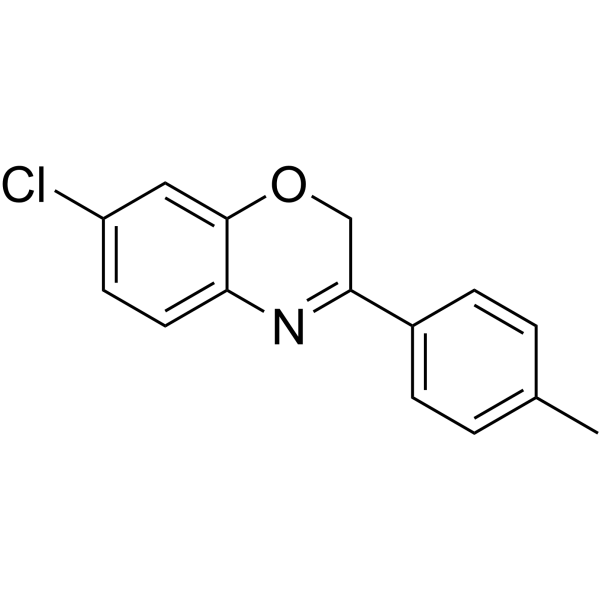
AR7 is an atypical RARA/RARα (retinoic acid receptor, alpha) antagonist. AR7 specifically activates chaperone-mediated-autophagy (CMA) activity without affecting macroautophagy .
loading...
    loading...
4
4 Cited Publications
Cat. No.: HY-112698
CAS No.: 1370032-19-1
Purity:  99.14%
Research Areas:  

Cancer

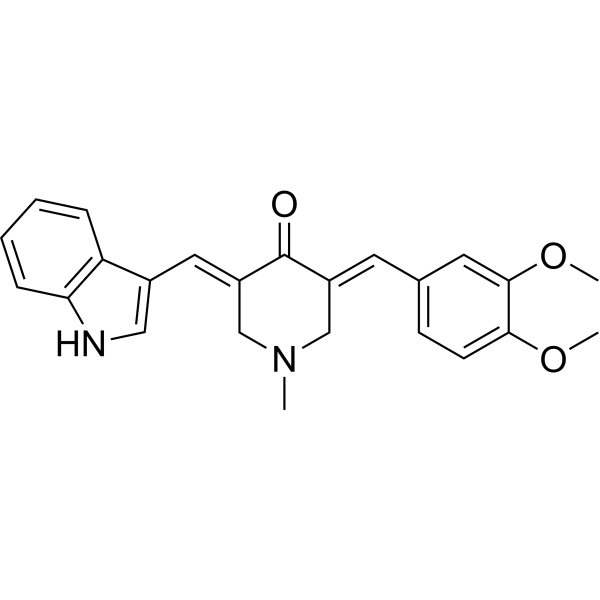
CA-5f is a potent late-stage macroautophagy/autophagy inhibitor via inhibiting autophagosome-lysosome fusion. CA-5f increases LC3B-II (a marker to monitor autophagy) and SQSTM1 protein, and also increases ROS production. Anti-tumor activity .
loading...
    loading...
Cat. No.: HY-161739
CAS No.: 2409960-03-6
Target:  

p62

Research Areas:  

Cancer

YOK-1304 is a ligand of p62-ZZ domain. YOK-1304 can activate p62-dependent selective macroautophagy. YOK-1304 can be used for AUTOTAC design .
loading...
    loading...
Cat. No.: HY-W489121
CAS No.: 774192-20-0
Target:  

p62 Autophagy

Research Areas:  

Cancer

YTK-105 is a p62/ZZ binding domain ligand and Autophagy enhancer. YTK-105 activates p62-dependent selective macroautophagy. YTK-105 serves as an autophagy-targeting ligand (ATL) for synthesizing AUTOTAC degraders .
loading...
    loading...
Cat. No.: HY-161742
CAS No.: 2410081-58-0
Target:  

AUTOTACs MetAP Autophagy p62

Research Areas:  

Cancer

Fumagilin-105 is an autophagy-targeting chimera (AUTOTAC) that degrades MetAP2 via p62-mediated macroautophagy in a ubiquitination-independent manner. Fumagilin-105 can inhibit the migration of tumor cells and induce programmed cell death. Fumagilin-105 has anti-tumor activity. (p62-ZZ ligand (HY-W489121); target-binding ligand (HY-B0751); linker (HY-W245803)) .
loading...
    loading...
Cat. No.: HY-161738
CAS No.: 2409959-99-3
Target:  

p62

Research Areas:  

Cancer

YOK-2204 is a ligand of p62-ZZ domain. YOK-2204 can activate p62-dependent selective macroautophagy. YOK-2204 can be used for AUTOTAC design .
loading...
    loading...
Cat. No.: HY-161737
CAS No.: 892572-23-5
Target:  

p62

Research Areas:  

Cancer

YT-8-8 is a ligand of p62-ZZ domain. YT-8-8 can activate p62-dependent selective macroautophagy. YT-8-8 can be used for AUTOTAC design .
loading...
    loading...
Cat. No.: HY-125465
CAS No.: 2403650-93-9
Target:  

Autophagy

Research Areas:  

Cancer

SLLN-15 is an oral active, selective and potent enhancer of autophagy that activates cytostatic macroautophagy/autophagy in triple-negative breast cancer (TNBC) .
loading...
    loading...
Cat. No.: HY-P10441
CAS No.: 1240687-76-6
Target:  

Peptides

Research Areas:  

Inflammation/Immunology

S-palm P0(180-199) is a polypeptide that increases MHC Class II limiting reactions. S-palm P0(180-199) can be used to establish a model of chronic inflammatory demyelinating multiple radiculopathy (CIDP) .
loading...
    loading...
Cat. No.: HY-101106R
CAS No.: 80306-38-3
Research Areas:  

Neurological Disease Cancer

AR7 (Standard) is the analytical standard of AR7 (HY-101106). This product is intended for research and analytical applications. AR7 is an atypical RARA/RARα (retinoic acid receptor, alpha) antagonist. AR7 specifically activates chaperone-mediated-autophagy (CMA) activity without affecting macroautophagy .
loading...
    loading...
Cat. No.: HY-180188
Target:  

Autophagy

Research Areas:  

Cardiovascular Disease Cancer

F1-ispinesib is a heterobifunctional F1-autophagy degrader, composed of an RNA-binding fragment (F1) and the LC3B ligand Ispinesib (HY-50759). F1-ispinesib induces degradation of COL15A1 mRNA via an LC3B-dependent macroautophagy mechanism. F1-ispinesib inhibits cell proliferation and enhances migration of human aortic smooth muscle cells .
loading...
    loading...
Cat. No.: HY-182269
CAS No.: 2475078-38-5
Research Areas:  

Cancer

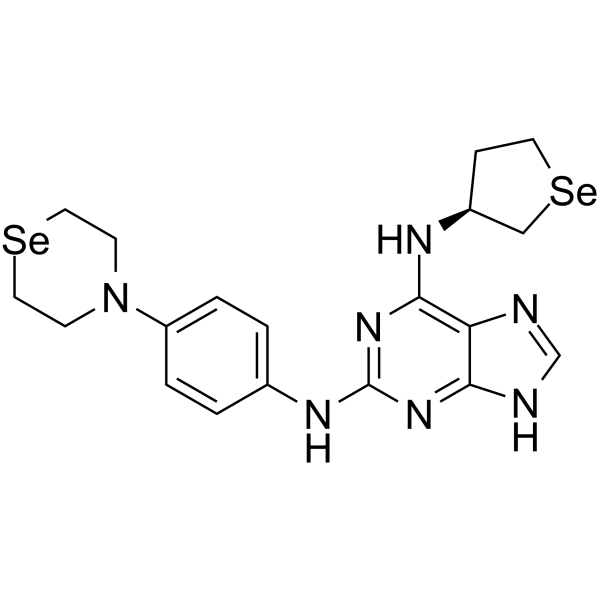
Cathepsin-IN-5 is a cathepsin inhibitor with IC50 values of 6.2 μM and 81 nM for cathepsin L and cathepsin S. Cathepsin-IN-5 inhibits cancer cells proliferation, induces apoptosis, reduces growth of hepatocellular tumors in mouse models, and modulates expression of genes linked to cell death, cell proliferation, and cellular processes. Cathepsin-IN-5 can be used for the research of hepatocellular carcinoma .
loading...
    loading...
  • 1

