12 Results for "

nematocidal

" in MedChemExpress (MCE) Product Catalog:
Products (12)

12 Results for "nematocidal" in MCE Product Catalog:

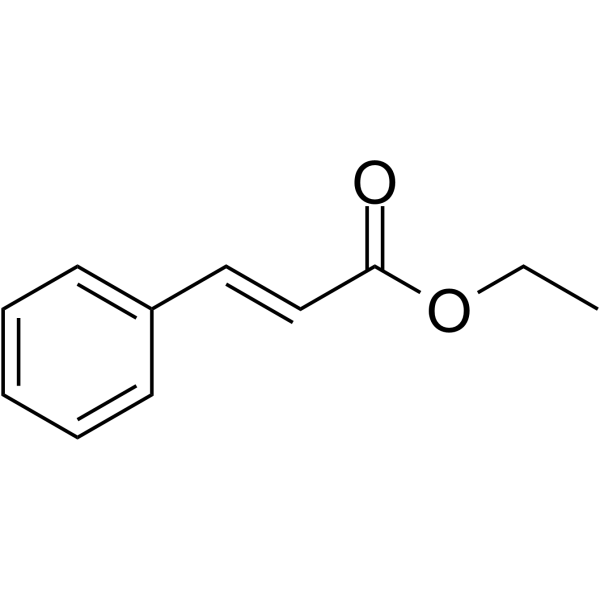
Cat. No.: HY-Y0121
CAS No.: 103-36-6
Ethyl cinnamate, an orally active chemical constituent of the rhizome of Kaempferia galanga, exhibits anti-cancer, nematocidal, sedative and vasorelaxant activities. Ethyl cinnamate is a fragrance ingredient used as a food flavor and additive for cosmetic products. Ethyl cinnamate is also an excellent clearing reagent for mammalian tissues. Ethyl cinnamate suppresses tumor growth through anti-angiogenesis by attenuating VEGFR2 signal pathway in colorectal cancer. Ethyl cinnamate inhibits the tonic contractions induced by high K+ and phenylephrine (PE) with respective IC50 values of 0.30 mM and 0.38 mM in rat aorta .
loading...
    loading...
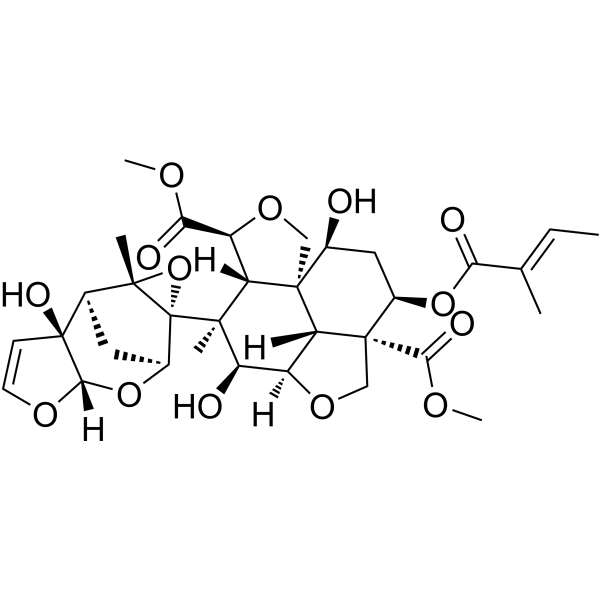
Cat. No.: HY-133108
CAS No.: 106500-25-8
Purity:  99.17%
Azadirachtin B is an limonoid isolated from seed kernels of Azadirachta indica. Azadirachtin B increases alkaline phosphatase (ALP) activity and stimulates osteoblast differentiation. Azadirachtin B is active against the Epstein-Barr virus early antigen (EBV-EA). Azadirachtin B has insecticidal, nematocidal, anticancer, anti-inflammatory, antiviral and osteogenic properties .
loading...
    loading...
Cat. No.: HY-Y0121R
CAS No.: 103-36-6
Ethyl cinnamate (Standard) is the analytical standard of Ethyl cinnamate. This product is intended for research and analytical applications. Ethyl cinnamate, an orally active chemical constituent of the rhizome of Kaempferia galanga, exhibits anti-cancer, nematocidal, sedative and vasorelaxant activities. Ethyl cinnamate is a fragrance ingredient used as a food flavor and additive for cosmetic products. Ethyl cinnamate is also an excellent clearing reagent for mammalian tissues. Ethyl cinnamate suppresses tumor growth through anti-angiogenesis by attenuating VEGFR2 signal pathway in colorectal cancer. Ethyl cinnamate inhibits the tonic contractions induced by high K+ and phenylephrine (PE) with respective IC50 values of 0.30 mM and 0.38 mM in rat aorta .
loading...
    loading...
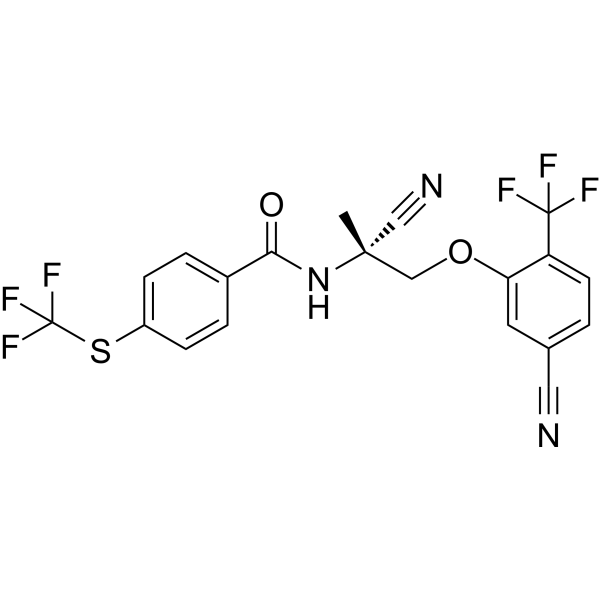
Cat. No.: HY-W756217
CAS No.: 887148-70-1
Synonyms: (R)-AAD1566
Target:  

nAChR

Research Areas:  

Others

(R)-Monepantel (AAD2224) is the optical R-enantiomer of monepantel. (R)-Monepantel has no nematocidal effect, is inactive .
loading...
    loading...
Cat. No.: HY-N8504
CAS No.: 59795-94-7
Synonyms: NSC 260179; Spectinabilin
Target:  

Bacterial

Research Areas:  

Infection

Neoaureothin is a bacterial metabolite that has been found in Streptomyces. It is an androgen receptor (AR) antagonist that inhibits binding of dihydrotestosterone (DHT) to ARs (IC50=13 μM) and inhibits DHT-induced expression of prostate-specific antigen in LNCaP cells (IC50=1.75 nM). Neoaureothin is cytotoxic to A549, HCT116, and HepG2 cells (IC50s=34.3, 47, and 37.2 μg/mL, respectively). It also has nematocidal activity against the pine wood nematode B. xylophilus (LC50=0.84 μg/mL) and increases survival of P. densiflora trees inoculated with B. xylophilus.
loading...
    loading...
Cat. No.: HY-N14784
CAS No.: 161815-17-4
Dechloromycorrhizin A is an antibiotic with weak activity against Gram-positive bacteria, yeasts and mildew, and strong nematocidal activity .
loading...
    loading...
Cat. No.: HY-N15098
CAS No.: 125602-42-8
Category:  

Microorganisms Antibiotics

Target:  

Parasite

Milbemycin α15 possess a potent antiparasitic activity, including acaricidal, insecticidal and nematocidal activities .
loading...
    loading...
Cat. No.: HY-130423R
CAS No.: 51596-10-2
Research Areas:  

Infection

Milbemycin A3 (Standard) is the analytical standard of Milbemycin A3 (HY-130423). This product is intended for research and analytical applications. Milbemycin A3 is a 16-membered macrocyclic lactone compound found in the soil bacterium Saccharopolyspora hygroscopicus subsp. aureolacrimosus. Milbemycin A3 enhances the opening of glutamate- and GABA-gated chloride channels and exhibits insecticidal activity. Milbemycin A3 can be used in insect resistance-related research .
loading...
    loading...
Cat. No.: HY-123265
CAS No.: 22388-89-2
Synonyms: Griseulin
Category:  

Microorganisms

Target:  

Bacterial

Luteoreticulin is a nitro-containing bacterial metabolite originally isolated from S. luteoreticuli. It has mosquitocidal activity against A. aegypti when used at a concentration of 6.25 mg/L and nematocidal activity against C. elegans.
loading...
    loading...
Cat. No.: HY-121003
CAS No.: 17398-00-4
Target:  

Fungal Parasite

Research Areas:  

Infection

Aspyrone is a polyketide fungal metabolite that has been found in Aspergillus and has diverse biological activities. It is active against a panel of 13 fungi when used at a concentration of 20 μg/mL and a panel of 21 bacteria in a disc assay when used at a concentration of 100 μg per disc.1 Aspyrone (10-1,000 mg/L) is nematocidal against P. penetrans.
loading...
    loading...
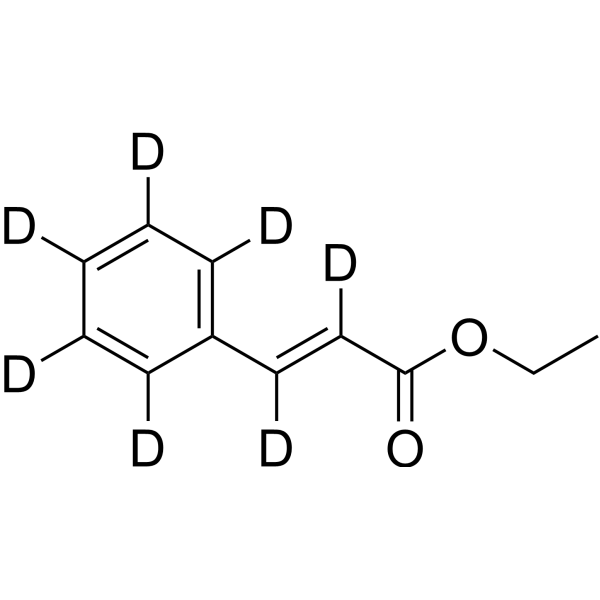
Cat. No.: HY-Y0121S1
CAS No.: 1336882-58-6
Ethyl cinnamate-d7 is deuterated labeled Ethyl cinnamate (HY-Y0121). Ethyl cinnamate, an orally active chemical constituent of the rhizome of Kaempferia galanga, exhibits anti-cancer, nematocidal, sedative and vasorelaxant activities. Ethyl cinnamate is a fragrance ingredient used as a food flavor and additive for cosmetic products. Ethyl cinnamate is also an excellent clearing reagent for mammalian tissues. Ethyl cinnamate suppresses tumor growth through anti-angiogenesis by attenuating VEGFR2 signal pathway in colorectal cancer. Ethyl cinnamate inhibits the tonic contractions induced by high K+ and phenylephrine (PE) with respective IC50 values of 0.30 mM and 0.38 mM in rat aorta .
loading...
    loading...
Cat. No.: HY-126638
CAS No.: 75731-43-0
Synonyms: NSC 324645
Marcfortine A is an indole alkaloid originally isolated from P. roqueforti. It has nematocidal activity against the parasitic nematode H. contortus (LD99=0.06 μg/mL) and inhibits motility of adult worms (EC50=2 μM). Marcfortine A eliminates H. contortus, T. colubriformis, and O. ostertagi from experimentally infected jirds (ED95s=0.33, 0.11, and 2.5 mg/animal, respectively). It dose-dependently inhibits nicotine-induced calcium mobilization in SH-SY5Y and TE-671 cells expressing α3 subunit-containing human nicotinic acetylcholine receptors (nAChRs) and muscle-type nAChRs, respectively.
loading...
    loading...
  • 1

