10 Results for "

patch-clamp electrophysiology

" in MedChemExpress (MCE) Product Catalog:
Products (10)

10 Results for "patch-clamp electrophysiology" in MCE Product Catalog:

4
4 Cited Publications
Cat. No.: HY-122560
CAS No.: 755002-90-5
Target:  

Potassium Channel

Research Areas:  

Cardiovascular Disease

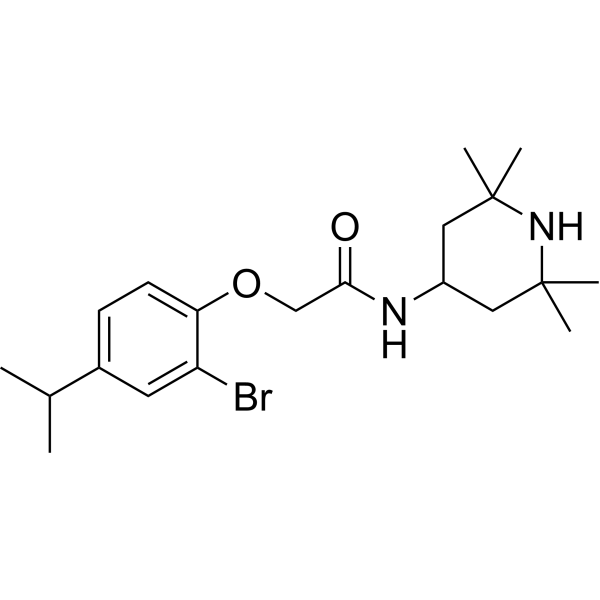
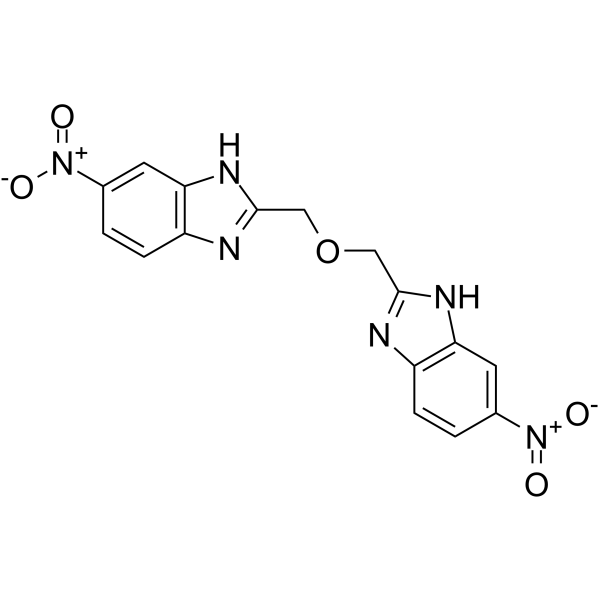
VU0134992 is the first subtype-preferring, orally active and selective Kir4.1 potassium channel pore blocker, with an IC50 of 0.97 µM. VU0134992 is 9-fold selective for homomeric Kir4.1 over Kir4.1/5.1 concatemeric channels (IC50=9 µM) at -120 mV .
loading...
    loading...
4
4 Cited Publications
Cat. No.: HY-122560A
CAS No.: 1052515-91-9
Purity:  98.34%
Target:  

Potassium Channel

Research Areas:  

Cardiovascular Disease

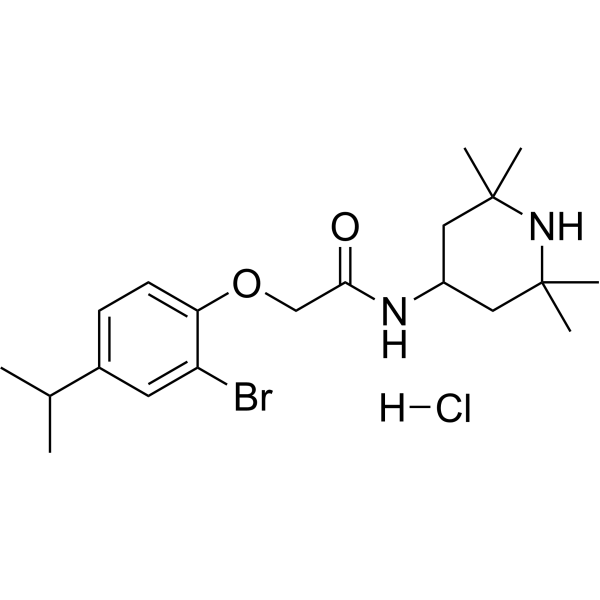
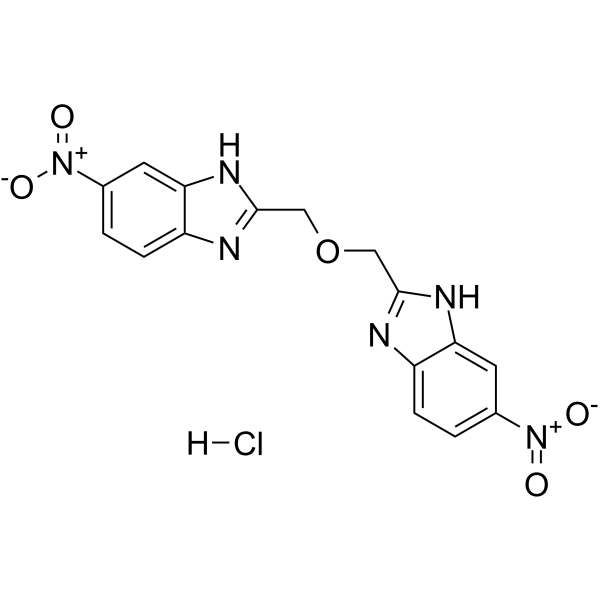
VU0134992 hydrochloride is the first subtype-preferring, orally active and selective Kir4.1 potassium channel pore blocker, with an IC50 of 0.97 µM. VU0134992 hydrochloride is 9-fold selective for homomeric Kir4.1 over Kir4.1/5.1 concatemeric channels (IC50=9 µM) at -120 mV .
loading...
    loading...
2
2 Cited Publications
Cat. No.: HY-18600A
CAS No.: 149888-94-8
Synonyms: NE-10064 dihydrochloride
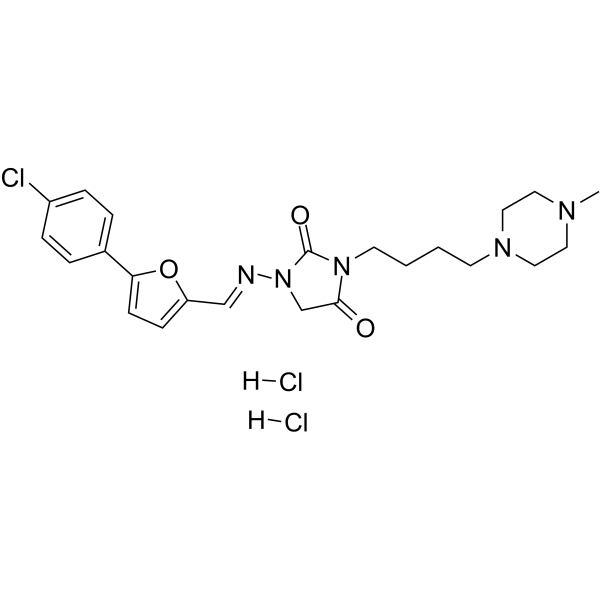
Azimilide (NE-10064) dihydrochloride is a class III antiarrhythmic agent, which works by blocking potassium channels in the heart. Azimilide dihydrochloride is a dual blocker of IKs (IC50 = 2.6 μM (2mM [K⁺]ₑ)) and IKr (IC50 = 1 μM (4 mM [K⁺])). Azimilide dihydrochloride blocked HERG channel at 0.1 and 1 Hz with IC50s of 1.4 μM and 5.2 μM respectively. Azimilide dihydrochloride also inhibits L-type calcium current (ICa) (IC50 = 17.8 μM) and sodium current (INa) (IC50 = 19 μM). Azimilide dihydrochloride can be used for the study of atrial fibrillation and ventricular fibrillation .
loading...
    loading...
2
2 Cited Publications
Cat. No.: HY-18600
CAS No.: 149908-53-2
Synonyms: NE-10064
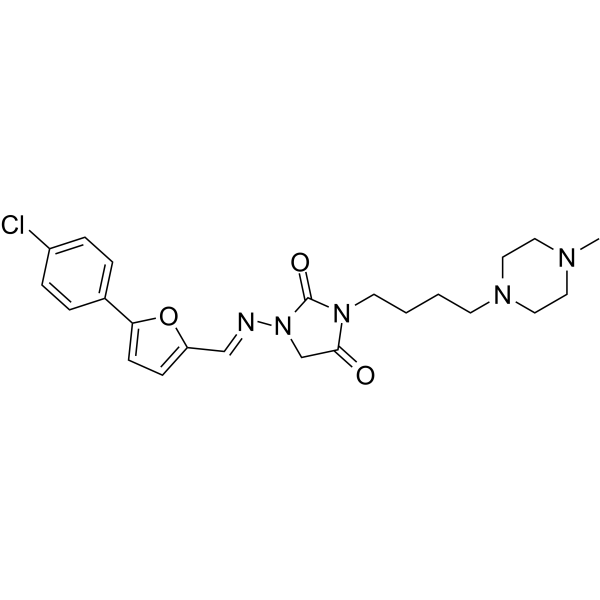
Azimilide (NE-10064) is a class III antiarrhythmic agent, which works by blocking potassium channels in the heart. Azimilide is a dual blocker of IKs (IC50 = 2.6 μM (2mM [K⁺]ₑ)) and IKr (IC50 = 1 μM (4 mM [K⁺])). Azimilide blocked HERG channel at 0.1 and 1 Hz with IC50s of 1.4 μM and 5.2 μM respectively. Azimilide also inhibits L-type calcium current (ICa) (IC50 = 17.8 μM) and sodium current (INa) (IC50 = 19 μM). Azimilide can be used for the study of atrial fibrillation and ventricular fibrillation .
loading...
    loading...
Cat. No.: HY-108585A
CAS No.: 1222810-74-3
Purity:  98.81%
Target:  

Potassium Channel

Research Areas:  

Neurological Disease

VU591 is a selective inhibitor of the renal outer medullary potassium channel (ROMK, Kir1.1). VU591 inhibits ROMK via binding to the intracellular pore region near residues Val168 and Asn171, with IC50 of 240 nM in Tl + flux assay and 300 nM in whole cell patch clamp electrophysiology, suppresses native ROMK mediated K + secretion in isolated perfused rat collecting ducts, and exerts antidepressive effects in the mouse tail suspension test (TST). VU591 can be used for the study of ROMK channel function, renal potassium handling, antidepressant mechanisms, and diuretic drug discovery .
loading...
    loading...
Cat. No.: HY-108585
CAS No.: 1315380-70-1
Purity:  98.02%
Target:  

Potassium Channel

Research Areas:  

Neurological Disease

VU591 hydrochloride is a selective inhibitor of the renal outer medullary potassium channel (ROMK, Kir1.1). VU591 hydrochloride inhibits ROMK via binding to the intracellular pore region near residues Val168 and Asn171, with IC50 of 240 nM in Tl + flux assay and 300 nM in whole cell patch clamp electrophysiology, suppresses native ROMK mediated K + secretion in isolated perfused rat collecting ducts, and exerts antidepressive effects in the mouse tail suspension test (TST). VU591 hydrochloride can be used for the study of ROMK channel function, renal potassium handling, antidepressant mechanisms, and diuretic drug discovery .
loading...
    loading...
Cat. No.: HY-114540
CAS No.: 185855-91-8
Research Areas:  

Neurological Disease

CP-339818 is a non-peptide Kv1.3 channel (IC50 = 200 nM) and Kv1.4 channel blocker. CP 339818 inhibits HCN channel with IC50s of 18.9 μM and 43.4 μM against HCN1 and HCN4 (high Cl -). CP-339818 has significantly weaker blocking effects on Kv1.1, Kv1.2, Kv1.5, Kv1.6, Kv3.1-4, and Kv4.2 channels. CP-339818 selectively blocked Kv1.3, thereby inhibiting the activation process of human T cells. CP-339818 can be used to study the physiological functions of HCN and Kv channels .
loading...
    loading...
Cat. No.: HY-184582
Target:  

Potassium Channel

Research Areas:  

Neurological Disease

Kv3.1 activator-2 is a Kv3.1 voltage-gated potassium channel (potassium channel) activator with concentration-dependent activity. Kv3.1 activator-2 opens Kv3.1 potassium channels, increases channel current amplitude, and exerts a positive channel activation effect. Kv3.1 activator-2 can be used in the research of neurological diseases .
loading...
    loading...
Cat. No.: HY-184663
Target:  

Potassium Channel

Research Areas:  

Neurological Disease

Kv3.1 activator-1 is a Kv3.1 voltage-gated potassium channel activator. Kv3.1 activator-1 exhibits distinct activating efficacy in both thallium flux assays and automated patch-clamp electrophysiological assays .
loading...
    loading...
Cat. No.: HY-D3480
BeRST voltage sensitive dye is a silicon-rhodamine-based voltage-sensitive dye that serves as a membrane potential indicator, featuring fast response kinetics, high sensitivity, photostability, and excellent signal-to-noise ratio. BeRST voltage sensitive dye relies on the photoinduced electron transfer (PeT) mechanism to report changes in neuronal membrane potential via fluorescent signals. BeRST voltage sensitive dye localizes to the extracellular surface of neuronal plasma membranes, including cell bodies and neurites. BeRST voltage sensitive dye can be used in studies related to Alzheimer's disease (Ex/Em = 658/683 nm) .
loading...
    loading...

