1. Search Result
Search Result
Results for "

sorghum

" in MedChemExpress (MCE) Product Catalog:

12

Inhibitors & Agonists

6

Natural
Products

Cat. No. Product Name Target Research Areas Chemical Structure
  • HY-129997
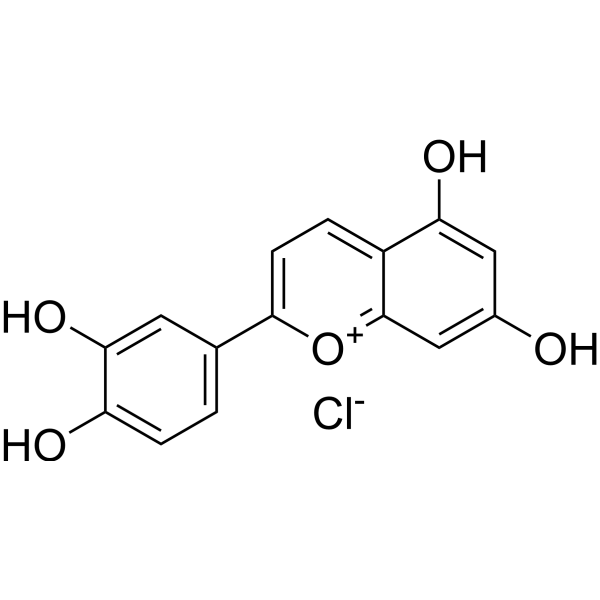
    Luteolinidin chloride
    1 Publications Verification

    CD38 NADPH Oxidase Tyrosinase Cardiovascular Disease
    Luteolinidin chloride is a deoxyanthocyanidin isolated from the plant Sorghum bicolor with antioxidant activity. Luteolinidin chloride is a potent CD38 inhibitor (Ki=11.4 μM) and protects the heart from ischemia/reperfusion injury by preserving endothelial nitric oxide synthase (eNOS) function and preventing endothelial dysfunction. Luteolinidin chloride is also a competitive inhibitor of tyrosinase (IC50=3.7 μM) and blocks the production of melanin .
    Luteolinidin chloride
  • HY-N8433

    Others Others
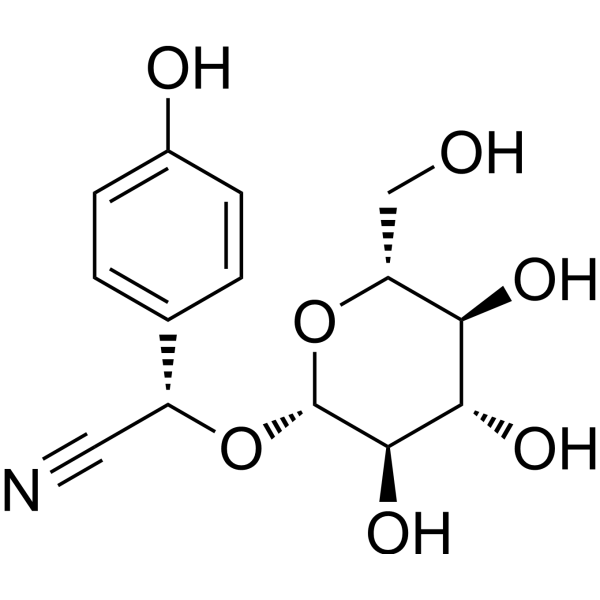
    Dhurrin is a cyanogenic glucoside isolated from Sorghum .
    Dhurrin
  • HY-N15245

    Phytohormone Others
    (+)-Sorgomol is the plants hormone that can be isolated from Sorghum bicolor. (+)-Sorgomol is the germination stimulant for plants, which induces seed germination of root parasites .
    (+)-Sorgomol
  • HY-W681867

    CGA-133205

    Herbicide Glutathione S-transferase Others
    Fluxofenim (CGA-133205) is a herbicide safener, with activity against Pyroxasulfone (HY-136633) and Metolachlor (HY-B1871). Fluxofenim enhances the activity of needle glutathione S-transferase (GST) towards the substrate 1-chloro-2,4-dinitrobenzene (CDNB) .
    Fluxofenim
  • HY-B1882

    Endogenous Metabolite Others
    Propazine is a triazine herbicide that effectively manages broad-leaved weeds and annual grasses in sweet sorghum cultivation.
    Propazine
  • HY-122118

    CP-17029

    Herbicide Others
    Lambast (CP-17029) is a herbicide. Lambast is more toxic to wheat and sorghum than to cucumber .
    Lambast
  • HY-121362R

    Reference Standards Bacterial Endogenous Metabolite Inflammation/Immunology Cancer
    Propazine (Standard) is the analytical standard of Propazine. This product is intended for research and analytical applications. Propazine is a triazine herbicide that effectively manages broad-leaved weeds and annual grasses in sweet sorghum cultivation.
    Evernic Acid (Standard)
  • HY-B1882R

    Endogenous Metabolite Reference Standards Others
    Propazine (Standard) is the analytical standard of Propazine. This product is intended for research and analytical applications. Propazine is a triazine herbicide that effectively manages broad-leaved weeds and annual grasses in sweet sorghum cultivation.
    Propazine (Standard)
  • HY-150033

    Photosystem II Herbicide Others
    Sorgoleone is a photosystem II inhibitor found in sorghum. Sorgoleone binds to the QB niche of the D1 protein, inhibits photosynthetic electron transport, and does not affect photosystem I reactions. Sorgoleone reduces radicle elongation and stunts growth. Sorgoleone inhibits CO2-dependent oxygen evolution, photosynthetic O2 evolution, and mitochondrial respiration. Sorgoleone can be used as a herbicide .
    Sorgoleone
  • HY-185169

    Quicaotong; Quinotrione; Y 13161

    Herbicide Others
    Benquitrione (Quicaotong) is a highly selective herbicide. Benquitrione is used to control several common harmful weeds in sorghum fields .
    Benquitrione
  • HY-N16632

    NO Synthase Inflammation/Immunology
    1-O-Caffeoylglycerol is a compound with anti-inflammatory activity found in Sorghum bicolor. 1-O-Caffeoylglycerol significantly inhibits LPS (HY-D1056) induced NO production (IC50 = 18.5 μM) and dose dependently inhibits iNOS protein expression. 1-O-Caffeoylglycerol can be used for research on inflammatory conditions .
    1-O-Caffeoylglycerol
  • HY-167959

    Herbicide Infection
    MCPA-isooctyl is a selective conductive phenoxycarboxylate herbicide and an alternative to 2,4-D Butyl ester (HY-B0867). MCPA-isooctyl effectively controls broadleaf weeds in various crop fields via post-emergence foliar or soil treatment. MCPA-isooctyl is absorbed by the roots, stems and leaves of plants; it is easily metabolized and detoxified in gramineous crops, but difficult to metabolize in dicotyledonous weeds, causing stem and leaf distortion, root deformation, and eventually weed death. When formulated into chitosan nanoparticles, MCPA-isooctyl still significantly inhibits the growth of weeds in wheat fields, and reduces their chlorophyll content and biomass at low doses .
    MCPA-isooctyl

Inquiry Online

Your information is safe with us. * Required Fields.

Salutation


Country or Region *

Applicant Name *


Organization Name *

Department *


Email Address *


Product Name *

Cat. No.


Requested quantity *

Phone Number *


Remarks

Inquiry Online

Inquiry Information

Product Name:
Cat. No.:
Quantity:
MCE Japan Authorized Agent:

