Search Result
Results for "
tissue imaging
" in MedChemExpress (MCE) Product Catalog:
6
Biochemical Assay Reagents
| Cat. No. |
Product Name |
Target |
Research Areas |
Chemical Structure |
-
- HY-145746
-
|
|
Fluorescent Dye
PD-1/PD-L1
|
Inflammation/Immunology
Cancer
|
|
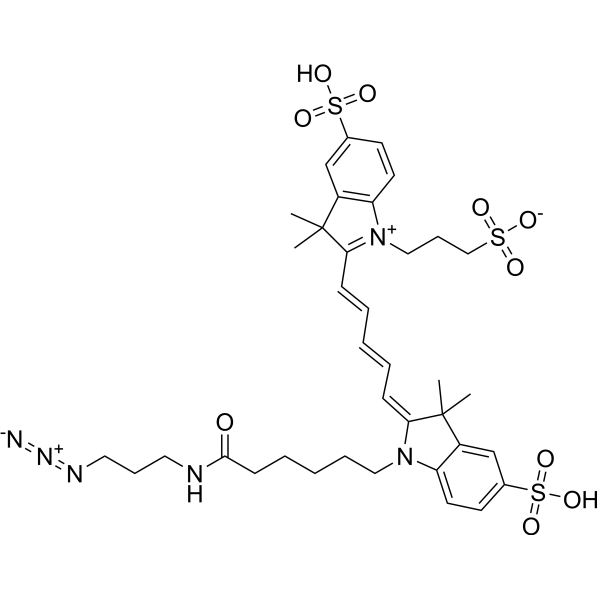
Sulfo-Cy5 azide is a near-infrared fluorescent probe with favorable click chemistry reactivity. Sulfo-Cy5 azide enables fluorescence imaging, tissue and cellular visualization of PD-L1 in tumors, and site-specific modification of anti-PD-L1 antibodies. Sulfo-Cy5 azide has been employed for RNA labeling and imaging. Sulfo-Cy5 azide can be conjugated to targeting agents for fluorescence imaging in atherosclerosis and breast cancer models (Ex/Em = 645/670 nm) .
|
-
-
- HY-D0286
-
|
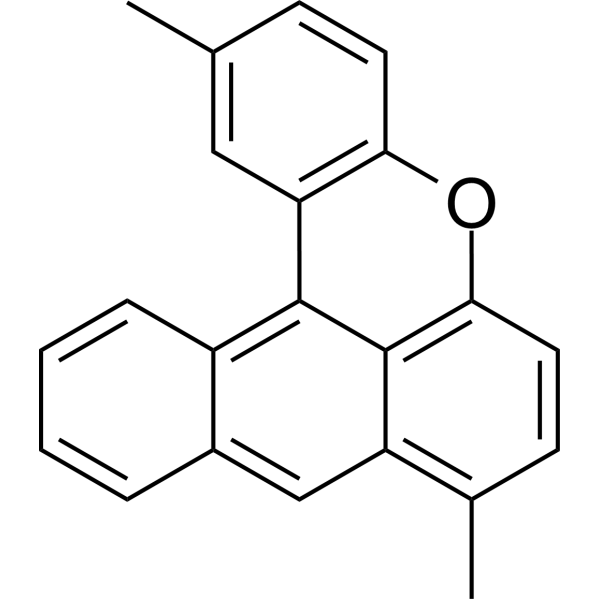
2,8-Dimethylnaphtho[3,2,1-kl]xanthene
|
Fluorescent Dye
|
Others
|
|
Fluorol Yellow 088 is a fluorescent dye that can be used as a biological material or an organic compound for life science research. Fluorol Yellow 088 is suitable for lipid staining in plant tissues, particularly for the fluorescence imaging of suberized cell walls and hydrophobic structures, with an excitation wavelength of 365 nm and an emission wavelength of ≥420 nm .
|
-
-
- HY-P4154
-
|
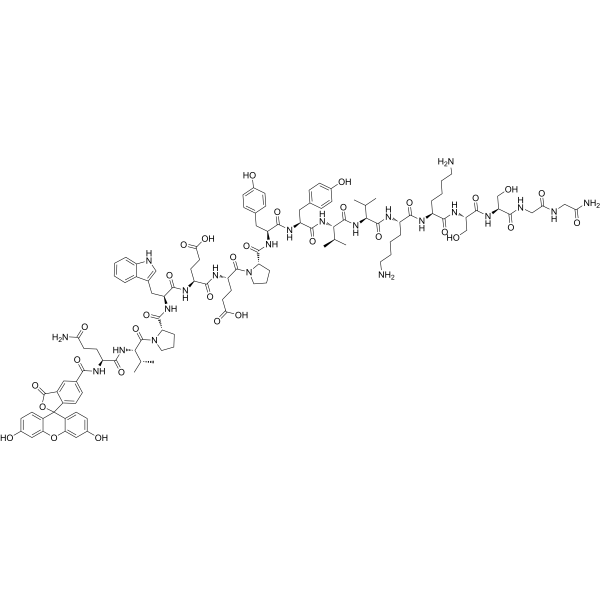
ALM-488
|
Fluorescent Dye
|
Neurological Disease
Cancer
|
|
Bevonescein (ALM-488) is a fluorescein-conjugated peptide that facilitates the targeted delivery of a fluorescent moiety (5-FAM (HY-66022)) to nerves after intravenous (IV) administration. Bevonescein binds nerve-associated connective tissue, labels peripheral nerves under real-time fluorescence imaging (FL) in living mice and human ex vivo nerve tissue. Bevonescein is a peptide-linked tracer which fluorescently labeled both intact and degenerated nerves (Ex/Em = 480/530 nm) .
|
-
-
- HY-139401
-
|
|
FAP
|
Cancer
|
|
FAPI-34 is a SPECT imaging agent targeting FAP. FAPI-34 specifically binds to FAP, is highly internalized by FAP-expressing cells, accumulates in FAP-expressing tumor lesions, and shows low uptake in normal tissues except the kidneys. FAPI-34 is applicable for tumor-related research .
|
-
-
- HY-P10943
-
|
|
Fluorescent Dye
|
Inflammation/Immunology
Cancer
|
|
APO-15 is a phosphatidylserine-binding fluorescent probe and apoptosis imaging reagent. APO-15 exhibits high chemical stability under proteolytic and oxidative conditions, enables quantification and imaging of drug-induced apoptosis in preclinical mouse models, and is applicable to fixed tissue samples and multiple in vivo administration routes (Ex = 488 nm; Em = 525 nm). APO-15 can be used in studies related to acute lung injury and breast cancer .
|
-
-
- HY-D1719A
-
|
|
Fluorescent Dye
|
Cancer
|
|
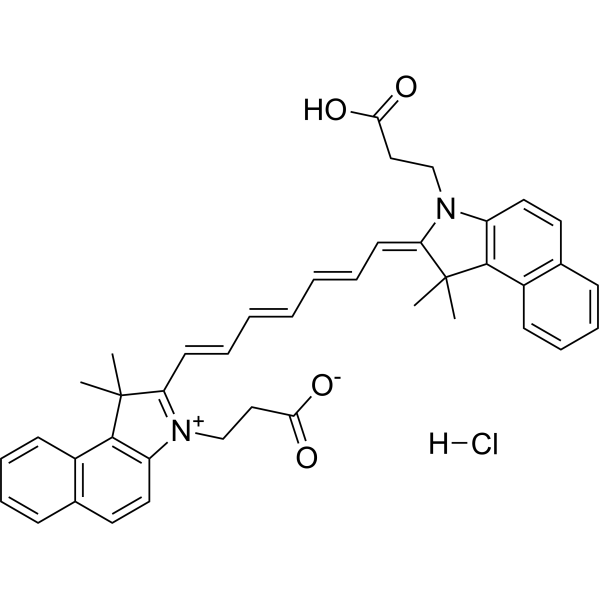
Cypate is a near-infrared fluorescent dye that belongs to the family of photosensitizers. Cypate has high photostability and optical properties, and is often used in near-infrared optical imaging, as well as optical imaging, tumor marking, and drug delivery. In addition, Cypate is also used as a molecular probe and combined with targeting molecules (such as CBT or small interfering RNA) to achieve efficient detection and imaging of specific cells or tissues .
|
-
-
- HY-109540
-
|
AF-0150
|
Heme Oxygenase (HO)
Interleukin Related
|
Inflammation/Immunology
|
|
Perfluorohexane (AF-0150) is a perfluorocarbon. Perfluorohexane is also an enhancer of high-intensity focused ultrasound (HIFU) therapy. Perfluorohexane increases HO-1 and IL-10. Perfluorohexane exerts an antioxidant effect. Perfluorohexane alleviates lung injury induced by LPS (HY-D1056A1). Perfluorohexane improves the efficiency and precision of HIFU and reduces damage to surrounding normal tissues. Perfluorohexane can be used in the study of acute lung injury .
|
-
-
- HY-D1537
-
|
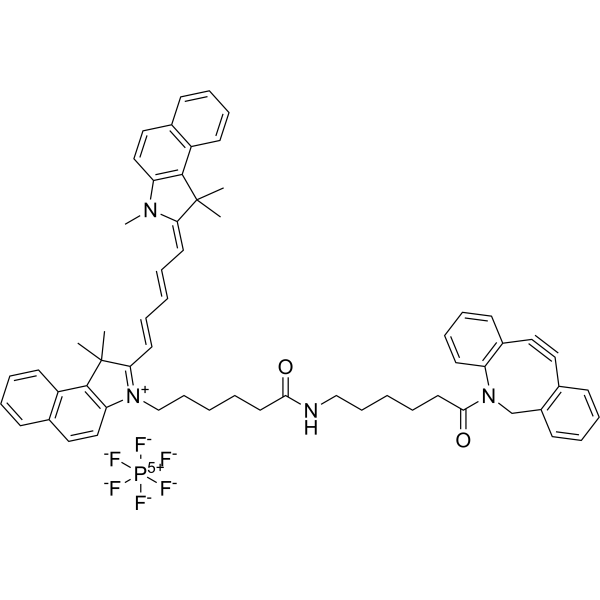
DBCO-Cy5.5; Cyanine5.5 DBCO
|
Fluorescent Dye
|
Others
|
|
Dibenzocyclooctyne-Cy5.5 (DBCO-Cy5.5) is a fluorescent dye. Dibenzocyclooctyne-Cy5.5 can be used to syntheses calcium-binding near-infrared fluorescent nanoprobe for bone tissue imaging .
|
-
-
- HY-D2640
-
|
|
Fluorescent Dye
|
Others
|
|
Cy5 HA (MW 5000) is a hyaluronic acid labeled with CY5 (HY-D0821). Cy5 HA (MW 5000) is widely used for cell imaging and in vivo imaging of shallow tissue (Ex/Em = 633/670 nm).
|
-
-
- HY-D2344
-
|
3-Benzothiazole-daphnetin
|
Fluorescent Dye
|
Others
|
|
3-BTD (3-Benzothiazole-daphnetin) is a Catechol-O-methyltransferase (COMT) two-photon fluorescence probe. 3-BTD can also be used for biological imaging of endogenous COMT in living cells and tissue sections .
|
-
-
- HY-D2647
-
|
|
Fluorescent Dye
|
Others
|
|
Cy5 HA (MW 500000) is a hyaluronic acid labeled with CY5 (HY-D0821). Cy5 HA (MW 500000) is widely used for cell imaging and in vivo imaging of shallow tissue (Ex/Em = 633/670 nm).
|
-
-
- HY-148796
-
|
GE3126
|
Fluorescent Dye
|
Others
|
|
Rizedisben (GE3126) is a fluorophore that can be used in fluorescence image-guided surgery. Rizedisben reduces non-specific adipose tissue fluorescence intensity and enhances nerve visibility .
|
-
-
- HY-D1275
-
|
|
Fluorescent Dye
|
Others
|
|
CAY10731 (compound 3) is a highly selective fluorescent probe for detection of hydrogen sulfide (H2S). CAY10731 is used to monitor exo- and endogenous H2S in both cancer and normal cells. CAY10731 is applied for imaging of H2S in living tissues at variable depths and in nematodes .
|
-
-
- HY-D2645
-
|
|
Fluorescent Dye
|
Others
|
|
Cy5 HA (MW 100000) is a hyaluronic acid labeled with CY5 (HY-D0821). Cy5 HA (MW 100000) is widely used for cell imaging and in vivo imaging of shallow tissue (Ex/Em = 633/670 nm).
|
-
-
- HY-D2638
-
|
|
Fluorescent Dye
|
Others
|
|
Cy5 HA (MW 3000) is a hyaluronic acid labeled with CY5 (HY-D0821). Cy5 HA (MW 3000) is widely used for cell imaging and in vivo imaging of shallow tissue (Ex/Em = 633/670 nm).
|
-
-
- HY-D2994
-
|
SNAP-MaP555
|
Fluorescent Dye
|
Others
|
|
SPY555-BG (SNAP-MaP555) is the benzylguanine derivative of SPY555 fluorophore. SPY555-BG emits light in the orange part of the UV-ViS spectrum. SPY555-BG is fluorogenic, highly cell permeable and well suited for STED and SIM superresolution imaging. SPY555-BG can be imaged with a standard Cy3 filterset. SPY555-BG can be used for widefield, confocal, SIM or STED imaging in living or fixed cells and tissue .
|
-
-
- HY-D2642
-
|
|
Fluorescent Dye
|
Others
|
|
Cy5 HA (MW 10000) is a hyaluronic acid labeled with CY5 (HY-D0821). Cy5 HA (MW 10000) is widely used for cell imaging and in vivo imaging of shallow tissue (Ex/Em = 633/670 nm).
|
-
-
- HY-D2624
-
|
|
Fluorescent Dye
|
Others
|
|
Cy3 HA (MW 10000) is a hyaluronic acid labeled with CY3 (HY-D0822). Cy3 HA (MW 10000) is widely used for cell imaging and in vivo imaging of shallow tissue (Ex/Em = 550/570 nm).
|
-
-
- HY-D2625
-
|
|
Fluorescent Dye
|
Others
|
|
Cy3 HA (MW 50000) is a hyaluronic acid labeled with CY3 (HY-D0822). Cy3 HA (MW 50000) is widely used for cell imaging and in vivo imaging of shallow tissue (Ex/Em = 550/570 nm).
|
-
-
- HY-D2646
-
|
|
Fluorescent Dye
|
Others
|
|
Cy5 HA (MW 200000) is a hyaluronic acid labeled with CY5 (HY-D0821). Cy5 HA (MW 200000) is widely used for cell imaging and in vivo imaging of shallow tissue (Ex/Em = 633/670 nm).
|
-
-
- HY-D2676
-
|
|
Fluorescent Dye
|
Others
|
|
Cy7 HA (MW 3000) is a hyaluronic acid labeled with CY7 (HY-D0825). Cy7 HA (MW 3000) is widely used for cell imaging and in vivo imaging of shallow tissue (Ex/Em = 740/770 nm).
|
-
-
- HY-D2653
-
|
|
Fluorescent Dye
|
Others
|
|
Cy5 HA biotin 3000 is a biotinylated hyaluronic acid labeled with CY5 (HY-D0821). Cy5 HA biotin 3000 is widely used for cell imaging and in vivo imaging of shallow tissues (Ex/Em = 633/670 nm).
|
-
-
- HY-NP071
-
|
LEL
|
Biochemical Assay Reagents
|
Others
|
|
Lycopersicon esculentum (Tomato) Lectin (LEL) specifically recognizes and binds to sugar structures, that combines with fluorescein for fluorescent labeling and imaging of cells and tissues. Lycopersicon esculentum (Tomato) Lectin is used to visualizes the vasculature within transplanted tissues by labeling with fluorescein .
|
-
-
- HY-D2663
-
|
|
Fluorescent Dye
|
Others
|
|
Cy5.5 HA (MW 500000) is a hyaluronic acid labeled with CY5.5 (HY-D0924). Cy5.5 HA (MW 200000) is widely used for cell imaging and in vivo imaging of shallow tissue (Ex/Em = 680/710 nm).
|
-
-
- HY-D2671
-
|
|
Fluorescent Dye
|
Others
|
|
Cy5.5 HA biotin 10000 is a biotinylated hyaluronic acid labeled with CY5.5 (HY-D0924). Cy5.5 HA biotin 10000 is widely used for cell imaging and in vivo imaging of shallow tissues (Ex/Em = 680/710 nm).
|
-
-
- HY-112636
-
|
|
Amyloid-β
|
Others
|
|
Astrophloxine is a fluorescent imaging probe capable of targeting antiparallel dimers. Astrophloxine can be used to detect aggregated Aβ in brain tissue and cerebrospinal fluid samples of Alzheimer's disease (AD) mice .
|
-
-
- HY-P10012
-
|
GYK-DTPA
|
Biochemical Assay Reagents
Radionuclide-Drug Conjugates (RDCs)
|
Cancer
|
|
Pendetide is a chelating agent, can be conjugated with Indium (111In) Capromab for further diagnostic use. Capromab pendetide is a FDA-approved imaging agent for the detection of soft tissue metastases in prostate carcinoma . Pendetide can be used for the synthesis/research of Radionuclide-Drug Conjugates (RDCs).
|
-
-
- HY-150970
-
|
|
Pyroptosis
|
Cancer
|
|
ICy-OH, an iodinated photosensitizer, is an effective anticancer agent. ICy-OH can be used not only for deep tissue imaging (λex=640 nm,λem=690-740 nm) but also to selectively induce cell death in pancreatic cancer cells via cell pyroptosis pathway .
|
-
-
- HY-160064
-
|
|
DNA Alkylator/Crosslinker
|
Cancer
|
|
SW1-A aptamer sodium is an optimized aptamer based on SW1 aptamer (HY-160063) that specifically targets liver cancer SMMC-7721 cells (Kd: 133.73 nM). SW1-A aptamer maintains strong affinity to liver cancer tissues and cells .
|
-
-
- HY-160063
-
|
|
Fluorescent Dye
DNA Alkylator/Crosslinker
|
Cancer
|
|
SW1 aptamer sodium is a high-affinity DNA aptamer (Kd: 123.62 nM) that targets liver cancer SMMC-7721 cells and targets intracellular components within the nucleus. SW1 aptamer sodium can also identify various other types of cancer cells and tissues, serving as an effective molecular probe for clinical cancer diagnosis .
|
-
-
- HY-D2621
-
|
|
Fluorescent Dye
|
Others
|
|
Cy3 HA (MW 5000) is a hyaluronic acid labeled with CY3 (HY-D0822). Cy3 HA (MW 5000) is widely used for cell imaging and in vivo imaging of shallow tissue (Ex/Em = 550/570 nm).
|
-
-
- HY-D2641
-
|
|
Fluorescent Dye
|
Others
|
|
Cy5 HA (MW 7000) is a hyaluronic acid labeled with CY5 (HY-D0821). Cy5 HA (MW 7000) is widely used for cell imaging and in vivo imaging of shallow tissue (Ex/Em = 633/670 nm).
|
-
-
- HY-D2677
-
|
|
Fluorescent Dye
|
Others
|
|
Cy7 HA (MW 100000) is a hyaluronic acid labeled with CY7 (HY-D0825). Cy7 HA (MW 100000) is widely used for cell imaging and in vivo imaging of shallow tissue (Ex/Em = 740/770 nm).
|
-
-
- HY-D2675
-
|
|
Fluorescent Dye
|
Others
|
|
Cy7 HA (MW 10000) is a hyaluronic acid labeled with CY7 (HY-D0825). Cy7 HA (MW 10000) is widely used for cell imaging and in vivo imaging of shallow tissue (Ex/Em = 740/770 nm).
|
-
-
- HY-D2643
-
|
|
Fluorescent Dye
|
Others
|
|
Cy5 HA (MW 50000) is a hyaluronic acid labeled with CY5 (HY-D0821). Cy5 HA (MW 50000) is widely used for cell imaging and in vivo imaging of shallow tissue (Ex/Em = 633/670 nm).
|
-
-
- HY-D2674
-
|
|
Fluorescent Dye
|
Others
|
|
Cy7 HA (MW 7000) is a hyaluronic acid labeled with CY7 (HY-D0825). Cy7 HA (MW 7000) is widely used for cell imaging and in vivo imaging of shallow tissue (Ex/Em = 740/770 nm).
|
-
-
- HY-D2622
-
|
|
Fluorescent Dye
|
Others
|
|
Cy3 HA (MW 3000) is a hyaluronic acid labeled with CY3 (HY-D0822). Cy3 HA (MW 3000) is widely used for cell imaging and in vivo imaging of shallow tissue (Ex/Em = 550/570 nm).
|
-
-
- HY-D2626
-
|
|
Fluorescent Dye
|
Others
|
|
Cy3 HA (MW 100000) is a hyaluronic acid labeled with CY3 (HY-D0822). Cy3 HA (MW 100000) is widely used for cell imaging and in vivo imaging of shallow tissue (Ex/Em = 550/570 nm).
|
-
-
- HY-D2672
-
|
|
Fluorescent Dye
|
Others
|
|
Cy7 HA (MW 3000) is a hyaluronic acid labeled with CY7 (HY-D0825). Cy7 HA (MW 3000) is widely used for cell imaging and in vivo imaging of shallow tissue (Ex/Em = 740/770 nm).
|
-
-
- HY-D2628
-
|
|
Fluorescent Dye
|
Others
|
|
Cy3 HA (MW 500000) is a hyaluronic acid labeled with CY3 (HY-D0822). Cy3 HA (MW 500000) is widely used for cell imaging and in vivo imaging of shallow tissue (Ex/Em = 550/570 nm).
|
-
-
- HY-D2623
-
|
|
Fluorescent Dye
|
Others
|
|
Cy3 HA (MW 7000) is a hyaluronic acid labeled with CY3 (HY-D0822). Cy3 HA (MW 7000) is widely used for cell imaging and in vivo imaging of shallow tissue (Ex/Em = 550/570 nm).
|
-
-
- HY-D2636
-
|
|
Fluorescent Dye
|
Others
|
|
Cy3 HA biotin 5000 is a biotinylated hyaluronic acid labeled with CY3 (HY-D0822). Cy3 HA biotin 5000 is widely used for cell imaging and in vivo imaging of shallow tissues (Ex/Em = 550/570 nm).
|
-
-
- HY-D2637
-
|
|
Fluorescent Dye
|
Others
|
|
Cy3 HA biotin 10000 is a biotinylated hyaluronic acid labeled with CY3 (HY-D0822). Cy3 HA biotin 10000 is widely used for cell imaging and in vivo imaging of shallow tissues (Ex/Em = 550/570 nm).
|
-
-
- HY-D2655
-
|
|
Fluorescent Dye
|
Others
|
|
Cy5 HA biotin 10000 is a biotinylated hyaluronic acid labeled with CY5 (HY-D0821). Cy5 HA biotin 10000 is widely used for cell imaging and in vivo imaging of shallow tissues (Ex/Em = 633/670 nm).
|
-
-
- HY-D2687
-
|
|
Fluorescent Dye
|
Others
|
|
Cy7 HA biotin 5000 is a biotinylated hyaluronic acid labeled with CY7 (HY-D0825). Cy7 HA biotin 5000 is widely used for cell imaging and in vivo imaging of shallow tissues (Ex/Em = 740/770 nm).
|
-
-
- HY-D2654
-
|
|
Fluorescent Dye
|
Others
|
|
Cy5 HA biotin 5000 is a biotinylated hyaluronic acid labeled with CY5 (HY-D0821). Cy5 HA biotin 5000 is widely used for cell imaging and in vivo imaging of shallow tissues (Ex/Em = 633/670 nm).
|
-
-
- HY-D2688
-
|
|
Fluorescent Dye
|
Others
|
|
Cy7 HA biotin 10000 is a biotinylated hyaluronic acid labeled with CY7 (HY-D0825). Cy7 HA biotin 10000 is widely used for cell imaging and in vivo imaging of shallow tissues (Ex/Em = 740/770 nm).
|
-
-
- HY-D2635
-
|
|
Fluorescent Dye
|
Others
|
|
Cy3 HA biotin 3000 is a biotinylated hyaluronic acid labeled with CY3 (HY-D0822). Cy3 HA biotin 3000 is widely used for cell imaging and in vivo imaging of shallow tissues (Ex/Em = 550/570 nm).
|
-
-
- HY-149765
-
|
|
Fluorescent Dye
|
Others
|
|
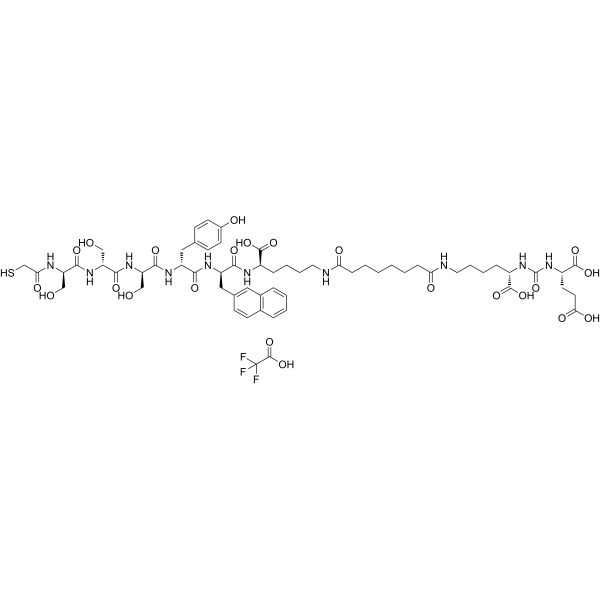
Bone-1064 is a EuK-based PSMA tetramer bone probe for high-contrast visualization of bone in surrounding tissue. Bone-1064 specifically binds hydroxyapatite in bone tissue and can be used for NIR-II fluorescence imaging in animal models .
|
-
-
- HY-D2661
-
|
|
Fluorescent Dye
|
Others
|
|
Cy5.5 HA (MW 100000) is a hyaluronic acid labeled with CY5.5 (HY-D0924). Cy5.5 HA (MW 100000) is widely used for cell imaging and in vivo imaging of shallow tissue (Ex/Em = 680/710 nm).
|
-
- HY-D2689
-
|
|
Fluorescent Dye
|
Others
|
|
Cy7.5 HA (MW 3000) is a hyaluronic acid labeled with CY7.5 (HY-D0926). Cy7.5 HA (MW 3000) is widely used for cell imaging and in vivo imaging of shallow tissue (Ex/Em = 770/820 nm).
|
-
- HY-D2691
-
|
|
Fluorescent Dye
|
Others
|
|
Cy7.5 HA (MW 7000) is a hyaluronic acid labeled with CY7.5 (HY-D0926). Cy7.5 HA (MW 7000) is widely used for cell imaging and in vivo imaging of shallow tissue (Ex/Em = 770/820 nm).
|
-
- HY-D2692
-
|
|
Fluorescent Dye
|
Others
|
|
Cy7.5 HA (MW 10000) is a hyaluronic acid labeled with CY7.5 (HY-D0926). Cy7.5 HA (MW 10000) is widely used for cell imaging and in vivo imaging of shallow tissue (Ex/Em = 770/820 nm).
|
-
- HY-D2656
-
|
|
Fluorescent Dye
|
Others
|
|
Cy5.5 HA (MW 3000) is a hyaluronic acid labeled with CY5.5 (HY-D0924). Cy5.5 HA (MW 3000) is widely used for cell imaging and in vivo imaging of shallow tissue (Ex/Em = 680/710 nm).
|
-
- HY-D2660
-
|
|
Fluorescent Dye
|
Others
|
|
Cy5.5 HA (MW 50000) is a hyaluronic acid labeled with CY5.5 (HY-D0924). Cy5.5 HA (MW 50000) is widely used for cell imaging and in vivo imaging of shallow tissue (Ex/Em = 680/710 nm).
|
-
- HY-D2693
-
|
|
Fluorescent Dye
|
Others
|
|
Cy7.5 HA (MW 50000) is a hyaluronic acid labeled with CY7.5 (HY-D0926). Cy7.5 HA (MW 50000) is widely used for cell imaging and in vivo imaging of shallow tissue (Ex/Em = 770/820 nm).
|
-
- HY-D2657
-
|
|
Fluorescent Dye
|
Others
|
|
Cy5.5 HA (MW 5000) is a hyaluronic acid labeled with CY5.5 (HY-D0924). Cy5.5 HA (MW 5000) is widely used for cell imaging and in vivo imaging of shallow tissue (Ex/Em = 680/710 nm).
|
-
- HY-D2662
-
|
|
Fluorescent Dye
|
Others
|
|
Cy5.5 HA (MW 200000) is a hyaluronic acid labeled with CY5.5 (HY-D0924). Cy5.5 HA (MW 200000) is widely used for cell imaging and in vivo imaging of shallow tissue (Ex/Em = 680/710 nm).
|
-
- HY-D2695
-
|
|
Fluorescent Dye
|
Others
|
|
Cy7.5 HA (MW 200000) is a hyaluronic acid labeled with CY7.5 (HY-D0926). Cy7.5 HA (MW 200000) is widely used for cell imaging and in vivo imaging of shallow tissue (Ex/Em = 770/820 nm).
|
-
- HY-D2690
-
|
|
Fluorescent Dye
|
Others
|
|
Cy7.5 HA (MW 5000) is a hyaluronic acid labeled with CY7.5 (HY-D0926). Cy7.5 HA (MW 5000) is widely used for cell imaging and in vivo imaging of shallow tissue (Ex/Em = 770/820 nm).
|
-
- HY-D2670
-
|
|
Fluorescent Dye
|
Others
|
|
Cy5.5 HA biotin 5000 is a biotinylated hyaluronic acid labeled with CY5.5 (HY-D0924). Cy5.5 HA biotin 5000 is widely used for cell imaging and in vivo imaging of shallow tissues (Ex/Em = 680/710 nm).
|
-
- HY-D2704
-
|
|
Fluorescent Dye
|
Others
|
|
Cy7.5 HA biotin (MW 10000) is a biotinylated hyaluronic acid labeled with CY7.5 (HY-D0926). Cy7.5 HA biotin (MW 10000) is widely used for cell imaging and in vivo imaging of shallow tissues (Ex/Em = 770/820 nm).
|
-
- HY-D2703
-
|
|
Fluorescent Dye
|
Others
|
|
Cy7.5 HA biotin (MW 5000) is a biotinylated hyaluronic acid labeled with CY7.5 (HY-D0926). Cy7.5 HA biotin (MW 5000) is widely used for cell imaging and in vivo imaging of shallow tissues (Ex/Em = 770/820 nm).
|
-
- HY-D2702
-
|
|
Fluorescent Dye
|
Others
|
|
Cy7.5 HA biotin (MW 3000) is a biotinylated hyaluronic acid labeled with CY7.5 (HY-D0926). Cy7.5 HA biotin (MW 3000) is widely used for cell imaging and in vivo imaging of shallow tissues (Ex/Em = 770/820 nm).
|
-
- HY-152102
-
|
|
Fluorescent Dye
|
Cancer
|
|
BTCy is a near-infrared (NIR) fluorescence probe with polarity-responsive and cell plasma membrane-targeting properties. BTCy can be used for in vivo imaging of tumor tissue (λex = 561 nm, λem = 600-700 nm) .
|
-
- HY-D2597
-
|
|
Fluorescent Dye
|
Others
|
|
Cy7.5-PEG2000-biotin is a biotinylated hyaluronic acid labeled with CY7.5 (HY-D0926). Cy7.5-PEG2000-biotin is widely used for cell imaging and in vivo imaging of shallow tissues (Ex/Em=770/820 nm).
|
-
- HY-D2598
-
|
|
Fluorescent Dye
|
Others
|
|
Cy7.5-PEG5000-biotin is a biotinylated hyaluronic acid labeled with CY7.5 (HY-D0926). Cy7.5-PEG5000-biotin is widely used for cell imaging and in vivo imaging of shallow tissues (Ex/Em=770/820 nm).
|
-
- HY-112641
-
|
|
Fluorescent Dye
|
Cancer
|
|
AkaLumine is a D-luciferin (HY-12591A) analogue with a Km of 2.06 μM for recombinant firefly luciferase (Fluc) protein. AkaLumine emits near-infrared (NIR) light (λmax=677 nm) in reactions with native Fluc. AkaLumine has high tissue-penetration and increases detection sensitivity from deep-tissue targets .
|
-
- HY-163545
-
|
|
Drug Derivative
|
Cancer
|
|
Tc-Me2P is a 99MTC-labeled acrylamide (PnAO) derivative that contains two 4-methyl-2-nitroimidazole groups. The primary activity of Tc-Me2P is as an imaging agent for tumor hypoxia. By specifically binding to hypoxic regions in tumor tissue, it can be used for single photon emission computed tomography (SPECT) and positron emission tomography (PET) imaging to detect hypoxia in tumors. Tc-Me2P can be used to study the targeting of different chemical structures in tumors and normal tissues .
|
-
- HY-D2630
-
|
|
Fluorescent Dye
|
Others
|
|
Cy3 HA MA (MW 3000) is a hyaluronic acid methacrylate labeled with CY3 (HY-D0822). Cy3 HA MA (MW 3000) is widely used in the fields of biolabeling and imaging, drug delivery and tissue engineering and regenerative medicine (Ex/Em = 550/570 nm).
|
-
- HY-D2651
-
|
|
Fluorescent Dye
|
Others
|
|
Cy5 HA MA (MW 50000) is a hyaluronic acid methacrylate labeled with CY5 (HY-D0821). Cy5 HA MA (MW 50000) is widely used in the fields of biolabeling and imaging, drug delivery and tissue engineering and regenerative medicine (Ex/Em = 633/670 nm).
|
-
- HY-D2649
-
|
|
Fluorescent Dye
|
Others
|
|
Cy5 HA MA (MW 5000) is a hyaluronic acid methacrylate labeled with CY5 (HY-D0821). Cy5 HA MA (MW 5000) is widely used in the fields of biolabeling and imaging, drug delivery and tissue engineering and regenerative medicine (Ex/Em = 633/670 nm).
|
-
- HY-D2685
-
|
|
Fluorescent Dye
|
Others
|
|
Cy7 HA MA (MW 100000) is a hyaluronic acid methacrylate labeled with CY7 (HY-D0825). Cy7 HA MA (MW 100000) is widely used in the fields of biolabeling and imaging, drug delivery and tissue engineering and regenerative medicine (Ex/Em = 740/770 nm).
|
-
- HY-D2681
-
|
|
Fluorescent Dye
|
Others
|
|
Cy7 HA MA (MW 3000) is a hyaluronic acid methacrylate labeled with CY7 (HY-D0825). Cy7 HA MA (MW 3000) is widely used in the fields of biolabeling and imaging, drug delivery and tissue engineering and regenerative medicine (Ex/Em = 740/770 nm).
|
-
- HY-D2632
-
|
|
Fluorescent Dye
|
Others
|
|
Cy3 HA MA (MW 10000) is a hyaluronic acid methacrylate labeled with CY3 (HY-D0822). Cy3 HA MA (MW 10000) is widely used in the fields of biolabeling and imaging, drug delivery and tissue engineering and regenerative medicine (Ex/Em = 550/570 nm).
|
-
- HY-D2633
-
|
|
Fluorescent Dye
|
Others
|
|
Cy3 HA MA (MW 50000) is a hyaluronic acid methacrylate labeled with CY3 (HY-D0822). Cy3 HA MA (MW 50000) is widely used in the fields of biolabeling and imaging, drug delivery and tissue engineering and regenerative medicine (Ex/Em = 550/570 nm).
|
-
- HY-D2683
-
|
|
Fluorescent Dye
|
Others
|
|
Cy7 HA MA (MW 10000) is a hyaluronic acid methacrylate labeled with CY7 (HY-D0825). Cy7 HA MA (MW 10000) is widely used in the fields of biolabeling and imaging, drug delivery and tissue engineering and regenerative medicine (Ex/Em = 740/770 nm).
|
-
- HY-D2650
-
|
|
Fluorescent Dye
|
Others
|
|
Cy5 HA MA (MW 10000) is a hyaluronic acid methacrylate labeled with CY5 (HY-D0821). Cy5 HA MA (MW 10000) is widely used in the fields of biolabeling and imaging, drug delivery and tissue engineering and regenerative medicine (Ex/Em = 633/670 nm).
|
-
- HY-D2634
-
|
|
Fluorescent Dye
|
Others
|
|
Cy3 HA MA (MW 100000) is a hyaluronic acid methacrylate labeled with CY3 (HY-D0822). Cy3 HA MA (MW 100000) is widely used in the fields of biolabeling and imaging, drug delivery and tissue engineering and regenerative medicine (Ex/Em = 550/570 nm).
|
-
- HY-D2684
-
|
|
Fluorescent Dye
|
Others
|
|
Cy7 HA MA (MW 50000) is a hyaluronic acid methacrylate labeled with CY7 (HY-D0825). Cy7 HA MA (MW 50000) is widely used in the fields of biolabeling and imaging, drug delivery and tissue engineering and regenerative medicine (Ex/Em = 740/770 nm).
|
-
- HY-D2648
-
|
|
Fluorescent Dye
|
Others
|
|
Cy5 HA MA (MW 3000) is a hyaluronic acid methacrylate labeled with CY5 (HY-D0821). Cy5 HA MA (MW 3000) is widely used in the fields of biolabeling and imaging, drug delivery and tissue engineering and regenerative medicine (Ex/Em = 633/670 nm).
|
-
- HY-D2631
-
|
|
Fluorescent Dye
|
Others
|
|
Cy3 HA MA (MW 5000) is a hyaluronic acid methacrylate labeled with CY3 (HY-D0822). Cy3 HA MA (MW 5000) is widely used in the fields of biolabeling and imaging, drug delivery and tissue engineering and regenerative medicine (Ex/Em = 550/570 nm).
|
-
- HY-D2680
-
|
|
Fluorescent Dye
|
Others
|
|
Cy7 HA (MW 200000) is a hyaluronic acid labeled with CY7 (HY-D0825). Cy7 HA (MW 200000) is widely used for cell imaging and in vivo imaging of shallow tissue (Ex/Em = 740/770 nm).
|
-
- HY-D2678
-
|
|
Fluorescent Dye
|
Others
|
|
Cy7 HA (MW 500000) is a hyaluronic acid labeled with CY7 (HY-D0825). Cy7 HA (MW 500000) is widely used for cell imaging and in vivo imaging of shallow tissue (Ex/Em = 740/770 nm).
|
-
- HY-D2627
-
|
|
Fluorescent Dye
|
Others
|
|
Cy3 HA (MW 200000) is a hyaluronic acid labeled with CY3 (HY-D0822). Cy3 HA (MW 200000) is widely used for cell imaging and in vivo imaging of shallow tissue (Ex/Em = 550/570 nm).
|
-
- HY-D2673
-
|
|
Fluorescent Dye
|
Others
|
|
Cy7 HA (MW 55000) is a hyaluronic acid labeled with CY7 (HY-D0825). Cy7 HA (MW 5000) is widely used for cell imaging and in vivo imaging of shallow tissue (Ex/Em = 740/770 nm).
|
-
- HY-D2686
-
|
|
Fluorescent Dye
|
Others
|
|
Cy7 HA biotin 3000 is a biotinylated hyaluronic acid labeled with CY7 (HY-D0825). Cy7 HA biotin 3000 is widely used for cell imaging and in vivo imaging of shallow tissues (Ex/Em = 740/770 nm).
|
-
- HY-D3267
-
|
|
Fluorescent Dye
|
Others
|
|
ACu1 is a copper (I)-selective two-photon fluorescent probe that enables the visual imaging of Cu + distribution in living cells and tissues .
|
-
- HY-D2659
-
|
|
Fluorescent Dye
|
Others
|
|
Cy5.5 HA (MW 10000) is a hyaluronic acid labeled with CY5.5 (HY-D0924). Cy5.5 HA (MW 10000) is widely used for cell imaging and in vivo imaging of shallow tissue (Ex/Em = 680/710 nm).
|
-
- HY-D2658
-
|
|
Fluorescent Dye
|
Others
|
|
Cy5.5 HA (MW 7000) is a hyaluronic acid labeled with CY5.5 (HY-D0924). Cy5.5 HA (MW 7000) is widely used for cell imaging and in vivo imaging of shallow tissue (Ex/Em = 680/710 nm).
|
-
- HY-D2694
-
|
|
Fluorescent Dye
|
Others
|
|
Cy7.5 HA (MW 100000) is a hyaluronic acid labeled with CY7.5 (HY-D0926). Cy7.5 HA (MW 100000) is widely used for cell imaging and in vivo imaging of shallow tissue (Ex/Em = 770/820 nm).
|
-
- HY-D2696
-
|
|
Fluorescent Dye
|
Others
|
|
Cy7.5 HA (MW 500000) is a hyaluronic acid labeled with CY7.5 (HY-D0926). Cy7.5 HA (MW 500000) is widely used for cell imaging and in vivo imaging of shallow tissue (Ex/Em = 770/820 nm).
|
-
- HY-D2669
-
|
|
Fluorescent Dye
|
Others
|
|
Cy5.5 HA biotin 3000 is a biotinylated hyaluronic acid labeled with CY5.5 (HY-D0924). Cy5.5 HA biotin 3000 is widely used for cell imaging and in vivo imaging of shallow tissues (Ex/Em = 680/710 nm).
|
-
- HY-159701A
-
|
|
Drug Intermediate
|
Others
|
|
DBCO-PEG2000-alendronic acid sodium is a PEG linker conjugated with alendronic acid (HY-B0631) and DBCO groups. Alendronic acid possesses bone-targeting properties, enabling strong chelation with calcium ions in bone and hydroxyapatite, and exhibits high specific adsorption on mineralized tissues such as bones and teeth. This compound can be applied to construct bone-targeted drug delivery systems and bone tissue imaging probes.
|
-
- HY-P11590
-
|
|
EGFR
|
Cancer
|
|
WGYRGFYC (WC8) is a selective HER2-targeting peptide that binds specifically to HER2 by mimicking the antigen-binding site of trastuzumab. The DOTA precursor of WGYRGFYC has a KD of 61.20 nM for HER2. WGYRGFYC enables specific and highly sensitive detection of HER2 expression in HER2-positive breast cancer cells and tumor tissues, and monitors the dynamic downregulation of HER2 expression. WGYRGFYC rapidly distributes to target tissues and is efficiently cleared from non-target tissues via the kidneys, generating an ideal tumor-to-background ratio in imaging; it is a component of the PET radiotracer Ga-DOTA-WC8. WGYRGFYC exhibits no significant cytotoxicity in breast cancer cells, and can be used for non-invasive imaging diagnosis and therapeutic efficacy evaluation of HER2-positive breast cancer .
|
-
- HY-P0036D
-
|
|
Drug Derivative
Radionuclide-Drug Conjugates (RDCs)
Somatostatin Receptor
Apoptosis
|
Cancer
|
|
NOTA‑Octreotide is a selective SSTR2‑targeting PET tracer. NOTA‑Octreotide binds specifically to SSTR2 and accumulates in SSTR2‑expressing tissues. NOTA‑Octreotide enables effective imaging of somatostatin receptor‑positive tumors in mice and shows high specific uptake in SSTR2‑expressing organs in healthy rats. NOTA-Octreotide can be used for PET imaging investigation of neuroendocrine tumors. .
|
-
- HY-D2652
-
|
|
Fluorescent Dye
|
Others
|
|
Cy5 HA MA (MW 100000) is a hyaluronic acid methacrylate labeled with CY5 (HY-D0821). Cy5 HA MA (MW 100000) is widely used in the fields of biolabeling and imaging, drug delivery and tissue engineering and regenerative medicine (Ex/Em = 633/670 nm).
|
-
- HY-D2682
-
|
|
Fluorescent Dye
|
Others
|
|
Cy7 HA MA (MW 5000) is a hyaluronic acid methacrylate labeled with CY7 (HY-D0825). Cy7 HA MA (MW 5000) is widely used in the fields of biolabeling and imaging, drug delivery and tissue engineering and regenerative medicine (Ex/Em = 740/770 nm).
|
-
- HY-D3172
-
|
|
Fluorescent Dye
|
Metabolic Disease
|
|
BD-105 is a glucagon-binding fluorescent probe with a Ka value of 13.3 μM. BD-105 exhibits changes in fluorescence intensity upon interaction with glucagon, and colocalizes with glucagon in cells and tissues. BD-105 is a selective cell stain that labels glucagon-secreting cells without staining insulin-secreting cells or non-endocrine control cells. BD-105 serves as an imaging reagent for glucagon in live cells and tissues .
|
-
- HY-D3430
-
|
|
Fluorescent Dye
Amyloid-β
|
Neurological Disease
|
|
PTPA-QM is a low-cytotoxicity Aβ protein probe that can be used for live-cell imaging and tissue section staining (Lys. Ex/Em = 385/615 nm). PTPA-QM can intercalate into the β-sheet layered structure of β-amyloid fibrils, form intermolecular interactions with amino acid residues, restrict intramolecular rotation and trigger fluorescence activation for imaging purposes. PTPA-QM is applicable to Alzheimer's disease-related research. Maximum excitation/emission wavelength: 448/605 nm .
|
-
- HY-D3411
-
|
|
Fluorescent Dye
|
Others
|
|
Rhobo6 is a cell-impermeable glycan-binding, fluorescence turn-on imaging agent with a Kd of 53 µM for glycans. Rhobo6 reversibly binds target glycans and enables wash-free live ECM visualization. Rhobo6 can be used for fluorescent labeling of ECM in living samples or decellularized tissues (Ex/Em = 488/561 nm) .
|
-
- HY-182092
-
|
|
Liposome
|
Others
|
|
DSPE-PEG1000-Asp6 is a PEG compound which composed of DSPE and a Asp6 peptide. DSPE-PEG1000-Asp6 achieves bone-targeted delivery of drugs or imaging agents by binding to bone tissue with the Asp6 peptide through high affinity .
|
-
- HY-182092A
-
|
|
Liposome
|
Others
|
|
DSPE-PEG5000-Asp6 is a PEG compound which composed of DSPE and a Asp6 peptide. DSPE-PEG5000-Asp6 achieves bone-targeted delivery of drugs or imaging agents by binding to bone tissue with the Asp6 peptide through high affinity .
|
-
- HY-182092C
-
|
|
Liposome
|
Others
|
|
DSPE-PEG3400-Asp6 is a PEG compound which composed of DSPE and a Asp6 peptide. DSPE-PEG3400-Asp6 achieves bone-targeted delivery of drugs or imaging agents by binding to bone tissue with the Asp6 peptide through high affinity .
|
-
- HY-182092B
-
|
|
Liposome
|
Others
|
|
DSPE-PEG2000-Asp6 is a PEG compound which composed of DSPE and a Asp6 peptide. DSPE-PEG2000-Asp6 achieves bone-targeted delivery of drugs or imaging agents by binding to bone tissue with the Asp6 peptide through high affinity .
|
-
- HY-D2699
-
|
|
Fluorescent Dye
|
Others
|
|
Cy7.5 HA MA (MW 10000) is a hyaluronic acid methacrylate labeled with CY7.5 (HY-D0926). Cy7.5 HA MA (MW 10000) is widely used in the fields of biolabeling and imaging, drug delivery and tissue engineering and regenerative medicine (Ex/Em = 770/820 nm).
|
-
- HY-D2666
-
|
|
Fluorescent Dye
|
Others
|
|
Cy5.5 HA MA (MW 10000) is a hyaluronic acid methacrylate labeled with CY5.5 (HY-D0924). Cy5.5 HA MA (MW 10000) is widely used in the fields of biolabeling and imaging, drug delivery and tissue engineering and regenerative medicine (Ex/Em = 680/710 nm).
|
-
- HY-D2664
-
|
|
Fluorescent Dye
|
Others
|
|
Cy5.5 HA MA (MW 3000) is a hyaluronic acid methacrylate labeled with CY5.5 (HY-D0924). Cy5.5 HA MA (MW 3000) is widely used in the fields of biolabeling and imaging, drug delivery and tissue engineering and regenerative medicine (Ex/Em = 680/710 nm).
|
-
- HY-D3352
-
|
AGSCYCSGPPRFECWCYETEGT-Cy5
|
Fluorescent Dye
c-Met/HGFR
|
Cancer
|
|
EMI-137 (AGSCYCSGPPRFECWCYETEGT-Cy5) is a fluorescent imaging agent targeting the c-Met receptor. EMI-137 specifically binds to the extracellular domain of the c-Met receptor and is used for fluorescent visualization of c-Met-expressing cells and tissues. EMI-137 can be applied to research related to colorectal cancer .
|
-
- HY-D2665
-
|
|
Fluorescent Dye
|
Others
|
|
Cy5.5 HA MA (MW 5000) is a hyaluronic acid methacrylate labeled with CY5.5 (HY-D0924). Cy5.5 HA MA (MW 5000) is widely used in the fields of biolabeling and imaging, drug delivery and tissue engineering and regenerative medicine (Ex/Em = 680/710 nm).
|
-
- HY-D2700
-
|
|
Fluorescent Dye
|
Others
|
|
Cy7.5 HA MA (MW 50000) is a hyaluronic acid methacrylate labeled with CY7.5 (HY-D0926). Cy7.5 HA MA (MW 50000) is widely used in the fields of biolabeling and imaging, drug delivery and tissue engineering and regenerative medicine (Ex/Em = 770/820 nm).
|
-
- HY-D2285
-
|
|
Fluorescent Dye
|
Cancer
|
|
MOR-CES2 is a near-infrared fluorescent probe (Ex= 630 nm, Em=735 nm) capable of identifying cancer cells and tissues, as well as exhibiting a sensitive response to inflammation. MOR-CES2 holds potential as an efficient imaging tool in assisting surgical resection of CES2-related tumors .
|
-
- HY-D2698
-
|
|
Fluorescent Dye
|
Others
|
|
Cy7.5 HA MA (MW 5000) is a hyaluronic acid methacrylate labeled with CY7.5 (HY-D0926). Cy7.5 HA MA (MW 5000) is widely used in the fields of biolabeling and imaging, drug delivery and tissue engineering and regenerative medicine (Ex/Em = 770/820 nm).
|
-
- HY-D2701
-
|
|
Fluorescent Dye
|
Others
|
|
Cy7.5 HA MA (MW 100000) is a hyaluronic acid methacrylate labeled with CY7.5 (HY-D0926). Cy7.5 HA MA (MW 100000) is widely used in the fields of biolabeling and imaging, drug delivery and tissue engineering and regenerative medicine (Ex/Em = 770/820 nm).
|
-
- HY-D2667
-
|
|
Fluorescent Dye
|
Others
|
|
Cy5.5 HA MA (MW 50000) is a hyaluronic acid methacrylate labeled with CY5.5 (HY-D0924). Cy5.5 HA MA (MW 50000) is widely used in the fields of biolabeling and imaging, drug delivery and tissue engineering and regenerative medicine (Ex/Em = 680/710 nm).
|
-
- HY-D2697
-
|
|
Fluorescent Dye
|
Others
|
|
Cy7.5 HA MA (MW 3000) is a hyaluronic acid methacrylate labeled with CY7.5 (HY-D0926). Cy7.5 HA MA (MW 3000) is widely used in the fields of biolabeling and imaging, drug delivery and tissue engineering and regenerative medicine (Ex/Em = 770/820 nm).
|
-
- HY-D2668
-
|
|
Fluorescent Dye
|
Others
|
|
Cy5.5 HA MA (MW 100000) is a hyaluronic acid methacrylate labeled with CY5.5 (HY-D0924). Cy5.5 HA MA (MW 100000) is widely used in the fields of biolabeling and imaging, drug delivery and tissue engineering and regenerative medicine (Ex/Em = 680/710 nm).
|
-
- HY-D2970
-
|
|
Fluorescent Dye
|
Neurological Disease
|
|
Golgi-P is a near-infrared Golgi-targeted fluorescent probe specifically used for the detection of Golgi polarity in living cells and living tissues. Golgi-P exhibits a significant polarity-dependent spectral behavior, with its emission wavelength shifting redward with polarity (Ex/Em: 700 nm/780-825 nm). Golgi-P achieves near-infrared fluorescence imaging directly in the brain tissue of depressed mice. Golgi-P combines polarity sensing with Golgi-targeting functionality, providing a new tool for the molecular diagnosis of depression .
|
-
- HY-W338446
-
|
|
Tau Protein
|
Neurological Disease
|
|
BF-170 is a selective tau fibril binding agent with an EC50 of 221 nM. It exhibits good blood-brain barrier permeability, and after intravenous injection in mice, the concentration in brain tissue reaches 9.1% ID/g within 2 minutes (with a brain clearance rate of 0.25% ID/g after 30 minutes). BF-170 can be used as a probe for tau protein pathology imaging in Alzheimer's disease (AD). It plays an important role in early-stage AD research and holds potential for imaging studies of tau-related neurodegenerative diseases .
|
-
- HY-165116
-
|
18:0p/22:6-PE; C18(Plasm)-22:6-PE; PE(P-18:0/22:6)
|
Endogenous Metabolite
|
Others
|
|
1-1(Z)-Octadecenyl-2-docosahexaenoyl-sn-glycero-3-PE (18:0p/22:6-PE) is a lipid identified in rat brain tissue by mass spectrometry imaging with specific structural and distribution characteristics, and isomers of different fatty acid chains can be identified by improved methods.
|
-
- HY-176913
-
|
|
Fluorescent Dye
|
Others
|
|
TA is an anthracene derivative with ultrasound-activated luminescence properties. TA can be activated by ultrasound and emit fluorescence. TA is generally not used directly but can be used to construct TA-NP nanoparticles. The ultrasound-activated luminescence of TA-NPs is mainly concentrated in the wavelength range of 600~650 nm, exhibiting good penetration ability into biological tissues, making it suitable for in vivo imaging .
|
-
- HY-180306
-
|
|
Estrogen Receptor/ERR
Radionuclide-Drug Conjugates (RDCs)
|
Cancer
|
Fluoroestradiol is an Estrogen receptor PET imaging tracer precursor. Fluoroestradiol, when radiolabeled with 18F, can be used as an Estrogen receptor PET imaging tracer. 18F-Fluoroestradiol exhibits the highest uptake selectivity and target-to-background ratio among several 18F-labeled estrogens. 18F-Fluoroestradiol has demonstrated Estrogen receptor expression in normal brain tissues and in meningiomas. 18F-Fluoroestradiol can quantify regional Estrogen receptor expression in breast cancer. 18F-Fluoroestradiol has potential applications in assessing and monitoring heterogeneity in ovarian cancer .
|
-
- HY-D0053
-
|
6-Carboxy-X-rhodamine
|
Fluorescent Dye
|
Others
|
|
6-ROX is a selective fluorescent probe and potential inhibitor of COX-2. 6-ROX binds to the active site of COX-2 and inhibits its conversion of arachidonic acid into prostaglandins. 6-ROX is often used in the field of optical imaging related to tumors and inflammation, and helps detect diseased tissues with high expression of COX-2 .
|
-
- HY-W010341
-
|
|
Biochemical Assay Reagents
|
Others
|
|
2-Pyridinecarbohydrazide is a versatile heterocyclic building block widely used in medicinal chemistry and coordination chemistry, and it finds extensive applications in various synthetic fields. 2-Pyridinecarbohydrazide reacts with the reducing end of carbohydrates to enhance mass spectrometry ionization efficiency, enabling isomer-specific identification of monosaccharides, disaccharides, ketoses/aldoses, and quantitative mass spectrometry imaging of biological tissues .
|
-
- HY-W094758A
-
|
|
Fluorescent Dye
|
Cancer
|
|
4-Di-1-ASP is a styryl dye used to stain glioma cells in living brain tissue for analysis of cell structure, viability, proliferation and endocytosis, cytokinesis and phagocytosis, as well as for observation of mitochondrial structures in living cells. 4-Di-1-ASP fluoresces green when imaged microscopically (λex /λem = 475/606 nm) .
|
-
- HY-159602
-
|
|
Epigenetic Reader Domain
|
Cancer
|
|
BET BD2-IN-3 (compound I-58) is an inhibitor of BET, targeting the BD2 domain of BET. BET BD2-IN-3 can be radiolabeled with [11C] for positron emission tomography (PET) imaging. BET [11C]BD2-IN-3 showed suitable biodistribution in peripheral organs and tissues in PET applications in mice .
|
-
- HY-P992459
-
|
|
ADC Antibody
Transmembrane Glycoprotein
|
Cancer
|
|
SGM-101 Antibody is a chimeric monoclonal antibody targeting carcinoembryonic antigen (CEA). SGM-101 Antibody can serve as a tumor-specific fluorescent imaging probe after being covalently conjugated with the near-infrared fluorescent dye BM104 . SGM-101 Antibody accumulates in CEA-positive tumor tissues via antigen-antibody specific binding, and emits near-infrared fluorescence to enable imaging of tumor lesions. SGM-101 Antibody can be used in research related to gastric cancer, colorectal cancer, pancreatic cancer, non-small cell lung cancer, breast cancer, peritoneal carcinomatosis, and liver metastases .
|
-
- HY-P11143
-
|
|
Interleukin Related
|
Cardiovascular Disease
|
|
IL4RPep-1 is a peptide that can specifically target atherosclerotic plaque, and its target is IL-4 receptor. IL4RPep-1 exhibits good plaque targeting and is not enriched in normal tissues. IL4RPep-1 has potential application as a targeting delivery system or molecular imaging probe for atherosclerosis research .
|
-
- HY-136675
-
|
|
Fluorescent Dye
|
Others
|
|
ASMI is a ratiometric, two-photon excited fluorescent probe, composed of a highly two-photon active and biocompatible merocyanine fluorophore and an acrylate moiety as a thiol reactive site. ASMI is able to selectively detect and monitor mitochondrial Cys with rapid responsiveness, imaging living cells and intact tissues with high contrast and brightness at a depth of 150 μm. The two-photon action cross section (Φσmax) of ASMI is 65.2 GM, corresponding to an excitation wavelength (λex) of 740 nm.
|
-
- HY-D3171
-
|
|
Fluorescent Dye
Cholinesterase (ChE)
|
Neurological Disease
|
|
AD-BChE/HClO is a dual-target two-photon fluorescent probe. AD-BChE/HClO can release 4-methylumbelliferone via butyrylcholinesterase-mediated hydrolysis of the ester bond at position 7, as well as hypochlorous acid-mediated thiocarbonyl oxidation. AD-BChE/HClO enables two-photon imaging in nerve cells and mouse brain tissues via tail vein injection. AD-BChE/HClO can be used for the research of Alzheimer's disease .
|
-
- HY-U00033
-
|
|
Endogenous Metabolite
|
Neurological Disease
|
|
Iomazenil is a benzodiazepine receptor antagonist with partial inverse agonist activity. Iomazenil can assess the binding potential of central benzodiazepine receptors in the cerebral cortex and may reflect neuronal function in viable tissue. Iomazenil use is associated with improved cognitive function in adult patients with ischemic cerebral pathology after indirect revascularization surgery. Iomazenil demonstrated restoration of benzodiazepine receptor binding potential in the affected hemisphere after surgery on brain SPECT imaging .
|
-
- HY-121364
-
|
|
Histamine Receptor
Fluorescent Dye
|
Others
|
|
Bodilisant is a histamine H3 receptor (hH3R) ligand and imaging/labeling agent, with a Ki value of 6.51 nM for hH3R. Bodilisant binds to hH3R to produce strong green fluorescence, localizes to the extracellular membrane without internalization, and generates clear, displaceable fluorescent labeling of hH3R in native human brain tissues. Bodilisant serves as a pharmacological tool to visualize the distribution of hH3R via fluorescence confocal laser scanning microscopy .
|
-
- HY-W112090
-
|
PdTFPP; 5,10,15,20-Tetrakis(pentafluorophenyl)-21H,23H-porphine palladium(II)
|
Fluorescent Dye
|
Others
|
|
Palladium meso-tetra(pentafluorophenyl)porphyrin (PdTFPP) derives from palladium(II), acting as a fluorescence-quenched optical probe and high-performance oxygen concentration sensor with outstanding photostability and antioxidant capacity. Palladium meso-tetra(pentafluorophenyl)porphyrin exhibits reduced luminescence intensity as dissolved oxygen concentration rises. Palladium meso-tetra(pentafluorophenyl)porphyrin can be applied for real-time monitoring of live-cell respiration, hypoxic tissue imaging, and nanofibrous organic semiconductors in photodetectors for ambient oxygen detection .
|
-
- HY-D1637
-
|
|
Fluorescent Dye
|
Others
|
|
5-Nitro BAPTA tetramethyl ester is a calcium chelator. 5-Nitro BAPTA tetramethyl ester involves in the two-photon probe synthesis, and is used for real-time imaging of intracellular calcium ions, calcium waves monitoring at a depth of 100-300 μm in liver tissues for 1100-4000 s. 5-Nitro BAPTA tetramethyl ester, together with fluorescent compound 2-Me-substituted TM, can be used to form a red fluorescent probe (CaTM-2 AM) .
|
-
- HY-112697
-
|
|
Biochemical Assay Reagents
|
Others
|
|
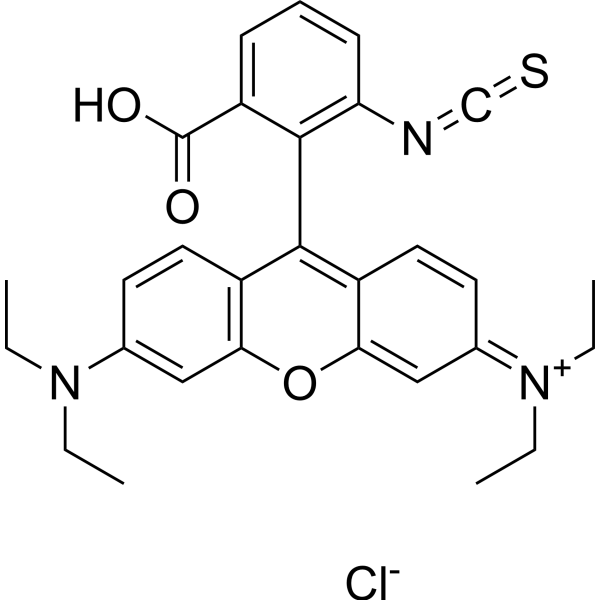
Rhodamine B isothiocyanate (RBITC) is a fluorescent dye commonly used in biological imaging and labeling applications. It has an isothiocyanate functional group that can be covalently attached to amino groups on proteins and other biomolecules, making it useful for fluorescent labeling of cells and tissues. RBITC fluoresces bright orange-red under green light excitation, which makes it easy to detect and track labeled molecules in complex samples. Due to its stability and sensitivity, RBITC has been widely used in various research fields, including cell biology, immunology, and neurobiology.
|
-
- HY-P11618
-
|
|
Glycoprotein VI
|
Cancer
|
|
10P3Me is a Glypican-3 (GPC3)-targeting probe with a Ka of 93.8 nM for the human target. 10P3Me exhibits high binding affinity to GPC3, targets GPC3-positive cells, and serves as an agent for PET imaging. 10P3Me selectively accumulates in GPC3-positive tumor tissues, including subcutaneous xenograft models and orthotopic HepG2-LUC liver cancer models, to achieve precise localization of lesions .
|
-
- HY-116450
-
|
|
Dopamine Receptor
|
Neurological Disease
|
|
TISCH is a potent and selective iodinated ligand with high affinity and selectivity for CNS D1 dopamine receptors. TISCH showed a Kd value of 0.205 nM in rat striatal tissue, indicating its effectiveness in biological activity. TISCH is able to easily cross the blood-brain barrier and show distribution in specific areas with D1 receptor density. TISCH is considered to be useful as a pharmacological tool for characterizing D1 dopamine receptors. When labeled with I-123, TISCH has the potential to be used as an in vivo imaging agent for CNS D1 dopamine receptors .
|
-
- HY-D1555
-
|
Cy7 DBCO
|
Fluorescent Dye
|
Others
|
|
Cyanine7 DBCO (Cy7 DBCO) is a near-infrared fluorescent dye and an efficient bio-orthogonal quencher. Cyanine7 DBCO is formed by covalent connection of the near-infrared fluorescent dye Cy7 and the dibenzocyclooctyne (DBCO) functional group. After reacting with N3-Cy5-COOH, the fluorescence of Cy5 decreases by 90% within 90 minutes, and rapid signal attenuation can be observed within 2-5 minutes. Cyanine7 DBCO can be used for the study of deep tissue imaging and receptor-targeted therapeutic strategies .
|
-
- HY-W075283
-
|
1-(4-Aminophenyl)-1,2,2-triphenylethene
|
|
Others
|
|
4-(1,2,2-Triphenylvinyl)aniline (1-(4-Aminophenyl)-1,2,2-triphenylethene) is a tetraphenylethene-based aggregation-induced luminescent molecule. 4-(1,2,2-Triphenylvinyl)aniline exhibits weak or no fluorescence in dilute solution/dispersed state, and strong fluorescence with increased quantum yield when aggregated into nanoparticles .
|
-
- HY-173291
-
|
|
Tau Protein
|
Neurological Disease
|
|
Tau ligand-1 (Compound 75) is a ligand for aggregated tau protein that can penetrate the blood-brain barrier . In tissues from patients with Alzheimer's disease, progressive supranuclear palsy, corticobasal degeneration, and Pick's disease, Tau ligand-1 exhibits high affinity for aggregated tau protein, with equilibrium dissociation constant (KD) values ranging from 1 to 3.8 nM . Tau ligand-1 can serve as a potential positron emission tomography (PET) tracer and holds promise for application in positron emission tomography imaging studies of tau-related diseases in the central nervous system .
|
-
- HY-137006
-
|
|
Fluorescent Dye
|
Others
|
|
MTT Formazan is a purple water-insoluble product formed by the reduction of yellow soluble MTT by succinate dehydrogenase in the mitochondria of viable cells. The amount of MTT Formazan produced is proportional to cellular metabolic activity, and it can serve as an indicator for evaluating cell viability and proliferation. MTT Formazan exhibits solvent-dependent solubility properties, and its absorbance value can be measured by spectrophotometry to reflect cellular status. MTT Formazan also supports the assessment of cell viability in bacterial MTT assays. MTT Formazan can be used in photoacoustic microscopy to enhance the imaging effect of viable cells, especially in applications in the fields of three-dimensional cell culture and tissue engineering .
|
-
- HY-P5362
-
|
|
Radionuclide-Drug Conjugates (RDCs)
Somatostatin Receptor
|
Neurological Disease
Cancer
|
|
NODAGA-LM3 is a ligand that can cross the blood-brain barrier and targets somatostatin receptor SSTR2 with high affinity (IC50 = 1.3 nM). NODAGA-LM3 does not trigger the internalization of SSTR2 and can inhibit agonist-induced internalization processes. NODAGA-LM3 shows low uptake in normal tissues such as the liver and spleen, but high uptake in the lungs and blood pool. 68Ga-labeled NODAGA-LM3 can serve as a PET imaging agent for well-differentiated neuroendocrine tumors, and is applied in studies related to small cell lung cancer and well-differentiated neuroendocrine tumors .
|
-
- HY-D3187
-
|
|
Fluorescent Dye
Glycosidase
|
Infection
Cancer
|
|
HMRef-αMan is a substrate-based green fluorescent probe (Ex/Em=465 nm/515 nm) targeting MAN2C1 (α-mannosidase). HMRef-αMan can be specifically cleaved by MAN2C1 to generate a highly fluorescent product, which thus gets activated to produce green fluorescence in malignant breast tissues, benign lesions and living cancer cells. The signal intensity of HMRef-αMan is directly correlated with MAN2C1 activity, and it can effectively detect tiny breast cancer lesions with a diameter of less than 1 mm. When used in combination with the red-emitting γ-glutamyl transpeptidase (GGT) probe gGlu-2OMe SiR600 (HY-D3188), HMRef-αMan enables precise optical differentiation of breast tissue types via a dual-color imaging strategy. HMRef-αMan has been widely used in the research of breast diseases such as breast cancer, fibroadenoma, phyllodes tumor and various types of papilloma .
|
-
- HY-P5362A
-
|
|
Radionuclide-Drug Conjugates (RDCs)
Somatostatin Receptor
|
Cancer
|
|
NODAGA-LM3 TFA is a ligand that can cross the blood-brain barrier and targets somatostatin receptor SSTR2 with high affinity (IC50 = 1.3 nM). NODAGA-LM3 TFA does not trigger the internalization of SSTR2 and can inhibit agonist-induced internalization processes. NODAGA-LM3 TFA shows low uptake in normal tissues such as the liver and spleen, but high uptake in the lungs and blood pool. 68Ga-labeled NODAGA-LM3 TFA can serve as a PET imaging agent for well-differentiated neuroendocrine tumors, and is applied in studies related to small cell lung cancer and well-differentiated neuroendocrine tumors .
|
-
- HY-D3447
-
|
|
Fluorescent Dye
Ferroptosis
|
Others
|
|
LPd peroxida probe-2 (Compound I-1) is a lipid peroxidation fluorescent indicator (Ex = 488 nm, Em = 535 nm). LPd peroxida probe-2 undergoes fluorescence spectral changes in response to lipid hydroperoxides and can be used for Ferroptosis detection and cell imaging.
|
-
- HY-D3189
-
|
|
Fluorescent Dye
PSMA
|
Cancer
|
|
5GluAF-2MeTG is an activatable fluorescent probe targeting the glutamate carboxypeptidase (CP) activity of PSMA (Ex/Em=490/500-600 nm). After being hydrolyzed by PSMA, 5GluAF-2MeTG releases a cell membrane-permeable fluorescent product, and achieves fluorescence activation by disrupting donor-excited photoinduced electron transfer (d-PeT). 5GluAF-2MeTG enables fluorescence imaging of live PSMA-expressing prostate cancer cells in vitro and visualizes the carboxypeptidase activity of PSMA. 5GluAF-2MeTG can be used to detect prostate cancer regions in preclinical excised tissue specimens .
|
-
- HY-159194
-
|
|
Liposome
|
Cancer
|
|
DSPE-PEG2000-Cy5.5 is a phospholipid-fluorophore conjugate consisting of Cy5.5 covalently linked to 1,2-distearoyl-sn-glycero-3-phosphoethanolamine (DSPE), serving as a surface label for liposomes in multimodal CT/optical imaging.DSPE-PEG2000-Cy5.5 can be used for the research of non-small cell lung cancer .
|
-
- HY-P11339
-
|
|
Integrin
|
Cancer
|
|
c-RGD-SH is a ligand for integrin αvβ3 (Integrin αvβ3). Conjugation of c-RGD-SH with core-crosslinked polymeric micelles (CCPM) enables the synthesis of a bimodal nanoprobe, which can be labeled with Cy7 and 111In for SPECT and NIRF imaging of tumors .
|
-
- HY-100138
-
|
|
Radionuclide-Drug Conjugates (RDCs)
ADC Linker
|
Cancer
|
|
2-Aminoethyl-mono-amide-DOTA-tris(tBu ester) is a metal chelator precursor containing a DOTA macrocyclic structure. DOTA can form highly stable complexes with metal ions (such as 68Ga, 177Lu) through four nitrogen atoms and four carboxylic acid groups to mediate targeted delivery of radionuclides. The tert-butyl ester group (tBu ester) of 2-Aminoethyl-mono-amide-DOTA-tris(tBu ester) also protects the carboxylic acid group during synthesis, and forms a free carboxyl group after deprotection reaction for coupling with targeting molecules (such as antibodies, peptides). 2-Aminoethyl-mono-amide-DOTA-tris(tBu ester) may be combined with tumor pre-targeting systems through bioorthogonal reactions (such as reverse electron demand Diels-Alder reaction) to study radioactive imaging or therapy of tumor tissues, and is mainly used in tumor pre-targeting research in the field of nuclear medicine .
|
-
- HY-153552A
-
|
|
FAP
|
Cancer
|
|
NH2-UAMC1110 TFA is an aminobutoxy derivative of the fibroblast activation protein (FAP) inhibitor UAMC1110 (HY-100684), and is a precursor compound for the synthesis of FAP inhibitor probes, not directly used in bioactivity experiments. For example, NH2-UAMC1110 TFA is involved in the synthesis of the radiotracer FAPI-QS, which exhibits high tumor selectivity and high dose effect, and has been used in tumor diagnosis. NH2-UAMC1110 TFA structurally incorporates an active amino group, allowing it to form covalent bonds with various molecules (such as DOTA, DATA5m, radionuclide chelators, etc.) to synthesize molecular imaging probes or targeted compounds with the ability to target FAP. NH2-UAMC1110 TFA specifically binds to the FAP active site, inhibiting its proline-selective serine protease activity (including dipeptidyl peptidase and endopeptidase activity), blocking FAP-mediated tissue remodeling-related processes. Its key activity is high targeting and high affinity, and its core function is to act as a targeting module coupled with bifunctional chelators (such as DOTA, DATA5m). NH2-UAMC1110 TFA can be applied to diagnostic imaging studies of tumors expressing FAP (such as colorectal cancer, pancreatic cancer, etc.), and also provides molecular tools for targeted research of FAP-related diseases with high FAP expression, such as fibrosis and arthritis .
|
-
- HY-153552
-
|
|
FAP
|
Cancer
|
|
NH2-UAMC1110 is an aminobutoxy derivative of the fibroblast activation protein (FAP) inhibitor UAMC1110 (HY-100684), and is a precursor compound for the synthesis of FAP inhibitor probes, not directly used in bioactivity experiments. For example, NH2-UAMC1110 is involved in the synthesis of the radiotracer FAPI-QS, which exhibits high tumor selectivity and high dose-response, and has been used for tumor diagnosis. NH2-UAMC1110 introduces an active amino group into its structure, enabling it to form covalent bonds with various molecules (such as DOTA, DATA5m, radionuclide chelators, etc.), thereby synthesizing molecular imaging probes or targeted compounds with the ability to target FAP. NH2-UAMC1110 specifically binds to the FAP active site, inhibiting its proline-selective serine protease activity (including dipeptidyl peptidase and endopeptidase activity), blocking FAP-mediated tissue remodeling processes. Its key activity is high targeting and high affinity, and its core function is to be coupled with bifunctional chelators (such as DOTA, DATA5m) as a targeting module. NH2-UAMC1110 can be applied to diagnostic imaging studies of tumors expressing FAP (such as colorectal cancer, pancreatic cancer, etc.), and also provides molecular tools for targeted research of FAP-related diseases with high FAP expression, such as fibrosis and arthritis .
|
-
- HY-100138R
-
|
|
Radionuclide-Drug Conjugates (RDCs)
ADC Linker
Reference Standards
|
Cancer
|
|
2-Aminoethyl-mono-amide-DOTA-tris(tBu ester) (Standard) is the analytical standard of 2-Aminoethyl-mono-amide-DOTA-tris(tBu ester) (HY-100138). This product is intended for research and analytical applications. 2-Aminoethyl-mono-amide-DOTA-tris(tBu ester) is a metal chelator precursor containing a DOTA macrocyclic structure. DOTA can form highly stable complexes with metal ions (such as 68Ga, 177Lu) through four nitrogen atoms and four carboxylic acid groups to mediate targeted delivery of radionuclides. The tert-butyl ester group (tBu ester) of 2-Aminoethyl-mono-amide-DOTA-tris(tBu ester) also protects the carboxylic acid group during synthesis, and forms a free carboxyl group after deprotection reaction for coupling with targeting molecules (such as antibodies, peptides). 2-Aminoethyl-mono-amide-DOTA-tris(tBu ester) may be combined with tumor pre-targeting systems through bioorthogonal reactions (such as reverse electron demand Diels-Alder reaction) to study radioactive imaging or therapy of tumor tissues, and is mainly used in tumor pre-targeting research in the field of nuclear medicine .
|
-
| Cat. No. |
Product Name |
Type |
-
- HY-112697
-
|
|
Fluorescent Dye
|
|
Rhodamine B isothiocyanate (RBITC) is a fluorescent dye commonly used in biological imaging and labeling applications. It has an isothiocyanate functional group that can be covalently attached to amino groups on proteins and other biomolecules, making it useful for fluorescent labeling of cells and tissues. RBITC fluoresces bright orange-red under green light excitation, which makes it easy to detect and track labeled molecules in complex samples. Due to its stability and sensitivity, RBITC has been widely used in various research fields, including cell biology, immunology, and neurobiology.
|
-
- HY-145746
-
|
|
Fluorescent Dye
|
|
Sulfo-Cy5 azide is a near-infrared fluorescent probe with favorable click chemistry reactivity. Sulfo-Cy5 azide enables fluorescence imaging, tissue and cellular visualization of PD-L1 in tumors, and site-specific modification of anti-PD-L1 antibodies. Sulfo-Cy5 azide has been employed for RNA labeling and imaging. Sulfo-Cy5 azide can be conjugated to targeting agents for fluorescence imaging in atherosclerosis and breast cancer models (Ex/Em = 645/670 nm) .
|
-
- HY-D0286
-
|
2,8-Dimethylnaphtho[3,2,1-kl]xanthene
|
Fluorescent Dye
|
|
Fluorol Yellow 088 is a fluorescent dye that can be used as a biological material or an organic compound for life science research. Fluorol Yellow 088 is suitable for lipid staining in plant tissues, particularly for the fluorescence imaging of suberized cell walls and hydrophobic structures, with an excitation wavelength of 365 nm and an emission wavelength of ≥420 nm .
|
-
- HY-W094758A
-
|
|
Fluorescent Dye
|
|
4-Di-1-ASP is a styryl dye used to stain glioma cells in living brain tissue for analysis of cell structure, viability, proliferation and endocytosis, cytokinesis and phagocytosis, as well as for observation of mitochondrial structures in living cells. 4-Di-1-ASP fluoresces green when imaged microscopically (λex /λem = 475/606 nm) .
|
-
- HY-D0053
-
|
6-Carboxy-X-rhodamine
|
Fluorescent Dye
|
|
6-ROX is a selective fluorescent probe and potential inhibitor of COX-2. 6-ROX binds to the active site of COX-2 and inhibits its conversion of arachidonic acid into prostaglandins. 6-ROX is often used in the field of optical imaging related to tumors and inflammation, and helps detect diseased tissues with high expression of COX-2 .
|
-
- HY-D1537
-
|
DBCO-Cy5.5; Cyanine5.5 DBCO
|
Fluorescent Dye
|
|
Dibenzocyclooctyne-Cy5.5 (DBCO-Cy5.5) is a fluorescent dye. Dibenzocyclooctyne-Cy5.5 can be used to syntheses calcium-binding near-infrared fluorescent nanoprobe for bone tissue imaging .
|
-
- HY-D2640
-
|
|
Fluorescent Dye
|
|
Cy5 HA (MW 5000) is a hyaluronic acid labeled with CY5 (HY-D0821). Cy5 HA (MW 5000) is widely used for cell imaging and in vivo imaging of shallow tissue (Ex/Em = 633/670 nm).
|
-
- HY-D2344
-
|
3-Benzothiazole-daphnetin
|
Fluorescent Dye
|
|
3-BTD (3-Benzothiazole-daphnetin) is a Catechol-O-methyltransferase (COMT) two-photon fluorescence probe. 3-BTD can also be used for biological imaging of endogenous COMT in living cells and tissue sections .
|
-
- HY-D2647
-
|
|
Fluorescent Dye
|
|
Cy5 HA (MW 500000) is a hyaluronic acid labeled with CY5 (HY-D0821). Cy5 HA (MW 500000) is widely used for cell imaging and in vivo imaging of shallow tissue (Ex/Em = 633/670 nm).
|
-
- HY-D1275
-
|
|
Fluorescent Dye
|
|
CAY10731 (compound 3) is a highly selective fluorescent probe for detection of hydrogen sulfide (H2S). CAY10731 is used to monitor exo- and endogenous H2S in both cancer and normal cells. CAY10731 is applied for imaging of H2S in living tissues at variable depths and in nematodes .
|
-
- HY-D2645
-
|
|
Fluorescent Dye
|
|
Cy5 HA (MW 100000) is a hyaluronic acid labeled with CY5 (HY-D0821). Cy5 HA (MW 100000) is widely used for cell imaging and in vivo imaging of shallow tissue (Ex/Em = 633/670 nm).
|
-
- HY-D2638
-
|
|
Fluorescent Dye
|
|
Cy5 HA (MW 3000) is a hyaluronic acid labeled with CY5 (HY-D0821). Cy5 HA (MW 3000) is widely used for cell imaging and in vivo imaging of shallow tissue (Ex/Em = 633/670 nm).
|
-
- HY-D2994
-
|
SNAP-MaP555
|
Fluorescent Dye
|
|
SPY555-BG (SNAP-MaP555) is the benzylguanine derivative of SPY555 fluorophore. SPY555-BG emits light in the orange part of the UV-ViS spectrum. SPY555-BG is fluorogenic, highly cell permeable and well suited for STED and SIM superresolution imaging. SPY555-BG can be imaged with a standard Cy3 filterset. SPY555-BG can be used for widefield, confocal, SIM or STED imaging in living or fixed cells and tissue .
|
-
- HY-D2642
-
|
|
Fluorescent Dye
|
|
Cy5 HA (MW 10000) is a hyaluronic acid labeled with CY5 (HY-D0821). Cy5 HA (MW 10000) is widely used for cell imaging and in vivo imaging of shallow tissue (Ex/Em = 633/670 nm).
|
-
- HY-D2624
-
|
|
Fluorescent Dye
|
|
Cy3 HA (MW 10000) is a hyaluronic acid labeled with CY3 (HY-D0822). Cy3 HA (MW 10000) is widely used for cell imaging and in vivo imaging of shallow tissue (Ex/Em = 550/570 nm).
|
-
- HY-D2625
-
|
|
Fluorescent Dye
|
|
Cy3 HA (MW 50000) is a hyaluronic acid labeled with CY3 (HY-D0822). Cy3 HA (MW 50000) is widely used for cell imaging and in vivo imaging of shallow tissue (Ex/Em = 550/570 nm).
|
-
- HY-D2646
-
|
|
Fluorescent Dye
|
|
Cy5 HA (MW 200000) is a hyaluronic acid labeled with CY5 (HY-D0821). Cy5 HA (MW 200000) is widely used for cell imaging and in vivo imaging of shallow tissue (Ex/Em = 633/670 nm).
|
-
- HY-D2676
-
|
|
Fluorescent Dye
|
|
Cy7 HA (MW 3000) is a hyaluronic acid labeled with CY7 (HY-D0825). Cy7 HA (MW 3000) is widely used for cell imaging and in vivo imaging of shallow tissue (Ex/Em = 740/770 nm).
|
-
- HY-D2653
-
|
|
Fluorescent Dye
|
|
Cy5 HA biotin 3000 is a biotinylated hyaluronic acid labeled with CY5 (HY-D0821). Cy5 HA biotin 3000 is widely used for cell imaging and in vivo imaging of shallow tissues (Ex/Em = 633/670 nm).
|
-
- HY-D2663
-
|
|
Fluorescent Dye
|
|
Cy5.5 HA (MW 500000) is a hyaluronic acid labeled with CY5.5 (HY-D0924). Cy5.5 HA (MW 200000) is widely used for cell imaging and in vivo imaging of shallow tissue (Ex/Em = 680/710 nm).
|
-
- HY-D2671
-
|
|
Fluorescent Dye
|
|
Cy5.5 HA biotin 10000 is a biotinylated hyaluronic acid labeled with CY5.5 (HY-D0924). Cy5.5 HA biotin 10000 is widely used for cell imaging and in vivo imaging of shallow tissues (Ex/Em = 680/710 nm).
|
-
- HY-D2621
-
|
|
Fluorescent Dye
|
|
Cy3 HA (MW 5000) is a hyaluronic acid labeled with CY3 (HY-D0822). Cy3 HA (MW 5000) is widely used for cell imaging and in vivo imaging of shallow tissue (Ex/Em = 550/570 nm).
|
-
- HY-D2641
-
|
|
Fluorescent Dye
|
|
Cy5 HA (MW 7000) is a hyaluronic acid labeled with CY5 (HY-D0821). Cy5 HA (MW 7000) is widely used for cell imaging and in vivo imaging of shallow tissue (Ex/Em = 633/670 nm).
|
-
- HY-D2677
-
|
|
Fluorescent Dye
|
|
Cy7 HA (MW 100000) is a hyaluronic acid labeled with CY7 (HY-D0825). Cy7 HA (MW 100000) is widely used for cell imaging and in vivo imaging of shallow tissue (Ex/Em = 740/770 nm).
|
-
- HY-D2675
-
|
|
Fluorescent Dye
|
|
Cy7 HA (MW 10000) is a hyaluronic acid labeled with CY7 (HY-D0825). Cy7 HA (MW 10000) is widely used for cell imaging and in vivo imaging of shallow tissue (Ex/Em = 740/770 nm).
|
-
- HY-D2643
-
|
|
Fluorescent Dye
|
|
Cy5 HA (MW 50000) is a hyaluronic acid labeled with CY5 (HY-D0821). Cy5 HA (MW 50000) is widely used for cell imaging and in vivo imaging of shallow tissue (Ex/Em = 633/670 nm).
|
-
- HY-D2674
-
|
|
Fluorescent Dye
|
|
Cy7 HA (MW 7000) is a hyaluronic acid labeled with CY7 (HY-D0825). Cy7 HA (MW 7000) is widely used for cell imaging and in vivo imaging of shallow tissue (Ex/Em = 740/770 nm).
|
-
- HY-D2622
-
|
|
Fluorescent Dye
|
|
Cy3 HA (MW 3000) is a hyaluronic acid labeled with CY3 (HY-D0822). Cy3 HA (MW 3000) is widely used for cell imaging and in vivo imaging of shallow tissue (Ex/Em = 550/570 nm).
|
-
- HY-D2626
-
|
|
Fluorescent Dye
|
|
Cy3 HA (MW 100000) is a hyaluronic acid labeled with CY3 (HY-D0822). Cy3 HA (MW 100000) is widely used for cell imaging and in vivo imaging of shallow tissue (Ex/Em = 550/570 nm).
|
-
- HY-D2672
-
|
|
Fluorescent Dye
|
|
Cy7 HA (MW 3000) is a hyaluronic acid labeled with CY7 (HY-D0825). Cy7 HA (MW 3000) is widely used for cell imaging and in vivo imaging of shallow tissue (Ex/Em = 740/770 nm).
|
-
- HY-D2628
-
|
|
Fluorescent Dye
|
|
Cy3 HA (MW 500000) is a hyaluronic acid labeled with CY3 (HY-D0822). Cy3 HA (MW 500000) is widely used for cell imaging and in vivo imaging of shallow tissue (Ex/Em = 550/570 nm).
|
-
- HY-D2623
-
|
|
Fluorescent Dye
|
|
Cy3 HA (MW 7000) is a hyaluronic acid labeled with CY3 (HY-D0822). Cy3 HA (MW 7000) is widely used for cell imaging and in vivo imaging of shallow tissue (Ex/Em = 550/570 nm).
|
-
- HY-D2636
-
|
|
Fluorescent Dye
|
|
Cy3 HA biotin 5000 is a biotinylated hyaluronic acid labeled with CY3 (HY-D0822). Cy3 HA biotin 5000 is widely used for cell imaging and in vivo imaging of shallow tissues (Ex/Em = 550/570 nm).
|
-
- HY-D2637
-
|
|
Fluorescent Dye
|
|
Cy3 HA biotin 10000 is a biotinylated hyaluronic acid labeled with CY3 (HY-D0822). Cy3 HA biotin 10000 is widely used for cell imaging and in vivo imaging of shallow tissues (Ex/Em = 550/570 nm).
|
-
- HY-D2655
-
|
|
Fluorescent Dye
|
|
Cy5 HA biotin 10000 is a biotinylated hyaluronic acid labeled with CY5 (HY-D0821). Cy5 HA biotin 10000 is widely used for cell imaging and in vivo imaging of shallow tissues (Ex/Em = 633/670 nm).
|
-
- HY-D2687
-
|
|
Fluorescent Dye
|
|
Cy7 HA biotin 5000 is a biotinylated hyaluronic acid labeled with CY7 (HY-D0825). Cy7 HA biotin 5000 is widely used for cell imaging and in vivo imaging of shallow tissues (Ex/Em = 740/770 nm).
|
-
- HY-D2654
-
|
|
Fluorescent Dye
|
|
Cy5 HA biotin 5000 is a biotinylated hyaluronic acid labeled with CY5 (HY-D0821). Cy5 HA biotin 5000 is widely used for cell imaging and in vivo imaging of shallow tissues (Ex/Em = 633/670 nm).
|
-
- HY-D2688
-
|
|
Fluorescent Dye
|
|
Cy7 HA biotin 10000 is a biotinylated hyaluronic acid labeled with CY7 (HY-D0825). Cy7 HA biotin 10000 is widely used for cell imaging and in vivo imaging of shallow tissues (Ex/Em = 740/770 nm).
|
-
- HY-D2635
-
|
|
Fluorescent Dye
|
|
Cy3 HA biotin 3000 is a biotinylated hyaluronic acid labeled with CY3 (HY-D0822). Cy3 HA biotin 3000 is widely used for cell imaging and in vivo imaging of shallow tissues (Ex/Em = 550/570 nm).
|
-
- HY-D2661
-
|
|
Fluorescent Dye
|
|
Cy5.5 HA (MW 100000) is a hyaluronic acid labeled with CY5.5 (HY-D0924). Cy5.5 HA (MW 100000) is widely used for cell imaging and in vivo imaging of shallow tissue (Ex/Em = 680/710 nm).
|
-
- HY-D2689
-
|
|
Fluorescent Dye
|
|
Cy7.5 HA (MW 3000) is a hyaluronic acid labeled with CY7.5 (HY-D0926). Cy7.5 HA (MW 3000) is widely used for cell imaging and in vivo imaging of shallow tissue (Ex/Em = 770/820 nm).
|
-
- HY-D2691
-
|
|
Fluorescent Dye
|
|
Cy7.5 HA (MW 7000) is a hyaluronic acid labeled with CY7.5 (HY-D0926). Cy7.5 HA (MW 7000) is widely used for cell imaging and in vivo imaging of shallow tissue (Ex/Em = 770/820 nm).
|
-
- HY-D2692
-
|
|
Fluorescent Dye
|
|
Cy7.5 HA (MW 10000) is a hyaluronic acid labeled with CY7.5 (HY-D0926). Cy7.5 HA (MW 10000) is widely used for cell imaging and in vivo imaging of shallow tissue (Ex/Em = 770/820 nm).
|
-
- HY-D2656
-
|
|
Fluorescent Dye
|
|
Cy5.5 HA (MW 3000) is a hyaluronic acid labeled with CY5.5 (HY-D0924). Cy5.5 HA (MW 3000) is widely used for cell imaging and in vivo imaging of shallow tissue (Ex/Em = 680/710 nm).
|
-
- HY-D2660
-
|
|
Fluorescent Dye
|
|
Cy5.5 HA (MW 50000) is a hyaluronic acid labeled with CY5.5 (HY-D0924). Cy5.5 HA (MW 50000) is widely used for cell imaging and in vivo imaging of shallow tissue (Ex/Em = 680/710 nm).
|
-
- HY-D2693
-
|
|
Fluorescent Dye
|
|
Cy7.5 HA (MW 50000) is a hyaluronic acid labeled with CY7.5 (HY-D0926). Cy7.5 HA (MW 50000) is widely used for cell imaging and in vivo imaging of shallow tissue (Ex/Em = 770/820 nm).
|
-
- HY-D2657
-
|
|
Fluorescent Dye
|
|
Cy5.5 HA (MW 5000) is a hyaluronic acid labeled with CY5.5 (HY-D0924). Cy5.5 HA (MW 5000) is widely used for cell imaging and in vivo imaging of shallow tissue (Ex/Em = 680/710 nm).
|
-
- HY-D2662
-
|
|
Fluorescent Dye
|
|
Cy5.5 HA (MW 200000) is a hyaluronic acid labeled with CY5.5 (HY-D0924). Cy5.5 HA (MW 200000) is widely used for cell imaging and in vivo imaging of shallow tissue (Ex/Em = 680/710 nm).
|
-
- HY-D2695
-
|
|
Fluorescent Dye
|
|
Cy7.5 HA (MW 200000) is a hyaluronic acid labeled with CY7.5 (HY-D0926). Cy7.5 HA (MW 200000) is widely used for cell imaging and in vivo imaging of shallow tissue (Ex/Em = 770/820 nm).
|
-
- HY-D2690
-
|
|
Fluorescent Dye
|
|
Cy7.5 HA (MW 5000) is a hyaluronic acid labeled with CY7.5 (HY-D0926). Cy7.5 HA (MW 5000) is widely used for cell imaging and in vivo imaging of shallow tissue (Ex/Em = 770/820 nm).
|
- HY-D2670
-
|
|
Fluorescent Dye
|
|
Cy5.5 HA biotin 5000 is a biotinylated hyaluronic acid labeled with CY5.5 (HY-D0924). Cy5.5 HA biotin 5000 is widely used for cell imaging and in vivo imaging of shallow tissues (Ex/Em = 680/710 nm).
|
- HY-D2704
-
|
|
Fluorescent Dye
|
|
Cy7.5 HA biotin (MW 10000) is a biotinylated hyaluronic acid labeled with CY7.5 (HY-D0926). Cy7.5 HA biotin (MW 10000) is widely used for cell imaging and in vivo imaging of shallow tissues (Ex/Em = 770/820 nm).
|
- HY-D2703
-
|
|
Fluorescent Dye
|
|
Cy7.5 HA biotin (MW 5000) is a biotinylated hyaluronic acid labeled with CY7.5 (HY-D0926). Cy7.5 HA biotin (MW 5000) is widely used for cell imaging and in vivo imaging of shallow tissues (Ex/Em = 770/820 nm).
|
- HY-D2702
-
|
|
Fluorescent Dye
|
|
Cy7.5 HA biotin (MW 3000) is a biotinylated hyaluronic acid labeled with CY7.5 (HY-D0926). Cy7.5 HA biotin (MW 3000) is widely used for cell imaging and in vivo imaging of shallow tissues (Ex/Em = 770/820 nm).
|
- HY-D2597
-
|
|
Fluorescent Dye
|
|
Cy7.5-PEG2000-biotin is a biotinylated hyaluronic acid labeled with CY7.5 (HY-D0926). Cy7.5-PEG2000-biotin is widely used for cell imaging and in vivo imaging of shallow tissues (Ex/Em=770/820 nm).
|
- HY-D2598
-
|
|
Fluorescent Dye
|
|
Cy7.5-PEG5000-biotin is a biotinylated hyaluronic acid labeled with CY7.5 (HY-D0926). Cy7.5-PEG5000-biotin is widely used for cell imaging and in vivo imaging of shallow tissues (Ex/Em=770/820 nm).
|
- HY-112641
-
|
|
Fluorescent Dye
|
|
AkaLumine is a D-luciferin (HY-12591A) analogue with a Km of 2.06 μM for recombinant firefly luciferase (Fluc) protein. AkaLumine emits near-infrared (NIR) light (λmax=677 nm) in reactions with native Fluc. AkaLumine has high tissue-penetration and increases detection sensitivity from deep-tissue targets .
|
- HY-D2630
-
|
|
Fluorescent Dye
|
|
Cy3 HA MA (MW 3000) is a hyaluronic acid methacrylate labeled with CY3 (HY-D0822). Cy3 HA MA (MW 3000) is widely used in the fields of biolabeling and imaging, drug delivery and tissue engineering and regenerative medicine (Ex/Em = 550/570 nm).
|
- HY-D2651
-
|
|
Fluorescent Dye
|
|
Cy5 HA MA (MW 50000) is a hyaluronic acid methacrylate labeled with CY5 (HY-D0821). Cy5 HA MA (MW 50000) is widely used in the fields of biolabeling and imaging, drug delivery and tissue engineering and regenerative medicine (Ex/Em = 633/670 nm).
|
- HY-D2649
-
|
|
Fluorescent Dye
|
|
Cy5 HA MA (MW 5000) is a hyaluronic acid methacrylate labeled with CY5 (HY-D0821). Cy5 HA MA (MW 5000) is widely used in the fields of biolabeling and imaging, drug delivery and tissue engineering and regenerative medicine (Ex/Em = 633/670 nm).
|
- HY-D2685
-
|
|
Fluorescent Dye
|
|
Cy7 HA MA (MW 100000) is a hyaluronic acid methacrylate labeled with CY7 (HY-D0825). Cy7 HA MA (MW 100000) is widely used in the fields of biolabeling and imaging, drug delivery and tissue engineering and regenerative medicine (Ex/Em = 740/770 nm).
|
- HY-D2681
-
|
|
Fluorescent Dye
|
|
Cy7 HA MA (MW 3000) is a hyaluronic acid methacrylate labeled with CY7 (HY-D0825). Cy7 HA MA (MW 3000) is widely used in the fields of biolabeling and imaging, drug delivery and tissue engineering and regenerative medicine (Ex/Em = 740/770 nm).
|
- HY-D2632
-
|
|
Fluorescent Dye
|
|
Cy3 HA MA (MW 10000) is a hyaluronic acid methacrylate labeled with CY3 (HY-D0822). Cy3 HA MA (MW 10000) is widely used in the fields of biolabeling and imaging, drug delivery and tissue engineering and regenerative medicine (Ex/Em = 550/570 nm).
|
- HY-D2633
-
|
|
Fluorescent Dye
|
|
Cy3 HA MA (MW 50000) is a hyaluronic acid methacrylate labeled with CY3 (HY-D0822). Cy3 HA MA (MW 50000) is widely used in the fields of biolabeling and imaging, drug delivery and tissue engineering and regenerative medicine (Ex/Em = 550/570 nm).
|
- HY-D2683
-
|
|
Fluorescent Dye
|
|
Cy7 HA MA (MW 10000) is a hyaluronic acid methacrylate labeled with CY7 (HY-D0825). Cy7 HA MA (MW 10000) is widely used in the fields of biolabeling and imaging, drug delivery and tissue engineering and regenerative medicine (Ex/Em = 740/770 nm).
|
- HY-D2650
-
|
|
Fluorescent Dye
|
|
Cy5 HA MA (MW 10000) is a hyaluronic acid methacrylate labeled with CY5 (HY-D0821). Cy5 HA MA (MW 10000) is widely used in the fields of biolabeling and imaging, drug delivery and tissue engineering and regenerative medicine (Ex/Em = 633/670 nm).
|
- HY-D2634
-
|
|
Fluorescent Dye
|
|
Cy3 HA MA (MW 100000) is a hyaluronic acid methacrylate labeled with CY3 (HY-D0822). Cy3 HA MA (MW 100000) is widely used in the fields of biolabeling and imaging, drug delivery and tissue engineering and regenerative medicine (Ex/Em = 550/570 nm).
|
- HY-D2684
-
|
|
Fluorescent Dye
|
|
Cy7 HA MA (MW 50000) is a hyaluronic acid methacrylate labeled with CY7 (HY-D0825). Cy7 HA MA (MW 50000) is widely used in the fields of biolabeling and imaging, drug delivery and tissue engineering and regenerative medicine (Ex/Em = 740/770 nm).
|
- HY-D2648
-
|
|
Fluorescent Dye
|
|
Cy5 HA MA (MW 3000) is a hyaluronic acid methacrylate labeled with CY5 (HY-D0821). Cy5 HA MA (MW 3000) is widely used in the fields of biolabeling and imaging, drug delivery and tissue engineering and regenerative medicine (Ex/Em = 633/670 nm).
|
- HY-D2631
-
|
|
Fluorescent Dye
|
|
Cy3 HA MA (MW 5000) is a hyaluronic acid methacrylate labeled with CY3 (HY-D0822). Cy3 HA MA (MW 5000) is widely used in the fields of biolabeling and imaging, drug delivery and tissue engineering and regenerative medicine (Ex/Em = 550/570 nm).
|
- HY-D2699
-
|
|
Fluorescent Dye
|
|
Cy7.5 HA MA (MW 10000) is a hyaluronic acid methacrylate labeled with CY7.5 (HY-D0926). Cy7.5 HA MA (MW 10000) is widely used in the fields of biolabeling and imaging, drug delivery and tissue engineering and regenerative medicine (Ex/Em = 770/820 nm).
|
- HY-D2666
-
|
|
Fluorescent Dye
|
|
Cy5.5 HA MA (MW 10000) is a hyaluronic acid methacrylate labeled with CY5.5 (HY-D0924). Cy5.5 HA MA (MW 10000) is widely used in the fields of biolabeling and imaging, drug delivery and tissue engineering and regenerative medicine (Ex/Em = 680/710 nm).
|
- HY-D2664
-
|
|
Fluorescent Dye
|
|
Cy5.5 HA MA (MW 3000) is a hyaluronic acid methacrylate labeled with CY5.5 (HY-D0924). Cy5.5 HA MA (MW 3000) is widely used in the fields of biolabeling and imaging, drug delivery and tissue engineering and regenerative medicine (Ex/Em = 680/710 nm).
|
- HY-D2665
-
|
|
Fluorescent Dye
|
|
Cy5.5 HA MA (MW 5000) is a hyaluronic acid methacrylate labeled with CY5.5 (HY-D0924). Cy5.5 HA MA (MW 5000) is widely used in the fields of biolabeling and imaging, drug delivery and tissue engineering and regenerative medicine (Ex/Em = 680/710 nm).
|
- HY-D2700
-
|
|
Fluorescent Dye
|
|
Cy7.5 HA MA (MW 50000) is a hyaluronic acid methacrylate labeled with CY7.5 (HY-D0926). Cy7.5 HA MA (MW 50000) is widely used in the fields of biolabeling and imaging, drug delivery and tissue engineering and regenerative medicine (Ex/Em = 770/820 nm).
|
- HY-D2285
-
|
|
Fluorescent Dye
|
|
MOR-CES2 is a near-infrared fluorescent probe (Ex= 630 nm, Em=735 nm) capable of identifying cancer cells and tissues, as well as exhibiting a sensitive response to inflammation. MOR-CES2 holds potential as an efficient imaging tool in assisting surgical resection of CES2-related tumors .
|
- HY-D2698
-
|
|
Fluorescent Dye
|
|
Cy7.5 HA MA (MW 5000) is a hyaluronic acid methacrylate labeled with CY7.5 (HY-D0926). Cy7.5 HA MA (MW 5000) is widely used in the fields of biolabeling and imaging, drug delivery and tissue engineering and regenerative medicine (Ex/Em = 770/820 nm).
|
- HY-D2701
-
|
|
Fluorescent Dye
|
|
Cy7.5 HA MA (MW 100000) is a hyaluronic acid methacrylate labeled with CY7.5 (HY-D0926). Cy7.5 HA MA (MW 100000) is widely used in the fields of biolabeling and imaging, drug delivery and tissue engineering and regenerative medicine (Ex/Em = 770/820 nm).
|
- HY-D2667
-
|
|
Fluorescent Dye
|
|
Cy5.5 HA MA (MW 50000) is a hyaluronic acid methacrylate labeled with CY5.5 (HY-D0924). Cy5.5 HA MA (MW 50000) is widely used in the fields of biolabeling and imaging, drug delivery and tissue engineering and regenerative medicine (Ex/Em = 680/710 nm).
|
- HY-D2697
-
|
|
Fluorescent Dye
|
|
Cy7.5 HA MA (MW 3000) is a hyaluronic acid methacrylate labeled with CY7.5 (HY-D0926). Cy7.5 HA MA (MW 3000) is widely used in the fields of biolabeling and imaging, drug delivery and tissue engineering and regenerative medicine (Ex/Em = 770/820 nm).
|
- HY-D2668
-
|
|
Fluorescent Dye
|
|
Cy5.5 HA MA (MW 100000) is a hyaluronic acid methacrylate labeled with CY5.5 (HY-D0924). Cy5.5 HA MA (MW 100000) is widely used in the fields of biolabeling and imaging, drug delivery and tissue engineering and regenerative medicine (Ex/Em = 680/710 nm).
|
- HY-D2680
-
|
|
Fluorescent Dye
|
|
Cy7 HA (MW 200000) is a hyaluronic acid labeled with CY7 (HY-D0825). Cy7 HA (MW 200000) is widely used for cell imaging and in vivo imaging of shallow tissue (Ex/Em = 740/770 nm).
|
- HY-D2678
-
|
|
Fluorescent Dye
|
|
Cy7 HA (MW 500000) is a hyaluronic acid labeled with CY7 (HY-D0825). Cy7 HA (MW 500000) is widely used for cell imaging and in vivo imaging of shallow tissue (Ex/Em = 740/770 nm).
|
- HY-D2627
-
|
|
Fluorescent Dye
|
|
Cy3 HA (MW 200000) is a hyaluronic acid labeled with CY3 (HY-D0822). Cy3 HA (MW 200000) is widely used for cell imaging and in vivo imaging of shallow tissue (Ex/Em = 550/570 nm).
|
- HY-D2673
-
|
|
Fluorescent Dye
|
|
Cy7 HA (MW 55000) is a hyaluronic acid labeled with CY7 (HY-D0825). Cy7 HA (MW 5000) is widely used for cell imaging and in vivo imaging of shallow tissue (Ex/Em = 740/770 nm).
|
- HY-D2686
-
|
|
Fluorescent Dye
|
|
Cy7 HA biotin 3000 is a biotinylated hyaluronic acid labeled with CY7 (HY-D0825). Cy7 HA biotin 3000 is widely used for cell imaging and in vivo imaging of shallow tissues (Ex/Em = 740/770 nm).
|
- HY-D3267
-
|
|
Fluorescent Dye
|
|
ACu1 is a copper (I)-selective two-photon fluorescent probe that enables the visual imaging of Cu + distribution in living cells and tissues .
|
- HY-D2659
-
|
|
Fluorescent Dye
|
|
Cy5.5 HA (MW 10000) is a hyaluronic acid labeled with CY5.5 (HY-D0924). Cy5.5 HA (MW 10000) is widely used for cell imaging and in vivo imaging of shallow tissue (Ex/Em = 680/710 nm).
|
- HY-D2658
-
|
|
Fluorescent Dye
|
|
Cy5.5 HA (MW 7000) is a hyaluronic acid labeled with CY5.5 (HY-D0924). Cy5.5 HA (MW 7000) is widely used for cell imaging and in vivo imaging of shallow tissue (Ex/Em = 680/710 nm).
|
- HY-D2694
-
|
|
Fluorescent Dye
|
|
Cy7.5 HA (MW 100000) is a hyaluronic acid labeled with CY7.5 (HY-D0926). Cy7.5 HA (MW 100000) is widely used for cell imaging and in vivo imaging of shallow tissue (Ex/Em = 770/820 nm).
|
- HY-D2696
-
|
|
Fluorescent Dye
|
|
Cy7.5 HA (MW 500000) is a hyaluronic acid labeled with CY7.5 (HY-D0926). Cy7.5 HA (MW 500000) is widely used for cell imaging and in vivo imaging of shallow tissue (Ex/Em = 770/820 nm).
|
- HY-D2669
-
|
|
Fluorescent Dye
|
|
Cy5.5 HA biotin 3000 is a biotinylated hyaluronic acid labeled with CY5.5 (HY-D0924). Cy5.5 HA biotin 3000 is widely used for cell imaging and in vivo imaging of shallow tissues (Ex/Em = 680/710 nm).
|
- HY-D2652
-
|
|
Fluorescent Dye
|
|
Cy5 HA MA (MW 100000) is a hyaluronic acid methacrylate labeled with CY5 (HY-D0821). Cy5 HA MA (MW 100000) is widely used in the fields of biolabeling and imaging, drug delivery and tissue engineering and regenerative medicine (Ex/Em = 633/670 nm).
|
- HY-D2682
-
|
|
Fluorescent Dye
|
|
Cy7 HA MA (MW 5000) is a hyaluronic acid methacrylate labeled with CY7 (HY-D0825). Cy7 HA MA (MW 5000) is widely used in the fields of biolabeling and imaging, drug delivery and tissue engineering and regenerative medicine (Ex/Em = 740/770 nm).
|
- HY-D3172
-
|
|
Fluorescent Dye
|
|
BD-105 is a glucagon-binding fluorescent probe with a Ka value of 13.3 μM. BD-105 exhibits changes in fluorescence intensity upon interaction with glucagon, and colocalizes with glucagon in cells and tissues. BD-105 is a selective cell stain that labels glucagon-secreting cells without staining insulin-secreting cells or non-endocrine control cells. BD-105 serves as an imaging reagent for glucagon in live cells and tissues .
|
- HY-D3430
-
|
|
Fluorescent Dye
|
|
PTPA-QM is a low-cytotoxicity Aβ protein probe that can be used for live-cell imaging and tissue section staining (Lys. Ex/Em = 385/615 nm). PTPA-QM can intercalate into the β-sheet layered structure of β-amyloid fibrils, form intermolecular interactions with amino acid residues, restrict intramolecular rotation and trigger fluorescence activation for imaging purposes. PTPA-QM is applicable to Alzheimer's disease-related research. Maximum excitation/emission wavelength: 448/605 nm .
|
- HY-D3411
-
|
|
Fluorescent Dye
|
|
Rhobo6 is a cell-impermeable glycan-binding, fluorescence turn-on imaging agent with a Kd of 53 µM for glycans. Rhobo6 reversibly binds target glycans and enables wash-free live ECM visualization. Rhobo6 can be used for fluorescent labeling of ECM in living samples or decellularized tissues (Ex/Em = 488/561 nm) .
|
- HY-D3352
-
|
AGSCYCSGPPRFECWCYETEGT-Cy5
|
Fluorescent Dye
|
|
EMI-137 (AGSCYCSGPPRFECWCYETEGT-Cy5) is a fluorescent imaging agent targeting the c-Met receptor. EMI-137 specifically binds to the extracellular domain of the c-Met receptor and is used for fluorescent visualization of c-Met-expressing cells and tissues. EMI-137 can be applied to research related to colorectal cancer .
|
- HY-D2970
-
|
|
Fluorescent Dye
|
|
Golgi-P is a near-infrared Golgi-targeted fluorescent probe specifically used for the detection of Golgi polarity in living cells and living tissues. Golgi-P exhibits a significant polarity-dependent spectral behavior, with its emission wavelength shifting redward with polarity (Ex/Em: 700 nm/780-825 nm). Golgi-P achieves near-infrared fluorescence imaging directly in the brain tissue of depressed mice. Golgi-P combines polarity sensing with Golgi-targeting functionality, providing a new tool for the molecular diagnosis of depression .
|
- HY-D3171
-
|
|
Fluorescent Dye
|
|
AD-BChE/HClO is a dual-target two-photon fluorescent probe. AD-BChE/HClO can release 4-methylumbelliferone via butyrylcholinesterase-mediated hydrolysis of the ester bond at position 7, as well as hypochlorous acid-mediated thiocarbonyl oxidation. AD-BChE/HClO enables two-photon imaging in nerve cells and mouse brain tissues via tail vein injection. AD-BChE/HClO can be used for the research of Alzheimer's disease .
|
- HY-D1555
-
|
Cy7 DBCO
|
Fluorescent Dye
|
|
Cyanine7 DBCO (Cy7 DBCO) is a near-infrared fluorescent dye and an efficient bio-orthogonal quencher. Cyanine7 DBCO is formed by covalent connection of the near-infrared fluorescent dye Cy7 and the dibenzocyclooctyne (DBCO) functional group. After reacting with N3-Cy5-COOH, the fluorescence of Cy5 decreases by 90% within 90 minutes, and rapid signal attenuation can be observed within 2-5 minutes. Cyanine7 DBCO can be used for the study of deep tissue imaging and receptor-targeted therapeutic strategies .
|
- HY-D3187
-
|
|
Fluorescent Dye
|
|
HMRef-αMan is a substrate-based green fluorescent probe (Ex/Em=465 nm/515 nm) targeting MAN2C1 (α-mannosidase). HMRef-αMan can be specifically cleaved by MAN2C1 to generate a highly fluorescent product, which thus gets activated to produce green fluorescence in malignant breast tissues, benign lesions and living cancer cells. The signal intensity of HMRef-αMan is directly correlated with MAN2C1 activity, and it can effectively detect tiny breast cancer lesions with a diameter of less than 1 mm. When used in combination with the red-emitting γ-glutamyl transpeptidase (GGT) probe gGlu-2OMe SiR600 (HY-D3188), HMRef-αMan enables precise optical differentiation of breast tissue types via a dual-color imaging strategy. HMRef-αMan has been widely used in the research of breast diseases such as breast cancer, fibroadenoma, phyllodes tumor and various types of papilloma .
|
- HY-D3189
-
|
|
Fluorescent Dye
|
|
5GluAF-2MeTG is an activatable fluorescent probe targeting the glutamate carboxypeptidase (CP) activity of PSMA (Ex/Em=490/500-600 nm). After being hydrolyzed by PSMA, 5GluAF-2MeTG releases a cell membrane-permeable fluorescent product, and achieves fluorescence activation by disrupting donor-excited photoinduced electron transfer (d-PeT). 5GluAF-2MeTG enables fluorescence imaging of live PSMA-expressing prostate cancer cells in vitro and visualizes the carboxypeptidase activity of PSMA. 5GluAF-2MeTG can be used to detect prostate cancer regions in preclinical excised tissue specimens .
|
- HY-159194
-
|
|
Fluorescent Dye
|
|
DSPE-PEG2000-Cy5.5 is a phospholipid-fluorophore conjugate consisting of Cy5.5 covalently linked to 1,2-distearoyl-sn-glycero-3-phosphoethanolamine (DSPE), serving as a surface label for liposomes in multimodal CT/optical imaging.DSPE-PEG2000-Cy5.5 can be used for the research of non-small cell lung cancer .
|
| Cat. No. |
Product Name |
Type |
-
- HY-D0286
-
|
2,8-Dimethylnaphtho[3,2,1-kl]xanthene
|
Biochemical Assay Reagents
|
|
Fluorol Yellow 088 is a fluorescent dye that can be used as a biological material or an organic compound for life science research. Fluorol Yellow 088 is suitable for lipid staining in plant tissues, particularly for the fluorescence imaging of suberized cell walls and hydrophobic structures, with an excitation wavelength of 365 nm and an emission wavelength of ≥420 nm .
|
-
- HY-NP071
-
|
LEL
|
Biochemical Assay Reagents
|
|
Lycopersicon esculentum (Tomato) Lectin (LEL) specifically recognizes and binds to sugar structures, that combines with fluorescein for fluorescent labeling and imaging of cells and tissues. Lycopersicon esculentum (Tomato) Lectin is used to visualizes the vasculature within transplanted tissues by labeling with fluorescein .
|
-
- HY-182092
-
|
|
Biochemical Assay Reagents
|
|
DSPE-PEG1000-Asp6 is a PEG compound which composed of DSPE and a Asp6 peptide. DSPE-PEG1000-Asp6 achieves bone-targeted delivery of drugs or imaging agents by binding to bone tissue with the Asp6 peptide through high affinity .
|
-
- HY-182092A
-
|
|
Biochemical Assay Reagents
|
|
DSPE-PEG5000-Asp6 is a PEG compound which composed of DSPE and a Asp6 peptide. DSPE-PEG5000-Asp6 achieves bone-targeted delivery of drugs or imaging agents by binding to bone tissue with the Asp6 peptide through high affinity .
|
-
- HY-182092C
-
|
|
Biochemical Assay Reagents
|
|
DSPE-PEG3400-Asp6 is a PEG compound which composed of DSPE and a Asp6 peptide. DSPE-PEG3400-Asp6 achieves bone-targeted delivery of drugs or imaging agents by binding to bone tissue with the Asp6 peptide through high affinity .
|
-
- HY-182092B
-
|
|
Biochemical Assay Reagents
|
|
DSPE-PEG2000-Asp6 is a PEG compound which composed of DSPE and a Asp6 peptide. DSPE-PEG2000-Asp6 achieves bone-targeted delivery of drugs or imaging agents by binding to bone tissue with the Asp6 peptide through high affinity .
|
| Cat. No. |
Product Name |
Target |
Research Area |
-
- HY-P4154
-
|
ALM-488
|
Fluorescent Dye
|
Neurological Disease
Cancer
|
|
Bevonescein (ALM-488) is a fluorescein-conjugated peptide that facilitates the targeted delivery of a fluorescent moiety (5-FAM (HY-66022)) to nerves after intravenous (IV) administration. Bevonescein binds nerve-associated connective tissue, labels peripheral nerves under real-time fluorescence imaging (FL) in living mice and human ex vivo nerve tissue. Bevonescein is a peptide-linked tracer which fluorescently labeled both intact and degenerated nerves (Ex/Em = 480/530 nm) .
|
-
- HY-P5362
-
|
|
Radionuclide-Drug Conjugates (RDCs)
Somatostatin Receptor
|
Neurological Disease
Cancer
|
|
NODAGA-LM3 is a ligand that can cross the blood-brain barrier and targets somatostatin receptor SSTR2 with high affinity (IC50 = 1.3 nM). NODAGA-LM3 does not trigger the internalization of SSTR2 and can inhibit agonist-induced internalization processes. NODAGA-LM3 shows low uptake in normal tissues such as the liver and spleen, but high uptake in the lungs and blood pool. 68Ga-labeled NODAGA-LM3 can serve as a PET imaging agent for well-differentiated neuroendocrine tumors, and is applied in studies related to small cell lung cancer and well-differentiated neuroendocrine tumors .
|
-
- HY-P10943
-
|
|
Fluorescent Dye
|
Inflammation/Immunology
Cancer
|
|
APO-15 is a phosphatidylserine-binding fluorescent probe and apoptosis imaging reagent. APO-15 exhibits high chemical stability under proteolytic and oxidative conditions, enables quantification and imaging of drug-induced apoptosis in preclinical mouse models, and is applicable to fixed tissue samples and multiple in vivo administration routes (Ex = 488 nm; Em = 525 nm). APO-15 can be used in studies related to acute lung injury and breast cancer .
|
-
- HY-P11339
-
|
|
Integrin
|
Cancer
|
|
c-RGD-SH is a ligand for integrin αvβ3 (Integrin αvβ3). Conjugation of c-RGD-SH with core-crosslinked polymeric micelles (CCPM) enables the synthesis of a bimodal nanoprobe, which can be labeled with Cy7 and 111In for SPECT and NIRF imaging of tumors .
|
-
- HY-P11049
-
|
|
Peptides
|
Neurological Disease
|
|
Stroke-homing peptide is a homing peptide. Stroke-homing peptide can home to ischemic stroke brain tissue and detect the apoptotic neuronal cells. Stroke-homing peptide can be used for the research of molecular imaging and selective drug delivery to stroke tissue .
|
-
- HY-P10012
-
|
GYK-DTPA
|
Biochemical Assay Reagents
Radionuclide-Drug Conjugates (RDCs)
|
Cancer
|
|
Pendetide is a chelating agent, can be conjugated with Indium (111In) Capromab for further diagnostic use. Capromab pendetide is a FDA-approved imaging agent for the detection of soft tissue metastases in prostate carcinoma . Pendetide can be used for the synthesis/research of Radionuclide-Drug Conjugates (RDCs).
|
-
- HY-P5362A
-
|
|
Radionuclide-Drug Conjugates (RDCs)
Somatostatin Receptor
|
Cancer
|
|
NODAGA-LM3 TFA is a ligand that can cross the blood-brain barrier and targets somatostatin receptor SSTR2 with high affinity (IC50 = 1.3 nM). NODAGA-LM3 TFA does not trigger the internalization of SSTR2 and can inhibit agonist-induced internalization processes. NODAGA-LM3 TFA shows low uptake in normal tissues such as the liver and spleen, but high uptake in the lungs and blood pool. 68Ga-labeled NODAGA-LM3 TFA can serve as a PET imaging agent for well-differentiated neuroendocrine tumors, and is applied in studies related to small cell lung cancer and well-differentiated neuroendocrine tumors .
|
-
- HY-P11143
-
|
|
Interleukin Related
|
Cardiovascular Disease
|
|
IL4RPep-1 is a peptide that can specifically target atherosclerotic plaque, and its target is IL-4 receptor. IL4RPep-1 exhibits good plaque targeting and is not enriched in normal tissues. IL4RPep-1 has potential application as a targeting delivery system or molecular imaging probe for atherosclerosis research .
|
-
- HY-P11590
-
|
|
EGFR
|
Cancer
|
|
WGYRGFYC (WC8) is a selective HER2-targeting peptide that binds specifically to HER2 by mimicking the antigen-binding site of trastuzumab. The DOTA precursor of WGYRGFYC has a KD of 61.20 nM for HER2. WGYRGFYC enables specific and highly sensitive detection of HER2 expression in HER2-positive breast cancer cells and tumor tissues, and monitors the dynamic downregulation of HER2 expression. WGYRGFYC rapidly distributes to target tissues and is efficiently cleared from non-target tissues via the kidneys, generating an ideal tumor-to-background ratio in imaging; it is a component of the PET radiotracer Ga-DOTA-WC8. WGYRGFYC exhibits no significant cytotoxicity in breast cancer cells, and can be used for non-invasive imaging diagnosis and therapeutic efficacy evaluation of HER2-positive breast cancer .
|
-
- HY-P0036D
-
|
|
Drug Derivative
Radionuclide-Drug Conjugates (RDCs)
Somatostatin Receptor
Apoptosis
|
Cancer
|
|
NOTA‑Octreotide is a selective SSTR2‑targeting PET tracer. NOTA‑Octreotide binds specifically to SSTR2 and accumulates in SSTR2‑expressing tissues. NOTA‑Octreotide enables effective imaging of somatostatin receptor‑positive tumors in mice and shows high specific uptake in SSTR2‑expressing organs in healthy rats. NOTA-Octreotide can be used for PET imaging investigation of neuroendocrine tumors. .
|
-
- HY-P11618
-
|
|
Glycoprotein VI
|
Cancer
|
|
10P3Me is a Glypican-3 (GPC3)-targeting probe with a Ka of 93.8 nM for the human target. 10P3Me exhibits high binding affinity to GPC3, targets GPC3-positive cells, and serves as an agent for PET imaging. 10P3Me selectively accumulates in GPC3-positive tumor tissues, including subcutaneous xenograft models and orthotopic HepG2-LUC liver cancer models, to achieve precise localization of lesions .
|
-
- HY-P10989
-
|
|
Peptides
|
Cancer
|
|
NG2 binding peptide is a short peptide that specifically recognizes NG2 proteoglycan and can be obtained by phage screening technology. NG2 binding peptide interacts with NG2 binding sites to achieve precise targeting of tumor angiogenesis in vitro and in vivo. NG2 binding peptide exhibits significant homing ability in wild-type tumor-bearing mice, but has no localization effect in NG2 knockout mice. Due to the tissue specificity of NG2 expression, NG2 binding peptide can be used in scenarios such as tumor targeted therapy, drug delivery, and molecular imaging diagnosis .
|
-
- HY-K0608
-
|
|
|
MCE Masson Staining Kit can simultaneously stain various tissue components, such as cell nuclei, collagen fibers, and muscle fibers. It features low toxicity, environmental friendliness, simple operation, and stable performance. The staining results show clear coloration and high contrast. The stained sections can be stored for long periods with minimal fading, facilitating long-term preservation and image analysis. This kit is widely used in studies of connective tissue, muscle tissue, and collagen fibers, and is suitable for histological observation and related pathological analyses.
|
-
- HY-K0609
-
|
|
|
MCE Modified Masson Staining Kit employs Celestine Blue hematoxylin for light nuclear staining, offering shorter differentiation time compared to conventional methods. It features low toxicity, environmental friendliness, simple operation, and stable performance. The staining results show clear coloration and high contrast. The stained sections can be stored for long periods with minimal fading, facilitating long-term preservation and image analysis. This kit is widely used in studies of connective tissue, muscle tissue, and collagen fibers, and is suitable for histological observation and related pathological analyses.
|
| Cat. No. |
Product Name |
Target |
Research Area |
Image |
-
- HY-P992459
-
|
|
ADC Antibody
Transmembrane Glycoprotein
|
Cancer
|
|
SGM-101 Antibody is a chimeric monoclonal antibody targeting carcinoembryonic antigen (CEA). SGM-101 Antibody can serve as a tumor-specific fluorescent imaging probe after being covalently conjugated with the near-infrared fluorescent dye BM104 . SGM-101 Antibody accumulates in CEA-positive tumor tissues via antigen-antibody specific binding, and emits near-infrared fluorescence to enable imaging of tumor lesions. SGM-101 Antibody can be used in research related to gastric cancer, colorectal cancer, pancreatic cancer, non-small cell lung cancer, breast cancer, peritoneal carcinomatosis, and liver metastases .
|
-
(5)
| Cat. No. |
Product Name |
|
Classification |
-
- HY-145746
-
|
|
|
Azide
Labeling and Fluorescence Imaging
|
|
Sulfo-Cy5 azide is a near-infrared fluorescent probe with favorable click chemistry reactivity. Sulfo-Cy5 azide enables fluorescence imaging, tissue and cellular visualization of PD-L1 in tumors, and site-specific modification of anti-PD-L1 antibodies. Sulfo-Cy5 azide has been employed for RNA labeling and imaging. Sulfo-Cy5 azide can be conjugated to targeting agents for fluorescence imaging in atherosclerosis and breast cancer models (Ex/Em = 645/670 nm) .
|
-
- HY-D1555
-
|
Cy7 DBCO
|
|
DBCO
|
|
Cyanine7 DBCO (Cy7 DBCO) is a near-infrared fluorescent dye and an efficient bio-orthogonal quencher. Cyanine7 DBCO is formed by covalent connection of the near-infrared fluorescent dye Cy7 and the dibenzocyclooctyne (DBCO) functional group. After reacting with N3-Cy5-COOH, the fluorescence of Cy5 decreases by 90% within 90 minutes, and rapid signal attenuation can be observed within 2-5 minutes. Cyanine7 DBCO can be used for the study of deep tissue imaging and receptor-targeted therapeutic strategies .
|
| Cat. No. |
Product Name |
|
Classification |
-
- HY-159194
-
|
|
|
Pegylated Lipids
Fluorescent Lipids
|
|
DSPE-PEG2000-Cy5.5 is a phospholipid-fluorophore conjugate consisting of Cy5.5 covalently linked to 1,2-distearoyl-sn-glycero-3-phosphoethanolamine (DSPE), serving as a surface label for liposomes in multimodal CT/optical imaging.DSPE-PEG2000-Cy5.5 can be used for the research of non-small cell lung cancer .
|
-
- HY-160064
-
|
|
|
Aptamers
|
|
SW1-A aptamer sodium is an optimized aptamer based on SW1 aptamer (HY-160063) that specifically targets liver cancer SMMC-7721 cells (Kd: 133.73 nM). SW1-A aptamer maintains strong affinity to liver cancer tissues and cells .
|
-
- HY-160063
-
|
|
|
Aptamers
|
|
SW1 aptamer sodium is a high-affinity DNA aptamer (Kd: 123.62 nM) that targets liver cancer SMMC-7721 cells and targets intracellular components within the nucleus. SW1 aptamer sodium can also identify various other types of cancer cells and tissues, serving as an effective molecular probe for clinical cancer diagnosis .
|
Your information is safe with us. * Required Fields.
Inquiry Information
- Product Name:
- Cat. No.:
- Quantity:
- MCE Japan Authorized Agent:

