
8 Results for "

triglyceride absorption

" in MedChemExpress (MCE) Product Catalog:
Products (8)

8 Results for "triglyceride absorption" in MCE Product Catalog:

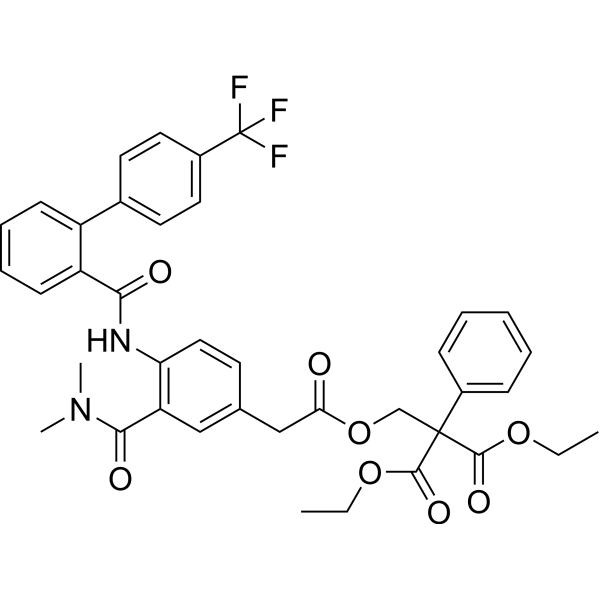
Cat. No.: HY-119220
CAS No.: 594842-13-4
Synonyms: JTT-130
Granotapide is an orally active microsomal triglyceride transfer protein (MTP) inhibitor. Granotapide reduces the absorption of cholesterol and triglycerides by inhibiting MTP. Granotapide can be used in the research of coronary artery disease, obesity, diabetes mellitus and hypertension .
loading...
    loading...
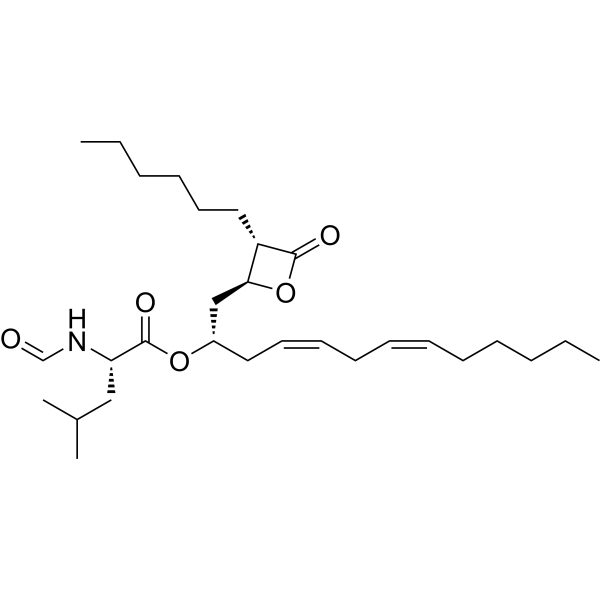
Cat. No.: HY-N2330
CAS No.: 96829-59-3
Target:  

Lipase

Lipstatin is a pancreatic lipase inhibitor (IC50=0.14 μM), whose structure is closely related to the known inhibitor, Esterastin. Lipstatin inhibits the absorption of triglycerides without affecting the absorption of oleic acid. Lipstatin has no inhibitory effects on other pancreatic enzymes, such as phospholipase A2 and trypsin (<200 μM) .
loading...
    loading...
Cat. No.: HY-127055
CAS No.: 6964-20-1
Target:  

Apolipoprotein

연구분야:  

Metabolic Disease Endocrinology

Tiadenol is an absorbable hypolipidemic agent. Tiadenol can effectively reduce triglycerides and decrease the level of apolipoprotein E in very low-density lipoproteins in hyperlipoproteinemia. Tiadenol causes hepatomegaly in rats and affects their hepatic lipid levels, cholesterol synthesis and absorption at high doses. Tiadenol can be used in the research of endocrine and metabolic diseases such as hyperlipidemia .
loading...
    loading...
Cat. No.: HY-154632
연구분야:  

Others

Omega 3 fatty acid triglycerides can be used as an excipient. Pharmaceutical excipients, or pharmaceutical auxiliaries, refer to other chemical substances used in the pharmaceutical process other than pharmaceutical ingredients. Pharmaceutical excipients generally refer to inactive ingredients in pharmaceutical preparations, which can improve the stability, solubility and processability of pharmaceutical preparations. Pharmaceutical excipients also affect the absorption, distribution, metabolism, and elimination (ADME) processes of co-administered drugs .
loading...
    loading...
Cat. No.: HY-W719455
CAS No.: 55483-00-6
Pungenin is a compound that can be isolated from Leontopodium leontopodioides. Pungenin exhibits lipase inhibitory activity. Pungenin reuduces triglyceride absorption .
loading...
    loading...
Cat. No.: HY-169473
CAS No.: 37635-44-2
Synonyms: Tribrassidin; TG(22:1/22:1/22:1)
Target:  

Drug Derivative

연구분야:  

Metabolic Disease

1,2,3-Tri-13(E)-docosenoyl glycerol (Tribrassidin; TG(22:1/22:1/22:1)) is an orally consumable triglyceride. 1,2,3-Tri-13(E)-docosenoyl glycerol was added to the diet of rats by mixing it with corn oil and undergoing ester exchange to improve its digestion and absorption .
loading...
    loading...
Cat. No.: HY-182014
CAS No.: 2408041-54-1
Target:  

LXR

TLC-2716 is an orally available, gut- and liver-restricted inhibitor against LXRα and LXRβ, with EC50 values of 7 nM and 15 nM, respectively. TLC-2716 represses LXRα/β transcriptional activity, downregulates genes involved in lipogenesis, lipid absorption and lipoprotein metabolism, and preserves peripheral reverse cholesterol transport. TLC-2716 reduces lipid accumulation, suppresses inflammation and fibrotic gene expression, enhances triglyceride-rich lipoprotein clearance, and improves glucose homeostasis and insulin sensitivity. TLC-2716 lowers serum and hepatic triglycerides, plasma cholesterol and other atherogenic lipid profiles in experimental models and humanized liver mice. TLC-2716 can be used for the research of dyslipidemia and related cardiometabolic disorders .
loading...
    loading...
Cat. No.: HY-N11231
CAS No.: 7176-02-5
Fucoxanthinol, a carotenoid, is a deacetylated Fucoxanthin (HY-N2302) metabolite with oral activity, and inhibits rat pancreatic lipase with an IC50 of 764 nM. Fucoxanthinol reduces expression of Bcl-2, Bcl-xL, survivin, XIAP, cIAP2, cyclin D1, cyclin D2, cyclin E, CDK4, CDK6, β-catenin, JunD, PPARγ, and induces GADD45α expression. Fucoxanthinol activates caspase-3, caspase-8, caspase-9, Nrf2/Keap1/ARE pathway, and inhibits activation of Akt, NF-κB, AP-1, PDPK1, GSK3β phosphorylation. Fucoxanthinol induces apoptosis, G0/G1 cell cycle arrest, inhibits cancer cell viability, proliferation, migration, invasiveness, tumour growth, adipocyte differentiation, oxidative stress, neurotoxicity, triglyceride absorption, angiogenesis, and obesity-induced inflammation. Fucoxanthinol can be used for the research of osteosarcoma, leukemia, lymphoma, adult T-cell leukemia, prostate cancer, colon cancer, breast cancer, hypertriglyceridaemia, Alzheimer’s disease, Parkinson’s disease, obesity, insulin resistance, malignant melanoma, and type II diabetes .
loading...
    loading...

