19 Results for "

two-photon fluorescent probe

" in MedChemExpress (MCE) Product Catalog:
Products (19)

19 Results for "two-photon fluorescent probe" in MCE Product Catalog:

Cat. No.: HY-D1378
CAS No.: 959839-06-6
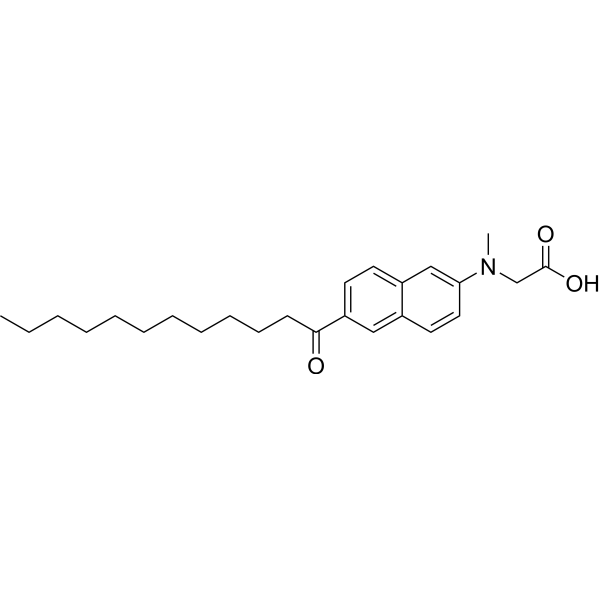
C-Laurdan is a modified Laurdan (HY-D0080) probe that imaging lipid rafts with environmentally sensitive fluorescence. C-Laurdan can be used in research of lipid arrangement and fluidity in biological membranes or artificial lipid membranes .
loading...
    loading...
Cat. No.: HY-D1637
CAS No.: 172646-43-4
Target:  

Fluorescent Dye

Research Areas:  

Others

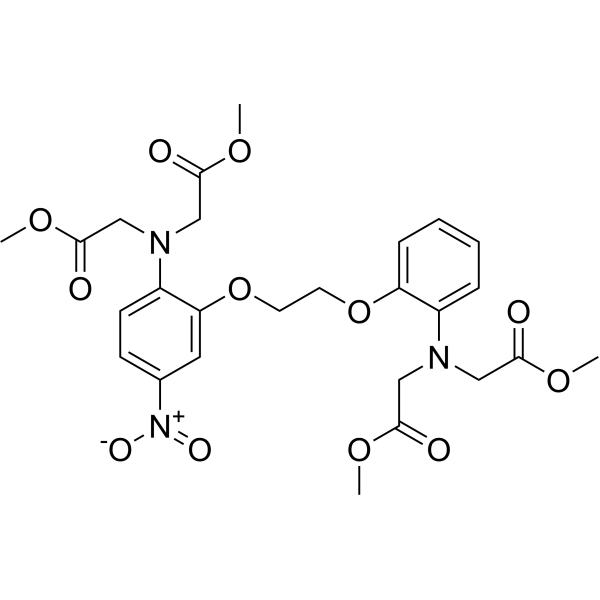
5-Nitro BAPTA tetramethyl ester is a calcium chelator. 5-Nitro BAPTA tetramethyl ester involves in the two-photon probe synthesis, and is used for real-time imaging of intracellular calcium ions, calcium waves monitoring at a depth of 100-300 μm in liver tissues for 1100-4000 s. 5-Nitro BAPTA tetramethyl ester, together with fluorescent compound 2-Me-substituted TM, can be used to form a red fluorescent probe (CaTM-2 AM) .
loading...
    loading...
Cat. No.: HY-D2971
CAS No.: 2781892-92-8
NCIC-VIS is a lysosome-targeted, viscosity-sensitive two-photon near-infrared fluorescent probe. NCIC-VIS has a rigid structure that can restrict molecular torsion, thereby increasing the fluorescence quantum yield and two-photon absorption cross-section. NCIC-VIS enables real-time imaging of the autophagy process in cells .
loading...
    loading...
Cat. No.: HY-D2474
CAS No.: 3030735-86-2
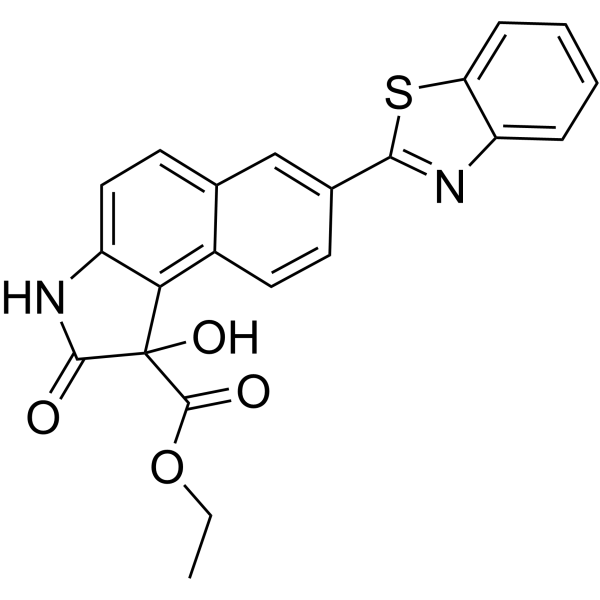
PSP is a two-photon fluorescent probe for selective and sensitive detection of H2Sn in live cells and tumor spheroids (Ex/Em = 440/640 nm). PSP can be utilized in ferroptosis research .
loading...
    loading...
Cat. No.: HY-139816
CAS No.: 2507992-93-8
Target:  

Fluorescent Dye

Research Areas:  

Neurological Disease

BTNPO is a unimolecular two-photon fluorescent probe.
loading...
    loading...
Cat. No.: HY-D1253
CAS No.: 2937819-61-7
Target:  

TrxR

Research Areas:  

Neurological Disease

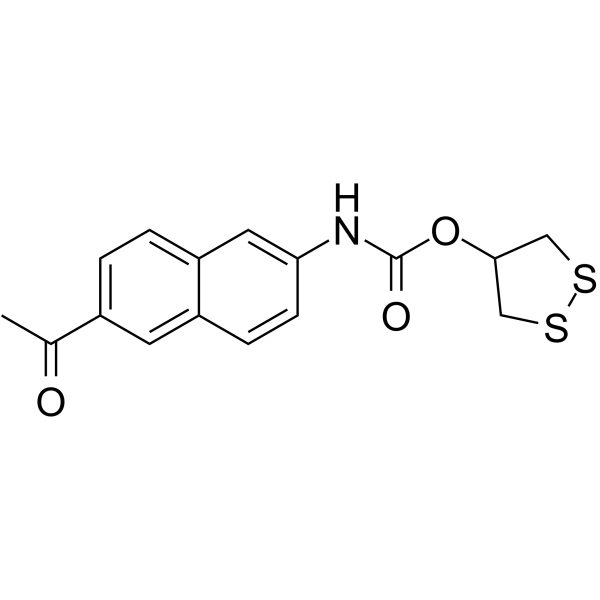
TP-TRFS is a highly selective and the first two-photon fluorescent probe of thioredoxin reductase (TrxR) .
loading...
    loading...
Cat. No.: HY-136675
CAS No.: 1850419-05-4
Target:  

Fluorescent Dye

Research Areas:  

Others

ASMI is a ratiometric, two-photon excited fluorescent probe, composed of a highly two-photon active and biocompatible merocyanine fluorophore and an acrylate moiety as a thiol reactive site. ASMI is able to selectively detect and monitor mitochondrial Cys with rapid responsiveness, imaging living cells and intact tissues with high contrast and brightness at a depth of 150 μm. The two-photon action cross section (Φσmax) of ASMI is 65.2 GM, corresponding to an excitation wavelength (λex) of 740 nm.
loading...
    loading...
Cat. No.: HY-D3267
CAS No.: 1314527-28-0
ACu1 is a copper (I)-selective two-photon fluorescent probe that enables the visual imaging of Cu + distribution in living cells and tissues .
loading...
    loading...
Cat. No.: HY-D2376
BH-Vis is a two-photon fluorescent probe that inhibits cell plasma membrane (CPM). BH-Vis has great potential to accurately identify pyroptosis at the cellular level during AAA development in the mouse abdominal aortic aneurysm AAA model .
loading...
    loading...
Cat. No.: HY-D3171
AD-BChE/HClO is a dual-target two-photon fluorescent probe. AD-BChE/HClO produces strong fluorescence only in the simultaneous presence of BChE and HClO. AD-BChE/HClO enables two-photon imaging in nerve cells and mouse brain tissues via tail vein injection. AD-BChE/HClO can be used for the research of Alzheimer's disease (Ex/Em = 450 nm/500 nm) .
loading...
    loading...
Cat. No.: HY-D2968
CAS No.: 2759816-87-8
DCM-ONOO is a near-infrared two-photon fluorescence probe specifically designed for real-time monitoring of the dynamic fluctuations of peroxynitrite (ONOO⁻) in epilepsy models. DCM-ONOO exhibits excellent optical properties, with a single photon excitation (Ex) of 520 nm; a single photon emission (Em) of 685 nm; a two-photon excitation of 820 nm; and a Stokes shift of 165 nm. When DCM-ONOO is combined with ONOO⁻, it shifts from 460 nm to 512 nm, and only generates a significant fluorescence response to ONOO⁻. DCM-ONOO has been successfully applied to rat epilepsy models .
loading...
    loading...
Cat. No.: HY-D3221
CAS No.: 1386860-79-2
MAO Probe 1 is a reactive two-photon fluorescent probe capable of crossing the blood-brain barrier, which is used to detect the activity of monoamine oxidases (MAO-A/MAO-B), with Km values of 70 μM (MAO-A) and 75 μM (MAO-B), respectively. IBC 2 (benzo[g]imino-coumarin 2), the enzymatic product of MAO Probe 1, can further specifically bind to and image plaques, enabling in vivo two-photon co-monitoring of MAO activity and Aβ plaques. MAO Probe 1 can be used in Alzheimer's disease research (IBC 2: Ex/Em = 850 nm/570-620 nm) .
loading...
    loading...
Cat. No.: HY-D3131
CAS No.: 2243068-74-6
Target:  

Fluorescent Dye

Research Areas:  

Others

Lyso-MPCB is a two-photon fluorescent probe used for lysosomal pH detection and autophagy monitoring. Lyso-MPCB integrates a benzimidazole pH-responsive group and a morpholine lysosome-targeting group, enabling specific localization to lysosomes. The fluorescence properties of Lyso-MPCB change with protonation, exhibiting blue fluorescence under alkaline conditions and green fluorescence under acidic conditions .
loading...
    loading...
Cat. No.: HY-D3173
CAS No.: 1708978-54-4
Synonyms: TPG-456
TP-α (TPG-456) is a glucagon-selective two-photon fluorescent probe with a Kd of 65 μM. TP-α directly interacts with glucagon to produce significant fluorescence enhancement. TP-α selectively stains viable glucagon-secreting α cells in pancreatic islets, enabling visualization of their localization, distribution and availability. TP-α is applicable to diabetes research (Ex/Em = 370nm/510 nm) .
loading...
    loading...
Cat. No.: HY-D3166
CAS No.: 2413816-64-3
CEMT is a carboxylesterase (CES) substrate and a ratiometric two-photon fluorescent reporter probe. CEMT can be hydrolyzed by CES to generate HMT, which is used for mitochondrial pH sensing. After activation by CES, CEMT exhibits ratiometric fluorescence changes in response to pH variations. CEMT targets and covalently binds to mitochondria, and can avoid leakage during acidification, thus enabling in situ imaging (Ex/Em = 410 nm/550 nm) .
loading...
    loading...
Cat. No.: HY-D3196
CAS No.: 1198157-60-6
AG2 is a glucose uptake tracer and two-photon fluorescent probe. AG2 is taken up by cells via glucose-specific transport systems, rather than passive diffusion; it preferentially accumulates in cancer cells and colon cancer tissues compared with normal cells and tissues; it mainly localizes to mitochondria, with a small amount also distributed in the cytoplasm and cell membrane. AG2 can be used for colon cancer research .
loading...
    loading...
Cat. No.: HY-D3368
Target:  

Fluorescent Dye

Research Areas:  

Inflammation/Immunology

DMA-SiRd is a fluorescent probe that can be used for crosstalk-free dual-channel imaging of lipid droplets and mitochondria, mapping of lipid microenvironment heterogeneity, and imaging of lipid droplet-mitochondria interactions. DMA-SiRd has two imaging channels: Ex/Em = 633/650-750 nm and Ex/Em = 546/570-620 nm, with two-photon excitation wavelengths of 1040 nm and 1200 nm for brain imaging. DMA-SiRd can be applied to the research of atherosclerosis .
loading...
    loading...
Cat. No.: HY-D3224
CAS No.: 2413777-91-8
HCP is a two-photon fluorescent probe capable of crossing the blood-brain barrier, which is specifically designed for real-time detection of hypochlorous acid (HClO/ClO -) produced by myeloperoxidase (MPO). Chlorination of the quinoline skeleton of HCP generates HCP-Cl, which eliminates intramolecular charge transfer (ICT) quenching and thereby produces fluorescence. HCP is suitable for in vivo dynamic imaging of HClO in the brains of epileptic mice and high-throughput screening of antiepileptic drugs (HCP-Cl: Ex/Em = 800 nm/495 nm) .
loading...
    loading...
Cat. No.: HY-D3117
CAS No.: 2146114-18-1
Target:  

Fluorescent Dye

Research Areas:  

Others

MBCB is a two-photon Fluorescent probe for dual-detection of mitochondrial SO₂ derivatives and viscosity. For SO₂ derivatives detection, the probe utilizes a Michael addition mechanism: nucleophilic addition of SO₂ derivatives to the C=C bond between the carbazole skeleton and 3-methylbenzothiazolium moiety destroys the strong intramolecular charge transfer (ICT) system between these groups, while enhancing the weak ICT system between the benzothiazole group and carbazole framework; this causes the red emission at 600 nm to decrease and the blue emission at 434 nm to increase, creating a ratiometric response based on the I₄₃₄ₙₘ/I₆₀₀ₙₘ intensity ratio. For viscosity detection, in low-viscosity environments, steric hindrance creates a twisted ICT (TICT) system with weak fluorescence, while in high-viscosity environments, intramolecular rotation is blocked, the TICT state is disrupted, and the strong ICT system is recovered, leading to a strong red emission at 567 nm with negligible change to the short-wavelength emission at 415 nm, creating a ratiometric response based on the I₅₆₇ₙₘ/I₄₁₅ₙₘ intensity ratio that has a logarithmic linear relationship with viscosity. The probe has excitation/emission wavelengths of Ex/Em = 351/434, 600 nm for SO₂ derivatives detection and Ex/Em = 351/567 nm for viscosity detection, with two-photon excitation at 740 nm for bioimaging; it also exhibits good mitochondrial targeting ability with a Pearson's colocalization coefficient of 0.93 when paired with Mito-Tracker Green. The probe shows high sensitivity and selectivity for SO₂ derivatives, has low cell cytotoxicity, and can be applied to detect exogenous/endogenous HSO₃⁻ in living cells and in vivo, as well as visualize mitochondrial viscosity changes induced by nystatin[1].
loading...
    loading...
  • 1

