



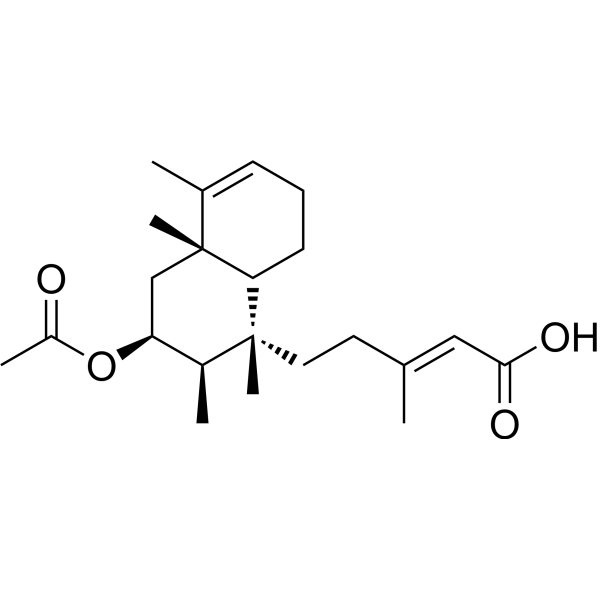
Solidagonic acid
Solidagonic acid is an acidic bitter principle that can be found in the root and rhizomes of Solidago altissima L. Solidagonic acid binds HSET/KIFC1, restores growth in HSET-overproducing fission yeast cells and reverts mitotic spindles from monopolar to bipolar morphology. Solidagonic acid can be used for the research of breast adenocarcinoma.
연구목적의 판매만을 진행합니다. 환자를 대상으로 한 판매는 하지 않습니다.
- CAS No.: 19941-91-4
- 화학식: C22H34O4
- 분자량:362.50
-
보관:
Please store the product under the recommended conditions in the Certificate of Analysis.

To place orders, for customer services and technical support, please contact: MedChemExpress USA
Tel: 609-228-6898 E-mail: [email protected] [email protected]


-
 Biological Activity
-
Chemical Information
- 순도&문서
- References
-
 Help & FAQs


All Kinesin Isoforms
More

Biological Activity
제품 설명
Cellular Effect
|
Cell Line

|
Type | Value | Description | References |
|---|---|---|---|---|
| MDA-MB-231 | IC50 |
260.6 μM
Compound: 1; SA
|
Antiproliferative activity against human MDA-MB-231 cells assessed as inhibition of cell viability incubated for 48 hrs by MTT assay
Antiproliferative activity against human MDA-MB-231 cells assessed as inhibition of cell viability incubated for 48 hrs by MTT assay
|
[PMID: 31753800] |
| WI-38 | IC50 |
265.3 μM
Compound: 1; SA
|
Antiproliferative activity against human WI38 cells assessed as inhibition of cell viability incubated for 48 hrs by MTT assay
Antiproliferative activity against human WI38 cells assessed as inhibition of cell viability incubated for 48 hrs by MTT assay
|
[PMID: 31753800] |
In Vitro
Solidagonic acid (1.56-50 µg per spot; 3 days) restores growth in HSET-overproducing TY27 fission yeast cells in a dose-dependent manner[1].
Solidagonic acid (2.8 μM; 2-3 days) rescues HSET-overproducing YA8 fission yeast cells from lethality, and restores bipolar spindle morphology[1].
Solidagonic acid (250 µM; 24 h) does not induce multipolar spindle formation or inhibit centrosome clustering in MDA-MB-231 human breast adenocarcinoma cells[1].
Solidagonic acid (48 h) has low cytotoxicity against MDA-MB-231 human breast adenocarcinoma cells (IC50 = 260.6 µM) and WI-38 normal human fibroblasts (IC50 = 265.3 µM), with no significant selectivity for cancer cells[1].
Solidagonic acid serves as a bioprobe in studies of HSET function[2].
MedChemExpress (MCE) has not independently confirmed the accuracy of these methods. They are for reference only.
-
Cell Line:HSET-overproducing fission yeast (YA8 strain, HSET-overexpressing TY27 derivative)
-
Concentration:2.8 μM
-
Incubation Time:2-3 days
-
Result:Rescued HSET-overproducing yeast cells from lethality at 2.8 μM, increasing relative cell viability from 6% to 8%.
Reduced the percentage of mitotic cells with abnormal monopolar spindles from 76% to 11% at 2.8 μM, increasing bipolar spindle formation.
Reduced monopolar spindle frequency to 49% at 2.8 μM.
Induced mild off-target cytotoxicity at 2.8 μM, reducing wild-type YA8 cell viability to 81%.


Chemical Information
-
CAS No. 19941-91-4
-
분자량 362.50
-
화학식 C22H34O4
-
SMILES
O=C(/C=C(CC[C@@]1([C@H]([C@H](C[C@]2(C)C(C)=CCC[C@H]21)OC(C)=O)C)C)\C)O
-
Structure Classification
-
Initial Source
-
선적
Room temperature in continental US; may vary elsewhere.
-
보관
Please store the product under the recommended conditions in the Certificate of Analysis.


순도&문서
References

Calculators
Concentration (start) × Volume (start) = Concentration (final) × Volume (final)


Solidagonic acid Related Classifications
HY-N11128 Related Classifications
 Powered by Bioz