



Kinesin-13
Kinesin-13 proteins are specialized microtubule (MT) depolymerases that regulate MT length by promoting tubulin removal at both ends[1][2]. Unlike conventional motile kinesins, Kinesin-13 motors form ring and spiral oligomers at MT ends, which stabilizes their position for efficient depolymerization[1][3]. Mechanistically, the conserved neck and loop-2 regions of Kinesin-13 coordinate ATP turnover to induce tubulin curvature and facilitate protofilament disassembly[3][4][5]. This depolymerization is critical for spindle assembly, kinetochore-MT attachment, and accurate chromosome segregation during mitosis and meiosis[2][6][7]. In disease models, Kinesin-13 dysregulation alters spindle morphology and microtubule flux, influencing cell division fidelity and axon regeneration[8][9][10]. Compared with related isoforms such as Kinesin-8, Kinesin-13 exhibits higher end-specific depolymerization activity and distinct structural elements, including the α4-helix and KVD motif, which are essential for MT-end recognition[11][12][13]. Kinesin-13 inhibitors and mutants that disrupt neck-mediated depolymerization or ATPase activity allow precise experimental modulation of MT dynamics for cell division and neuronal studies[6][7]. Collectively, the Kinesin-13 family serves as a versatile model for understanding controlled MT depolymerization, isoform-specific regulation, and targeted cytoskeletal interventions in diverse eukaryotic systems[14][15].
References:
- [1]. Tan D, et al. Kinesin-13s form rings around microtubules. J Cell Biol. 2006 Oct 9;175(1):25-31. [Content Brief]
- [2]. Ems-McClung SC, et al. Kinesin-13s in mitosis: Key players in the spatial and temporal organization of spindle microtubules. Semin Cell Dev Biol. 2010 May;21(3):276-82. [Content Brief]
- [3]. Leong SY, et al. Kinesin-13 and Kinesin-8 Function during Cell Growth and Division in the Moss Physcomitrella patens. Plant Cell. 2020 Mar;32(3):683-702. [Content Brief]
- [4]. Moores CA, et al. The role of the kinesin-13 neck in microtubule depolymerization. Cell Cycle. 2006 Aug;5(16):1812-5. [Content Brief]
- [5]. Wickstead B, et al. The expanded Kinesin-13 repertoire of trypanosomes contains only one mitotic Kinesin indicating multiple extra-nuclear roles. PLoS One. 2010 Nov 23;5(11):e15020. [Content Brief]
- [6]. Mulder AM, et al. A new model for binding of kinesin 13 to curved microtubule protofilaments. J Cell Biol. 2009 Apr 6;185(1):51-7. [Content Brief]
- [7]. Belsham HR, et al. A synthetic ancestral kinesin-13 depolymerizes microtubules faster than any natural depolymerizing kinesin. Open Biol. 2022 Aug;12(8):220133. [Content Brief]
- [8]. Hu H, et al. A kinesin-13 family kinesin in Trypanosoma brucei regulates cytokinesis and cytoskeleton morphogenesis by promoting microtubule bundling. PLoS Pathog. 2024 Feb 1;20(2):e1012000. [Content Brief]
- [9]. Wagenbach M, et al. A kinesin-13 mutant catalytically depolymerizes microtubules in ADP. J Cell Biol. 2008 Nov 17;183(4):617-23. [Content Brief]
- [10]. Friel CT, et al. The kinesin-13 MCAK has an unconventional ATPase cycle adapted for microtubule depolymerization. EMBO J. 2011 Aug 26;30(19):3928-39. [Content Brief]
- [11]. Patel JT, et al. The family-specific α4-helix of the kinesin-13, MCAK, is critical to microtubule end recognition. Open Biol. 2016 Oct;6(10):160223. [Content Brief]
- [12]. Do KK, et al. The kinesin-13 KLP10A motor regulates oocyte spindle length and affects EB1 binding without altering microtubule growth rates. Biol Open. 2014 Jun 6;3(7):561-70. [Content Brief]
- [13]. Ghosh-Roy A, et al. Kinesin-13 and tubulin posttranslational modifications regulate microtubule growth in axon regeneration. Dev Cell. 2012 Oct 16;23(4):716-28. [Content Brief]
- [14]. Wang W, et al. Insight into microtubule disassembly by kinesin-13s from the structure of Kif2C bound to tubulin. Nat Commun. 2017 Jul 10;8(1):70. [Content Brief]
- [15]. Wang H, et al. Patronin mediates a switch from kinesin-13-dependent poleward flux to anaphase B spindle elongation. J Cell Biol. 2013 Oct 14;203(1):35-46. [Content Brief]
All Product Categories
-
Kinesin-13 Related Products (2)
Related Products (2)

-
UMK57
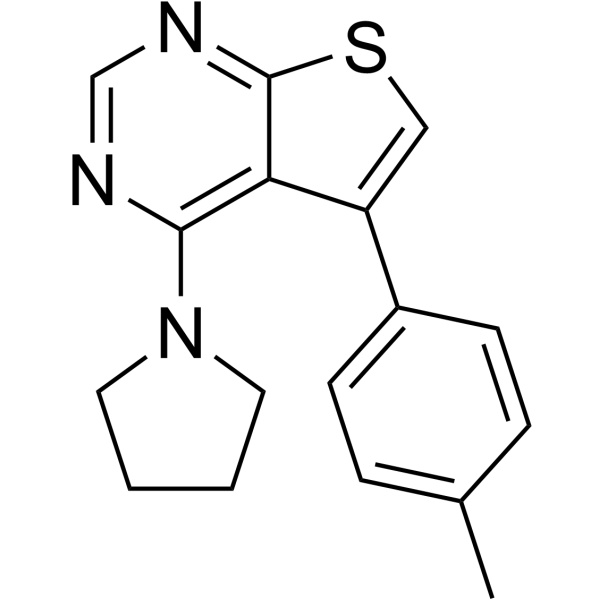 0 ImagesUMK57 is a MCAK activator and kinetochore-microtubule destabilizer. UMK57 enhances MCAK-dependent microtubule depolymerization, increases kinetochore-microtubule turnover, reduces chromosome mis-segregation and lagging chromosomes, and inhibits cancer cell proliferation. UMK57 triggers adaptive resistance in Aurora B cancer cells via reversible Aurora B signaling pathway alterations. UMK57 can be used for the research of solid tumors.
-
DHTP
 0 ImagesDHTP is a kinesin-13 family of microtubule depolymerases selective allosteric inhibitor that inhibits kinesin-13 ATPase activity and microtubule depolymerization activity. DHTP inhibits Kif2a and MCAK with IC50 values of 1.2 μM and 4.6 μM, respectively, and does not inhibit other kinesin families. DHTP modulates microtubule dynamics in cells, leading to less dynamic microtubules. DHTP links kinesin-13 overexpression to cancer and Paclitaxel (HY-B0015) resistance. DHTP can be used for the research of cancer.



