



Kinesin-14
Kinesin-14 motor proteins are ATP-dependent microtubule-based motors that move toward microtubule minus-ends, generating forces critical for mitotic spindle organization[1][2]. Mechanistically, Kinesin-14s align antiparallel microtubules, crosslink spindle fibers, and regulate metaphase spindle length by balancing plus-end-directed motor forces[3][4]. In fission yeast and human cells, Kinesin-14 interacts with the γ-tubulin ring complex (γ-TuRC) to modulate microtubule nucleation and spindle pole integrity[5][6]. Loss of Kinesin-14 function can induce aneuploidy through kinesin-5-dependent microtubule protrusions that disrupt chromosome segregation during cytokinesis[7]. Compared with related isoforms, such as Kinesin-5 or Kinesin-14 subtypes Ncd and HSET, Kinesin-14 exhibits unique tail and stalk domain interactions that determine minus-end-directed motility, crosslinking specificity, and spindle localization[8][9][10]. Plant-specific Kinesin-14s, including OsKCH2, show inherent minus-end-directed processivity and can transport actin filaments along microtubules, compensating for the absence of cytoplasmic dynein[11][2]. These properties make Kinesin-14 a target for experimental manipulation using small molecules or genetic perturbations to investigate spindle dynamics, microtubule organization, and chromosome segregation fidelity[5][3].
References:
- [1]. Cross RA. Kinesin-14: the roots of reversal. BMC Biol. 2010 Aug 16;8:107. doi: 10.1186/1741-7007-8-107. PMID: 20731883; PMCID: PMC2922096. et al. Kinesin-14: the roots of reversal. BMC Biol. 2010 Aug 16;8:107. [Content Brief]
- [2]. Gicking AM, et al. Functional diversification of the kinesin-14 family in land plants. FEBS Lett. 2018 Jun;592(12):1918-1928. [Content Brief]
- [3]. Ogren A, et al. Kinesin-14 motors participate in a force balance at microtubule plus-ends to regulate dynamic instability. Proc Natl Acad Sci U S A. 2022 Feb 22;119(8):e2108046119. [Content Brief]
- [4]. Hepperla AJ, et al. Minus-end-directed Kinesin-14 motors align antiparallel microtubules to control metaphase spindle length. Dev Cell. 2014 Oct 13;31(1):61-72. [Content Brief]
- [5]. Olmsted ZT, et al. Kinesin-14 and kinesin-5 antagonistically regulate microtubule nucleation by γ-TuRC in yeast and human cells. Nat Commun. 2014 Oct 28;5:5339. [Content Brief]
- [6]. Olmsted ZT, et al. Kinesin-14 Pkl1 targets γ-tubulin for release from the γ-tubulin ring complex (γ-TuRC) . Cell Cycle. 2013 Mar 1;12(5):842-8. [Content Brief]
- [7]. Syrovatkina V, et al. Loss of kinesin-14 results in aneuploidy via kinesin-5-dependent microtubule protrusions leading to chromosome cut. Nat Commun. 2015 Jun 2;6:7322. [Content Brief]
- [8]. Simeonov DR, et al. Distinct Kinesin-14 mitotic mechanisms in spindle bipolarity. Cell Cycle. 2009 Nov 1;8(21):3571-83. [Content Brief]
- [9]. Liu X, et al. Kinesin-14 HSET and KlpA are non-processive microtubule motors with load-dependent power strokes. Nat Commun. 2024 Aug 3;15(1):6564. [Content Brief]
- [10]. Mitra A, et al. Kinesin-14 motors drive a right-handed helical motion of antiparallel microtubules around each other. Nat Commun. 2020 May 22;11(1):2565. [Content Brief]
- [11]. Tseng KF, et al. The preprophase band-associated kinesin-14 OsKCH2 is a processive minus-end-directed microtubule motor. Nat Commun. 2018 Mar 14;9(1):1067. [Content Brief]
All Product Categories
-
Kinesin-14 Related Products (3)
Related Products (3)

-
AZ82
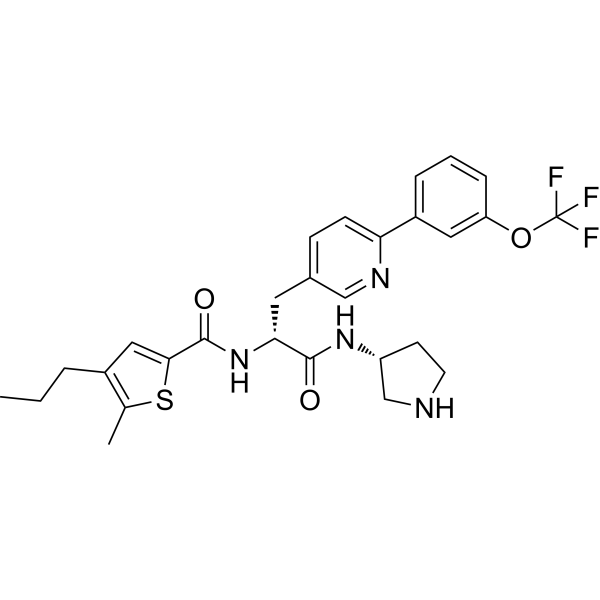 0 ImagesAZ82 is a selective kinesin-like protein KIFC1 (HSET/KIFC1) inhibitor, with a Ki of 43 nM and an IC50 of 300 nM for KIFC1.
-
CW-069
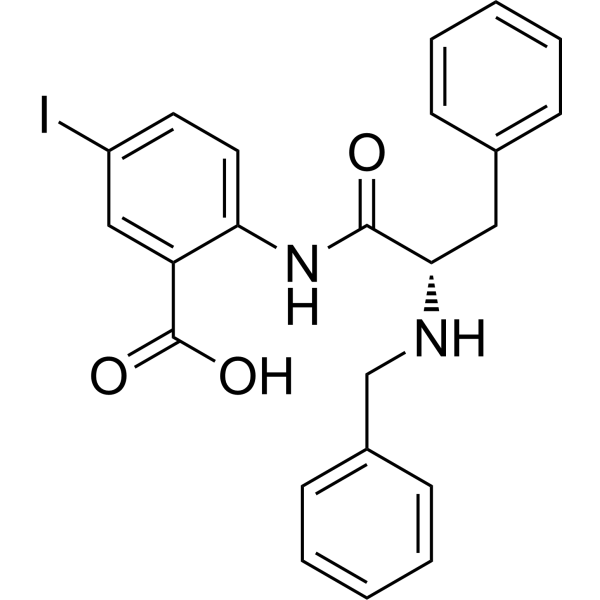 0 ImagesCW-069 is an allosteric inhibitor of microtubule motor protein HSET with an IC50 of 75 μM.
-
CCT369834
 0 ImagesCat. No.: HY-180304CAS No.: 2902671-78-5CCT369834 is an ATP-competitive HSET inhibitor with an IC50 of 39 nM. CCT369834 is a trans-cyclooctene-tagged probe. CCT369834 and HSET specifically co-localize on mitotic spindles. CCT369834 can be used for the research of cancer.



