



Spirotetramat

Based on 1 Customer Validation
Spirotetramat (BY-108330) is an orally active Insecticide and lipid biosynthesis inhibitor. Spirotetramat regulates the activities of superoxide dismutase (SOD) and glutathione peroxidase (GSH-Px), with short-term exposure increasing their activities and long-term exposure altering their activities. Spirotetramat induces the activity and mRNA expression of carboxylesterase (CarE). Spirotetramat induces oxidative stress and lipid peroxidation in tadpoles. Spirotetramat is toxic to amphibian tadpoles and exhibits sublethal/non-lethal toxicity to amphibians. Spirotetramat causes death in immature psyllids, aphids, scale insects, mealybugs, whiteflies and thrips, and shows a high lethal rate against Cacopsylla pyri nymphs. Spirotetramat reduces the fecundity of Aphis gossypii. Spirotetramat induces tolerance in the offspring of exposed Aphis gossypii, and acts on Myzus persicae, Bemisia tabaci and Tetranychus urticae.
For research use only. We do not sell to patients.
- Purity : 99.13%
- CAS No.: 203313-25-1
- Formula: C21H27NO5
- Molecular Weight:373.44
-
Storage:
Store at room temperature 3 years.
In solvent -80°C, 2 years , -20°C, 1 year


To place orders, for customer services and technical support, please contact: MedChemExpress USA
Tel: 609-228-6898 E-mail: [email protected] [email protected]


-
 Biological Activity
-
Chemical Information
-
Solvent & Solubility
- Protocols
- Purity & Documentation
- References
-
 Help & FAQs


-

HY-120253R
Spirotetramat (Standard)Pesticide -
HY-134094
FluridoneABA Biosynthesis Inhibitor -

HY-134094R
Fluridone (Standard)ABA Biosynthesis Inhibitor -

HY-W754777
IPPD-QEnvironmental Pollutant -

HY-167887
7PPD-QQuinone Derivative -
HY-116541
Acibenzolar-S-methylPlant Activator -
HY-W744966
MandipropamidCesA3 Inhibitor -
HY-W016443
L-m-TyrosineUnnatural Amino Acid -
HY-W013170
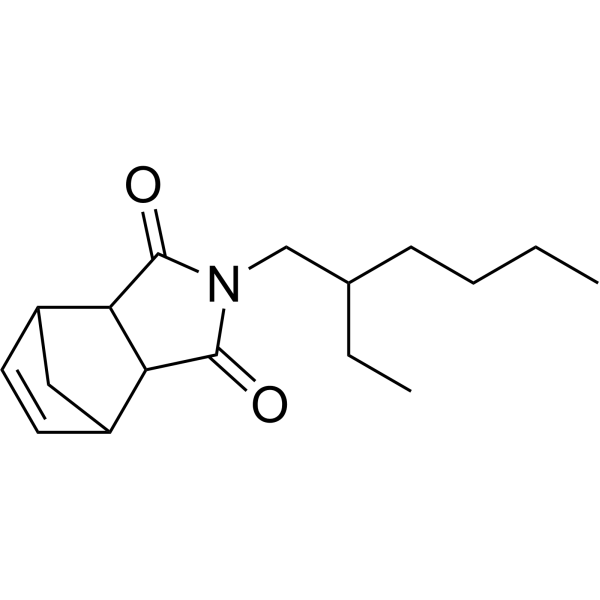
MGK-264Synergist -
HY-141630
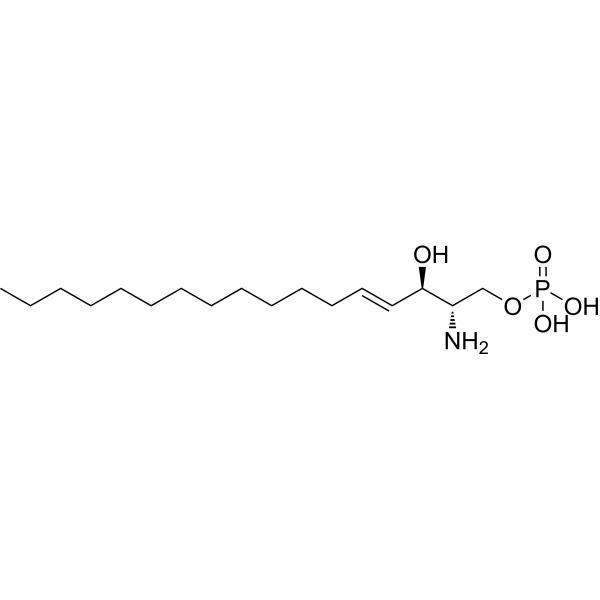
Sphingosine-1-phosphate (d17:1)Ceramide Derivative -

HY-175045
77PD-QP-Phenylenediamine Derivative -
HY-W008467
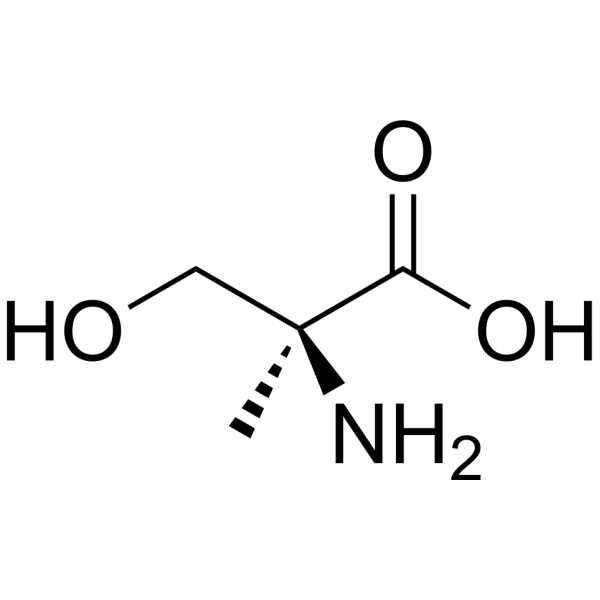
(S)-2-amino-3-hydroxy-2-methylpropanoic acidAmino Acid Derivative


Biological Activity
Description
In Vitro
Spirotetramat (0.48-120.0 mg AI liter-1; 10 days) exhibits potent activity against Cacopsylla pyri nymphs from FE1, FE2, FE3, and FE4 populations, with LC90 values ranging from 67.3 to 125.22 mg AI liter-1, and no strong indications of resistance development (all RF90 values <5)[2].
Spirotetramat (3.75-1920 mg/L; 1-5 days) exhibits increasing toxicity to 4-day old Aphis gossypii with longer exposure, reaching an LC50 of 12.3 mg/L after 5 days of exposure[3].
Spirotetramat (8 days) reduces fecundity of 4-day old Aphis gossypii in a concentration-dependent manner, with the LC75 concentration reducing offspring production to 6.7% of control levels on day 8 of exposure[3].
Spirotetramat (53.9 mg/L; 5 days) significantly increases carboxylesterase activity in Aphis gossypii over 5 days, reaching 3361 ΔOD min-1 mg-1 on day 5[3].
Spirotetramat (53.9 mg/L; 1-5 days) upregulates CarE-YS1 mRNA expression in Aphis gossypii in a time-dependent manner, reaching a 5.2-fold increase relative to control on day 5 of exposure[3].
Spirotetramat (53.9 mg/L; 5 days) leads to offspring of Aphis gossypii whose parents were exposed showing a 2.5-fold increase in tolerance to spirotetramat, with an LC50 of 28.4 mg/L compared to 11.6 mg/L in control offspring[3].
MedChemExpress (MCE) has not independently confirmed the accuracy of these methods. They are for reference only.
In Vivo
Spirotetramat (0.03-3.23 mg/L; aquatic exposure; continuous; 4, 15, or 30 days) induces oxidative stress and alters lipid peroxidation in Bufo bufo gargarizans tadpoles, with GSH-Px activity being the most sensitive parameter, showing initial activation followed by prolonged inhibition[1].
MedChemExpress (MCE) has not independently confirmed the accuracy of these methods. They are for reference only.
-
Animal Model:Bufo bufo gargarizans (Gosner stages 33-35, healthy, same-size individuals)[1]
-
Dosage:4.00 mg/L, 4.60 mg/L, 5.30 mg/L, 6.10 mg/L, 7.00 mg/L, 8.00 mg/L
-
Administration:aquatic exposure; continuous; 96 h
-
Result:Showed no mortality in the 4.00 mg/L and 4.60 mg/L groups over 96 h.
Recorded first mortality at 72 h in the 5.30 mg/L (2 deaths) and 6.10 mg/L (3 deaths) groups, increasing to 5 and 6 deaths, respectively, by 96 h.
Observed mortality as early as 24 h in the 7.00 mg/L (1 death) and 8.00 mg/L (1 death) groups, increasing to 22 and 29 deaths, respectively, by 96 h.
Determined the 72 h median lethal concentration (LC50) as 6.98 mg/L, and the 96 h LC50 as 6.45 mg/L.
Induced poisoning symptoms including slow swimming/breathing, reduced swimming ability, weak activity, and fading body color in tadpoles exposed to higher concentrations.
-
Animal Model:Bufo bufo gargarizans (Gosner stages 33-35, healthy, same-size individuals)[1]
-
Dosage:0.03 mg/L, 0.06 mg/L, 0.13 mg/L, 0.65 mg/L, 3.23 mg/L
-
Administration:aquatic exposure; continuous; 4, 15, or 30 days
-
Result:Increased SOD activity significantly (P < 0.05) in all groups except the 3.23 mg/L group after 4 days of exposure compared to the control.
Decreased SOD activity significantly (P < 0.05) in the 0.65 mg/L group after 15 days compared to its 4-day value, with no significant differences between any treatment group and the control.
Showed no significant differences in SOD activity between treatment groups (except 0.65 mg/L) and the control after 30 days.
Increased GSH-Px activity significantly (P < 0.05) in the 0.06 mg/L, 0.13 mg/L, 0.65 mg/L, and 3.23 mg/L groups after 4 days of exposure compared to the control.
Inhibited and decreased GSH-Px activity significantly (P < 0.05) in all groups except the 0.13 mg/L group after 15 and 30 days compared to the control and 4-day values.
Showed no significant differences in MDA content between treatment groups and the control after 4 or 15 days.
Decreased MDA content significantly (P < 0.05) in the 0.13 mg/L, 0.65 mg/L, and 3.23 mg/L groups after 30 days compared to the control.


Chemical Information
-
CAS No. 203313-25-1
-
Appearance Solid
-
Molecular Weight 373.44
-
Formula C21H27NO5
-
Color White to light brown
-
SMILES
O=C(OCC)OC1=C(C2=CC(C)=CC=C2C)C(N[C@]13CC[C@@H](OC)CC3)=O
-
Synonyms
BY-108330
-
Shipping
Room temperature in continental US; may vary elsewhere.
-
Storage
Store at room temperature 3 years
In solvent -80°C 2 years -20°C 1 year


Solvent & Solubility
In Vitro:
DMSO : 50 mg/mL (133.89 mM; Need ultrasonic; Hygroscopic DMSO has a significant impact on the solubility of product, please use newly opened DMSO)
Please refer to the solubility information to select the appropriate solvent. Once prepared, please aliquot and store the solution to prevent product inactivation from repeated freeze-thaw cycles.
Storage method and period of stock solution: -80°C, 2 years; -20°C, 1 year. When stored at -80°C, please use it within 2 years. When stored at -20°C, please use it within 1 year.
Please refer to the solubility information to select the appropriate solvent. Once prepared, please aliquot and store the solution to prevent product inactivation from repeated freeze-thaw cycles.
Storage method and period of stock solution: -80°C, 2 years; -20°C, 1 year. When stored at -80°C, please use it within 2 years. When stored at -20°C, please use it within 1 year.
Concentration (start) × Volume (start) = Concentration (final) × Volume (final)
In Vivo:
Select the appropriate dissolution method based on your experimental animal and administration route.
- For the following dissolution methods, please ensure to first prepare a clear stock solution using an In Vitro approach and then sequentially add co-solvents:
- To ensure reliable experimental results, the clarified stock solution can be appropriately stored based on storage conditions. As for the working solution for In Vivo experiments, it is recommended to prepare freshly and use it on the same day.
- The percentages shown for the solvents indicate their volumetric ratio in the final prepared solution. If precipitation or phase separation occurs during preparation, heat and/or sonication can be used to aid dissolution.
Add each solvent one by one: 10% DMSO 40% PEG300 5% Tween-80 45% Saline
Solubility: ≥ 2.5 mg/mL (6.69 mM); Clear solution
This protocol yields a clear solution of ≥ 2.5 mg/mL (saturation unknown).
Taking 1 mL working solution as an example, add 100 μL DMSO stock solution (25.0 mg/mL) to 400 μL PEG300, and mix evenly; then add 50 μL Tween-80 and mix evenly; then add 450 μL Saline to adjust the volume to 1 mL.
Preparation of Saline: Dissolve 0.9 g sodium chloride in ddH₂O and dilute to 100 mL to obtain a clear Saline solution.
Add each solvent one by one: 10% DMSO 90% (20% SBE-β-CD in Saline)
Solubility: 2.5 mg/mL (6.69 mM); Suspended solution; Need ultrasonic
This protocol yields a suspended solution of 2.5 mg/mL. Suspended solution can be used for oral and intraperitoneal injection.
Taking 1 mL working solution as an example, add 100 μL DMSO stock solution (25.0 mg/mL) to 900 μL 20% SBE-β-CD in Saline, and mix evenly.
Preparation of 20% SBE-β-CD in Saline (4°C, storage for one week): 2 g SBE-β-CD powder is dissolved in 10 mL Saline, completely dissolve until clear.
In Vivo Dissolution Calculator
Please enter the basic information of animal experiments:
-
-
-
-
Recommended: Prepare an additional quantity of animals to account for potential losses during experiments.
Please enter your animal formula composition:
-
%DMSO +
Recommended: Keep the proportion of DMSO in working solution below 2% if your animal is weak.
-
%+
-
+%Tween-80 + +
-
%Saline +
The co-solvents required include: DMSO, . All of co-solvents are available by MedChemExpress (MCE). , Tween 80. All of co-solvents are available by MedChemExpress (MCE).
Working solution concentration: 0.22 mg/mL
Method for preparing stock solution: mg drug dissolved in μL DMSO. Stock solution concentration: mg/mL.
1. Take μL DMSO stock solution;
2. Add μL .
μL , mix evenly;
3. Then add μL Tween 80, mix evenly;
4. Then add μL
Please ensure that the stock solution in the first step is dissolved to a clear state, and add co-solvents in sequence. You can use ultrasonic heating (ultrasonic cleaner, recommended frequency 20-40 kHz), vortexing, etc. to assist dissolution.


Purity & Documentation
-
Data Sheet (286 KB)
-
SDS (762 KB)
- English - EN (762 KB)
- Français - FR (762 KB)
- Deutsch - DE (762 KB)
- Norwegian - NO (762 KB)
- Español - ES (762 KB)
- Swedish - SV (762 KB)
- Italian - IT (762 KB)
- Korean - KR (762 KB)
- Portuguese - PT (762 KB)
-
Handling Instructions (2659 KB)
References
[1]. Yin X, et al. Effects of spirotetramat on the acute toxicity, oxidative stress, and lipid peroxidation in Chinese toad (Bufo bufo gargarizans) tadpoles. Environ Toxicol Pharmacol. 2014;37(3):1229-1235. [Content Brief]
[2]. Civolani S, et al. Testing Spirotetramat as an Alternative Solution to Abamectin for Cacopsylla pyri (Hemiptera: Psyllidae) Control: Laboratory and Field Tests. J Econ Entomol. 2015 Dec;108(6):2737-42. [Content Brief]
[3]. Gong Y, et al. Effects of spirotetramat treatments on fecundity and carboxylesterase expression of Aphis gossypii Glover. Ecotoxicology. 2016;25(4):655-663. [Content Brief]


Complete Stock Solution Preparation Table
Please refer to the solubility information to select the appropriate solvent. Once prepared, please aliquot and store the solution to prevent product inactivation from repeated freeze-thaw cycles.
Storage method and period of stock solution: -80°C, 2 years; -20°C, 1 year. When stored at -80°C, please use it within 2 years. When stored at -20°C, please use it within 1 year.
| Optional Solvent | Concentration Solvent Mass | 1 mg | 5 mg | 10 mg | 25 mg |
|---|---|---|---|---|---|
| DMSO | 1 mM | 2.6778 mL | 13.3890 mL | 26.7781 mL | 66.9452 mL |
| 5 mM | 0.5356 mL | 2.6778 mL | 5.3556 mL | 13.3890 mL | |
| 10 mM | 0.2678 mL | 1.3389 mL | 2.6778 mL | 6.6945 mL | |
| 15 mM | 0.1785 mL | 0.8926 mL | 1.7852 mL | 4.4630 mL | |
| 20 mM | 0.1339 mL | 0.6695 mL | 1.3389 mL | 3.3473 mL | |
| 25 mM | 0.1071 mL | 0.5356 mL | 1.0711 mL | 2.6778 mL | |
| 30 mM | 0.0893 mL | 0.4463 mL | 0.8926 mL | 2.2315 mL | |
| 40 mM | 0.0669 mL | 0.3347 mL | 0.6695 mL | 1.6736 mL | |
| 50 mM | 0.0536 mL | 0.2678 mL | 0.5356 mL | 1.3389 mL | |
| 60 mM | 0.0446 mL | 0.2232 mL | 0.4463 mL | 1.1158 mL | |
| 80 mM | 0.0335 mL | 0.1674 mL | 0.3347 mL | 0.8368 mL | |
| 100 mM | 0.0268 mL | 0.1339 mL | 0.2678 mL | 0.6695 mL |


Spirotetramat Related Classifications
HY-120253 Related Classifications
 Powered by Bioz
Keywords
- Spirotetramat
- 203313-25-1
- BY-108330
- BY108330
- BY 108330
- Environmental Pollutants
- Insecticide
- SOD
- Glutathione Peroxidase
- Carboxylesterase (CES)
- Aphis gossypii
- tadpoles
- Cacopsylla pyri
- Tetranychus urticae
- malondialdehyde (MDA)
- Myzus persicae
- Bemisia tabaci
- acetyl-coenzyme A carboxylase (ACCase)
- glutathione peroxidase (GSH-Px)
- superoxide dismutase (SOD)
- Inhibitor
- inhibitor
- inhibit