



77PD-Q

Based on 1 Customer Validation
77PD-Q is a p-phenylenediamine (PPD) derivative. 77PD-Q exhibits toxic to the aquatic bacterium V. fischeri. 77PD-Q can be used as an exposure biomarker in environmental monitoring.
연구목적의 판매만을 진행합니다. 환자를 대상으로 한 판매는 하지 않습니다.
- Purity : 98.40%
- CAS No.: 3078541-61-1
- 화학식: C20H34N2O2
- 분자량:334.50
-
보관:Powder -20°C, 3 years ; In solvent -80°C, 6 months , -20°C, 1 month


To place orders, for customer services and technical support, please contact: MedChemExpress USA
Tel: 609-228-6898 E-mail: [email protected] [email protected]


-
 Biological Activity
-
Chemical Information
- 순도&문서
- References
-
 Help & FAQs


-

HY-W754777
IPPD-QEnvironmental Pollutant -

HY-167887
7PPD-QQuinone Derivative -
HY-134094
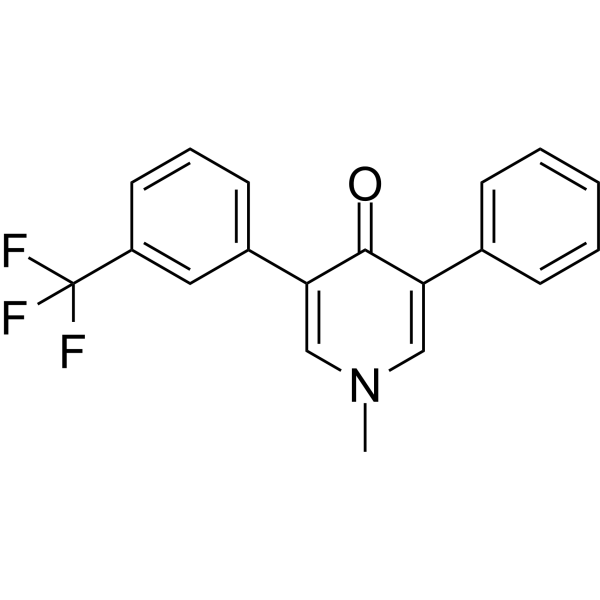
FluridoneABA Biosynthesis Inhibitor -

HY-21197
Perfluoroenanthic acidPollutant -

HY-134094R
Fluridone (Standard)ABA Biosynthesis Inhibitor -
HY-130189
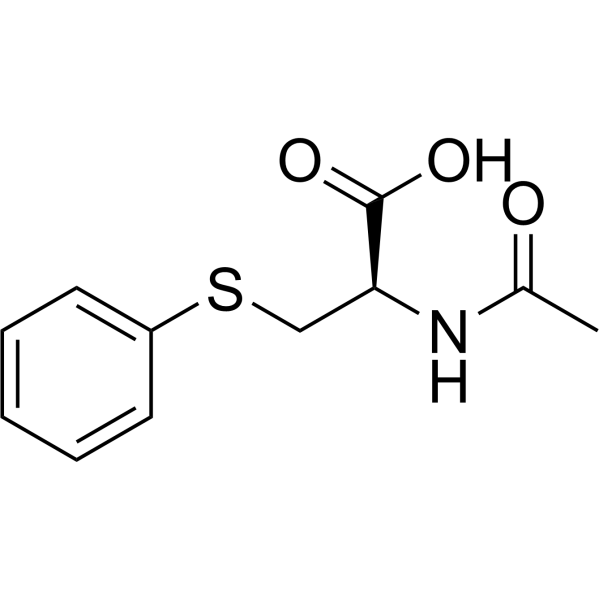
S-Phenylmercapturic acidBenzene Metabolite -

HY-130189R
S-Phenylmercapturic acid (Standard)Benzene Metabolite -

HY-120253
SpirotetramatInsecticide -

HY-120253R
Spirotetramat (Standard)Pesticide -

HY-W775354
1,2,3,4,7,8-HexachlorodibenzofuranCYP1A1/1B1 Activator -

HY-W762018
2,3,4,6,7,8-HexachlorodibenzofuranDioxin-like PCDF


Biological Activity
제품 설명
In Vitro
77PD-Q (2 h) is rapidly metabolized by human liver microsomes and S9 fraction, with a metabolic efficiency of 77.8% in HLM and 32.0% in S9[2].
77PD-Q shows dose-dependent toxic to the aquatic bacterium V. fischeri with an EC50 of 13.6 mg/L[3].
MedChemExpress (MCE) has not independently confirmed the accuracy of these methods. They are for reference only.


Chemical Information
-
CAS No. 3078541-61-1
-
Appearance Solid
-
분자량 334.50
-
화학식 C20H34N2O2
-
Color Orange to red
-
SMILES
CC(NC(C(C=C1NC(CCC(C)C)C)=O)=CC1=O)CCC(C)C
-
선적
Room temperature in continental US; may vary elsewhere.
-
보관
Powder -20°C 3 years In solvent -80°C 6 months -20°C 1 month


순도&문서
-
Data Sheet (266 KB)
-
SDS (252 KB)
- English - EN (252 KB)
- Français - FR (252 KB)
- Deutsch - DE (252 KB)
- Norwegian - NO (252 KB)
- Español - ES (252 KB)
- Swedish - SV (252 KB)
- Italian - IT (252 KB)
- Korean - KR (252 KB)
- Portuguese - PT (252 KB)
-
Handling Instructions (2659 KB)
References
[1]. Balapure AK,et al. Structural requirements for prostaglandin analog interaction with the ovine corpus luteum prostaglandin F2 alpha receptor. Implications for development of a photoaffinity probe. Biochem Pharmacol. 1989 Jul 15;38(14):2375-81. [Content Brief]
[2]. Yang Y, et al. Characterizing the Metabolism of Tire Rubber-Derived p-Phenylenediamine Quinones to Identify Potential Exposure Biomarkers in Humans. Environ Sci Technol. 2024;58(41):18098-18108. [Content Brief]
[3]. Wang W, et al. Toxicity of substituted p-phenylenediamine antioxidants and their derived novel quinones on aquatic bacterium: Acute effects and mechanistic insights. J Hazard Mater. 2024 May 5;469:133900. [Content Brief]

Calculators
Concentration (start) × Volume (start) = Concentration (final) × Volume (final)


77PD-Q Related Classifications
HY-175045 Related Classifications
 Powered by Bioz